Arq Neuropsiquiatr 2004;62(3-A):588-591
Ambulatório de Cefaléias, Escola de Medicina da Santa Casa de Misericórdia de Vitória ES, Brasil. (EMESCAM): 1Professor Adjunto, Doutor; 2Médico ex-acadêmico do Projeto de Extensão em Cefaléias da EMESCAM.
Received 30 September 2003, received in final form 19 January 2004. Accepted 3 March 2004.
Dr. Renan Barros Domingues - Avenida Nossa Senhora da Penha 699 / sala 709 / Torre B - 29055-131 Vitória, ES - Brasil. E-mail: [email protected]
HEADACHE EPIDEMIOLOGY IN VITÓRIA,
ESPÍRITO SANTO
Renan Barros Domingues
1, Gustavo Wruck Kuster
2,
Livia Almeida Dutra
2, Jasper Guimarães Santos
2ABSTRACT - This is the first headache survey in the region of Vitória, ES Brazil. A high prevalence of headache sufferers was found (52.8%). Headache was more common among women (63.9%) and less common among people older than 55 years old. The type of professional activity was not related with the headache prevalence. The most frequent causal attribution was stress. Most headache sufferers are not under reg-ular medical treatment (9%), and most of them use analgesic drugs without proper orientation. The most used compounds are combinations with caffeine (33%) and simple analgesics (52.3%).
KEY WORDS: headache, prevalence, self medication.
Epidemiologia da cefaléia em Vitória, Espírito Santo
RESUMO - Este estudo é o primeiro a avaliar a prevalência da cefaléia na região de Vitória, ES. Demonstrou-se alta prevalência de portadores de cefaléia (52,8%), com maior freqüência no Demonstrou-sexo feminino (63,9%) e em pessoas com menos de 55 anos. Não houve diferença de prevalência em relação ao tipo de atividade profissional. O estresse foi apontado como o fator causal mais freqüente. Verificou-se que poucos porta-dores de cefaléia fazem acompanhamento médico regular (9%) e que a maioria usa medicamentos anal-gésicos sem orientação adequada, sendo os medicamentos mais utilizados combinações contendo cafeína (33%) e os analgésicos comuns (52,3%).
PALAVRAS-CHAVE: cefaléia, prevalência, auto-medicação.
The importance of primary headaches is relat-ed to the high frequency of headache disorders, considerable impact of headache on work and so-cial activities, and to the consequences of a consi-derable consumption of drugs by headache suffer-ers1. Several studies have focused on the
epidemi-ology of headache in different cities and in speci-fic populations in Brazil2-5.
Here we report the results of the first large epi-demiological headache survey among inhabitants of the region of Great Vitória, Espírito Santo Brazil. This study aimed to identify the prevalence of headache symptoms, the causal attributions of headache, the medical assistance sought by the headache patients, and the pattern analgesic use reported by headache sufferers in this region of the country.
METHOD
A questionnaire was administered by a group of medical students attending a specialized headache serv-ice. This questionnaire was randomly applied to Great Vitória region inhabitants, including the cities of
Arq Neuropsiquiatr 2004;62(3-A) 589
in a week he or she uses. The reason for the specific anal-gesic choice was evaluated asking them who have rec-ommended the analgesic product. The answers were cat-egorized into the following groups: medical prescription, self medication, drugstore seller recommendation, unpro-fessional advice, and unknown. Individuals with headache were also asked if they were under regular medical assistance for this problem. Chi square was used for sta-tistical comparisons of headache prevalence between dif-ferent age groups and difdif-ferent professional activities. The study protocol was submitted to the research eth-ic committee of Escola de Medeth-icina da Santa Casa de Misericórdia de Vitória (EMESCAM) and was approved.
RESULTS
The questionnaire was applied to 2500 inhabi-tants of Vitória region, being 1477 (59.1%) women. The mean age was 33.4 years (SD 16.6). The num-ber of individuals referring headache was 1320 (52.8%). The prevalence of headache was higher among women, 925 (62.6%) of women had headache while only 395 (38.6%) men were hea-dache sufferers. The prevalence of heahea-dache was significantly lower among people over 55 years old (p<0.001) (Table 1). The prevalence of headache was higher among people under 30 years old when compared with people over 30 years old (p<.025), but it was not different of the headache prevalence of people between 30-55 years old.
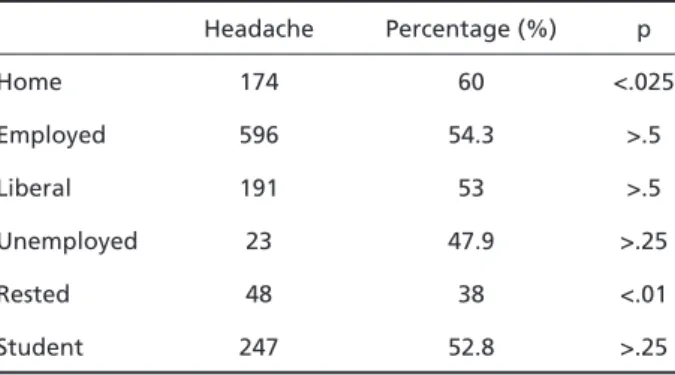
The occupation types were: home (287), emplo-yed (1098), liberal (360), unemploemplo-yed (48), rested (126), and student (468). The other occupation types were less frequent and were not included in any of these groups. In general there were not dif-ferences in the headache prevalence between tho-se occupation groups, however headache was less frequent among rested people (p<0.01). This could be associated with the decreasing frequency of hea-dache with age. Heahea-dache was more prevalent among home working women (60%, p<0.025). This difference may actually reflect the gender in-fluence, since this group included only women (Table 2).
The most frequent causal attributions of hea-dache symptoms were the following: 304 (23%) in-dividuals referred that they did not know the cause of headache, 253 (19.1%) mentioned that stress of any kind or depression should be the headache e-tiology, 158 (12%) declared to have migraine, 149 (11.3%) said that sinusitis was the cause. Other cau-sal attributions were: 99 (7.5%) ophthalmologic dis-orders, 68 (5.2%) correlated headache with
hyper-tension, 62 (4.7% of all individuals and 6.7% of the women with headache) declared headache as a consequence of menstruation, 39 (3%) hunger, 26 (2%) allergy, 25 (1.9%) sunlight exposition, 22 (1.7%) sleep problems, 17 (1.3%) digestive prob-lems, 12 (0.9%) infections, 10 (0.8%) alcohol con-sumption. Other factors such as coffee deprivation, hypoglycemia, noise, dietary problems, smoking, physical activity, and odors were rarely mentioned. Only 369 (36.4%) of those diagnosis were establis-hed by a physician. Most of these diagnosis, 623 (61.5%), were self made diagnosis, and 19 (1.9%) were given by a friend or a relative.
Most (69.9%) of headache sufferers declare to regularly use analgesics for pain relief, however only 122 (9.2%) of the headache population were under regular medical attention for this problem, and only 263 (28.5%) have chosen the analgesic based on medical prescription. Other prescription sources were: self medication-522 (56.6%), friend or relative-115 (12.5%), and drugstore seller-22 (2.4%). Most analgesic users, 490 (53.1%), declared to take one to five analgesic tablets a week, 290 (31.4%) used less than one analgesic tablet a week, 83 (9%) used 6 to 10 tablets a week, and 46 (5%) used more than 10 tablets a week. The most used analgesic drug was dypirone (26.8%), followed by acetaminophen (25.5%), and the combination of isomethepten plus dypirone and caffeine (16.5%). The products and their frequency of use are list-ed on Table 3.
Table 2. Headache prevalence according to the professional activity.
Headache Percentage (%) p
Home 174 60 <.025
Employed 596 54.3 >.5
Liberal 191 53 >.5
Unemployed 23 47.9 >.25
Rested 48 38 <.01
Student 247 52.8 >.25
Table 1. Prevalence of headache according to the age group.
Age (years) Headache Percentage (%) p
<30 690 55.8 <.025
30-55 556 53.1 >.50
590 Arq Neuropsiquiatr 2004;62(3-A)
DISCUSSION
This study aimed to asses the importance of headache in this region of Brazil. The assessment we have made has some methodological differ-ences from other previous headache prevalence studies carried out in other regions. We have decid-ed not to asses the prevalence of headache dur-ing a limited period of time, such as 6 months, 1 year, or 2 years. Although to limit the period of time may exclude past diseases, this procedure may include for instance people with a recent disease leading to a secondary headache. We asked indi-viduals if he or she consider him or herself a per-son with headache or a headache sufferer. We believe that with this procedure we have includ-ed only people who consider that headache is a health problem for him or herself and have exclud-ed people with an isolatexclud-ed episode of headache. Also, we did not assess specific headache disorders, such as migraine or tension type headache, like sev-eral other epidemiological studies have previous-ly done. We aimed a rapid questionnaire once it was randomly applied to people walking or work-ing in public places. Askwork-ing specific questions about headache pattern, localization, and associated symptoms would certainly take too much time to be applied.
The prevalence of headache was high, and the prevalence among women was higher than among men. This difference has been found in previous studies6. The type of professional activity has not
influenced the headache frequency. Most studies have shown a uniform prevalence of headache in different social and economic groups7. In recent
sur-veys an increased risk of headache has been found in lower-income groups6,7. In this study we have not
assessed income or education levels. However, we have verified that unemployed people had the same headache prevalence than active working people. We have found a smaller prevalence of hea-dache among rested people. We believe this cor-relates with the decreasing prevalence of heada-che with increasing age, like it was shown in pre-vious studies8.
Causal attributions were questioned in order to assess the perceived causes of headache among headache sufferers. Many individuals (23%) did not have any king of explanation for this symptom. Among headache sufferers with a causal explana-tion for headache symptoms the most frequent one was stress of any kind followed by migraine and sinusitis. In a previous Australian study, Fernandez and Sheffield have also found that the main causal
Table 3. Frequency of use of analgesic products.
Analgesic Number of users Frequency (%)
Acetaminophen + caffeine 1 0,11
Rofecoxib 1 0,11
Tryptans 2 0,22
Homeopatic product 2 0,22
Acetaminophen + fenilpropanolamin + feniltoxolamin 3 0,33
Dipyrone + prometazine + adifenin 4 0,43
Diclofenaco 5 0,54
Escopolamin + dipyrone 5 0,54
Mefenamic acid 9 0,98
Acetylsalicylic acid 12 1,30
Uncertain 13 1,41
Scopolamine 15 1,63
Others 35 3,79
Ergot derivatives 39 4,23
Acetylsalicylic acid + caffeine 47 5,09
Orphenadrine + dipyrone + caffeine 101 10,94
Isometheptene + dipyrone + caffeine 152 16,47
Acetaminophen 226 24,49
Arq Neuropsiquiatr 2004;62(3-A) 591
attribution among headache sufferers was men-tal stress9. The high frequency of individuals
refer-ring sinusitis as the etiology of their headache problem is surprising once International Headache Classification Criteria considers only acute sinusi-tis as a headache cause10. This could be due to the
fact most diagnoses were not done by a physi-cian, since only 36.4% of those headache suffer-ers had their etiology given by a physician. Also, it must be considered that some physicians are not yet familiar with such diagnostic criteria. It is obvi-ous that huge discrepancies exist between objec-tive medical information and subjecobjec-tive perceptions about the etiology of headache. However, the know-ledge of the causal attributions can be important for educational purposes and in the establishment of public health policies for headache patients.
Most of the headache sufferers declared to use analgesic drugs. The most common prescription source was self-medication. In a study in a city of South Brazil, Vilarino et al. have found headache as the main complaint among self-medicated peo-ple11. They have found age, education level, and
periodic medical consultation as significant statis-tical factors in self-medication risk. The small per-centage of people under regular headache med-ical care in our region is certainly related with the high percentage of self-medicated headache pop-ulation we have found. Two other reasons have cer-tainly been implicated in the high level of self me-dication we have found. The first reason is the de-ficiency in public health system to provide adequate and specialized treatment for headache sufferers. The second is the availability of simple analgesics and combinations that can be easily bought with-out any kind of medical prescription in our region as well as in all regions of our country.
It is worrisome that 14% of the headache suffe-rers declared to use more than five analgesic tablets a week. In the past decades there have been sev-eral studies showing that besides the risk of hepat-ic and renal complhepat-ications of analgeshepat-ics overuse, they also are associated with the risk of transfor-mation of migraine into to chronic daily headache/ transformed migraine12. In this study, the most used
isolated analgesic was dypirone, followed by parac-etamol. The combinations with caffeine were even more common than Dypirone, with 33% of patients taking one of the four combinations reported, but less frequent than common analgesic products (52.3%) (Table 3). This finding is relevant since caf-feine withdrawal has been associated with rebound
headache13. Krymchantowsky has described that the
combination of simple analgesics and caffeine was the most overused category of overused medica-tions in a population of patients with transformed migraine, followed by simple analgesics13. Although
we have not studied specific modalities of heada-che, it is possible that the pattern of self medica-tion we have found is associated with a significant risk of transformed migraine in our region, special-ly considering that the type and amount of anal-gesic ingestion play a key role in the development of this condition. In fact, in our specialized heada-che ambulatory we have found that transformed migraine represents 25.2% of the diagnosis (unpub-lished data).
We conclude that these data demonstrate that headache is an important public health problem in our region. Although 36.4% were diagnosed by a physician, only 9.2% of headache sufferers are still under medical assistance for this problem. This reflects an inefficient medical care system for this kind of medical problem. Also, it was shown that public health policies such as the divulgation of self medication risks are necessary. We hope these data can stimulate health authorities of our region to give more attention to primary prevention, diag-nosis, and treatment of headache disorders.
REFERENCES
1. Barea LM, Forcelini CM. A epidemiologia das cefaléias primárias. In Speciali JG, Silva WF, (eds). Cefaléias. São Paulo: Lemos Editorial; 2002:51-61.
2. Bigal ME, Bigal JO, Bordini CA, Speciali JG. Prevalence and costs of headaches for the public health system in a town in the interior of the State of São Paulo. Arq Neuropsiquiatr 2001;50:504-511.
3. Costa MZ, Soares CB, Heinisch LM, Heinisch RH. Frequency of headache in the medical students of Santa Catarina’s Federal University. Headache 2000;40:740-744.
4. Sanvito WL, Monzillo PH, Peres MF, et al. The epidemiology of migraine in medical students. Headache 1996;36:316-319.
5. Bigal ME, Bordini CA, Speciali JG. Etiology and distribution of headaches in two Brazilian primary care units. Headache 2000;40:241-247. 6. Rasmussen BK. Epidemiology of headache. Cephalalgia 2001;21:
774-777.
7. Mitsikostas DD, Tsaklakidou D, Athanasiadis N, Thomas A. The preva-lence of headache in Greece: correlations to latitude and climatologi-cal factors. Headache 1996;36:168-173.
8. Rasmussen BK, Jensen R, Schroll M, Olesen J. Epidemiology of headache in a general population-a prevalence study. J Clin Epidemiol 1995;44: 1147-1157.
9. Fernandez E, Sheffieldt J. Descriptive features and causal attributions of headache in an Australian community. Headache 1996;36:246-250. 10. Headache Classification Committee of the International Headache
Society. Classification and diagnostic criteria for headache disorders, cranial neuralgias and facial pain. Cephalalgia 1988;8(Suppl. 7):1-96. 11. Vilarino JF, Soares IC, Silveira CM, Rodel AP, Bortoli R, Lemos RR. Self