Physical practice is associated
with less functional disability in
medical students with migraine
Renan B. Domingues1,2, Antônio Lúcio Teixeira2,3, Simone A. Domingues1
ABSTRACT
The aim of this study was to investigate possible association between migraine and physical practice among 480 medical students who were submitted to a questionnaire about headaches and physical practices. Migraine diagnosis was assessed by ID-Migraine and functional disability was evaluated with MIDAS. The type (aerobic or strength training), the weekly frequency and the intensity of physical practice and body mass index (BMI) were assessed. There was a reduction in functional disability of migraine in students reporting physical practice (no physical practice - MIDAS=8.81±1.40, physical practice - MIDAS=15.49±1.78; P=0.03). Frequency, intensity, and type of physical practices were not associated with functional impact of migraine. BMI did not correlate with migraine impact (normal weight - MIDAS=12.34±1.33, overweight or obese - MIDAS=17.45±3.86; P=0.33). These results were confirmed by multivariate analysis. Our data suggest that physical practice is inversely related with functional disability of migraine in university students regardless of BMI.
Key words: aerobic physical practices, migraine, strength training, university students.
A prática de exercícios físicos está associada a menor comprometimento funcional da migrânea entre estudantes de medicina
RESUMO
O objetivo deste estudo foi avaliar a possível associação entre migrânea e a prática de exercícios físicos em uma população de 480 estudantes de medicina. O rastreio de migrânea foi realizado com o inventário ID-migrânea e o comprometimento funcional da migrânea foi estimado com o inventário MIDAS. O tipo (aeróbica ou musculação), frequência e intensidade da atividade física e o índice de massa corpórea (IMC) foram determinados. Houve menor comprometimento funcional da migrânea nos estudantes que referiram praticar exercícios (não praticantes de exercícios - MIDAS=8,81±1,40, praticantes de exercícios - MIDAS=15,49±1,78; P=0,03). A frequência, o tipo e a intensidade dos exercícios não se correlacionaram com o grau de comprometimento funcional da migrânea. Não houve associação entre o IMC e a severidade da migrânea (peso normal - MIDAS=12,34±1,33; sobrepeso ou obesidade - MIDAS=17,45±3,86; P=0,33). Estes resultados foram confirmados por análise multivariada. Portanto, os dados sugerem uma relação inversa entre prática de exercícios físicos e grau de comprometimento funcional da migrânea em estudantes universitários, independentemente do IMC.
Palavras-chave: exercícios aeróbicos, migrânea, musculação, estudantes.
Correspondence
Renan Barros Domingues Rua Prof. Almeida Cousin 125/1310 29055-565 Vitória ES - Brasil
E-mail:[email protected]
Received 4 March 2010 Received in final form 21 July 2010 Accepted 29 July 2010
1Headache Clinic, Department of Pathology, Health Sciences School of Santa Casa de Misericórdia de Vitória (EMESCAM); 2Neurosciences Postgraduation Program, Federal University of Minas Gerais (UFMG); 3Internal Medicine Department, Federal University of Minas Gerais (UFMG).
Migraine is a common and disabling primary headache disorder1-3. It has been
suggested that physical practice beneits patients with migraine4-7. According to
How-ever, most of the studies in this ield were not controlled for the type, the frequency, or the intensity of the physi-cal practices or were carried out with a small number of subjects10. Conversely, physical practice has been
recog-nized as potential trigger of migraine attacks11-14.
here-fore, there are no deinitive conclusions about the actu-al efect of physicactu-al practice on the severity of migraine. Migraine individuals with obesity or overweight have increased risk of greater frequency of migraine attacks15.
Weight management has been suggested to be part of mi-graine treatment and aerobic physical practices are one of the main strategies for weight loss and weight control16,17.
However, it is unknown whether reducing weight with physical practice can really improve migraine. Also, mi-graine has been recognized as a risk factor for cardiovas-cular disorders such as coronary heart disease and stroke18
but it has not been established yet how physical practic-es afect the cardiovascular risk in subjects of migraine.
he objective of this study was to investigate the asso-ciation of physical practice and weight on the functional disability of migraine among medical students.
METHOD
his is a cross sectional, community-based study. All medical students from the irst to the fourth year of the Escola Superior de Ciências da Santa Casa de Vitória (EMESCAM), Vitória, Brazil received a questionnaire about headache and physical practice. he questionnaire was distributed to 480 students. he questionnaires were fulilled by the students and they were asked to return the questionnaire to the principal investigator. Age, gender, and ethnicity were asked.
he students were asked about their physical practice in the last three months. Physical practices were classiied as aerobic (including running, cycling, or swimming) or strength training. Weekly frequency of physical practice was recorded. Based on previously established physical practice protocols the frequency of exercising per week was divided in two groups: [1] less than three times a week, and [2] three or more times a week17. he
intensi-ty of the physical practice was classiied according to the Borg 0-10 Ratio Scale of perceived exertion19. According
to the perception of the intensity of exercising, the sub-jects were divided into two groups: 1) very light to some-what hard, and 2) hard to exhaustive physical practices. he Portuguese version of ID-migraine was used to screen for migraine diagnosis20. hose who gave positive
responses to two or more of the three questions were considered to have migraine. he data of those considered to have migraine were compared with the data of those who reported no headache. he impact of migraine was assessed with migraine disability assessment (MIDAS) inventory21,22.
he body mass index (BMI) was calculated. he stu-dents with BMI<18.5 were classiied as underweight, 18.5 to 24.5 were classiied as normal weight, 25 to 29.9 were classiied as overweight, and 30 or greater were classi-ied as obese23. he students were divided in two
catego-ries according to the BMI: [1] underweight and normal weight, and [2] overweight and obese. he prevalence and impact of migraine in these categories were compared.
he Mann-Whitney U-test was used for the compar-ison of median MIDAS between the diferent groups ac-cording to the frequency and intensity of the practice of physical practices. he Chi-square test was used to com-pare the migraine prevalence in the diferent groups of students according to physical practices. he correlation between BMI and MIDAS was evaluated with Spearman test. An ordinal logistic regression was performed with the MIDAS as the dependent variable and gender, phys-ical activity and BMI as covariates. All the calculations were performed using GraphPad Prism version 4.00 for Windows software (GraphPad Software Inc., San Diego, CA, USA). he level of signiicance was set at p<0.05.
his study received full approval by the Ethics Com-mittee on Research of the Escola Superior de Ciências da Santa Casa de Vitória (EMESCAM), Vitória, Brazil and informed consent was obtained from each participant.
RESULTS
status diferences between students with migraine and students reporting no headache are shown in Table 1.
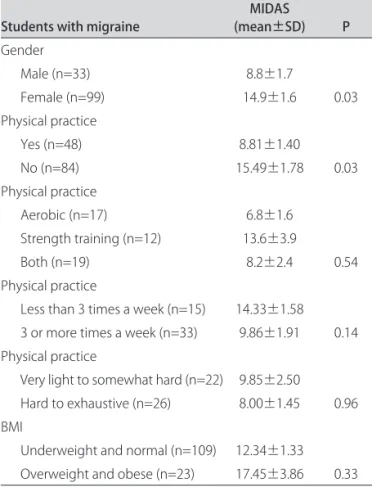
Students with migraine who presented regular physi-cal practice had a signiicantly lower disability as assessed by MIDAS than those who did not practice physical ac-tivities (P=0.03). he functional disability of migraine was also higher among women (P=0.03). he proportion of male students with migraine with or without physical ac-tivity (36.4 and 63.6, respectively) and the proportion of female students with migraine practicing and not prac-ticing exercises (32.6 and 67.4, respectively) were not sig-niicantly diferent (P=0.7).
he impact of migraine was not signiicantly difer-ent among those reporting aerobic physical practice or strength training (P=0.54). here was no signiicant dif-ference in the migraine functional disability of students reporting physical practice three or more times a week and those reporting physical practice less than three times a week (P=0.14). he impact of migraine was not signiicantly diferent among the students reporting very light to somewhat hard physical practice than those re-porting hard to exhaustive physical practice (P=0.96). he functional disability of students reporting and not report-ing physical practice is shown in Table 2.
Seventeen students (4.3%) were classiied as under-weight, 301 (75.4%) were classiied as normal under-weight, 75 (18.8%) as overweight, and 6 (1,5%) as obese. he preva-lence of migraine was not signiicantly diferent between those classiied as underweight and normal weight than among those classiied as overweight and obese (P=0.5). he impact of migraine among the students classiied as underweight or normal weight was not signiicantly dif-ferent that among those classiied as overweight or obese (P=0.34). he functional impact of migraine among over-weight and obese was not signiicantly diferent of the functional impact of migraine among under or normal weight students (P=0.33) (Table 2). Furthermore there was no correlation between BMI and MIDAS (P=0.38). A multivariate analysis conirmed these results showing that gender and physical activity inluence the severity of migraine, as assessed by MIDAS, but not the weight sta-tus (Table 3).
DISCUSSION
We have found a lower migraine functional disabil-ity among medical students reporting regular physical practice. We also have found that female students had higher migraine functional disability. hese two variables
Table 1. Demographic and physical practice data of students with migraine and students without headache history.
Students Migraine (N=132) Without headache (N=56) P value
Age (mean ± SD, min-max) 21±0.2 (17-30) 20.8±0.3 (17-29) 0.45 Gender (%)
Male 17.5 14.4
Female 52.6 15.5 0.002
Ethnicity (%)
White 52.6 20.2
Brown 14.9 8
Black 2.7 1.6 0.60
Physical practice (%)
Yes 25.5 12.8
No 44.7 17 0.40
Type of physical practice (%)
Aerobic 21.9 11
Strength training 14.1 11
Both 26.5 15.5 0.8
Frequency(%)
Less than 3 times a week 20.8 11.1
3 or more times a week 45.8 22.3 0.85
Physical practice (%)
Very light to somewhat hard 28.8 13.7
Hard to exhaustive 34.8 22.7 0.54
were independently associated with higher MIDAS scores since the proportion of male and female migraneurs prac-ticing and not pracprac-ticing exercises were not statistically signiicant. here were not signiicant diferences when analyzed separately type of physical practice and inten-sity of physical practice. he students reporting physical practice 3 times or more a week had a lower functional disability of migraine but this diference was not signii-cant. In a representative sample of the Brazilian popula-tion, Queiroz et al. found that people reporting physical practice 3 or more times a week had a lower prevalence of chronic daily headache with migranous features24,
howev-er, these authors did not assess functional disability. he
present study shows an inverse association between the migraine functional disability and the regular practice of physical practice.
It has been shown that overweight and obese mi-graneurs have an increased risk of having more frequent migraine attacks and chronic migraine15. If obesity is an
exacerbating factor for migraine and if the practice of physical practices reduces the risk of obesity16 it could be
argued that physical practice reduces the impact of mi-graine by reducing weight. In our study the overweight and obese students had a higher functional disability re-lated to migraine, however, this diference was not statis-tically signiicant. herefore, the present study does not support the hypothesis that physical practice beneits mi-graneurs by reducing weight and suggests that physical practice may have an independent role in the improve-ment of migraine.
Our study has some clear limitations. The ID-mi-graine is a screening tool. Although it has been validated in Portuguese language it has not the same accuracy than a clinical evaluation by a headache expert using the Inter-national Headache Criteria25. he evaluation of the
prac-tice of physical pracprac-tices was based on retrospective in-formation and not on a validated tool. he Borg 0-10 Ra-tio Scale of perceived exerRa-tion is a subjective assessment tool and does not measure physiologic variables during the physical practice, such as heart rate and blood pres-sure. his study was conducted in a speciic communi-ty so that the present data can not be generalized. Also, this type of study does not allow the deinition of a pre-cise causal relationship. herefore it remains to be es-tablished if the regular practice of physical activity has a beneicial impact on migraine or if more severe migraine picture reduces physical activity due to exercise-induced pain. In either case this relationship is relevant. If physi-cal practice improves migraine it should be recommend-ed to migraneurs. If migraine rrecommend-educes physical practice it may explain, at least in part, why migraine is a risk fac-tor for cardiovascular disorders such as coronary disease and stroke18. It has been established that physical
activi-ty under medical supervision and follow-up reduces the risk of such diseases26. However, there are not
prospec-Table 2. Functional disability of migraine, as assessed by the MIDAS, according to the physical practice status and body mass index.
Students with migraine (mean±SD)MIDAS P
Gender
Male (n=33) 8.8±1.7
Female (n=99) 14.9±1.6 0.03 Physical practice
Yes (n=48) 8.81±1.40
No (n=84) 15.49±1.78 0.03 Physical practice
Aerobic (n=17) 6.8±1.6 Strength training (n=12) 13.6±3.9
Both (n=19) 8.2±2.4 0.54
Physical practice
Less than 3 times a week (n=15) 14.33±1.58 3 or more times a week (n=33) 9.86±1.91 0.14 Physical practice
Very light to somewhat hard (n=22) 9.85±2.50
Hard to exhaustive (n=26) 8.00±1.45 0.96 BMI
Underweight and normal (n=109) 12.34±1.33 Overweight and obese (n=23) 17.45±3.86 0.33
SD: standard deviatation; BMI: body mass index.
Table 3. Ordinal regression analysis of the variables related to the severity of migraine, as assessed by the migraine disability assessment.
p value Odds ratio 95% Conidence interval
Gender 0.005 2.98 1.39-6.38
Physical activity 0.024 2.27 1.12-4.63
Underweight 0.534 0.41 0.02-6.92
Normal weight 0.395 2.62 0.28-24.24
tive studies evaluating the role of physical activity in the relationship between migraine and cardiovascular disor-ders. Only prospective and controlled studies evaluating the impact of regular physical practice on migraine sever-ity can irmly establish the direction of the association.
In conclusion, when analyzing the inluence of gen-der, physical practice, frequency, type, intensity of phys-ical practice, and weight on the functional impact of mi-graine among medical students we have found that only gender and physical practice were independently related with greater disability. Considering this and all the very well known beneits of physical practice the present study suggests that migraneurs should be encouraged to prac-tice physical exercises.
REFERENCES
1. Lipton RB, Stewart WF, Diamond S, Diamond SL, Reed W. Prevalence and burden o migraine in the United States: data from the American Migraine Study II. Headache 2001;41:646-657.
2. Queiroz LP, Peres MF, Piovesan EJ, et al. A nationwide population-based study of migraine in Brazil. Cephalalgia 2009;9:642-649.
3. Domingues RB, Cezar PB, Schmidt Filho et al. Prevalence and impact of headache and migraine among Brazilian Tupiniquim natives. Arq Neurop-siquiatr 2009;67:413-415.
4. Van-Gijin J. Relief of common migraine by physical practice. J Neurol Neu-rosurg Psychiatry 1987;50:1700-1701.
5. Kumar KK. Physical practice for prophylaxis of migraine. Headache 1988; 28:228.
6. Dittrich SM, Günther V, Franz G, Burtscher M, Holzner B, Kopp M. Aero-bic physical practice with relaxation: inluence on pain and psychological well-being in female migraine patients. Clin J Sport Med 2008;18:363-365. 7. Varkey E, Hagen K, Zwart J-A, Linde M. Physical activity and headache:
results from the Nord-Trøndelag Health Study (HUNT). Cephalalgia 2008;28: 1292-1297.
8. Koseoglu E, Akboyraz A, Soyuer A, Ersoy AO. Aerobic physical practice and plasma beta endorphin levels in patients with migrainous headache without aura. Cephalalgia 2003;23:972-976.
9. Narin SO, Pinar L, Erbas D, Ozturk V, Idiman F. The efects of physical
prac-tice and physical pracprac-tice-related changes in blood nitric oxide level on mi-graine headache. Clin Rehabil 2003;17:624-630.
10. Busch V, Gaul C. Physical practice in migraine therapy: is there any evidence for eicacy? A critical review. Headache 2008;48:890-899.
11. Indo T, Takahashi A. Swimmer’s migraine. Headache 1990;30:485-487. 12. Fukui PT, Gonçalves TR, Strabelli CG, et al. Trigger factors in migraine
pa-tients. Arq Neuropsiquiatr 2008;66:494-499.
13. Thompson JK. Physical practice-induced migraine prodrome symptoms. Headache 1987;27:250-251.
14. Nadelson C. Sports and physical practice-induced migraines. Curr Sports Med Rep 2006;5:29-33.
15. Bigal ME, Lipton RB. Obesity and chronic daily headache. Curr Pain Head-ache Rep 2008;12:56-61.
16. Sharma M. Behavioural interventions for preventing and treating obesity in adults. Obes Rev 2007;8:441-449.
17. Moreira MM, Souza HP, Schwingel PA, Sá CK, Zoppi CC. Efects of aerobic and anaerobic exercise on cardiac risk variables in overweight adults. Arq Bras Cardiol 2008;91:200-206.
18. Schürks M, Rist PM, Bigal ME, Buring JE, Lipton RB, Kurth T. Migraine and cardiovascular disease: systematic review and meta-analysis. BMJ 2009; 339: 3914.
19. Mahler DA, Horowitz MB. Clinical evaluation of exertional dyspnea. Clin Chest Med 1994;15:259-269.
20. Gil-Gouveia R, Martins I. Validation of the Portuguese version of ID-Migraine. Headache 2009 DOI 10.1111/j.1526-4610.2009.01449.x
21. Stewart WF, Lipton RB, Dowson AJ, Sawyer J. Development and testing of the Migraine Disability Assessment (MIDAS) questionnaire to assess head-ache-related disability. Neurology 2001;56(Suppl):S20-S28.
22. Fragoso YD. MIDAS (Migraine Disability Assessment): a valuable tool for work-site identiication of migraine in workers in Brazil. Sao Paulo Med J 2002; 120:118-121.
23. De Vriendt T, Huybrechts I, Ottevaere C, Van Trimpont I, De Henauw S. Va-lidity of self-reported weight and height of adolescents, its impact on clas-siication into BMI-categories and the association with weighing behav-iour. Int J Environ Res Public Health 2009;6:2696-2711.
24. Queiroz LP, Peres MFP, Kowacs F, et al. Chronic daily headache in Brazil: a nationwide population based study. Cephalalgia 2008;28:1264-1269. 25. Headache Classiication Subcomitte of the International Headache Society.
The Internacional Classiication of Headache Disorders. 2nd Edition.
Ceph-alalgia 2004;24:1-160.