Nonlinear analysis of structural elements under
unilateral contact constraints by a Ritz type approach
Ricardo A.M. Silveira
a, Wellington L.A. Pereira
a, Paulo B. Gonc
ßalves
b,*aDepartment of Civil Engineering, School of Mines, Federal University of Ouro Preto, Campus Universita´rio, Morro do Cruzeiro 35400-000 Ouro Preto, MG, Brazil
bDepartment of Civil Engineering, PUC-Rio, Rua Marqueˆs de Sa˜o Vicente, 225, Ga´vea 22453-900 Rio de Janeiro, RJ, Brazil
Received 5 September 2007; received in revised form 11 December 2007 Available online 28 December 2007
Abstract
A nonlinear modal solution methodology capable of solving equilibrium and stability problems of uni-dimensional structural elements (beams, columns and arches) with unilateral contact constraints is presented in this work. The contact constraints are imposed by an elastic foundation of the Winkler type, where special attention is given to the case in which the foundation reacts in compression only, characterizing the contact as unilateral. A Ritz type approach with moveable boundaries, where the coordinates defining the limits of the contact regions are considered as additional variables of the problem, is proposed to solve this class of unilateral contact problems. The methodology is illustrated by particular prob-lems involving beams, beam-columns and arches, and the results are compared with available results obtained by finite element and mathematical programming techniques. It is concluded that the Ritz type approach proposed is particularly suited for the analysis of structural problems where the number, but not the length, of the contact regions between the bodies are known a priori. Therefore, it can substitute in these cases finite element applications and be used as a benchmark for more general and complex formulations as well.
Ó2008 Elsevier Ltd. All rights reserved.
Keywords: Unilateral contact; Stability; Ritz method; Tensionless foundation; Nonlinear structural analysis
1. Introduction
Contact interactions between a deformable structure and an elastic foundation are usually modeled by means of bilateral boundary conditions: displacements and/or forces prescribed in some (known) area of the structure. Such models are satisfactory for some engineering applications, but they stop being reliable when loss of contact occurs. Generally, in this case, it is necessary to establish unilateral boundary conditions as part of the solution, since the true contact area is unknown a priori. Structural elements used in foundation structures, pavements, flotation structures, beam-column joints, pipes on elastic foundation, piles partially
0020-7683/$ - see front matterÓ2008 Elsevier Ltd. All rights reserved.
doi:10.1016/j.ijsolstr.2007.12.012
* Corresponding author. Tel.: +55 21 3527 1188; fax: +55 21 3527 1195.
E-mail addresses:[email protected](R.A.M. Silveira),[email protected](P.B. Goncßalves). International Journal of Solids and Structures 45 (2008) 2629–2650
embedded in soil, saddle-supported pipelines, composite laminate structures and protection shells in aggressive environments are examples of structures found in civil and mechanical engineering where unilateral contact may occur.
Even in the range of small deformations and under linear elastic behavior of the material, unilateral con-straints introduce high nonlinearities, which cannot be dealt satisfactorily by usual nonlinear structural anal-ysis methods. So, in order to study the equilibrium and stability of slender structural elements with unilateral constraints two types of nonlinearities, geometric and contact, must be taken into account and a reliable and efficient solution method is necessary.
In general, the first step to obtain the numerical solutions of contact problems consists in the discretization of the continuous system. For this, some numerical technique, such as Ritz method, finite element method (FEM) or boundary element method (BEM) is usually employed. After the discretization, attention is given to the selection of a proper methodology to treat adequately the contact constraints. Among several options found in the literature, one can mention:
(i) Transformation of the contact problem into a minimization problem without constraint through the adaptation of usual formulations of structural mechanics—differentiable functional and bilateral con-straints—to the case of unilateral contact constraints. The convergence of these procedures, which are unavoidably of iterative nature, or incremental-iterative nature, is not guarantied. However, these pro-cedures may or not introduce new concepts and existing computational codes for nonlinear analyses can be adapted to this particular case, leading to economy in computational time if no change in the contact region occurs between two load steps (Adan et al., 1994; Holmes et al., 1999; Silveira and Goncßalves, 2001; Li and Berger, 2003).
(ii) Use of mathematical programming techniques. This approach allows the solution of the contact problem with or without explicit elimination of unilateral constraints. Methods such as Lagrange’s multipliers or penalties allow the elimination of the unilateral constraints (Simo et al., 1985; Barbosa, 1986; Wriggers and Imhof, 1993; Wriggers, 2002; Wriggers and Zavarise, 2004; Fisher and Wriggers, 2005). Usually these methods are based on the use of the special finite elements derived to simulate the impenetrability condition between two surfaces (Wriggers and Imhof, 1993; Wriggers, 2002). On the other hand, the uni-lateral constraints can be maintained in the formulation, retaining the original philosophy of the prob-lem, and an alternative linear complementary problems (LCPs) can be obtained and solved by, for example, Lemke’s or Dantig’s algorithms (Lemke, 1968; Ascione and Grimaldi, 1984; Joo and Kwak, 1986; Barbosa, 1986; Silveira, 1995; Koo and Kwak, 1996; Silva, 1998; Silva et al., 2001; Silveira and Goncßalves, 2001; Wriggers, 2002; Pereira, 2003; Holanda and Goncßalves, 2003).
Numerical simulations dealing with the equilibrium and stability of structural elements under contact con-straints, including here structure-foundation problems, can be easily found in the literature. For example, finite element applications including contact constraints in the stability of rods, limit-point behaviour of thick rubber spherical shells and large deformation post-buckling behavior of structures are presented, respectively, byStein and Wriggers (1984), Endo et al. (1984) and Simo et al. (1986). Algorithms specifically designed to trace complex nonlinear equilibrium paths, such as arc-length procedures (Crisfield, 1991), have been used byWriggers et al. (1987), Stein et al. (1990), Bjo¨rkman (1992), Koo and Kwak (1996) and Silveira and Gon-alves (2001), among others, to solve stability problems of structures with unilateral contact constraints.
Tscho¨pe et al. (2003a,b)extended methods for the detection of critical points to problems with inequality con-straints. Different formulations, algorithms and discretisation techniques for structural contact problems are described in depth on Wriggers’ book (Wriggers, 2002). RecentlyWriggers and Zavarise (2004)presented a state of art of the solution of contact problems within a computational mechanics approach.
dynamic response of thin and moderately thick plates resting on a tensionless Winkler or Pasternak-type foundation (Yu et al., 2007; Gu¨ler and Celep, 2005; Celep and Gu¨ler, 2004; Celep and Gencßoglu, 2003). Numerical approximations involving the stability, buckling and post-buckling behavior of plates under uni-lateral contact constraints imposed by elastic foundation appear in recent papers by Muradova and Stav-roulakis (2006), Shen and Li (2004), Shen and Yu (2004), Shen and Teng (2004) and Holanda and Goncßalves (2003). Wang et al. (2005) provide an important review of the state of the art of beams and plates on elastic foundation; they include soil modeling as well as analytical and numerical possibilities for solving this class of contact problem.
This paper focuses on unilateral contact problems involving beams, columns and arches on a tensionless elastic foundation of the Winkler-type; it adopts the first alternative described above for the treatment of the contact constraints. Since 1990, the authors of this paper have analyzed several contact problems involving a deformable structure with contact constraints (Silveira, 1995; Silva et al., 2001; Silveira and Goncßalves, 2001; Pereira, 2003; Holanda and Goncßalves, 2003; Pereira and Silveira, 2006). These works attempted to establish reliable methodologies for the analysis of structures with unilateral boundary conditions. Therefore, this arti-cle can be considered as an extension of these previous ones, but adds a new contribution by providing an alternative methodology for the analysis of structures resting unilaterally on an elastic foundation.
The aim of the present work is to develop a semi-analytical methodology, using a Ritz type approach, for the elastic equilibrium and instability analysis of beams, columns and arches resting on a tensionless Winkler-type elastic foundation. In the proposed Ritz approach the displacements and end points of the contact regions are taken as basic unknowns. This approach is particularly suited for the analysis of struc-tural problems where the number, but not the location or length of the contact areas, is known a priori, leading to a fast convergence. When complicated loading cases are considered, one can perform initially an analysis considering bilateral contact and identify the number of regions where the foundation is under traction. This data can be considered as a starting point in the iterative procedure, leading usually to a small number of iterations. The number of contact regions can also be determined, but this leads to a more involved and numerically less stable algorithm. This leads to highly nonlinear equations. In order to solve the resulting algebraic nonlinear equations and obtain nonlinear equilibrium paths, the New-ton–Raphson method is used together with an arc-length iteration procedure (Crisfield, 1991). This incre-mental-iterative strategy allows limit points to be passed and, consequently, snap buckling phenomena to be identified. Unilateral contact problems analyses and comparisons with existing results validate the pro-posed formulation.
Of course, the finite element method is the most appropriate tool to analyze complex nonlinear systems with unilateral constraints. However, it is usually expensive with respect to both storage and CPU costs, par-ticularly in the analysis of two and three dimensional contact problems. As a result, it is difficult to deal with situations such as sensitivity analyses, optimization, feedback control problems and parametric analyses. Not surprisingly, in recent years a lot of attention has been paid to reducing the coast of nonlinear solutions by using reduced-order models (Rega and Troger, 2005). We believe the present methodology, although case spe-cific and tested for uni-dimensional structural systems, is a semi-analytical reliable alternative for the construc-tion of reduced-order approximaconstruc-tions for several structure-foundaconstruc-tion problems with unilateral constraints which can be effectively used in practical applications.
2. Formulation of the unilateral contact problem
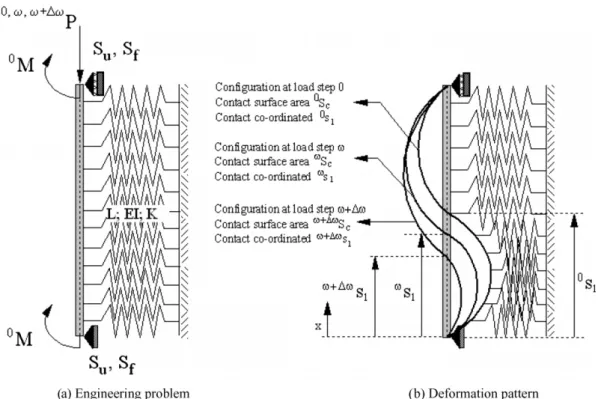
Consider the structural system shown inFig. 1a consisting of a bar and an elastic tensionless foundation, and assume that both bodies may undergo large deflections and rotations but small strains, within the elastic range of the material. In addition, the contact surface is assumed unbonded and frictionless. The column is defined as a solid elastic continuum which occupies a domain i
V(i= 0,xandx+Dx). Its boundaryi
S is composed of three regions:i
Su,iSfandiSc, where the surface forces are specified oniSfand the displacements
are specified oni
Su. The remaining part,iSc, corresponds to the region where contact is likely to occur, which
is not known a priori.
DSij;jþ ðDu xþDx
i;j Sjk;iÞ;k¼0 ð1aÞ
Deij ¼
1
2ðDui;jþDuj;iþDuk;iDuk;jÞ ð1bÞ
DSij¼CijklDekl ð1cÞ
where the customary summation convention is used. In Eq.(1a),DSijare the components of the 2nd Piola–
Kirchhoff stress increment tensor, the unknowns of the problem, andx+Dx
Sijare the Cartesian components
of this same tensor at statex+Dx, which are referred to the previous equilibrium configurationx.Dui,Deij
andCijkldefine the increment of displacement and strains and material properties, respectively.
As in many engineering applications, if the designer is interested only on the response of the foundation at the contact area, it is possible to construct simple mathematical models for describing the response of the foundation at the contact zone with a reasonable degree of accuracy. Using the well-known Winkler model (Hete´nyi, 1946;Kerr, 1964), the following constitutive equation can be written to describe the elastic founda-tion reacfounda-tion:
Drb¼CbDub ð2Þ
whereDrbandDubare the incremental compressive reaction and deflection of the foundation, respectively, and
Cbis the foundation elastic modulus.
For the two bodies under investigation, the displacements and the surface forces are specified oniSuand i
Sf,
respectively, and the following conditions must be satisfied onSc:
(i) The gap in the potential contact area,u, after the increment of the displacements, must satisfy the fol-lowing inequality constraint at configurationx+Dx:
uP0 ð3Þ
rbP0 ð4Þ
(iii) The complementary relation betweenuandrbis:
Z
xþDxS c
rbuxþDxdSc ¼0 ð5Þ
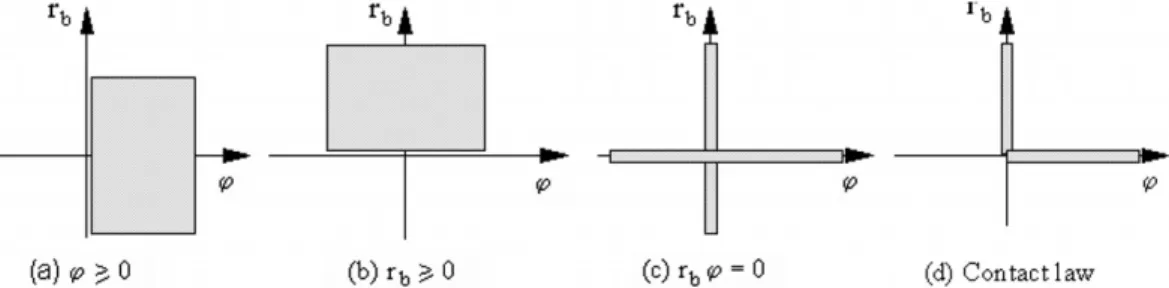
These three constraints define in a complete way the contact as being unilateral.Fig. 2shows the domain of validity of these relations and the contact law.
For a given load increment, the solution of the unilateral contact problem can be obtained by solving Eq.
(1a), together with Eqs.1b, 1c and 2, and by satisfying the appropriate boundary conditions onSuandSf, as
well as the restrictions(3)–(5)onSc. However, the nonlinearity due to the unilateral constraints and the
non-linear strain–displacement relations make it difficult to solve this problem directly. For this reason, an equiv-alent minimization problem is formulated, which is particularly suitable for numerical analysis. According to
Joo and Kwak (1986) and Silveira and Goncßalves (2001), the optimization’s problem:
MinPðDu;DubÞ ð6Þ
Subject to :u60; onSc ð7Þ
where,
P¼
Z
xV x
Sijþ
1 2DSij
Deijx dV þ
Z
xþDxS c
x rbþ
1 2Drb
Duxþb DxdSc
Z
xþDxS f
FiDuxþi DxdSf ð8Þ
is equivalent to the unilateral contact problem described above by Eqs.(1) to (5).
3. Discretization procedure and modal solution
The solution of the minimization problem defined by Eqs. (6) and (7), using mathematical programming techniques, was presented by Silveira (1995), Silveira and Goncßalves (2001) and Holanda and Goncßalves (2003). Now, a different strategy of solution is proposed assuming that contact constraints (3)–(5) on Sc,
and the elastic foundation displacements, can be introduced in the analysis by considering explicitly the coor-dinates defining the limits of the contact regions (sk) as additional variables of the problem (see Fig. 1b).
Hence, for a structural member in contact with a tensionless elastic foundation and subjected to conservative loads, the total potential energy functional can be rewritten as:
P1ðu;Sc;kÞ ¼Uðu;ScÞ kF T
ru ð9Þ
whereUis the strain energy which is a function of the displacement vectoruand of the vectorSc, which
con-tains the coordinates defining the limits of the contact regions (sk). These coordinates are considered here as
additional variables of the problem. Note that the length of each contact region is a function of the system parameters and is not known a priori. This characterizes the unilateral contact problem as nonlinear. Fr is
a fixed load vector (reference vector) andk is a scalar load multiplier.
If the Ritz method is applied, the following displacement field, written in matrix form, can be used to approximateP1:
u¼WA ð10Þ where the matrixWcontains the functions that satisfy the boundary conditions onSuand the components of
vectorAare the unknown coefficients. Thus, substituting(10)into(9), considering a small variation in the total potential energy, and expanding Eq.(9)in a Taylor series, one obtains:
dP1¼
oP1
oA dAþ oP1
oScdScþ 1 2 dA
To2P1
oA2 dAþ2dA
T o2P1
oAoScdScþdSc
To2P1
oSc2dSc
þ0ðdA3;dSc
3Þ ð11aÞ
or, using a more compact matrix notation:
dP1¼gTdUþ
1 2ðdU
T
MdUÞ þ0ðdU3Þ ð11bÞ
in which the vectorUcontains the unknown variables of the problem (AandSc),gis the gradient vector (out-of-balance load vector), andMis the Hessian matrix, which can be written as follow:
M¼ K J JT S
¼
o2P1
oA2
o2P1
oAoSc
o2P1
oScoA
o2P1
oSc2
2
4
3
5 ð12Þ
whereK,Sand Jare the stiffness, contact and joining matrices, respectively.
For equilibrium, the change in Eq.(11b)should be stationary irrespective ofdUand hence, the equilibrium equations are:
oP1
oU ¼g¼
oP1
oA
oP1
oSc
( )
¼ 0
0
ð13Þ
which represent a nonlinear algebraic equations system, involving polynomial or transcendental functions of
sk.
3.1. Nonlinear solution strategy
The incremental-iterative solution strategy for geometrically nonlinear elastic contact problems adopted in this work will be summarized in this section. In the Ritz method context, the equilibrium Eq.(13) can be rewritten as follow:
g¼Fi ðUÞ kFr ffi0 ð14Þ
whereFidefines a set of generalized internal forces in terms of the componentsU=U(A,Sc).
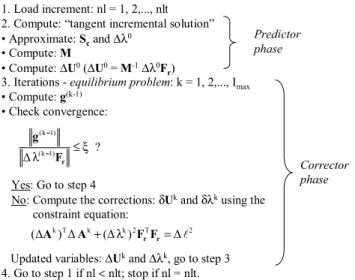
Fig. 3shows the incremental-iterative solution strategy used to solve Eq.(13)or Eq.(14). Here a constant cylindrical arc-length constraint is adopted (Crisfield, 1991). In this solution scheme two distinct steps are required for each load increment: (1) a predictor phase, where approximations for Dk0, DA0 and Sc0 are obtained; (2) acorrector phase, where these approximations are corrected to satisfy the equilibrium equations. The arc-length constraint equation is only applied on the unknown amplitudesA.
4. Examples
The general semi-analytical approach proposed is now particularized for two structural systems under uni-lateral contact constraints.
4.1. Example 1: beam-column
Consider a beam-column of length L and bending stiffness EI, resting on a tensionless Winkler foundation of stiffness K subjected to two concentrated moments at the supports plus an axial load, as illustrated in
P2¼
EI 2
Z L
0
1þ1 2
dw dx
2
" #2
d2w dx2
2
dxP 2
Z L
0
1þ1 4
dw dx
2
" #
dw dx
2
dx
þK 2
Z s1
0
w2dxMdw dx
ðx¼0Þ Mdw
dx
ðx¼LÞ
ð15Þ
wheres1represents the length of the contact region. For this system, the expected behavior of the member is
shown inFig. 1b, where one contact region of lengths1is expected.
For a simply supported bar, the following linear combination of harmonic functions can be used to approx-imate the displacement field
w¼X n
i¼1
Wi sin
ipx L
ð16Þ
whereiis the number of half-waves,nis the total number of modes necessary to achieve convergence andWi
are the modal amplitudes. After substitution of(16)and its derivatives in Eq.(15), an approximated form for
P2is obtained. Hence:
P2ðWi;s1;kÞ ¼UðWi;s1Þ VðWi;M;kPÞ ð17Þ
whereUis the strain energy, which is a function of the modal amplitudesWiand of the coordinate defining the
limit of the contact region s1and Vis the potential of the external load. The analytic expression for this
approximation is shown in theAppendix A.
The nonlinear algebraic equations for this particular problem are, according to Eq.(13):
oP2
oU ¼g¼
oP2
oWi; i¼1;. . .;n oP2
os1 8 <
:
9 =
;
¼ 0
0
ð18Þ
4.2. Example 2: shallow arch
Now, consider the arch shown inFig. 4a. It is a circular pinned arch of radiusR, length 2cR, bending stiff-ness EI and membrane stiffstiff-ness EA in contact with a tensionless Winkler foundation of modulusK. For this system, the expected deformation pattern is shown inFig. 4b, where a central contact region defined by the angles ±/is expected. The total potential energy of the arch may be written as (Brush and Almroth, 1975):
P3¼
EI 2R3
Z c
c du dh
d2
w dh2
2
dhþEA 2R
Z c
c du dhþwþ
1 2R u
dw dh
2
" #2
dhþKR 2
Z /
/
w2dhPwðh¼0Þ
ð19Þ
whereuandware the tangential and transversal displacements, respectively, of a point along the centroidal-axis, andhis the circumferential co-ordinate. These displacements for a simply supported arch may be approx-imated by:
u¼X m
iu
Uiusin
ð2iu1Þph
2c
ð20aÞ
w¼X n
iw
Wiwcos
ð2iw1Þph
2c
ð20bÞ
whereiuandiw are the number of half-waves, andUiu andWiw are the modal amplitudes.
The substitution of u and w and their derivatives in Eq.(19)leads toP3as a function of the modal
ampli-tudesUiu andWiw, contact angle/, and load parameterk, i.e.:
P3ðUiu;Wiw;/;kÞ ¼UðUiu;Wiw;/Þ VðWiw;kPÞ ð21Þ
where the contact angle limit/is the additional variables of the problem. The analytic expression forP3is
shown in theAppendix B.
The equilibrium equations of the arch are then:
oP3
oU ¼g¼
oP3
oUiu; iu¼1;. . .;m oP3
oW
iw; iw¼1;. . .;n oP3
o/ 8 > > > <
> > > :
9 > > > =
> > > ;
¼ 0 0 0 8 > <
> :
9 > =
> ;
ð22Þ
5. Results and discussion
This section aims to validate the proposed semi-analytical methodology for the analysis of structural ele-ments under unilateral constraints as well as the adopted nonlinear solution strategy. The results of this work are compared with available results obtained by finite element and mathematical programming techniques. The finite element methodology for the small displacement analysis where the contact problem is solved as a linear complementary problem, LCP, involving only the original variables subjected to inequality con-straints, which is solved by Lemke’s algorithm (Lemke, 1968), can be found in Silva et al. (2001), Pereira (2003) and Pereira and Silveira (2006). For the geometrically nonlinear analysis of slender structural elements
φ contact region
γ γ
θ P
R R
K
EI, EA
φ h
(a) Structural problem (b) Deformation pattern
under unilateral contact the relevant information is found in Silveira (1995), Silveira and Goncßalves (2001) and Holanda and Goncßalves (2003).
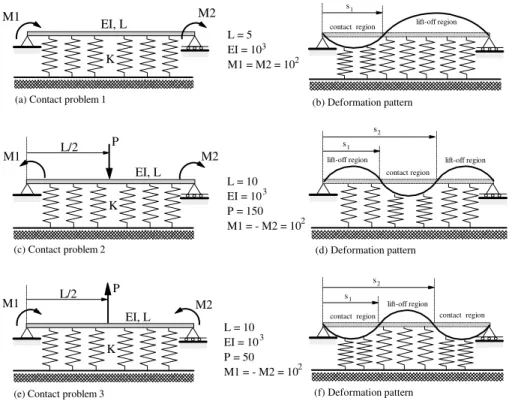
First the behavior of a beam subjected to three different loading cases is analyzed. They are illustrated in
Fig. 5together with the relevant parameters (given in consistent units) and the expected deformation pattern. Although small displacements and linear behavior of the material are considered, the unilateral contact must be solved by an iterative process since the contact lengths are unknown a priori. So, the proposed algorithm (seeFig. 3) is employed considering only one load step. In all the numerical analysis a convergence factor of
n= 103is adopted. Consider first the beam illustrated inFig. 5a. Ten terms are considered in Eq.(16). This is
enough to achieve convergence in all examples presented here. Initially, an elastic foundation that reacts in compression and tension (bilateral contact problem) is considered. The results are presented inFig. 6a where the anti-symmetrical behavior of the beam can be observed for different values of the foundation modulus
k= KL4/EI. Good agreement with the analytical and numerical results given byHete´nyi (1946) and Pereira (2003)is observed. Now, a tensionless foundation is considered. The results for the beam deflection and elastic foundation reaction are presented for the same values of the foundation moduluskinFig. 6b and c, respec-tively. The contact region (and the corresponding displacements) decreases steadily as the parameter k
increases, while the beam displacements in the non-contact region increase. This is followed by a drastic increase in the foundation reaction in the contact region. The dependence of the contact area on the founda-tion stiffness is one of the main characteristics of tensionless foundafounda-tion as compared with the convenfounda-tional foundation. Again a good agreement is observed between the modal solution and the FE results.
The second contact problem is shown in Fig. 5c. The results are shown inFig. 7a (bilateral contact con-straints), and Fig. 7b and c (unilateral contact constraints). Again, the variation of the beam displacements and elastic foundation reaction for different values of the non-dimensional elastic foundation stiffness param-eterkis presented. The good agreement with results obtained through finite element/LCP approach (Pereira, 2003) and analytical formulation (Hete´nyi, 1946) demonstrates the accuracy and efficiency of the proposed methodology. The influence of the foundation stiffness parameterkas well as of the type of contact constraints imposed is clearly noted for large values of k. There is for relatively stiff foundations a marked difference
(b) Deformation pattern
contact region
K
EI, L M2
M1
L = 5 EI = 10 M1 = M2 = 10
3 2
lift-off region
(a) Contact problem 1
s1
K L/2 M1
P
M2 EI, L
L = 10 EI = 10 P = 50 M1 = - M2 = 10
3
2
contact region
lift-off region
contact region
(f) Deformation pattern (e) Contact problem 3
s1
s2
K L/2 M1
P
M2
EI, L contact region
lift-off region lift-off region
L = 10 EI = 10 P = 150 M1 = - M2 = 10
3
2
(d) Deformation pattern (c) Contact problem 2
s1
s2
0.0 0.1 0.2 0.3 0.4 0.5 0.6 0.7 0.8 0.9 1.0 x/L
-0.008 -0.006 -0.004 -0.002 0 0.002 0.004 0.006 0.008
w/L
Present work FE/LCP solution Analytical solution k1
k2
k3
k4
k5 k1 = 6.25
k2 = 62.5 k3 = 625 k4 = 6250 k5 = 62500
(a) Bilateral contact: beam displacement
0.0 0.1 0.2 0.3 0.4 0.5 0.6 0.7 0.8 0.9 1.0 x/L
-0.01 -0.005 0 0.005 0.01 0.015 0.02
w/L
Present work FE/LCP solution k1
k2 k3
k4 k5 k1 = 6.25
k2 = 62.5 k3 = 625 k4 = 6250 k5 = 62500
(b) Unilateral contact: beam displacement
k1 = 6.25
k2 = 62.5
k3 = 625
0.0 0.1 0.2 0.3 0.4 0.5 0.6 0.7 0.8 0.9 1.0 x/L
-2.8 -2.4 -2.0 -1.6 -1.2 -0.8 -0.4 0.0
Rb
L
3
EI
K
EI, L M2
M1
(c) Unilateral contact: elastic foundation reaction.
0 0.1 0.2 0.3 0.4 0.5 0.6 0.7 0.8 0.9 1 x/L
-0.1 -0.08 -0.06 -0.04 -0.02 0 0.02
w/L Present work
FE/LCP solution Analytical solution
k1 = 102 k2 = 103 k3 = 104 k4 = 105
(a) Bilateral contact: beam displacement
0.0 0.1 0.2 0.3 0.4 0.5 0.6 0.7 0.8 0.9 1.0 x/L
-0.1 -0.08 -0.06 -0.04 -0.02 0 0.02
w/L Present work
FE/LCP solution k4 = 105
k1 = 102 k2 = 103 k3 = 104
(b) Unilateral contact: beam displacement
k1
k2
k3
0.0 0.1 0.2 0.3 0.4 0.5 0.6 0.7 0.8 0.9 1.0 x/L
-120.0 -100.0 -80.0 -60.0 -40.0 -20.0 0.0
Rb
L
3
EI
k4 k1 = 102
k2 = 103 k3 = 104
k4 = 105 K
L/2 M1
P
M2
EI, L
(c) Unilateral contact: elastic foundation reaction
0.0 0.1 0.2 0.3 0.4 0.5 0.6 0.7 0.8 0.9 1.0 x/L
-0.02 -0.01 0 0.01 0.02 0.03
w/L
Present work
FE/LCP solution k5 = 106
k4 = 105
k3 = 104
k2 = 103
k1 = 102
(a) Unilateral contact: beam displacement
0.0 0.1 0.2 0.3 0.4 0.5 0.6 0.7 0.8 0.9 1.0 x/L
-0.025 -0.02 -0.015 -0.01 -0.005 0 0.005 0.01 0.015
w/L
Unilateral contact Bilateral contact No contact (k = 0) k = 104
(b) Comparison between bilateral and unilateral contact problems
0.0 0.1 0.2 0.3 0.4 0.5 0.6 0.7 0.8 0.9 1.0 x/L
-25.0 -20.0 -15.0 -10.0 -5.0 0.0
Rb
L
3
EI
k1 = 102
k2 = 103
k3 = 104
K L/2 M1
P
M2 EI, L
(c) Unilateral contact: elastic foundation reaction
between the displacements of the tensionless and the conventional foundation models. Under unilateral con-straints the beam displacement w increases on the non-contact region and decreases on the contact region. Consequently, considerable error may result if the unilateral character of the foundation is not taken into account in the analysis. As shown inFig. 7, askincreases, we approach the limiting case ofk?1, the ten-sionless rigid foundation case. As in many numerical applications, the rigid foundation can be simulated by considering a very large value fork.Fig. 5e shows the third example.Fig. 8shows the relevant results for dif-ferent values of the k. Again a good agreement between the present results with those previously obtained using the FE/LCP approach (Pereira, 2003) is observed.
Now, consider the arch shown in Fig. 4a. It is a slender circular arch of radius R, length 2cR, bending stiffness EI and membrane stiffness EA in contact with a tensionless foundation of modulus K. For a con-centrated load P applied at h= 0, the expected deformation pattern is shown in Fig. 4b, where a central contact region, defined by the angles ±/, is expected. For the arch, five terms (m= 5) in Eq. (20a) and 10 terms (n= 10) in Eq. (20b) are considered to obtain convergence in all cases. The arch lateral
displace-0 1 2 3 4 5 6 7 8 9 10
θ
-0.01 -0.0075 -0.005 -0.0025 0 0.0025 0.005 0.0075 0.01
w R
Present work FE/LCP solution
o
φ = 3.73
Bilateral contact
Bilateral contact
Unilateral contact
Unilateral contact
γ γ
θ P
R R
K
EI, EA h
k = 106
(a) Arch displacement
0 1 2 3 4 5 6 7 8 9 10
θ
-0.0001 -7.5E-5 -5E-5 -2.5E-5 0 2.5E-5 5E-5 7.5E-5 0.0001
Rb
h
3
EI
Present work FE/LCP solution o
φ = 3.73
k = 106
φ
contact region
φ
(b) Elastic foundation reaction
ment w and elastic foundation reaction rb are shown in Fig. 9a and b, respectively, considering the
fol-lowing data (Walker, 1969): R/h= 500 (h= thickness), c= 10°, EI = 1.4, EA = 420, a non-dimensional elastic foundation stiffness parameter k= KR4/EI = 106, and P= 0.1. Due to the problem symmetry,
results are shown for half arch. The conventional foundation model (bilateral contact) was also considered
0.0x100
4.0x10⁻⁴
8.0x10⁻⁴
1.2x10⁻³
1.6x10⁻³
2.0x10⁻³
w/L (x/L = 0.85) 0.0
0.5 1.0 1.5 2.0 2.5 3.0 3.5 4.0 4.5 5.0 5.5 6.0
P Pe
Present work FE/LCP solution
Unilateral contact: P/Pe≅1
Bilateral contact: P/Pe≅ 5.6
Bilateral contact results (k = 625)
Unilateral contact results (k = 625)
β= P/Pe
(a) Column equilibrium paths for the bilateral and unilateral contact problems
5.0x10⁻⁵ 1.0x10⁻⁴ 1.5x10⁻⁴ 2.0x10⁻⁴ 2.5x10⁻⁴
w/L (x/L = 0.85) 0.0
0.2 0.4 0.6 0.8 1.0 1.2
P Pe
Present work FE/LCP solution
k = 6.25
k = 625
k = 6250
S ,u Sf
M
0
M
0
P
0,ω,ω+∆ω
L; EI; K
S ,u Sf
(b) Nonlinear equilibrium paths for various values of k (unilateral constraints)
in Fig. 9a. One can observe that, under unilateral contact constraints, the arch displacement wincreases in the non-contact region. The contact angle between the bodies 2/= 7.46°coincide with that obtained using the FE/LCP approach (Silveira, 1995).
The first stability problem under contact constraints is illustred inFig. 10a. It is a beam-column under an increasing compressive axial loadPand constant bending moments at the supports (see alsoFig. 1). The bend-ing momentsMat the supports have a constant small value and act as initial load imperfections, generating in the unilateral contact case a non-contact region. Thus, this analysis aims to verify the nonlinear response and changes on the contact and non-contact regions with the monotonic increment of the loadP.
0 0.01 0.02 0.03 0.04
w/R (θ = 0)
-100 0 100 200 300 400 500 600 700 800 900
P
R
2
EI
Present work FE/LCP solution k = 107
k = 106
k = 2.5 105
k = 105
k = 5 104
k = 2.5 104
k = 104
γ γ
θ P
R R
K
EI, EA
h
k = 0
(a) Arch equilibrium paths for various values of k
0.10 0.15 0.20 0.25 0.30 0.35 0.40
Sc/R
-100 0 100 200 300 400 500 600
P
R
2
EI
Present work FE/LCP solution
φ φ
Sc
k = 2.5 105
k = 105
k = 5 104
k = 2.5 104
k = 104
(b) Variation of the contact region Sc between the bodies
The results are obtained through the proposed nonlinear solution strategy and by considering the following data:L= 5; EI = 103; EA = 12 106andM= 1.Fig. 10a, where the non-dimensional load parameterP/P
eis
plotted as a function of the non-dimensional displacementw/L, shows the nonlinear response of the column considering both bilateral and unilateral contact.
For the bilateral contact case (conventional Winkler model), the load-displacement response is asymptotic to the value of the theoretical critical load of the perfect column given by (Brush and Almroth, 1975):
Pcr¼
np
L
2
EIþ L np
2
K ð23Þ
For this geometry and a non-dimensional elastic foundation stiffness parameterk= KL4/EI = 625, the
col-umn buckles with two half-waves (n= 2) and the following relationship is found Pcr/Pe ffi 5.6, with
Pe=p2EI/L2.
For the unilateral contact case, the equilibrium path is asymptotic to the first bifurcation load of the perfect column (Pcr/Peffi1). This response can be better understood observing the column deformation patterns also
presented inFig. 10a. Note the reduction of the contact regionScwith increasingP. After the separation of the
bodies the bar deformation is similar to the first buckling mode (n= 1). This example highlights again the fact that considerable error may result if the appropriate foundation model is not taken into account in the anal-ysis (Silva et al., 2001).
The influence of the foundation stiffness is illustrated in Fig. 10b, where again the non-dimensional load parameter P/Pe is plotted as a function of w/L (x/L= 0.85). The non-dimensional foundation
stiff-ness parameter k assumes the values 6.25, 625 and 6250. Independent of the foundation stiffness, the equilibrium path is asymptotic to the first bifurcation load and reproduces the results obtained bySilveira (1995).
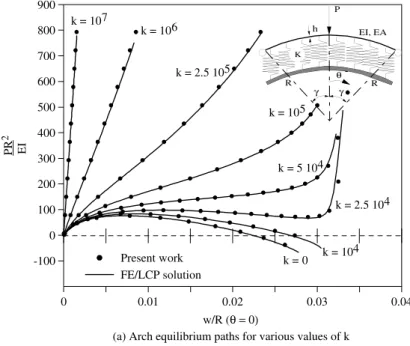
As a last example, consider the same slender circular arch analysed previously (Fig. 4a). Now, an incre-mental load P is applied at h= 0 and the nonlinear response is obtained, with the central contact region defined by the angles ±/. The results are shown inFig. 11a and b. InFig. 11a, the variation of the lateral displacement w is plotted as a function of the load parameter PR2/EI, for different values of the
non-dimensional elastic foundation stiffness parameterk= KR4/EI. The nonlinear equilibrium path of the
sys-tem without foundation (k= 0) was originally presented by Walker (1969), with the arch exhibiting a snap-through behavior and a limit load PR2/EI = 76.3. For a flexibly foundation (k< 104), no additional effects were observed in the pre and post-buckling behavior. With k= 104, a small increase is observed in the limit load (PR2/EI = 83.4). For kP5104, the snap-through behavior disappears, and for k= 106 and 107 the equilibrium paths are practically linear (very stiff foundation). Again, the results of Silveira (1995) agree well with those obtained in this work. Fig. 11b shows the variation of contact regions Sc
(2R/) with the applied load.
6. Conclusions
problems considerable error may result if the elastic foundation is not adequately modelled and its unilat-eral constraint character is not taken into account.
This methodology is particularly suited for the analysis of structural problems where the number and loca-tion, but not the length, of the contact and non-contact regions are known a priori. In these cases, it can sub-stitute large and time-consuming finite element packages usually used in this type of analysis. This simplified but accurate semi-analytical approach can be efficiently used to perform detailed parametric analyses and thus contribute to a better understanding of the effects of unilateral constraints in structural analysis. It can also be used as a benchmark for more general and complex formulations.
Acknowledgements
The authors are grateful for the financial support from the Brazilian National Council for Scientific and Technological Development (CNPq/MCT). They also acknowledge the support from FAPERJ-CNE, USIM-INAS, FAPEMIG and Gorceix Foundation. Special thanks also to Professor Michael Engelhardt and his department at the University of Texas for their hospitality during the manuscript’s preparation.
Appendix A
Expression for P2 in terms of the coefficients obtained through the exact integration of the harmonic
functions:
P2¼
Xn
i
Xn
j
WiWja2ijbþ
Xn i Xn j Xn k Xn l
WiWjWkWla4ijklb þ
Xn i Xn j Xn k Xn l Xn p Xn q
WiWjWkWlWpWqa6ijklpqb
þX
n
i
Xn
j
WiWja2ijmþ
Xn i Xn j Xn k Xn l
WiWjWkWla4ijklm
þX
n
i
Xn
j
WiWja 2f
ij
Xn
i
MWiaMi ðx¼0Þ
Xn
i
MWiaMi ðx¼LÞ ð24Þ
where:
a2b
ij ¼
EI 4
i2j2p4
L4
Z L
0
cos ðijÞpx L
h i
cos ðiþjÞpx L
h i
n o
dx
a4b
ijkl¼
EI 16
i2j2klp6
L6
Z L
0
cos ðijkþlÞpx L
h i
þcos ðijþklÞpx L
h i
n
cos ðijklÞpx L
h i
cos ðijþkþlÞpx L
h i
þcos ðiþjkþlÞpx L
h i
þcos ðiþjþklÞpx L
h i
cos ðiþjklÞpx L
h i
cos ðiþjþkþlÞpx L
h io
dx
a6b
ijklpq¼
EI 256
i2j2klpqp8
L8
Z L
0
cos ðijkþlpþqÞpx L
h i
n
þcos ðijkþlþpqÞpx L
h i
cos ðijkþlpqÞpx L
h i
cos ðijkþlþpþqÞpx L
h i
þcos ðijþklpþqÞpx L
h i
þcos ðijþklþpqÞpx L
h i
cos ðijþklpqÞpx L
h i
cos ðijþklþpþqÞpx L
þcos ðijklpþqÞpx L
h i
þcos ðijklþpqÞpx L
h i
cos ðijklpqÞpx L
h i
cos ðijklþpþqÞpx L
h i
þcos ðijþkþlpþqÞpx L
h i
þcos ðijþkþlþpqÞpx L
h i
cos ðijþkþlpqÞpx L
h i
cos ðijþkþlþpþqÞpx L
h i
þcos ðiþjkþlpþqÞpx L
h i
þcos ðiþjkþlþpqÞpx L
h i
cos ðiþjkþlpqÞpx L
h i
cos ðiþjkþlþpþqÞpx L
h i
þcos ðiþjþklpþqÞpx L
h i
þcos ðiþjþklþpqÞpx L
h i
cos ðiþjþklpqÞpx L
h i
cos ðiþjþklþpþqÞpx L
h i
þcos ðiþjklpþqÞpx L
h i
þcos ðiþjklþpqÞpx L
h i
cos ðiþjklpqÞpx L
h i
cos ðiþjklþpþqÞpx L
h i
þcos ðiþjþkþlpþqÞpx L
h i
þcos ðiþjþkþlþpqÞpx L
h i
cos ðiþjþkþlpqÞpx L
h i
cos ðiþjþkþlþpþqÞpx L
h io
dx
a2m
ij ¼
P 4
ijp2
L2
Z L
0
cos ðijÞpx L
h i
þcos ðiþjÞpx L
h i
n o
dx
a4ijklm ¼ P 64
ijklp4
L4
Z L
0
cos ðijkþlÞpx L
h i
þcos ðijþklÞpx L
h i
þ n
cos ðijklÞpx L
h i
þ
þcos ðijþkþlÞpx L
h i
þcos ðiþjkþlÞpx L
h i
þcos ðiþjþklÞpx L
h i
þcos ðiþjklÞpx L
h i
þcos ðiþjþkþlÞpx L
h io
dx
a2ijf ¼ K 4
Z s1
0
cos ðijÞpx L
h i
cos ðiþjÞpx L
h i
n o
dx; aMi ðx¼0Þ ¼ip L; a
M
i ðx¼LÞ ¼
ip
L cosðipÞ
Appendix B
Expression for P3 in terms of the coefficients obtained through the exact integration of the harmonics
P3¼
Xm
iu
Xm
ju
UiuUjua
2b
iuju
Xm
iu
Xn
iw
UiuWiwa
2b
iuiwþ
Xn
iw
Xn
jw
WiwWjwa
2b
iwjwþ
Xm
iu
Xm
ju
UiuUjua
2m
iuju
þX
m
iu
Xn
iw
UiuWiwa
2m
iuiwþ
Xn
iw
Xn
jw
WiwWjwa
2m
iwjwþ
Xm iu Xn iw Xn jw
UiuWiwWjwa
3m1
iuiwjw
X m iu Xm ju Xn iw
UiuUjuWiwa
3m1
iujuiwþ
Xm iu Xm ju Xm ku
UiuUjuUkua
3m
iujukuþ
Xn iw Xn jw Xn kw
WiwWjwWkwa
3m
iwjwkw
X m iu Xn iw Xn jw
UiuWiwWjwa
3m2
iuiwjwþ
Xm iu Xm ju Xn iw
UiuUjuWiwa
3m2
iujuiw
þX m iu Xm ju Xm ku Xm lu
UiuUjuUkuUlua
4m
iujukulu
Xm iu Xn iw Xn jw Xn kw
UiuWiwWjwWkwa
4m
iuiwjwkw
þX m iu Xm ju Xn iw Xn jw
UiuUjuWiwWjwa
4m
iujuiwjw
Xm iu Xm ju Xm ku Xn iw
UiuUjuUkuWiwa
4m
iujukuiw
þX n iw Xn jw Xn kw Xn lw
WiwWjwWkwWlwa
4m
iwjwkwlwþ
Xn
iw
Xn
jw
WiwWjwa
2f
iwjwP
Xn
iw
Wiwa
P
iwðh¼0Þ ð25Þ
where:
a2b
iu;ju¼
EIp2
16R3c2ð2iu1Þð2ju1Þ
Z c
c
cos ðiujuÞ
ph c
þcos ðiuþju1Þ
ph c
dh
a2b
iu;iw¼
EIp3
16R3c3ð2iu1Þð2iw1Þ 2Z c
c
cos ðiuiwÞ
ph c
þcos ðiuþiw1Þ
ph c
dh
a2iwb;jw¼ EIp4
64R3c4ð2iw1Þ 2
ð2jw1Þ 2Z c
c
cos ðiwjwÞ
ph c
þcos ðiwþjw1Þ
ph c
dh
a2m
iu;ju¼
EAp2
16Rc2ð2iu1Þð2ju1Þ
Z c
c
cos ðiujuÞ
ph c
þcos ðiuþju1Þ
ph c
dh
a2m
iu;iw¼
EAp
4Rcð2iu1Þ
Z c
c
cos ðiuiwÞ
ph c
þcos ðiuþiw1Þ
ph c
dh
a2m
iw;jw¼
EA 4R
Z c
c
cos ðiwjwÞ
ph c
þcos ðiwþjw1Þ
ph c
dh
a3m1
iuiwjw¼
EAp3
64R2c3ð2iu1Þð2iw1Þð2jw1Þ
Z c
c
cos ð2iu2iwþ2jw1Þph
2c
þcos ð2iuþ2iw2jw1Þph
2c
cos ð2iu2iw2jwþ1Þph
2c
cos ð2iuþ2iwþ2jw3Þph
2c
dh
a3m1
iujuiw¼
EAp2
16R2c2ð2ju1Þð2iw1Þ
Z c
c
cos ð2iuþ2ju2iw1Þph
2c
cos ð2iu2juþ2iw1Þph
2c
þcos ð2iu2ju2iwþ1Þph
2c
cos ð2iuþ2juþ2iw3Þph
2c
dh
a3m
iujuku¼
EAp
16R2cð2ku1Þ
Z c
c
cos ð2iu2juþ2ku1Þph
2c
cos ð2iuþ2ju2ku1Þph
2c
þcos ð2iu2ju2kuþ1Þph
2c
cos ð2iuþ2juþ2ku3Þph
2c
a3m
iwjwkw¼
EAp2
32R2c2ð2jw1Þð2kw1Þ
Z c
c
cos ð2iw2jwþ2kw1Þph
2c
þcos ð2iwþ2jw2kw1Þph
2c
cos ð2iw2jw2kwþ1Þph
2c
cos ð2iwþ2jwþ2kw3Þph
2c
dh
a3m2
iuiwjw¼
EAp
8R2cð2jw1Þ
Z c
c
cos ð2iuþ2iw2jw1Þph
2c
cos ð2iu2iwþ2jw1Þph
2c
þcos ð2iu2iw2jwþ1Þph
2c
cos ð2iuþ2iwþ2jw3Þph
2c
dh
a3m2
iujuiw¼
EA 8R2
Z c
c
cos ð2iu2ju2iwþ1Þph
2c
þcos ð2iu2juþ2iw1Þph
2c
cos ð2iuþ2ju2iw1Þph
2c
cos ð2iuþ2juþ2iw3Þph
2c
dh
a4iumj ukulu¼
EA 64R3
Z c
c
cos ðiujukuþluÞph
c
þcos ðiujuþkuluÞph
c
cos ðiujukuluþ1Þph
c
cos ðiujuþkuþlu1Þph
c
cos ðiuþjukuþlu1Þph
c
cos ðiuþjuþkulu1Þph
c
þcos ðiuþjukuluÞph
c
þcos ðiuþjuþkuþlu2Þph
c
dh
a4m
iuiwjwkw¼
EAp3
128R3c3ð2iw1Þð2jw1Þð2kw1Þ
Z c
c
cos ðiuiwjwþkwÞph
c
þcos ðiuiwþjwkwÞph
c
cos ðiuiwjwkwþ1Þph
c
cos ðiuiwþjwþkw1Þph
c
cos ðiuþiwjwþkw1Þph
c
cos ðiuþiwþjwkw1Þph
c
þcos ðiuþiwjwkwÞph
c
þcos ðiuþiwþjwþkw2Þph
c
dh
a4iumj uiwjw¼
3EAp2
128R3c2ð2iw1Þð2jw1Þ
Z c
c
cos ðiujuiwþjwÞph
c
þcos ðiujuþiwjwÞph
c
cos ðiujuiwjwþ1Þph
c
cos ðiujuþiwþjw1Þph
c
cos ðiuþjuiwþjw1Þph
c
cos ðiuþjuþiwjw1Þph
c
þcos ðiuþjuiwjwÞph
c
þcos ðiuþjuþiwþjw2Þph
c
dh
a4m
iujukuiw¼
EAp
32R3cð2iw1Þ
Z c
c
cos ðiujukuþiwÞph
c
þcos ðiujuþkuiwÞph
c
cos ðiujukuiwþ1Þph
c
cos ðiujuþkuþiw1Þph
c
cos ðiuþjukuþiw1Þph
c
cos ðiuþjuþkuiw1Þph
c
þcos ðiuþjukuiwÞph
c
þcos ðiuþjuþkuþiw2Þph
c
a4m
iwjwkwlw¼
EAp4
1024R3c4ð2iw1Þð2jw1Þð2kw1Þð2lw1Þ
Z c
c
cos ðiwjwkwþlwÞph
c
þcos ðiwjwþkwlwÞph
c
cos ðiwjwkwlwþ1Þph
c
cos ðiwjwþkwþlw1Þph
c
cos ðiwþjwkwþlw1Þph
c
cos ðiwþjwþkwlw1Þph
c
þcos ðiwþjwkwlwÞph
c
þcos ðiwþjwþkwþlw2Þph
c
dh
a2iwfjw¼
KR 4
Z /
/
cos ðiwjwÞ
ph c
þcos ðiwþjw1Þ
ph c
dh; aPi
wðh¼0Þ ¼1
References
Adan, N., Sheinman, I., Altus, E., 1994. Post-buckling behavior of beams under contact constraints. Transactions of the ASME Journal Applied Mechanics 61 (4), 764–772.
Ascione, L., Grimaldi, A., 1984. Unilateral contact between a plate and an elastic foundation. Meccanica 19, 223–233.
Barbosa, H.J.C., 1986. Numerical algorithms for contact problems in elasticity. D.Sc. Thesis, Federal University of Rio de Janeiro— COPPE, Rio de Janeiro, Brazil (in Portuguese).
Bjo¨rkman, G., 1992. Path following and critical points for contact problems. Computational Mechanics 10 (3-4), 231–246. Brush, D.O., Almroth, B.O., 1975. Buckling of Bars, Plates, and Shells. McGraw-Hill, New York.
Celep, Z., Gencßoglu, M., 2003. Forced vibrations of a rigid circular plate on a tensionless Winkler edge support. Journal of Sound and Vibration 263 (4), 945–953.
Celep, Z., Gu¨ler, K., 2004. Static and dynamic responses of a rigid circular plate on a tensionless Winkler foundation. Journal of Sound and Vibration 276 (1-2), 449–458.
Crisfield, M.A., 1991. Non-linear Finite Element Analysis of Solids and Structures. John Wiley & Sons, West Sussex, England. Endo, T., Oden, J.T., Becker, E.B., Miller, T., 1984. A numerical analysis of contact and limit-point behavior in a class of problems of
finite elastic deformation. Computers and Structures 18 (5), 899–910.
Fisher, K.A., Wriggers, P., 2005. Frictionless 2D contact formulations for finite deformations based on the mortar method. Computational Mechanics 36, 226–244.
Gu¨ler, K., Celep, Z., 2005. Response of a rectangular plate-column system on a tensionless Winkler foundation subjected to static and dynamic loads. Structural Engineering and Mechanics—An International Journal 21 (6), 699–712.
Hete´nyi, M., 1946. Beams on Elastic Foundation. University of Michigan Press, Ann Arbor.
Holanda, A.S., Goncßalves, P.B., 2003. Post-buckling analysis of plates resting on a tensionless elastic foundation. Journal of Engineering Mechanics, ASCE 129 (4), 438–448.
Holmes, P., Domokos, G., Schmitt, J., Szebere´nyi, I., 1999. Constrained Euler buckling: an interplay of computation and analysis. Computer Methods in Applied Mechanics and Engineering 170 (3-4), 175–207.
Hsu, M.H., 2006. Mechanical analysis of non-uniform beams resting on nonlinear elastic foundation by the differential quadrature method. Structural Engineering and Mechanics—An International Journal 22 (3), 35–50.
Joo, J.W., Kwak, B.M., 1986. Analysis and applications of elasto-plastic contact problems considering large deformation. Computers and Structures 24 (6), 953–961.
Kadkhodayan, M., 2006. An investigation into the influence of deformable dies on the springback of circular plates. Scientia Iranica 13 (2), 201–205.
Kerr, A.D., 1964. Elastic and viscoelastic foundation models. Transactions of the ASME Journal Applied Mechanics 31, 491–498. Koo, J.S., Kwak, B.M., 1996. Post-buckling analysis with frictional contact combining complementary relations and an arc-length
method. International Journal for Numerical Methods in Engineering 39, 1161–1180.
Ku¨cßu¨karslan, S., Banerjee, P.K., 2005. Inelastic dynamic analysis of pile-soil-structure interaction. International Journal of Computational Engineering Science 5 (1), 245–258.
Lemke, C.E., 1968. On complementary pivot theory. In: Dantzig G.B., Yenott A.F. (Ed.), Mathematics of Decision Sciences. Li, J., Berger, E.J., 2003. A semi-analytical approach to three-dimensional normal contact problems with friction. Computational
Mechanics 30 (4), 310–322.
Maheshwari, P., Chandra, S., Basudhar, P.K., 2004. Response of beams on a tensionless extensible geosynthetic-reinforced earth bed subjected to moving loads. Computers and Geotechnics 31, 537–548.
Muradova, A.D., Stavroulakis, G.E., 2006. A unilateral contact model with buckling in von Ka´rma´n plates. Nonlinear Analysis: Real World Applications 8, 1261–1271.
Pereira, W.L.A., Silveira, R.A.M., 2006. Numerical analysis of long beams under unilateral contact imposed by elastic foundation. In: Proceedings of XXVII Ibero-Latin American Congress of Computational Methods in Engineering (XXVII CILAMCE), Para´, Brazil. Pereira, W.L.A., 2003. Numerical formulation for analysis of beams in contact with elastic bases. M.Sc. Thesis, Federal University of
Ouro Preto, Minas Gerais, Brazil (in Portuguese).
Rega, G., Troger, H., 2005. Dimension reduction of dynamical systems: methods, models, applications. Nonlinear Dynamics 41, 1–15. Shames, I.H., Dym, C.L., 1995. Energy and Finite Element Methods in Structural Mechanics (SI Unit Edition). Taylor & Francis,
Philadelphia.
Shen, H.-S., Li, Q.S., 2004. Post-buckling of shear deformable laminated plates resting on a tensionless elastic foundation subjected to mechanical or thermal loading. International Journal of Solids and Structures 41 (16–17), 4769–4785.
Shen, H.-S., Teng, J.G., 2004. Post-buckling analysis of unilaterally constrained laminated thin plates. Composite Structures 66, 571–578. Shen, H.-S., Yu, L., 2004. Nonlinear bending behavior of Reissner–Mindlin plates with free edges resting on tensionless elastic
foundations. International Journal of Solids and Structures 41 (16–17), 4809–4825.
Silva, A.R.D., Silveira, R.A.M., Goncßalves, P.B., 2001. Numerical methods for analysis of plates on tensionless elastic foundation. International Journal of Solids and Structures 38 (10), 2083–2100.
Silva, A.R.D., 1998. Analysis of plates under contact constraints. M.Sc. Thesis, Federal University of Ouro Preto, Minas Gerais, Brazil (in Portuguese).
Silveira, R.A.M., Goncßalves, P.B., 2001. A modal nonlinear solution for structural elements under contact constraints imposed by elastic foundations. In: Domı´ nguez, J., Brebbia, C.A. (Eds.), Computational Methods in Contact Mechanics V. WIT Press, Southampton. Silveira, R.A.M., Goncßalves, P.B., 2001. Analysis of slender structural elements under unilateral contact constraints. Structural
Engineering and Mechanics—An International Journal 12 (1), 35–50.
Silveira, R.A.M., 1995. Analysis of slender structural elements under unilateral contact constraints. D.Sc. Thesis, Catholic University (PUC-Rio), Rio de Janeiro, Brazil (in Portuguese).
Simo, J.C., Wriggers, P., Schweizerhof, K.H., Taylor, R.L., 1986. Finite deformation post-buckling analysis involving inelasticity and contact constraints. International Journal for Numerical Methods in Engineering 23, 779–800.
Simo, J.C., Wriggers, P., Taylor, R.L., 1985. A perturbed Lagrangian formulation for the finite element solution of contact problems. Computer Methods in Applied Mechanics and Engineering 50, 163–180.
Stein, E., Wagner, W., Wriggers, P., 1990. Nonlinear stability—analysis of shell and contact-problems including branch-switching. Computational Mechanics 5 (6), 428–446.
Stein, E., Wriggers, P., 1984. Stability of rods with unilateral constraints, a finite element solution. Computers and Structures 19 (1-2), 205–211.
Tscho¨pe, H., O˜ nate, E., Wriggers, P., 2003a. Direct computation of instability points for contact problems. Computational Mechanics 31 (1-2), 173–178.
Tscho¨pe, H., Wriggers, P., O˜ nate, E., 2003b. Direct computation of instability points with inequality constraints using the FEM. Engineering Computations 20 (5-6), 611–628.
Walker, A.C., 1969. A non-linear finite element analysis of shallow circular arches. International Journal of Solids and Structures 5, 97– 107.
Wang, Y.H., Tham, L.G., Cheung, Y.K., 2005. Beams and plates on elastic foundations: a review. Progress in Structural Engineering and Materials 7 (4), 174–182.
Wriggers, P., Imhof, M., 1993. On the treatment of nonlinear unilateral contact problems. Archive of Applied Mechanics 63, 116–129. Wriggers, P., Wagner, W., Stein, E., 1987. Algorithms for non-linear contact constraints with application to stability problems of rods and
shells. Computational Mechanics 2 (3), 215–230.
Wriggers, P., Zavarise, G., 2004. Computational contact mechanics. In: Stein, E., De Borst, R., Hughes, T.J.R. (Eds.), Encyclopedia of Computational Mechanics. John Wiley & Sons, West Sussex, England.
Wriggers, P., 2002. Computational Contact Mechanics. John Wiley & Sons, West Sussex, England.