A WORK PROJECT, PRESENTED AS PART OF THE REQUIREMENTS FOR THE AWARD OF A MASTERS DEGREE IN MANAGEMENT FROM THE NOVA –
SCHOOL OF BUSINESS AND ECONOMICS
Strategic Business Plan
Strategies to make
Coaching for all
a successful project
Sara Fisher Tavares Barreiros, 917
A Project carried out on the Management Course, under the supervision of:
Violetta Gerasymenko
1
Abstract
Coaching for all (C4all) is a project created by TESE-Associação para o Desenvolvimento or TESE-Association for development (TESE), aimed at
disseminating and democratizing access to coaching methods among people seeking
employment and other vulnerable groups of people. The initial results of the C4All
project were well below their expectations. Therefore, we developed a Business Plan in
order to understand if and how the performance of C4all can be improved. The results
of our analysis suggest a number of changes that C4all need to undertake in order to
survive and achieve better outcomes in the future.1
Key Words: Business PlanCoaching TrainingThird Sector
1
First, I would like to thank my parents for all the support they have provided me during all these years. I also want to thank all my friends, for encouraging me to pursue my dreams and for all the emotional support.
Next, I need to thank my Adviser, Violetta Gerasymenko, for her support and dedication.
2
Table of Contents
Abstract ... 1
1. Introduction ... 3
2. Executive Summary ... 4
3. Company Analysis ... 6
4. Industry and Competition Analysis ... 10
5. Team Analysis ... 14
6. Target Customers and C4All’s Offer Analyses ... 15
7. Operation and Financial Analysis... 18
8. Business Model ... 24
9. Main Suggestions ... 25
10. Conclusion ... 29
11. Bibliography ... 30
12. Appendixes ... 32
Tables
Table 1 – Strengths and Weaknesses Presentation ... 8Table 2 – Opportunities and Threats Presentation... 13
Table 3 – C4all Costs (2012) ... 20
Table 4 – C4all Revenue (2012)... 20
Table 5 – Costs - Best Scenario... 22
Table 6 – Revenues - Best Scenario... 22
Table 7 – Break-Even Calculations – The Equilibrium Quantity and Revenue...24
Table 8 – Break-Even Calculations – Income Statement using the Sales Price of 300€... 24
Table 9 – Break-Even Calculations – Income Statement using the Sales Price of 330€... 24
3
1. Introduction
The purpose of the present Work Project is to study how a well established
Portuguese Association, with 10 years of existence, could become self-sustainable with
a coaching training – C4All - recently launched in the market. This question arose as a
result of unsatisfactory performance of the first C4all training event.
As some scholars mention the most important aspect of writing the business plan is
not the plan itself, but all the learning that goes on as we identify the concept and then
research the concept, the industry, the competitors, and most importantly, the customers
(Bygrave, W. and Zacharakis, A., 2008: 235-237). So, with the construction of a
Business Plan it would be easier to understand the current situation and the next
decisions that should be taken.
We will follow the usual structure of business plans which consist of the following
parts, such as, Industry, Customer and Competitor Analysis; Marketing Plan; Team
Analysis; Operations Analysis; and Financial Plan.
The present study aims to outline proposals for how TESE could generate revenue
from its recent C4all project. Specially, we aim to answer the following question:
What strategies should TESE adopt, with regard to the C4all project, to be more
successful?
Methodology
This Work Project was carried out during the internship within TESE. The
organization was selected from a list of possible organizations that were available to
receive a Nova Master Student. After an interview with TESE I was selected to develop
a Business Plan for one of TESE’ projects, called Coaching for all (C4all).
Internal documents of TESE such as financial reports, surveys, C4all power-point
4 constructed by them to use in the training, and documents describing the current
situation of the individual training sessions represent the main source of data in our
Business Plan. We also relied on two interviews: one with C4all’s Coordinator and the
other with TESE’s Coordinator. The interview with the C4all Coordinator took place at
the beginning of my internship, and it was the moment when I received the majority of
the documents that would be used to make the creation of a Business Plan possible. In
this interview the coordinator explained to me how and why C4all was created and the
problems TESE was having with this training. The second interview was with TESE’s
Coordinator, in order to present my work, my main conclusions and receive feedback.
Finally, our data were also completed by the field notes from attending one of the C4all
training sessions.
2. Executive Summary
According with Segers, J., Vloeberghs, D., Henderickx, E., Inceoglu, I. (2011:204)
citing Grief (2007) and Kilburg (1996), Coaching is defined as an intensive and systematic facilitation of individuals or groups by using a wide variety of behavioral techniques and methods to help them attain congruent goals or conscious self-change and self-development in order to improve their professional performance, personal wellbeing and, consequently, to improve the effectiveness of their organization. Therefore, C4all is a coaching training that promises to be distinctive and
very useful for the participants. As TESE call it, this is a “Social Coaching Training”
that provides a deep knowledge to the participants about how coaching tools can be
applied in the 3rdSector. It is important to mention that “Social Coaching Training” is a
terminology that doesn’t exists in the literature, because it was created by TESE.
5
non-government organizations, social movements, volunteer groups, cooperatives, etc.) that seem to have little else in common other than what they are not. So, the same authors citing Levitt, T. (1973) defined the 3rd sector organizations as to be involved in activities that: “business and government are either not doing, not doing well, or not doing often enough.”2
In respect to TESE’s consumers, the main ones are the workers from institutions
operating in the 3rd Sector. So, after five training sessions planned, the participants profile followed a pattern - almost all of them are connected with the 3rd sector.
As regards the partners, in 2012, TESE had two partners – Tiara Atlantic Park
Lisboa and Buran Design Studio; the former is a luxury hotel in Lisbon and the second
a design company that designed a flyer to promote C4all. In partnership with the hotel
TESE could use a room there to carry out C4all once a month and the Design Company
would produce a flyer promoting C4all (this flyer was never used).
Financially, during 2012, TESE incurred losses of 1242,05€ with C4all training.
Our analysis reveals that for the project to break-even, there should be at least 6
participants per coaching session. In the case of coaching sessions, the maximum
number of participants is 15, and the profit would be equal to 2506€.
Therefore, after a deep analysis of C4all training programme, many conclusions
were drawn, and some advice given. A key factor is the current Portuguese economic
situation which has a huge influence on the actual results. So, TESE should understand
that this might not be the perfect moment to implement a project like C4all. On the
other hand, one of the most important conclusions in this study is related to the fact that
TESE accepts guests on C4all training events. The guests are workers from TESE’s
company who are invited to participate in C4all. From my point of view these guests are
2
6 not potentially useful in the promotion of the project. Therefore, this situation should be
avoided taking into account the low number of participants C4all received per training
event. Besides this, another important suggestion concerns the performance appraisal
system which is only based on the clients’ feedback. So, C4all Coordinator should
implement self-and peer observation to complement the results they already have.
Finally, it is important to mention that this entire study was based on the
information C4all Coordinator provided me with until the middle of November 2012.
3. Company Analysis
Company presentation
TESE-Associação para o Desenvolvimento, Association for Development in areas
of Technology, Engineering, Health (in Portuguese “Saúde”) and Education (TESE) is a non-profit association of private law, created in 2002, by students, with the legal status
of a Non Governmental Organization for Development, registered in the Ministry of
Foreign Affairs, and is governed by their own statutes and by Portuguese Law.
TESE’s vision is to be an organization of reference in the prediction and in the
promotion of innovative solutions that best respond to emerging social needs. TESE’s
mission is to create and implement innovative responses that best promote social
development, equal opportunities and quality of life by creating partnerships with
public, private and social organizations.3
Concerning C4all training, one of TESE’s projects, was created in 2011 and
launched in April 2012. C4all aims to support financially other TESE projects, such as,
Orienta.te4 and Faz.te Foward5. According to TESE, the C4all target customers are composed of social workers who want to use this tool in their workplace; practitioners
3
http://www.tese.org.pt/index.php?option=com_content&view=article&id=67&Itemid=65&lang=pt 4
The goal of this project is to promote education, training and/or socio-professional inclusion of young people from vulnerable socio-economic contexts.
5
7 acting in the area of promoting employment and vocational integration with youth
and/or adults; coaches wishing to apply coaching tools in a social/community context;
community leaders who want to be agents of positive change in their communities; and
all people interested in initiating a process of personal development through coaching.
Moreover, according to TESE, this training helps the attendees develop an attitude
towards coaching and acquiring skills to implement coaching tools in their daily work
and with the people they deal with. Summing up, C4all target customers are composed
mainly of two different groups of people - (1) private individuals interested in using
coaching for self-development and (2) private individuals and organizations who seek to
acquire coaching tools to practice them in their workplace. The goals of the C4all
project are to enhance coaching as a tool of intervention in the social context, contribute
to the empowerment of individuals and their communities; promote the learning of
theoretical and practical skills in the area of coaching; facilitate personal and
professional development.6
Regarding the coaching concept, Segers, J., Vloeberghs, D., Henderickx, E.,
Inceoglu, I. (2011:205), tried to create a framework aiming to understand the coaching
industry by exploring 3 main questions: “What can be coaching agendas”, “How is
coaching done”, “Who can act as a coach”. Concerning the “What” and according to
these authors, coaching can have 3 types of agenda that could “range from a low-to-high engagement level for all the parties involved (…)”. Taking this into consideration
the entities can offer coaching sessions focused on participants’ life aspects, on their
skills, or on their individual performance. In the case of C4all, this is training focused
on the participants´ skills and performance given by external coaches.
6
8
Finally, it is important to notice that TESE named C4all “Social Coaching
Training”. This terminology doesn’t exist in the Literature, and for TESE this means
that the training is more directed to people working in the 3rd sector. Therefore, coaching could be seen as beneficial for the participants because, according to TESE, it
increases people’s confidence and self-esteem; helps in the development of
interpersonal skills; and developing good governance of personal and professional life.
On the other hand, as C4all is more directed to the 3rd sector of workers, the price charged is lower than the price charged by other entities offering coaching sessions.
Strengths and Weaknesses Analysis
In the following table we summarize a list of the strengths and weaknesses of the
C4All project of TESE in 2012.
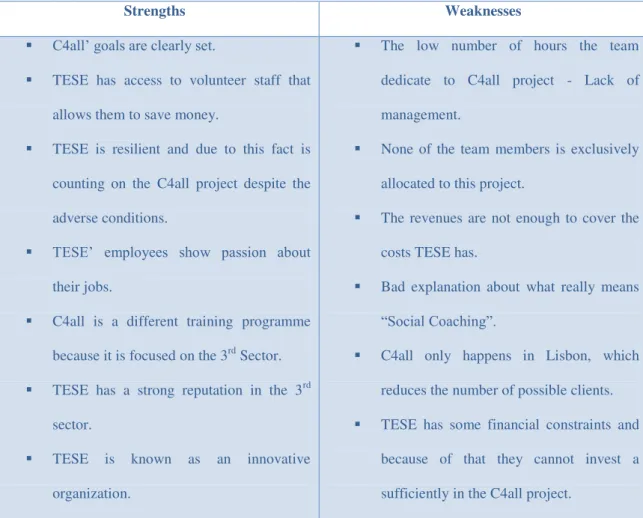
Table 1: Strengths and Weaknesses Presentation
Strengths Weaknesses
C4all’ goals are clearly set.
TESE has access to volunteer staff that
allows them to save money.
TESE is resilient and due to this fact is
counting on the C4all project despite the
adverse conditions.
TESE’ employees show passion about
their jobs.
C4all is a different training programme
because it is focused on the 3rd Sector.
TESE has a strong reputation in the 3rd
sector.
TESE is known as an innovative
organization.
The low number of hours the team
dedicate to C4all project - Lack of
management.
None of the team members is exclusively
allocated to this project.
The revenues are not enough to cover the
costs TESE has.
Bad explanation about what really means
“Social Coaching”.
C4all only happens in Lisbon, which
reduces the number of possible clients.
TESE has some financial constraints and
because of that they cannot invest a
9
C4all events take place in a luxury hotel.
The price charged is competitive.
Poor acceptance by the public. Until now,
two C4all training events were cancelled.
TESE is not a certificated body and
doesn’t have accreditation to give
“training”.
Poor Performance Appraisal System.
Therefore, in this table it is possible to verify that, at the present moment, TESE has
several strengths and also weaknesses that influence a lot C4all performance. One of the
biggest weaknesses is the number of hours the team dedicate to C4all’s project, item
discussed in the Main Suggestions. According to the afore-mentioned criteria we will
analyze the financial situation of TESE further and now we will examine in more detail
the last two weaknesses pointed to in the table, regarding the Performance Appraisal
System and the Terminology Used.
Performance Appraisal System: C4all’s Coordinator decided, in the first C4all event, in April/May 2012, to implement a performance appraisal system aiming to know
what participants thought about the sessions, the trainers and what kind of things they
think should be improved. Therefore, in three events evaluated by the participants, I
only had access to the results of the 1st one. Taking this into account, the results of this event were very good, because on a scale from 1 to 5, the mean was 4,54 points.
However, some members of the group received grades like 2 and 3 in areas such as
“subject knowledge” and “creativity of the activities and handouts”. The Coordinator
said that these grades are due to the fact that the subjects that these trainers taught were
“less interesting” and “more theoretical”. Therefore, only the Coordinator had access to
the grades that the participants gave. The other three team members had access to a
presentation containing the participants’ comments and graphs with the “mean of the
10 could say that this option is wrong because, of course, this decision avoids several
internal conflicts. However, is this the best decision? Why cannot collaborators have
access to the results of their performance appraisal? And would the fact that they have
access to their individual results not allow them to improve their performance? These
are all questions that should be taken into account by the team leader. Therefore, this
item will be explored in more detail in the Main Suggestions.
Terminology used: The question, regarding this item, is the following: Can C4all
be considered a training programme? The answer to this question involves a serious
research about “training concept”. So, after an analysis of this theme, I concluded that
C4all training shouldn’t be presented to the companies as a “training” programme
because (1) it does not offer credits to the participants, (2) it can lead to a serious
misunderstanding, because it can make a company think that C4all could be included in
the “Annual Company Training Program”. In Portugal, according to the Portuguese
Labour Code, it is mandatory for each worker to receive 35 hours per year of training
(Article nº 131, second point). So, because TESE is not an entity certified by DGERT
(General Direction for Employment and Labour Relations), the training given by them
is not considered valid for this purpose, information omitted when TESE advertise
C4all. Therefore in my opinion TESE should consider a change of terminology used
from “training programme” to “workshop”.
4. Industry and Competition Analysis
Portuguese Third Sector
According to Quintão, C. (2011:15), the third sector is composed of 17000
Associations, of which 5500 are Sports Associations, 3300 are Cltural Associations and
the rest is divided into Volunteers Firefighters Associations and Non-profit
11 of Social Solidarity; 350 Foundations and 3150 Cooperatives.7 Accordingly, the graphs in Appendix 2, taken from an article named “Portugal’s Nonprofit sector in a Comparative Context” written by Salamon, L. et al (2012), can better illustrate this
sector. It is important to notice that as this publication dates from 2012, most of the data
are from 2006.
So, in graph 1, Appendix 1, we were able to see that the “Nonprofit institutions
(NPI) sector’s workforce of 185,00 workers represents 4,3% of Portugal’s total
employment. This turns out to be the eighth largest workforce in the country when compared to all Portuguese industries – larger than the agriculture (2,3%), financial services (2,0%), and publishing and broadcasting (1,5%) industries”8.
The second graph, Appendix 1, represents the average employee compensation in
the NPI and the other sectors. Therefore, we can verify the workers from NPI are the
ones who receive least in the Portuguese market (14,709€), staying below the
Portuguese average (18,679€). According to Salamon, L. et al (2012), “these difference
in employee compensation do not indicate that nonprofit workers are less valuable (…), but rather that they tend to serve people who cannot afford to pay higher prices for the
services they receive. (…) compensation can be interpreted as a form of charitable
contribution (…)”. This is one of the possible points of view justifing why people
choose to work for one sector that pays less than others.
Competition
In Portugal, TESE is providing a distinctive training programme directed to 3rd sector workers. Therefore it is important to carry out a competitor analysis, to be able to
understand how these competitors influence C4all’s results. Hence, in Appendix 2, it is
7
http://isociologia.pt/App_Files/Documents/is-wp-ns-002_110411025242.pdf 8
12
possible to find a table where TESE’s main competitors are described taking into
account their positioning, the price charged, the description and goals of the training
provided. So, TESE’s main competitors are entities providing courses to develop
professional coaches. Although, TESE is not a certified company, TESE’s Coordinator
told me that they intend to apply for certification in the near future in order to be able to
also train professional coaches. Concerning the positioning of TESE and their
competitors, TESE’s positioning is the following: “We are an organization of reference
in the 3rd sector in Portugal and in developing countries. We add real value, being
present from the identification of new needs to the implementation of innovative
responses. We learn with experience and renewing the cycle. We are present in major
network platforms of sharing experience and knowledge, nationally and
internationally.”9
Therefore, in the Coaching Market, TESE is the only entity from the
3rd sector providing this kind of training, and being an organization of reference in the sector it is a gain for the organization. However, TESE’s competitors have more
experience regarding coaching training events and are entities of reference in the
Coaching Market.
Regarding the price charged by TESE, this is influenced by the fact that TESE
doesn’t have certification to train professional coaches, which leads to the fact that
TESE is the company that charges the lowest price respecting the Coaching Market.
Hence, if TESE gets the certification, the company would achieve more credibility in
the market and this will lead to a potential adjustment and increase in their price, never
forgetting that C4all is directed to people with low income. Comparing the prices
charged for a coaching training session, the prices could vary from 369€ (C4all’s price)
and 1300€ per module to become a professional coach.
9
13 Summing up, C4all is a different and distinctive coaching training, more directed to
a specific and small target which leads to the situation where TESE loses clients,
because the C4all’ participants should have some specific characteristics, such as, some
knowledge about the 3rd sector.
Opportunities and Threats Analysis
At this moment, it is very important to define the opportunities and threats TESE
has to face, respectively, to understand what should be the next decisions that should be
taken. In the following table it is possible to see the main opportunities and threats
TESE is facing at this precise moment.
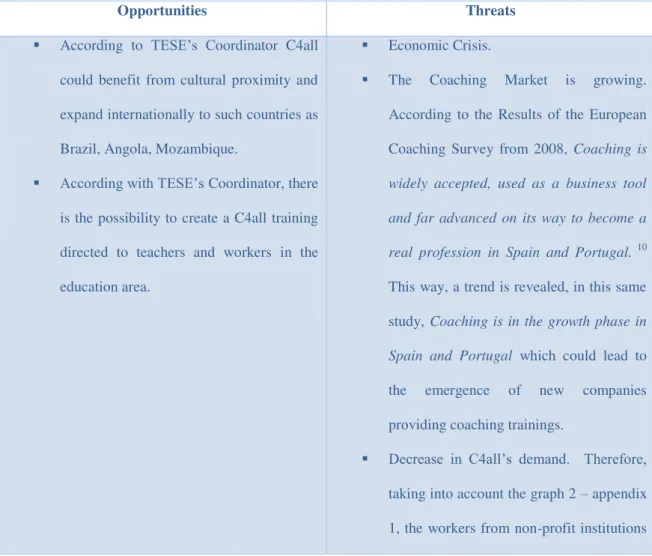
Table 2: Opportunities and Threats Presentation
Opportunities Threats
According to TESE’s Coordinator C4all
could benefit from cultural proximity and
expand internationally to such countries as
Brazil, Angola, Mozambique.
According with TESE’s Coordinator, there
is the possibility to create a C4all training
directed to teachers and workers in the
education area.
Economic Crisis.
The Coaching Market is growing.
According to the Results of the European
Coaching Survey from 2008, Coaching is
widely accepted, used as a business tool
and far advanced on its way to become a
real profession in Spain and Portugal. 10
This way, a trend is revealed, in this same
study, Coaching is in the growth phase in
Spain and Portugal which could lead to
the emergence of new companies
providing coaching trainings.
Decrease in C4all’s demand. Therefore,
taking into account the graph 2 – appendix
1, the workers from non-profit institutions
10
14
are the ones that have the lower salaries.
Hence, and because C4all is directed to
these specific workers, and due to the fact
that Portugal is facing an Economic Crisis,
this can lead to a decrease in the demand
for training coaches.
Trivialization of the Coaching concept.
Therefore, the biggest opportunities TESE has, at this moment, are relative to the
conditions in which C4all is provided to customers, in terms of physical conditions and
pricing and, according to TESE’s coordinator, the possibility to take C4all training to
emerging countries, where the Portuguese Language is spoken.
Concerning the threats, at this moment, TESE face four big ones, such as, the
Portuguese economic crisis; the trivialization of the concept of coaching; the decrease in
C4all demand; and the fact that Coaching Market is growing. So, nowadays people are
facing expenditure constraints due to the crisis Portugal is facing, and because C4all is
directed to workers from the 3rd sector, who receive less than people working in other
sectors, this could be TESE’s biggest threat.
5. Team Analysis
C4all was formed by four individuals in 2012, all of them professional coaches
certificated by the International School of Professional Coaching (ISPC). All of these
team members have experience of at least three years in the 3rd sector. On the other hand, the four C4all team elements work in parallel in others TESE projects, so they
only dedicate a few hours to C4all project. So, at this moment the team is composed of:
- Teresa Roque is a social worker specialising in community intervention and training
consultant. She has two undergraduate degrees, one in Theatre and the other in Applied
15 in the third sector, since 2001. Nowadays, she works as an advisor and consultant in
several organizations and is also an actress.
- Ana Almeida is a social worker with expertise in community intervention in the
Orienta.te project. She holds a bachelor degree in Psychology and is currently studying for a post-graduate qualification in Social Work. Ana has experience in intervention
with young people and families in the clinical and community context.
- Sara Almeida has worked for TESE since 2007, as the Project Coordinator of
Orienta.Te São Domingos de Rana. She has first degree in sociology and a post graduate degree in Economics and Public Policy. Sara has extensive experience working
with young people living in vulnerable areas.
- Ricardo Rodrigues has been a trainee at TESE since July 2010. He has an under
graduate degree in Clinical Psychology and a post graduate degree in Psychology of
Sport and Physical Activity. Regarding Ricardo’s professional experience, he did an
internship in Monsanto Prison, has worked in Group Intervention and rehabilitation
Airborne and at Clube Atlético de Queluz.
6. Target Customers and C4a
ll’s Offer Analyses
Target Customers and Market Segmentation
Segmentation is done throw the analysis of four specific points that help in the
identification of possible consumers. So, the criteria used are: geographic, demographic,
psychographic, behavioural.
Geographic: C4all is a training programme exclusively provided in Portugal, more
specifically in Lisbon. So, C4all training is more directed to people living in Lisbon or
the surrounding area.
16
TESE named “Social Coaching” could be more attractive to people, already working in
the social sector, which reduces significantly the number of possible participants.
Psychographic: The people attending this training are passionate about social
missions and work with a vulnerable population, with whom they will apply the
knowledge they get in C4all training.
Behavioural: C4all should be seen as a way to improve and acquire new knowledge about coaching tools and their application in real life. This project is more
oriented towards practitioners dealing with disadvantaged populations. So, according to
TESE11 citing the conclusions obtained in the Final Study of the Global Coaching Client by International Coach Federation, based on a survey of 2165 coaching clients from 64
countries, coaching is a powerful weapon, because it increases confidence and
self-esteem and increases the participant’s work performance.
Target
According to TESE, C4all’s main target is composed of social intervention
practitioners who want to use this tool among their audiences; practitioners acting in the
employability promotion area and vocational integration with youth and adults; coaches
wishing to apply coaching tools in a social context; community leaders who want to be
agents of positive change in their communities; all people interested in initiating a
process of personal development through coaching; and finally organizations acting in
social contexts, dealing with vulnerable populations and with youth or adults seeking a
job.12
11
http://www.tese.org.pt/images/stories/clipping/pdf/c4all_apresentacaopublicoemgeral.pdf 12
17
Four P’s
C4all’ Offers (Product): C4all is composed of 2 full weekends, 7,5 hours per day,
making a total of 30 hours in class plus 30 hours of self-reflection and 2 sessions of 1
hour of individual coaching. The training is performed by 4 professional coaches. The
content of this training is extensive and includes themes, such as, (1) The Importance of
Personal and Social Development; (2) Self-knowledge; (3) Vision, Mission and
Personal Values; (4) Steps to Excellence; (5) Origin and evolution of coaching and its
application in different contexts; (6) Self-Coaching; (7) The role of the coach and the
coachee; (8) Coaching in Social Intervention; (9) Simulation of coaching individual
sessions; (10) 2 Individual sessions of coaching with a professional coach.
Price: Regarding the price charged by TESE, this was achieved after the
application of a survey to 34 social workers where they were questioned about the
maximum amount they were willing to pay for a coaching training event. Therefore,
after knowing the answers, TESE calculated the mean and this revealed a number
around 283€. The team decided that the price should be 300€ plus taxes.
Promotion: So, before launching C4all, TESE and Buran Design Studio, in a
partnership, decided to construct a flyer. However, the result was not the expected one
and TESE decided never to use it. The explanation was the fact that the final result
didn’t please the team, because of the colors and information included. This way,
nowadays, when a session is close, the promotion of it is done on TESE’s Facebook,
TESE’s official site and recently C4all’s team created a specific Facebook Page for the
training, where attendants can share opinions and where the training events are
promoted.
18
excellent facilities. TESE didn’t pay anything for the space because it was offered by
the hotel. In 2013, according to C4all’s coordinator, the partnership with this hotel
would end, and TESE could be forced to rent a room in a cheaper hotel.
7. Operation and Financial Analysis
Operations Plan
C4all was the chosen project to be launched by TESE in 2012. However, the team
also came up with three other possible projects, such as:
-Coaches’ Bank, consisting of an online platform where certified coaches could enrol,
and be ready to perform coaching sessions charging “social prices”, well below the
market. At that time, the team understood this idea would be unfeasible, and it was
ruled out.
-Social Coaching Training, implying a coaching training programme applied to the
social context. The target of this training would be 3rd sector workers; community leaders and the general public. The methodology used would be practical, theoretical
and experimental.
-Professional Coaching Certification which would consist of a partnership between
TESE and ISPC. The idea would be to develop professional coaches. To do this, TESE
would need ISPC as a partner to give the professional certificates due to the fact TESE
is not a certified entity.
Therefore, after some analysis, they realised the only feasible project was the Social
Coaching Training. The first idea was to have this workshop once a month, however
early on TESE understood that it would not be so easy.
C4all Current Situation
The first session of C4all was booked for the beginning of 2012, more concretely at
19 excluding the summer months (July and August). Therefore, before the first event, the
team carried out a list of important activities, such as the application of a survey to 34
practitioners from the 3rd sector; followed by the analysis of the results, and based on that they decided what would be the price charged. After this, the team started the
preparation of the workshop’s content: the activities; the manual about coaching the
team decided to construct; the power-point presentations and the collection of phone
numbers and e-mails from organizations operating in the 3rd Sector. With these phone numbers, the team established a first contact with the organizations, sending them an
e-mail with C4all’s description, as a way to disseminate information. One week later, they
call again to the institutions to do the follow-up of the first call and e-mail. This activity
is always conducted before a C4all session is carry out.
Concerning the activities undertaken during the sessions, these include activities
like power-point presentations about: the evolution of coaching; coaches’ attitudes; the
role of the coach and the coachee; coaches’ competencies; and role-plays. Therefore, the
training is mainly divided into two main parts, such as, the theoretical part and group
dynamics. On the last day of training, the coordinator’s team applied a survey aiming to
collect feedback from the participants about the sessions and the coaches.
In respect to the activities carried out after the training, these include the two
individual coaching sessions and the individual home-work correction. Finally, although
TESE is not a certified entity, C4all participants receive a “certificate”, usually sent by
post.
Financial Plan
According to TESE’s information, C4all had, until this moment, six planned events.
The first was in April, and for personal reasons it was cancelled after the first weekend,
20 event did not take place, it is not included in Table 3 – C4all’s Costs. In the second
event, in May, five participants came from the first session, and five were new
participants, making a total of ten attendants. In this event, six participants paid the
enrolment fee. In the next month (June), another event was planned, four people were
enrolled and three employees from TESE were invited, however, this session was
cancelled due to the fact the team considered the number of participants too low. The
fourth event planned would happen in September however C4all didn’t have enough
registrations and the session was cancelled. Regarding the fifth session, in October, it
comprised four guests and three paying participants. Finally, in November, C4all had 2
participants paying and 5 guests and the team decided to carry out the session. In the
next tables, we can visualize the current situation of C4all training until this moment,
where it had 24 attendants, of whom 13 were guests and 11 participants paying for the
training.
Table 3:C4all’ Costs (2012)
Costs from May, October and November Editions
Number of Participants Paying 11
Number of Guests 13
Team Wages
Coordinator 1.200,00 € Member 1 618,00 € Member 2 276,00 € Member 3 276,00 €
Training's Preparation (100€ per day, 2 days per session) 600,00 €
Work after the Training
Home-works Correction and 2 Individual Coaching Sessions13 420,75 €
Construction of the C4all “certificates”; designing of the evaluation report14 450,00 €
IT Materials (1st session) 53,30 €
Coffee Break (4€ per person, and per session) 288,00 €
Room Rent - €
Structural Costs 450,00 €
Total Costs 4.632,05 €
Table 4:C4all’ Revenue (2012) Revenue
Prompt Payment (300€) Phased Payment (330€) Total Revenue
13
Three hours per participant paying the training, 12,75€ per hour. 14
21
April/May Edition 5 1.500,00 € 1 330,00 € 1.830,00 € June and
September Edition
0 - € 0 - € - €
October Edition 1 300,00 € 2 660,00 € 960,00 € November Edition 2 600,00 € 0 - € 600,00 €
Total 8 2.400,00 € 3 990,00 € 3.390,00 €
Therefore, until this moment TESE, with three performed sessions, had a deficit of
1242,05 €.
Assumptions
Regarding the assumptions, the following scenarios will be produced taking into
account the monthly editions planned for 2013, and the information provided by C4all’s
Coordinator. Therefore, the first assumption is concerning the type of payment the
participant chose. The participants choosing the prompt payment option will receive a
discount of 30€, and people choosing the phased payment will have to pay another 30€.
The phased payment has the following rule, 40% of the price before the training and
60% after. In all the scenarios, the probability of choosing one instead of the other is the
same. The second assumption implies that during the first years of C4all, TESE should
not have guests attending the C4all sessions, because these people represent a cost
without a revenue associated. The third assumption is concerning the fact that in 2013,
for which all the scenarios are designed, the partnership with Tiara Park Atlantic Lisboa
ends, and due to this fact, TESE would start paying a room rent in a cheaper hotel, such
as Hotel Fenix Urban that charges 100€ per day15. So, I constructed three different scenarios: (1) the best scenario, representing the maximum capacity, pointed out by the
coordinator’s training - 15 participants; (2) the worst scenario, with 0 participants and
(3) the break-even point that is the point where the difference between the revenue and
the costs are equal to zero.
15
22
Best Scenario
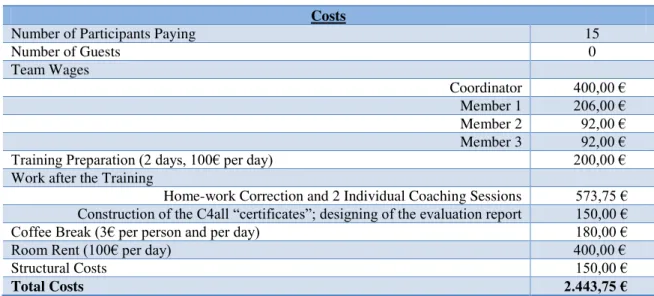
In this scenario, I will assume that 15 participants are enrolled in a C4all event. In
this case, the total amount of costs, including the variable16 and fixed17costs, is 2444€. On the other hand, with fifteen enrolments, the revenue would be a value between
4500€ and 4950€. In this situation, TESE would be able to cover their costs and have a
maximum profit of 2506€ and minimum of 2056€, in one single session. It’s important
to notice that some of the costs would be different in 2013 compared to 2012, like the
room rent and the cost with the coffee break per person, that previously was 4€ per
person per session (4days) and now, based on the information that was provided to me,
would be 3€ per person per day.
Table 5: Costs - Best Scenario Costs
Number of Participants Paying 15
Number of Guests 0
Team Wages
Coordinator 400,00 € Member 1 206,00 € Member 2 92,00 € Member 3 92,00 €
Training Preparation (2 days, 100€ per day) 200,00 €
Work after the Training
Home-work Correction and 2 Individual Coaching Sessions 573,75 €
Construction of the C4all “certificates”; designing of the evaluation report 150,00 €
Coffee Break (3€ per person and per day) 180,00 €
Room Rent (100€ per day) 400,00 €
Structural Costs 150,00 €
Total Costs 2.443,75 €
Table 6: Revenue - Best Scenario Revenue
Prompt Payment (300€) Phased Payment
(330€) Total Revenue
Session with 15 participants 0 - € 15 4.950,00 € 4.950,00 € Session with 15 participants 7 2.100,00 € 8 2.640,00 € 4.740,00 € Session with 15 participants 8 2.400,00 € 7 2.310,00 € 4.710,00 € Session with 15 participants 15 4.500,00 € 0 - € 4.500,00 €
16
Costs with the Coffee-Break and with the Work After the Training: Home-Work Correction and 2 Individual Coaching Sessions. 17
23 The best scenario possible implies that the fifteen participants opt for the phased
payment, instead of the prompt payment.
Worst Scenario
In this second scenario, C4all training didn’t receive any registrations. Therefore,
the team would cancel the session. So, according with C4all’s Coordinator, the coaches’
wages are only paid if the event is carry out and don’t vary taking into account the
number of participants. Then in this specific scenario, the team members will not
receive anything. However, TESE will incur some specific costs, such as, (1) Training
preparation costs, which as mentioned previously, are 100€ per day, 2 days per session;
and (2) Structural costs – including communication and accountability costs – of 150€
per session planned. So, in this specific scenario the revenue would be equal to zero and
the costs equal to 350€. TESE loses money every time a C4all training is cancelled.
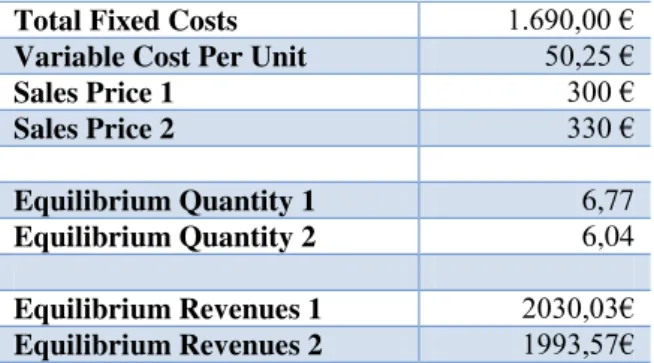
Break-Even Point
In this scenario, the goal is to equalize the costs and the revenue aiming to present
the scenario where TESE would break even. This way, aiming to get the number of
participants that makes the revenue equal to the costs, it is important to calculate the: (1)
Total Fixed Costs, which includes all the costs previously presented excepting the costs
of the Coffee-Breaks and the costs of the Work After the Training: Home-Work
Correction and 2 Individual Coaching Sessions; (2) the Variable Costs per Unit18 including the costs of the Coffee-Break and of the Work After the Training:
Home-Work Correction and 2 Individual Coaching Sessions. Finally, to prove that the
break-even point calculated makes the difference between the rbreak-evenue and the costs equal to
zero, two income statements were created.
18
24
Table 7: Break-Even Calculations – The Equilibrium Quantity and Revenue
Table 8: Break-Even Calculations –Income Statement using the Sales Price of 300€
Table 9: Break-Even Calculations –Income Statement using the Sales Price of 330€
So, the number of participants which satisfies the Break-Even condition is a value
between 6 and 7, depending on the method of payment participants choose.
8. Business Model
The Business Model presented below was constructed taking into account the
information provided by C4all’s Coordinator in 2012. For 2013 some changes could
occur like the end of the partnerships and the creation of new ones.
Table 10– Business Model
Total Fixed Costs 1.690,00 €
Variable Cost Per Unit 50,25 €
Sales Price 1 300 €
Sales Price 2 330 €
Equilibrium Quantity 1 6,77
Equilibrium Quantity 2 6,04
Equilibrium Revenues 1 2030,03€
Equilibrium Revenues 2 1993,57€
Income Statement 1
Equilibrium Revenues 2030,03€
Total Fixed Costs 1690,00€
Total Variable Costs 340,03€
Final Result - €
Income Statement 2
Equilibrium Revenues 1993,57€
Total Fixed Costs 1690,00€
Total Variable Costs 303,57€
Final Result - €
Infrastructure TESE Customers
Partners
- Tiara Park Atlantic Lisboa Hotel.
- Buran Design Studio.
Key Processes
- Application of Surveys aiming to establish the price;
-Preparation of the Training ( 2 days per edition);
- Contact the possible participants;
“C4all is a training programme aiming to disseminate
Coaching’s methodology as an intervention tool among vulnerable populations and contexts, democratizing access
Segments
- People living near Lisbon. -3rd sector workers.
- People wanting to know more about coaching techniques. - People who want to improve and acquire new knowledge about coaching tools and their applications in the 3rd Sector.
Channels
25
9. Main Suggestions
After an intensive analysis of the C4all project which contrary to what TESE
thought didn’t support any other project, and in fact represented one more cost for them,
I was able to conclude that they should implement some changes and re-think some of
their previous decisions. The following points represent their main problems and my
suggestions concerning each point.
1.C4all’ Guests: In the first session, C4all had 6 participants, and the majority
of them didn’t pay the enrolment fee because they were TESE’s guests. As mentioned
before, these guests are usually TESE workers, who are invited with the intention of
finding more about C4all project and also to have some contact with the coaching
methodology. This situation happened in the majority of the events planned, and the
question is: Should TESE accept so many guests taking into account that the number of
participants paying is low? Therefore, TESE should re-consider this situation, because
guests represent a cost, without a return. For example, in terms of costs related to
coffee-breaks, if TESE hadn’t accepted guests in 2012, it could have saved a total of
156€ on the three sessions carried out. In my opinion, in these first two or three years
and taking into account TESE wanted C4all to grow, they should not accept guests on
C4all events.
-Carry out the Training; - Work after the training (Home-work correction and Individual Coaching sessions).
Capabilities
- All the trainers are professional coaches.
to this effective tool.” -TESE and C4all Facebook; -TESE Official Site; - Telephone; - Meetings.
Finance
26
2. Target: In my opinion, TESE should revise the C4all target, previously defined, because the association is not considering some characteristics that their targets have.
For example, the odds of a person living far from Lisbon participating in C4all sessions
are reduced. One of the reasons supporting this idea is the fact of C4all events being
composed of two full weekends, which means that this kind of participants will incur
extra costs19. Besides that, nowadays, people are facing a great economic change, which will lead to expenditure restraint. Taking this into account and the fact that people
working in the 3rd sector have lower wages compared to the other sector, in my
opinion, TESE should consider the creation of another C4all training programme more
directed to people working in the public sector. According to TESE’s Coordinator, this
suggestion is viable taking into account the increased importance this sector is giving to
the corporate social responsibility.
3. Performance Appraisal System: Regarding this item, in a very sensible
decision, C4all’s Coordinator decided to implement a performance appraisal system.
The problems in this item are the fact that this performance appraisal system is only
using one source – the participants’ opinion – and the way in which the results were
presented to the other team members. Therefore, the conclusions that the coordinator
could infer only from the participants’ opinion are poor. So, what TESE should do is to
implement a peer and self-evaluation system to complement what they already have. On
the other hand, the results should be shown, and discussed between all the coaches. So,
according to Caetano, A. (2008:62), as a way to present the results, all the team
members should receive a sheet containing their own evaluation, and the evaluations
made by the clients and by their peers, in aggregate form, using the grades attributed, in
order to arrive at a mean number per trainer. Besides this, the questionnaire applied to
19
27 the participants has a particularity, because it asks for the participants’ name, making no
reference to whether it is optional or not. In my opinion, and taking into consideration
that the team want real results, impartial ones, the sheet should not ask for any kind of
identification.
4. Team Work: The team in charge of the C4all project is composed of four
employees. Taking this into account, it is important to mention that none of these
employees work exclusively on this project, in other words, the four team members are
also allocated to other TESE’ projects on which they spend more working time. So,
according to TESE’s Coordinator instead of hiring another employee to be one hundred
per cent committed to the project, the best option is to allocate the existing human
resources to the Project. Citing TESE’s coordinator, this option is viable and easy to
implement.
5. Marketing: The Marketing campaigns involving C4all are poor. In the
beginning TESE had a partnership with Buran Design Company, and this institution
designed a flyer that never was used. Besides that, C4all sessions were also promoted
on TESE’s Facebook, TESE’s official site and C4all Facebook, only created after the
fifth session planned (October). So, taking into account the results achieved until now
it’s clear that this is not enough to spread information. Moreover, TESE has a data base
with some names and contacts of institutions that might be interested in this training.
So, as mentioned previously, the idea is to call these institutions aiming to get more
participants. Until now, from a list of 50 contacts, only 4 booked a meeting and none of
them agreed to participate. In my opinion, TESE should invest in word-of-mouth
publicity which could be more efficient in this case. To solve or minimize this problem,
the team created a Facebook Page, which represents, nowadays, one of the best channels
28
attract more people, because people could be invited to “Like” the page. However, it is
important to mention that with the creation of a Facebook Page, C4all could also receive
bad opinions, which is a risk that should be considered and, in my opinion, taken.
6. Economic Situation: Portugal is passing through a very difficult crisis that affects almost all the people. Therefore, when I had the possibility to establish phone
contacts with the foundations and associations that could be interested in participating
in C4all training, many of them referred to the economic constraints they have at this
moment. Nowadays, they don’t have money to invest in this type of training and some
said that this training doesn’t represent a priority for them at this moment. Therefore,
TESE should take into consideration that this might not be the moment to launch C4all
training in the Portuguese market.
7. Price Charged: The price charged should be based on several criteria, such as,
the price charged by other companies providing coaching trainings; the target’s opinion;
the duration of the training and some other characteristics. Therefore, a comparison with
the market is highly recommended. So, regarding C4all, TESE established the price
only taking into account the results from a first survey applied to practitioners from the
3rd Portuguese Sector. Therefore, I conclude that this is not enough. On the other hand, after understanding how the price was defined, an incongruence emerged – the survey
was applied before C4all was launched, so the respondents didn’t know many aspects of
the project, such as, the content, the coaches and the duration. This fact influenced the
answers TESE received. Hence, to solve this question, TESE should re-survey the
people that attended the previous events, using a similar questionnaire, and ask them
about the price they think is fair bearing in mind all the C4all aspects they already
29
8. Coaching for all training: After attending one of C4all’s training sessions, I had a more concrete opinion concerning some aspects involving this training. So, as I have
already mentioned C4all is composed of two full weekends from 9:30am to 6:30pm
with one hour and a half for lunch. In my opinion, this schedule is extremely hard for
the participants, because they will lose two full weekends which, from my point of
view, can lead to a simple situation: people go to the first weekend, and if they opt for
the phased payment, don’t go to the second and don’t pay the second payment portion
(60% of the price). This is a situation to think about, because the team could change the
program’s organization and opt for another structure, more convenient for the
participants, and that minimizes this kind of problem. So, one of the possible solutions
is to charge the greater amount of the price first, inverting the current situation, 60% of
the price before the training and 40% after.
10. Conclusion
I had the opportunity to do an internship in TESE-Associação para o
Desenvolvimento, aiming to design a Business Plan for the only profitable project this
association have – Coaching for all. So, I had the chance to talk with C4all’s
coordinator, to meet with TESE’s Coordinator, attend one of the C4all’ training events,
and look critically at the decisions that have been taken so far.
Therefore, after analysing the whole Business Plan, it seems obvious that TESE
should implement some changes to C4all “Training” aiming to improve its performance
and it results. Moreover, in my opinion, 2013 would be the year when a major question
would be answered – “Will C4all be able to break-even in 2013?”. So, taking into
account the future results, TESE could decide if C4all should continue in existence or if
30 In conclusion, in my opinion it is prudent to say that C4all could be a successful
project for TESE if some changes were implemented, or on the other hand, it may be a
failure if TESE continue ignoring the fact that C4all has been created to support
financially other TESE projects. It is a shock when in the Financial Analysis, we can
observe that the number of guests attending the “training” is superior to the number of
participants paying. The situation as it is now is not sustainable much longer.
11. Bibliography
Books and Publications− Salamon, Lester; Sokolowsky, S. W.; Haddock, Megan; and Tice, Helen S.
2012. Portugal’s Nonprofit Sector in Comparative Context. Jonh Hopkins
Center for Civil Society Studies in cooperation with Portugal’s Instituto
Nacional de Estatistica.
− Quintão, Carlota. 2011. O Terceiro Sector e a sua renovação em Portugal. IS
Working Papers, 2nd Serie, 15. Available from:
http://isociologia.pt/publicacoes_workingpapers.aspx, consulted in September,
11th 2012.
− Caetano, António. 2008. Avaliação de Desempenho – O Essencial que os
avaliadores e avaliados precisam de saber. Lisboa: Livros Horizonte, LDA.
− Bygrave, William; Zacharakis, Andrew; (2008). Entrepreneurship. United States
of America: Jonh Wiley & Sons, Inc.
− Segers, Jesse; Inceoglu, Ilke. 2012. Exploring supportive and Developmental
Career Management Through Business Strategies and Coaching. Human Resources Management, January-February 2012, Vol. 51, No. 1. Pp. 99-120.
− Brandsen, Taco; Van de Donk, Wim; Putters, Kim. 2005. Griffins and
31
Third Sector. Routledge: Taylor & Francis Inc., Intl Journal of Public Administration, 28: 749-765.
− Segers, Jesse; Vloeberghs, Daniel; Henderickx, Erik; Inceoglu, Ilke. 2011.
Structuring and Understanding the Coaching Industry: The Coaching Cube. Academy of Management Learning & Education, 2011, Vol. 10, No. 2, 204-221.
− Results of the European Coaching Survey2007/2008. 2008. Germany: Frank
Bresser Consulting Report. Available in:
http://www.coachfederation.org/includes/docs/065-europeancoachingsurvey2008.pdf, consulted in January, 4th 2013.
Other Sources
−
http://isociologia.pt/App_Files/Documents/is-wp-ns-002_110411025242.pdf,consulted in September 11th, 2012.
− http://www.tese.org.pt/, consulted in July 4th 2012.
− http://www.ispcoaching.com/en/go/overview, consulted in September 24th 2012.
− https://www.escoladecoaching.com/index.php?option=com_content&view=artic
le&id=62&Itemid=235, consulted in September 24th September 2012.
−
http://www.erickson-college-portugal.com/, consulted in September 24th September 2012.32
12. Appendixes
Appendix 1
–
Graphs characterizing the Portuguese Third Sector
Graph 1– Share of Total Employment, NPIs vs. Selected Industries, Portugal, 2006
33 Name of the
Organization
(competitors)
Positioning Year Number
of
Coaches
Where is
the
training
Target Number of
hours
Price Description of the product Main Objectives
ISPC - International
School of
Professional Coachi
ng–Private Sector
The ISPC (International School of Professional Coaching) is aligned to a form of Coaching that honours the Client (Coachee) as an expert in his life and work and believes that every
Coachee is creative, resourceful and
constitutes a whole.
2007 2 Lisbon and Porto Trainers; Entrepreneurs; Managers; Consultants; Team Leaders; Teachers. 61 (28+3+30) Weekends Coaching I: 680€ Coaching II: 1280€
This school offers several types of coaching programs: Coaching I, Coaching II, Coaching III, Coaching for Leaders, Customized Coaching, Coaching – Ethic Code.
This school trains professional coaches.
-Understand the importance of a vision which is very well constructed and shared;
-Developed a self knowledge, and the process of self-knowledge; -Control the main Coaching techniques.
Escola de Coaching
ECIT – Private
Sector The Expertise Coaching International Training (ECIT) - COACHING SCHOOL follows the standards and code of ethics of the
2006 1 Lisbon, Porto and
Algarve
General Public 60 minutes each individual session Or 61,50€/ each individual session
Or 1080€ +
TAXES (total program to
became a professional
coach).
The individual sessions could be face-to-face or online. These sessions aim to help people to improve their social behaviour and to achieve their personal goals. On the other hand, the school offers a full course, constituted by 4 phases, to become a professional coach.
-Develop awareness of their actual capabilities and believe in them; -Expand the capacity to accept and appreciate; -Accept the natural ability to remodel undesirable beliefs and attitudes; -Achieving greater self confidence and security; -Draw clear goals in all areas of your life;
34
Certified Coaches Federation, which represents for Europe and Portuguese speaking countries.
-Integrate the ability to make appropriate choices greater balance and emotional maturation.
Erickson College
Portugal – Private
Sector
Erickson College has been a worldwide educational organization since 1980, providing professional training programs in coaching and human development across the globe. Erickso n is dedicated to expanding the key technologies of Coaching & Business Leadership. More than 20 years of experi ence
Lisbon Professionals Coaches, Leaders, Executives and other Professionals seeking their performance improvement. 16 days (four modules) Enrollment fee: 350€ Each module: 1250€ plus taxes
To receive the certificate of professional coach the school offers four modules. Participants paying in prompt payment will receive a discount of 10% in the price.
-Improve their performance.
-Develop their leadership skills.
-improve their ability to manage time, deepen their skills.