The Role of Empirical Research in the
Study of Complex Forms of Governance
in Agroindustrial Systems
1Guilherme Fowler A. Monteiro2, Maria Sylvia Macchione Saes3,
Silvia Morales de Queiroz Caleman4 e Décio Zylbersztajn5
Abstract: The growing complexity of supply chains poses new challenges for Agricultural Research Centers and statistical agencies. The aim of this perspective paper is to discuss the role of empirical research in understanding the complex forms of governance in agribusiness. The authors argue that there are three fundamental levels of analysis: (i) the basic structure of the market, (ii) the formal contractual arrangements that govern relations within the agroindustrial system and (iii) the transactional dimensions governed by non-contractual means. The case of the agrochemical industry in Brazil illustrates how traditional analyses that only address market structure are insufficient to fully explain the agricultural sector and its supply chain. The article concludes by suggesting some indicators which could be collected by statistical agencies to improve understanding of the complex relationships among agribusiness segments. In doing so, the paper seeks to minimize costs and to enable a better formulation of public and private policies.
Key-words: complex forms, empirical research, market structure, contracts, non-measurable attributes.
Resumo: A crescente complexidade das relações entre os agentes das cadeias produtivas coloca novos desafios para os centros de pesquisa e estatística do setor agrícola. O objetivo do presente artigo é discutir o papel da pesquisa empírica para o entendimento das formas complexas de governança no setor agroindustrial. Os autores argumentam que há três níveis fundamentais de análise: (i) a estrutura básica do mercado, (ii) o regime contratual formal que rege as relações dentro do sistema agroindustrial e (iii) as dimensões transacionais governadas por meios não contratuais. O caso da indústria de agroquímicos no Brasil
1 A draft version of this paper was presented at the International Meeting on Enhancing Data
for Complex Agricultural Establishments, jointly organized by the Farm Foundation, the USDA, Agriculture and Agri-Food Canada, and Statistics Canada. The meeting was held at Niagara-on--the-Lake, Canada, on June 2011. The authors acknowledge research support from Gabriela Jardim.
2 Professor, Insper Institute of Education and Research. E-mail: [email protected] 3 Associate Professor, University of São Paulo. E-mail: [email protected]
1. Introduction
Just like other industries, the agroindustrial sector is experiencing a period of rapid transformations which are not the result of an isolated factor occurring in a single point in time. The changes that today characterize the agroindustrial sector arise from adjustments that have accumulated over time, thereby creating a new productive and organizational reality. This reality is mainly expressed thought the development of complex relationships among the agents that operate in the various segments of the supply chains.
In the Brazilian case, researchers have witnessed a growing interdependence between the agricultural sector and the up- and downstream segments since the 1970s. The input sector, for instance, has taken on a key role in fostering technological advances in agriculture, substantially contributing to the spectacular increase in agricultural productivity in Brazil in the last decades. Perhaps more importantly, the relationship between the agricultural sector and the input segment has shifted over time from a strict market position (i.e., where price and quantity represent the basic coordination vectors) to a more complex position characterized by the establishment of contractual arrangements among the agents.
The emergence of contractual arrangements has also occurred in other countries. As an example, Kunkel et al. (2009) note that the incidence of contracts in the U.S. agrifood production reached 41% in 2005. According to the authors, contracts
encompassed 39% of the transactions in 2003, 36% in 2001, 28% in 1991, and 11% in 1969. In line with this trend, the issue of agricultural con-tracts has been broadly studied (MASTEN, 2000;
MENARD, 1996; MARTINEZ, 2002; MONDELLI and ZYLBERSZTAJN, 2008; BARJOLLE, 2001; JAMES et al., 2007; LOADER, 1996; SAUVÉE, 2002;
RAYNAUD and SAUVEE, 2004)6.
In empirical terms, the increasing use of contracts in agriculture brings more complexity to the study of the agribusiness sector. It happens because much of the relevant information is not revealed by the prices established in the market, but is embedded in the contractual clauses. As a result, researchers have to examine not only the basic market conditions, but also the contractual relationships between agents in the different sectors of agricultural production7.
6 Specifically in the case of Brazil, the use of contracts
as economic coordination devices has already been studied in the soybean production sector (LEME and ZYLBERSZTAJN, 2008), in the paper and cellulose segment (SOUZA et al., 2009; GUIMARÃES et al., 2011; SILVA et al., 2009), in aviculture (ZYLBERSZTAJN and NOGUEIRA, 2002), in tomato production (ZYLBERSZTAJN and NADALINI, 2007), in the seed industry (ZYLBERSZTAJN and LAZZARINI, 2005), in the biofuel sector (DALMONECH et al., 2010; PEIXOTO, 2008), in the tobacco sector (BEGNIS et al., 2007), in meat production (PINOTTI and PAULILLO, 2006; MIELE and WAQUIL, 2007; SILVA and SAES, 2007; BRUM and JANK, 2001), in the fruit sector (SAES, 2007; SAMPAIO, 2007; SOUZA FILHO et al., 2010), and in food franchising (SILVA and AZEVEDO, 2007). For a general assessment see Zylbersztajn (2005a).
7 It should be noted that here already lies a major challenge for Brazilian researchers. In the U.S., the agricultural census – and related research – has collected information on contracts since 1969, but in Brazil researchers lack a systematic database on the subject.
indicadores que poderiam ser coletados pelos centros de estatística como forma de aprimorar o entendimento das relações complexas entre os segmentos agroindustriais, minimizando custos e resultando em melhor elaboração de ações de políticas públicas e privadas.
Palavras-chaves: formas complexas, pesquisa empírica, estrutura de mercado, contratos, atributos não mensuráveis.
The present paper, however, points to a third level of analysis that has so far been ignored, suggesting an even greater challenge for researchers and statistical agencies. As noted by Zylbersztajn (2009), the systematic collection of data from contracts tends to be inherently limited, capturing only part of the incentives present in most institutional arrangements. If data based on contracts is used without considering the transactional dimensions governed by other means – or the relational and dynamic aspects of learning embedded in the contractual relationships –, the analytical results can lead to erroneous conclusions. In other words, empirical research into the agribusiness sector should consider three levels of analysis: (i) the basic structure of the market (price, quantity, etc.); (ii) the formal contractual arrangements that govern relations between agents; and (iii) the transactional dimensions governed by non--contractual means.
The objective of this perspective paper is to discuss the role of empirical research in understanding complex forms of governance in agribusiness. The paper is structured as follows: 1. Introduction, 2. Overview of the empirical studies in Brazil, 3. Analytical perspective, 4. Illustration, and 5. Concluding remarks.
2. Empirical studies in Brazil:
taking step
In order to characterize the current state of the Brazilian empirical research in agribusiness, the authors conducted an exploratory analysis of the quarterly issues of the Journal of Rural Economics and Sociology (Revista de Economia e Sociologia Rural8). Enjoying a high reputation in Brazil’s academic and business milieu, the journal represents an important database for scientific studies in the Brazilian agribusiness sector. Specifically, the authors made a deliberate effort to identify the source(s) of the data used in the papers published from 2005 to 2010, making a distinction between
8 www.revistasober.org
primary sources of information (i.e., information collected by the researcher herself through data gathering) and secondary sources of information (i.e., information provided by a statistical agency). As a general result, the authors identified that secondary sources for data are present in most studies. As table 1 shows, 66% of the studies are based on secondary data, 24% use primary data, and 9% use both forms of data collection. Table 1 also indicates a moderate growth in the use of primary data over time, from 20% in 2005 to 24% in 2009. In any event, the prevalence of the application of secondary data for the formulation of empirical studies is indisputable. Noting that Brazil does not have a systematic collection of data on agricultural contracts, one can conclude that most studies do not consider the contractual aspects of agribusiness despite the growing importance of this issue.
It is also interesting to examine the topics of the studies that use primary data, so that one can identify the alignment of the form of data collection with the research subject. Table 2 shows that from all research based on primary data, topics such as “technological aspects”, “socio--environmental aspects”, and “market structure” are the most representative. It appears therefore that even in studies where the empirical variables are related to the structure of the market, primary sources of data can play a major role. This finding is not without a degree of surprise, suggesting that in some cases even the basic market information is not readily available for Brazilian researchers.
Table 1. Form of data collection: Revista de Economia e Sociologia Rural.
Secondary Data Primary Data Both Total
No. of articles (%) No. of articles (%) No. of articles (%) No. of articles (%)
2005 28 80 7 20 0 0 35 100
2006 18 58 9 29 4 13 31 100
2007 26 67 8 21 5 13 39 100
2008 25 63 11 28 4 10 40 100
2009 24 63 9 24 5 13 38 100
2010* 6 67 3 33 0 0 9 100
Total 127 66 47 24 18 9 192 100
*Articles published in the first volume of 2010.
Source: Revista de Economia e Sociologia Rural(RESR), various years. Prepared by the authors.
Table 2. Number of articles using primary data: main themes.
Contractual aspects
Technological aspects
Physical (geographical) aspects
Socio-environmental aspects
Market structure
2005 1 3 1 4 1
2006 1 7 0 5 4
2007 2 5 0 4 7
2008 3 4 1 7 5
2009 2 5 0 4 4
2010 1 1 0 1 1
Total 10 25 2 25 22
Source: Source: Revista de Economia e Sociologia Rural(RESR), various years. Prepared by the authors.
3. An analytical framework
Most of the time, empirical studies in agribusiness involve the recognition of the relevant empirical variables which provide a better understanding of the interactions in the food chains. Before discussing the variables that support the empirical studies, however, it is necessary to identify the theoretical assumptions that underlie such studies.
Generally speaking, an implicit assumption exists that one cannot understand the current dynamics of agriculture without analyzing the relationships between the segments of the supply chains. That is, studies normally set a systemic perspective on agriculture which enables us to understand how the transactions between the different production sectors are coordinated (ZYLBERZSTAJN, 1996). The adoption of a systemic approach of agribusiness, in turn, requires knowledge of the organization and the internal dynamics of each agricultural segment,
in conjunction with knowledge of the business environment (i.e., organizational and institutional environments).
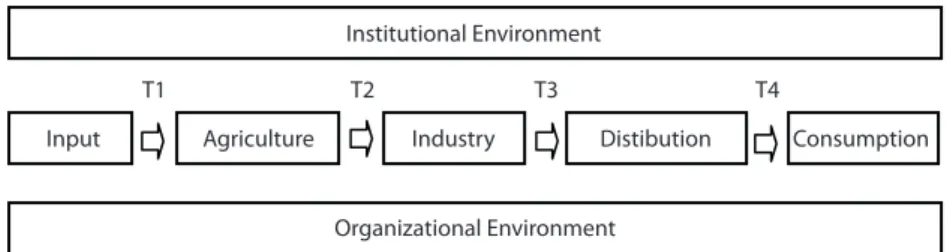
Especially in relation to the business environment, studies seek to understand the formulation of strategies in the face of restrictions imposed by the so-called “rules of the game” (NORTH, 1991, 2005). It is assumed that institutions determine the environment in which transactions occur, while providing the structure of incentives and controls that induce cooperation among agents. From this perspective, the business environment encompasses the formal rules – i.e., macroeconomic and commercial policies adopted by governments, trading partners and competitors –, as well as informal rules. The figure below illustrates the argument.
In line with the systemic approach, studies of agribusiness systems can focus on firms, industries, or strictly coordinated sub-systems9.
9 For the definition of strictly coordinated sub-system see
Figure 1. Typical Agroindustrial System.
Institutional Environment
Input
T1 T2 T3 T4
Agriculture Industry Distibution Consumption
Organizational Environment
Source: Based on Zylbersztajn (1996) – Ti means transaction i.
Such studies are based on two main elements, namely: (i) the market structure that characterizes each segment of the production system, and (ii) the relationships between agents who work within and between segments (transaction analysis). These elements are primarily associated with two theoretical approaches, respectively: the Theory of Industrial Organization (IO) and Transaction Cost Economics (TCE).
The Theory of Industrial Organization examines the market structures, its patterns of competition, and the implications for public policy and business strategies (SCHERER and ROSS, 1990; OSTER, 1994). The key question involves the pattern of competition between the agribusiness segments and sub-segments. The focus of the analysis is the technological and strategic determinants that shape a particular market structure.
Nevertheless, to the extent that the purpose of analysis of agribusiness goes beyond the investigation of competition, including also the coordination of the production chain, the analysis of industrial organization tends to be adapted to allow the study of inter-segment governance structures. As a result, the explanatory power of industrial organization is enlarged to focus on the internal structure of organizations (NICKERSON, 2000). Although this apparent expansion of the analytical scope of IO is theoretically attractive, one should note that it is not free from criticism. Governance structures
Coordinated Food Systems: Exploring the Limits of the Coasian Firm, International Food and Agribusiness Management Review, v. 2, n. 2, pp. 249-265.
are not really addressed in the work traditionally associated with the theory of industrial organization. In general, it is implicitly assumed that the most efficient governance structure will be adopted through some mechanism associated with competitive rivalry.
The issue of organizational adaptation only becomes possible with the development of the Transaction Cost Economics approach introduced by Ronald Coase (1960, 1991), and more recently by Oliver Williamson (1975, 1996). According to this approach, efficiency relates to the minimization of transaction costs, which requires examining the alignment between the governance structure and the attributes of the transaction. In general, TCE emphasizes three attributes: transaction frequency, asset specificity, and uncertainty. According to Williamson (1985), asset specificity is the key variable for selecting an effective form of governance. An asset is considered specific to a transaction when its reallocation implies loss of value.
also the role played by “non-market”, contractual relations (hybrid forms and hierarchy).
Specifically in the case of intermediary solutions – i.e., neither market nor hierarchies – Menard (2004) argues in favor of a deeper comprehension of the nature and the characteristics of hybrid forms of organization. Menard (2004) states that additional mechanisms to contracts, such as reputation and trust, should be considered as key variables in the study of the efficiency of transactions. Partnerships, strategic alliances and business networks are increasingly frequent as organizational formats in agribusiness, being therefore subject to a closer look.
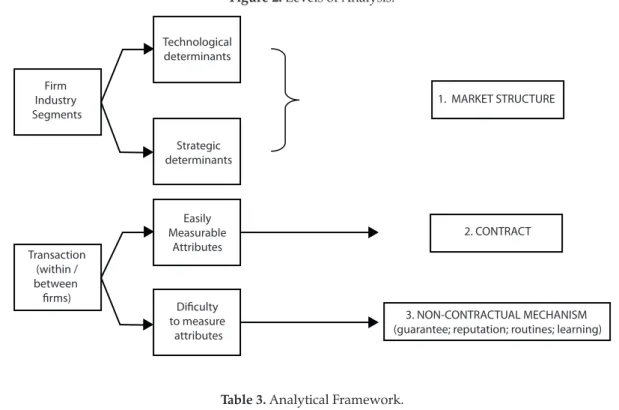
The above description suggests the existence of two basic levels of analysis. On one hand, the study of agribusiness systems involves the examination of the market structure. On the other, the study of food chains encompasses the analysis of contractual coordination. Although this conceptual framework characterizes much of the empirical research in agribusiness, the present article points to a third level of analysis that has so far been ignored, namely the transactional dimen-sions governed by explicit non-contractual forms.
According to Barzel (1997), every transaction can be broken down into different attributes (or dimensions). Each attribute is related to a property right and may be associated with a given level of measurement cost. In general terms, the value of an asset can be dissipated if the property rights over its attributes are not properly delineated, which can occur if it is hard to measure – and therefore contract for – a given attribute (ZYLBERZSTAJN, 2005). For example, because the color of an apple is an easily observable dimension, a supermarket chain can establish a contract with producers in which color is a transacted attribute. However, because the flavor of an apple is not easily measured ex ante, the supermarket chain is unable to establish an unambiguous contract for the apple’s flavor which can be effectively secured by law.
Barzel (1997) makes a distinction between legal property rights and economic property rights. The former refers to that which the state
“guarantees” to an agent. The latter is the agent’s ability, in expected terms, to consume the goods or services associated with a given asset. Legal rights are the basis of agreements whose enforcement is straightforwardly dependent on the state. Such agreements are outlined as contracts and take place in the market. The state is in charge of setting restrictions with which the contract must conform. Once these restrictions are delineated, however, individuals are free to establish among themselves the most appropriate contract terms to meet their varying needs10.
At the opposite extreme to the design of contracts we are faced with non-contractual agreements which are characterized by a less precise definition of the transacted attributes due to high measurement costs. The enforcement of these agreements is generally associated with the existence of a long-term relationship sustained by agents’ reputation or a guarantee mechanism supported by third parties.
Because the perfect measurement of the attri-butes of an asset is always costly (BARZEL, 1997), contracts explicitly describe some attributes of the transaction, implicitly delineate others, but do not consider all transacted dimensions. Even so, attributes whose measurement is too costly remain part of the transaction. As a result, contracts and long-term relationships can coexist in an exchange process, and the study of agribusiness systems must also consider the transactional dimensions governed by non-contractual means.
As an example, one can think of a particular organizational arrangement that derives from a strategy that involves tacit knowledge.11
10 It is worth noting that the effectiveness of a contract
depends largely on the precision of its terms; as a result individuals tend to use explicit, standardized measures of the attributes transacted. The use of uniform measures gives to the contract its impersonal character. On the other hand, the efficiency of the enforcement by the state depends on (a) the existence of explicit, objective dispute resolution criteria, (b) the clear delineation of the laws, and (c) the efficiency of judges and other elements of the judiciary.
11 Inspired by the work of Penrose (1959), this literature
Figure 2. Levels of Analysis.
Firm Industry Segments
Transaction (within / between
firms)
Technological determinants
Strategic determinants
Easily Measurable
Attributes
Dificulty to measure
attributes
1. MARKET STRUCTURE
2. CONTRACT
3. NON-CONTRACTUAL MECHANISM (guarantee; reputation; routines; learning)
Table 3. Analytical Framework.
1. Market structure 2. Contract 3. Non-contractual mechanisms
Main argument
Technological and strategic determinants influence the market structure of the firm,
industry, and segment.
Coordination may occur through three mechanisms: price, contracts, or
vertical integration. The choice of governance mechanism basically results from the degree of asset specificity.
The value of an asset can be dissipated if the property rights over its attributes are not
properly delineated.
Unit of analysis Firm, industry, or segment. Transaction. Attributes whose measurement is costly.
Empirical variables
Data about price, quantity, costs, existence and magnitude of entry barriers,
import/export level etc.
Type and magnitude of asset specificity: locational, physical,
human, dedicated, and brand.
Aspects of reputation, guarantees provided by third parties, routines,
and learning.
If knowledge cannot be formally encoded or is not subject to decomposition, the governance of the production system may include the search for consensus. The emergence of some consensus mechanism encompasses a negotiation process and the possibility of mutual adjustments (MENARD, 2004). The mode of coordination then probably includes some routine and a process of learning through feedback rather than centrally--planned decision making.
Figure 2 and Table 3 summarize the argument.
within the organization. Langlois (1992) uses the term capabilities. Teece et al. (1997) define dynamic capabilities as the key asset of a company. Some authors use the term knowledge-based view (KOGUT and ZANDER, 1992).
4. Illustration: the agrochemical
industry in Brazil
aspects and the role played by reputation. Given this fact, we examine a set of primary data gathered from interviews with industry players.
4.1. Market structure and competition in the agrochemical industry
In order to discuss the dynamics of Brazil’s agrochemical industry and its impact on other segments of the agroindustrial chain, Saes et al. (2009) start their study by characterizing the structure of the market. Information about demand for agrochemicals was obtained through
secondary data12. Specifically, the authors
analyzed data from the Brazilian Institute of
Geography and Statistics (IBGE)13 and the
National Supply Corporation (Conab)14.
Between 1976 and 2007, the area dedicated to the cultivation of grain in the country grew by 25%, strongly boosting the demand for agrochemicals. Moreover, the authors note that the largest growth in grain cultivation occurred during the late 1990s, mainly as a result of the expansion of soybean crops. However, demand for agrochemicals is not uniform throughout the different regions of the country, among the different crops, and the various classes of pesticides15.
Another secondary source used to qualify the demand was the National Union of the Agrochemical Industry (Sindag16). According to
the last survey available, the state of São Paulo was characterized as the major consumer of agrochemicals with a total consumption of US$ 808.2 million or 20.6% of the value traded in 2006. Other major consumers are the states of Mato Grosso (17.9%), Paraná (13.4%), Rio Grande do Sul (10.4%), Minas Gerais (9.0%), Goiás (8.8%), Bahia (6.0%), and Mato Grosso do Sul (4.7%).
12 The demand for agrochemicals is determined by technical
production aspects (coefficient of use and degree of effectiveness), by the availability and extension of rural credit, and especially by the expansion of the planted area.
13 www.ibge.gov.br 14 www.conab.org.br
15 For instance, herbicide, fungicide, insecticide, and acaricide. 16 www.sindag.com.br
Data from Sindag also allowed the authors to differentiate the demand according to crop use. Soybean emerges as the largest recipient of agrochemicals, consuming 38.5% of the value traded in 2006, followed by sugar cane and cotton. Taken together, these three crops account for 61.4% of total pesticide acquisition.
Finally, data from the Institute of Agricultural Economics (IEA17) was used to complement the
analysis of demand. It was found that herbicides accounted for the greatest value of agrochemicals sold in the state of Sao Paulo in 2006: US$ 348.1 million or 43.1% of the industry’s revenues in the state. In quantitative terms, the consumption of herbicides in Sao Paulo reached 48,370 tones (46.4% of the total). These results are best explained by the composition of agricultural production in Sao Paulo which concentrates on herbicide-dependent crops: soybean, sugar cane, and corn.
Regarding the analysis of the supply of agrochemicals, a systematic collection of data is not available since relevant information is private and deemed strategic by the firms. Against this backdrop, information was found in specialized publications18. This data allowed the authors to
evaluate the concentration of agrochemicals in the domestic market. Basically, two indicators were calculated: the concentration ratio (CR4) and the Herfindahl-Hirshman Index (HHI). The average CR4 for Brazil’s agrochemical industry is 52% (i.e., the industry’s four largest firms represent 52% of the market) and the average HHI is 928. According to Motta (2004), a highly concentrated market is one with an HHI above 1800. The results, therefore, are not conclusive: the CR4 suggests a market concentration, whereas the HHI does not. By and large, although the manufacture of active ingredients19 is concentrated in the agrochemical
industry, the dominance of a single firm is not
17 www.iea.sp.gov.br
18 Specialized publications include Gazeta Mercantil, Agroanalysis, Preços Agrícolas, and sectorial studies by Brazil’s state development bank, BNDES.
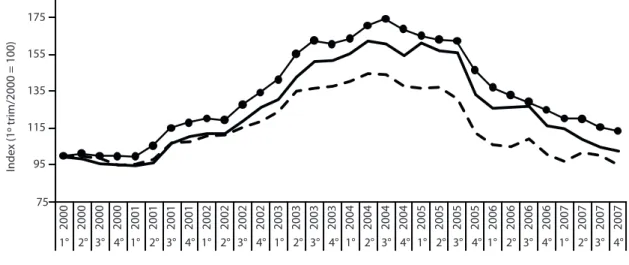
Figure 3. Herbicides: Price evolution (Low competition, High competition and Monopoly), São Paulo, 1st quarter/2000 to 4th quarter/2007.
175
155
135
115
95
75
1° 2° 3° 4° 1° 2° 3° 4° 1° 2° 3° 4° 1° 2° 3° 4° 1° 2° 3° 4° 1° 2° 3° 4° 1° 2° 3° 4° 1° 2° 3° 4°
2000
2000 2000 2000 2001 2001 2001 2001 2002 2002 2002 2002 2003 2003 2003 2003 2004 2004 2004 2004 2005 2005 2005 2005 2006 2006 2006 2006 2007 2007 2007 2007
Low competition High competition Monopoly
Inde
x (1º tr
im/2000 = 100)
Source: Saes et al.(2009).
observed. Hence, the information allows us to argue that the Brazilian agrochemical market presents characteristics of an oligopoly.
An important aspect is the fact that although gaining access to the agrochemical market can be difficult due to high initial investments in R&D, smaller firms may enter the industry through the production of pesticides whose patents have already expired (generic agrochemicals). The National Association of Agrochemical Companies
(Aenda)20 estimates that market for generic
products represents between 60% and 70% of the global market.
From this perspective, the agrochemical market can be divided into two groups. On one hand, there are companies that sell patented products and eventually commercialize generic agrochemicals. On the other hand, there are companies that only produce generic agrochemicals. Considering that the manufacture of active ingredients is concentrated, the agrochemical industry has characteristics of an oligopoly with a competitive fringe: the nucleus includes firms that sell patented products and the fringe encompasses companies that only sell generic products.
According to Aenda, the Brazilian market was characterized in 2007 by 59 generic products
20 www.aenda.org.br
whose supply was diversified, i.e., existence of at least three producers. The domestic market is also characterized by the existence of products marketed by two companies. In this case, the provision of an active ingredient can be either the result of a competitive process after patent expiration or the result of a strategic alliance between firms.
With respect to pricing, the analysis conducted by Saes et al. (2009) drew on data for herbicides sold in the state of Sao Paulo. Prices were originally collected by the Agricultural Economics Institute (IEA). From the classification proposed by the Brazilian Association of Generic Agrochemicals21, the authors constructed price
indexes. In the chart above, the label “low” corresponds to the average price for the group of herbicides characterized by low competition (two competitors), “high” is the average price for the group of herbicides with three or more competitors, and “monopoly” is the average monopoly price in the production of herbicides. As expected, the monopoly price is always higher compared to other prices. In addition, herbicides with high competition have lower prices when compared to herbicides with low competition.
According to the above discussion, the characterization of the agrochemical industry in Brazil is that of a classic production sector. Basically, one can conclude that (i) due to its supply and demand characteristics, the Brazilian agrochemical market has the structure of an oligopoly with a competitive fringe, and that (ii) the available data supports the usual ideas about price behavior. Nevertheless, it is worth mentioning that the above analysis does not capture key elements of the dynamics of firms’ behavior – for example, their business strategies. In general, contractual relations not only affect the performance of the supply chain, enabling the implementation of various competitive strategies, but can also imply monitoring or the incentives for strategy adoption. The existence of contracts between the agents acting in the agrochemical industry is the cornerstone of investigations into the relationships between agents. This kind of information, however, is not revealed by secondary sources of information, making necessary the search for primary data – e.g., information provided by agents through qualitative interviews.
4.2. Contractual relations in the agrochemical industry
Contracts can be found in the agrochemical market, particularly in transactions established between dealers and farmers, and between cooperatives and their members. The most relevant aspect of these transactions is that related to the financing of the purchase. One can find different purchasing mechanisms: spot purchase, hire purchase, and “harvest time” purchase. In the case of spot purchase, producers are able to buy products at more competitive prices. In hire purchase, the financial costs of the transaction are usually embedded in the price. In “harvest time” purchase, payment is made in kind, characterizing a purchasing mechanism that resembles an exchange contract of inputs for grains.
In “harvest time” purchase, for the reseller to actualize the exchange, a sophisticated contractual architecture is necessary so as to
provide assurances to the system (Figure 4). Insofar as agrochemical firms do not engage in grain marketing, they team up with traders in order to facilitate the transaction.22 Once an operational
agreement is laid down, the agrochemical firm informs the reseller about the availability of the arrangement. It then is up to the reseller to manage the exchange with producers. Producers establish a resale contract with the reseller, and the reseller signs a contract with the trader. The payment to the reseller is made by the trader, which receives the grain (usually soybean) from the producer. The reseller transfers the payment to the agrochemical firm.
Contracts are always made with the endor-sement of a notarized security – first-degree Rural Producer Bond (CPR)23 – which is issued
by the producers. It is worth emphasizing that when a CPR is registered there is a crop lien: the product to be harvested is given as a guarantee for the transaction. Moreover, the fact that the CPR is a first-degree bond gives it priority for payment. In order for producers to perform this type of operation they need to acquire a full line of products from the agrochemical firm (a technological package of at least six products). Under-capitalized producers generally adhere to this operation mode, although on some occasions even well-capitalized producers find this arrangement to be favorable.
22 Syngenta, Bayer, and Basf hold partnerships with Bunge/
ADM/Cargill, which undertake to receive a certain quantity of soybean.
23 The CPR can be physical via product delivery settlement,
Figure 4. “Harvest time” purchase.
Operational Agreement
Trader
Agrochemical firm
agrochemical
Reseller
Grain
(soybean)
agrochemical
Contract (1)
Producer $
Contract (2)
$
Source: Saes et al (2009).
In order to facilitate the delivery operation, some resellers keep their own warehouses for receipt of grains and subsequent transfer to traders. However, few resellers provide effective storage service. In general, the operation requires resellers to monitor the whole process of delivery of grain in warehouses within the region. Failure to conduct this monitoring means that a reseller may be taken to court on the grounds of failure to meet the contractual prerogatives.
The transaction between a cooperative and an associate producer occurs in a manner similar to that between reseller and producer. Cooperatives sell inputs and occasionally receive grain for processing and storage. In general, cooperatives estimate their members’ demand for agrochemicals in a given instant in time and make the purchase from suppliers. Some cooperatives also provide agronomic advice through their technical assistants. The sale of agrochemicals can also be either spot, hire, or “harvest time”.
The spot and hire sales mimic the relationship between producer and reseller, except for the fact that the cooperative may, in theory, offer products at better prices. In the case of “harvest time” purchase, the cooperative may also receive grains and can itself establish a contract for the
exchange of inputs for grains with its associates, selling the end product through the trader. As described above, cooperatives can receive credit from the traders and pay this funding in cash or in kind.
Thus we find that, contrary to what the analysis of available data may suggest, the final marketing of agrochemicals may not occur through a perfect market mechanism in which farmers drive up to the counter of a reseller (or cooperative) and buy a product in a non--recurrent transaction whose consummation is instantaneous. This simple finding may have important ramifications in the analysis of the agrochemical industry. For instance, any estimate of elasticity of demand may be biased if one fails to take account of the contractual arrangements described above.
Figure 5. Number of contracts (total), soybean production – State of Goiás, Midwest, Brazil.
350
300
250
200
150
100
50
0
2002/03 2003/04 2004/05
178
298
192
Source: Rezende (2008) – prepared by the authors.
buyers use a particular type of contract and another group of buyers transact in a different way. In this case, estimators may be biased.
In this regard, resellers report that “harvest time” purchase represent between 20% and 25% of their transactions. Representatives of the cooperative sector, in turn, state that the importance of this contractual mode was higher in the past, and that currently it is mainly used by less-capitalized producers. Still, in the 2006/2007 crop, one cooperative from the state of Mato Grosso do Sul reported that 50% of its sales were made under this contractual mode. In Mato Grosso, it is estimated that exchange contracts are much more frequent; in the 2006/2007 crop almost 100% of the associates adhered to this type of contract.
In order to provide a complete overview of the agrochemical industry, we must take one step further and inquiry about the existence of additional (non-contractual) dimensions that may influence the transactions.
4.3. The role of reputation
One relevant aspect of exchange contracts refers to its possible intentional breach. Contract breaches can always occur, and in the past
have mainly occurred due to weather problems (e.g., drought) and product valorization. Rezende (2008), for instance, studied contract breaches by soybean producers in moments of substantial price increases.
In the case of soybean production in the state of Goiás (a major soybean producer in the Midwest of Brazil), Rezende (2008) reports a generalized contractual breach in 2003/2004 due to a sharp increase in soybean prices in the international market. At that time, producers chose not to deliver the grains to the trading companies under the “harvest time” purchase price. As a consequence, the availability of “harvest time” contracts was reduced in 2004/2005 (Figure 5).24
Of particular interest, however, is the fact that the possibility of contract breach adds an ingredient of reputation to the relationship among agrochemical firm, reseller/cooperative, and producer. Reports from industry sources indicate that the occurrence of contract breaches
Table 4. Effects perceived by producers as a result of breach of contract – State of Goiás.
Producers (%)
Agrochemical firms began to demand greater assurances of credit 50 Negotiations with the companies have become tougher 46
Reduction in the number of contracts 30
Less financial support for production 27
Reduction in the cultivation total area 11
Reduction in the amount of soybeans sold 11
Producer reports no effect 19
Source: Rezende (2008).
in the past has led companies to become more severe in the formatting of this type of operation. In effect, Rezende (2008) interviewed a group of 70 producers on the potential effects suffered after the episode of breach of contracts in 2003 (Table 4). About half of producers reported that agrochemical firms began to demand greater assurances of credit; 46% of producers said that the negotiations with the companies have become tougher; 30% of respondents have reduced the number of contracts; and 27% had fewer resources for their production.
More importantly, evidence suggests that even producers who did not break contracts were also negatively affected by the new strategies developed by the firms (REZENDE, 2008). This aspect is relevant to the extent that even if one considers the existence of formal contracts in the marketing of agrochemicals, the dynamics of reputation should also be taken into account. A group of producers that acts in a way that diminishes their reputation can have effects on the future availability of financing to the whole industry. As a result, the conditions of the industry (e.g., elasticity of demand) can be affected, as well.
5. Concluding remarks
The aim of this perspective paper is to discuss the role of empirical research in unders-tanding the complex forms of governance in agribusiness. The authors argue that there are three fundamental levels of analysis: (i) the basic
structure of the market, (ii) the formal contractual arrangements that govern relations within the agroindustrial system, and (iii) the transactional dimensions governed by non-contractual means. The case of the agrochemical industry in Brazil illustrates how traditional analyses that only address market structure are insufficient to fully explain the agricultural sector and its supply chain.
At present, the information that researchers need to examine the new reality of the agribusiness sector is not collected by research institutions in Brazil. Thus, it is imperative that research institutions make efforts to systematize the data related to contracts in agribusiness systems. It is noteworthy that this type of initiative is already a routine in American institutions such as Cori25 (Contracting and Organizations Research
Institute). Cori is a research institution based at the University of Missouri / Columbia that has a comprehensive database on contracts and a range of information on organizational governance. Admittedly, the task is not trivial; however, the gains for the understanding and analysis of complex forms of governance in agribusiness systems will be significant.
In Brazil, we could encourage the collection of data covering an expanded set of variables. As the foregoing discussion suggests, the main variables that could be collected by research institutes are:
• Basic information about (formal and
informal) contracts, as well as the degree of standardization of contracts;
• Average length of different contractual relations (short- and long-term);
• Contract clauses: transacted attributes; object of contract; bonuses and financial incentives;
• Frequency (recurrence of the relationship over a period);
• Contract breach;
• Number of agents that transact (for the sale and purchase of products);
• Contractual modes;
• Existence, type, and magnitude of
transaction guarantees.
Certainly the challenge at hand for the collection and organization of these new variables is enormous. However, the complexity of agroindustrial systems unavoidably requires researchers and research institutes to employ greater analytical sophistication.
6. References
BARJOLLE, D. Hybrid Forms of Governance: the case of Artisanal Food Products. In: 78th EAAE Seminar “Economics of Contracts in Agriculture and the Food supply Chain”, Copenhagen, Denmark, 15-15, June 2001.
BARZEL, Y. Economic analysis of property right. 2nd ed. Cambridge: University Press, 1997.
BRUM, B. L. R.; JANK, M. S. A padronização na gestão da cadeia de suprimentos da carne bovina por supermercados. Gestão da Produção, vol. 8, n. 1, p. 68-83, abr. 2001.
COASE, R. H. The problem of social cost. Journal of law and economics, vol. 3, October, p. 1-44, 1960.
COASE, R.H. The nature of the firm. In: WILLIAMSON, O. E.; WINTER, S.G. (Org), The nature of the firm. New York: Oxford University Press, 1991.
DALMONECH, L. F. ET AL. Análise dos fatores interve nientes nas quebras de contrato no setor de combustíveis brasileiro. RAE Eletrônica, vol. 9, n. 2, p. 0-0, 2010.
GUIMARÃES, L. O. et al. Olhe bem as montanhas...: a expansão geográfica do comércio de móveis na encruzilhada. Revista de Administração Contemporânea, vol. 15, n. 2, p. 349-359, 2011.
JAMES JR, H. et al. Markets, Contracts, or Integration? The Adoption, Diffusion, and Evolution of Organizational Form Contracting and Organizations. Research Institute University of Missouri. This version: April 12, 2007.
KOGUT, B.; ZANDER, U. Knowledge of the firm, combinative capabilities and the replication of technology. Organization Science, vol. 3, n. 3, p. 383-397, 1992.
KUNKEL, P. L. et al. Agriculture Production Contract. Farm Legal Series. University of Minnesota, June, 2009.
LANGLOIS, R. N. Transaction cost economics in real time. Industrial and Corporate Change, vol. 1, n.1, 1992.
LEME, M. F. P.; ZYLBERSZTAJN, D. Determinantes da escolha de arranjos institucionais: Evidências na comercialização de fertilizantes para soja. Revista de Economia e Sociologia Rural, vol. 47, p. 517-546, 2008.
LOADER, R. Transaction costs and relationship in agri--food systems. In: Proceedings of the 2nd International Conference on Chain Management in agri-food business, Wageningen Agricultural University, p. 417-429,1996.
MARTINEZ, S. W. Vertical coordination of marketing systems: lessons from the poultry, egg, and pork industries. Agricultural Economic Report, n. 807, April, 2002.
MASTEN, S. E. Transaction costs economics and the organization of agricultural transactions. In: BAYE, M. R. (ed.) Industrial Organization (Advances in Applied Microeconomics, v.9), Emerald Group Publishing Limited, 2000, p. 173-195.
MENARD, C. On clusters, hybrids, and other strange forms: the case of the French poultry Industry. Journal of Institutional and Theoretical Economics, vol. 152, p. 155-183, 1996.
MENARD, C. The economics of hybrid organizations. International Journal of institutional and theoretical economics, vol. 160, n. 3, p. 345-376, 2004.
MIELE, M.; WAQUIL, P. D. Estrutura e dinâmica dos contratos na suinocultura de Santa Catarina: um estudo de casos múltiplos. Estudos Econômicos, vol. 37, n. 4, p. 817-847, dez 2007.
MONDELLI, M.; ZYLBERSZTAJN, D. Direct-Contracting and Brokers in the Producer-Processor Transaction: The Uruguayan Beef Industry Case. In: The International Society for New Institutional Economics (ISNIE), Toronto, vol. 1. p. 1-22, 2008.
NICKERSON, J. Towards an Economizing Theory of Strategy, forthcoming, Strategic Management Journal. 2000. Disponível em: <http://scholar.google.com.br/ scholar?hl=pt-BR&q=NICKERSON%2C+J.+Towards+ an+Economizing+Theory+of+Strategy&btnG=Pesquis ar&lr=&as_ylo=&as_vis=0> Acesso em 08 jul 2011.
NORTH, D. C. Institutions. The journal of economic perspectives, vol. 5, n. 1, p. 97-112, 1991.
NORTH, D. C. Understanding the Process of Economic Change. Princeton Economic History of the Western World. Princeton: Princeton University Press, 2005.
OSTER, S.. 1990. Modern Competitive Analysis. Oxford: Oxford University Press.
PENROSE, E. The Theory of the Growth of the Firm. New York: Wiley, 1959.
PEIXOTO, R. C. D. A Rede Paraense de Agricultura Familiar e Biodiesel. Boletim do Museu Paraense Emílio Goeldi. Ciências humanas, vol. 3, n. 3, p. 375-384, Dez 2008.
PETERSON, C. H. et al. Strategic choice along the vertical coordination continuum. International Food and Agribusiness Management Review, vol. 4, n. 2, p. 149-166, 2001.
PINOTTI, R. N.; PAULILLO, L. F. O. A estruturação da rede de empresas processadoras de aves no Estado de Santa Catarina: governança contratual e dependência de recursos. Gestão da Produção, vol. 13, n. 1, p. 167-177, abr 2006.
PRAHALAD, C.; HAMEL, K.. Gary The Core Competence of the Corporation. Harvard Business Review, May-June. p. 78-91, 1990.
RAYNAUD, E.; SAUVEE, L. Fit between Branding Strategies and Governance of Transactions. In: 8th Annual Conference of the New Institutional Economics, “Institutions and Economic and Political Behavior”, Tucson, Arizona, 2004.
REZENDE, C. L. Pacta sunt servanda? Quebra dos contratos de soja verde. Tese de Doutorado, 2008. Tese (Doutorado em Administração). Programa de Pós Graduação em Administração, Departamento de Administração, Faculdade de Economia, Administração e Contabilidade da Universidade de São Paulo.
SAES, M. S. M. A distribuição de quase-renda e a estratégia de diferenciação no café. Revista Administração Contemporânea, vol. 11, n. 2, p. 151-171, jun 2007.
SAES, M. S. et al. Organização dos Mercados de Insumos e Relações com a Agricultura. Relatório
PENSA desenvolvido a pedido da Confederação Nacional da Agricultura (CNA), 2009.
SAMPAIO, L. M. B. Modelo Principal-Agente para contratos entre pequenos produtores e empresa exportadora de manga no Rio Grande do Norte. Revista de Economia e Sociologia Rural, vol. 45, n. 4, p.879-898, dez 2007.
SAUVÉE, L. Efficiency, Effectiveness and the Design of Network Governance. In: 5th international conference on chain management in agribusiness and the food industry. The Netherlands, June, 2002.
SCHERER, F.; ROSS, D. Industrial Market Structure and Economic Perfomance. Boston: H. Mifflin, 1990.
SILVA, C. L.; SAES, M. S. M. Governance structure and transaction cost: relationship between strategy and asset specificity. Nova economia, vol. 17, n. 3, p. 443-468, dec 2007.
SILVA, F. L. et al. Estudo da relação de confiança em programa de fomento florestal de indústria de celulose na visão dos produtores rurais. Revista Árvore, vol. 33, n. 4, p. 723-732, ago 2009.
SILVA, V. L. S.; AZEVEDO, P. F. Formas plurais no franchising de alimentos: evidências de estudos de caso na França e no Brasil. Revista Administração Contemporânea, vol. 11, n. spe1, p. 129-152, 2007.
SOUZA FILHO, H. M. et al. Barreiras às novas formas de coordenação no agrossistema do caju na região nordeste, Brasil. Gestão da Produção, vol. 17, n. 2, p. 229-244, 2010.
SOUZA, U. R. et al. Determinantes dos novos contratos de fomento florestal na mesorregião do Vale do Rio Doce, Minas Gerais. Revista Árvore, vol. 33, n. 2, p. 377-386, abr 2009.
TEECE, D. J. et al. Dynamic capabilities and strategic management. Strategic Management Journal, vol. 18, n. 7, p. 509-533, 1997.
WILLIAMSON, O. E. Markets and hierarchies. New York: Free Press, 1975.
WILLIAMSON, O. E. The Mechanisms of Governance. New York: Oxford University Press, 1996.
WILLIANSON, O. E. The Economic Institutions of Capitalism: Firms, Markets, Relational Contracts. New York: The Free Press, 1985.
ZYLBERZSTAJN, D. Papel dos contratos na coordenação agro-industrial: um olhar além dos mercados. Revista de Economia e Sociologia Rural, vol. 43, n. 3, p. 385-420, 2005a.
ZYLBERZSTAJN, D. Measurement Costs and Governance Perspectives: two views about the same subject. In: 5th International Society for New Institutional Economics, Barcelona, Espanha, 2005b.
ZYLBERZSTAJN, D. Empirical Research in Contracts: Watch your Steps. In: International Meeting of the International Society for New Institutional Economics, Berkeley, USA, 2009.
ZYLBERZSTAJN, D.; NOGUEIRA, A. C. L. Estabilidade e difusão de arranjos verticais de produção: uma contribuição teórica. Economia e Sociedade, vol. 11, n. 2, p. 329-346, 2002.
ZYLBERSZTAJN, D.; LAZZARINI, S. G. On the Survival of Contracts: Assessing the Stability of Technology Licensing Agreements in the Brazilian Seed Industry. Journal of Economic Behavior & Organization, vol. 56, p. 103-120, 2005.