www.jcol.org.br
Journal of
Coloproctology
Original article
Complications after intestinal resection in Crohn’s disease:
laparoscopic versus conventional approach
☆Paulo Gustavo Kotze*, Vinícius Rezende Abou-Rejaile, Ivan Folchini de Barcelos,
Juliana Ferreira Martins, Eron Fábio Miranda, Juliana Gonçalves Rocha,
Lorete Maria da Silva Kotze
Colorectal Surgery Unit, Hospital Universitário Cajuru, Pontifícia Universidade Católica do Paraná (PUC-PR), Curitiba, PR, Brazil
a r t i c l e i n f o
Article history:
Received 12 June 2013 Accepted 17 July 2013
Keywords:
Crohn’s disease Laparoscopic surgery Complications
a b s t r a c t
Background: signii cant advances in medical therapy for Crohn’s disease (CD) occurred in the last 12 years, mainly due to the introduction of anti-TNF therapy. Laparoscopic colorectal surgery represented the most important advance on surgical treatment in the management of CD, as it also had developed in the treatment of other conditions. There is a tendency for lower complication rates after laparoscopic bowel resections as compared to open surgery. The aim of this study was to analyze and compare the complication rates after bowel resections for CD between the two approaches in a Brazilian case series.
Methods: this was a retrospective longitudinal study, including CD patients submitted to bowel resections from a single Brazilian Inl ammatory Bowel Diseases (IBD) referral center, treated between January 2008 and June 2012 with laparoscopic approach (LA) or conventional approach (CA).
Variables analyzed: age at surgery, gender, Montreal classii cation, smoking, concomitant medication, type of surgery, surgical approach, presence and type of complication up to 30 days after the procedures. Readmission and reoperation rates, as well as mortality, were also analyzed. Patients were allocated in two groups regarding the type of procedure (LA or CA), and complication rates and characteristics were compared. Statistical analysis was performed with Mann-Whitney test (quantitative variables) and chi-square test (qualitative variables), with p < 0.05 considered signii cant.
Results: a total of 46 patients (25 men) were included (16 submitted to LA), with mean age of 38.1 (± 12.7) years. The groups were considered homogeneous according to age, gender, CD location, perianal disease and concomitant medications. There were more patients with i stulizing CD on the CA group (p = 0.029). The most common procedure performed was ileocolic resection on both groups (56.7% of the CA and 75% of the LA patients – p = 0.566). Overall, total complications (surgical and medical, including minor and major issues) oc-curred in 60% (18/30) of the CA group and 12.5% (2/16) of the LA group (p = 0.002). Wound in-fection was the most frequent complication (10/30 on CA and 1/16 on the LA groups). There were 3 deaths in the CA group. Specii c analysis of each complication did not demonstrate
☆
Study carried out at the Colorectal Surgery Unit of Hospital Universitário Cajuru, Pontifícia Universidade Católica do Paraná (PUC-PR), Curitiba, PR, Brazil.
* Corresponding author.
E-mail: [email protected] (P.G. Kotze)
Palavras-chave:
Doença de Crohn Cirurgia laparoscópica Complicações
r e s u m o
Complicações após ressecções intestinais na doença de Crohn: há diferenças entre as vias convencional e videolaparoscópica?
Introdução: avanços signii cativos no tratamento medicamentoso da doença de Crohn (DC) ocorreram nos últimos 12 anos, principalmente após a introdução da terapia anti-TNF. A cirurgia laparoscópica colorretal representa um dos maiores progressos no tratamento ci-rúrgico minimamente invasivo da DC, bem como no manejo de outras afecções. Existe uma tendência a menores taxas de complicações com as ressecções intestinais laparoscópicas quando comparadas a cirurgia convencional. O objetivo deste estudo foi analisar e compa-rar as taxas de complicações após ressecções intestinais na DC entre as duas vias de acesso em uma série de casos brasileira.
Método: estudo retrospectivo longitudinal, incluindo pacientes com DC submetidos a res-secções intestinais em um centro de referência brasileiro em doença inl amatória intesti-nal (DII), tratados entre janeiro de 2008 e junho de 2012, com cirurgia laparoscópica (CL) ou cirurgia convencional (CC). As variáveis analisadas foram: idade no momento da cirurgia, gênero, classii cação de Montreal, tabagismo, medicações concomitantes, tipo de cirurgia, via de acesso, presença e tipo de complicação em até 30 dias do procedimento. Readmissão, reoperações e mortalidade também foram avaliadas. Os pacientes foram alocados em dois grupos de acordo com a via de acesso (CL ou CC), sendo as taxas de complicações compa-radas entre si. Análise estatística foi realizada pelos testes de Mann-Whitney (variáveis quantitativas) e chi-quadrado (qualitativas), com p<0.05 considerado signii cativo.
Resultados: No total, 46 pacientes (25 homens) foram incluídos (16 operados por CL), com média de idade de 38,1 (± 12,7) anos. Os grupos foram considerados homogêneos em re-lação à idade, gênero, localização da doença, DC perianal e medicações concomitantes. Houve predomínio da forma i stulizante no grupo de cirurgias abertas (p = 0.029). O proce-dimento mais realizado foi a ileocolectomia direita em ambos os grupos (56,7% na CC e 75% na CL – p = 0.566). No total, complicações pós-operatórias (cirúrgicas e clínicas) ocorreram em 60% (18/30) dos casos após CC e 12,5% (2/16) após a CL (p = 0.002). Infecção da ferida operatória foi a complicação mais frequente (10/30 na CC e 1/16 na CL). Ocorreram 3 óbitos no grupo da CC. Em análise individualizada das complicações, não houve diferença entre os grupos em relação a sepse abdominal, infecções urinárias, pneumonia, reinternações, reoperações e óbitos (p=0.074).
Conclusões: houve maior taxa de complicações nos pacientes operados por CC comparado a CL. A seleção de casos para cirurgia laparoscópica provavelmente contribuiu para este resultado, havendo uma tendência a utilização da cirurgia convencional nos casos mais graves, geralmente com DC abdominal i stulizante. A CL parece ser a via de acesso reco-mendada na maioria dos casos de DC não-complicada.
© 2013 Elsevier Editora Ltda. Todos os direitos reservados. any difference between the groups regarding abdominal sepsis, urinary tract infections, pneumonia, readmission, reoperations and deaths (p = 0.074).
Conclusions: there was a higher complication rate in patients operated with CA as compared to LA. This was probably due to patient selection for the laparoscopic approach, with severe cases, mostly due to i stulizing abdominal CD, being operated mainly by open surgery. LA tends to be the recommended approach in most cases of non-complicated CD.
© 2013 Elsevier Editora Ltda. All rights reserved.
Introduction
Despite recent advances in medical therapy for Crohn’s disease (CD), especially with the development and wider acceptance of biological therapy, surgical treatment with intestinal resec-tion still has a key role in the management of these patients. In addition to being incurable, CD affects mainly young indi-viduals, which determines the need for treatment in the long
term, making it difi cult to achieve total disease control. It is estimated that approximately 70 to 90% of patients will require some form of surgical treatment throughout their lifetime.1,2
The role of laparoscopic surgery in the management of colorectal diseases is well established, with numerous ben-ei ts in both benign and oncologic resections.3 However,
mes-entery ini ltration and friability, presence of i stulae, adhe-sions and concomitant immunosuppression can signii cantly complicate a procedure that already has intrinsic difi culties even when using the conventional approach.2,6
In spite of these characteristics, laparoscopic surgery has been increasingly performed in the management of CD, es-pecially in primary ileocolic disease.7 Recent studies have
demonstrated that this is a feasible, safe, effective procedure, which shows benei ts in postoperative recovery, even in the presence of abscesses and intestinal i stulae.5,7 However,
care-ful preoperative evaluation is required to predict the occur-rence of complications in these situations.8
In Brazil, there are few data on the actual role of laparo-scopic surgery in CD, as well as on the complication rates when compared to procedures performed by laparotomy. The indication of laparoscopy in the treatment of inl ammatory bowel diseases (IBD) is not common in our country. In a na-tional survey published in 2008, whereas benign diseases rep-resented 49.6% of the operated patients, CD reprep-resented only 2% of these indications.9
Due to the scarcity of data on the subject in our country, the objective of this study was to analyze the rates of postop-erative complications in patients with CD submitted to bowel resection surgery, comparing the data between the laparo-scopic (LA) and conventional (CA) approaches.
Method
This study was approved by the Human Research Ethics Committee of the Pontifícia Universidade Católica do Paraná (PUCPR), under protocol number 14201613.0.0000.0020/2013 through the Brazil platform system.10
This was a retrospective, longitudinal study carried out in a single referral center for the treatment of IBD in southern Brazil. All patients with CD consecutively submitted to ab-dominal operations with intestinal resection between Janu-ary 2008 and August 2012 were analyzed, regardless of the approach used, either laparoscopic (LA) or conventional (CA).
Inclusion criteria were: patients between 18 and 65 years of age, with CD, regardless of the medication used prior to the pro-cedures, submitted to abdominal surgery with resection of any intestinal segment (small intestine, colon or rectum), operated during the evaluation period. Exclusion criteria were: patients undergoing abdominal surgery for CD without bowel resection (deviation stoma, stricturoplasty or diagnostic laparoscopy), pa-tients with ulcerative colitis (UC) or indeterminate form of IBD.
There was no sample size calculation for this study, which was carried out with a convenience sample, based on the ac-tual number of patients consecutively submitted to surgery during the study period.
Data were collected by reviewing electronic medical charts and the i lling out of a protocol previously estab-lished for the service. The analyzed variables included: de-mographics (gender, age), Montreal classii cation, smoking, concomitant medications prior to the procedure, surgical approach used (LA or CA), type of surgery, presence and type of complication found.
Patients were distributed according to the surgical ap-proach used in the two study groups, laparoscopic apap-proach
(LA) and conventional approach (CA). The characteristics of each group were compared in an attempt to i nd homogeneity between them. Early postoperative complications (occurring up to 30 days after surgery) were described and compared be-tween the groups. Any situation that deviated from a normal postoperative period requiring medical, surgical, endoscopic treatment or radiological intervention was considered a com-plication. Among these, we evaluated the presence of abdom-inal sepsis, anastomotic dehiscence, i stulas, abscesses, sur-gical wound infection, reoperation, pneumonia, urinary tract infection, pancreatitis, central catheter infection, CD l are, readmission or death, among others.
Laparoscopic procedures were performed under general anesthesia, according to the colorectal surgery unit stan-dardization, using four ports (2 of 5 and 2 of 10 mm), prior-ity approach from medial to lateral, and the performance of anastomoses according to the location of the resected area. Preference was given to extra-corporeal and mechanical anastomosis. Some surgical procedures were performed with the aid of a harmonic scalpel.
Conventional procedures were performed under general anesthesia associated with epidural catheter with median laparotomy.
The dissection of the affected areas was performed lateral to medially and anastomoses were preferably mechanical.
There was no randomization concerning the type of ap-proach and the selection of the latter for certain cases was made by the attending physician. Patients were not all oper-ated by the same surgeon, as the colorectal surgery unit is a teaching hospital, with the participation of fellow physicians. The study hypothesis was that there would be a lower rate of complications in patients submitted to LA when compared to the CA. Statistical analysis was performed using the Mann-Whitney test (quantitative variables) and chi-square test (qualitative), with p < 0.05 considered statistically signii cant.
Results
Forty-eight patients with CD underwent abdominal operations during the study period. Two cases were excluded for not un-dergoing a bowel resection procedure (one patient underwent multiple stricturoplasties and another derivative loop ileos-tomy for severe perianal CD). Of the 46 patients included, 16 (34.8%) were submitted to the LA and 30 (65.2%) to CA.
Clinical characteristics and medications used by patients at the time of the procedures are detailed in Table 1. It was observed that patients submitted to the LA showed a trend to shorter mean duration of CD than the group submitted to the CA (53.56 × 96.87 months), in absolute numbers. An-other noteworthy fact was a trend to greater use of biologi-cal agents in the LA group (10/16 patients, 62.5%). However, there was no signii cant difference between the groups re-garding these and the remaining variables and they were considered homogeneous.
the CA group and of ileal location (L1) in the group of patients submitted to the LA, however without statistically signii cant difference.
According to the behavior of CD, patients submitted to the LA had predominantly stenotic disease (B2 – 68.8%) when compared to the group submitted to the CA, where penetrat-ing injuries (B3 – 56.7%) were more prevalent, with signii cant statistical difference (p = 0.029).
The main surgical indications in patients submitted to the CA were: intestinal i stulae (n = 18), stenosis (n = 17), and intra-abdominal abscesses (n = 3). In the group submitted to the LA, they were stenosis (n = 14), abdominal i stulae (n = 4) and clinical failure (n = 1). It is noteworthy the fact that some patients had more than one surgical indication.
The most often performed surgical procedures were isolat-ed right ileocolectomy (13 × 11) and segmental bowel resection (5 × 1) in the CA and LA groups, respectively. Other procedures such as right ileocolectomy and associations (stricturoplasty, enterectomy or segmental sigmoidectomy), left colectomy, rectosigmoidectomy, subtotal colectomy and total proctocolec-tomy were also carried out at smaller numbers.
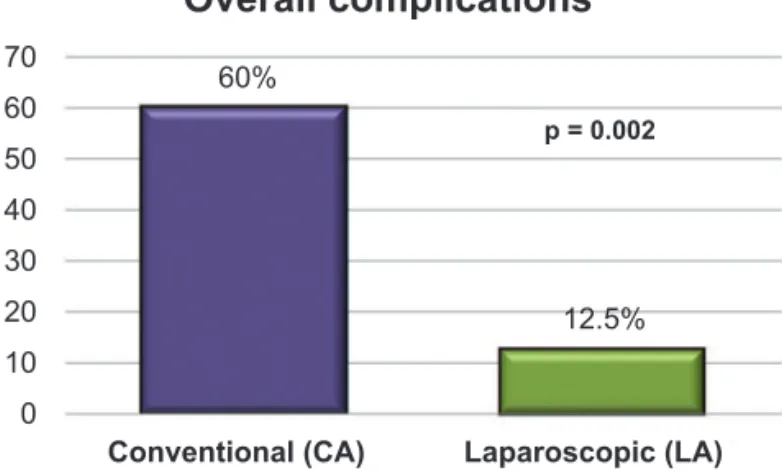
Regarding postoperative complications in up to 30 days after the procedures, 18 patients (60%) of the CA group had
some type of complication, compared with only 2 patients (12.5%) in the LA group (p = 0002) (Fig. 1). Table 3 shows the frequency and type of complication according to the surgical access approach. Despite the higher number of complications in the CA group, there was no statistical difference between the two groups regarding abdominal sepsis, surgical wound abscess, presence of urinary tract infection, pneumonia, read-missions, reoperations and deaths (p = 0.074) when compared individually. There were cases where patients had more than one complication.
Discussion
Some studies have demonstrated the feasibility and safety of laparoscopy surgery in CD.4-8 This access approach has been
in-creasingly used in the management of benign and malignant colorectal diseases, showing advantages when compared to conventional surgery. The classic benei ts of laparoscopy, such as better cosmetic results, less postoperative pain and faster recovery, are also observed in CD. However, some doubts still remain, especially regarding surgical complications after the
Table 1 – Demographic data, clinical characteristics and current medications in the two groups of patients. Statistical analysis was performed using the Mann-Whitney and chi-square tests (p <0.05).
CA (n = 30)
LA (n = 16)
p value (< 0.05)
Mean age (years) 38.13 38.25 0.686
Gender M/F 15/15 10/6
Mean duration of CD (months)
96.87 53.56 0.235
Smoker 2/30 (6.7%) 1/16 (6.2%) 0.957 Current medications
Corticosteroids 8 (26.7%) 4 (25%) 0.902 Azathioprine 22 (73.3%) 10 (62.5%) 0.447 Biological agents 11 (36.7%) 10 (62.5%) 0.094
CA, conventional approach; LA, laparoscopic approach.
Table 2 – Montreal classifi cation in the analyzed groups. Statistical analysis was performed using the chi-square test (p < 0.05).
CA n = 30 LA n = 16 p value (< 0.05)
A1 3 (10%) 3 (18.8%) 0.694
A2 18 (60%) 9 (56.2%)
A3 9 (30%) 4 (25%)
L1 9 (30%) 10 (62.5%) 0.095
L2 5 (16.7%) 2 (12.5%)
L3 16 (53.3%) 4 (25%)
L4 0 (0%) 0 (0%)
B1 4(13.3%) 2 (12.5%) 0.029a
B2 9 (30%) 11(68.8%)
B3 17 (56.7%) 3 (18.8%)
Perianal (p) 14 (46.7%) 4 (25%) 0.152
aStatistically signii cant difference. CA, conventional approach; LA,
laparoscopic approach.
Table 3 – Early postoperative complications between the two groups. Statistical analysis was performed using the chi-square test (p < 0.05).
CA n = 30 LA n = 16 p value (< 0.05) Anastomosis
dehiscence
1 (3.33%) 0 (0%) 0.074
Abdominal sepsis
7 (23.3%) 0 (0%)
Wound abscess 10 (33.3%) 1 (6.25%) Intestinal
obstruction
1 (3.33%) 0 (0%)
ITU 0 (0%) 0 (0%)
Pneumonia 3 (10%) 0 (0%)
Readmissions 7 (23.3%) 0 (0%) Reoperations 6 (20%) 1 (6.25%)
Death 3 (10%) 0 (0%) 0.191
Others 8 (26.6%) 1 (6.25%) –
CA, conventional approach; LA, laparoscopic approach.
Overall complications
70 60 50 40 30 20 10 0
60%
Conventional (CA) Laparoscopic (LA)
12.5%
p = 0.002
procedures. Would the LA be safe in intestinal resections in CD? What is the real learning curve necessary to perform these pro-cedures through the minimally invasive technique?
Two meta-analyses compared the laparoscopic access with conventional surgery in primary ileocolic resections in patients with CD, with substantial advantages in favor of laparoscopy regarding postoperative ileus recovery, length of hospital stay and postoperative complications.11,12 Even in
re-current disease or CD complicated by i stulae and abscesses, when performed by experienced surgeons, ileocolic resec-tions by laparoscopic approach seems to be safe and feasible, without increasing the rates of postoperative complications.13
Clearly, more complex cases require a longer learning curve, more experience and use of last-generation equipment such as sealants and harmonic scalpel, for adequate safety. This is mainly necessary in more advanced cases, with the oc-currence of mesentery thickening, inl ammatory masses and internal i stulas.
In our country, despite the increasing use of laparoscopy in colorectal diseases, only a small portion is performed in patients with CD.9 The probable explanation for this fact
may be based on two factors. First, with the increasing use of biological therapy by medical experts, the need for sur-gery may be decreasing over time. Furthermore, inadequate management often noticed in patients with CD may delay surgical indication; this will result in patients coming to the surgeons as potentially complicated cases, which would limit the use of laparoscopy in these situations due to the natural selection of cases.
In the present study, there was a predominance in the CA use (65.2%) compared to the LA (34.8%) considering the total number of patients. In addition to the approach indication being dependent on the surgeon’s experience, one of the fac-tors that contributed to this difference was patient selection for the LA. The presence of previous abdominal surgery and obesity, added to the complexity of most cases, the advance and natural evolution of CD to stenoses, i stulas and masses are factors that hinder the laparoscopic procedure even in the hands of experienced surgeons. For this reason, there was a greater tendency for the indication of the CA in these cases and the LA in less complex cases.
The clinical and demographic characteristics were similar in both groups. However, although there was no statistical sig-nii cance, the duration of CD was higher in patients submit-ted to the CA (96.8 months), which shows that patients with longer time of diagnosis probably had more complicated CD.
There was no statistical difference regarding the medi-cations used during surgery, although there was a trend to greater use of anti-TNF agents in the LA group. This fact seems to have no justii cation that can be interpreted.
The Montreal classii cation was similar regarding age at diagnosis (A), disease location (L) and the presence of perianal disease (p) between the two study groups. However, the phe-notypic behavior of CD was different, with a predominance of stenotic disease in patients submitted to LA (68.8%) and pen-etrating in those submitted to the CA (56.7%), with statistical signii cance. What justii es these i ndings is once again the selection of cases for surgical access approach.
Penetrating lesions, represented by i stulas (enteroenteric, enterocutaneous and enterocolonic) are severe complications
that considerably hinder the surgical procedure. The inl am-matory process intensii cation, formation of adhesions and masses in these situations often make the laparoscopic ap-proach unfeasible. Due to the severity and technical difi cul-ties, there was a greater number of cases with penetrating disease submitted to the CA, compared to the LA group. The most common surgical indications were intestinal i stulae (n = 18) and intra-abdominal abscesses (n = 17) in the CA group, a fact that corroborates the use of this approach in patients with more aggressive and complicated disease. In patients submitted to LA, the presence of stenosis was the most com-mon feature (n = 14) and to a lesser extent, intestinal i stulae (n = 4). This fact also proves that case selection had great in-l uence on our resuin-lts.
Although many patients had more than one indication for surgery, these data differ from recent studies that evaluated the use of LA. Soop et al., in a prospective study of 109 patients undergoing laparoscopic ileocolic resection, observed as the main surgical indication clinical failure (63%), followed by i -brostenotic disease (27%), in addition to i stulas and abscesses (6% and 4% respectively).14 Fichera et al., also in a prospective
study of patients with ileocolic CD, reported failure to medi-cal therapy as the main surgimedi-cal indication using open sur-gery (45/87), whereas for the laparoscopic approach it was the presence of obstructive lesions (36/59). These data on laparo-scopic surgery indication can be compared with those of the present study, in spite of the different methodology used.15
The most often performed operation was isolated right il-eocolectomy in both groups (CA = 13 vs. LA = 11). Associated procedures, as well as enterectomies and colectomies, were also carried out in a smaller number of patients. CD of the ter-minal ileum and right colon occurs in over 55% of cases and most of these patients will require surgical resection during the course of the disease.17 Therefore, ileocolic resections are
currently the most often performed operations and the ones with the most benei ts using laparoscopic surgery, especially in primary CD, in the present study and in several reviewed studies.5,6,11,12,14,16–19
Early postoperative complications (within up to 30 days) were signii cantly higher in patients submitted to the CA (60%). Only 2 patients in the LA group had some type of complication (12.5%). This signii cant difference can be explained by some aspects in the selection of the surgical method used and the variables analyzed by the chosen methodology. Clearly, patients with more severe and more complicated CD were submitted to the CA, which explains the higher incidence of complications.
Any situation that deviated from a normal postoperative period requiring medical, surgical, endoscopic treatment or radiological intervention was considered a postoperative complication.
The approach selection differed according to the surgeon’s experience, case severity and presence of comorbidities. There was a trend toward the use of the CA in patients con-sidered to be severe cases, with multiple abdominal surgeries, obesity, severe i stulizing CD or presence of large abdominal masses. For the same reason, there were three deaths among patients operated by the CA. The LA in these cases, in addition to not yielding the same benei ts as the primary ileocolic re-sections, can increase the rate of complications related to the procedure even when performed by experienced surgeons.
Thus, despite the discrepancy in our results, these data should be interpreted with caution due to the methodological bias of case selection and convenience sample. The LA seems to actually show more benei ts than the CA, especially in pri-mary ileocolic disease, although some studies have demon-strated its feasibility in recurrent and colonic CD. However, patient selection for this procedure must be carefully per-formed in order to detect the ideal candidate and offer the benei ts of a minimally invasive surgery.
Despite the large difference found in the overall rates of complications between the groups, individual analysis of the complications among them showed no signii cant statistical difference. With a larger sample, this difference would tend to occur in some of the complications analyzed.
This study has clear limitations, as previously explained. The retrospective methodology, associated with the relatively low number of patients analyzed may have brought some bias to the analysis. Clearly, the selection of cases performed by the assistant surgeon, choosing less complicated cases for the laparoscopic approach, seems to have a direct association with the low number of complications found in this group of patients. In addition, patients were not operated by the same surgeon, due to the fact that the institution is a teaching hos-pital with active medical fellowship program.
In summary, in this retrospective series of CD patients submitted to bowel resections, patients submitted to the LA had lower rates of complications than the ones submitted to the CA. This fact can be explained by the initial, carefully performed selection of these patients. It is expected that this study can contribute as a stimulus to perform a prospective study in our country with a larger sample size, to achieve more solid conclusions on the subject.
Conl icts of interest
The authors declare no conl icts of interest.
R E F E R E N C E S
1. Hwang JM, Varma MG. Surgery for inl ammatory bowel disease. World J Gastroenterol 2008, May 7;14(17):2678–90. 2. Araújo SEA, Dias AR, Seid VE, Campos FG, Nahas SC.
Videocirurgia no Manejo da Doença de Crohn Intestinal. Rev Bras Coloproct, 2010;30(3): 265-271.
3. Queiroz FLDE, Giusti M, Côrtes W, Neto PR, Cherem A. Resultados do Registro de Cirurgias Colorretais
Videolaparoscópicas Realizadas no Estado de Minas Gerais - Brasil de 1996 a 2009. Rev Bras Coloprocto 2010;30(1):61-67. 4. Duepree H-J, Senagore AJ, Delaney CP, Brady KM, Fazio VW. Advantages of Laparoscopic Resection for Ileocecal Crohn’s Disease. Dis Colon Rectum 2002;45:605–10.
5. Nguyen SQ, Teitelbaum E, Sabnis A, Bonaccorso A, Tabrizian P, Salky B. Laparoscopic resection for Crohn’s disease: an experience with 335 cases. Surg Endosc 2009;23(10):2380–4. 6. Maartense S, Dunker MS, Slors JFM, Cuesta M, Pierik EGJM, Gouma DJ, et al. Laparoscopic-assisted versus open ileocolic resection for Crohn’s disease: a randomized trial. Ann Surg 2006;243(2):143–9.
7. Holubar SD, Dozois EJ, Privitera A, Cima RR, Pemberton JH, Young-Fadok T, et al. Laparoscopic surgery for recurrent ileocolic Crohn’s disease. Inl amm Bowel Dis 2010; 16(8):1382–6.
8. Riss S, Bittermann C, Schwameis K, Kristo I, Mittlböck M, Herbst F, et al. Determinants for postoperative complications after laparoscopic intestinal resection for Crohn’s disease. Surg Endosc 2012; 26(4):933–8.
9. Valarini R, Campos FGCM. Resultados do Registro Nacional Brasileiro em Vídeo-Cirurgia Colorretal - 2007. Rev Bras Coloproct 2008; 28(2): 145-155.
10. Plataforma Brasil. Acessado em 19/05/2013; Disponível em ww.saude.gov.br/plataformabrasil>.
11. Rosman AS, Melis M, Fichera a. Metaanalysis of trials comparing laparoscopic and open surgery for Crohn’s disease. Surg Endosc 2005;19(12):1549–55.
12. Tilney HS, Constantinides VA, Heriot AG, Nicolaou M, Athanasiou T, Ziprin P, et al. Comparison of laparoscopic and open ileocecal resection for Crohn’s disease: a metaanalysis. Surg Endosc 2006;20(7):1036–44.
13. Goyer P, Alves A, Bretagnol F, Bouhnik Y, Valleur P, Panis Y. Impact of complex Crohn’s disease on the outcome of laparoscopic ileocecal resection: a comparative clinical study in 124 patients. Dis Colon Rectum 2009;52(2):205–10.
14. Soop M, Larson DW, Malireddy K, Cima RR, Young-Fadok TM, Dozois EJ. Safety, feasibility, and short-term outcomes of laparoscopically assisted primary ileocolic resection for Crohn’s disease. Surg Endosc 2009;23(8):1876–81.
15. Fichera A, Peng SL, Elisseou NM, Rubin M a, Hurst RD. Laparoscopy or conventional open surgery for patients with ileocolonic Crohn’s disease? A prospective study. Surgery 2007;142(4):566–71.
16. Makni a, Chebbi F, Ksantini R, Fétirich F, Bedioui H, Jouini M, et al. Laparoscopic-assisted versus conventional ileocolectomy for primary Crohn’s disease: Results of a comparative study. Journal Visc Surg 2013;150(2):137–43.
17. Lee Y, Fleming FJ, Deeb a-P, Gunzler D, Messing S, Monson JRT. A laparoscopic approach reduces short-term complications and length of stay following ileocolic resection in Crohn’s disease: an analysis of outcomes from the NSQIP database. Colorectal Dis 2012;14(5):572–7.
18. Alessandroni L, Bertolini R, Campanelli A, Di Castro A, Natuzzi G, Saraco E, et al. Video-assisted versus open ileocolic resection in primary Crohn’s disease: a comparative case-matched study. Updates Surg 2010;62(1):35–40.