Rev Bras
Cineantropom
Hum
DOI: http://dx.doi.org/10.5007/1980-0037.2016v18n2p136
original article
Effect of body composition on aerobic capacity
of animals submitted to swimming exercise
Efeitos da composição corporal na capacidade aeróbia
de animais submetidos ao exercício de natação
Robson Chacon Castoldi1
Leandro Fernandes Coladello2
Tatiana Emy Koike2
Guilherme Akio Tamura Ozaki2
Alan José Barbosa Magalhães2
Marcelo Papoti3
Regina Celi Trindade Camargo Filho2
José Carlos Camargo Filho2
Abstract – he aim of this study was to verify the inluence of body composition on the CAER of animals submitted to diferent types of physical training. Twenty-three Wistar rats were divided into groups according to the training protocol: control (CTLE); aerobic training (TAE); anaerobic training (TAN); and concurrent physical training (TCc). he critical load test (CC) was carried out for determining the anaerobic threshold at the beginning and end of the training period. TAE was composed of swimming exercise with intensity corresponding to 70% of the anaerobic threshold; TAN was composed of water jumps with overload of 50% of the body weight of each animal; and TCc was composed of a combination of aerobic and anaerobic protocols described above. After four weeks of training, the weight of epididymal adipose tissue and soleus, plantar and gastrocnemius muscles was collected and measured. Dispersion analysis was used to draw graphics and analysis of the simple linear regression model was performed to identify the inluence of each variable on CAER. Body Fat demonstrated positive inluence of 5% on the relationship with the Anaerobic hreshold. Soleus and gastrocnemius muscles showed negative inluence of 13.1% and 37.0%, respectively. he plantaris muscle showed no inluence on the Anaerobic hreshold. Body composition inluenced the CAER of the animals analyzed. Moreover, it was veriied that body fat favored loatability, while higher muscle mass impaired it.
Key words: Anaerobic threshold; Rats; Adipose tissue.
Resumo – Objetivou-se veriicar a inluência da composição corporal na CAER de animais submetidos a diferentes tipos de treino físico. Foram utilizados 23 ratos Wistar, divididos em grupos de acordo com o protocolo de treino: controle (CTLE); treino aeróbio (TAE); treino anaeróbio (TAN); e treino físico concorrente (TCc). Foi realizado o Teste de carga crítica (CC) para a determinação do limiar anaeróbio no início e no inal do período de treino. O TAE foi composto por exercício de natação com intensidade correspondente a 70% do Limiar Anaeróbio; o TAN por meio de saltos aquáticos com sobrecarga de 50% do peso corporal de cada animal; e o TCc pela combinação dos protocolos aeróbio e anaeróbio, descritos anteriormente. Após quatro semanas de treino, foi coletado e mensurado o peso do tecido adiposo epididimal e dos músculos sóleo, plantar e gastrocnêmio. Foi utilizada a análise de dispersão para a elaboração e gráicos e a análise do modelo de regressão linear simples para identiicar a interferência de cada uma
das variáveis na CAER. A Gordura Corporal demonstrou inluência positiva de 5% na relação
com o Limiar Anaeróbio. Os músculos sóleo e gastrocnêmio mostraram inluência negativa de 13,1% e 37,0%, respectivamente. Enquanto o músculo plantar não mostrou qualquer inluência
no limiar anaeróbio. A composição corporal inluenciou na CAER dos animais analisados. Além
disso, notou-se que a gordura corporal favoreceu a lutuabilidade, enquanto a maior massa
1 University of Campinas. Campinas, SP. Brazil.
2 “Julio de Mesquita Filho” State University of São Paulo. Presidente Prudente, Brazil. Brazil.
3 University of São Paulo. School of Physical Education and Sports of Ribeirão Preto. Ribeirão Preto, Brazil.
he evaluation of the aerobic capacity (CAER) through the maximum steady state blood lactate test (MFEL) is considered the gold standard1. In order
to minimize costs and test interference in the training period, Chimin et al.2,have developed a test based on MFEL to estimate C
AER called critical
workload (CCT). However, when exercise was conducted in the aquatic environment, CAER can be inluenced by muscle density and / or body fat accumulation3,4.
Studies by Voltarelli et al.3 corroborate the inluence of body
composi-tion on physical performance. By analyzing individual CAER in swimming obese female rats, they found that presumably for the same relative exercise intensity, obese animals performed less efort compared to the control group. For determining MFEL in normal and obese rats of both sexes, Araujo et al.4 identiied MFEL value at 6% of body weight in both obese
groups, while in the female control group, this value was around 5% by weight body. hus, it is suggested that the variation in body composition by increasing body fat may facilitate the loatability capacity of obese rats during swimming exercise.
Another important variable on CAER is the training speciicity. While some exercise modalities seem to contribute to performance gain, other protocols may not be efective, especially when performed on the ground or on the liquid medium. Voltarelli et.al.3 found that MFEL presented
diferent CAER values when performed on a liquid medium and on a tread-mill, suggesting that MFEL is dependent on the type of exercise used.
hus, the way the exercise protocol is used and body composition seemed to be the variables that afect the CAER values. herefore, the de-velopment of methods aimed at identifying and reducing the inluence of this bias is essential for the proper assessment of the physical performance of animals. hus, the aim of this study was to investigate the inluence of body composition and the use of diferent exercise models performed on the liquid medium on the CAER of Wistar rats.
METHODOLOGICAL PROCEDURES
Animals
Effect of body composition on swimming exercise performance Castoldi et al.
EXPERIMENTAL GROUPS
Animals were divided into groups according to the training protocol as control (CTLE, n = 6); aerobic training (TAE n = 6), anaerobic training (TAN n = 6); and concurrent physical training (TCc, n = 5).
• Control group: animals remained free in their cages, with unrestricted access to water and food.
• Aerobic Training group: composed of swimming sessions lasting 30 minutes, three times a week, in appropriate tanks, divided by PVC cylinders for the individualization of stalls, so that each animal was individually trained. Intensity was equivalent to 70% of the anaerobic threshold (Lan), set by the Critical Workload Test (CC).
• Anaerobic Training Group: composed of four sets of 10 jumps three times per week in a cylindrical PVC container, especially modiied for jumps in water (50 cm long) of depth appropriate to the size of animals (38 cm deep). A 1-minute interval was allowed between each series of jumps. he overload used corresponded to 50% of the body weight of each animal adapted in the anterior thorax region through a vest.
• Concurrent Physical Training Group: composed of a combination of both physical training models mentioned above. Exercise sessions were conducted in sequence (aerobic and anaerobic training) without break from one to the other, three times a week, comprising 30 minutes of swimming (load deined at 70% Lan) and four series of 10 jumps, overload of 50% of the body weight of each animal.
Critical load test (CC) and anaerobic threshold determination
he determination of CAER by means of the critical load (CC) was obtained by inducing the exercise in four randomized stimuli and loads correspond-ing to 7, 9, 11 and 13% of body weight (PC), so that all animals performed four eforts and reached exhaustion between two and ten minutes, as proposed by Hill 5 and used by Machado et al.6.
he exercise performance time was controlled with the use of a spe-ciic timer (TIMEX®, model 85103). Every efort was performed with an interval of 24 hours, according to method proposed by Marangon et al.7
and reproduced by Chimin et al.2. hen, linear regression was performed
between load and the inverse of the time for each efort (1 / tlim), from which the equation to check the value corresponding to CAER was generated.
Material collection and preparation
weight of the animal using the following formula: {[TecAdp (g) x 100] / weight (g)}. his procedure was established as a way of correcting the diference in body weight among animals (9).
Statistical analysis
Data obtained were used in the drawn of dispersion graphs involving vari-ables inserted two by two. In each graph, Lowess smoothing curves were plotted (locally weighted scatter plot smooth) to view the trend of points. To identify the inluence of muscle weight and fat tissue on the aerobic capacity, as well as the efect of diferent training protocols on the physical performance of animals, simple linear regression procedures were used, with respective R² values. All calculations used the SPSS 17.0 statistical package.
RESULTS
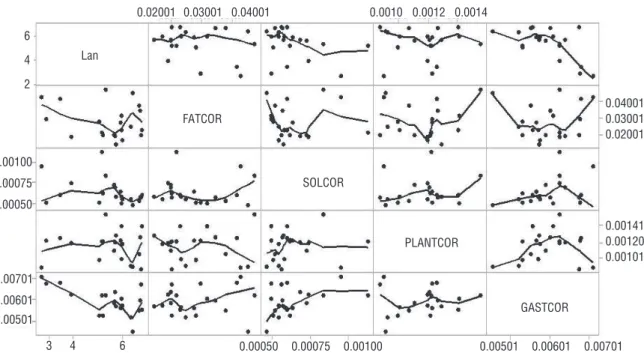
Figure 1 shows the data dispersion according to each of the variables ana-lyzed. Furthermore, it was possible to identify the relationship between values corresponding to variables together.
Figure 1. Influence of body composition on the aerobic capacity [N = 23].
Lines show the average values of each animal. Points identify the real value presented by the animal (no correction by the average). Lan: Anaerobic Threshold. SOLCOR: Soleus Muscle Mass corrected by the animal’s weight. FATCOR: Visceral Fat Mass corrected by the weight of each animal. PLANTCOR: Plantaris Muscle Mass corrected by the weight of each animal. GASTCOR: Gastrocnemius Muscle Mass corrected by the weight of each animal.
accumula-Effect of body composition on swimming exercise performance Castoldi et al.
When observing the inluence factor of the soleus muscle on CAER, it was found that this muscle has a negative inluence on the density / performance relationship by 13% (R² = 13.1). hus, soleus does not seem to be the main muscle acting in the swimming exercise (Table 1). As the plantar muscle, which showed the lowest interference on CAER after isolated veriication (R² = 0). It was also observed that the line is not related to the density values and Lan obtained for each animal after adjusted analysis (Table 1). However, it was found that the negative inluence of density of the gastrocnemius muscle on the aerobic performance of animals was higher when compared with other variables (33.7%) (Table 1).
Table 1. Variable anaerobic threshold response as a function of the following predictor variables visceral fat mass, soleus muscle mass, plantaris muscle mass, gastrocnemius muscle mass
Variable R-sq Regression line
FATCOR 05.0% LANCOR = 6.241 - 27.39 FATCOR
SOLCOR 13.1% LANCOR = 7.222 - 2746 SOLCOR
PLANTCOR 00.0% LANCOR = 5.571 - 86 PLANTCOR
GASTCOR 37.0% LANCOR = 12.60 - 1200 GASTCOR
Lan: Anaerobic Threshold. SOLCOR: Soleus Muscle Mass corrected by the animal’s weight.
FATCOR: Visceral Fat Mass corrected by the weight of each animal. PLANTCOR: Plantaris
Muscle Mass corrected by the weight of each animal. GASTCOR: Gastrocnemius Muscle Mass corrected by the weight of each animal. R-Sq = R² value.
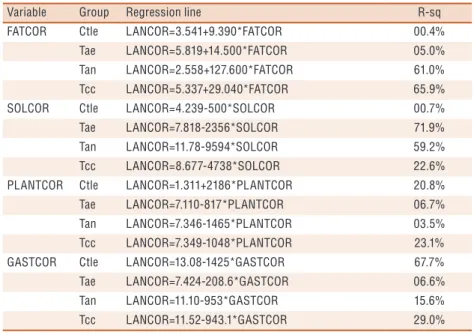
Examining the inluence of each treatment on C
AER, it was found
that the greater the muscle mass, the smaller the Lan value.
Prob-ably, increasing muscle mass generated by training models negatively
inluenced loatability, resulting in decreased performance (Table 2).
Table 2. Variable response anaerobic threshold as function of depending on the predictors variables and grouped by training.
Variable Group Regression line R-sq
FATCOR Ctle LANCOR=3.541+9.390*FATCOR 00.4%
Tae LANCOR=5.819+14.500*FATCOR 05.0%
Tan LANCOR=2.558+127.600*FATCOR 61.0%
Tcc LANCOR=5.337+29.040*FATCOR 65.9%
SOLCOR Ctle LANCOR=4.239-500*SOLCOR 00.7%
Tae LANCOR=7.818-2356*SOLCOR 71.9%
Tan LANCOR=11.78-9594*SOLCOR 59.2%
Tcc LANCOR=8.677-4738*SOLCOR 22.6%
PLANTCOR Ctle LANCOR=1.311+2186*PLANTCOR 20.8%
Tae LANCOR=7.110-817*PLANTCOR 06.7%
Tan LANCOR=7.346-1465*PLANTCOR 03.5%
Tcc LANCOR=7.349-1048*PLANTCOR 23.1%
GASTCOR Ctle LANCOR=13.08-1425*GASTCOR 67.7%
Tae LANCOR=7.424-208.6*GASTCOR 06.6%
Tan LANCOR=11.10-953*GASTCOR 15.6%
Tcc LANCOR=11.52-943.1*GASTCOR 29.0%
Lan: Anaerobic Threshold. SOLCOR: Soleus Muscle Mass corrected by the animal’s weight. FATCOR: Visceral Fat Mass corrected by the weight of each animal. PLANTCOR: Plantaris Muscle Mass corrected by the weight of each animal. GASTCOR: Gastrocnemius Muscle Mass
he aim of this study was to observe the physical performance of Wistar rats in liquid medium based on body composition. It was found that animals that had greater mass in the Gastrocnemius and Soleus muscles showed lower anaerobic threshold values, and therefore lower CAER. his can be explained by the decreased loatability, making it harmful to the swimming mechanics.
he inding in this study corroborates results reported by Araujo et al.4, who when evaluating obese animals, found that they had higher C
AER
values. In this sense, the inclusion of body composition values when LAN is used as reference for performance is necessary.
It was observed that when evaluating animals with higher fat percent-age, they show better performance due to their better loatability. his can lead to false positive results since it overestimates the real anaerobic threshold value, and therefore, CAER.
he efect of diferent types of exercises was previously described by Voltarelli et al.3. he authors found that C
AER can be ergometer
depend-ent. hat is, depending on the exercise model used, the animal may have diferent anaerobic threshold values.
In the present study, exercise models in liquid medium were used with the aim of obtaining the degree of interference of body fat and muscle density. As the swimming exercise sufers interference from animal loat-ability, lower performance of animals showing higher muscle mass was found, which was speciically attributed to TAN and TCc.
It is likely that the use of a diferent ergometer could favor animals with greater muscle mass. In this case, a protocol using treadmill could be able to provide better performance, since it inluences loatability. Moreover, in the latter case, the favoring factor of body fat in liquid medium could be an aggravating factor in treadmill exercise or other protocol carried out in dry conditions.
According to Araujo et al.4, protocols using animal models have gained
prominence in the area of exercise physiology. However, there is still lack of physical testing protocols to simulate efort so that it can be adapted or extrapolated to human beings 10. hus, the accurate determination of C
AER
becomes substantial for conducting animal studies.
he indings of this study may serve as a parameter for the prescrip-tion of exercise intensity in studies using animals in swimming exercises. Identifying the efect of a particular variable on loatability and perfor-mance can minimize the favoring of certain animals, particularly if they are submitted to exercise protocols that may result in increased muscle mass or hyper caloric diet, in this case, the increase in body fat percentage.
Effect of body composition on swimming exercise performance Castoldi et al.
CORRESPONDING AUTHOR Robson Chacon Castoldi Rua Roberto Simonsen, 305- CEP: 19060-900 - P. Prudente/SP, Brasil.
E-mail: [email protected]
Future studies will contribute to literature based on the development of measurement techniques to identify in vivo fat percentage. hus, prescrip-tion can be made before the training period.
CONCLUSION
It was concludes that, when the performance of animals in the aquatic environment was evaluated, the increase in epididymal adipose tissue had a positive inluence on the physical performance of animals and the increased muscle mass showed negative inluence.
REFERENCES
1. Gobatto CA, Alice M, Mello R De, Papoti M. Avaliações Roedores : Aplicações Ao Treinamento Em Diferentes Modelos Experimentais. Rev Mackenzie Educ Física Esport 2008;7(1):137–47.
2. Chimin P, Araújo GG, Macnchado-Gobatto FB, Gobatto CA. Critical load during continuous and discontinuous training in swimming Wistar rats. Motri 2009;5(4):45–58.
3. Voltarelli F, Nunes W, Silva A, Romero C, Garcia D, PaolI J, et al. Determinação do Limiar Anaeróbio em Ratas Obesas com Glutamato Monossódico (MSG). Rev Logos 2003;11(1):84–92.
4. Araujo GG de, Araújo MB de, DAngelo RA, Manchado F de B, Mota CS de A, Ribeiro C, et al. Máxima Fase Estável de Lactato em Ratos Obesos de Ambos os Gêneros. Rev Bras Med Esporte 2009;15(6):46–9.
5. Hill D. he critical power concept. A review. Sport Med 1993;16(4):237–54.
6. Machado J, Horie G, Castoldi R, Camargo R, Camargo Filho J. Efeito do trei-namento concorrente na composição corporal e massa muscular de ratos Wistar. Rev Bras Cienc Mov 2014;22(3):34–42.
7. Marangon L, Gobato C, Mello M, Kokobun E. Utilization of an hyperbolic model for the determination of critical load in swimming rats. Med Sci Sports Exerc 2002;34(149):45–58.
8. Ozaki GAT, Koike TE, Castoldi RC, Garçon AAB, Kodama FY, Watanabe AY, et al. Efeitos da remobilização por meio de exercício físico sobre a densidade óssea de ratos adultos e idosos. Motri 2014;10(3):71–8.
9. Shi H, Strader A, Woods S, Seeley R. he efect of fat removal on glucose tolerance is depot speciic in male and female mice. Am J Physiol Endocrinol 2007;293(4):1012–20.