Social representations of nursing students about
hospital assistance and primary health care
Representações sociais dos estudantes de enfermagem sobre assistência hospitalar e atenção primária
Representaciones sociales de los estudiantes de enfermería sobre asistencia hospitalaria y atención primaria
Felismina Rosa Parreira Mendes
I,II, Maria Otília Brites Zangão
III,
Maria Laurência Grou Parreirinha Gemito
III, Isaura da Conceição Cascalho Serra
IIII Universidade de Évora, School of Nursing, Center for Research in Sport, Health, and Human Development. Évora, Portugal.
II Universidade de Évora, School of Nursing, Interdisciplinary Center of Social Sciences. Évora, Portugal.
III Universidade de Évora, School of Nursing. Évora, Portugal.
How to cite this article:
Mendes FRP, Zangão MOB, Gemito MLGP, Serra ICC. Social Representations of nursing students about hospital assistance and primary health care. Rev Bras Enferm [Internet]. 2016;69(2):321-8. DOI: http://dx.doi.org/10.1590/0034-7167.2016690218i
Submission: 05-08-2015 Approval: 11-04-2015
ABSTRACT
Objective: To analyze how social representations of hospital and community care are structured in two groups of nursing students – 1st and 4th years. Method: Qualitative research oriented by the Theory of Social Representations. We used a questionnaire
with Free Association of Words. Data were analyzed in the Software IRaMuTeQ 0.6 alpha 3. Results: We applied the method of Descending Hierarchical Classifi cation and obtained four classes. Class 4 has the largest social representation (30.41%) within the corpus. The two organizational axes are nurse and disease/patient in the central core. On the periphery are the care and help related to the nurse and the treatment and prevention associated with the disease. Conclusion: Social representations focus on disease/patient and on the role of nurses in the treatment, prevention, and care. Health promotion and the social determinants of health are absent from the social representations of students.
Key words: Nursing Students; Nursing Education; Hospital Assistance; Primary Health Care; Skills-Based Education.
RESUMO
Objetivo: analisar como se estruturam as representações sociais dos cuidados hospitalares e comunitários em dois grupos de estudantes de enfermagem – 1º e 4º anos. Métodos: pesquisa qualitativa orientada pela Teoria das Representações Sociais. Utilizou-se um questionário com Associação Livre de Palavras. Os dados foram analisados no Software IRaMuTeQ 0.6 alpha 3.Resultados: aplicou-se o método da Classifi cação Hierárquica Descendente e obtiveram-se 4 classes. A classe 4 tem a maior representação social (30,41%) do corpus. Os dois eixos organizadores são enfermeiro e doença/doente no núcleo central. Na periferia destaca-se o cuidado e ajuda ligados ao enfermeiro e o tratamento e a prevenção associados à doença. Conclusões:
as representações sociais centram-se na doença/doente e no papel do enfermeiro no tratamento, prevenção e cuidado. A promoção da saúde e os determinantes sociais da saúde estão ausentes das representações sociais dos estudantes.
Descritores: Estudantes de Enfermagem; Educação em Enfermagem; Assistência Hospitalar; Atenção Primária à Saúde; Educação Baseada em Competências.
RESUMEN
INTRODUCTION
The performance of this study started from the daily life of the authors, professors of a school of nursing, who for years have questioned themselves about the hegemony of the clinic, based on in-hospital care and on the curricular structure of the several plans of the nursing program. This conceptual hege-mony tends to dominate the process of knowledge and skills acquisition throughout the program on the part of the students. Then, the challenge of performing this study arose, with the objective of analyzing Social Representations (SR) of nursing students, from the 1st and 4th years of the program, about
hospi-tal and community care, and verify that the apparent hegemony of the early years during the education process of the students models their SR about hospital and community care.
Studies carried out in other countries(1-2), namely Brazil,
show a similar reality with students representing public and community health in a predominantly negative way, and the nursing profession focused on patient care. They also noted that the technicality and the strong biological conception of contents dominate the education in nursing, which leads to a professional profile that is not prepared to meet the chal-lenges of integral attention to health in terms of promotion, prevention, early attention, and rehabilitation of individuals and populations.
In schools, if within the theoretical concepts of holism and care dominate the conceptions underlying the education of students, is, however, the performance and the training of technical and instrumental procedures that are privileged, with clinical teachings that occur mostly in hospital settings. Even though a few curricula have given emphasis on Primary Health Care in the 1990s, nursing teaching has been consis-tent and traditionally focused on the preparation of nurses to nursing practice in different care settings(3).
Before the hospital-centrism that continues to dominate the curricula of the nursing program, we try to understand how this concept is expressed in the SR of the students regarding hospital and community care, making a comparison between students of the 1st year (who are beginning the program), who
have not had contact with the contents of the curricular units of the study plan yet, and students of the 4th year (at the end of
their academic path).
The option for the 1st and 4th year students lies in the fact
that we are faced with individuals who built their SR from the common sense (1st year) and scientific universe (4th year),
with important implications in professional practice. The SR orient the behaviors and practices and, therefore, justify the positions and behaviors. The SR built by students express a symbolic reality, not apprehensible in a first approximation, which has the capacity to mobilize the reality by generating and guiding behaviors and attitudes(4).
In addition, they (SR) not only influence the practices of care in each of the work contexts (in-hospital and community care), but they also influence future options for professional work context. Recently graduated nurses opt predominantly for professional practice in hospital care to the detriment of community care. Over the years, it has been verified that, of the 35 students recently graduated annually at the University of Évora, just a small percentage opt to start their career in community health(5).
This study aims to analyze how social representations of hospital and community care are structured in two groups of nursing students – 1st and 4th year.
Education in nursing: From hospital-centrism to commu-nity care
In Portugal, nursing teaching followed, for many years, a hospital-centered orientation accomplished in the importance and weight consensually attributed to clinical areas, and in the curricula of nursing programs, according to Flexner’s forma-tive models. This orientation was based on the conception of hospital as the central paradigm of the health system and the base of technological intervention, inseparable from the cure of the disease. In this scenario, community health care had a secondary role, which was translated in social devaluation not only of the provided care, but also of professionals (namely doctors and nurses) who worked with this type of care(6).
The primary health care reform, which started in Portugal in the 1970s and was accomplished in the late 1990s, with the aim of refocusing the provision of care – from the hospital to the community – greatly contributed to reverse the situation of hospital-centrism of health care and of nursing education itself. However, this reform encountered, for many years, the weight of history – a strong social distrust in face of health care in the community.
Historically, nursing education was centered on a medical/ clinical model based in the field of technical procedures of diagnostic and treatment, in which the curricula in nursing teaching expressed a fragmented care, giving rise to a con-cern for the values of a person-centered approach(7). It was Isaura da Conceição Cascalho Serra E-mail: [email protected]
CORRESPONDING AUTHOR
tiene la mayor representación social (30,41%) del corpus. Los dos ejes organizadores son enfermero y enfermedad/enfermo en el núcleo central. En la periferia se destaca el cuidado y la ayuda ligados al enfermero y el tratamiento y la prevención asociados a la enfermedad. Conclusión: las representaciones sociales se centran en la enfermedad/enfermo y en el papel del enfermero en el tratamiento, prevención y cuidado. La promoción de salud y los determinantes sociales de la salud están ausentes de las representaciones sociales de los estudiantes.
The social representation of nursing community continues to be oriented by a lower status and social valuation, precisely for being away from contexts in which technology, intensiv-ist care, and emergency situations dominate – phenomena historically inseparable of the affirmation of skills and social valuation of nurses(12).
These concepts are far from the modern concept of health promotion, which suggests the union of individual efforts, collective and institutional actions to intervene in the day-to-day reality of individuals and communities, to solve health problems of the population, and to improve their quality of life. In this sense, all actions and/or omissions concerning self-care are related to models, socio-cultural values, and beliefs. Therefore, not only the individual options, as the biologicist model proposes, determine health conceptions and practices in the western world. The process of health and illness and the demand for care should be designed as a dynamic, historical, and social processes(13).
If in the political field the public/community health came to be conceived as the support network of the communities individually and collectively considered and began to domi-nate the agendas of health, the same did not happen in cur-ricula of basic education of future nurses.
This study aims at analyzing how social representations of hospital and community care are structured in two groups of nursing students – 1st and 4th years.
METHOD
This is a qualitative research oriented by the Theory of Social Representations (TSR), extensively used in nursing. It enables researchers to gather the participants’ own interpreta-tion of the reality they intend to study, allowing to understand attitudes and behaviors of a social group. It is a type of knowl-edge socially organized and shared(14).
Some authors claim that TSR can be a way to try to explain that there may be differences between the ideal of a thought according to science, reason and reality, and thinking in the social world(15). This world needs to be captured and
under-stood when you intend to propose transforming actions for a particular group. Such actions are those that enable to modify the beliefs and the values underlying the models and practices (formative, in this case) of individuals or groups.
The sample consisted of 132 students of the Nursing Teach-ing TrainTeach-ing Program (CLE) of the School of NursTeach-ing at the University of Évora (ESESJDUE), being 71 of the 1st year and
61 of the 4th year. All students from 1st and 4th years who have
agreed to participate integrate the study. All of them signed an informed consent form.
In data collection, we used a questionnaire composed of two parts. In the first were the socio-demographic variables and in the second were two inductor stimuli, using the tech-nique of Free Association of Words. Data were collected dur-ing the years of 2012 and 2013. For the treatment of sociobio-graphical data we used IBM® SPSS® Statistic Software version
20; we performed the analysis in IRaMuTeQ Software ( Inter-face de R pour les Analyses Multidimensionnelles de Textes et
concerned for training professionals with skills and abilities who would ensure the provision of in-hospital care, led to the cure of disease and symptom relief, and who expressed the technical rationality inherent to the biomedical perspective.
From the 1970s, with the reconceptualization of health by the World Health Organization (WHO) and the occurence of different international health conferences, in particular Alma-Ata (1978), changes in health policies arose and, conse-quently, a reconfiguration and valuation of health care in the community was perceived, with the main investment being directed to health promotion and disease prevention by en-couraging and making individuals responsible for their health and its maintenance. These facts had also their impact and marked nursing teaching(8). The objective was to make
nurs-ing practitioners/nurses able to act alongside the individual or within the community in the three levels of prevention, and also to prepare them to be able to study and solve the health problems of a community(9).
In the early 1980s, the expectation of care and the contri-butions of social sciences and humanities began to be valued in the curriculum, relieving the subjugation to biomedical per-spective(4), but still with the odds underlying the cure of the
disease, and therefore the hospital care, to be central to the education.
In 1988, with the integration of nursing teaching in high-er education, is clearly assumed that the technical-scientific preparation of future professionals should focus on three lev-els of prevention and be directed to the individual, families, and community(10).
About ten years later (1999), the investments in out-hospital health care became stronger, being included in the curriculum of the nursing program theoretical and theoretical-practical disciplines and clinical teaching directed to the provision of care in the community, focusing on the needs of each user, including the individual, the family, and community groups in care and still seeing the family as the unit of care.
Simultaneously, the conceptual matrix followed is the one based on the recommendations of the World Health Orga-nization (WHO) and on the International Council of Nurses (ICN), in addition to the principles set out in the Ordem dos Enfermeiros [Order of Nurses] (OE), that resulted in a set of concepts that should support the acquisition of skills of stu-dents aiming at building an independent socio-professional identity. The formative process needed to capture and main-tain independence and autonomy made of questioning of ex-isting models, affirmation of alternative models, and integra-tion of new scientific developments.
de Questionnaire) 0.6 alpha 3, developed by Pierre Ratinaud, which allows performing statistical analysis of textual corpus and of individuals/words tables(16). The corpus consists of 398
Initial Context Units (UCI) with 268 segments examined, i.e., 64.32% of total corpus.
The study was carried out according to the recommenda-tions of the Declaration of Helsinki of the World Health Or-ganization and the European Community regarding research involving human beings. We also obtained authorization from the Ethics Committee/Health and Welfare Area of the Univer-sity of Évora.
RESULTS
Of the 134 students included in the study, 52.98% were in the 1st year and 45.52% were in 4th year of CLE.
Most of the students are female, accounting for 79.85%, and only 19.4% are male, which is justified by the fact that nursing is still a mostly female profession. According to data from 2014 of the Order of Nurses, there were 66,452 nurses in Portugal, of which 54,374 (81.82%) were female and 12,078 (18.17%) were male. In Europe there are no data available for 2014, but in 2012 this trend was identical in both national and European scenarios(17). We also verified that, per education
area, the female sex is mostly inserted in the area of Health and Social Protection (76.6%), following Education (80.7%)
(18); on the other hand, in the European panorama are only
provided data regarding 2012, being this trend maintained(19).
Regarding the variable age of students, it is among the 15-19 years and 40-44 years, with most in the range of 20-24 years with 50.75%, followed by the range of 15-19 years with 37.31%. We also found that a small percentage is aged above 30 years, which is due to the new admission mode of students in higher education, “Above 23 years of age”. Higher edu-cation by the age of 23 is intended to candidates who have 23 years or more, or those who will be 23 years of age until December 31 of the year in which they apply for, and are not qualified to apply for the general quota, such as, for example, insufficient schooling or lack of admission test.
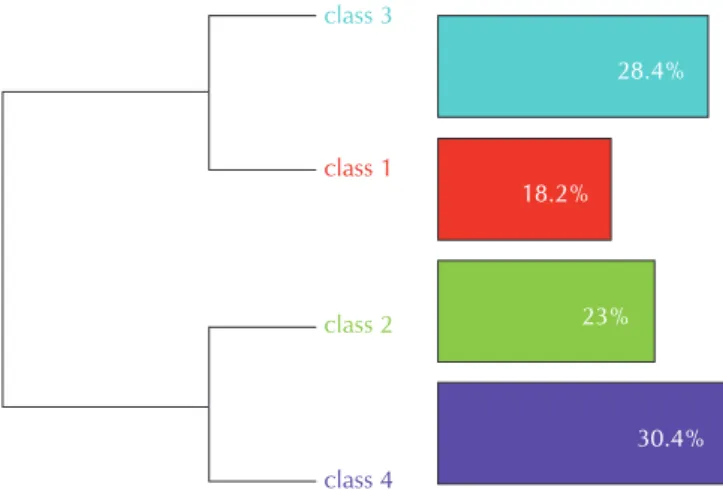
The corpus consists of 398 Initial Context Units (UCI) with 268 segments examined, that is, 64.32% of total corpus. From arrays crossing segments of text and words, we applied the method of Descending Hierarchical Classification (DCH) and obtained four classes (Figure 1).
The Descending Hierarchical Classification dendrogram (Figure 1) allows us to understand the expressions and each of the words spoken by the participants, analyzing them from their social places and insertions(20).
In this figure, which illustrates interclass relationships, readings should be taken from top to bottom, that is, at first, the corpus was divided into two subgroups. Secondly, the higher subgroup was divided into two, from which classes 3 and 1 resulted, and the lower subgroup was also divided into two classes, namely classes 2 and 4. This means that classes 1 and 3 have a lesser relationship or proximity with classes 2 and 4. Class 3 has greater relationship or proximity with class 1, as well as class 2 has greater relationship or proximity with
class 4. The DCH ended here because the four classes were stable, that is, they were composed of Elementary Context Units (UCE) with similar vocabulary.
When performing factorial correspondence analysis (FCA), the IRAMUTEQ allowed visualizing, in the form of a factorial plan, the opposition arising from DCH. As shown in Figure 2, we may observe that the four classes are in opposite quad-rants, i.e., each class covers specific semantic contexts, which refers to the semantic root of the word that interfered the most in the class and allows understanding the action of the attri-bute variables and of the four classes observed.
On the vertical axis are two groupings of words that ex-plain 38.18% of the total variance of the UCE and refer to two semantic fields: one in the higher plan, with class 2 contribu-tions, and the other in opposition, in the lower plan, in which the words from classes 1, 3, and 4 are.
Class 2, which refers to the hospital care, appears distant from the other classes. As for classes 1, 3, and 4, though ar-ranged in the same factorial axis, they appear agglomerate on the horizontal axis, explaining 32.95% and referring to a set of care inherent in the process of caring for patients. The analysis of the dendrogram (Figure 1) and the factorial plan (Figure 2) draw attention to the fuzzy mode of social representations that students have about the care provided in different contexts (hospital and community).
We found that in class 1 the central word is help, followed by welfare, care, and society; in class 2, the central word is a nurse, followed by doctors, hospitalization, and resource; in class 3, the central word is treatment, followed by vaccine, communicating, and screening; and in class 4, the central word is education, followed by urgency, prevention, and pro-motion. It should be noted that class 4 is the one that has the greater social representation (30.41%) of the corpus, followed by class 3 (28.38%). Then, there is class 2 (22.97%) and fi-nally class 1 (18.24%).
It should be noted that classes 1 and 3 are close in the factorial plan, but there is a separation of concepts, pointing to the domination of responsibility, quality, society, help, care, and welfare in class 1 (1st year students), and the treatment
class 3
28.4%
18.2%
23%
30.4%
class 1
class 2
class 4
disease/patient in the central core. In an area of the periphery outstands the care and help directly linked to nurse, and in another zone of the periph-ery are treatment and prevention associated with the disease.
The word cloud groups and organizes the words graphically depending on their frequency. It is a simpler lexical analysis, however graphically quite interesting, to the extent that it enables the rapid identification of keywords of a corpus.
In the cloud of words more evoked by students outstands nurse, disease/patient, treatment, preven-tion, care, and help. We can also see words such as education, hospitalization, attention, older adults, responsability, educating, disease, treatment, care, and prevention. We can perceive that the word cloud confirms the results previously mentioned.
DISCUSSION
The process of building the representations is associated around four classes, with a central core that features two organizational axes, nurse and disease/patient.
The two organizational axes of the represen-tation of students refer to a social represenrepresen-tation dominated by hospital-centrism, in which the practice of nursing is expressed and assumes as reference patient/disease.
Notes: [resource / nurses / hospitalization / center / comfort]; [voluntary work / society / care / support]; [teaching / educating / prevention / promotion]; [disease / treatment / wel-fare / help / quality / cure / responsibility / screening / communicating / vaccine / recovery]
Figure 2 – Factorial Correspondence Analysis
Notes: [informing / population / screening / promotion / prevention / education / teaching / treatment / recovery / support / orienting / vaccine / voluntary work / medicine / disease]; [nurse / hospitalization / resource / comfort / hygiene / com-munity / center / patient / hospital / care / need / solidarity]; [care / planning / society / welfare / quality / monitoring / hospital care / proximity / responsibility / older adults / help / multidisciplinarity]
Figure 3 – Similitude dendrogram dominates class 3 (students in 25-29 years group). On the
oth-er hand, thoth-ere is a proximity between classes 2 and 4 in toth-erms of factorial plan, but a greater dispersion of concepts in these two classes. Nevertheless, it is possible to affirm that class 2 adds concepts closer to the tradition of hospital care (female sex and higher age) and is more distant from all others. Class 4 presents concepts related to preventive and health promo-tion philosophy, with the educapromo-tion of patients/populapromo-tions (4th year students).
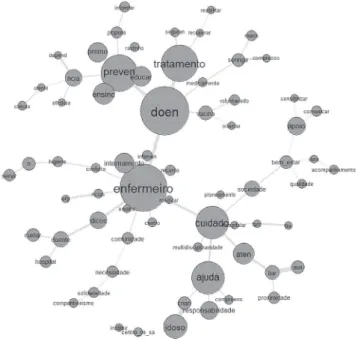
The analysis of similitude or similarity is based on graph theory, for a graph is the ideal mathematical model for the study on the relationships between discrete objects of any type and allows identifying the co-occurence among the words and the outcome, bringing indications of the connectedness be-tween words, assisting in the identification of the structure of a textual corpus, also distinguishing the common parts and the specifics on the basis of illustrative variables (descriptive) identified in the analysis(21). This analysis of similarities
en-abled visualizing the relationship between the words and their connectivity within each class and, on the other hand, the link between the several classes. With this analysis we were able to understand how students relate the various words to describe their SR of hospital and community care.
The theory of SR tells us that it is precisely in the everyday social interactions and formative spaces that the object of care or the representation of professionalism (identity) are mutually built. This means and requires not only new interpretations, but a broadening of the concept of health care to promote a comprehensive and interactive vision of the individual and collective health issues nowadays(22).
Hospital-centrism has dominated the nursing education over time and finds its support bases in the Flexner Report (1910), which advocated teaching focused on disease and the hospital as an institution of reference both for teaching and for clinical practice.
Historically, the community health was absent, during long years, from the agenda of health and health education, and only after the Alma-Ata Conference (1978) the emphasis on primary prevention and health promotion put nurses in key positions as health care role models, advocates, and provid-ers. The inclusion of these health concepts in the nursing cur-ricula can give students the knowledge and skills required to educate patients about specific strategies to improve health(23),
which is felt by the students interviewed.
If the privileged place of flexnerian theses was the academy, it is also true that its impact has spread to society and, even to-day, to the common sense, the whole universe of health is in-separable from the disease and the context in which assumes legitimacy – the hospital.
The concepts that dominate the periphery linked to dis-ease/patient are treatment and prevention, and the concepts that dominate the periphery linked to nurse are care and help, concepts ancestrally inseparable from the nursing profession. It is paradigmatic that the concepts present in the periphery linked to the nurse (care and help) dominate the SR of first-year students of the course, and in this sense are built from common sense and their worldview, since the contact with the contents of the curriculum had not yet occurred when they were interviewed.
Regarding age and sex variables, outstands, in female and of higher age students, SR based on concepts inseparable from hospital care. Some authors point out differences according to gender issues, in which, in the female sex, evocations of humanization, dedication, and team most frequently occur. These evocations, namely humanization, reflect the relevance and the growing educational (and public) concerns before the humanization policy of health services, both in Portugal and in most countries. The female gender seems to gather and carry the responsibility for ancestral values in the nursing his-tory, from which humanization and dedication are just two examples.
Also regarding the age of students(24), it should be noted
that the vocational behavior is developed as the individual progresses in age(25).
We found that classes with greater representativeness in the corpus and in which the variable year course (seniors) and age are refer to dominant concepts of hospital-centrism, though permeated by concepts that traditionally dominate the perfor-mance of nursing in the community. A possible explanation for these SR may reside in the fact the senior students, in the
4th year of the course, perform two clinical
teachings/intern-ships in community care. But, even here, is the prevention of disease that outstands, and not health promotion.
There are authors who emphasize in their study on SR of the students about health promotion that SR do not vary de-pending on the year of formation, but on the social involve-ment of students in the academic life and their personal inter-est on the topic(13). Other authors state that in the accounts of
students do not emerge the idea that nurses working in hos-pitals can provide care centered on family, which no longer happens in the context of community care(26). This means that
students understand hospital and community care as contexts to refer to completely different spheres of activity (patients in the hospital and their families in the community).
This is one of the reasons why some authors claim that aca-demic education is a hegemonic factor within the fragmenta-tion of practices(27). Others state the same, claiming the need
for change in the education of professionals, which requires new methodological elements and new practice environ-ments, closer to the reality of the population(13).
The criticism of the hospital-centered approach in educa-tion, considered way too biologicist, is also emphasized for denying the social determination of health and for produc-ing a reductionist approach of knowledge(28). In pedagogical
terms, this is considered a mass, passive model with harmful effects on the education of health professionals.
If the academic education of nurses reflects the influences of the Flexner Report, and if it is true that these health profes-sionals have given enormous contributions to health over the past century, today a model of education of flexnerian bases is inadequate to meet the health challenges of the 21st
cen-tury, when health care more and more based on a community care(28). Flexnerian education is not consistent with the current
challenges because it is fragmented, focused on overcome de-mographic and epidemiological realities, not training profes-sionals to face contemporary health issues.
In current society, health and all its practices are recog-nized as a result of a social and political process whose mate-rial conditions inevitably pervade the nursing practice(29). The
current health contexts require nurses to have an education capable of responding to new challenges and new practices, and a comprehensive and interactive vision of social and health issues, in line with the complexities of these areas and the plurality of society nowadays(22).
CONCLUSION
The process of building students’ SR refers to the hegemon-ic model of education dominated by the flexnerian model, by hospital-centrism in forth-year students, and by common sense in first-year students.
position of power, as professionals who teach and educate hygienist measures and those of disease prevention.
The SR of the students do not show the changes of educa-tion in terms of community care either, whose syllabus began to integrate the curriculum of the program and are present, through several theoretical, theoretical-practical, and practical curriculum units in 3 years of the program, for more than 12 years. This fact allows questioning if the SR of nursing students about hospital and community care is related to the contents they are acquiring and developing throughout their education, or if the results do not do more than confirm the continuing hegemony of hospital-centrism, in the academy and society, and point to the need to rethink the formative models.
The current society and the new dynamics of health need nurses who are politically and socially involved and who de-velop a practice of action-reflection in their everyday lives re-garding each of the different work contexts, and not nurses
that limited the care to one or several techniques, according to the hospital-centrism tradition.
To conclude, we point the benefits and limitations of the study. Its main contribution is that it not only corroborates several studies and analyses on the subject, but also shows the need for a critical and reflexive participation on the education and professional profile of nurses, both internal and external to the academy, which promotes new reference models and questions and fights the hegemonic models socially prevalent in society, in which the professional practice of nursing is in-separable from the hospital, disease, and treatment or cure, omitting its central, unique, and decisive role on the health of individuals and populations.
The main limitation of the study resulted from the difficulty in capturing the SR of hospital and community care. The ques-tion is whether this is an inherent limitaques-tion to the study or a limitation inherent in the education model of students.
REFERENCES
1. Sousa FEM, Oliveira EN, Nunes JM, Lopes RE, Gubert FA. Percepção de estudantes de enfermagem acerca da profissão. Rev Rene [Internet]. 2010[cited 2015 Oct];11(4):110-7. Avail-able from: http://www.revistarene.ufc.br/revista/index.php/ revista/article/view/432
2. Erdmann AL, Rodrigues ACRL, Koerich MS, Backes DS, Dra-go LC, Klock P. O olhar dos estudantes sobre sua formação profissional para o Sistema Único de Saúde. Acta Paul En-ferm [Internet]. 2009[cited 2015 Jul];22(3):288-94. Available from: http://www.scielo.br/pdf/ape/v22n3/a08v22n3.pdf 3. Mackey S, Hatcher D, Happell B, Cleary M. Primary
health care as a philosophical and practical framework for nursing education: rhetoric or reality? Contemp Nurse [Internet]. 2013[cited 2015 Oct];45(1):79-84. Avail-able from: http://web.b.ebscohost.com/ehost/pdfviewer/ pdfviewer?sid=6d97b388-2a2b-4f16-a98e-69055b5048 7c%40sessionmgr198&vid=12&hid=116
4. Formozo GA, Oliveira DC. [Social representations of the care provided to HIV seropositive patients]. Rev Bras Enferm [Internet]. 2010[cited 2015 Feb];63(2):230-7. Available from: http://www.scielo.br/pdf/reben/v63n2/10.pdf Portuguese. 5. Parreira Mendes FR, Mantovani MF. [Current dynamics of
nursing in Portugal: nurses’ representations]. Rev Bras Enferm [Internet]. 2010[cited 2015 Oct];63(2):209-15. Available in: http://www.redalyc.org/articulo.oa?id=267019594007 6. Carapinheiro G. A Saúde enquanto matéria política. In G.
Carapinheiro (Org). Sociologia da Saúde. Estudos e Per-spectivas. Coimbra: Pé de Página Editores; 2006: 137-64. 7. Wood C. Choosing the ‘right’ people for nursing: can
we recruit to care? Br J Nurs [Internet]. 2014[cited 2015 Oct];23(10):528-30. Available from: http://www.ncbi. nlm.nih.gov/pubmed/24851917
8. Portugal. Ordem dos Enfermeiros. Ordem dos Enfermeiros elabora dossiê documental sobre a Legislatura de 2009/2013. Rev Ord Enferm [Internet]. 2010[cited 2015 Oct];33:11-4.
Available from: http://www.ordemenfermeiros.pt/comunica cao/Revistas/ROE33Janeiro_2010.pdf
9. Cardoso R. Caring in Silence: The Voice of Nursing in Portu-gal. Interações. [Internet]. 2012 Nov[cited 2015 Apr];22:23-37. Available from: http://interacoes-ismt.com/index.php/ revista/article/view/333/345
10. Fernandes, O. Entre a teoria e a experiência. Loures: Lu-sociência; 2007.
11. D’Espiney LMCA. Enfermeiros nas comunidades: Produção de cuidados e reconstrução identitária. [Tese]. Universidade de Lisboa [Internet]. Lisboa. 2010[cited 2015 Apr 02]; Avail-able from: http://repositorio.ul.pt/bitstream/10451/3394/1/ ulas060468_td_Luisa_d_espiney.pdf
12. Carapinheiro G. Saberes e Poderes no Hospital. Porto: Edições Afrontamento; 1993.
13. Vendruscolo C, Verdi M. Promoção da Saúde: represen-tações sociais de estudantes dos cursos de graduação na área da saúde. Rev Saude Transf Soc [Internet]. 2011[cited 2015 Feb];1(2):108-15. Available from: http://incubadora. periodicos.ufsc.br/index.php/saudeetransformacao/article/ view/516/669
14. Silva SED, Camargo BV, Padilha MI. A teoria das representa-ções sociais nas pesquisas da Enfermagem brasileira. Rev Bras Enferm [Internet]. 2011[cited 2015 Oct];64(5):947-51. Avail-able from: www.scielo.br/pdf/reben/v64n5/a22v64n5.pdf 15. Moscovici S, Hewstone M. De la science au sens
com-mun. In Serge Moscovici (Editor), Psychologie sociale. 6a ed. Paris: PUF; 1996: 539-66.
16. Camargo BV, Justo AM. Tutorial para o uso do software de análise textual IRAMUTEQ. Laboratório de Psicologia Social da Comunicação e Cognição – LACCOS. [Inter-net]. 2013[cited 2015 Apr 02]; Universidade Federal de Santa Catarina. Available from: http://www.iramuteq.org/ documentation/fichiers/tutoriel-en-portugais
Alunos matriculados no ensino superior: total e por sexo, Base de Dados Portugal Contemporâneo. 2014[cited 2015 Feb]. Available from: http://www.pordata.pt/Portugal/Alu nos+matriculados+no+ensino+superior+total+e+po r+sexo-1048
18. Fundação Francisco Manuel dos Santos. Pordata. [Internet]. Alunos do sexo feminino em % dos matriculados no en-sino superior: total e por área de educação e formação - Portugal, Base de Dados Portugal Contemporâneo. Lisboa: 2014[cited 2015 Feb]. Available from: http://www.pordata. pt/Portugal/Alunos+do+sexo+feminino+em+percentag em+dos+matriculados+no+ensino+superior+total+e +por+area+de+educacao+e+formacao-1051
19. Fundação Francisco Manuel dos Santos. Pordata. [Internet]. Mulheres no total de alunos matriculados (ISCED 5-6): total e por área de educação (%) – Europa, Base de Dados Portu-gal Contemporâneo. Lisboa: 2014 [cited 2015 Feb]. Avail-able from: http://www.pordata.pt/Europa/Mulheres+no+t otal+de+alunos+matriculados+(ISCED+5+6)+total+e +por+area+de+educacao+(percentagem)-1305 20. Austregesilo SC, Leal MCC, Figueiredo N, Goes PSA. A
Interface entre a Atenção Primária e os Serviços Odon-tológicos de Urgência (SOU) no SUS: a interface entre níveis de atenção em saúde bucal. Ciênc Saúde Coletiva [Internet]. 2015[cited 2015 Oct];20(10):3111-20. Avail-able from: http://www.scielosp.org/pdf/csc/v20n10/1413-8123-csc-20-10-3111.pdf
21. Marchand P, Ratinaud P. L’analyse de similitude appliqueé aux corpus textueles: les primaires socialistes pour l’election présidentielle française. Em: Actes des 11eme Journées in-ternationales d’Analyse statistique des Données Textuelles. JADT. [Internet]. 2012[cited 2015 Apr 02];687-99. Available from: http://lexicometrica.univ-paris3.fr/jadt/jadt2012/Com-munications/Marchand,%20Pascal%20et%20al.%20-%20 L%27analyse%20de%20similitude%20appliquee%20 aux%20corpus%20textuels.pdf
22. Zoboli ELCP, Schveitzer MC. Nursing values as social prac-tice: a qualitative meta-synthesis, Rev Latino-Am Enferma-gem [Internet]. 2013[cited 2015 Feb 02];21(3):695-703.
Available from: http://www.scielo.br/pdf/rlae/v21n3/0104-1 169-rlae-21-03-0695.pdf
23. Bryer J, Cherkis F, Raman J. Health-Promotion behav-iors of undergraduate nursing students: a survey analy-sis. Nurs Educ Perspec [Internet]. 2013[cited 2015 Oct 12];11(3):569-85. Available from: https://www.questia.com/ library/journal/1G1-352615134/health-promotion-beha viors-of-undergraduate-nursing
24. Brito AMR, Brito MJM, Gazzinelli MFC, Montenegro LC. [Social representations of Nursing students about “being nurse”]. Rev Bras Enferm [Internet]. 2011[cited 2015 Feb 02];64(3):527-35. Available from: http://www.scielo.br/ pdf/reben/v64n3/v64n3a17.pdf Portuguese.
25. Simões AJC. Motivações e expectativas profissionais dos estudantes de enfermagem: estudo numa escola da área de Lisboa. [Dissertação]. Universidade Aberta. Lisboa [In-ternet]. 2008[cited 2015 Apr 02]; Available from: https:// repositorioaberto.uab.pt/bitstream/10400.2/1229/1/ Motiva%C3%A7%C3%B5es%20e%20Expectativas%20 Profissionais%20dos%20Estudantes%20de%20En.pdf 26. Rodrigues MFMR, Costa MLV. Enfermeiro de família: que
representação? Rev Ciênc Saúde [Internet]. 2013[cited 2015 Feb 02];5?42-52. Available from: http://www.salutisscientia. esscvp.eu/Site/Artigo.aspx?artigoid=31021
27. Reis CB, Andrade SMO. Representações sociais das en-fermeiras sobre a integralidade na assistência à saúde da mulher na rede básica. Ciênc Saúde Coletiva [Internet]. 2008 Feb[cited 2015 Feb 02];13(1):61-70. Available from: http://www.scielo.br/pdf/csc/v13n1/10.pdf
28. Almeida FN. [Recognizing Flexner: an inquiry into the production of myths in medical education in contem-porary Brazil]. Cad. Saúde Pública [Internet]. 2010[cited 2015 Feb 02];26 (12):2234-49. Available from: http:// www.scielo.br/pdf/csp/v26n12/03.pdf Portuguese. 29. Keepnews D. Mapping the Economic Value of Nursing: A