RESEARCH
Quality of life and accession to the pharmacological
treatment among elderly hypertensive
Qualidade de vida e adesão ao tratamento farmacológico entre idosos hipertensos
Calidad de vida y adhesión al tratamiento farmacológico entre personas mayores hipertensiva
Darlene Mara dos Santos Tavares
I, Michelle de Oliveira Guimarães
II, Pollyana Cristina dos Santos
Ferreira
I, Flavia Aparecida Dias
I, Nayara Paula Fernandes Martins
I, Leiner Resende Rodrigues
II Universidade Federal do Triângulo Mineiro, Postgraduate Program in Health Care. Uberaba, Minas Gerais, Brazil. II Universidade Federal do Triângulo Mineiro, Undergraduate Nursing Course. Uberaba, Minas Gerais, Brazil.
How to cite this article:
Tavares DMS, Guimarães MO, Ferreira PCS, Dias FA, Martins NPF, Rodrigues LR. Quality of life and
accession to the pharmacological treatment among elderly hypertensive. Rev Bras Enferm [Internet]. 2015;68(6):122-9. DOI: http://dx.doi.org/10.1590/0034-7167.2016690118i
Submission: 02-04-2015 Approval: 08-23-2015
ABSTRACT
Objective: tocompare variables obtained in adherence and non-adherence to drug treatment for hypertension, according to socioeconomic situation, time of diagnosis, self-reported morbidities, indicative of depression and quality of life. Method:
cross-sectional analytical study of 524 elderly with adherence and 505 non-adherence to the treatment. A descriptive analysis, Chi-square test and Student t test (p < 0.05) were held. Results: there was higher proportion of older subjects, indicative of morbidity and depression among those with adherence. Non-adherence subjects had lower scores in all domains and quality of life facets. Conclusion: actions favoring the adherence to pharmacological treatment should be recommended, to minimize the impact of comorbidities and improve quality of life.
Key words: Hypertension; Health of the Elderly; Quality of Life.
RESUMO
Objetivo: comparar as variáveis obtidas em situação de adesão e não adesão ao tratamento farmacológico para hipertensão arterial sistêmica, segundo condições socioeconômicas, tempo de diagnóstico, morbidades autorreferidas, indicativo de depressão e qualidade de vida. Método: estudo transversal realizado com 524 idosos aderentes e 505 não. Realizou-se análise descritiva, testes Qui-quadrado e t-Student (p<0,05). Resultados: observou-se entre os aderentes maior proporção de idosos mais velhos, morbidades e indicativo de depressão. Aqueles não aderentes obtiveram escores inferiores em todos os domínios e facetas de qualidade de vida. Conclusão: devem-se preconizar ações que favoreçam a maior adesão ao tratamento farmacológico, visando minimizar o impacto das comorbidades e melhorar a qualidade de vida.
Descritores: Hipertensão; Saúde do Idoso; Qualidade de Vida.
RESUMEN
Objetivo: comparar las variables obtenidas en el estado de cumplimiento y la no adhesión a al tratamiento farmacológico de la hipertensión, de acuerdo con las condiciones socioeconómicas, momento del diagnóstico, morbilidades auto-reporte, indicativo de la depresión y la calidad de vida. Método: estudio transversal con 524 miembros y 505 ancianos no. Una prueba de la t análisis descriptivo, prueba de Chi-cuadrado y Student (p <0,05). Resultados: se observó entre los abonados mayor proporción de sujetos de edad avanzada, indicativos de la morbilidad y la depresión. No conforme con puntajes más bajos en todas las áreas y facetas de la calidad de vida. Conclusíon: se debe promover acciones que favorezcan el más alto es el tratamiento farmacológico para reducir al mínimo el impacto de las comorbilidades y mejorar la calidad de vida.
Palabras clave: Hipertensíon; Salud del Anciano; Calidad de Vida.
INTRODUCTION
Scientific literature has highlighted that systemic hyperten-sion (SH) is the most prevalent morbidity among the elderly, above 50%, and being one of the leading causes of death(1).
The correct diagnosis and monitoring persistence are rel-evant factors to achieve the goal in the treatment and reduce cardiovascular morbidity and mortality. In this context, it is noteworthy that non-adherence to treatment has been identi-fied as the main cause of uncontrolled blood pressure(2).
A study conducted among elderly hypertensive people in Fortaleza showed that 96.5% reported to follow the treatment, however, requiring guidelines(3). A survey conducted among
elderly hypertensive patients in a primary care unit in Maran-hão showed that 60.6% were adherent, 31.8% loosely adher-ent and 7.6% were non-adheradher-ent to drug therapy(4).
Despite many advances in the SH treatment, success in con-trolling the disease in practice is limited. A survey conducted in New York showed that individuals with serious concerns about their medications tend to have lower medication adherence(5).
It is noted that several factors have been associated with poor adherence to drug treatment. A review study showed that five groups of factors influence adherence to treatment among elderly hypertensive: therapeutic regimen; socioeco-nomic and demographic aspects; services and health profes-sionals; psychosocial and cultural aspects; and family and so-cial support. It is noteworthy that the male and elderly with low income are the most vulnerable population(6).
Among the elderly hypertensive patients in a survey con-ducted in Maranhão, the lower adherence was related to low education(4). However, in a survey conducted in Santa
Cata-rina, the authors observed no relationship between medica-tion adherence and gender, income, marital status and occu-pation, among the elderly with hypertension(7).
Negative psychological aspects of hypertension are also high-lighted in a survey in Minas Gerais(8), caused by regular use of
antihypertensive medications that can contribute to sadness and dissatisfaction with the difficulty of controlling blood pressure, suggesting their relationship with clinical depression.
In addition, it is known that SH, often silent, may have a nega-tive effect on quality of life (QOL) in the affected subject(9). A
sur-vey among elderly people with hypertension in the United States observed lower QOL scores associated with lower levels of ad-herence to antihypertensive medication(10). Based on the above, it
is observed a gap on the relationship between medication adher-ence and QOL of elderly people, which is measured by a specific instrument. There is also the divergence of the influence of socio-economic factors in treatment adherence among elderly patients with SH. Thus, the objective of this study was to compare the el-derly adherent and non-adherent to drug treatment for SH, accord-ing to socioeconomic variables, time of diagnosis of hypertension, self-reported morbidities, indicative of depression and QOL.
METHOD
This study was preceded by the Research Ethics Com-mittee with Humans approval from Universidade Federal
do Triângulo Mineiro. The elderly were approached at their homes, it was presented the research objectives and Free Con-sent Term and Informed.
It is a household survey, with cross-sectional, observational and analytical design, developed in the city of Uberaba-MG, and it is part of a research project entitled “Morbidity, quality of life and function-al capacity of elderly people”, carried out by the Research Group on Public Health of the Federal University of Triângulo Mineiro (UFTM).
For the sample, it was used a list containing the name and address of the elderlies who participated in the two previous studies in 2005 and 2008, conducted by the Research Group on Public Health/UFTM. In previous projects, to calculate the sample 95% confidence was considered, 80% of test power, error margin of 4% for interval estimates and a ratio of π=0.5 for the proportion of interest. The initial sample consisted of 3.034 elderlies; however, with the losses obtained in 2012, resulted in 2.116 elderlies. Among them, there were 1.691 elderlies interviewed, being 265 canceled due to death and 160 for cognitive decline.
In this study, it was considered the following inclusion cri-teria: people aged 60 years old or older, living in the urban area of the city of Uberaba-MG, which showed no cognitive decline and that self-reported SH. There were excluded those who did not report SH (n=640) or did not respond to Morisky and Green tests (n=22). Thus, 1.029 elderlies participated.
Interviewers were selected, with previous experience in data collection and who were trained by the main researcher on how to approach the elderly, the application of instruments and ethical principles that involve research. Data collection occurred in the elderlies´ homes and the interviewer had as a reference list containing the name and address from the previ-ous project. The interviews were reviewed by field supervi-sors and, when there was inconsistent data, the interview was returned to the interviewer so he could get back in touch with the elderly again and complete it properly.
Before starting the interview, the Mini Mental State Exami-nation was applied to assess cognitive ability. The translated version and validated was used in Brazil(11).
To assess the socioeconomic profile and self-reported mor-bidities, an instrument built by the Research Group on Public Health/UFTM used in previous research since 2005 was used.
To verify adherence to pharmacological treatment for SH, the Morisky and Green Test were applied. The result ranges from 0 to 4, in which 4 means more adherent and those with 3 or less points were non-adherent(12).
The Abbreviated Geriatric Depression Scale was also ap-plied to measure the presence of indicative of depression. The version validated in Brazil was used(13). This scale consists of
15 closed questions with objective answers (yes or no). It is considered positive screening for depression when the score is greater than five points(13).
In both groups there were more female (χ²=0.170;
p=0.680), married or living with a partner (χ²=3.550; p=0.314), four to seven years of study (χ²=3.796; p=0.434) and monthly individual income of one minimum wage (χ²=6.015; p=0.305). There were more elderly people being 70├80 years old; however, there were older elderly among the adherents of pharmacological treatment (22.3%) when compared to non-adherents (16.8%) (p=0.031).
The average of SH diagnosis time was similar in both groups, corresponding to 14.95 years (SD=11.50) in adher-ents and 15.52 (SD=12.1) among non-adherent (t=0.246; p=0.437).
The non-adherent elderly to drug treatment had a higher number of comorbidities (µ = 6.58, SD = 3.0) than the ad-herent (µ = 5.86, SD = 3.14) (t = -3.724, p< 0.001).
Among those who did not adhere to drug treatment, com-pared to those who adhere, there was a higher proportion of those who self-reported: rheumatism (22.2% vs 15.6%; p=0.007); poor circulation (48.1% vs. 40.6%; p=0.016); constipation (28.7% vs 19.5%; p=0.001), kidney problems (17.0% vs 9.0%; p<0.001) benign tumors (3.2% vs 1.1%; p=0.025), vision problems (54.3% vs 46.5%; p=0.012) and indicative of depression (35.8% vs 23.9%; p<0.001), respectively.
Among adherents, 6.9% and 25.5% of non-adherents reported having already discontinued treatment. The most common reasons among the adherents were to find that they were cured (16.7%), not feeling anything (8.3%), not feeling the need for treatment (8.3%); and for adherents: not feeling anything (16.3%) believe that it should take the medicine only when they felt ill (14%) and forgetfulness (10.9%).
In both groups, the highest percentage assessed their QOL as good (50.4% of the adherents and 48.3% among non-ad-herents). Most of them were satisfied with their health, with 48.9% of the adherents and 36.6% of non-adherents.
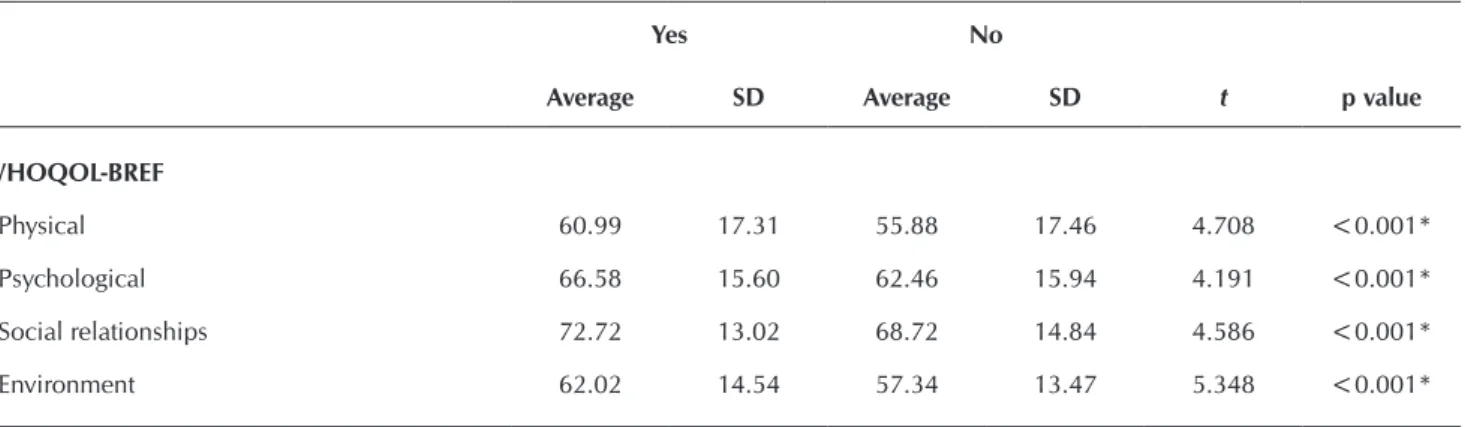
When applying the WHOQOL-BREF, in both the lowest score was found in the physical domain and the biggest in social relations; non-adherents elderly had significantly lower scores on the physical, psychological, social relationships and environment (Table 1).
World Health Organization Quality of Life Old (WHOQOL-OLD) consists of 24 items of Likert scale assigned to six facets: sensory abilities; autonomy; past, present and future activities; social participation; death and dying; and intimacy(15).
Although the questionnaires can be self-administered, it was decided to interview them because of possible difficulty of reading or understanding the items outlined in the ques-tionnaire, as well as potential vision problems presented by the elderly people.
The variables considered in this study were socioeconom-ic - gender; age group in years; marital status; education in years of study; individual income in minimum wages; time of diagnosis of SH in years; self-reported morbidity; adherence to pharmacological treatment for SH; discontinuation of treat-ment and reason; indicative of depression; QOL domains and facets of the WHOQOL-BREF and WHOQOL-OLD.
From collected data two groups were created: Group 1 (el-derly adherents to drug treatment for SH, n=524) and Group 2 (elderly who do not adhere to drug treatment for SH, n=505). An electronic spreadsheet in Excel® program was built. The
collected data were processed on a microcomputer by two researchers, with double entry, and subsequent verification of the existence of inconsistent records. Then, it was proceeded to verify the consistency between the databases. When in-consistent data were identified, the original interviews were revised and the correction was performed. The database was transported to the software Statistical Package for Social Sci-ences (SPSS), version 17.0, continuing with data analysis.
The statistical analysis was held through the distribution of absolute frequencies and percentages for categorical variables and measures of centrality (average) and dispersion (standard deviation) for numerical variables. To compare the variables, the chi-square test for categorical variables and Student t test for numerical variables (p <0.05) were applied.
RESULTS
Among 1,029 elderlies interviewed, 50.9% adhered to pharmacological treatment for SH and 49.1% did not adhere to the treatment.
Table 1 - Distribution of median and standard deviation of domains and facets scores of quality of life according to adherence for treatment, Uberaba, Minas Gerais, Brazil, 2012
Yes No
Average SD Average SD t p value
WHOQOL-BREF
Physical 60.99 17.31 55.88 17.46 4.708 <0.001*
Psychological 66.58 15.60 62.46 15.94 4.191 <0.001*
Social relationships 72.72 13.02 68.72 14.84 4.586 <0.001*
Environment 62.02 14.54 57.34 13.47 5.348 <0.001*
The lowest scores in WHOQOL-OLD, were found in the facet of social participation and the biggest in death and dy-ing in both groups; non-adherents elderly had lower scores in sensory abilities, autonomy, past, present and future activities, social participation and intimacy (Table 1).
In Table 1 there are the average and standard deviation of QOL scores according to domains and facets.
DISCUSSION
This research corroborates a study conducted with elderly people with SH, enrolled in a family health care facility of São Luís-MA, and found that the highest percentage adhere to drug treatment (60.6%)(4).
Thus, as in this study, a research of adults and elderly with SH of a Family Health Strategy (ESF) of Londrina-PR also showed no association between genders and adherence to pharmacological treatment (p=0.060), which prevailed women in both groups(16).
Regarding to marital status, a survey conducted with el-derly people in Tubarão-SC identified a higher percentage of married in both groups, no significant association with adher-ence to pharmacological treatment for SH (p=0.068)(7) and
this research. Even with these results, it should be noted that the scientific literature indicates that the family often repre-sented by the spouse, has a fundamental role in adherence to pharmacological treatment for SH as well as in adapting to changes in lifestyle imposed by the disease(17).
In the study of Londrina, education also was not associ-ated with adherence to pharmacological treatment (p=0.167)
(16). However, an integrative review study identified in national
and international literature that low educational levels may be associated with lower adherence to pharmacological treat-ment for SH(6). Elderly with few years of education or illiterate
may have difficulty understanding the written prescriptions, thus affecting adherence to treatment(17). Thus, health
profes-sionals should guide clearly and simply prescriptions, consid-ering the level of education of the elderly.
Similar with the results of this research, in the study conduct-ed in Tubarão-SC, income was not associatconduct-ed with adherence to pharmacological treatment for SH in the elderly (p=0.800)(7). It
is possible, though not investigated, the free supply of medicine by the National Health System, favoring this result. Moreover, national studies of elderly point out that the lower the socioeco-nomic status, the lesser knowledge about the disease and more difficult access to health services, which could reflect in lower adherence to pharmacological treatment(6,17).
A research conducted in Londrina-PR also highlighted the association of adherence with pharmacological treatment for SH with increasing age (p<0.001)(16). With aging, people
be-come more susceptible to chronic diseases, which can cause major concern with their health situation and influence the better/greater adherence to pharmacological treatment for SH(16), justifying the data found in this study.
As for the time of SH, a study conducted in Tubarão-SC with elderly people with SH found that the average of SH di-agnosis time was similar among those adherents (11.5±9.8 years) and non-adherents (10.5±8.3 years) to treatment for SH(7), being similar to this research.
Corroborating also the results of this study, a research con-ducted with adults and elderly from data from the National Survey by Household Sample (PNAD) showed a lower pro-portion of non-adherent to pharmacological treatment for SH among those who had more comorbidities (p<0,0001)
(18). However, the presence of comorbidities may lead to the
increased use of medication by the elderly and more medica-tion doses that together with inadequate knowledge about the therapy can hamper treatment adherence.
Health education can be a useful tool to minimize or avoid the impact of these factors on adherence to medicine for SH(6).
Thus, it is important for nurses to perform follow-up actions and monitoring the health of the elderly in order to contribute to iden-tify difficulties about the adherence and to provide guidance.
Regarding the association between comorbidities, it is noteworthy that SH is common among individuals with arthri-tis. It is noteworthy that autoimmune diseases such as rheu-matoid arthritis are characterized by chronic inflammation of various parts of the body, reaching the cardiovascular system. Thus, it appears that the results of this study may be related to this fact; that is adherents would have less control of the dis-ease, contributing to the presence of arthritis. It is important
Yes No
Average SD Average SD t p value
WHOQOL-OLD
Sensory abilities 73.04 23.30 66.13 23.28 4.763 <0.001*
Autonomy 68.06 31.06 62.05 31.42 3.080 0.002*
Past, present and future activities 70,0 29.49 65.27 29.82 2.558 0.011*
Social participation 65.17 16.62 60.44 31.23 3.048 0.002*
Death and dying 73.88 37.30 72.50 25.36 0.691 0.490
Intimacy 72.58 33.44 67.38 19.81 3.022 0.003*
that elderly people who present other chronic disease, such as rheumatism, and use multiple medications are accompanied by the health team and advised on the relationship between arthritis and SH, emphasizing the need to proceed with the proposed treatment.
The relationship between SH and circulatory problems such as varicose veins, is described in the scientific literature. In a study developed with elderly people, it was found that those with other health problems, such as circulation prob-lems (varicose veins), tended to value less the medication treatment for SH(19) and may justify the results obtained in this
study. It is noteworthy also that the investigation of comor-bidities and polypharmacy should be carried out by the health team, in order to facilitate monitoring of the therapeutic plan to be followed by the elderly.
As for constipation, a national study found that there is less consumption of fruits and vegetables among those who do not adhere to pharmacological treatment for SH(20) and can justify
this result. However, it is necessary other studies to elucidate this relationship. It is noteworthy that the low intake of fiber in foods, can cause health problems such as constipation(21). Although not
investigated, there is possible lower intake of these foods, high in fiber, among non-adherent elderly to treatment for SH may have contributed to the higher proportion of constipation cases.
It is highlighted the importance of appropriate follow-up of therapy for SH as a favorable factor to the reduction of compli-cations, such as kidney problems(3). From this perspective, the
nurse should guide and carry out monitoring of the elderly with SH, to adequate adherence to medication use. In individuals with chronic kidney disease in the early stages, strict BP con-trol can be quite effective for non-progression of renal damage. However, those who already have protein loss need strict and proper establishment of antihypertensive medication(1).
Consid-ering these factors, it is assumed that the subjects in this study who reported the presence of kidney problems were not prop-erly adhering to medication treatment for SH.
It is noteworthy that hypertension is a highly prevalent mor-bidity and often this disease is treated without further specific investigation of the causal factors. In this case, there is the pres-ence of tumors, usually benign, such as pheochromocytoma, being secondary causes of SH. Therefore, it is possible, although not investigated that non-adherent elderly for SH treatment may have limited access, or be less frequent to health services, so the relationship between SH and the presence of benign tumors has not been investigated or the proper treatment for tumors had not yet been established. A research is suggested between the two morbidities in order to prevent complications.
In this research, a higher proportion of elderly with vision problems was identified among those who did not adhere to treatment for SH. It is suggested that visual deficiency may fa-vor the discontinuation of treatment, by the difficult to see the schedule for the medication and identification of medication and appropriate dose. Thus, it is important that the vision prob-lem is identified and corrected or mitigated early. The support of family is also important to assist and supervise the elderly(22),
especially among those experiencing visual problems in the proper use of medicines for SH, whenever necessary.
Consistent with this research, an international study of el-derly patients with SH in the US found that the presence of indicative of depression was associated with low adherence to pharmacological treatment (p<0.01)(23). In the same study, the
authors report that low social support may have negatively in-fluenced the adherence to pharmacological treatment(23).
More-over, although it has not been the focus of this research, it is possible that the presence of depressive symptoms interfere in stimulating self-care, impacting adherence to pharmacological treatment. In this sense, the healthcare team should early in-vestigate the presence of depressive symptoms among elderly people with SH, in order to minimize health risks and identify support networks for the elderly with chronic disease to encour-age them to adhere the appropriate use of medication.
Regarding to the discontinuation of treatment for SH, a re-search conducted in public service in Ribeirão Preto-SP found that 58% had adverse effects and 48% reported forgetting to take antihypertensive medication among adherent and non-adherent to the treatment for SH(2), diverging from the present study.
Although it has not been the target of this investigation, it is suggested to simplify the treatment as a strategy to provide increased adherence, but the number of associates and differ-ent morbidities and medicines used may influence adherence to treatment for SH due to therapy complexity(2). In this study,
there was a higher number of associated morbidities for those who did not adhere to medicine treatment.
Regarding the self-assessment of QOL and satisfaction with health, such a result can be explained by the fact that QOL is influenced by multiple factors, not being related only to the membership. The self-assessment of health among the elderly does not preclude satisfaction with QOL(24).
In the evaluated domains by WHOQOL-BREF, the lowest scores for the physical domain can be associated with effects of anti-hypertensive medication, which among other symp-toms can cause pain, fatigue and sleep disorders(9). The nurse
can encourage participation in groups as well as encourage the practice of physical activity for better blood pressure con-trol, helping to reduce pain and discomfort(24), enabling to
im-prove these aspects.
The highest score in the social relationships domain to both groups can be justified due to be established and built satisfy-ing relationship with family, friends and health professionals throughout their lives and valued at that stage(25). The elderly
were found to have own knowledge, expectations, values and individual experiences due to different living conditions and health. These factors may influence adherence or not to medi-cine treatment for SH. Thus,, the health team must consider and appreciate these aspects(22), which may reflect positively
in social relationships.
Comparing the groups, the lowest score in the physical domain among those non-adherent was similar to an inter-national study that identified among the elderly with SH the lowest level of medication adherence associated with lower scores on the physical component(10). Although it has not
involvement of elderly people who adhere to treatment of SH by other chronic diseases, which can influence the physical domain, since multiple morbidities may limit the functional-ity of the elderly(26). In this context, it is reinforced the need
to investigate aspects committed in this domain in order to develop strategies to minimize its impact.
Referring to the psychological domain, a research conducted in the US found that elderlies who had lower adherence to an-tihypertensive medication had lower scores on the mental com-ponent(10), consistent with this investigation. Considering the
higher prevalence of indicative of depression among non-adher-ent elderly in this investigation, it appears that this fact can result in a lower commitment to treatment because of the change of emotional state. The nurse can create strategies that aim to iden-tify the components involved in this domain to develop actions to support and psychological monitoring by the interdisciplinary team to better adherence to medicine treatment.
For the social relationships domain, , a research on elderly people with SH in the United States found that non-adherent to treatment subjects had lower social support(24), being
simi-lar to this result. Emotional changes and nervousness of some elderly affect social relationships and lead to lower adher-ence to treatment of SH(10). Such changes can be supported
by trusts, developed by the educator and motivator role of the health professional.
It should be emphasized that the support network repre-sented by social relationships can promote to improve health and greater adherence to medicine therapy(22). Health
educa-tion is highlighted in this context, strengthening links between health professionals, family and elderly, favoring personal re-lationships and trust, in order to clarify the SH, guiding for the risks of non-adherence to medicine treatment, as well as possible complications arising from no control of SH.
The lowest score in the environment among the adherents cannot indicate greater difficulty in lifestyle changes that re-quire daily adjustment(24), such as dietary changes and physical
activity. Also the complex and costly therapy, which may not be compatible with the economic reality of individuals, especially for those with multiple chronic morbidities(1), considering the
greater number of diseases among non-adherents in this study. Thus, compounds medications may be indicated in general not available for free in public services, reflecting negatively on fi-nancial resources, valued item in this domain(14).
The lowest score in social participation in both groups may be due to change in eating routine, self-care and medicine treatment, which can influence the participation of social events in order to avoid foods that influence blood pressure control(27), impacting negatively participation in daily
activi-ties, especially in the community, being an aspect examined in this facet(15). Thus, the participation of health groups and
sharing fears and insecurities can facilitate exchanges of expe-riences and coping strategies of situations experienced.
The highest scores on the facet of death and dying to both groups can be justified due to the higher percentage of 70-79 years old elderly. It is believed, at this age they have a greater reflection on the finitude of life. A survey conducted with in-dividuals aged 75 years old and older in Tocantins showed
that most respondents are not frightened to death, but with other issues such as serious illness causing physical and psy-chic dependence(26).
The lowest score on the facet sensory abilities among the el-derly non-adherent to treatment, although not investigated, may be related to higher visual loss identified by self-report of the elderly, a fact that may interfere with the self-care and medicine treatment. Visual problems can affect both the understanding of the treatment as the correct use of the product, such as the time and name of the medication(17). In this way, nurses can use
educational strategies to clarify impaired sensations, either from the physiological changes, either of antihypertensive medica-tions, allowing adjustments to losses and constituting a support network for these elderlies. However, it is stressed the need to investigate this aspect of anti-hypertensive therapy.
Concerning the facet of autonomy, it is emphasized that chronic disease and other morbidities require more health care for the elderly, which can take the family to interfere in the de-cision-making of the elderly and contribute to less autonomy and no motivation for self-care(28). It is noteworthy that among
the elderly who do not adhere to medicine treatment, more as-sociated morbidities requiring more health care were identified. Thus, investigating the actions of self-care and support them in improving the independence of older people in family and soci-ety(28), becomes a priority for the nursing care and health team.
As for facet of past, present and future activities, the great-est impact may be related to the higher percentage of elderly patients with multiple comorbidities and indicative of depres-sion that would ease their prospects for the future, measured aspect in this facet(15). Thus, higher spending on health among
non-adherent elderly people can result in lower scores in this facet. In addition, it can be reflected on the difficulties that hy-pertensive patients have in adopting control measures, requir-ing commitment and persistence(29), which may be affected
by psychological aspects. In this sense, the care of the family health team, which includes home visits, and medical and/or nursing visits are strategies that can facilitate the effective ad-herence process, minimizing the impacts for both the health system and for the patients(29).
Regarding the facet of social participation, the lowest score among elderly people who did not adhere to treatment may also be related to higher self-reported health problems, which can be considered limiting for participation in certain activi-ties. Multiple morbidities and their consequences, such as physical, emotional and social impairment, may interfere with routine activities of the elderly(26). Moreover, relationships
acquired throughout life can be strengthened in this phase, such as family, religious and health services ties(26) and can be
decisive in the search for social activities. In this context, it is emphasized that group activities contribute to the socializa-tion of the elderly as well as for interacsocializa-tion with people who experience the same difficulties. It is a way of overcoming the problems and could encourage coping with chronic illness, treatment and better medication adherence(25).
and intimate relationships(15), especially for families. It is clear
that family support through relationships of trust and en-couragement becomes essential to face SH, increasing confi-dence(22) and consequently interfering positively in the QOL.
In this context, the activities related to the health of elderly involving family area highlighted. Sharing doubts and experi-ences can guide health professionals involved in the care of the elderly. Thus, those non-adherent can be identified and, through individual consultation, clarify them about the risks and raise awareness of the correct adherence to therapy, also addressing the benefits for health and QOL.
CONCLUSION
From the results obtained, there is the need for health actions aimed at early identification of health problems and complica-tions that may negatively impact adherence to pharmacological
treatment for SH, such as the presence of comorbidities. It is emphasized the importance of monitoring these elderly indi-vidually or through groups offered in health services, such as HiperDia, encouraging greater understanding of the disease and adherence to pharmacological treatment. The family should also be involved in this process, assisting the elderly if necessary, correctly and encouraging them to use medicine prescription for SH, and provide emotional support for the ad-justments in lifestyle.
Due to the cross-sectional design of this study, it is not possible to establish a cause and effect relationship between the associated variables; however, it was possible to increase knowledge of the factors that can contribute to lower adher-ence to pharmacological treatment for SH in the elderly in-vestigated. Thus, these results may provide an insight to the design of health in specific actions aimed at maintaining phar-macological therapy for SH.
REFERENCES
1. Sociedade Brasileira de Cardiologia, Sociedade Brasileira de Hipertensão, Sociedade Brasileira de Nefrologia. VI Diretrizes Brasileiras de Hipertensão. Arq Bras Cardiol. 2010;95(1 supl.1):1-51.
2. Bastos-Barbosa RG, Feriolli E, Moriguti JC, Nogueira CB, Nobre F, Ueta J et al. Treatment adherence and blood pressure control in older individuals with hyperten-sion. Arq Bras Cardiol [Internet]. 2012[cited 2015 Feb 02];99(1):636-41. Available from: http://www.scielo.br/ pdf/abc/v99n1/en_aop05112.pdf
3. Romero AD, Silva MJ, Silva ARV, Freitas RWJF, Damasceno MMC. [Characteristics of an elderly hypertensive popula-tion assisted at a family health unit]. Rev Rene [Internet]. 2010[cited 2015 Feb 02];11(2):72-8. Available from: http:// www.revistarene.ufc.br/vol11n2_html_site/a08v11n2.htm Portuguese.
4. Cunha PRMS, Branco DRC, Bernandes ACF, Aguiar MAF, Rolim ILTP, Linard AG. Prevalência e causas de não ad-esão ao tratamento anti-hipertensivo de idosos na aten-ção básica. Rev Pesq Saúde [Internet]. 2012[cited 2015 Feb 02];13(3):11-6. Available from: http://www.periodi-coseletronicos.ufma.br/index.php/revistahuufma/article/ view/1455
5. Rajpura J, Nayak R. Medication adherence in a sample of elderly suffering from hypertension: evaluating the influ-ence of illness perceptions, treatment beliefs, and illness burden. J Manag Care Pharm [Internet]. 2014[cited 2015 Feb 02];20(1):58-65. Available from: http://www.amcp. org/WorkArea/DownloadAsset.aspx?id=17481
6. Soares MM, Silva LOL, Dias CA, Rodrigues SM, Machado CJ. Adesão do idoso ao tratamento da hipertensão arte-rial sistêmica: revisão integrativa. Cogitare Enferm [Inter-net]. 2012[cited 2015 Feb 02];17(1):144-50. Available from: http://ojs.c3sl.ufpr.br/ojs/index.php/cogitare/article/ view/26389/17582
7. Pucci N, Pereira MR, Vinholes DB, Pucci P, Campos ND.
Conhecimento sobre hipertensão arterial sistêmica e adesão ao tratamento anti-hipertensivo em idosos. Rev Bras Cardiol [Internet]. 2012[cited 2015 Feb 02];25(4):322-9. http://www. rbconline.org.br/wp-content/uploads/V25n04a08.pdf
8. Ribeiro AG, Cotta RMM, Ribeiro SMR, Dias CMGC, Araújo RMA. [Social representation of women with hypertension in relation to the disease: unraveling the adherence to the treat-ment in relation to the schedule of the Family Health]. Phy-sis [Internet]. 2011[cited 2015 Feb 02];21(1):87-112. Avail-able from: http://www.scielo.br/pdf/physis/v21n1/v21n1a 05.pdf Portuguese.
9. Carvalho MV, Siqueira LB, Sousa ANL, Jardim PCBV. The influence of hypertension on quality of life. Arq Bras Car-diol [Internet]. 2013[cited 2015 Feb 02];100(2):164-74. Available from: http://www.scielo.br/pdf/abc/v100n2/ en_v100n2a09.pdf
10. Holt EW, Muntner P, Joyce CJ, Webber L, Krousel-Wood MA. Health-related quality of life and antihypertensive med-ication adherence among older adults. Age Ageing [Inter-net]. 2010[cited 2015 Feb 02];39(4):481-7. Available from: http://www.ncbi.nlm.nih.gov/pmc/articles/PMC2886202/ pdf/afq040.pdf
11. Bertolucci PHF, Brucki SMD, Campacci SR, Juliano Y. O mini-exame do estado mental em uma população geral: impacto da escolaridade. Arq Neuropsiquiatr [Internet]. 1994[cited 2015 Feb 02];52(1):1-7. Available from: http:// www.scielo.br/pdf/anp/v52n1/01.pdf
12. Morisky DE, Green LW, Levine DM. Concurrent and pre-dictive validity of a self-reported measure of medication adherence. Med Care [Internet]. 1986[cited 2015 Feb 02];24(1):67-73. Available from: http://www.ncbi.nlm. nih.gov/pubmed/3945130
pdf/anp/v57n2B/1446.pdf
14. Fleck MPA, Louzada S, Xavier M, Chachamovich E, Vieira G, Santos L et al. [Application of the Portuguese version of the abbreviated instrument of quality life “WHOQOL-bref”]. Rev Saúde Pública [Internet]. 2000[cited 2015 Feb 02];34(2):178-83. Available from: http://www.revistas. usp.br/rsp/article/viewFile/25001/26829 Portuguese.
15. Fleck MPA, Chachamovich E, Trentini C. Development and validation of the Portuguese version of the WHOQOL-OLD module. Rev Saúde Pública [Internet]. 2006[cited 2015 Feb 02];40(5):785-91. Available from: http://www.scielo.br/pdf/ rsp/v40n5/07.pdf
16. Girotto E, Andrade SM, Cabrera MAS, Matsuo T. Adher-ence to pharmacological and non pharmacological treat-ment for arterial hypertension and associated factors in primary care. Ciênc Saúde Coletiva [Internet]. 2013[cited 2015 Feb 02];18(6):1763-72. Available from: http://www. scielo.br/pdf/csc/v18n6/27.pdf Portuguese.
17. Marques EIW, PetucoVM, Gonçalves CBC. Motivos da não adesão ao tratamento médico prescrito entre os ido-sos de uma unidade de saúde da família do município de Passo Fundo – RS. RBCEH. 2010; 7(2):267-79.
18. Ferreira RA, Barreto SM, Giatti L. [Self-reported hypertension and non-adherence to continuous-use medication in Brazil: a population-based study]. Cad Saúde Pública [Internet]. 2014[cited 2015 Feb 02];30(4):815-26. Available from: http:// www.scielo.br/pdf/csp/v30n4/0102-311X-csp-30-4-0815.pdf Portuguese.
19. Carvalho F, Telarolli Junior R, Machado JCMS. Uma inves-tigação antropológica na terceira idade: concepções sobre a hipertensão arterial. Cad Saúde Pública. 1998;14(3):617-21.
20. Dourado CS, Macêdo-Costa KNF, Oliveira JS, Leadebal ODCP, Silva GRF. Adesão ao tratamento de idosos com hipertensão em uma unidade básica de saúde de João Pessoa, Estado da Paraíba. Acta Scientiarum Health Sci-ences [Internet]. 2011[cited 2015 Feb 02];33(1):9-17. Available from: http://periodicos.uem.br/ojs/index.php/ ActaSciHealthSci/article/view/7708
21. Sandri R, Bernardi JR, Siviero J. Consumo de fibras e líqui-dos em mulheres participantes de uma universidade da terceira idade no Sul do Brasil. RBCEH [Internet]. 2012[cit-ed 2015 Feb 02];9(2):213-25. Available from: http://www. upf.br/seer/index.php/rbceh/article/view/213-225/pdf
22. Faquinello P, Marcon SS, Waidmann MAP. [The social network as a health support strategy for hypertensive pa-tients]. Rev Bras Enferm [Internet]. 2011[cited 2015 Feb 02];64(5):849-56. Available from: http://www.scielo.br/pdf/ reben/v64n5/a08v64n5.pdf Portuguese.
23. Krousel-Wood M, Islam T, Muntner P, Holt E, Joyce C, Morisky DE, et al. Association of depression with antihy-pertensive medication adherence in older adults: cross-sectional and longitudinal findings from CoSMO. Ann Be-hav Med [Internet]. 2010[cited 2015 Feb 02];40(3):248-57. Available from: http://www.ncbi.nlm.nih.gov/pmc/articles/ PMC3109732/pdf/nihms291208.pdf
24. Rabelo DR, Lima CFM, Freitas PM, Santos JC. Qualidade de vida, condições e autopercepção da saúde entre idosos hipertensos e não hipertensos. RKG [Internet]. 2010[cited 2015 Feb 02];13(2):115-30. Available from: http://revistas. pucsp.br/index.php/kairos/article/view/5370/3850
25. Reiners AAO, Seabra FMF, Azevedo RCS, Sudré MRS, Du-arte SJH. Adesão ao tratamento de hipertensos da atenção básica. Ciênc Cuid Saúde [Internet]. 2012[cited 2015 Feb 02];11(3):581-7. Available from: http://eduem.uem.br/ojs/ index.php/CiencCuidSaude/article/viewFile/16511/pdf
26. Cótica CS. [Perception of quality of life and finitude of mid-dle-aged adults and elderly practitioners and non-practitio-ners of physical activity]. Rev Bras Geriatr Gerontol [Inter-net]. 2011[cited 2015 Feb 02];5(4):201-13. Available from: http://www.scielo.br/pdf/rbgg/v15n4/07.pdf Portuguese.
27. Carvalho MAN, Silva IBS, Ramos SBP, Coelho LF, Gon-çalves ID, Figueiredo Neto JA. [Quality of Life of Hyperten-sive Patients and Comparison of two Instruments of HRQOL Measure]. Arq Bras Cardiol [Internet]. 2012[cited 2015 Feb 02];98(5):442-51. Available from: http://www.scielo.br/pdf/ abc/2012nahead/aop03112 Portuguese.
28. Tavares DMS, Martins NPF, Diniz MA, Dias FA, San-tos NMF. [Quality of life of the elderly with hyperten-sion]. Rev Enferm UERJ [Internet]. 2011[cited 2015 Feb 02];19(3):438-44. Available from: http://www.facenf.uerj. br/v19n3/v19n3a17.pdf Portuguese.