Regina Lúcia Dalla Torre Silva
I, Mayckel da Silva Barreto
II,
Guilherme Oliveira de Arruda
II, Sonia Silva Marcon
III Universidade Estadual de Maringá, Health Science Center, Department of Nursing. Maringá, Paraná, Brazil. II Universidade Estadual de Maringá, Health Science Center, Postgraduate Program in Nursing. Maringá, Paraná, Brazil.
How to cite this article:
Silva RLDT, Barreto MS, Arruda GO, Marcon SS. Evaluation of the care program implementation to people with high blood pressure. Rev Bras Enferm [Internet]. 2016;69(1):71-8. DOI: http://dx.doi.org/10.1590/0034-7167.2016690111i
Submission: 04-09-2015 Approval: 09-22-2015
ABSTRACT
Objective: to evaluate the implementation of the care program for people with hypertension in Maringá-PR. Method: it is an
evaluative research of cross-sectional design. Data were collected through structured interviews with 63 nurses between April and June 2013. Results: as missing or insuffi cient, there were: transportation for outside activities; work equipment; educational materials; training resources; inclusion of the family in the care plan; risk classifi cation of individuals; determination of therapy from the risk classifi cation and referral of the patient to medical and/or specialized tests. Conclusion: in addition to qualifying structure, there are: the need to identify people with hypertension as risk factors, perform risk stratifi cation and systematic care planning, establishing an advanced clinical practice, such as support for self-care and management cases, accomplish with existing protocols and develop collective actions based on information systems.
Key words: Health Evaluation; Hypertension; Primary Health Care; Program Development; Health Public Policy.
RESUMO
Objetivo: avaliar a implantação do programa de assistência às pessoas com hipertensão arterial em Maringá-PR. Método: pesquisa
avaliativa de desenho transversal. Os dados foram coletados por meio de entrevista estruturada, junto a 63 enfermeiros, entre abril e junho de 2013. Resultados: identifi caram-se como ausentes ou insufi cientes: transporte para atividades externas; equipamentos de trabalho; materiais educativos; capacitação dos recursos humanos; inclusão da família no plano de cuidados; classifi cação do risco dos indivíduos; determinação da terapêutica a partir da classifi cação do risco e referenciação do paciente para médicos e/ou exames especializados. Conclusão: além de qualifi car a estrutura, destacam-se: a necessidade de identifi car pessoas com hipertensão conforme fatores de risco, realizar a estratifi cação de risco e o planejamento sistematizado de cuidados, instituir práticas clínicas avançadas, como o apoio ao autocuidado e a gestão de casos, cumprir os protocolos já existentes e desenvolver ações coletivas com base em sistemas de informações.
Descritores: Avaliação em Saúde; Hipertensão; Atenção Primária à Saúde; Desenvolvimento de Programas; Políticas Públicas de Saúde.
RESUMEN
Objetivo: evaluar la implantación del programa de asistencia a las personas con hipertensión arterial en Maringá-PR. Método:
investigación evaluativa de diseño transversal. Los datos fueron recogidos por medio de entrevista estructurada, junto a 63 enfermeros, entre abril y junio de 2013. Resultados: se identifi caron como ausentes o insufi cientes: transporte para actividades externas; equipamientos de trabajo; materiales educativos; capacitación de los recursos humanos; inclusión de la familia en el plano de cuidados; clasifi cación del riesgo de los individuos; determinación de la terapia a partir de la clasifi cación del riesgo y referenciación del paciente para médicos y/o exámenes especializados. Conclusión: además de cualifi car la estructura, se
Evaluation of the care program implementation to people with high
blood pressure
INTRODUCTION
Today, chronic non-communicable diseases (NCDs) are responsible for the largest burden of morbidity and mortal-ity in many countries, representing one of the major health challenges of global development in the coming decades(1).
Among them, Arterial Hypertension (AH) has attracted the attention of world public health(2) due to multiple risk
fac-tors, high prevalence and progressive, asymptomatic clinical course, hard to control(1,3). If it is not appropriately treated, the
AH leads to the emergence of renal complications and cardiac and cerebrovascular diseases, resulting in high medical and socioeconomic costs(4).
Among the several challenges caused by the high preva-lence of hypertension and its problems, there is a lack of ad-equate infrastructure to meet the individual and integral needs of patients in most of the Primary Health Care Services (APS). Also, intervention strategies against the disease should be as-sociated with improvement of process indicators (risk rating, making evidence-based decisions, request for additional tests and drug prescriptions) and outcomes (adherence to treat-ment, improving control pressure and greater patient satisfac-tion). Therefore, it is essential the linking of patients to the Family Health Strategy (ESF) and conducting activities to pro-mote health, among others.
Even with the implementation of the ESF (1994), the Care Reorganization Plan for Arterial Hypertension and Diabetes Mellitus (2001) and the Pact in Defense of Life (2005), which together increased the access of individuals to the diagnosis, the medical consultations and medicines, there are still few services geared to promotion activities for health because the biomedical device did not allow to modify the conditions and broader determinants of this process, operating a care model and centralized care in symptoms(5). In Brazil, there are other
factors that greatly aggravate and complicate the implementa-tion of public programs for prevenimplementa-tion and control of hyperten-sion, such as the continental size of the country, social inequal-ity, the difference in the distribution and allocation of financial and material resources and the lack of trained human resources and aware of an efficient and problem-solving activities(6).
In this way, given the obstacles that hinder the implementation and maintenance of public health programs in Brazil, the evalu-ation and identificevalu-ation of points that weaken the role of the ESF teams may represent important management and planning tool. Because, to identify the absence and/or lack of items necessary for the care to individuals with hypertension, the possibility of adapting them to the real demands of customers increases and thus improving the care provided to patients and their families. Therefore, to produce information on the structural, care and
organizational obstacles relating to health care of people with hypertension, creative solutions can be elaborate and propose focused on building more efficient services.
It was found that the assessing for implementation of AH Care Program in the city of this study is incipient(7). Thus, considering
the importance of systematic action of the ESF teams in the con-text of AH and the lack of investigations detailing assessing the hypertension program deployment conditions in the country(3),
the aim of the study was to evaluate the implementation of the care program of people with hypertension in Maringá-PR.
METHOD
This study is an evaluative research, cross-sectional design, conducted within the APS in a medium-sized municipality in southern Brazil, with a population of 367,410 inhabitants and Human Development Index of 0.808, considered very high(8).
Since 1994, the ESF is considered the center of health care in the county. In 2013, during the data collection period, there were 27 Basic Health Units (UBS), 65 ESF teams, one team of the Program of Community Health Agents (PACS) and seven teams from the Family Health Support Centers (NASF).
Data collection was carried out between April to June 2013, through interviews using a structured questionnaire. The nurses of the ESF teams were the informants, because, in that munici-pality, they are the professionals most involved in team man-agement and lower turnover. On the occasion, two nurses were away on medical leave and did not participate in the study.
It is noteworthy that, in studies of evaluative nature, it is healthy the worker´s participation in the preparation of logi-cal evaluation model. With this, there is a greater likelihood that the constructed model be closer to reality for the practical implementation of the program. However, it was not possible to use this building strategy in this study, not only for ques-tion time but also by the operating factor. Thus, considering the experience of other researchers(3), the instrument used for
data collection was prepared by the recommendations by the Health Ministry to primary care to individuals with hyperten-sion(9), and validated then using the Delphi technique. The
instrument consisted of 121 questions, divided into three di-mensions: structural, care practices and care organization.
The structural dimension has 79 questions regarding the physical area, materials, and equipment, materials for health education, supplies, laboratory tests, medication and human resources. The dimension “care practices” has 25 questions divided into promoting health and individual care, and the dimension “care organization” has 17 questions.
The interviews were scheduled by phone and held in a reserved area in the UBS. Data were entered and compiled Mayckel da Silva Barreto E-mail: [email protected]
CORRESPONDING AUTHOR
destacan: la necesidad de identificar personas con hipertensión conforme factores de riesgo, realizar la estratificación de riesgo y el planeamiento sistematizado de cuidados, instituir prácticas clínicas avanzadas, como el apoyo al autocuidado y la gestión de casos, cumplir con los protocolos ya existentes y desarrollar acciones colectivas con base en sistemas de informaciones.
in Excel for Windows. Then the variables of each dimension were analyzed for frequency of negative responses (absence or failure) and the presence of items needed for the imple-mentation of the care program in individuals with hyperten-sion. Subsequently, the method of Quantic intervals was used based on three equiprobable intervals (tertiles)(10) to select
only those variables with frequencies of negative responses contained in the second (33% to 66%) or third tertile (66% to 99 %), that values greater than 33%. The variables were expressed in absolute and relative fre-quency tables.
The study was developed in line with the resolution 446/12 of the National Health Council and the project was approved by the Permanent Committee on Ethics in Research Involving Human Beings of the State Univer-sity of Maringá. All participants signed the Informed Consent Form in two ways.
RESULTS
The working time in the ESF of the 63 nurses interviewed ranged from nine months to 13 years with an average of 6.3 years. Most of them (82.5%) worked in the same ESF team for more than three years. According to them, several aspects necessary for primary care to individuals with hypertension were absent and/or lack. Concerning the physical area, for example, more than 50.0% of UBS had no offices for the reception and nursing consultation and almost 40.0% did not have room for the ACS and the development of group activities.
With regard to materials and equipment, nurses highlighted the lack of a car to outside activities whenever necessary (96.8%); sphyg-momanometer for the obese people in nursing practice (85.7%) and doctors (66.7%); materi-als for carrying out health education (81.0%); computer (66.7%) and printer (58.7%). The training of human resources to adequately meet both the hypertensive emergencies and for the continuing care of individuals with hy-pertension did not occur in a high proportion of professionals (Table 1).
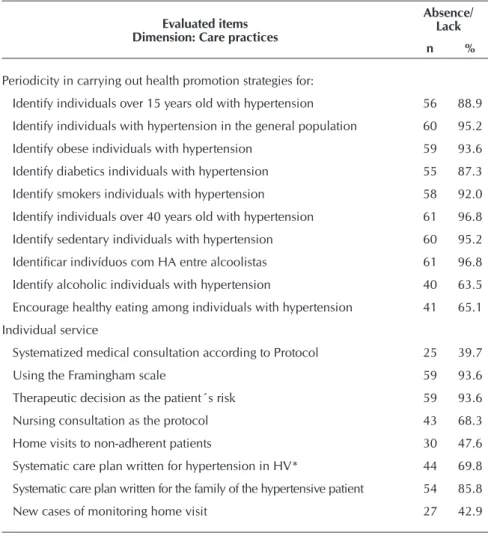
In Table 2, showing the results related to the dimension “care practices”, accord-ing to the nurses, the ESF teams were not regularly performing strategies for early di-agnosis of hypertension in the general popu-lation and groups with different risk factors or to stimulate the change of lifestyle among those already diagnosed. Regarding service conducted among individuals with hyper-tension, most of the teams did not use the
Framingham scale (93.6%) for determining the degree of risk and did not direct therapy for this risk (93.6%). Many profes-sionals revealed that they have not carried out home visits to non-adherent patients (47.6%) and new cases (42.8%), and neither a care plan was systematized for the individual´s fam-ily with AH (85.8 %).
Table 1 - Distribution of the family health teams, according to absence/
lack of items in the structural dimension (N=63) referred by nurses, Maringá, Paraná, Brazil, 2013
Evaluated items Absence/Lack
Dimension: Structural n %
Physical area
Covered area and with seats outside the UBS 28 44.4
Waiting room with satisfactory number of seats 22 34.9
Office to host 32 50.8
Office for nursing consultation 32 50.8
Room for collective activities 24 38.1
Room for ACS compatible with number of agents/activities 22 34.9
Materials and equipment
Sphygmomanometer (obese) in doctor's office 42 66.7
Sphygmomanometer (obese) in nursing office 54 85.7
Sphygmomanometer (child) in doctor's office 22 34.9
Sphygmomanometer (child) in nursing office 40 63.5
Computer available per team 42 66.7
Printer 37 58.7
Enough telephone line 32 50.8
Car to outside activities whenever necessary 61 96.8
Materials for health education
Materials for conducting the health training 51 81.0
DVD 28 44.4
Multimedia projector 35 55.6
Training to meet the individual with AH
Doctor 51 81.0
Nurse 47 74.6
Nursing assistant 50 79.4
Health Community Agent 49 77.8
Professional training for emergency service 36 57.1
Concerning the dimension “health care organization”, most of the nurses reported that their teams did not use the HIPERDIA for planning and evalu-ation of the program (58.7%) and had no counter-referral for a referral to the cardiologist (95.2%) and conducting specialized studies (87.3%). Accord-ing to those nurses interviewed, no team held a biannual medical consul-tation for patients without target organ damage, bimonthly for patients with lesions in target and monthly organ for patients without adequate control of the disease (Table 3).
DISCUSSION
The study results point out the aspects that exist or are not enough, related to the implementation and maintenance of the care program to individuals with AH in a city in south-ern Brazil, compromising the care to a greater or lesser degree. Some meth-odological limitations, such as not having been evaluated the results of the program from the perspective of patients, and not incorporating work-ers in the construction of the evalua-tion process, circumscribe the findings of this research to the components of the structure and process, guided by an ideal model recommended by pro-tocols. It is also important to ratify the respondents of this study were nurses, which makes the findings of absence or lack of resources required for the implementation of the program relat-ing to their perceptions.
However, this study does not cancel the scientific value of the re-sults found since it was noticed that the choice of the professional nurse to be the respondent for this study was right, as data showed that the average time of performance of this professional in the ESF teams in the city was more than six years, which reinforces the reliability of informa-tion collected and allows inferences backed by the professional practices.
Regarding the structural dimen-sion, the absence of a specific physical space for accommodating (50.8%), the nurse´s office (50.8%) and ACS rooms (39.4%) and the no structure for the development of group activities
Table 2 - Distribution of family health teams, according to absence/lack of items
on the size care practice (N = 63) referred to by nurses, Maringá, Paraná, Brazil, 2013
Evaluated items Dimension: Care practices
Absence/ Lack
n %
Periodicity in carrying out health promotion strategies for:
Identify individuals over 15 years old with hypertension 56 88.9 Identify individuals with hypertension in the general population 60 95.2 Identify obese individuals with hypertension 59 93.6 Identify diabetics individuals with hypertension 55 87.3 Identify smokers individuals with hypertension 58 92.0 Identify individuals over 40 years old with hypertension 61 96.8 Identify sedentary individuals with hypertension 60 95.2 Identificar indivíduos com HA entre alcoolistas 61 96.8 Identify alcoholic individuals with hypertension 40 63.5 Encourage healthy eating among individuals with hypertension 41 65.1 Individual service
Systematized medical consultation according to Protocol 25 39.7 Using the Framingham scale 59 93.6 Therapeutic decision as the patient´s risk 59 93.6 Nursing consultation as the protocol 43 68.3 Home visits to non-adherent patients 30 47.6 Systematic care plan written for hypertension in HV* 44 69.8 Systematic care plan written for the family of the hypertensive patient 54 85.8 New cases of monitoring home visit 27 42.9
Notes: *HV: Home visit; AH: Arterial Hypertension
Table 3 - Distribution of family health teams, according to absence/lack of items
on the dimension of health care organization (N = 63) referred by the nurses, Maringá, Paraná, Brazil, 2013
Evaluated items
Dimension: Health care organization
Absence/ Lack
n %
brochures and videos that addressed the issue of AH specifi-cally. It is likely that this lack arises from a failure in the organi-zational process and planning of active teams, since the other nurses noted the presence of the material, which indicates at least that they are available by the municipality. This is very important since the relationship between education, health and their practices are conditioned by multi-determined and complex structures in the pursuit of creating links between medical action and thinking and doing every day of the population(14).
From this perspective, a study conducted in China with 360 individuals with hypertension showed that after two years of professional monitoring through interactive health educa-tion workshops, it was observed significant improvement in patients’ knowledge about the disease and decrease in fac-tors clinical risk for the prevention of complications related to AH(15). Therefore, the development of educational activities
for health becomes a major factor in stimulating adherence to treatment of the disease.
About the training of professionals, it was observed that most of them had not received training for the adequate man-agement of patients with hypertension. Thus, currently, most of the activities carried out within the APS is oriented toward acute problems and the urgent needs of patients(1). Increased
attention to people with chronic diseases requires a focus on compliance and long-term monitoring(16). While the blame for
the failure to follow the prescribed regimens is imputed to patients, non-adherence is fundamentally also a failure of the health system. The health care (which provides support, con-stant monitoring and, above all, timely information) increases the patients’ knowledge and improved treatment adherence(17).
This assistance logic reduces the number of complications of the disease and provides a better quality of life for individu-als and their families(18), especially if health professionals are
engaged in continuing training practices.
Similarly, over half of the nurses said that professionals in their team did not receive training for emergency service when patients arrive at the UBS with a severe hypertensive crisis or cardiac arrest, brought by relatives. UBS, in general, is the closest health service to the residence and where the family seeks immediate care. Thus, gaps in training of health professionals to work in the face of chronic and emergency conditions must be overcome, and continuing education prac-tices appropriate to the new optics of health care, considering a model of care for chronic conditions in the APS, ruled on extensive host in risk stratification and management of clinical through supported self-care and case management has been proposed in the Brazilian scenario(19).
When the level of implementation of the Care Program of AH is evaluated concerning the dimension “care practices”, it is observed that the teams were very incipient. This is because over 87% of them did not develop strategies to diagnose indi-viduals with hypertension in the general population, and, when developed, these activities were associated with municipal pro-grams to promote health, created under the municipal health department. Thus, it is clear that the teams, mostly were lim-ited to check the BP only for the spontaneous demand, either in (38.1%) were identified. This shows that despite the
municipal-ity having the ESF as health care model since 1994, it has not ful-ly incorporated the theoretical and practical of this model bases, which prioritize continuous care, promoting health, group calls the and community work of ACS on the staff.
A study with ESF nurses in a capital of the Brazilian Mid-west pointed to weaknesses in the physical structure of the UBS and lack of inputs such as educational materials, which stimulate the performance of activities of the individuals with hypertension. This has compromised their practices, by re-stricting the actions to actions imposed by the physical struc-ture that privileged enough offices only to the medical staff, and therefore regard only to the biomedical model. On the other hand, They also revealed that they have to live with daily requirements of managers(11). Thus, it was observed that
some-times the flaws are in the structural dimension, avoiding the direct control of health professionals. However, charging for various practices of those hegemonic, in line with protocols and manuals, continues relapsing in the professionals.
Concerning the sub dimension “materials and equipment”, nurses negatively highlighted that most of the ESF teams do not have the vehicle available to perform outside activities whenever necessary. Only the rural team had a car every day, one team from the urban area twice a week and the other only once a week, and only part-time (morning or afternoon). It is up to the staff conducting a comprehensive home care and other community spaces, as well as surveillance and health promotion to outside health units(9). However, besides the lack of means of
transporta-tion, other factors intervene so that this activity does not achieve its purpose. Qualitative research conducted with ten nurses from ESF noted that the lack of professionals in the community is also justify by the large number of visits within the health facilities, the lack of time and excessive bureaucratic services(12).
Nurses revealed that most UBS do not have sphygmoma-nometer for checking the blood pressure (BP) in obese pa-tients and children, especially in the nursing team offices. The absence of sphygmomanometer for obese people was also evidenced in the study in a northeastern capital(3). This is
wor-risome because the manuals highlight the importance of the cuff being compatible with the circumference of the patient´s forearm(13). Thus, the absence of appropriate equipment raises
doubts about the quality of care provided in health facilities across the country, as well as to the data records and infor-mation systems, mainly by the constant association between hypertension and obesity. In these cases, either the BP is not being checked or is being incorrect.
Also in materials and equipment, here is the fact that more than half of UBS does not provide one computer per team, or even a printer. It should be noted that the municipality was in the electronic medical record computerization process and this is no longer the today´s reality. However, if the same UBS acted two, three and up to four ESF teams, it is inconceivable that did not exist at least one computer per team, as this de-pends on the update of the Information System data of prima-ry care (SIAB), HIPERDIA, among other information systems.
patients with any complaints or general acceptance. A similar situation was found in the study conducted in Recife (PE), in which the gathering of new patients with AH was made pre-dominantly by BP measurement of UBS patients, and only 25% of the teams used other strategies to diagnose new cases, such as campaigning and joint efforts in the community(3).
Regarding promotion of health group practices, it was found that most teams did not stimulate the change in lifestyle through the programmed physical activity or by changes in diet. Studies show that those most assiduous among individu-als accompanied by AH programs to meetings in the commu-nity (group activities) promoted by the professionals show a greater reduction of blood pressure(16,20). The presence of the
patient in group activities appears to constitute a determin-ing condition for the proper management of the treatment of hypertension, maybe by promoting individual motivation and generating attitudes that contribute to reducing BP. The pa-tient in this type of activity identifies with other papa-tients with similar problems and learn to express their fears and expecta-tions. Thus, he comes to share the experiences of each and discuss real solutions to the health problems that are similar, favoring adherence to treatment(16,21).
It should be noted that even with the inclusion of the Fami-ly Health Support Centers (NASF) in 2010 in the municipality, with support teams, with the accountability actuation, shared management and support the coordination of care in ESF teams, most of these teams did not incorporate the develop-ment of activities aimed at promoting health and disease pre-vention, materialized through the creation and maintenance of the groups of the healthy habits of life stimulus, such as walking and healthy eating.
In individual care, it was found that 26 teams (41.3%) did not engage in consultation with a medical history and complete physical examination. The care of patients with AH was con-ducted in groups that meet every three months, with the limited objective of verifying the BP and weight as well as prescribe and dispense medicines. On these occasions, it is not stratified and not differentiated care according to the degree of risk and the need of each. Patients are only consulted individually by the doc-tor when they have a complaint and spontaneously seek to UBS for this purpose, with the absence of scheduled appointments.
The frequency of consultation of individual with AH varies depending on the disease control. Thus, according to the clin-ical condition of every person, the return can be scheduled for periods ranging from one week to six months to decom-pensated patients and stabilized patients, respectively(9). The
standardization of a consultation schedule for patients with hypertension is not recommended for the most suitable and decisive care plan is the one that suits individual needs and characteristics and evolution of each case(22).
Another problem related to individual care is the assess-ment and classification of the patient’s risk according to the Framingham scale because 93.6% of the teams did not use this classification or otherwise stratify individual risk. How-ever, this procedure is pointed out in the protocols as es-sential to the therapeutic decision making and management of the case(9,13). From risk identification, it is recommended
appropriate measures on lifestyle: healthy eating, smoking cessation, alcohol abuse and physical inactivity. In cases of high risk, the healthcare team should consider the classifica-tion to define drug treatment(9,14).
In this study, it was observed that the care provided to pa-tients did not consider their individual needs and risks, which are attended evenly, because for most of the cases the return was scheduled every three months, being held group meet-ings and without clinical examination. These figures are worse than those reported in another study, which showed that at least 50% of professional teams stratified cardiovascular risk(3).
Thus, patients who for various reasons routinely or sporadi-cally did not attend the quarterly meetings of the group neces-sarily need enter the spontaneous demand line to have access to medical consultations and medicines that although avail-able in UBS, mostly are dispensed during meetings. This fact hinders the individual´s relationship with the health team and their adherence to treatment of chronic disease.
Also in individual care, it appears that the nursing consulta-tion is an underutilized strategy because most nurses (68.3%) reported not carry it out according to the protocol but simply to check blood pressure and weight during group activity or only for spontaneous demand and do not constitute as a routine service.
Case-control study conducted in Sweden, along with 212 hypertensive people divided into two groups, showed that the intervention group, which received regular nursing visits for two years had a significant reduction in heart rate, body mass index, weight, waist, low-density cholesterol, waist-hip ratio and per-ceived stress(23). In assisting the individual with AH, it is during
the nursing consultation that the BP is checked, stratifying the individual risk, orienting about the disease and the use of drugs and their adverse effects, the reported symptoms is evaluated and guidance on personal lifestyle and family is provided, and this activity does not interfere directly with patient compliance with the treatment plan proposed, whether medicated or not(16).
Such adherence as well as being influenced by the nursing consultation, is strongly associated with the services provided through home visits and guidelines(24), which reinforces the
im-portance of considering the high frequency of teams that did not perform home visits for non-adherent patients or new cases. Home visits also can constitute family involvement factor in the therapeutic process, which facilitates adherence to treatment(24).
It is also worth mentioning the high lack of care plans directed to the family, considering that when the assistance to the person with AH inserts and incorporates the family as a unit care, it pro-vides a broader understanding of the health/disease process and non-curative interventions needs(25), besides stimulating the
and subjectivity of people as indispensable aspects in the pro-cess of getting sick and to care for themselves(26).
Concerning the dimension “health care organization”, it was found that all teams have a specific instrument to docu-ment registration, monitoring, and evaluation of program ac-tivities, the HIPERDIA. However, more than half (58.7%) of the teams does not use this information for planning, evalu-ation of the Assistance Program for Hypertension and moni-toring of followed patients. These results are similar to those found in an evaluative study in a northeastern Brazilian capi-tal, where the use of information for action planning was not part of the routine of the studied teams(3). These data allow to
infer that the system of program information is seen by most teams just like a bureaucratic procedure of registration of indi-viduals with hypertension and its use as a management tool, and monitoring of patients is still incipient.
I is repeated once again that the care model is centered on medical care because by identifying the active search for miss-ing patients is not performed, nor even valued by other team members, point to the disparities between ACS responsibili-ties and nurses, regarding the search for missing patients, but what opposite to what is expected of these professionals. The active search, along with the rescheduling of appointments, meets one of the essential attributes of the APS and the model of care to individuals with NCDs, which is the longitudinal care, improving recognition of the needs of patients, reduc-ing costs and hospitalizations, prevention, and promotion of health and patients´ satisfaction. Thus, over time the trust be-tween professional and patient is established, leaving them more comfortable to expose their problems and discuss their self-care measures. In the same way, when professionals, in fact, know the patients and their needs, performing faster and more thorough assessment of the problem(27).
About the treatment based on care networks, it became clear that most teams presented difficulties for transporting the individual to medical and/or specialized tests. The mecha-nisms of coordination for healthcare services network are nec-essary to ensure the integration between levels of care. As-sistance to NCDs, in particular, requires the use of resources, which in technological complexity, are not only located in
APS, so that access to other levels of care should be coordi-nated and performed by primary care, as it should be a way for individuals in the health system(1).
CONCLUSION
The results of the study indicate that, from the perspective of nurses, aspects that have hindered the implementation of the as-sistance program to the individual with AH, such as the absence or lack of transportation for outside activities; work equipment; educational materials; training of human resources; systematic planning of care with individuals and families; determination of therapeutic from the risk classification and, finally, the referral of the patient to medical and/or specialized tests. It also points out that the work performed not completely matched with that proposed by the Ministry of Health nor the protocols developed in the county. According to nurses, medical consultation, for ex-ample, was not set and in many cases, care was replaced by the group for distribution of the medicines.
The study also found that according to the nurses, the great-est difficulties in implementing the program are related to care practices dimensions and organization of health care, which involve the work process of the teams and each professional individually. Accordingly, to carry out the standardized care professional faces some conditions imposed by every day: un-predictability, variability, and distortions that prevent compli-ance with the current rules and protocols, leading them to create their ways to perform the service.
It is believed that the findings can sensitize municipal man-agers and units to seek assurance of financial resources and political representation, and also to community involvement in improving the framework for the care and own training and motivation of staff to achieve the advanced level of attention from program implementation to hypertension in the munici-pality. It is highlighted the need to conduct active surveillance to identify people with hypertension as risk factors, perform risk stratification and systematic care planning, establishing an advanced clinical practice, such as support for self-care and case management, comply with existing protocols and devel-op collective actions based on information systems.
REFERENCES
1. Schmidt MI, Duncan BB, Silva GA, Menezes AM, Mon-teiro CA, Barreto SM, et al. Chronic non-communicable diseases in Brazil: burden and current challenges. Lancet [Internet]. 2011[cited 2015 Apr 24];377(9781):199-61. Available from: http://www.thelancet.com/pdfs/journals/ lancet/PIIS0140-6736(11)60135-9.pdf
2. Lu Z, Cao S, Chai Y, Liang Y, Bachmann M, Suhrcke M, et al. Effectiveness of interventions for hypertension care in the community-a meta-analysis of controlled studies in Chi-na. BMC Health Serv Res [Internet]. 2012[cited 2015 Jan 8];12(216):1-12. Available from: http://www.biomedcen tral.com/content/pdf/1472-6963-12-216.pdf
3. Costa JMBS, Silva MRF, Carvalho EF. [The implementa-tion analysis of the arterial hypertension care by the Fam-ily Health teams in Recife city (Pernambuco, Brazil).] Ciênc Saúde Colet [Internet]. 2011[cited 2014 Dec 15];16(2):623-33. Available from: http://www.scielo.br/pdf/csc/v16n2/ v16n2a26.pdf Portuguese.
5. Brasil. Ministério da Saúde. Mortalidade por doenças crônicas no Brasil: situação em 2009 e tendências de 1991 a 2009. Brasília (DF): MS; 2010.
6. Malfatti CRM, Assunção AN. [Hypertension and diabetes in the Family Health Strategy: an analysis of the frequency in the follow-up care by the teams of Family Health.]. Ciênc Saúde Coletiva [Internet]. 2011[cited 2014 Dec 18];16(Supl 1):1383-8. Available from: http://www.scielo. br/pdf/csc/v16s1/a73v16s1.pdf
7. Silva RLDT. Avaliação da implantação da assistência às pessoas com hipertensão arterial em um município do estado do Paraná. [tese]. Maringá (PR). Programa de Pós-graduação em Enfermagem. Universidade Estadual de Maringá – UEM; 2013.
8. Instituto Brasileiro de Geografia e Estatística (IBGE). Cidades [Internet]. Rio de Janeiro, 2013 [cited 2013 Apr 24];. Avail-able from: http://cidades.ibge.gov.br/xtras/perfil.php?lang= &codmun=411520&search=parana|maringa
9. Brasil. Ministério da Saúde. Secretaria de Atenção a Saúde. Departamento de Atenção Básica. Hipertensão arterial sistêmica para o Sistema Único de Saúde. Brasília: DF; 2006. 10. Nagahama EEI. [Evaluation of the implementation of
reproductive health services in Maringá, Paraná State, Brazil.].Cad Saúde Pública [Internet]. 2009[cited 2015 Feb 15];25(Sup2):279-90. Available from: http://www.scielo. br/pdf/csp/v25s2/10.pdf Portuguese.
11. Pedrosa ICF, Corrêa ACP, Mandú ENT. Influencias da infraestrutura de centros de saúde nas práticas profis-sionais: percepções de enfermeiros. Ciênc Cuid Saúde [Internet]. 2011[cited 2014 Apr 22];10(1):58-65. Avail-able from: http://www.periodicos.uem.br/ojs/index.php/ CiencCuidSaude/article/view/13288/pdf
12. Bertoncini JH, Pires DEP, Scherer MDA. [Work condi-tions and renormalization of nursing activities in family health]. Trab Educ Saude [Internet]. 2011[cited 2015 Apr 24];9(Supl 1):157-73. Available from: http://www.scielo. br/pdf/tes/v9s1/08.pdf Portuguese.
13. Sociedade Brasileira de Cardiologia; Sociedade Brasileira de Hipertensão; Sociedade Brasileira de Nefrologia. VI Diretrizes Brasileiras de Hipertensão. Arq Bras Cardiol [Internet]. 2010[cited 2014 Oct 15];95(1):1-51. Available from: http://publicacoes.cardiol.br/consenso/2010/Dire triz_hipertensao_associados.pdf
14. Silva CMC, Meneghim MC, Pereira AC, Mialhe FL. [Health education: a historical reflection of its practices]. Ciênc Saúde Coletiva [Internet]. 2010[cited 2014 Oct 28];15(5):2539-50. Available from: http://www.scielo.br/ pdf/csc/v15n5/v15n5a28.pdf Portuguese.
15. Lu CH, Tang ST, Lei YX, Zhang MQ, LinWQ, Ding SH, et al. Community-based interventions in hypertensive patients: a comparison of three health education strate-gies. BMC Public Health [Internet]. 2015[cited 2014 Oct 28];15(33):1-9. Available from: http://www.biomedcen tral.com/1471-2458/15/33
16. Barreto MS, Ganassin GS, Matsuda LM, Marcon SS. Dis-satisfaction with the Health Service and Non-Adherence to Antihypertensive Medication Treatment in Brazil. Open J Nursing [Internet]. 2015 [cited 2015 Mar 02];5(1):49-5.
Available from: http://www.scirp.org/journal/PaperInfor mation.aspx?paperID=53331#.VTzcXCFViko
17. Barreto MS, Reiners AAO, Marcon SS. Knowledge about hy-pertension and factors associated with the non-adherence to drug therapy. Rev Latino-Am Enfermagem [Internet]. 2014[cit-ed 2014 Sep 10];22(3):491-8. Available from: http://www. scielo.br/pdf/rlae/v22n3/0104-1169-rlae-22-03-00491.pdf
18. Martins AG, Chavaglia SR, Ohl RI, Martins IM, Gamba MA. Compliance with outpatient clinical treatment of hy-pertension. Acta Paul Enferm [Internet]. 2014[cited 2014 Dec 07];27(3):266-72. Available from: http://www.scielo. br/pdf/ape/v27n3/en_1982-0194-ape-027-003-0266.pdf
19. Mendes EV. As redes de atenção à saúde. Ciênc Saúde Coletiva [Internet]. 2010[cited 2015 Apr 26];15(5):2297-305. Available from: http://www.scielo.br/pdf/csc/v15n5/ v15n5a05.pdf
20. Serafim TS, Jesus ES, Pierin AMG. Influence of knowledge on healthy lifestyle in the control of hypertensive. Acta Paul En-ferm [Internet]. 2010[cited 2014 Nov 19];23(5):658-64. Avail-able from: http://www.scielo.br/pdf/ape/v23n5/en_12.pdf 21. Fernandes MTO, Silva LB, Soares SM. [Use of technologies
working with groups of diabetic and hypertensive individuals in Family Health]. Ciênc Saúde Coletiva [Internet]. 2011[cited 2014 Nov 19];16(Supl. 1):1331-40. Available from: http:// www.scielo.br/pdf/csc/v16s1/a67v16s1.pdf Portuguese
22. Carvalho AKM, Abreu RNDC, Moreira TMM, Diógenes MAR, Abreu AAC, Souza ACC, et al. Consulta de enferma-gem na percepção dos portadores de hipertensão atendi-dos na estratégia saúde da família. REME Rev Min Enferm [Internet]. 2011[cited 2014 Oct 19];15(3):341-7. Avail-able from: http://www.reme.org.br/artigo/detalhes/43 23. Drevenhorn E, Bengtson A, Nilsson PM, Nyberg P,
Kjell-gren KI. Consultation training of nurses for cardiovascular prevention: a randomized study of 2 years duration. Blood Pressure [Internet]. 2012[cited 2014 Nov 19];21(5):293-9. Available from: http://www.tandfonline.com/doi/pdf/10.31 09/08037051.2012.680734
24. Ribeiro AG, Cotta RMM, Silva LS, Ribeiro SMR, Dias CMGC, Mitre SM, et al. Hipertensão arterial e orientação domiciliar: o papel estratégico da saúde da família. Rev Nutr [Internet]. 2012[cited 2014 Nov 22];25(2):271-82. Available from: http://www.scielo.br/pdf/rn/v25n2/09.pdf 25. Gomes TJO, Silva MVR, Santos AA. Controle da pressão arte-rial em pacientes atendidos pelo programa Hiperdia em uma Unidade de Saúde da Família. Rev Bras Hipertens [Internet]. 2010[cited 2014 Nov 19];17(3):132-9. Available from: http:// departamentos.cardiol.br/dha/revista/17-3/03-controle.pdf 26. Pires CGS, Mussi FC. Refletindo sobre pressupostos para o
cuidar/cuidado em saúde na educação em saúde da pes-soa hipertensa. Rev Esc Enferm USP [Internet]. 2009[cited 2014 Oct 27];43(1):229-36. Available from: http://www. scielo.br/pdf/reeusp/v43n1/30