http://dx.doi.org/10.1590/0104-530X2260-15
Resumo: Este artigo tem como objetivo caracterizar a estrutura organizacional para a inovação em empresas do setor elétrico de acordo com a literatura relacionada à transição tecnológica e à organização do trabalho para a inovação. Por meio de estudos de caso, identiicou-se que maioria das empresas estudadas apresenta estruturas organizacionais mais aptas a lidar com regimes tecnológicos estabelecidos. Entretanto, a crescente demanda da sociedade pela sustentabilidade dos sistemas energéticos coloca ao setor elétrico um enorme desaio que exigirá das empresas do setor grandes esforços em Pesquisa & Desenvolvimento para a inovação tecnológica. Argumenta-se que empresas organizadas sob a lógica adhocrática são mais aptas a lidar com os desaios da transição rumo à sustentabilidade imposta ao setor elétrico.
Palavras-chave: Gestão da inovação; Transição tecnológica; Inovação; Sustentabilidade.
Abstract: This article aims to characterize the organizational structure for innovation in electric utilities according the literature related to technological transition and work organization for innovation. Case studies showed that most companies have presented more suitable organizational structures to deal with established technological regimes. However, the growing demand of society for sustainable energy systems poses a great challenge to the power industry, as these require great efforts in R&D for radical technological innovation from the companies in the sector. It is argued that companies organized under adhocracy are better able to cope with the challenges of the transition towards sustainability imposed on the electricity sector.
Keywords: Innovation management; Technological transition; Innovation; Sustainability.
Investigating work organization for innovation and
technological transition in the Brazilian power sector
Investigação sobre a organização do trabalho para a inovação e transição tecnológica no setor elétrico brasileiro
Guilherme Amaral1
Roberto Marx1
Mario Salerno1
1 Departamento de Engenharia de Produção, Escola Politécnica – Poli, Universidade de São Paulo – USP, Av. Prof. Almeida Prado, 128, CEP 05508-070, São Paulo, SP, Brazil, e-mail: [email protected]; [email protected]; [email protected]
Received Sept. 22, 2015 - Accepted May 5, 2016
Financial support: None.
1 Introduction
The increasing demand of society for sustainable energy systems presents a great challenge to the power industry, which will require a genuine process of technological transition in the whole system (Raven et al., 2009). This process will require great efforts in R&D for technological innovation (Kemp, 1994; Raven et al., 2009; Organization for Economic Development, 2010). In Brazil, the R&D efforts to respond to the pressures from society for sustainable technologies, applied to the power sector, are coordinated by the companies under the ANEEL regulations. However, despite the considerable resources involved, which by law represent 1% of the net operating revenue of all companies in the sector, studies have highlighted the low eficiency of the projects when evaluating the impacts on the development and the application
of new technologies (Bin et al., 2015; Amaral, 2012; Pompermayer et al., 2011).
Several are the reasons found by researchers to explain the low effectiveness of R&D programs in the Brazilian electric sector. Among them, we can highlight the challenges of management and of work organization to handle innovation projects by companies (Bin et al., 2015). Thus, it is pertinent to question how have companies in the Brazilian electric sector been structured to deal with the challenges of technological transition? This work aims to contribute with an answer to this question to characterize the organization of work for innovation in the sector.
on the subject and the studies on work management for innovation. This gap is identiied by Markard et al. (2012) through a bibliometric analysis in which they argue that many studies address the patterns caused by the transition in technology systems and the enormous challenges for its management; however, in management ields, there is a lack in studies to contribute to the efforts for the transition towards the sustainability of production processes.
Another contribution of this paper refers to the characterization of the technological transition process in the electricity sector, which, by their speciicities, require new organizational arrangements in utility companies, which must be structured to deal with innovation management that contribute to this process. The importance of organizational design for innovation is recognized by academic literature (Tushman & O’Reilly, 1996; Salerno, 2004; Lam, 2005; Worley & Lawler, 2006; Biazzo, 2009; Marx et al., 2012).
Therefore, a set of theoretical challenges have posed a relection on the nature and the depth of change that organizations face when dealing with transition technology and on how this process will require organizational changes in the sectors involved in this process.
Next topic will seek to characterize the social demand for technological transition in the electricity sector, which justiies the need for studies on the organization of work to increase the effectiveness of the efforts for innovation in the industry.
A third topic will present the debate on the technological transition and the concepts related to strategic niche management. The objective is to characterize the ongoing process in the electricity sector as a genuine process of technological transition in a socio-technical system. This process will require an organizational approach to innovation in the sector that relates more to the management of radical innovation than it does to the traditional project management and to product development with incremental innovation. The fourth topic will deepen this discussion by developing a theoretical model based on the work of Marx (2011).
This model will be tested by case studies under the hypothesis that the companies in the Brazilian electricity sector are not adequately organized to address the challenges posed by the technological transition demands, which may partly explain the low effectiveness of the R&D programs of these companies.
The case study methodology and a discussion of the results will be presented in the ifth topic. Finally, the sixth topic presents the indings, implications and gaps that remain to be explored in future research motivated to contribute to the effectiveness of the transition process towards the sustainability of the Brazilian electrical system.
2 The challenges of technological
transition towards sustainability in
the energy sector
The technological transition comes to the electricity sector as a demand by the pressures to develop a new system based on sustainable technologies. Despite representing only 17% of the inal energy consumption, the electricity sector is responsible for much of the CO2 emissions in the world, accounting for 32% of total emissions according to the “International Energy Agency (IEA)” (Organization for Economic Development, 2010). According to the agency, in a scenario where there are no major changes in the energy and technology policies in the sector, CO2 emissions from the electricity generation worldwide will almost double between 2007 and 2050.
A drastic reduction of CO2 emission levels, aiming at a complete “decarbonisation” of electricity generation, will not be possible without a strategic management for the technology transition of companies operating in the sector. Many of the technologies with low carbon emissions are still considerably more expensive than the technologies based on fossil fuels, and there are still no clear indications that there is a dominant solution to be sought for the establishment of a sustainable electrical system (Raven et al., 2009; Organization for Economic Development, 2010).
In Brazil, despite its national energy matrix, composed mainly by renewable energy sources, mostly hydroelectric representing 70.45% of generation in March 2015 (Agência Nacional de Energia Elétrica, 2015), there are challenges to the sector posed by the great increase in demand due to economic growth and to the policy of universal distribution of electricity, which will require technological solutions that can hardly be achieved without major coordinated efforts in R&D by the companies in the sector.
The country, as almost all Latin American countries, has a high rate of losses in the grid (Organization for Economic Development, 2010), which represents the low energy eficiency of the national electricity system. In addition, the increase in the environmental requirements and restrictions for new hydroelectric power plants, linked to the growth in energy consumption and to the structural ongoing changes in the economy, results in enormous challenges and bottlenecks for the sector in the next future.
To intervene in this scenario, the international energy agency argues that governments and businesses should maintain and even expand its R&D in the sector for the development of technological innovations that give answers to the social pressures for technological transition (Organization for Economic Development, 2010).
and development program for the Brazilian electrical system was regulated in 2000. Such regulation, enacted by the National Electric Energy Agency (ANEEL), was based on several international research and on the observation of the effects of market liberalization and privatization on the dynamics of the investment in R&D by the utility companies (Centro de Gestão e Estudos Estratégicos, 2001). Consequently, it was instituted a mandatory investment in R&D of 1% of net operating revenues of the companies in the sector.
However, for the development of alternative technological trajectories, such as technologies with low-carbon and more eficient smart grids of energy distribution, it is necessary that innovative companies achieve success when developing projects with technological innovations. Efforts to develop organizational structures that help companies to manage product development with radical innovation now have great importance to the entire industry, since studies show evidences of the low eficiency of the technology policy tools applied to the sector (Bin et al., 2015; Amaral, 2012).
This new challenge assumes a central importance for the future of the electricity sector. To stand out, or even to survive in this new environment, it is of great relevance to companies the development of a theoretical framework based on the assumptions of the organization of work for innovation theory. Therefore, allowing greater eficiency in the development of organizational structures to improve the product
development with sustainable technologies according to the speciic dynamics of technological transition.
3 Technological transition:
implications for work management
for innovation in the electric sector
Sectors such as the electricity sector, sanitation or transport can be deined as socio-technical systems by their speciic characteristics (Hughes, 1989; Geels, 2002; Markard et al., 2012). This means that in such systems, the process of technological development and innovation is supported by several institutions that constitute the technological system, as presented in Figure 1. By covering several dimensions, such as the knowledge generated and disseminated in universities and technical schools, public regulations and other complementary technologies that make up a particular dynamics of its development trajectory (Hughes, 1989; Kemp, 1994; Raven et al., 2009; Geels & Schot, 2007).Socio-technical systems have a tendency to stability, which implies that innovations for technology transition in such systems must be managed in order to overcome the forces that regulate the stability of this sector (Geels, 2010). This fact allows us to characterize the process of innovation for technological transition as a radical innovation process in which the socio-technical structures necessary for the proper
performance of new technologies developed changes (Gomes et al., 2011).
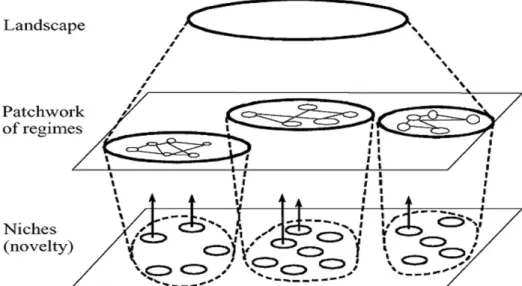
To enable the analysis of the systemic phenomena involved in the process of product development with innovation for the technological transition within pre-established socio-technical systems, Geels (2002, 2004) proposes a multi-level perspective methodology, presented in Figure 2.
This methodology is characterized as an analytical technique, or an exploratory technique, to formulate strategies aiming at the technological transition based on different levels, which are analytical concepts to understand the complex and dynamic socio-technical change triggered by technological transition (Schot & Geels, 2008; Geels, 2002).
According to the multi-level perspective of technological transition, since socio-technical regimes usually induce incremental innovations that contribute little to the transition, radical innovations are generated in niches within those regimes (Kemp, 1994). It is considered that such technological niches are the “locus” of radical innovations in socio-technical systems, since the radical innovation could hardly survive under the conditions imposed by the environment adapted to established technologies. Niche management demands greater dynamism to establish relationships between different actors in a genuine process of trial and error to its development (Raven & Geels, 2010).
The strategic niche management becomes the analytical concept used by researchers seeking to develop innovation management models appropriate to the technological transition (Schot & Geels, 2008). It is not the objective of this paper a study on the strategic niche management in the Brazilian electric
sector. However, it is recognized that to increase the eficiency of investments in R&D in the energy sector, a radical innovation for the technological transition demanded by society should be managed in the technological niches. Consequently, it becomes important to identify the dynamics of niche development and its impact on the management of work for innovation in companies of the sector.
The creation and protection of technological niches can be characterized by three different steps: “shielding”, “nurturing” and “empowering” (Raven & Geels, 2010). The shielding process relates to the ways used by decision makers to protect the radical innovation from the competition arising from the current socio-technical system. The process of nurturing refers to the internal processes to support the development of radial innovation and its incorporation or adaptation to a socio-technical system. Finally, the empowering process relates to the competitive attributes, relating to the creation of an ecosystem to support radical innovation arising from the strategic management of technological niches.
Boon et al. (2014) proposes a framework to characterize how the processes of niche protection evolve along the development of technological niches considering their creation phase, maintenance and “phasing out”. The authors highlight two ways in how the dynamics of the development of technological niches inluence the protection processes of these niches, as characterized above. Throughout development, certain actors can adopt more restrictive or more accommodating protection strategies. The object of their study is the relationship between these strategies and the management of the border of technological niches.
Lopolito et al. (2013) argues that the success of the radical innovations managed in technological niches depends on three mechanisms that are interrelated and determine the dynamics of their evolution: Convergence of expectations, Networking and Learning, as shown in Figure 3.
Despite the focus on the structure of the technological niches and on the creation of networks through relationships with various stakeholders, Sushandoyo & Magnusson (2014) argue that, from the point of view of a company seeking to develop radical innovations for technological transition, strategic niche management can be characterized in a temporal process of market creation, which comprises four different stages: technological niche, niche market, bridging market and mass market. As presented in Figure 4.
Recent studies on the dynamic of evolution of niches argue that their management calls for autonomy, lexibility and strategy of organizational systems for the feasibility of projects (Gomes et al., 2011; Lopolito et al., 2013; Sushandoyo & Magnusson, 2014). This argument allows us to build a bridge between the literature on technological transition and the organization of work for innovation management. Thus, this article sought to contribute to the literature by developing a theoretical model based on the knowledge on radical innovation management,
especially synthesized and developed by Marx (2011), to be tested in companies from the Brazilian electric sector.
4 Organization of work for
innovation and strategic niche
management in the electricity
sector
The implication of the technological transition concepts to the organization of work for innovation can be analyzed through the indings of several authors, whose different organizational structures are better suited to managing projects with radical innovation (Clark & Wheelwright, 1993; Tushman & O’Reilly, 1996; O’Connor, 1998; Zancul et al., 2006; Marx, 2011). These authors consider that classical organizational structures are more effective in dealing with incremental innovations, namely, operating within an established technological regime. Furthermore, it is recognized that to increase eficiency in the innovation process development, a greater degree of lexibility and autonomy by the innovation project team is needed (Salerno, 2004; Gomes & Salerno, 2010; Marx, 2011), which must be explored by enterprises wishing to act and develop technological niches to seek the transition from established technological systems.
Figure 3. Mechanisms interactions within the niche. Source: Lopolito et al. (2013).
The challenge for the technological transition becomes managing the development of technological niches by inducing radical innovation in companies. Thus, organizational structures with greater autonomy and lexibility that relate to the complex and dynamic environment imposed on these niches, according to the dynamic depicted in Figure 3, becomes a proxy for organizational maturity to deal with such a challenge.
The transition is directly related to the environment in which the companies operate, it is the object in transition and, at the same time, it is where the main interactions occur for innovation. Mintzberg (2003) deines four possibilities of environmental characteristics in which companies are immersed. It can be characterized by the speed of the changes as stationary or dynamic and by the mix of skills and relationships involved, which marks the work in organizations immersed in such environment. The author develops ideal organizational settings that would best adapt to the speciicity of each environment characteristic, and, these settings can be grouped as different variations of classic bureaucracies and adhocracies (Mintzberg, 2003).
Several other authors have proposed organizational structures to deal with the problems arising from the demand for innovations and changes in the competitive environment due to the greater dynamism of the changes, for example, Clark & Wheelwright (1993), Tushman & O’Reilly (1996), Christensen (1997), among others. It can be argued that, despite the differences in each proposed alternative and possible gaps left by each of them, there is a common element related to the need for autonomy and lexibility to the teams involved directly in the innovation process.
In his research on work organization for innovation, Marx (2011) develops a synthesis between two logics for the organizational structures of innovative companies, which have become an analytical tool that enables researchers interested in the subject to investigate possible organizational structures
of companies involved in technological transition process. Table 1 shows the two logical structures presented and the indicators deining them.
According to the studies conducted by the author, companies with bureaucratic structures in transition, i.e. companies based in classical organizational structures, derived from Taylorism, which spend efforts in pursuit of innovation, are more apt to develop incremental innovations related to current technological regime. On the other hand, companies that have demonstrated greater ability to innovate are companies with adhocracy structures, with greater degrees of lexibility and autonomy, according to the characteristics described above (Marx, 2011).
Based on the work of Marx (2011), case studies were developed to identify the structures of the companies operating in the Brazilian electricity sector in relation to their efforts for innovation, which will be presented in the next section.
5 Case studies: the organization of
work for innovation in companies
from the Brazilian electric sector
As argued in previous topics, the environment in which power companies are involved, regarding to the technological transition process, is of great complexity and dynamism for inducing innovation in technological niches within its established socio–technical system (Kemp, 1994; Geels, 2002). This environment will require new organizational forms for the companies willing to face the challenges posed by technological transition (Mintzberg, 2003; Salerno, 2009; Marx et al., 2012; Lopolito et al., 2013; Sushandoyo & Magnusson, 2014).According Marx (2011), it is recognized that a starting point for any relection on the organization of work for innovation should be the recognition of the interrelationship between organizational lexibility, autonomy and strategy. Thus, this work assumes that,
Table 1. Alternative logics of innovative organizations.
Adhocracy logic Bureaucracy logic in transition
I. Principal competitive priority Radical and continuum innovation Costs, quality, incremental innovation.
II. Environment Dynamic and complex Stable and simple
III. Organizational structure
Low hierarchy, autonomy to manage
business, lexible team and mission
oriented.
Hierarchy, Low autonomy,
Functional structure, ixed team.
IV. Knowledge low which enable
innovation
Are complex and there is no direction, included between partners.
Linear low through the operational
areas to the functional areas responsible for innovation. V. Eficiency metrics Uses intensely innovation metrics Innovation metrics just as
the adhocracy logic of work organization is more effective for the organization of the departments related to innovation in electricity companies dealing with the challenges imposed to the utilities by the technological transition process. Moreover, the unsuitability of the companies to that logic can be interpreted as part of the explanation for the low eficiency of R&D programs for innovation in the sector.
5.1 Methodology
The methodology used was case studies to identify in electric companies its management structure for R&D projects, deined as the locus of development of new products with technological innovation in the sector. The problem question to be answered is: How have companies in the Brazilian electric sector been structured to deal with the challenges of technological transition?
The hypothesis behind this study is that structures applying the adhocracy logic are better able to cope with the challenges from the transition to sustainability through strategic niche management, and utility companies should seek this organizational structure to deal with such challenges and increase the eficiency of their R&D programs. This hypothesis will be tested for the case studies according with the criteria for this type of study applied to studies in management ield elaborated by Eisenhardt (1989).
19 interviews were conducted in eight companies covering the entire production chain of generation, transmission and distribution of electricity. Table 2 shows the proile of the companies interviewed in relation to its resources for R&D investment.
Case study is a research strategy that focuses on understanding the dynamics present in a given object. To support the case study methodology were raised secondary data, primary data and interviews in accordance with the recommendations by Yin (2005).
According Eisenhardt (1989), the case study methodology is an inductive methodology, it begins with a hypothesis developed through observation of a
given phenomenon or literature and seeks conirmation through confrontation with reality.
Semi-structured interviews were conducted in search for indicators to investigate the propositions deined as a hypothesis to be tested in this case study. The managers and directors responsible for the management of R&D were interviewed between the months of July 2013 and February 2014. For each question, indicators were deined for the analysis of the interview results, aiming their characterization according to the proposed by Marx (2011) described in Table 1.
The case studies were subsidized with an exploratory research based on the literature and on secondary data to enable the investigation of the behavior of the utilities assessed in terms of technological development and its response to the obligation of investment in R&D in addition to its competitive priority and the environment where they work for transition. Table 3 shows the structure of the area responsible for managing the R & D program in the cases studied.
5.2 Presentation and discussion of the results
Since one of the criteria to understand the organizational structure of the companies, to deal with the technological transition through the development of products with radical innovation, the structures of the areas responsible for R&D were evaluated. It is suggested that companies that have areas speciically structured for innovation, which are subordinated to directors with a greater autonomy, directly related to strategic issues, and that provide greater operative lexibility, may have greater chance of success in the development of innovations that contribute to the process technological transition. Companies with classically structured areas, with various hierarchical levels, little autonomy and lexibility for the execution of budgets and stafing projects are more inclined
Table 2. Proile of companies in the case study.
Company Segment in the sector R&D budget by year (R$ 000)*
Investmens already applied in R&D (R$ *000)
G1 Power generation R$ 8,000 R$ 12.700
GD1 Distribution, generation R$ 57,000 R$ 250.000
G2 Power generation R$ 15,000 R$ 115.000
G3 Power generation R$ 28,950 n/d
T1 Transmission R$ 6,000 R$ 30.500
G4 Power generation R$ 10,000 n/d
GD2 Distribution, generation R$ 14,300 n/d
GD3 Distribution, generation R$ 22,000 R$ 240.000
to incremental innovations (Zancul et al., 2006) operating in the established socio-technical system.
The competitive strategy of the company is the base of its organizational design, and from its deinition, autonomy is the decisive factor to allow individual and collective skills to be applied to deal with complex environments that require great interaction and information exchange. According to Marx (2011), to deal with innovation, consequently, with the technological transition, the organization should be designed to operate by work in groups with autonomy and lexibility to allocate people and to deine process management. Indicators I, II and III, presented in Table 1, relate to this strategic dimension of the organizational structuring process.
In turn, indicators IV and V are related to the process of learning and knowledge management. Knowledge is key resource for organizations that innovate (Salerno, 2004; Marx, 2011). Companies that have a process for generating and attracting ides to R&D projects may have less involvement and possibly lower chance of success of the program in the development of new technologies that contribute to increasing the electric system eficiency for technological transition (Bhattacharya et al., 1998; Cooper & Perspective, 2008).
Knowledge management tools can, and should, be used to beneit and support the maintenance and generation of new knowledge by irms according to Marx (2011). With regard to such management and participation in the capture of ideas for R&D projects, the companies interviewed, mostly, do not have formal processes. Most companies assign to the technical areas the responsibility for generating demands for the development projects, in a manner little dynamic. Many companies do not have any technological planning and innovation does not appear in any point of their competitive strategies.
On the other hand, the case studies show that there are companies with formal processes of knowledge management and acquisition of new projects in the management of the R&D program linked to technological efforts adhering in its planning, and that there are companies that attach great importance to innovation and present efforts in skills development for innovation.
As an example of this case, the R&D projects in the GD2 Company are given as priority projects. Moreover, all technology providers need to frame their projects and provide part of their solutions through R&D projects with transfer of knowledge and technology. In each engineering project of the
Table 3. R&D units structure in Brazilian utility companies.
G1
The R&D management is subject to the Regulatory Board of the company. It has two professionals
dedicated to the management of the R&D program. It does not have autonomy for budgeting or
approving projects. It consists of managers with little autonomy and lexibility for stafing.
GD1
Until 2010 there was no area dedicated to managing the R&D program. In 2010, a R&D manager position was created subordinated to the Regulatory Board of the Vice President of Regulatory Affairs. In 2011, an Innovation Board linked to Vice President of Human Resources was created, which
became subject to the R&D Manager. Currently the area has 11 professionals to program management and does not have autonomy or lexibility to manage the program.
G2
The area responsible for R&D is subject to the operating department and to the production planning board. It has ive junior employees responsible for managing the R&D program. No strategic
management.
G3 The department responsible for the R&D management has two junior employees and it is subordinate to the Department of Planning and Expansion of the Board of Engineering and Construction.
T1
The R&D area used to be subject to the regulatory affairs unit; however, after recent changes in the
business area, it became directly subordinated to the CEO, in the strategic management unit. The
R&D area has three senior oficials added to budgetary autonomy and lexibility approved by the
Presidency.
G4 The R&D area is subject to the management of new enterprises, consisting of three employees. It does not have budgetary autonomy and the projects are approved by the board directly.
GD2
There are two areas related to R&D responsibilities. The board of innovation strategies is directly subordinated to the CEO and it deals with innovation strategies in the medium and long terms with greater insight into new markets and marketing. This board has its own budget and autonomy to run it. The Technology Superintendence is the area responsible for managing and implementing the
R&D budget related to the ANEEL program aimed at the incremental projects on the technologies already adopted by the group. It is subject to vice president of distribution and it is responsible for the management of all R&D projects. It has three employees.
GD3
The area responsible for R&D is subject to engineering and planning division, a company operating
division subordinated to the board engineering and the network management vice president of distribution. It has 16 employees without executive budget.
Amaral, G. et al.
Gest. Pr
od.
, São Carlos, v
. 24, n. 2, p. 236-247, 2017
G1 GD1 G2 G3 T1 G4 GD2 GD3
I. Principal competitive priority Costs, quality, incremental innovation. Costs, quality, incremental innovation. Costs, quality, incremental innovation. Costs, quality, incremental innovation. Radical and continuum innovation Costs, quality, incremental innovation. Radical and continuum innovation
Inovação radical e contínua
II. Environment Stable and simple Stable and simple Stable and simple Stable and simple Stable and simple Stable and simple Dynamic and complex Dynamic and complex III. Organizational structure Hierarchy, Low autonomy, Functional structure, ixed team. Hierarchy, Low autonomy, Functional structure, ixed team. Hierarchy, Low autonomy, Functional structure, ixed team. Hierarchy, Low autonomy, Functional structure, ixed team. Low hierarchy, autonomy to manage business,
lexible team and
mission oriented. Hierarchy, Low autonomy, Functional structure, ixed team. Low hierarchy, autonomy to manage business,
lexible team and
mission oriented. Hierarchy, Low autonomy, Functional structure, ixed team. IV. Knowledge low which enable innovation Linear low through the operational areas to the functional areas responsible for innovation.
Linear low
through the operational areas to the functional areas responsible to innovation.
Linear low
through the operational areas to the functional areas responsible to innovation.
Linear low
through the operational areas to the functional areas responsible to innovation.
Linear low
through the operational areas to the functional areas responsible to innovation.
Linear low
through the operational areas to the functional areas responsible to innovation.
Are complex and there is no direction, include between partners.
Linear low
through the operational areas to the functional areas responsible to innovation.
V. Eficiency
metrics
Innovation
metrics just as
improvement metrics.
Innovation
metrics just as
improvement metrics.
Innovation
metrics just as
improvement metrics.
Innovation
metrics just as
improvement metrics.
Use intensely innovation metrics
Innovation
metrics just as
improvement metrics.
Use intensely innovation metrics
Innovation
metrics just as
improvement metrics. Organizational
structure
Bureaucracy logic in transition
Bureaucracy logic in transition
Bureaucracy logic in transition
Bureaucracy logic in transition
Bureaucracy logic in transition
Bureaucracy
logic in transition Adhocracy logic
This characterization was based on the synthesis elaborated by Marx (2011), which identiied indicators for the classiication of organizational structures considering two ideal types of work organization for innovation: Adhocracy and Bureaucracy in Transition.
It was argued that companies organized under the adhocracy logic are better able to cope with the challenges of the transition towards sustainability imposed to the electricity sector. Based on the literature, it is argued that the process of innovation management for the technological transition should occur through the strategic niche management. In addition, power sector utilities companies should seek a suitable organizational structure to deal with such challenges. This requires greater autonomy and lexibility of their functional structures for managing expectations and networks, in addition to dealing with the learning needed to increase the eficiency of their R&D programs.
There are two contributions from this article. On the one hand, it sought to establish a bridge between the literature on technological transition and on work organization for innovation.
Another contribution is to characterize the technological transition process in the Brazilian electric sector, and its implication for the organization of work in companies in the sector. Based on both literatures, it was noted that the technological transition could be characterized by a multi-level transition, where the innovation occurs in technological niches. Such niches are protected environments that induce the development of new technologies that contribute to the transition towards sustainability.
Adhocracy organizational structures, which have autonomy and lexibility, are necessary for the induction of new technologies through innovation, and companies need to seek new organizational forms to suit this dynamic. This process may contribute to the increase of the R&D programs eficiency in the sector.
There are large gaps to be exploited by researchers interested in contributing to the technological transition process in the electricity sector. New research on the dynamics of the development of new technologies in companies need to be developed to be able to develop organizational models, to assist companies in the implementation of management systems and organization of work for more effective innovation. This involves research able to characterize the process of strategic niche management in the electricity sector, and innovation management models applied to this speciic dynamic of technological development.
References
Agência Nacional de Energia Elétrica – ANEEL. (2015). Banco de informações de geração. Brasília. Recuperado em 23 de março de 2015, de http://www.aneel.gov. br/aplicacoes/capacidadebrasil/capacidadebrasil.cfm company, it is also highlighted a team to invest part
of the budget in R&D projects. Sometimes, such investment is made with the project own budget, not depending on the ANEEL program fund. According to respondents, this practice is due to the criteria established by the Agency for the evaluation of innovation projects, which often does not relect the dynamics of innovation; in this way, the company chooses to invest part of their own resources instead of submitting it to the agency. The company has a plan with ive deined areas for investment in R&D projects. This plan was developed by a board of innovation strategies subject to the presidency of the group.
Based on the results, the cases were classiied according with the proposal made by Marx (2011) presented in Table 4. It is considered that most of the companies studied are not assuming organizational structures suited to the challenges of innovation and technological transition.
The case studies also indicates that there is a relationship between the companies that had success in the development of technological innovations and those ho present formal processes for knowledge management and for project selection and development, following a technological strategy deined by the company and choose projects through a knowledge low based on internal and external communication. Such companies showed gains with the projects developed under the program, while companies that do not have formal structures for technology management often even assess the results of projects after completion.
Most of the companies studied had organizational structures better able to cope with established socio-technical regimes, with classical organizations focused on eficiency and departmentalized. Only one company studied presented a management aligned with the literature, including reaping positive inancial results from its R & D program, in which organizational structures favor autonomy, lexibility and strategic alignment. Two other companies have shown to help their program management in a process of internalization of skills. They are restructuring their departments and developing efforts to prospect for industrial partners and to deine corporate strategies for innovation; however such efforts did not have not shown results in the organizational structure of the company.
6 Conclusions and implications for
future research
Gomes, L. A. V., Amaral, G. S. G., Sbragia, R., Salerno, M. S., & Freitas, S. L. (2011). Integration of managerial and sociological perspective of innovation: a framework to the development process of radical innovation product. In Proceedings of the 20th International Conference for the international association of management of technology. Miami.
Gomes, L. A. V., & Salerno, M. S. (2010). Modelo integrado de processo de desenvolvimento de produto e de
planejamento inicial de spin-offs acadêmicos. Gestão & Produção, 17(2), 245-255.
Hughes, P. T. (1989). The evolution of large technological
systems. In W. E. Bijker, T. P. Hughes & T. P. Pinch (Eds.),
The social construction of technological systems: new directions in the sociology and history of technology. Cambridge: MIT Press.
Kemp, R. (1994). Technology and the transition to environmental sustainability: the problem of technological regime shifts. Futures, 26(10), 1023-1046. http://dx.doi. org/10.1016/0016-3287(94)90071-X.
Lam, A. (2005). Organizational innovation. In J. Fagerberg & R. R. Nelson (Eds.), The Oxford Handbook of Innovation (pp. 115-147). Oxford: Oxford University Press.
Lopolito, A., Morone, P., & Taylor, R. (2013). Emerging innovation niches: an agent based model. Research Policy, 42(6-7), 1225-1238. http://dx.doi.org/10.1016/j. respol.2013.03.002.
Markard, J., Raven, R., & Truffer, B. (2012). Sustainability transitions: an emerging field of research and its prospects. Research Policy, 41(6), 955-967. http://
dx.doi.org/10.1016/j.respol.2012.02.013.
Marx, R. (2011). Organização do trabalho para a inovação (1. ed.). São Paulo: Atlas.
Marx, R., Mello, A. M., & Salerno, M. S. (2012). Organizational structures to support innovation: how do companies decide? Revista de Administração e Inovação, 9, 5-20.
Mintzberg, H. (2003). Criando organizações eicazes (2. ed.). São Paulo: Atlas.
O’Connor, G. C. (1998). Market learning and radical innovation: a cross case comparison of eight radical
innovation projects. Journal of Product Innovation Management, 15(42), 151-166. http://dx.doi. org/10.1111/1540-5885.1520151.
Organization for Economic Development – OECD. (2010). Energy technology perspectives: scenarios & strategies to 2050. Paris.
Pompermayer, F. M., De Negri, F., & Cavalcante, L. R. (2011). Inovação tecnológica no setor elétrico brasileiro: uma avaliação do programa de P&D regulado pela ANEEL. Brasília: Instituto de Pesquisa Econômica Aplicada.
Raven, R., & Geels, F. (2010). Socio-cognitive evolution in niche development: comparative analysis of biogas Amaral, G. S. G. (2012). A pesquisa e desenvolvimento
no setor elétrico brasileiro: uma investigação da política tecnológica para o setor com base na teoria evolucionária da mudança técnica (dissertação de mestrado). Programa de Pós-graduação em Engenharia de Produção, Escola Politécnica, Universidade de São Paulo, São Paulo.
Bhattacharya, S., Krishnan, V., & Mahajan, V. (1998).
Managing new product definition in highly dynamic environments. Management Science, 44(11), 50-64.
Biazzo, S. (2009). Flexibility, structuration, and simultaneity in new product development. Journal of Product Innovation Management, 26(3), 336-355. http://dx.doi.
org/10.1111/j.1540-5885.2009.00662.x.
Bin, A., Vélez, M. A., Ferro, A. F. P., Salles-Filho, S., Mattos, C., & Da, P. (2015). Da inovação: desafios para o setor elétrico. Gestão & Produção, São Carlos, 22(3), 552-564. http://dx.doi.org/10.1590/0104-530X1294-14.
Boon, W., Moors, E., & Meijer, A. (2014). Exploring
dynamics and strategies of niche protection. Research Policy, 43(4), 792-803. http://dx.doi.org/10.1016/j. respol.2014.01.005.
Centro de Gestão e Estudos Estratégicos – CGEE. (2001). Diretrizes estratégicas para o Fundo Setorial de Energia Elétrica (pp. 209-244, Parcerias Estratégicas, Vol. 13). Brasília.
Christensen, C. (1997). The Innovator’s Dilemma: when new technologies cause great irms to fail. Boston: Harvard Business Scholl Press.
Clark, K.B., & Wheelwright, S. C. (1993). Managing new product and process development. New York: Free Press.
Cooper, R., & Perspective, G. (2008). The stage-gate idea-to-launch process- update, what’s new, and nexgen system. Journal of Product Innovation Management, 25(3), 213-232. http://dx.doi.org/10.1111/j.1540-5885.2008.00296.x.
Eisenhardt, K. (1989). Building theories from case study. Research Academy of Management, 14, 532-550.
Geels, F. W. (2002). Technological transitions as evolutionary reconfiguration processes: a multi-level perspective and a case-study. Research Policy, 31(8-9), 1257-1274. http://dx.doi.org/10.1016/S0048-7333(02)00062-8.
Geels, F. W. (2004). From sectoral systems of innovation to socio-technical systems. Research Policy, 33(6-7), 897-920. http://dx.doi.org/10.1016/j.respol.2004.01.015. Geels, F. W. (2010). Ontologies, socio-technical transitions (to sustainability), and the multi-level perspective. Research Policy, 39(4), 495-510. http://dx.doi.org/10.1016/j. respol.2010.01.022.
development in Denmark and the Netherlands (1973-2004). Research Policy, 30, 87-99.
Raven, R., Jolivet, E., Mourik, R. M., & Feenstra, Y. (2009).
Managing societal acceptance in new energy projects: a toolbox method for project managers. Technological Forecasting and Social Change, 76(7), 963-977. http://
dx.doi.org/10.1016/j.techfore.2009.02.005
Salerno, M. S. (2004). Da rotinização à flexibilização: ensaio sobre o pensamento crítico brasileiro de organização do trabalho. Gestão & Produção, 11(1), 21-32. http:// dx.doi.org/10.1590/S0104-530X2004000100003.
Salerno, M. S. (2009). Reconfigurable organisation to cope with unpredictable goals. International Journal of Production Economics, 122(1), 419-428. http://dx.doi.
org/10.1016/j.ijpe.2009.06.015.
Schot, J. W., & Geels, F. W. (2008). Strategic niche
management and sustainable innovation journeys:
theory, findings, research agenda and policy. Technology Analysis and Strategic Management, 20(5), 537-554. http://dx.doi.org/10.1080/09537320802292651.
Sushandoyo, D., & Magnusson, T. (2014). Strategic niche management from a business perspective: taking cleaner vehicle technologies from prototype to series production. Journal of Cleaner Production, 74, 17-26. http://dx.doi.
org/10.1016/j.jclepro.2014.02.059.
Tushman, M. L., & O’Reilly, C. A. (1996). Ambidextrous organizations: managing evolutionary and revolutionary change. California Management Review, 38(4), 8-30. http://dx.doi.org/10.2307/41165852.
Worley, C., & Lawler, E. (2006). Designing organizations that are built to change. MIT Sloan Management Review, 48(1), 19-23.
Yin, R. K. (2005). Estudo de caso: planejamento e métodos (3. ed.). Porto Alegre: Bookman.