*e-mail: [email protected]
Trabalho apresentado no XV CBECIMAT, Natal - RN, Novembro de 2002.
Evaluation of the Reliability of Si
3N
4-Al
2O
3-CTR
2O
3Ceramics
through Weibull Analysis
Claudinei dos Santosa*, Kurt Streckera,Francisco Piorino Netob, Olivério Moreira de Macedo Silvab, Sandro Aparecido Baldacimb,
Cosme Roberto Moreira da Silvab
a
Departamento de Engenharia de Materiais -FAENQUIL Polo Urbo Industrial, s/n, Gleba AI-6, 12600-000 Lorena - SP, Brazil
b
Divisão de Materiais – AMR-CTA/IAE
Pça. Marechal do Ar Eduardo Gomes 50, 12228-904 São José dos Campos - SP, Brazil
Received: January 26, 2003; Revised: May 15, 2003
The objective of this work has been to compare the reliability of two Si3N4 ceramics, with
Y2O3/Al2O3 or CTR2O3/Al2O3 mixtures as additives, in regard to their 4-point bending strength and
to confirm the potential of the rare earth oxide mixture, CTR2O3, produced at FAENQUIL, as an
alternative, low cost sinter additive for pure Y2O3 in the sintering of Si3N4 ceramics. The oxide
mixture CTR2O3 is a solid solution formed mainly by Y2O3, Er2O3, Yb2O3 and Dy2O3 with other
minor constituents and is obtained at a cost of only 20% of pure Y2O3. Samples were sintered by a
gas pressure sintering process at 1900 °C under a nitrogen pressure of 1.5 MPa and an isothermal holding time of 2 h. The obtained materials were characterized by their relative density, phase composition and bending strength. The Weibull analysis was used to describe the reliability of these materials. Both materials produced presented relative densities higher than 99.5%t.d.,
β-Si3N4 and Y3Al5O12 (YAG) as cristalline phases and bending strengths higher than 650 MPa, thus
demonstrating similar behaviors regarding their physical, chemical and mechanical characteris-tics. The statistical analysis of their strength also showed similar results for both materials, with
Weibull moduli m of about 15 and characteristic stress values σo of about 700 MPa. These results
confirmed the possibility of using the rare earth oxide mixture, CTR2O3, as sinter additive for high
performance Si3N4 ceramics, without prejudice of the mechanical properties when compared to
Si3N4 ceramics sintered with pure Y2O3.
Keywords: Si3N4, rare earth oxides, mechanical properties, Weibull analysis
1. Introduction
Silicon nitride based ceramics possess great potentials for structural applications and, therefore, the reliability of their mechanical properties is very important for successful aplications. The characteristics of the liquid phase formed during the sintering such as viscosity, dihedral and contact angles are important for a successfull sintering and, conse-quently, for the mechanical properties of the sintered body1-3.
Several additives have been investigated in order to optimize the sintering process and to adapt the
microstruc-tural characteristics to the intended properties. Yttrium oxide (Y2O3) is one of the most frequently used sintering additive due to the characteristics of the intergranular phase formed. The use of additive mixtures based on the Y2O3/Al2O3 system presented higher bending strengths and fracture toughness than other systems4-6.
earth oxides, CTR2O3, by the alkaline fusion of the ore Xenotime, abundantly found in Brazilian soils. The final product is an oxide solid solution of yttrium and rare earth (Er+3, Yb+3, Dy+3, Ho+3) elements occupying Y+3 positions in
the Y2O3 structure. The relative cost of this concentrate is only 20% of pure Y2O3, as demonstrated in previous studies3.
One of the main problems encountered in the use of ce-ramics for structural components is the great dispersion of their mechanical strength, reducing the reliability. Obtain-ing consistent data about the mechanical strength of ceramic materials is more complex than for ductile materials, be-cause of their inherent brittleness and the statistical nature of the distribution of defects, ultimately causing the failure of the components. Therefore, the mechanical behaviour must be described by statistical methods. The statistical approach by Weibull is frequently used to describe the vari-ation of the mechanical properties in ceramic materials7-10.
The objective of the present work was the comparison of the reliability in terms of the bending strength by the Weibull analysis of two Si3N4 based ceramic materials, using mixtures of Y2O3/Al2O3 or CTR2O3/Al2O3 as additives, and demonstrating the possibility of the substituion of pure Y2O3 by CTR2O3, produced at DEMAR, as sintering additive without prejudice of the mechanical properties.
2. Experimental
Si3N4-CTR2O3-Al2O3 mixtures (SNTRA) were prepared using 86 vol.% of Si3N4 and 14 vol.% of Al2O3/CTR2O3 in the stoichiometry of the phase Y3Al5O12, YAG11. For
com-parison, another mixture based on Si3N4-Y2O3-Al2O3 (SNYA) was prepared, in the same proportions as the previous
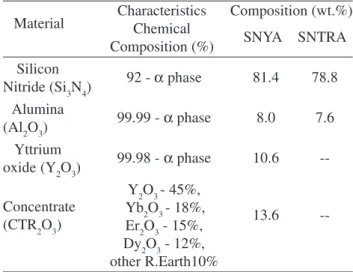
mix-ture. The sample compositions are resumed in Table 1. Sam-ples were prepared by isostaticaly pressing under 300 MPa and subsequent sintered at 1900 °C, for 2 h, under 1.5 MPa of N2, and further heat treatment at 1400 °C, for 24 h under 0.1 MPa of N2. The samples were characterized by the rela-tive density, using the immersion method, the phase com-position determined by X-ray diffractometry, and the me-chanical properties by 4-point bending strength and Weibull analysis.
Microstructural analysis was executed by scanning elec-tronic microscopy (SEM). Prior to analysis the samples were polished and plasma etched, using a mixture of CF4/O2 in a proportion of 4:2 for 2 min, and covered with a fine gold layer.
For the accomplishment of the bending tests, batches of 21 samples were grinded and polished, obtaining bars of 4 × 3 × 45 mm, according ASTM C 1116 - 94. The tests were conducted using a 4-point bending device with outer and inner spans of 40 and 20 mm, I1 and I2, respectively, as shown in Fig. 1. The speed of the crosshead displacement has been 0.5 mm/s. The bending strength of the samples was calculated by Eq. 1.
(1)
where:
σf: Bending strength (MPa); Fa: Rupture load (N);
b: Width of the samples (mm); h: Height of the samples (mm); I1: Outer span distance (mm); I2: Inner span distance (mm).
For the statistical evaluation of the fracture strength the
Figure 1. Schematic illustration of the 4-point bending test, with
b: sample width (mm), h: sample height (mm), I1: outer span
dis-tance (mm), I2: inner span distance (mm).
Table 1. Characteristics and compositions of the materials studied in this work.
Material CharacteristicsChemical Composition (wt.%) SNYA SNTRA Composition (%)
Silicon
92 - α phase 81.4 78.8 Nitride (Si3N4)
Alumina
99.99 - α phase 8.0 7.6 (Al2O3)
Yttrium
99.98 - α phase 10.6 --oxide (Y2O3)
Concentrate
Y2O3 - 45%,
13.6 --(CTR2O3)
two-parameter Weibull distribution function9 has been used,
according Eq. (2):
(2)
where:
P: Failure probability; m: Weibull modulus;
σ0: Characteristic strength;
σ: Bending strength.
The Weibull parameters m and σ0, are obtained transforming Eq. 2 in Eq. 3 and plotting
ln ln [1/(1-P)] vs. ln σ.
(3)
The stress value for 50% of rupture probability was es-timated as reference and also for direct comparison with the average fracture stress. The Weibull parameters m were determined using a factor of correction of 0.938, correspond-ing to 21 samples, in agreement with the German norm DIN-51-11012.
3. Results and Discussion
3.1. Sintering
Table 2 presents the results of phase composition, rela-tive density and weight loss of the sintered samples. Both compositions studied resulted in almost completely densified materials exhibiting only small weight losses during sintering, indicating a possible substitution of Y2O3 by CTR2O3 as sinter additive without decrease of the sintering activity in these systems. Furthermore, in both materials
β-Si3N4 and YAG have been identified as the only cristalline phases, giving further evidence for a possible substitution of Y2O3 by CTR2O3.
Table 2. Phase composition, relative density and weight loss of sintered samples.
System Phases Relative Weigth loss density (%) (%) Si3N4-Y2O3- β-Si3N4,
99.7 ± 0.2 2.4 ± 0.3 Al2O3 YAG
Si3N4-CTR2O3- β-Si3N4,
99.5 ± 0.2 2.3 ± 0.4 Al2O3 YAG
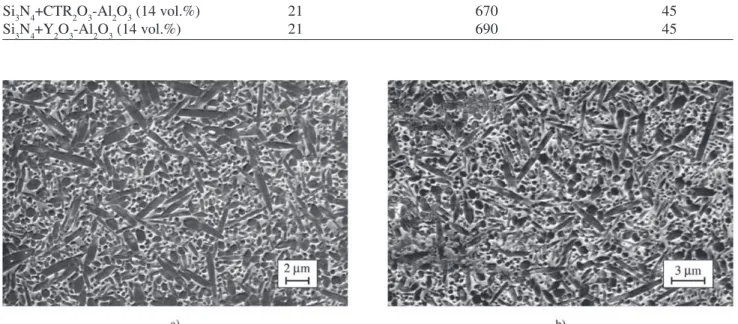
Figure 2. SEM micrographs of polished and plasma etched surfaces of sintered samples: a) SNYA; b) SNTRA.
Table 3. 4-point bending strength of sintered samples.
Specimen type Number of specimens Average bending strength, Standard deviation
σf (MPa) ∆σf (MPa)
Si3N4+CTR2O3-Al2O3 (14 vol.%) 21 670 45
3.2. Microstructure
Figure 2 presents the microstructures of the sintered and heat treated samples. In general, the presence of a great amount of elongated grains with a high aspect ratio is ob-served in both samples, SNYA and SNTRA. Grains with high aspect ratios are decisive for the improvement of the bending strength and fracture toughness of these materials3-6. The microstructural aspects observed take us
to believe that the use of CTR2O3 as additive results in a similar microstructure compared to Si3N4 sintered with Y2O3, which will contemplate in similar mechanical behaviors for both materials.
3.3. Mechanical Properties
The results of the bending strength are shown in Table 3. The properties presented by the sintered samples were promising for structural applications, comparable to other results reported in the literature using similar amounts and types of additives and sinter conditions3-6. It was
veri-fied that the use of the additive mixtures proposed in this work, allied to the employed sintering conditions, resulted in elevated bending strengths. The good mechanical strength of the produced materials is a consequence of the high final densities, or low porosity and microstructures composed of fine and elongated β-Si3N4 grains, leading also to the high fracture toughness of the Si3N4 ceramics.
3.4. Weibull Analysis
Figure 3 presents a comparison between failure prob-ability of the SNYA and SNTRA samples, as function of the bending strength.
It is observed that in spite of SNTRA samples possess smaller average strengths than SNYA samples, the curves are similar, indicating a similar behavior of failure probability. These results are confirmed by the Weibull analysis, whose results are presented in Table 4 and Fig. 4. The Weibull analysis was applied to the 4-point bending strength values. In the Table 4 the values for the Weibull moduli (m), characteristic strength (σ0) and the correlation coefficient (R) of the interpolation are listed. The correla-tion coefficients present values tending to 1, indicating that the rupture stress data are very well adjusted according to Weibull´s analysis9.
Table 4. Weibull parameters m and σ0 of sintered samples.
Specimen type Number of Weibull Correlation Characteristic specimens modulus, m coeficient (R) stress (σ0)
Si3N4+CTR2O3-Al2O3 (14vol.%) 21 15.5 R = 0.986 683 Si3N4+Y2O3-Al2O3 (14vol.%) 21 15.3 R = 0.969 713
Figure 3. Comparative Failure Probability between SNYA and SNTRA samples.
In general, the parameter m, observed in a vast range of ceramic materials, depends strongly on processing, the microstructure, pore distribution and of the surface finish-ing degree. These values are, typically, between 3 and 15, meaning that a material with m = 15 presents less scatter-ing of the fracture strength than a material with m = 310,13.
Quinn10 reports that a m value exceeding 10 indicates a
“good” ceramic material. Considering that the specimens were sintered under the same conditions and that the rela-tive densities are similar for SNYA and SNTRA, the pre-dominant factors for this resistance behavior are the char-acteristics of the microstructure and the intergranular phase formed. The same values of m = 15 determined for both materials (SNYA and SNTRA) demostrate that they con-tain similar defects and also similar defect size distributions. Therefore, the reliability of both materials studied are al-most identical, and both are suited for high performance mechanical applications.
4. Conclusions
den-Figure 4. Weibull diagrams for the Si3N4-Y2O3-Al2O3 (SNYA) and Si3N4-CTR2O3-Al2O3 (SNTRA).
the lower cost rare earth oxide mixture, CTR2O3, produced at DEMAR-FAENQUIL, resulting ultimately in a cost re-duction of these Si3N4 ceramics. The average bending strengths of these materials exceeding 670 MPa turns them suitable for structural applications. Furthermore, the elevated Weibull moduli m of 15 and characteristical stresses σ0 of 700 MPa, demonstrate the high reliability of these ceram-ics, and also that similar defect populations must have been present in both materials. This observation represents fur-ther support for a possible substitution of pure Y2O3 by the rare earth oxide mixture, CTR2O3, without causing signifi-cant reduction of the mechanical properties.
Acknowledgements
This work received financial support by FAPESP under Grant no. 01/08682-6.
References
1. Kingery, W.D.; Bowen, H.K.; Uhlmann, D.R. Introduction to
Ce-ramics. 2nd.ed., USA, p. 1032, 1976.
2. Bellosi, A. “Design and Process of Non-oxide Ceramics. Case study: Factors affecting microstructure and Properties of Silicon
nitride”; pp. 285-304 in Materials Science of Carbides, Nitrides
and Borides”; Edited by Y.G.Gogotsi, and R.A.Andreievski, Kluer Academic Publishers, Netherlands, 1999.
3. Ribeiro, S. Estudo comparativo das propriedades do nitreto de
silício sinterizado com óxido de ítrio/óxido de silício e concentrado de óxidos de ítrio e terras raras/óxido de silício. Faculdade de Engenharia Química de Lorena (Doctoral Thesis), p. 194, 1997.
4. Strecker, K.; Gonzaga, R.; Ribeiro, S.; Hoffmann, M.J., Mat. Lett,
v.45, p. 39-42, 2000.
5. Ribeiro, S.; Strecker, K.; Vernilli Jr., F. Estudo comparativo da
oxidação do nitreto de silício sinterizado com óxidos de ítrio e de terras raras. In:Encontro Nacional da Sociedade Portuguesa de Materiais, 8., Materiais’97, Marinha Grande - Portugal, Anais. Ed. L. Guerra Rosa. Aveiro: Sociedade Portuguesa de Materiais, v.2, p. 133-141, 1997.
6. Ribeiro, S.; Vernilli Jr, F.; Strecker, K. Cerâmica , v. 44, n. 285/286, p. 43, 1998.
7. Piorino Neto, F. Variáveis que Afetam a Avaliação do Módulo de
Ruptura em Ensaios de Flexão (Dissertação de Mestrado),São Carlos-SP, UFSCar, p. 153, 1990.
8. Zanoto, E.D.; Migliore Jr., A.R.; Cerâmica, v. 37, n. 247, p. 07-16,
1991.
9. Weibull, W. A statistical distribution function of wide applicability,
Journal of Applied Mechanics, p. 293-297, 1958.
10. Quinn, G.D. Strenght and Proff Testing, Engineered Materials
Handbook, vol 4, Ceramics and Glasses. ASM International, Met-als Park, OH, p 585-598, 1991.
11. Keller, K.; Mah, T.; Parthasarathy, T.A. Ceramic Eng, Sci. Proc.,
v. 11[7-8], p. 1122-1133, 1990.
12. Normennausschuß Materialprüfung im DIN Deutsches Institut für
Normung e.V. 4-Punkt- Biegeversuch, Statistische Auswertung,
Ermittlung der Weibull-Parameter, DIN 51 110, Teil 3, 1993.
13. Walker, W.J.; Reed, J.S. J Am Ceram Soc, v. 82, n. 1,
p. 50-56, 1996.