THE AUTOMOTIVE INDUSTRY IN BRAZIL
Jean-François Brunelière* Universidade Federal do Rio Grande do Norte
Abstract: Corporate translation represents a real paradox for Translation Studies (TS): while the discipline’s academic institutionalization and the origins of many translation training centres are heavily indebted to the globalization movement, fundamental research on communication in the economic pulse of this movement is still underdeveloped. The various impacts (in terms of economy, manpower and prestige) of international operations, which largely depend on multilingualism and translation, represent an excellent motivation for studying multinational companies’ behaviour, especially at the intersection of language and power. With this in mind, the present article focuses on PSA Peugeot Citroën’s activity in the Brazilian market in the expectation that the character of its power structure will be revealed in its external communication. A descriptive methodology was used to analyse all 2013 press releases on its Brazilian corporate website, in comparison with those on Argentinian and International sites, to determine how questions of power can explain textual shifts. The analysis demonstrates the extent of Brazilian publishing autonomy and the subsidiary’s relationships with other corporate divisions. This case study can be considered an illustration of how corporate translation can quickly lead to core issues within TS.
Keywords: Descriptive Translation Studies. Power. Multinational Companies.
* Possui graduação (licenciatura e bacharelado) em Letras Francês pela
ENTREPRISES ET TRADUCTION À L’ÉGARDE JEUX: L’INDUSTRIE AUTOMOBILE AU BRÉSIL
Résumé: La traduction réalisée par les entreprises représente un paradoxe pour la traductologie : alors que l’institutionnalisation académique de la discipline et les origines des centres de traduction doivent beaucoup au mouvement de mondialisation, la recherche fondamentale en communication économique y est toujours sous-développée. L’importance des impacts (en termes économiques, d’emploi et de prestige) des opérations internationales, qui dépendent éminemment du multilinguisme et de la traduction, nous incite à étudier le comportement des entreprises multinationales, et en particulier la dynamique entre langues et pouvoir. Cet article traite de l’activité de PSA Peugeot Citroën au Brésil et entend révéler certaines de ses structures de pouvoir via l’analyse de sa communication externe. Des méthodes descriptives sont utilisées pour analyser les communiqués de presse présentés par PSA sur son site Internet brésilien en 2013, en les rapprochant des communiqués des sites argentins et international et en cherchant à déterminer en quoi des questions de pouvoir pourraient expliquer certaines modifications textuelles. L’analyse démontre l’autonomie éditoriale de la filiale brésilienne de l’entreprise, ainsi que le type de relation qu’elle noue avec d’autres filiales. Cette étude de cas illustre la manière dont la traduction dans les entreprises mène rapidement à des questions clés pour la traductologie.
Mots-clés: Etudes Descriptives de la Traduction. Pouvoir. Entreprises Multinationales.
NEGÓCIOS E TRADUÇÃO COMO JOGOS DE PODER: A INDÚSTRIA AUTOMOBILÍSTICA NO BRASIL
prin-cipalmente quando questões de língua e de poder se encontram. Assim, este artigo retrata a atividade da PSA Peugeot Citroën no mercado bra-sileiro, procurando verificar como sua estrutura de poder transparece na sua comunicação externa. Por meio de métodos descritivos, analisamos os comunicados de imprensa publicados no site corporativo brasileiro em 2013, comparando-os com aqueles publicados nos sites argentino e inter-nacional, no intuito de verificar em que medida questões de poder podem explicar modificações textuais. A análise demonstra a autonomia da filial brasileira e as relações que constrói com outros setores da empresa. Esse estudo de caso pode ser considerado uma ilustração da maneira como a tradução nas empresas leva rapidamente a temáticas essenciais para os Estudos da Tradução.
Palavras-chaves: Estudos Descritivos da Tradução. Poder. Empresas Multinacionais.
Introduction
In spite of the clear link between the remarkable globalization movement following World War II (at economic, cultural and political levels) and the subsequent development of translation training centres around the world, we have to admit that, since Translation Studies (TS) established itself as a discipline (HOLMES 1972, was a key moment), business translation has not been an important topic in its research programs. Nevertheless, for those interested in studying the relationship between translation and questions of power, an analysis of translated communication in multinational companies (MNCs) could prove useful.
the so-called BRICS coalition makes Brazil a particularly valuable object of study.
1. Cross-border News and Power Issues
manufacturer, released on three versions of its corporate website (Brazilian, Argentinean and International).
This could serve as a good opportunity for TS to introduce MNC communication of MNCs in the TS agenda (which claims to be interdisciplinary), and offer new insights about real-world practice to other disciplines that are already working on globalization, international trade and organizations. But one of our first tasks will be, as far as the methodology is concerned, to opt for one of the many approaches available within TS. Our interest for power issues may influence our choice at that point.
2. From Norms and Power to Research on Organization
Power is intimately connected with translation, through the concept of norms. The use of norms had already gained wide currency within sociology for a number of years before Gideon Toury, who can be considered as the main architect of the norms concept within TS, defined them as “a category for descriptive analysis of translation phenomena” (1978, 91). In sociological traditions, norms are considered a manifestation of power relationships within societies. Translation scholar Theo Hermans confirms this for TS when he states that:
Given the nature of translation and of Translation studies, an approach through these concepts [rules and conventions] may well be productive, especially if we wish to focus on the social dimension of translating and on the place of translation in relation to power and ideology. (HERMANS 1996, 26.
micro-level analyses, in order to identify regularities in (1) the “choice of [...] individual texts to be imported through translation” (TOURY 1995, 58), which are an indication of the “preliminary norms”, then (2) analysis of the “degree of fullness of the translation” (idem) and the “textual-linguistic norms” at work, which constitute the “operational norms”. Through this analysis, the nature of power relationships between the Brazilian subsidiary and others PSA Peugeot Citroën’s entities should become more evident and, beyond linguistic considerations, lead us directly to organizational issues within the MNC. But before describing the corpus, a few words about the company and its organization might bring the greater context of the study into focus.
3. PSA Peugeot Citroën, Brazil and Language(s)
In 2011, PSA Peugeot Citroën, a car manufacturer with French origins, was the 7th ranked car manufacturer in the world with
communication may be an opportunity to discover more about the relationship between translation and power in this company and, more generally, in MNCs.
3.1. PSA Press Releases on the Brazilian Corporate Website: power relations at work
One of the privileged channels towards the international cooperation within PSA Peugeot Citroën is its entire system of websites. Let us notice here the complexly structured network: 27 websites are listed on http://www.psa-peugeot-citroen.com/en/ content/all-sites, but a few of them, the “commercial” ones, for example (www.peugeot.com or www.citroen.com), give access to dozens of others – basically one per country, in fact one per market, involved.
Our article focuses on the Brazilian press releases, which can be found on the PSA Peugeot Citroën Brazilian corporate website1 (www.psa-peugeot-citroen.com.br), in the “news and videos” (novidades e vídeos) page.
Although the Brazilian website provides access to Brazilian press releases, for comparison, the content of two other PSA websites will be included: Argentina (constructed on the same model as Brazil, but with press releases in Spanish) and the international site (a different model, with press releases in both French and English). The Brazilian website does not hide the existence of these sites, but instead provides direct links to them through special icons.We shall visit these two sites to understand how the Brazilian press releases compare to the others.
To generate a representative sample, we select a complete year: 2013. Based on the Brazilian website, we look for possible connections between press releases and evidence of power relationships (through translation) between the Brazilian, the
1 For simplicity’s sake, website will indicate “corporate website” in the rest of the article.
Argentinian and the international websites. Another of our questions is to what extent the general approach to distribution is a matter of localization, as suggested by Pym (2004), Orengo (2005) and Van Doorslaer (2012) in the case of news releases.
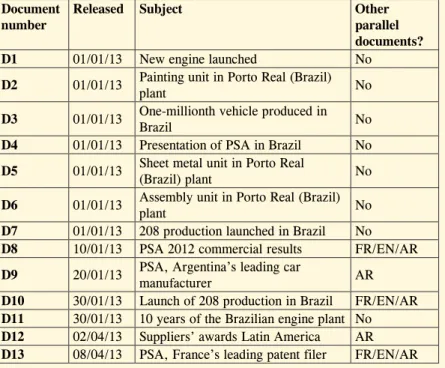
The first step of our analysis consists of listing all the news documents released in 2013 on the Brazilian website: a total of 33 documents, listed from D1 to D33 (Table 1). In this table, a distinction is drawn between specifically ‘national’ documents and those that can be shared by different websites. We use AR, BR, EN and FR (from now on) in order to refer to the particular document in Spanish on the Argentinian website, Portuguese on the Brazilian website and English and French on the international website. For instance, D8 AR is the Argentinian document corresponding to the Brazilian document 8.
Table 1. All 2013 press releases from the Brazilian PSA website
Document
number Released Subject Other parallel documents?
D1 01/01/13 New engine launched No
D2 01/01/13 Painting unit in Porto Real (Brazil) plant No
D3 01/01/13 One-millionth vehicle produced in Brazil No
D4 01/01/13 Presentation of PSA in Brazil No
D5 01/01/13 Sheet metal unit in Porto Real (Brazil) plant No
D6 01/01/13 Assembly unit in Porto Real (Brazil) plant No
D7 01/01/13 208 production launched in Brazil No
D8 10/01/13 PSA 2012 commercial results FR/EN/AR
D9 20/01/13 PSA, Argentina’s leading car manufacturer AR
D10 30/01/13 Launch of 208 production in Brazil FR/EN/AR
D11 30/01/13 10 years of the Brazilian engine plant No
D12 02/04/13 Suppliers’ awards Latin America AR
D14 24/04/13 PSA’s first quarter 2013 revenues FR/EN/AR
D15 27/04/13 Partnership with an educational institute in Brazil No
D16 15/05/13 Students welcomed for training in PSA’s plant in Brazil No
D17 03/06/13 PSA gives computers to an association in Brazil No
D18 05/06/13 A PSA petrol engine wins international award FR/EN/AR
D19 12/06/13 A 208 with all Brazilian employees’ signatures No
D20 14/06/13 Three European awards for PSA’s hybrid air technology FR/EN/AR
D21 19/06/13 PSA announces record sales in Argentina FR/EN/AR
D22 28/06/13 PSA delivers 139 light commercial vehicles to Brazilian Justice Department
No
D23 03/07/13 PSA’s 3rd plant in China FR/EN
D24 11/07/13 PSA’s first half 2013 results FR/EN/AR
D25 22/08/13 PSA offers tennis lessons to young Brazilians No
D26 29/08/13 PSA participate in a congress about
diesel in Brazil No
D27 05/09/13 PSA, number one exporter from Rio de Janeiro to Mercosul market No
D28 10/10/13 Partnership between PSA and a Brazilian institute for researches No
D29 17/10/13 Exposition about mobility in Sao Paulo AR
D30 18/10/13 First presentation of the hybrid air technology in Sao Paulo AR
D31 25/11/13 New president of PSA FR/EN/AR
D32 26/11/13 PSA gives computers to an association in Brazil No
D33 27/11/13 Partnership between PSA and a Rio de Janeiro university for research on
It is tempting to immediately begin analysing the relationships between these various texts. However, an initial “panoramic view” of each site, and of its general “editorial” politics might provide us with a better understanding of the deep communication tendencies of each market.
3.2. Different global scopes
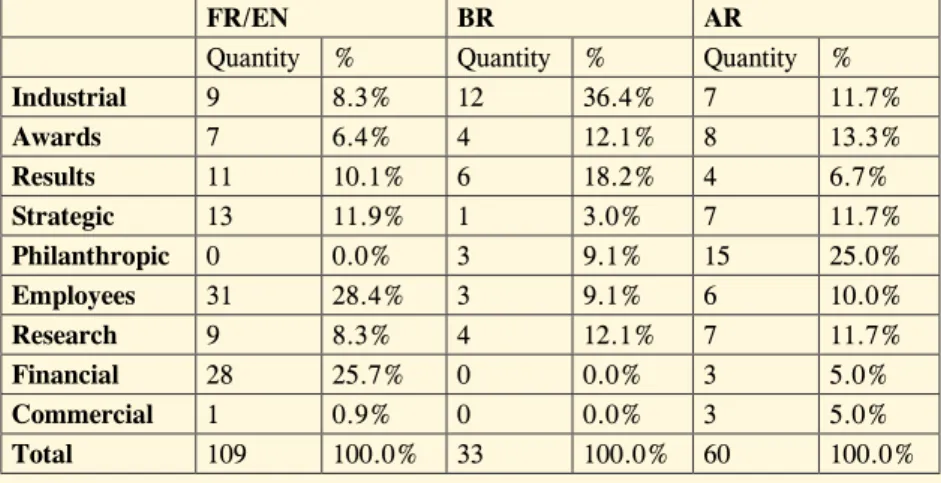
While 33 documents were published on the news section of the Brazilian PSA website in 2013, 60 documents were published on the Argentinian website and 109 on the international one. Although the international website’s press releases are texts only, the South-American ones are often texts plus image(s) or sometimes videos (8 in Brazil, 9 in Argentina).
A categorization of the news released on the three websites might help us to understand how they function. Nine thematic categories are sufficient to roughly describe all the news: (1) Industrial (plants and production); (2) Awards (whether won or awarded by PSA); (3) Results (sales or financial results directly linked with sales); (4) Strategic (new CEO or Board members); (5) Philanthropic projects; (6) Employees (nominations/interviews/training, labour union agreements, etc.), (7) Research (new technology launches, cooperation with universities, etc.), (8) Financial and (9) Commercial (vehicle launches, motor shows, etc.).
Table 2. Thematic scope of the press releases observed.
FR/EN BR AR
Quantity % Quantity % Quantity %
Industrial 9 8.3% 12 36.4% 7 11.7%
Awards 7 6.4% 4 12.1% 8 13.3%
Results 11 10.1% 6 18.2% 4 6.7%
Strategic 13 11.9% 1 3.0% 7 11.7%
Philanthropic 0 0.0% 3 9.1% 15 25.0%
Employees 31 28.4% 3 9.1% 6 10.0%
Research 9 8.3% 4 12.1% 7 11.7%
Financial 28 25.7% 0 0.0% 3 5.0%
Commercial 1 0.9% 0 0.0% 3 5.0%
Total 109 100.0% 33 100.0% 60 100.0%
Table 3. Geographic scope of the press releases observed.
FR/EN BR AR
Quantity % Quantity % Quantity %
World 75 68.8% 5 15.2% 19 31.7%
Brazil 1 0.9% 22 66.7% 2 3.3%
Argentina 1 0.9% 2 6.1% 26 43.3%
One particular
country 11 10.1% 2 6.1% 6 10.0%
Europe 21 19.3% 1 3.0% 1 1.7%
Latin America 0 0.0% 1 3.0% 6 10.0%
Total 109 100.0% 33 100.0% 60 100.0%
– very general – observations already demonstrate that PSA did not choose to homogenise the scope of its news communication worldwide. The subsidiary seems to insist on local information, while the international press releases are much more strategic in scope. The local-oriented view in South America would drive any curious Brazilians or Argentinians seeking a better global understanding of the company’s to the international website or other foreign source. Although 2013 was a difficult year for PSA, as can be understood through the multiple international releases dealing with financial issues (loans, the French State guarantee on PSA’s debt, bond issues, etc.), these topics do not seem worthy of mention in Brazil. Moreover, many “Employee” themes in the European sector (e.g. the “social contract” as a means of reducing the European workforce) are fully ignored in Brazil. The Brazilian audience is informed more about partnerships with local universities and training centres than about, for instance, the worldwide strategic alliance with General Motors. It could well be that the company, in concert with the geographical distance, is making use of its different regional identities (and media networks) to “protect” its image in South America. However, is this astute use of Internet segmentation by the subsidiaries or something decided at headquarters? Although information from such a macro-level could not be obtained from the corpus, it would seem reasonable to suspect that the translation process is indeed used to occlude certain facts and promote others.
The difference in focus between Brazilian and Argentinian press releases is a demonstration of the autonomy of these subsidiaries. However, despite the local power detectable in the macro-level of analysis, a closer look at texts is needed if we want to go further in our understanding of the company’s use of its corporate websites.
Brazilian and the Argentinian websites and (3) texts that are also released on the international website of the company. No need to stress that certain situations, texts and images are obviously international without necessarily being “global” – which would mean, in our case: interesting from the perspective of all the “national” websites involved.
3.2.1. Brazilian only
Of the items in our sample, eight are videos (D1 to D7 and D11) and the rest are texts. The videos can be considered as “local” documents, since they always deal with the Brazilian plant or “Brazilian” events (e.g. one-millionth vehicle produced in Brazil). These videos are, for the most part, images only, with very few textual elements, and have no relationship with other documents available elsewhere. Therefore, they will not be analysed together with the twenty-five other textual documents, about which much more can be said.
For eleven of the press releases on the Brazilian website (44% of total texts), there is no equivalent document on any of the other websites. At the end of each of these documents, without exception, the same short standard text, describing PSA’s activities in Brazil2, is used as a kind of copyright signature. At first sight, the “Brazilian only” press releases do not provide us with really strategic information; they are not central in the company’s global communication. Their function rather seems to be symbolic: giving a local flavour to the Brazilian corporate website. As far as Brazilian independence on the overall website is concerned, there can be no doubt: though the obvious interaction with European sources remains visible, the Brazilian managers have kind of a “private corner” of the website in their own hands. How it is negotiated with the headquarters and to what extent it tells us more about
2 Brazilian “signature” text: A PSA Peugeot Citroën no Brasil […] presente industrialmente
participation in decision-making cannot be deduced without greater insight into the overall PSA Internet management system. And, of course, Internet management (translation included) functions merely as an indicator of larger power relationships.
3.2.2. Brazilian-Argentinian (or Brazilian and Argentinian)
In 2013, four press releases (16% of all texts) are parallel on the Brazilian and the Argentinian websites. They deal with events, occurring either in Brazil or in Argentina that are not global in scope. In D12 (about “Latin America suppliers” awards), both countries are directly involved, but the release might also deal with a more local fact (such as the exposition happening in one of the two countries only, for instance), recognized as important by the neighbouring country (as in D9, D29 and D30).
Before even trying to identify which document is “the original”, our observation is that the verbal formulation in both languages is so parallel in terms of syntax and lexicon that the reader suspects that one is the model of the other. Was their production simultaneous? Was the French partner monitoring this production? Although it is difficult to make categorical statements based solely on this corpus, the fact is that any parallel text production would necessarily involve coordination between the subsidiaries. However, to create and maintain such cooperation some kind of pressures is necessary, since it would seem that each subsidiary would tend to develop its own discourse: therefore these parallel texts are, in themselves, evidence of power relations within the company.
3.2.2.1. In-house competition?
continuará su apuesta a la producción en el país con la presentación de un nuevo vehículo que será fabricado en la planta de El Palomar” promises a bright future for Argentina in the AR text, with PSA in the role of supporter of the local economy, but this is entirely missing in the BR version. Neither Argentinians nor Brazilians have the monopoly of this type of behaviour, as D12 exemplifies (Table 4).
Table 4. Information deleted in Argentinian PSA 2013 press release D12.
AR Tenemos por objetivo crecer con calidad e innovación en América
Latina
BR Temos o objetivo de crescer com qualidade e inovação no Brasil e na
América Latina
AR logramos producir y lanzar automóviles modernos e innovadores en el
mercado regional
BR estamos conseguindo produzir e lançar automóveis modernos e
inovadores no mercado nacional, como o Novo Citroën C3 e o Peugeot 208, que começa a ser vendido no país nos próximos dias
Linguistic “fidelity” to textual and discursive features contrasting with the merciless deletion of others: it is a matter of power. It seems actually that any kind of descriptive research, whether small or large scale confirms such heterogeneities.
3.2.2.2. Who are the actors, really?
One of the grey areas in such situations, and in the explanatory part of our cultural-empirical research, is the lack of access to information partly hidden behind the curtain. Who exactly is translating, then revising, who decides about dissemination, when do French – or other – decision makers interfere with their Brazilian colleagues, if at all?
It seems obvious that two different actors play a role: a ‘linguistic’ translator first, then a ‘censor-reviser’. But this formulation is too narrow since, especially in international business, it is very naive to imagine that only two individual people are involved: in our contemporary society translators are integrated into the (collective) corporate production of discourse (see PIEKKARI et al. 2013).
3.2.2.3. Text origins
In fact, our questions about directionality (which language/ source provides the message to the partner from the other country?) should become simpler from the moment we can establish who is publishing first. Hence, chronological observation of our releases shall be helpful. D9, dealing with sales in Argentina, was available on the Brazilian website eleven days after being posted on the Argentinian site. The other three texts were available on the Brazilian website first, then on the Argentinian one (up to five days later).
indicate the origin of the texts, except in case there would be one common original text.
In an attempt to find out about general and recurrent tendencies, we could say that the Argentinian and Brazilian websites share texts when regional events occur in Latin America, with text creation priority going to the event-hosting country, and translation being used by the other, including leeway to hide certain elements (especially the success of its neighbour, if the event does not serve as a simple example of the company’s well-being and implies comparison between countries’ industrial performances).
3.2.3. Brazilian, international, Argentinian
In 2013, ten texts (40% of total texts) are parallel on the Brazilian and international PSA websites (bearing in mind that the international site is always available in both French and English). Nine of these texts are also parallel with texts released on the Argentinian site.
These texts deal with two main types of events. The first ones could be called “real international events” (D8, D13, D14, D18, D20, D24 and D31). There is no reason why Brazil would be in charge of the dissemination of such announcements. The second type could be called “local events with general (even if only symbolic) significance for every country in which PSA is present” (D10, D21, D23). In this case, the “authorship” of the initial text may be local, for a later global distribution, or the text could have been written in collaboration between local and global levels of the company. Other clues must to be discovered by specific methods.
3.2.3.1. First international, then Brazilian/Argentinian
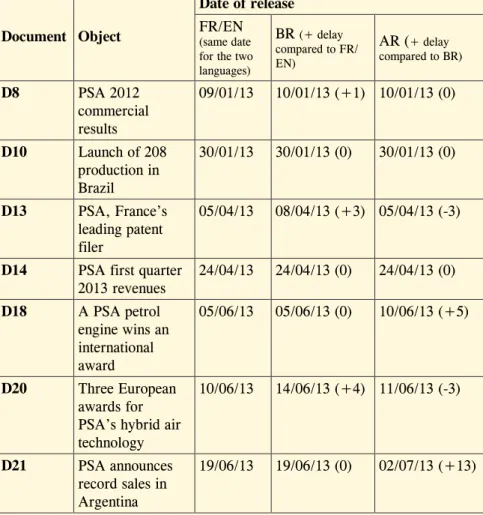
A first observation at the macro level, basic but often illuminating, is the exact date of the release (Table 5).
Table 5. Simultaneous and linear vs. capricious chronology in the distribution?
Document Object
Date of release FR/EN
(same date for the two languages)
BR (+ delay compared to FR/ EN)
AR (+ delay
compared to BR)
D8 PSA 2012
commercial results
09/01/13 10/01/13 (+1) 10/01/13 (0)
D10 Launch of 208 production in Brazil
30/01/13 30/01/13 (0) 30/01/13 (0)
D13 PSA, France’s leading patent filer
05/04/13 08/04/13 (+3) 05/04/13 (-3)
D14 PSA first quarter 2013 revenues
24/04/13 24/04/13 (0) 24/04/13 (0)
D18 A PSA petrol engine wins an international award
05/06/13 05/06/13 (0) 10/06/13 (+5)
D20 Three European awards for PSA’s hybrid air technology
10/06/13 14/06/13 (+4) 11/06/13 (-3)
D21 PSA announces record sales in Argentina
D23 PSA’s 3rd plant in
China
01/07/13 03/07/13 (+2) __
D24 PSA’s first half 2013 results
08/07/13 11/07/13 (+3) 31/07/13 (+20)
D31 New president of PSA
25/11/13 25/11/13 (0) 27/11/13 (+2)
Half of the texts are released “simultaneously” (at least the same day) in FR/EN and in BR. One would actually not expect otherwise from an international company mastering its worldwide image/communication. For the other parallel releases, a little delay in the release on the Brazilian corporate website can be used as an indication of information streams. But the chronological analysis of the Argentinian releases does not allow any clear chronological priority to be established between AR and BR texts, which compromises the (possible) hypothesis that AR texts are (indirect) source texts for Brazil.
As is well-known from many historical cases in literature, no one can certify that the historical succession of given publications takes place in the same order as their production. Other factors may have an influence (the team’s organization and workload for instance), not to mention the complexity of the text production (see genetic criticism and BELLEMIN-NOËL 1972). There are many reasons for extending this entire logic of chronology to translations, and even more to mass communication and international discourse.
3.2.3.2. Dominant French models
Although PSA claims to work in English3 while always providing press releases in both French and English, the fact remains that Brazilian texts are much closer to French ones than to English ones, at both the syntactic and the lexical level. Any page of the corpus may illustrate this basic tendency (see one fragment in Table 6, but many others could have been chosen).
Table 6. Syntactic and lexical comparison between Brazilian, French and English versions of PSA 2013 press release D20.
Origin Sample item D20
BR Os membros do júri salientaram em particular nesta inovação a adaptabilidade do motor ao estilo de condução de cada um. O motor escolhe de maneira autônoma um dos três modos de funcionamento disponíveis: Zero emissão, térmico a gasolina ou misto.
FR Les membres du jury ont notamment salué l’adaptabilité du moteur à la conduite de chacun offerte par cette innovation. Le moteur se règle de manière autonome sur un des trois modes de conduite possible : zéro émission, thermique essence ou mixte.
EN In particular, jury members were impressed by Hybrid Air’s ability to adapt to different driving styles, as the engine can select from one of three modes autonomously: air power (zero emission), petrol power or combined power.
AR Los miembros del jurado felicitaron principalmente la adaptabilidad del motor al manejo, ofrecida por esta innovación. El motor se regula de manera autónoma en uno de los tres modos de manejo posible: cero emisión, térmica nafta o mixta.
There is no evidence that AR texts, which seem to be consistently more source-oriented (using a nearly word for word replacement)
3 See how Annick Kruch’s (Head of PSA’s corporate university) presented the situation in
than BR ones, are used next to the FR model4. Generally speaking, no elaborate linguistic test is needed to confirm the influence of FR rather than EN or to notice that the BR translation is very source-oriented. For similar reasons, no list of illustrations will be produced to demonstrate how, in lexical terms, the same dominance of the French model is at work5.
One of the key trends underlying the relations between BR, EN, FR (and AR) texts is that the priorities in BR contrast heavily with the so-called “translation universals” (e.g. BAKER 1996), linguistic patterns that can be found in translations (such as explicitation, simplification, normalization and levelling out)6, which happen to be marginal in our corpus. The few shifts we are able to observe in the texts are not motivated by linguistic concerns. They are much more strategic and more interesting to us, since they demonstrate power games that go on between the different entities of which the MNC consist.
What we sometimes notice is interference between languages. The strong French influence in the Brazilian subsidiary sometimes leads to awkward “interlanguage”, e.g. “subida de gama” as a translation of “montée en gamme” (D8, D24) or “lançamentos através do mundo” for “à travers le monde” (D8). Some English expressions that are already part of French jargon at the management level are fully translated in BR text, e.g. “fluxo de caixa livre operacional” for “free cash flow opérationnel” (D14), and several expressions progressively migrate from English to French, then, occasionally, to Portuguese. The migration is total7 for: “flagship showroom” → “flagship” → “flagship store (espaço conceito)”,
4 This is why no further illustrations will be borrowed from the Argentinean website after
table 6.
5 Translations such as “evoluções contrastadas” for “évolutions contrastées”, when “trends
decidedly mixed” is used in English, are very common in the texts we analyse.
6 One can notice how Pym’s discussion, relating universals and norms (2008), is parallel to
our methodological approach here.
7 This way of importing English loanwords through the translation of French texts to
but partial for “channel mix” → “mix canal” → “composição de vendas”. Such dynamics seem to be part of a new global expert language: the international model is used by “avant-garde” kernels, while more traditional areas follow along more conservatively.
3.2.3.3. Tactical international marketing
In the international press, discourse between various countries and cultures is both an unavoidable topic and, at the same time, an active agent. Like in any other international environment, when redistributing international texts, the Brazilian subsidiary makes use of clever word selections in order to upgrade its position in the company’s “internal ranking” (table 7).
Table 7. Brazilian version of PSA 2013 press release D23 adds mention of Latin America to a text about China.
BR a China é uma das três zonas de desenvolvimento prioritárias da PSA Peugeot Citroën como parte de sua estratégia de internacionalização – juntamente com a América Latina e a Rússia.
FR PSA Peugeot Citroën a fait de la Chine l’une de ses trois zones de développement prioritaires dans le cadre de sa stratégie d’internationalisation.
EN PSA Peugeot Citroën identified China as one of its three priority development regions in its strategy of international expansion.
Table 8. voluntary omission of the new 308 model in the Brazilian PSA 2013 press release D14.
BR EN
o lançamento, em 2013, de
importantes modelos, como o Peugeot 2008 em abril, o Citroën C4 Picasso de 5 lugares em junho, inaugurando a nova plataforma EMP2, entre outros, totalizando 17 lançamentos no ano, sendo 9 na Europa.
model launches such as the Peugeot 2008 in April, the new five-seat Citroën C4 Picasso in June (debuting the new EMP2 platform) and the new Peugeot 308 in October. In all, the year will see the launch of 17 models, of which 9 in Europe
A simple accident in terms of inattention is excluded8. Would it be a “local technical device” for maintaining sales of the current version, preventing people from postponing their purchase until the new model comes out? This example is indicative of a very selective translation process that screens the information to which readers will be given access.
3.2.3.4. The autonomy of Argentinian and Brazilian subsidiaries
In 2013, the Argentinian corporate website released: 38 “Argentinian only” documents (including 9 videos), 4 texts parallel to BR texts (already analysed in this article) and 20 texts parallel with EN/FR ones (including 9 parallel with a BR text also). Although the Brazilian and Argentinian subsidiaries are officially gathered under the AmLat (Latin America) label within PSA, with one single President, they seem to have their autonomy as far as corporate communication on websites is concerned. Although they
8 In Brazil, the current version of the Peugeot 308 (produced in Argentina) was launched
demonstrate a strong interest in international information that can be valued at a local level, the large majority of the 109 international press releases available on the PSA’s international website (more than 90%, actually) remains simply ignored on the Brazilian site. Brazilian clients or investors are supposed to find information about PSA’s social negotiations or strategic alliances with other companies elsewhere. This very particular understanding of what corporate communication is sheds light on the power relationship within the company, where no hegemonic presence of the headquarters can yet be felt in the subsidiary’s website options.
3.2.3.5. A parallel text with Brazilian origins?
3.3. Localization, a satisfactory model here?
After having analysed the Brazilian press releases in detail, we can go back to one of our initial questions. Is localization, the process of turning a text linguistically and culturally appropriate to the target local (PYM 2004, 29), a potential model to account for the reality of PSA’s production/distribution of press releases in Brazil?
The erratic distribution chronology between Argentina and Brazil and the fact that Argentina uses more texts coming from the international website contradict the “one to many” translation model which underlies the localization model. If a strong international “centre” is easy to identify, there is no clue that one (and only one) centre would be the origin of texts released in Argentina and Brazil. Argentina and Brazil can also produce texts and diffuse them (in a smaller scale). And the overall process often appears to be more of a “push” (with local subsidiaries eclectically reproducing what they like from series of texts released on the international website) than a “pull” process (i.e. a broad spectrum of texts from the international website being reproduced on many “local” websites). The most spectacular effects described in translations are related neither to linguistic nor to cultural questions, but to strategic options.
The (very few) divergences between Brazilian versions and their French models, often caused by linguistic “difficulties”, indicate that the very first step of a localization process, i.e. internationalization, consisting in the removal of “the culture-specific features [...] in order to minimize the problems of later distributing that text to a series of locales” (idem, p. 31) has not been well treated. It would have imposed at least an “easy to translate” French model if not an English model: this is indeed one of the basic recipes of global products (cf. Walt Disney). Would the French teams not have imagined that their texts had a good chance of being used on other continents?
a more interesting material for whoever wants to understand the global patterns of communication of MNCs.
4. Summarizing: Press releases as a first step towards general patterns of global communication
One particular article on a complex issue such as French car industries in Brazil has little chance of offering more than a starting point for TS, even if we reduce the discussion to the question of power. But a few initial questions will be hard to ignore within this particular area of study. Informational texts have a good chance, as Cronin suggests, to be representatives of “the changing relationship between translation and its markets [since] the Web leads to the breakdown of traditional divisions between technical and marketing material” (CRONIN 2003, 17). The globalized business of our contemporary world causes major changes in the way we see and practice translation (CRONIN 2003). The relationships detected in this study are probably not limited to press releases alone. Of course, larger zones and other methods will need to be explored to achieve our general goal, i.e. to understand the globalization of a MNC communication and its relationships with translation.
intervention on behalf of the headquarters. Besides the general international priority, the Brazilian apparent (relative) autonomy suggests that central control from headquarters on that specific part of communication may not qualify as hegemonic.
Of course, we cannot take for granted that the kind of relationship we observed for press releases would necessarily be the same in others areas of communication (advertising, technical documents, etc.), where the headquarters, other partners or specific techniques (BRUNELIÈRE 2013) may be more influent in translation strategies. But we hope that this first accurate observation of a representative sector of the company’s communication can shed light on the overall system and help us to construct hypotheses and increase our understanding of its higher levels. Our first conclusion, anyway, is the impact of many organizational complexities and situations on the verbal identity of a big multinational.
References
BAKER, M. “Corpus-based translation studies: The challenges that lie ahead.”
Terminology, LSP and Translation. Studies in language engineering in honour of Juan C. Sager. Ed. H. Somers. Amsterdam: Benjamins (1996): 175-186.
BRUNELIÈRE, J-F. “Formas de se referir aos funcionários em um relatório anual do setor automotivo: um estudo de corpora.” In-Traduções 5, 9 (2013): 106-124.
BRUNELIÈRE, J-F. “Empréstimos em catálogos automotivos brasileiros: contribuição dos Estudos Descritivos da Tradução à compreensão do fenômeno.”
CRONIN, M. Translation and Globalization. London & New York: Routledge, 2003.
HERMANS, T. “Norms and the determination of translation: atheoretical framework.” Translation, Power, Subversion. Eds. R. Alvarez and M. Vidal. Multilingual Matters: Clevedon, England (1996): 25-51.
HOLMES, J. (1972) “The name and nature of translation studies.” Translated!: Papers on Literary Translation and Translation Studies. Ed. R. Van Den Broeck. Amsterdam: Rodopi (1988): 67-80.
International Organization of Motor Vehicle Manufacturers (OICA). World
Motor Vehicle Production – World Ranking of Manufacturers – Year 2011.
2012. Available at http://oica.net/wp-content/uploads/ranking-without-china-30-nov-12.pdf; accessed 14 September, 2013.
KANG, J-H. Recontextualization of news discourse: a case study of translation of news discourse on North Korea. The Translator 13, 2 (2007): 219-242.
LOGEMANN, M.; PIEKKARI, R. “Localize or local lies? The power of language and translation in the multinational corporation.” Critical Perspectives on International Business 11, 1 (2015): 30-53.
ORENGO, A. Localizing News: Translation and the “Global-national” dichotomy.
Language and Intercultural Communication 5, 2 (2005): 168-187.
PIEKKARI, R.; WELCH, D.; WELCH, L.; PELTONEN, J.-P.; VESA, T. “Translation behaviour: An exploratory study within a service multinational.”
International Business Review 22 (2013): 771-783.
PSA Peugeot Citroën (PSA). Document de référence 2012. 2013. Available at http://www.psa-peugeot-citroen.com/fr/report/161; accessed 24 August, 2013.
PSA Peugeot Citroën (PSAb). Questions à Annick Kruch. Planète, n.6. 2011. Available at https://www.yumpu.com/fr/document/view/17511417/psa-peugeot-citroen-planete-6-psa-planete-plus-psa-; accessed 14 March, 2014.
PYM, A. “On Toury’s laws of how to translate.” Beyond Descriptive Translation
Studies. Eds. Anthony Pym, M. Shlesinger, D. Simeoni. Amsterdam &
Philadelphia: John Benjamins (2008): 311-328.
______. The Moving Text: Localization, Translation, and Distribution. Amsterdam and Philadelphia: John Benjamins, 2004.
TOURY, G. Descriptive Translation Studies – and beyond. Amsterdam & Philadelphia: John Benjamins, 1995.
______. “The Nature and Role of Norms in Literary Translation.” Literature and Translation: New Perspectives in Literary Studies. Eds. J. S Holmes, José Lambert, R. Van Den Broeck. Leuven: Acco (1978): 83-100.
VAN DOORSLAER, L. Translating, narrating and constructing images in journalism with a test case on representation in Flemish TV news. Meta 57,4 (2012): 1046-1059.