MAPPING COMPETENCIES: IDENTIFYING GAPS IN MANAGERIAL
NURSING TRAINING
Aida Maris Peres1, Tessy Nnonyelum Miozzo Ezeagu2, Priscila Meyenberg Cunha Sade3, Pollyana Bahls de Souza4, Danelia Gómez-Torres5
1 Ph.D. in Nursing. Professor, Nursing Department, Universidade Federal do Paraná (UFPR). Curitiba, Paraná, Brazil. E-mail: aidamaris.
2 Nursing Graduate Student, UFPR. Scholarship, Fundação Araucária. Curitiba, Paraná, Brazil. E-mail: [email protected] 3 Doctoral. student, Post-graduate Program in Nursing, UFPR. Professor, Department of Nursing, UFPR. Capes Research Grant.
Curitiba, Paraná, Brazil. E-mail: [email protected]
4 M.Sc. Professor, Universidade Estadual do Centro Oeste do Paraná. Garapuava, Paraná, Brazil. E-mail: [email protected] 5 Ph.D. in Nursing. Professor, Universidad Autónoma del Estado de México. Toluca, Estado del Mexico, Mexico. E-mail: gomezdanelia@
usa.net
ABSTRACT
Objective: mapping necessary competencies in managerial nursing training.
Method: a cross-sectional study conducted between March and June 2013 with 258 students from three Higher Education Institutions of a municipality in the South of Brazil.
Results: mapping made it possible to identify necessary competencies for managerial nursing training, including those acquired and gaps.
The relative majority of the students considered having the right attitude to act as a nurse in the managerial dimension; however, signiicant gaps during their training were identiied in managerial competencies of supervision, auditing and change processes.
Conclusion: this mapping provides subsidies for pedagogical planning, seeking to promote the acquisition of managerial competencies during undergraduate course training.
DESCRIPTORS: Professional competence. Nursing students. Competency-based education. Research in nursing education. Research in nursing administration.
MAPEAMENTO DE COMPETÊNCIAS:
GAPS
IDENTIFICADOS NA
FORMAÇÃO GERENCIAL DO ENFERMEIRO
RESUMO
Objetivo: mapear as competências necessárias para a formação gerencial do enfermeiro.
Método: estudo de corte transversal realizado entre março e junho de 2013 com 258 discentes de três Instituições de Ensino Superior de um município do Sul do Brasil.
Resultados: o mapeamento possibilitou a identiicação das competências gerenciais necessárias à formação, as adquiridas e as lacunas. A
maioria relativa dos discentes considerou ter atitude para atuar como enfermeiro na dimensão gerencial, entretanto, para as competências
gerenciais de supervisão, auditoria e processos de mudança, identiicaram-se gaps signiicativos durante sua formação.
Conclusão: este mapeamento fornece subsídios ao planejamento pedagógico, com vistas a promover a apreensão de competências gerenciais durante a graduação.
DESCRITORES: Competência proissional. Estudantes de enfermagem. Educação baseada em competências. Pesquisa em educação de
enfermagem. Pesquisa em administração de enfermagem.
MAPEAMIENTO DE COMPETENCIAS:
GAPS
IDENTIFICADAS EN LA
FORMACIÓN GERENCIAL DEL ENFERMERO
RESUMEN
Objetivo: mapear las competencias necesarias para la formación gerencial de las enfermeras.
Método: estudio transversal realizado entre marzo y junio de 2013, con 258 estudiantes de tres centros de enseñanza superior de una ciudad en el sur de Brasil.
Resultados: el mapeo permitió la identiicación de las competencias gerenciales necesarias para la formación, las adquiridas y los vacíos. La
mayoría relativa de los estudiantes considera que poseen la actitud para actuar como enfermeros en la dimensión de gestión, sin embargo,
para la gestión de los procesos de supervisión, auditoría y de cambio, identiican algunas lagunas importantes en su educación.
Conclusión: este mapeo proporciona subsidios para la planiicación educativa, con el in de promover la detención de las capacidades de
gestión durante el grado.
DESCRIPTORES: Competencia profesional. Estudiantes de enfermería. Educación basada en las competencias. Investigación en la educación de enfermería. Investigación en la administración de enfermería.
INTRODUCTION
Despite being incorporated by the working world, the concept of competence was introduced in training proposals and professional updates. In this logic, competence relates to a combination of
its three ields – Knowledge, Skill and Attitude, ac
-quired during educational processes and expressed by the individual through their behavior in a par-ticular professional context.1-2
Knowledge is attributed as the denotative of
knowing, and corresponds to information acquired by individuals to an ability, meaning the know-how; which is related to one’s ability to put into practice acquired knowledge; and the attitude, whose de-notative is knowing how to be/to act, related to the individual’s behavior in a professional context.2
On the world scene, some studies on profes-sional training point out that the construction of competencies implies articulating different knowl-edge for developing professional practice, not only in acquiring and incorporating knowledge and skills, but also in personal and relational attitudes which aim at constructing a common project in order to transform the health reality.3-5 In Brazil, the relevance
of this theme has advanced to legal determinations for nursing education in the country, with the elabo-ration of the National Curricular Guidelines (DCNs) from 2001, which emphasized Nursing training based on developing competencies, including those related to administration/management.2,6
Development of management
skills/competen-cies is an indispensable set of knowledge identiied in
order to plan, make decisions, interact and manage people. Therefore, establishing the competencies to be developed during nurses’ training is still a chal-lenge.3,7 The discrepancy between the required skills
and those existing in an organization stand out. In-stitutional demands in health require professionals
with increasingly complex training. However, even though the debate is scarce, it is known that there are gaps between the teaching-learning process and the work environment regarding the acquired skills for future nursing professionals.2,7
Mapping competencies is a managerial tool that allows for diagnosing discrepancies between
the competencies necessary to fulill organizational
requirements and the existing internal competen-cies.8 In the case of this study of innovative
applica-tion in the educaapplica-tional scenario, these discrepancies are represented by revealing gaps in developing the skills required in training nurses, with the purpose of supporting the planning and evaluation of peda-gogical projects in undergraduate nursing courses. In view of the above, issues related to the de-velopment of competencies must be problematized by educational institutions in order to prioritize what is fundamental for Nursing training and their future action in the work environment. The present study aims to map the competencies necessary for training managerial nurses.
METHOD
This is a cross-sectional study using the compe-tency mapping method,8 conducted between March
and June 2013 in three undergraduate nursing cours-es located in a municipality in the South of Brazil.
This mapping followed three steps: 1) identify-ing managerial competencies necessary for trainidentify-ing nurses through documentary analysis, between January and March of 2013, with its sources being the 27 syllabus/program topics and 58 objectives
of the Nursing Administration discipline included
in the pedagogical projects in force in the year 2013 of the three higher education institutions (HEIs); 2) application of a questionnaire between March and
pointing out the managerial knowledge, skills and attitudes acquired during the training; 3) identifying the gaps between the competencies described by the educational institution in the documentary analysis and the competencies acquired by the students ac-cording to their answers in the questionnaires; this
stage was carried out from April to June 2013. A known population of 359 students from the
three mapped undergraduate courses was considered to determine the number of participants in the study.
A conidence level of 99% and a permissible margin
of error of 4.3% were established for sample calcula
-tion, obtaining an intentional sample of 258 students.9
Inclusion criteria for the participants of the research were established according to the following points: being regularly enrolled in one of the nursing courses in one of the three educational institutions and attending the second year of the nursing course.
As exclusion criteria, the following principles were deined: students enrolled in the irst year of the
nursing course, or those who were not present on the dates and times scheduled with the institutions for the questionnaire application.
In order to organize the data collected in the
irst stage, a structured script was used that allowed
for analyzing the disciplines’ syllabi/programs and objectives, based on the competencies described in the DCNs for undergraduate nursing courses. In the second stage, a questionnaire composed of two semi-structured and 17 semi-structured questions was applied
to second to ifth year students, with the purpose of
obtaining conceptions from the participants related to managerial competencies acquired throughout their undergraduation, as it is from the second year that they begin to have contact with content related to Nursing administration in the studied HEIs.
In order to deine the competency gaps, a
classiication was implemented based on the per
-centage of the students who answered that they did not gain/achieve the knowledge, skills and/or
attitudes proposed in the Nursing Administration
discipline by following the indicators adopted in
the methodological framework, which consist in identifying gaps between the necessary skills and those actually achieved.8 Therefore, it was agreed
that competency gaps would be classiied as the
difference between the percentages of the
neces-sary competencies identiied from the documentary
research and those acquired as pointed out in the questionnaires by the students who obtained a score
greater than 1%; and those with a score greater than or equal to 50% as signiicant competency gaps. This score corresponds to the value of 50%, assigned as the average minimum inal score for approval in the Nursing Administration discipline in these HEIs.
Data analysis of the documents allowed for
identifying the competencies and their ields accord
-ing to the classiication into Knowledge, Skills and Attitudes (KSA). Data analysis of the questionnaires
was performed by simple descriptive statistics (ab-solute and relative frequencies), using the statistical functions of the Biostat 2007 software.
Data collection began after project approval by the Research Ethics Committee involving Hu-man Subjects of a university in the South of Bra-zil. Permission was granted on March 27, 2013, under opinion number 231.163, and Certificate
of Presentation for Ethical Appreciation (CAAE)
098448113.5.0000.0102, as well as after the partici-pants signed the Clear and Informed Consent Form.
RESULTS
Specific competencies identified through
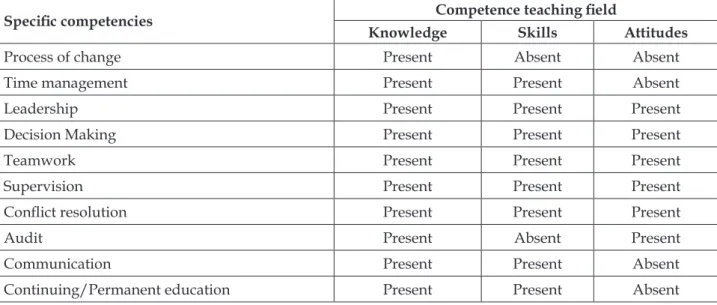
documentary analysis were classiied into the three KSA ields. The KSAs required for general nursing
training are shown in the pedagogical projects of the analyzed HEIs and in the National Curricular Guidelines (DCNs) for undergraduate nursing
courses. Each document showed a group of speciic
competencies in the syllabus/programs and
objec-tives of the Nursing Administration discipline. Not
all of the speciic competencies found were identi
-ied in the three KSA ields (Chart 1).
Chart 1 - Synthesis of skills and ields identiied from the Nursing Administration discipline’s syllabus/ program topics and objectives. South of Brazil, 2013
Speciic competencies Competence teaching ield
Knowledge Skills Attitudes
Planning in health/nursing Present Present Present
Information system Present Present Absent
Speciic competencies Competence teaching ield
Knowledge Skills Attitudes
Process of change Present Absent Absent
Time management Present Present Absent
Leadership Present Present Present
Decision Making Present Present Present
Teamwork Present Present Present
Supervision Present Present Present
Conlict resolution Present Present Present
Audit Present Absent Present
Communication Present Present Absent
Continuing/Permanent education Present Present Absent
In the second stage, from the 258
question-naires analyzed, 80 (31%) students were enrolled in
the 2nd year, 93 (36%) in the 3rd year of the course,
59 (23%) in the 4th year and 26 (10%) were in their
5th year. Regarding the Nursing Administration
discipline, we veriied that 78 (30%) students had
already taken it, which suggests that they had al-ready experienced some of the skills listed in the applied questionnaire.
Regarding the competencies selected in the questionnaire to act as a nurse in the management
area according to the KSA classiication: 124 (48%)
of the students reported having learned Knowl
-edge, 110 (42.6%) Skills, and 158 (61.4%) Attitudes
throughout the undergraduate nursing course. However, there was an increase in the percentage
among students after they inished the discipline Nursing Administration, up to 199 (77%), 142 (55%), and 219 (85%), respectively.
In general, the answers obtained regarding the
speciic competencies mentioned by the students
were those more taught in theoretical classes than in practical classes or in the curricular internship (Table 1).
Table 1 - Absolute and relative frequency of managerial competencies addressed during nursing graduation of three Higher Education Institutions. Southern Brazil, 2013
Speciic competence Theoretical classes
Practical classes
Curricular
internship
n % n % n %
Teamwork 216 83.7 179 69.4 136 52.7
Communication 198 76.7 168 65.1 124 48.1
Decision Making 173 67 149 57.7 131 50.8
Planning in health/nursing 166 64.3 126 48.8 96 37.2
Leadership 159 61.6 113 43.8 86 33.3
Continuing/Permanent education 151 58.5 107 41.5 82 31.8
Time management 146 56.6 155 60.1 104 40.3
Conlict resolution 139 53.9 114 44.2 83 32.2
Information system 122 47.3 86 33.3 70 27.1
Human/physical and material resources 112 43.4 83 32.2 65 25.2
Process of change 108 41.9 75 29 64 24.8
Supervision 74 28.7 46 17.8 43 16.6
Table 2 reveals the gaps between the KSA ields
of speciic competencies identiied by documentary research and the competences achieved by the stu-dents, according to data from the questionnaire.
Table 2 - Knowledge, Skill and Attitude gaps found, Southern Brazil, 2013
Knowledge
Speciic competence GAP (%) Competency achieved (%)
Communication ‡ 1 99
Leadership § 3 97
Teamwork § 3 97
Decision Making † 7 93
Planning in health / nursing § 9 91
Information system § 10 90
Conlict resolution § 10 90
Time management § 17 83
Continuing / Permanent education § 17 83
Process of change § 21 79
Human, physical and material resources § 24 76
Supervision § 28 72
Audit § 41 59
Skills*
Speciic competence GAP (%) Competency achieved (%)
Conlict resolution § 30 70
Teamwork § 35 65
Communication § 37 63
Decision Making § 37 63
Time management § 39 61
Continuing / Permanent education § 40 60
Planning in health / nursing § 41 59
Leadership § 45 55
Information system § 48 52
Human, physical and material resources § 49 51
Supervision || 56 44
Attitudes†
Speciic competence GAP (%) Competency achieved (%)
Teamwork § 21 79
Conlict resolution § 23 77
Decision Making § 27 73
Planning in health / nursing § 33 67
Leadership § 41 59
Human, physical and material resources § 44 56
Process of change || 51 49
Supervision || 55 45
Audit || 65 35
DISCUSSION
The syllabus/program topics and objectives of the Nursing administration disciplines revealed
a group of speciic competencies in agreement with
the DCNs guidelines. However, not all data were
listed in the three KSA ields when the documents were analyzed in the irst research stage. Skills and Attitude were not present in more than half of the speciic competencies.
It should be noted that after the curricular changes that took place in Brazil from the creation of the DCNs for nursing undergraduate courses, the development of competencies must also be conducted and directed towards acquiring and de-veloping skills and attitudes.2 Thus, teaching content
aimed at developing the necessary competencies for nursing work need to be supported by knowledge regarding products, services and care needs; skills for when they are performing the work or analyzing patients’ expectations; and with favorable attitudes towards the legal and ethical principles of work.5,10-11
In general, both before and after taking the
Nursing Administration discipline, the majority of
the students admitted having more acquired the area
of Attitudes in order to act in the managerial dimen
-sion. On the other hand, they revealed that the speciic
competencies were more approached in the theoretical classes than in practical classes or in the internship. Therefore, we can infer that these competencies were
more related to Knowledge than to Skills or Attitudes. A study carried out with 59 graduates of a
nursing course pointed out that speciic competen
-cies had more emphasis on Knowledge and Skills than on Attitudes throughout the course, revealing that the attitudinal ield is the one with the greatest gap during undergraduation, and that Attitudes
end up being developed in professional practice.12
According to students’ perception, the only
specific competence that was more addressed during practical than theoretical classes was time management. This result can be explained by the
practical nature required in the ield of Skills for
developing this competence, which are acquired during organizational and planning activities re-quired for practical classes and internships. This competence is a decisive factor in organizing nurs-ing work, since it facilitates acquirnurs-ing the perception of time; making optimal use of available time to plan and develop health work processes.13
Gaps have been observed in all managerial
competencies among all three KSA ields. Despite
these gaps being less than 50%, they require atten
-tion from HEIs and teachers, especially those that are close to this percentage such as what is observed
for the Skills ield with the following competencies: Leadership; Information systems; Human, physical
and material resources.
Among the managerial competencies, we can
deduce that leadership is the most required for ex-ercising nursing work processes. It is intrinsic that nurses assume the role of being a leader as soon as they graduate.7,14-15 On the other hand, information
systems comprise the routine work of nurses, pres-ently considered as indispensable for their activity since they are aimed at gaining time in accessing information, which facilitates thinking; in operational support, which facilitates doing; in managing people, which assists in the decision-making process and motivates communication among the teams.6,16
Re-garding the human, physical and material resources competence, this should be used as a plan that fore-sees short, medium and long term organizational demands with the purpose of obtaining quality,
eficacy and eficiency in the health work process.17
Among the signiicant gaps above 50% in the mapping of speciic competencies, we can highlight Supervision in the ields Skills and Attitudes, and the Process of Change and Auditing, both in the Attitudes ield. Auditing was not mentioned in the Skills ield.
The Skills and Attitudes addressed in Supervi
-sion which resulted in a signiicant gap in this study
are basic to nursing training, since in addition to the
leadership competence, they are required by the Law
of professional nursing exercise and by the Nursing Code of Ethics. Nurses performance in supervising the work of the nursing team happens through operative instruments used with the intention of optimizing actions of the groups in their work environment, and
requires Skills and Attitudes to attain resolution with
the institutional resources that are offered to them.18-20
We highlight the importance of trained pro-fessionals in addressing and solving interpersonal, intergroup and institutional problems related to mobilizing the competence processes of change. Nurses need to seek cognitive and technical
com-petencies, but also Behavioral and Attitude skills to
innovate and sustain the transformations required
in their managerial work in health. The Attitude ield has proved to be challenging during academic
training, and consequently in professional practice, given that the Process of Change competence in the current conjuncture is directly linked to intense and rapid transformations, such that nurses must recognize and be able to express this dynamism in a
-ing their team towards adherence to the necessary organizational changes.2,12
Also in the Attitudes ield, the gap related to Auditing reveals that students did not recognize this
competence, which is used for systematic and formal evaluation of an activity by someone not directly involved in its execution, to determine whether this activity is being carried out in accordance with its objectives. When performing their duties, nurses use nursing audits to verify whether the quality of care is adequate, as this competence supports care management and decision making.21-23
The discussion of the results suggests that managerial training of future nurses should be reviewed in order to mobilize competencies from
signiicant experiences to be relected in professional practice, especially in the Skills and Attitudes ields.
These academic experiences need to be supported
by opportunities that enable eficient processes for
decision making and communication, that motivate autonomy, co-responsibility and teamwork.20,24
As limitations, we can point out the need to
better understand the HEIs participating in the study,
since their speciicities, characteristics and organiza -tion culture need to be considered in order to obtain an accurate diagnosis of the local situation. This situ-ational recognition is also necessary in planning the teaching-learning process, so that it can be meaningful, consistent and able to mobilize nursing students to seek new knowledge in a contextualized perspective, aiming for competent professional performance.
CONCLUSION
We highlight that it was possible to achieve the study objective of mapping the necessary com-petencies for managerial training of nurses. This mapping made it possible to more clearly diagnose how the teaching-learning process is consolidated in the approach of managerial subjects relevant to the nursing undergraduate course program/syllabus.
The greatest number of speciic managerial skills
and the smallest gaps were veriied in the Knowl
-edge ield. The largest gaps were concentrated in the other two ields, which suggests that Skills and
Attitudes are less acquired by the students in Nurs
-ing Administration disciplines.
In view of the above, it can be inferred that there is a need for changes in managerial nursing training. To that end, HEIs and teachers need to rethink their
work in a critical-relective way. It is necessary to
overcome resistance to change, to invest in spaces of practice and in teacher training.The teaching-learning
process in these disciplines needs to occur through method and planning, with both being in tune with theory, practice and internships, comprising real work situations that allow learning to be mediated and in-terpreted according to the work context.
In this sense, we propose a continuity of further studies that map competencies in the area of nursing education, considering that this type of research is still scarce. We conclude that the use of this method is valid for modifying and updating the didactic-pedagogical approach of Nursing Man-agement disciplines taught by HEIs, reducing the gaps between teaching the planning and learning of management skills in the undergraduation context.
REFERENCES
1. Serrano MTP, Costa ASMC, Costa NMVN. Cuidar em
enfermagem: como desenvolver a(s) competência(s). Rev Enf Ref [Internet]. 2011 Mar [cited 2015 Jul 08];
serIII(3):15-23. Available from: http://www.scielo. mec.pt/scielo.php?script=sci_arttext&pid=S0874-02832011000100002&lng=es
2. Almeida ML, Peres AM. Conocimientos, habilidades
y actitudes sobre la gestión de los egresados de enfermería de una universidad pública brasileña.
Invest Educ Enferm [Internet]. 2012 Jan-Abr [cited 2015 Jul 8]; 30(1):66-76 Available from: http://www.scielo. org.co/scielo.php?script=sci_arttext&pid=S0120-53072012000100008&lng=en&nrm=iso
3. Camelo SHH, Angerami ELS. Professional competence: the construction of concepts, strategies developed by health services and implications for nursing. Texto Contexto Enferm [Internet]. 2013 Jun [cited 2015
Jul 08]; 22(2):552-60. Available from: http://dx.doi. org/10.1590/S0104-07072013000200034
4. Soto-Fuentes P, Reynaldos-Grandón K, Martínez-Santana D, Jerez-Yáñez O. Competencias para la enfermera/o en el ámbito de gestión y administración:
desafíos actuales de la profesión. Aquichán [Internet]. 2014 Mar [cited 2015 Jun. 15]; 14(1):79-99. Available
from: http://www.scielo.org.co/pdf/aqui/v14n1/ v14n1a08.pdf
5. Blažun H, Kokol P, Vošner J. Survey on speciic nursing competences: students’ perceptions.Nurse Educ Prac. [Internet]. 2015 Feb [cited 2016 Mai 09]; 15(5):359-65.
Available from: http://www.sciencedirect.com/
science/article/pii/S1471595315000293
6. Peres AM, Ciampone MHT. Gerência e competências
gerais do enfermeiro. Texto Contexto Enferm. [Internet]. 2006 Sep [cited 2015 Oct 29]; 15(3):492-9.
Available from: http://dx.doi.org/10.1590/S0104-07072006000300015
7. Sade PMC, Peres AM. Development of nursing
[Internet]. 2015 Dec [cited 2016 Apr 25]; 49(6):988-94. Available from: http://dx.doi.org/10.1590/S0080-623420150000600016
8. Brandão HP. Mapeamento de competências: métodos, técnicas e aplicações em gestão de pessoas. São Paulo
(SP) Atlas; 2012.
9. Agranonik M, Hirakata VN. Cálculo de tamanho
de amostras: proporções. Rev HCPA [Internet]. 2011 [cited 2016 Ago 17]; 33(1):382-8. Available
from: http://www.seer.ufrgs.br/hcpa/article/ viewFile/23574/15837
10. Siles J, Solano-Ruiz MC, Freitas GF, Oguisso T. Political systems and the perspective on nursing education during the Spanish transition (from the
Franco Regime to Democracy). A Contribution based on nursing history. Aquichán [Internet]. 2010 Dec [cited 2015 Jul 8]; 10(3):192-203. Available from:
http://www.redalyc.org/articulo.oa?id=74116984002
11. Latrach-Ammar C, Febré N, Demande I, Araneda J,
González I. La importancia de las competências em la formación de enfermeria. Aquichán [Internet]. 2011 Dec [cited 2015 July 08]; 11(3):305-15. Available from:
http://www.scielo.org.co/scielo.php?script=sci_ arttext&pid=S1657-59972011000300006&lng=en 12. Almeida MDLD, Peres AM, Bernardino E, Santos MF.
Egressos de uma universidade pública e perspectivas de atuação no gerenciamento em enfermagem. Rev Rene [Internet]. 2014 Nov/Dec [cited 2015
Jul 8]; 15(6):933-41. Available from: http://www. revistarene.ufc.br/revista/index.php/revista/ article/view/1806/pdf
13. Montezeli JM, Peres AM, Bernardino E. Nurse management skills required at an emergency care unit. J Res Fundam Care [Internet] 2013 Jul-Set [cited
2015 Jul 8]; 5(3):245-52. Available from: http://dx.doi. org/10.9789/2175-5361.2013.v5i3.245-252
14. Amestoy SC, Backes MS, Triandade LL, Canever BP.
The scientiic production regarding leadership in the
context of nursing. Rev Esc Enferm USP [Internet].
2012 Feb [cited 2014 Nov 20]; 46(10):219-24. Available
from: http://www.scielo.br/pdf/reeusp/v46n1/ en_v46n1a30.pdf
15. Ekström L, Idvall E. Being a team leader: newly registered nurses relate their experiences. J Nurs Manag. [Internet]. 2015 Jul [cited 2015 Dec 25];
23(1):75-86. Available from: http://onlinelibrary. wiley.com/doi/10.1111/jonm.12085/full
16. Gonçalves LS, Castro TC, Fialek SN. Computer experience of Brazilian nurses of a teaching hospital. J Health Inform. [Internet] 2015 Jul-Set [cited 2015
Nov 30]; 7(3):82-7. Available from: http://www.jhi-sbis.saude.ws/ojs-jhi/index.php/jhi-sbis/article/ view/342/237
17. Baldissera VDA, Góes HLF. El método Altadir de planificación popular como instrumento de enseñanza de la gestión en enfermería. Invest Educ Enferm.[Internet]. 2012 Jul-Dec [cited 2015 Jul 8];
30(2):252-9. Available from: http://www.scielo. org.co/scielo.php?script=sci_arttext&pid=S0120-53072012000200011&lng=pt&tlng=pt
18. Lelli LB, Bernardino E, Peres AM, Fabriz LA. Estratégias gerenciais para o desenvolvimento de competências em enfermagem em hospital de ensino.
Cogitare Enferm [Internet]. 2012 Abr-Jun [cited 2015 out 29]; 17(2):262-9. Available from: http:// ojs.c3sl.ufpr.br/ojs/index.php/cogitare/article/ view/24932/18480
19. Carvalho JFS, Chaves LDP. Supervisão de enfermagem no uso de equipamento de proteção individual em um hospital geral. Cogitare Enferm [Internet]. 2010 Jul-Set
[cited 2015 Jul 8]; 15(3):513-20. Available from: http:// dx.doi.org/10.5380/ce.v15i3.18897
20. Uchimura KY, Bosi MLM. Abilities and skills among Family Health Strategy workers. Interface (Botucatu) [Internet]. 2012 Mar [cited 2015 July 08]; 16(40):149-60.
Available from: http://dx.doi.org/10.1590/S1414-32832012005000006
21. Silva MVS, Silva LMS, Dourado HHM, Nascimento
AAM, Moreira TMM. Limites e possibilidades da
auditoria em enfermagem e seus aspectos teóricos e práticos. Rev Bras Enferm. [Internet]. 2012 Jun [cited
2015 Jul 01]; 65(3):535-8. Available from: http:// dx.doi.org/10.1590/S0034-71672012000300021 22. Pinto KA, Melo CMM. Nurses’ practice in health
audit. Rev Esc Enferm USP [Internet]. 2010 Sep [cited
2015 July 08]; 44(3):671-8. Available from: http:// dx.doi.org/10.1590/S0080-62342010000300017 23. Viana CD, Bragas LZT, Lazzari DD, Garcia CTF,
Moura GMSS. Implantação da auditoria concorrente de enfermagem: um relato de experiência. Texto
Contexto Enferm [Internet]. 2016 [cited 2016 Aug 15]; 25(1):e3250014. Available from: http://www. scielo.br/scielo.php?script=sci_arttext&pid=S0104-07072016000100702&lng=en
24. Hayashida KY, Bernardes A, Maziero VG, Gabriel CS.
A tomada de decisão da equipe de enfermagem após
revitalização do modelo compartilhado de gestão. Texto Contexto Enferm [Internet]. 2014 Jun [cited 2016
Aug 15]; 23(2):286-93. Available from: http://www. scielo.br/scielo.php?script=sci_arttext&pid=S0104-07072014000200286&lng=en
Correspondence: Priscila Meyenberg Cunha Sade
Rua Ângelo Cunico, 600 – casa 69 Barreirinha – Curitiba, PR, Brasil
E-mail: [email protected]
Received: December 16, 2015