Work-related stress according to the
demand-control model and minor psychic
disorders in nursing workers
*Janete de Souza Urbanetto1, Maria Cristina Cademartori Magalhães2, Vanessa Oreda Maciel3,
Viviane Massena Sant’Anna4, Andréia da Silva Gustavo5, Carlos Eduardo Poli-de-Figueiredo6,
Tânia Solange Bosi de Souza Magnago7
ESTRESSE NO TRABALHO SEGUNDO O MODELO DEMANDA-CONTROLE E DISTÚRBIOS PSÍQUICOS MENORES EM TRABALHADORES DE ENFERMAGEM
ESTRÉS LABORAL SEGÚN EL MODELO DEMANDA-CONTROL Y TRASTORNOS PSIQUIÁTRICOS MENORES EN TRABAJADORES DE ENFERMERÍA
* Extracted from the course conclusion study, “Estresse no trabalho e distúrbios psíquicos menores em trabalhadores de enfermagem em um hospital universitário ”, Nursing, Nutrition and Physical Therapy School, Pontiical Catholic University of Rio Grande do Sul, 2011. 1 Nurse. Doctorate in Health Sciences. Adjunct Professor in the Nursing Course, Pontiical Catholic University of Rio Grande do Sul. Porto Alegre, RS, Brazil. [email protected] 2 Psychologist. Undergraduate Nursing student, Pontiical Catholic University of Rio Grande do Sul. Porto Alegre, RS, Brazil. 3 Undergraduate Nursing student, Pontiical Catholic University of Rio Grande do Sul. Porto Alegre, RS, Brazil. 4 Undergraduate Nursing student, Catholic University of Rio Grande do Sul. Porto Alegre, RS, Brazil. 5 Nurse. Doctorate in Epidemiology. Adjunct Professor in the Nursing Course, Pontiical Catholic University of Rio Grande do Sul. Porto Alegre, RS, Brazil. 6 Physician. Doctorate in Physiology. Full Professor in Medical School, Pontiical Catholic University of Rio Grande do Sul. Porto Alegre, RS, Brazil. 7 Nurse. Doctorate in Nursing. Adjunct Professor in the Nursing Course, Federal University of Santa Maria. Santa Maria, RS, Brazil.
RESUMO
Estudo transversal cujo objeivo foi avaliar a associação entre o estresse no trabalho, segundo o Modelo Demanda-Controle, e a ocorrência de Distúrbio Psíquico Menor (DPM) nos trabalhadores de enfermagem. Pariciparam 335 proissionais, sendo 245 técnicos de enfermagem, com idade pre
-dominante entre 20 e 40 anos. Os dados foram coletados uilizando-se a Job Stress Scale e o Self-Reporing Quesionnaire-20.
A análise foi realizada uilizando-se esta
-ísica descriiva e analíica. A prevalência de suspeição para DPM encontrada foi de 20,6%. Os trabalhadores nos quadrantes
trabalho aivo e alto desgaste, do Modelo Demanda-Controle, apresentaram chances de desenvolver DPM, quando comparados com os situados no quadrante baixo desgas -te. Conclui-se que o estresse afeta a saúde mental dos trabalhadores e que os aspectos relacionados a alta demanda psicológica e alto controle ainda necessitam de maiores aprofundamentos para que se entenda sua inluência nos processos de adoecimento dos trabalhadores de enfermagem.
DESCRITORES
Enfermagem Estresse psicológico Esgotamento proissional Saúde do trabalhador Transtornos mentais.
ABSTRACT
This was a cross-sectional study that aimed to assess the association between work-related stress according to the Demand-Control Model, and the occur
-rence of Minor Psychic Disorder (MPD) in nursing workers. The participants were 335 professionals, out of which 245 were nursing technicians, aged predominantly between 20 and 40 years. Data were col
-lected using the Job Stress Scale and the
Self-Reporting Questionnaire-20. The analysis was performed using descriptive and analytical statistics. The prevalence of suspected MPD was 20.6%. Workers classified in the quadrants active job and high strain of the Demand-Control Mod
-el presented higher potential for dev-el
-oping MPD compared with those classi
-fied in the quadrant low strain. In conclu
-sion, stress affects the mental health of workers and the aspects related to high psychological demands and high control still require further insight in order to un
-derstand their influence on the disease processes of nursing workers.
DESCRIPTORS
Nursing
Stress, psychological Burnout, professional Occupaional health Mental disorders
RESUMEN
Estudio transversal cuyo objeivo fue eva
-luar la asociación entre el estrés laboral, según el Modelo Demanda-Control, y la aparición de Trastorno Psíquico Menor (TPM) en los trabajadores de enfermería. Pariciparon 335 profesionales, siendo 245 técnicos de enfermería, con edad predo
-minante entre 20 y 40 años. Los datos fue
-ron recolectados uilizándose la Job Stress Scale y el Self-Reporing Quesionnaire-20. El análisis se realizó mediante estadísica descripiva y analíica. La prevalencia de probable TPM encontrada fue del 20,6%. Los trabajadores en los cuadrantes trabajo acivo y alto desgaste, del modelo deman
-da-control, presentan probabilidades de desarrollar TPM, en comparación con los situados en el cuadrante bajo desgaste. Se
concluye que el estrés afecta la salud men
-tal de los trabajadores y que los aspectos relacionados con la alta demanda psicoló
-gica y alto control todavía necesitan de ma
-yores conocimientos para comprender su inluencia en los procesos de enfermedad de los trabajadores de enfermería.
DESCRIPTORES
Enfermería Estrés psicológico Agotamiento profesional
Salud laboral Trastornos mentales
DOI: 10.1590/S0080-623420130000500024
O
riginal
a
INTRODUTION
Working in healthcare can expose workers to stress
-ful situaions, due to its speciic characterisics, such as rouinely dealing with situaions of paients’ and families’ sufering and, high and urgent care demand. According to the Internaional Labor Organizaion (ILO), psychosocial factors are globally recognized as associated with changes in health and can afect workers from diferent areas(1). In
-creased lexibility and job insecurity, work intensiicaion and relaionship issues in the working environment are some of the factors that have led to an increase in
work-related stress(1).
However, the associaion between stress and health changes is not always easily found, because it should be approached not only through the biological aspects, but also through the speciic and individual determinants of health/disease process(2).
In the 1970s, Robert Karasek pioneered the study of work-related stress and its ef
-fect on workers’ health(3). In order to assess
these aspects, he proposed a two-dimen
-sional model, called the Demand-Control Model (DCM), which related two variables, psychological demand and job control, to the risk of disease(3). He qualiied the demand as
psychological pressures at work, both quan
-itaive (related to ime and speed in per
-forming work) and qualitaive (conlicts and contradictory demands), and control, as in the use of skills and autonomy at work. The Job Stress Scale (JSS), short version of the in
-strument for data collecion of the DCM, has been validated in Portuguese(3).
The intersecions of the high and low levels of these two dimensional results in four quadrants, called DCM quadrants. High
strain consists of high psychological demand and low job control, and represents the highest health risk because it can lead to adverse efects such as faigue, depression and anxiety. The passive job quadrant, with low psychological demand and low job control, can lead to loss of skill and disinterest in work and is considered the second quadrant most related to health issues. The acive job quadrant, with high psychological demand and high job control, generates less harmful efects, because work is seen as a challenge. And inally, the low strain quadrant, with low psychological demand and high job control, is considered the ideal situaion in which the workers are in a comfort zone to perform their work(3).
Among the diseases that afect the health of work
-ers are the Minor Psychic Disord-ers (MPD), described as non-psychoic symptoms, such as insomnia, faigue, irritability, forgefulness, diiculty in concentraing, and somaic complaints(4).
The World Health Organizaion (WHO), guided by a concern with the impact of mental health disorders in developed countries, created the Self-Reporing Ques
-ionnaire (SRQ 20)(5) to assess the MPD. It is divided into
four groups of prevalent symptoms: the anxious-depres
-sive mood group, which assesses issues such as tension, worry and sadness; the somaic symptoms group, which assesses sleep quality, stomach problems, poor diges
-ion and lack of appeite; the lack of vital energy group, which assesses faigue, dissaisfacion, diiculty with de
-cision making, sufering in performing work and diiculty in thinking clearly; and the depressive thoughts group, which assesses disinterest, feeling worthless and consid
-eraion of suicide(5-6).
According to a WHO estimate, MPD affects about 30% of workers(7). Population studies conducted in
the city of Pelotas (1999-2000) found the prevalence of psychological distress in 28.5%(8). A prevalence of
24.95% MPD has been verified in periph
-eral areas of São Paulo(9). Data from the
State Center for Health Surveillance of Rio Grande do Sul showed that health work
-ers made up the third largest category of notification of diseases in general (12.2%), and mental disorders that are the second largest cause of illness (9.3%)(10).
Regarding nursing, job characterisics are based on acions interdependent of other work processes in health, strongly grounded in interpersonal relaionships with other workers and service users and generally de
-veloped under high pressure (acions must be developed quickly) and work demand (heavy workload).
Taking these aspects into consideraion and the high percentage of workers with MPD evidenced by WHO, it is important to invesi
-gate the relaionship between work-related stress and psy
-chological distress in nursing work, since
levels of attention and concentration required to perform the tasks, combined with the level of pressure exerted by the or-ganization of work can generate tension, fatigue and burnout or burnout(7).
The impact of workers’ mental health issues brings im
-portant consequences for workers, organizaions, society and the State, afecing the full working capacity of the indi
-vidual and his social paricipaion(11).
From these consideraions, the following guiding quesion was designed for this study: – Is there an asso
-ciaion between work-related stress and the occurrence of MPD in nursing workers? In order to answer this ques
-ion, this study aimed to assess the associaion between work-related stress, according to the DCM, and the oc
-currence of MPD in nursing workers.
...the association
between stress and health changes is not always easily
found, because it should be approached not only through the biological aspects, but also through the
speciic and individual
determinants of health/disease
METHOD
This was a cross-secional study in a hospital in Porto Alegre, with approximately 600 beds. The populaion con
-sisted of 660 nursing workers from emergency, intensive care and units of the insituion. Professionals working in the insituion for less than one year (294, 44.5%), preg
-nant women, managers, professionals on medical or other leave, and on vacaion in the last month of collecion (due to the need of performing work aciviies in the last 30 days (SRQ-20)(5) were excluded. Three hundred sixty-six eligible
workers remained. Out of those, 335 professionals agreed to paricipate (55 nurses, 245 technicians and 35 nursing aids). Losses (8.5%) resulted from refusals to paricipate.
Data were collected from October 2010 to April 2011. Workers were interviewed in situ and during working hours, through a quesionnaire containing sociodemo
-graphic variables (gender, age, marital status and level of educaion), employment variables (job, shit, working hours, other job, and ime in the same job), issues related to work stress from the JSS(3), short version of the instru
-ment for data collecion DCM by Karasek, and issues re
-lated to MPD contained in SRQ 20(5-6).
The Job Stress Scale contains ive quesions concern
-ing psychological demand, and six regard-ing job control(3).
Ater verifying the normal distribuion of the scores relat
-ed to each dimension, the mean score of all paricipants was used as a cutof, according to the theoreical frame
-work adopted(3). For the psychological demand, the mean
was 15.22 (± 2.43) points, and 17.51 (± 2.0) points for the control. Scores ≤15 were considered low psychological demand; scores ≥16 were considered high demand; val
-ues ≤17 were considered low control and val-ues ≥18 were considered high control.
The DCM quadrants by Karasek were established from the associaion of the dimensions high and low demand and low control, and classiied as: acive job (high demand and high control), passive job (low demand and low con
-trol), low strain (low demand and high control) and high strain (high demand and low control)(3).
For ideniicaion of MPD, the SRQ-20 was used, con
-taining 20 quesions regarding symptoms and emoional diiculies related to work and life in general within the last 30 days(5-6). From the answers yes or no in the 20
SQR-20 quesions, the score of six or more posiive responses for men and eight or more for women was considered psychological distress(5-6).
For data analysis, descripive staisics were used to characterize the workers. Coninuous variables were de
-scribed by measures of central tendency and dispersion (mean and standard deviaion) and categorical variables as absolute (n) and relaive (%) frequencies. For the asso
-ciaion of exposure and outcome, the chi-square test with Monte Carlo simulaion was used, since they are categor
-ical variables. For the selecion of potenial confounders,
p <0.25 was adopted for the inclusion in the mulivariate analysis.
In order to idenify the factors signiicantly related to the presence of MPD, the binary logisic regression model was used. Workers with aciviies classiied as high strain, acive work and passive work were compared with those allocated in the low strain category. The measure of asso
-ciaion was expressed as odds raios (OR) and their respec
-ive conidence intervals (95% CI). For the adjusted logisic regression, all variables with a minimum signiicance level of < 0.250 in bruit logisic regression were used.
The sotware used for data storage was Microsot Excel, and the Staisical Package for the Social Sciences (SPSS, SPSS Inc, Chicago) version 1.17 for Windows was used for staisical analysis. The research project was approved by the Research Ethics Commitee of the Poniical Catholic University of Rio Grande do Sul (OF. CEP. 1132/09) and a consent form was signed by all paricipants. The quesion
-naire respected the work dynamics of inpaient units to avoid interference in the work of professionals.
RESULTS
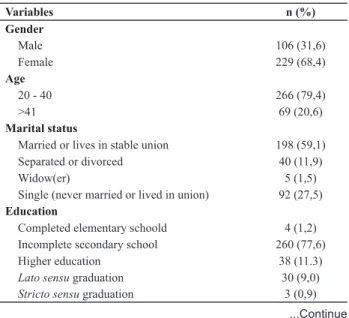
A Workers in this study (n=335) were iniially assessed for sociodemographic and labor aspects (Table 1). The as
-pects that prevailed were female gender, ages between 20 and 40 years (mean 33.64±8.72, median 31 years, with minimum of 20 and maximum of 69 years), married and had completed high school.
Regarding labor characterisics, the inpaient units concentrated more workers (45.7%), out of which 83.6% were technicians/nursing assistants, 70.2% had worked up to seven years in the same posiion (average 6.7±5.7 years), 54.3% worked on the night shit and 78.2% did not have another job (Table 1).
Table 1 - Sociodemographic and labor aspects of nursing workers - Porto Alegre, RS, October 2010 to April 2011
Variables n (%)
Gender
Male 106 (31,6)
Female 229 (68,4)
Age
20 - 40 266 (79,4)
>41 69 (20,6)
Marital status
Married or lives in stable union 198 (59,1)
Separated or divorced 40 (11,9)
Widow(er) 5 (1,5)
Single (never married or lived in union) 92 (27,5) Education
Completed elementary schoold 4 (1,2) Incomplete secondary school 260 (77,6)
Higher education 38 (11.3)
Lato sensu graduation 30 (9,0)
Stricto sensu graduation 3 (0,9)
Variables n (%)
Sector
Emergency units 61 (18,2)
Intensive care units 121 (36,1)
Units 153 (45,7)
Role
Nurse 55 (16,4)
Nursing technician 245 (73,1)
Nursing assistant 35 (10,5)
Time in the job
< 7 years 235 (70,2)
8 - 14 years 57 (17,0)
>15 years 43 (12,8)
Shift
Day 153 (45,7)
Night 182 (54,3)
Other job
No 262 (78,2)
Yes 73 (21.8)
Table 2 shows that similar percentages among work
-ers with high and low psychological demands and high and low job control. Regarding the quadrants, there was a slight predominance of acive jobs (30.4%), while for oth
-ers the distribuion was close, between 21 and 25%, ap
-proximately.
Table 2 - Frequency in the dimensions and in the quadrants of the Job Demand-Control Stress Scale - Porto Alegre, RS, October 2010 to April 2011
Variables n (%)
Psychological demand
High 175 (52,2)
Low 160 (47.8)
Job Control
High 178 (53,1)
Low 157 (46,9)
Demand-Control Quadrants
Low Strain 76 (22,7)
Passive Job 84 (25,1)
Active Job 102 (30,4)
High Strain 73 (21.8)
Table 3 provides an overview of the answers to SRQ 20. Psychological distress prevailed in 20.6% of the work
-ers. In the individual analysis of each quesion, there was a predominance of airmaive answers to the quesion feels nervous, tense or worried, related to depressive-anxious mood, followed by quesions sleeps badly and
oten has headaches, related to somaic symptoms.
Table 3 - Frequency of answers to SQR20 questions of nursing workers - Porto Alegre, RS, October 2010 to April 2011
SRQ 20 Factors NO YES
Lack of energy
Is easily tired 252 (75,2) 83 (24,8)
Finds it dificult to make decisions 299 (89,3) 36 (10,7)
Feels tired all the time 242 (72,2) 93 (27,8)
...Continuation ...Continuation
...Continue ...Continue
SRQ 20 Factors NO YES
Lack of energy
Finds it dificult to enjoy daily activities 243 (72,5) 92 (27,5) Has trouble thinking clearly 287 (85,7) 48 (14,3) Daily work is suffering 298 (89,0) 37 (11,0) Somatic symptoms
Has uncomfortable feelings in the stomach
226 (67,5) 109(35,5)
Often has headaches 183 (54,6) 152(46,4)
Sleeps badly 174 (51,9) 161(48,1)
Poor digestion 245 (73,1) 90 (26,9)
Hands shake 291 (86,9) 44 (13,1)
Has poor apetite 317 (94,6) 18 (5,4)
Depressive/anxious humor
Feels nervous, tense or worried 150 (44,8) 185(55,2) Is easily frightened 283 (84,5) 52 (15,5)
Has felt unhappy lately 235 (70,1) 100(29,9) Has cried more than usual 290 (86,6) 45 (13,4) Depressive thoughts
Has lost interest in things 276 (82,4) 59 (17,6)
Is unable to play a useful part in life 325 (97,0) 10 (3,0)
Feels worthless 331 (98,8) 4 (1,2)
Has had the thought of ending own life 319 (95,2) 16 (4,8)
MPD presence 266 (79,4) 69 (20,6)
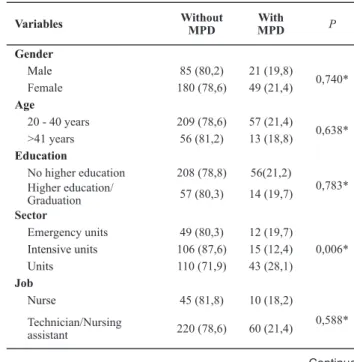
The sociodemographic variables were not associated with the occurrence of MPD. As for the labor variables, the labor sector was associated with MPD, evidencing signiicant diference among the groups (p=0.006 and p=0.003, respecively). When the demand-control quad
-rants were analyzed, workers classiied as high strain and acive job, there was an associaion with psychological distress (p <0.001) (Table 4).
Table 4 - Association of sociodemographic variables, labor and the Demand-Control Quadrants, with DPM - Porto Alegre, RS, October 2010 to April 2011
Variables Without
MPD
With
MPD P
Gender
Male 85 (80,2) 21 (19,8)
0,740*
Female 180 (78,6) 49 (21,4)
Age
20 - 40 years 209 (78,6) 57 (21,4)
0,638* >41 years 56 (81,2) 13 (18,8)
Education
No higher education 208 (78,8) 56(21,2)
0,783* Higher education/
Graduation 57 (80,3) 14 (19,7)
Sector
Emergency units 49 (80,3) 12 (19,7)
0,006*
Intensive units 106 (87,6) 15 (12,4)
Units 110 (71,9) 43 (28,1)
Job
Nurse 45 (81,8) 10 (18,2)
0,588* Technician/Nursing
Variables Without
MPD
With
MPD P
Time in the job
< 7 years 180 (76,6) 55 (23,4)
0,215*
8 - 14 years 49 (86,0) 8 (14,0)
> 15 years 36 (83,7) 7 (16,3)
Shift
Day 117 (76,5) 36 (23,5)
0,277*
Night 148 (81,3) 34 (18,7)
Other job
No 208 (79.4) 54 (20.6)
0.808*
Yes 57 (78.1) 16 (21.9)
Demand-Control Quadrants
Low Strain 69 (90,8) 7 (9,2)
0,000*
Passive Job 76 (90,5) 8 (9,5)
Active Job 74 (72,5) 28 (27,5)
High Strain 46 (63,0) 27 (37,0)
* Pearson’s Chi-quare
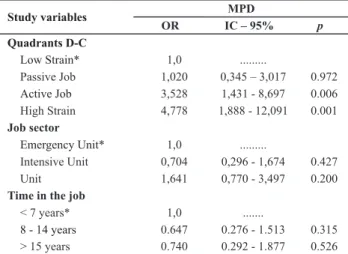
Table 5 presents the results of the adjusted analysis among the quadrants of the MDC and DCM. Workers allo
-cated in the quadrants acive job and high strain presented 3.5 and 4.7 chances higher for the development of MPD, respecively, when compared to the ones classiied in the quadrant low strain, even ater adjustments for the poten
-ial confounding factors (job sector and ime in the job).
Table 5 - Multivariate analysis of demand-control quadrants and MPD - Porto Alegre, RS, October 2010 to April 2011
Study variables MPD
OR IC – 95% p
Quadrants D-C
Low Strain* 1,0 ...
Passive Job 1,020 0,345 – 3,017 0.972
Active Job 3,528 1,431 - 8,697 0.006 High Strain 4,778 1,888 - 12,091 0.001
Job sector
Emergency Unit* 1,0 ...
Intensive Unit 0,704 0,296 - 1,674 0.427
Unit 1,641 0,770 - 3,497 0.200
Time in the job
< 7 years* 1,0 ...
8 - 14 years 0.647 0.276 - 1.513 0.315 > 15 years 0.740 0.292 - 1.877 0.526 * Reference categories. Adjusted regression for the sector and time in the job.
nursing staff, one in Rio Grande do Sul and one in Ba
-hia, found MPD prevalence of 18.7%(14) and 33.3% (15),
respectively.
Regarding the SRQ 20 questions, the depressive-anxious mood category (especially feels nervous, tense or worried) and somatic symptoms (sleeps badly and
often has headaches) were the most prevalent in the option yes. Questions related to depressive thoughts had the lowest prevalence. Another study also found similar results(13).
In the lack of energy group, the percentages re
-lated to each question did not surpass 27%, and the specific question related to suffering at work was be
-tween the SRQ 20 lowest percentages. In a study with nursing workers, it was found that the coping strategies created by the workers characterized the survival rela
-tionship of the individual in unfavorable situations of work, representing an important protective factor for the health of nursing professionals within the context of the work studied(16).
The aspect above, in this and in that study, may portray versatility of the worker seeking strategies to cope with possible situations of suffering/stress(17) such
as “creative suffering”, reinforcing the focus on caring for patients and their families, which may contribute to the higher prevalence in almost all questions of the so
-matic symptoms group.
However, aspects prevalent in this study, like those in the categories of depressive-anxious mood and somaic symptoms, must be problemaized and their consequenc
-es discussed in the proc-ess of daily work of prof-essionals. Headaches and poor sleep can impair atenion required in the care process and contribute to the occurrence of in
-cidents that compromise paient and worker safety. More
-over, due to the relaional nature of nursing work, they can produce irritability and generate conlicts and inter
-personal diiculies with other team members, managers, users and their families. These aspects are undervalued daily and in assessments of adverse events that frequently occur in nursing care.
As for job stress, nursing workers are predomi
-nantly in active and passive jobs. In two other studies with nursing workers that aspect was also assessed. In the first(14), there was a prevalence in the passive job
quadrant (29.9%), followed by active job (28.5%), and lower prevalence in high strain (21.2%). In the second study(18), a higher prevalence of workers in passive jobs
(35.6%) was found, followed by low strain (26.5%), and also higher prevalence of the quadrant high strain, around 21%.
Regarding the assessment of the association of MPD occurrence with the variables in this study, an associa
-tion of the work sector (primarily inpatient units) and the demand-control quadrants (mainly from active job) ...Continuation
DISCUSSION
The results of this study evidenced a prevalence of 20.6% of MPD in nursing workers and positive associa
-tion between MPD (SRQ20) and job stress (DCM). In a study performed with basic health workers in Botucatu, the prevalence of MPD was 42.6%(12). It was
was found in the initial statistical evaluation. However, when the statistical analysis was enhanced by using lo
-gistic regression, only the demand-control quadrants remained associated, demonstrating that the chances of occurrence of MPD are higher in the quadrant high strain, which reinforces the indications of the authors of the DCM model about this quadrant being the high
-est health risk(3).
Other studies have also conducted this analysis. In a study with health workers, there was an association of the quadrants with MPD occurrence; out of the work
-ers who were in the high strain quadrant, 64.4% had MPD and, of those in the quadrant active job, 43.2% had MPD(12).
Another study with municipal teachers in Santa Vitória da Conquista (Bahia) showed higher prevalence of PMD in teachers classified in the high strain quad
-rant (77.8%), followed by those classified in active job (62.4%) and passive job (51.8%). The study also evi
-denced nearly twice as high of a chance of MPD devel
-opment in teachers allocated in these quadrants when compared to those in the quadrant low strain(13).
Corroborating data from this research, a study with nursing workers who sought to elucidate the aspects above found an association (p <0.05) of the quadrants of high train (OR=4.6, IC=2.45 to 8.82) and active iob (OR=2.78, IC=1.40 to 5.51) with the MPD(15). Another
study with the same population revealed, after logis
-tic regression, that workers in high strain quadrant al
-so had increased chances of developing MPD by 2.76 times (95% IC=1.21 to 6.27) compared to those who were in the low strain quadrant(14).
Active job is considered by the DCM authors as a quadrant with little association with workers’ health problems(3). However, this finding deserves consid
-eration because, given the healthcare demands and strong commitment with care actions, workers allo
-cated in this quadrant have psychological distress, al
-though they consider that they have opportunities for learning, decision making and autonomy among other aspects, characteristic dimension of high job control.
This has been analyzed in the combination of two models of work-related stress (demand-control and effort-reward imbalance) and self-reported health by nursing workers. There were more chances for the health status self-reported as bad when the worker had excessive commitment to work, regardless of age, education, type of employment contract or number of
jobs(19).
It must also be considered that the activities of health professionals are strong generators of tension due to long working hours, limited number of profes
-sionals and psycho-emotional strain in the tasks per
-formed in a hospital setting. This strain can
approach psychic suffering, by potentializing the exposure to psychic charge and not by living with the object of work (...), but by the work conditions in which these nursing workers are inserted(20).
The associaion of the acive job quadrant with MPD needs to be analyzed, since workers perceive them
-selves to have high demands, but also high job control. The findings of this study evidence that high control was not effective in reducing the effects of high psycho
-logical demands on workers. This aspect was also noted in another study(15).
The findings of this study, which are also rein
-forced in similar publications, bring subsidies relevant for discussions and reflections to be performed in or
-der to envision strategies to minimize the occurrence of worker health problems in general and, more spe
-cifically, among nursing workers. There is the need to implement programs to support worker health, in order to minimize the effects of stress on the health status of nurses from the identification of signs and symp -toms(21). Exposure to psychic burden impacts psychic
and emotional health, harming rationality, social and physical well-being(22), among others.
CONCLUSION
It is considered that, within the limitations intrinsic to the cross-sectional study, which does not allow con
-clusion about causal relationships, the results observed help reinforce some of the findings of other studies, consolidating the theoretical approach adopted.
It was evidenced that 20.6% of the nursing workers had suspected MPD, and that this is associated with work-related stress. The survey revealed that workers allocated in high strain and acive job quadrants are more likely to develop MPD when compared to the low strain quadrant.
It should be noticed that the active job is a quadrant considered to have extensive professional autonomy and beneficial psychological effects. This finding re
-quires more extensive investigations in order to under
-stand other aspects that may interfere with or enhance the effects of psychological demands and worker job control, such as, for example, gravity/patient depen
-dence, staffing levels, styles of leadership, conflicting relationships, among others, expanding the discussion to intrinsic aspects of nursing work that can contrib
-ute to the establishment of mental health problems of nursing workers.
Based on the results achieved, although focused on a group of workers at a single institution, the percent
-age of MPD and its relationship with job stress should be analyzed by professionals and institutional manag
-ers, in order to learn, reflect and identify the implica
-tions of these results in the performance and job satis
REFERENCES
1. Organização Internacional do Trabalho OIT). Riscos emergen
-tes e novas formas de prevenção num mundo de trabalho em mudança [Internet]. Genebra; 2010 [citado 2012 abr. 12]. Disponível em: htp://www.dnpst.eu/uploads/relatorios/rela
-toriooit2010.pdf
2. Costa JRA, Lima JV, Ameida PC. Stress no trabalho do enfer
-meiro. Rev Esc Enferm USP. 2003;37(3):63-71.
3. Alves MGM, Chor D, Faerstein E, Lopes CSL, Werneck GL. Versão resumida da “Job Stress Scale”: adaptação para o por
-tuguês. Rev Saúde Pública. 2004;38(2):164-71.
4. Goldberg D, Huxley P. Common mental disorders: a bio-social model. London: Tavistock; 1992.
5. Mari JJ, Williams P. A validity study of a psychiatric screening quesionnaire (SRQ-20) in primary care in of São Paulo. Br J Psychiatry. 1986;148(1):23-6.
6. Santos KOB, Araújo TM, Oliveira NF. Estrutura fatorial e con
-sistência interna do Self-Reporing Quesionnaire (SRQ-20) em população urbana. Cad Saúde Pública. 2009;25(1):214-22.
7. Brasil. Ministério da Saúde; Organização Pan-Americana da Saúde (OPAS). Doenças relacionadas ao trabalho: man
-ual de procedimentos para os serviços de saúde. Brasília; 2001.
8. Costa JSD, Menezes AMB, Olinto MTA, Gigante DP, Macedo S, Brito MAP, et al. Prevalência de distúrbios psiquiátri
-cos menores na cidade de Pelotas, RS. Rev Bras Epidemiol. 2002;5(2):164-73.
9. Maragno L, Goldabaum M, Gianini RJ, Novaes HMD, Cesar CLG. Prevalência de transtornos mentais comuns em popu
-lações atendidas pelo Programa Saúde da Família (QUA
-LIS) no Município de São Paulo, Brasil. Cad Saúde Pública. 2006;22(8):1639-48.
10. Nussbaumer L, Dapper V, Kalil F. Agravos relacionados ao trabalho noiicados no Sistema de Informações em Saúde do Trabalhador no Rio Grande do Sul, 2009. Bol Epidemiol. 2010;12(1):3-5.
11. Guimarães LAM, Marins DA, Grubits S, Caetano D. Pre
-valência transtornos mentais em trabalhadores de uma uni
-versidade pública do estado de São Paulo. Rev Bras Saúde Ocup. 2006;31(113):7-18.
12. Braga LC, Carvalho LR, Binder MCP. Condições de trabalho e transtornos mentais comuns em trabalhadores da rede bási
-ca de saúde de Botu-catu (SP). Ciênc Saúde Coleiva. 2010;15 Supl1:1585-96.
13. Reis EJB, Carvalho FM, Araújo TM, Porto LA, Silvany Neto MA. Trabalho e distúrbios psíquicos em professores da rede municipal de Vitória da Conquista, Bahia, Brasil. Cad Saúde Pública. 2005;21(5):1480-90.
14. Kirchhof ALC, Magnago TSBS, Camponogara S, Griep RH, Tavares JP, Prestes, FC, et al. Condições de trabalho e car
-acterísicas sócio demográicas relacionadas a presença de distúrbios psíquicos menores em trabalhadores de enferma
-gem. Texto Contexto Enferm. 2009;18(2):215-23.
15. Araújo TM, Aquino E, Menezes G, Santos CO, Aguiar L. As
-pectos psicossociais do trabalho e distúrbios psíquicos entre trabalhadoras de enfermagem. Rev Saúde Pública. 2003;37(4):424-33
16. Dal Pai D, Lautert L. Estratégias de enfrentamento do adoe
-cimento: um estudo sobre o trabalho da enfermagem. Acta Paul Enferm. 2009;22(1):60-5.
17. Dejours C, Abdoucheli E, Jayet C. Psicodinâmica do trabal
-ho: contribuições da Escola Dejouriana à análise da relação prazer, sofrimento e trabalho. São Paulo: Atlas; 2009.
18. Urbaneto JS, Silva PC, Hofmeister E, Negri BS, Costa BEP, Figueiredo CEP. Workplace stress in nursing workers from an emergency hospital: Job Stress Scale analysis. Rev Laino Am Enferm. 2011;19(5):1122-31
19. Griep RH, Rotenberg L, Landsbergis P, Vasconcellos-Silva PR. Uso combinado de modelos de estresse no trabalho e a saúde auto-referida na enfermagem. Rev Saúde Publica. 2011;45(1):145-52.
20. Carvalho MB, Felli VEA. O trabalho de enfermagem psiquiátrica e os problemas de saúde dos trabalhadores. Rev Laino Am Enferm. 2006;14(1):61-9.
21. Guido LA, Linch GFC, Pithan LO, Umann J. Stress, coping and health condiions of hospital nurses. Rev Esc Enferm USP [Internet]. 2011 [cited 2012 Apr 12];45(6):1434-9. Available from: htp://www.scielo.br/pdf/reeusp/v45n6/ en_v45n6a22.pdf