RESUmo
Este trabalho é uma revisão integraiva, que objeiva analisar a produção cieníica dedi-cada à sexualidade da mulher com câncer de mama após a mastectomia, com foco na interferência dos desconfortos ísicos de-correntes dos tratamentos sobre sua vida sexual. O estudo abrangeu trabalhos publi -cados no período de 2000 a 2009, uilizan-do as bases MEDLINE, LILACS e PsycINFO, por meio dos descritores mastectomy, bre-ast neoplasms, sexuality, sexual behavior, amputaion, psychossexual development, marital relaions. Foram selecionados nove arigos, que abordavam as repercussões dos desconfortos ísicos provenientes dos tratamentos oncológicos na vivência da se -xualidade. Os achados evidenciaram que, mesmo quando existe intensa e saisfató-ria vida sexual no período prévio à doença, fatores como estresse, dor, fadiga, insulto à imagem corporal e baixa autoesima, de -correntes dos tratamentos, podem desor-ganizar o funcionamento sexual da mulher acomeida. É necessário sensibilizar os pro -issionais para acolherem o tema em políi-cas e estratégias prevenivas, diagnósipolíi-cas e terapêuicas.
DEScRitoRES Mulheres
Neoplasias da mama Mastectomia Sexualidade Revisão
Do the physical discomforts from breast cancer
treatments affect the sexuality of women
who underwent mastectomy?
C
r
i
ti
C
a
l
r
ev
i
ew
AbStRAct
The objecive of this integraive review is to analyze the scieniic producion address-ing the sexuality of women with breast cancer following mastectomy, focused on the efects that the physical discomfort due to cancer treatments have on their sex life. The search included aricles published in the period between 2000 and 2009 on the MEDLINE, LILACS and PsycINFO da-tabases, using the following descriptors:
mastectomy, breast neoplasms, sexuality, sexual behavior, amputaion, psychosexual development, and marital relaions. Nine aricles were selected, which addressed the efects of the physical discomfort from cancer treatments on the paients’ sexual -ity. The indings revealed that, even when the paient’s sex life is intense and fulilling before the disease, factors such as stress, pain, faigue, insult to body image, and low self-esteem due to the treatments may al -ter the sexual funcioning of the afected woman. Healthcare professionals must be sensiized in order to welcome and include the topic in policies as well as in preven-ive, diagnosic, and therapeuic strategies.
DEScRiPtoRS Women
Breast neoplasms Mastectomy Sexuality Review
RESUmEn
Revisión integraiva que objeiva anali -zar la producción cieníica orientada a la sexualidad de mujeres con cáncer de mama luego de mastectomía, atendiendo la interferencia de las incomodidades ísi-cas derivadas del tratamiento en su vida sexual. El estudio incluye trabajos publica -dos entre 2000 y 2009, uilizando las bases MEDLINE, LILACS y PsycINFO, uilizando los descriptores mastectomy, breast neo-plasms, sexuality, sexual behavior, amputa-ion, psychossexual development, marital relaions. Fueron seleccionados nueve ar -ículos abordando las repercusiones de la incomodidad ísica provocada por los tra-tamientos oncológicos en la experiencia de la sexualidad. Los hallazgos evidenciaron que, incluso exisiendo intensa y saisfac-toria vida sexual en el período previo a la enfermedad, factores como estrés, dolor, faiga, insulto a la imagen corporal y baja autoesima derivados del tratamiento, pueden desorganizar el funcionamiento se -xual de la mujer afectada. Es necesario sen -sibilizar a los profesionales para atender el tema en políicas y estrategias prevenivas, diagnósicas y terapéuicas.
DEScRiPtoRES Mujeres
Neoplasias de la mama Mastectomía
Sexualidad Revisión Vanessa monteiro cesnik1, manoel Antônio dos Santos2
Desconfortos físicos Decorrentes Dos tratamentos Do câncer De mama influenciam a sexualiDaDe Da mulher mastectomizaDa?
¿las incomoDiDaDes físicas DerivaDas Del tratamiento De cáncer De mama influyen en la sexualiDaD De la mujer mastectomizaDa?
intRoDUction
Breast cancer is probably the type of tumor that most frightens women, due to its high prevalence, as well as its
psychological and physical efects(1). The impact caused by
the disease is related to its possible efects, as well as to
living without the breast and the consequences of the mu
-ilaion for the marital relaionship(2). It is in the resump
-ion of social rela-ionships, of leisure aciviies, of work and of family life that the concerns of the afected women emerge in relaion to their own bodies. At this point, they generally feel saisied with the end of the treatment, but are mentally and physically exhausted by the prolonged exposure to invasive and painful procedures(3-5). In ad
-diion to the social aspects, the physical dimensions of cancer also reveal a devastaing scenario of a muilaing disease, with the addiional connotaion of a “dirty” ill
-ness, which produces secreions, necrosis and releases
unpleasant odors. These associaions favor the sigmaiza
-ion of cancer paients and their withdrawal from their so
-cial lives(6). This disease also produces important changes
in the body image and self-image of the women, which may afect their experiences of sexuality
and their marital saisfacion. Such interfer
-ence in the sexual pracice is oten experi
-enced as physical changes caused by can
-cer treatments, such as loss of the breast, faigue and vaginal dryness, leading to pain and discomfort during sexual intercourse (dyspareunia)(7-8).
Studies have reported that many breast cancer survivors report faigue ater the compleion of the treatment and that this symptom is reported to be highly disrupive and a limiing factor in the quality of life of
these women(9-10). According to another re
-cent review(4), it is known that there are barriers for the
intervenions that address the sexuality of women with cancer. These barriers stem from the implicit assumpions about this subject, both of the paient and the caregiver. What happens in pracice is that this topic ends up be
-ing marginalized in the care and not be-ing discussed by
the caregiver with the paient, which indicates to the pa
-ient that she can not raise the topic in quesion. When invesigaing the issue of the visibility of sexual quesions in Nursing pracice, a study showed an increasing number of studies that seek to promote relecions that contribute to change the scenario of concealment and invisibility of this topic(11). It is up to nurses and other healthcare profes
-sionals to try to respond to the quesions that women en
-counter in the various care scenarios, since the diiculies of experiencing sexuality are more common than might be imagined. However, there is a lack of openness in the service, making it impossible to form a bond between the paient and the professional, which makes it diicult to
verbalize the problem(12) and invalidates the integrality of
the care, making this a public health problem in Brazil.
A study pointed out that this issue is neglected in the formaion of the health professionals, who in the course
of their future pracice may encounter challenging situ
-aions for which they feel unprepared. It is known that the graduate Nursing student has incorrect noions about sexuality. Obtaining knowledge on this topic can help to minimize undue and inappropriate aitudes when faced with such a topic, whether in terms of sex educaion, in detecing alteraions or in prevening eventual problems. For this, the educaional insituions need to commit to
training the student in this theme(13). This is true not only
for Nursing students, but also for students of Medicine, Psychology, Physiotherapy, and Occupaional Therapy,
among other courses. These indings show that sexual
-ity and marital life are sill neglected dimensions in pub
-lic healthcare. In this ield, an issue that has not received proper atenion from researchers is the inluence of the
physical discomfort produced by the breast cancer treat
-ment on the sexual life. Thus, the proposal of the present
study is jusiied, where the original contribuion is to fo
-cus on the impact of the physical discomfort in the sexual life of the woman, caused by breast cancer treatments, in the irst months ater breast surgery. The knowledge generated by the examinaion of the physical impact triggered in the women afected by breast cancer can contribute to
beter training, sensiizaion and instrumen
-talizaion of healthcare professionals in re
-laion to the topic and thus promote more qualiied care for these women. Based on
these assumpions, this study aimed to in
-vesigate the repercussions of the physical
discomfort caused by breast cancer treat
-ments, regarding the sexuality of women
with mastectomies, from the analysis of na
-ional and interna-ional scieniic literature published from 2000 to 2009.
mEthoD
This is a retrospecive, descripive and documentary study, using an integraive literature review. This type of
review was chosen as the methodological approach be
-cause it allows previous studies on the topic selected to be summarized, maintaining the standards of clarity, rigor
and replicaion of the primary studies(14). This methodol
-ogy proposes a discussion of the methods, sources, aims
and results, allowing conclusions to be established regard
-ing the demarcated ield of knowledge(15). The PICOC strat
-egy was used to structure the clinical quesion, in order
to clarify the components that guided the search for evi
-dence(16). The guiding quesion of the present study was:
In women with breast cancer (P), how do the physical dis
-comforts caused by the treatments that they underwent (I) inluence their experience of sexuality (O) in the irst months ater breast surgery (T), when compared to the period before the disease (C)?
...an issue that has not received
proper attention from researchers is
the inluence of the
physical discomfort produced by the breast
The ime frame of this study was from January 2000 to
December 2009. To achieve the aim, the following meth
-odological steps for undertaking an integraive review
were followed(17): a) systemaic survey of the naional and
internaional publicaions on mastectomy and sexuality; b) deiniion of the variables to be invesigated: ideniicaion of the authors, study type, year of publicaion, journals in which the studies were published, the origin of the aricles, the language in which they were writen, the aims and the results obtained; c) descripive analysis of the study results and criical evaluaion of the contribuions provided for the producion of knowledge in the theme.
To ensure the comprehensiveness of this review, the fol
-lowing databases were consulted: MEDLINE, LILACS and Psy
-cINFO. The data were collected from April to May 2010. The aricles indexed with the following keywords were studied:
mastectomy, breast neoplasms, sexuality, sexual behavior,
amputaion, psychosexual development, marital relaions.
The descriptors were chosen according to DeCS - Health Sci
-ence Descriptors (the irst four keywords) and Terminologia Psi (the others). The descriptors were chosen in order to expand the possibiliies of combinaions and maximize the number of aricles returned and thus prevent the speciicity
of some terms restricing the corpus of the study.
In this literature review the following parameters were
considered as inclusion criteria in the search for the ar
-icles: 1) aricles on female breast cancer: 2) writen in English, Portuguese or Spanish; 3) published between 2000 and 2009; 4) that present empirical results; 5) that
provide the abstract in the indexing databases; 6) pub
-lished in journals available in full on the world wide web,
being the site of the journal itself or through the SIBI sys
-tem of the University of São Paulo, a service network that includes an online catalog providing access to databases and the content of the journals indexed; 7) publicaions
that dealt with mastectomy as a treatment for breast can
-cer and its repercussions on the sexuality of the women afected; and 8) that focused on these issues from the perspecive of women with mastectomies and not the percepion of other people related to them. The following
limits were established as exclusion criteria: 1) presenta
-ion in disserta-ion, thesis, book chapter, book, editorial, summary, comment or criique format; 2) aricles about
prophylacic mastectomy; 3) aricles from literature re
-view studies; 4) research reports with women who had re
-currence breast cancer or metastasis; 5) studies with only women who had breast reconstrucion surgery; 6) aricles not concerned with the theme invesigated.
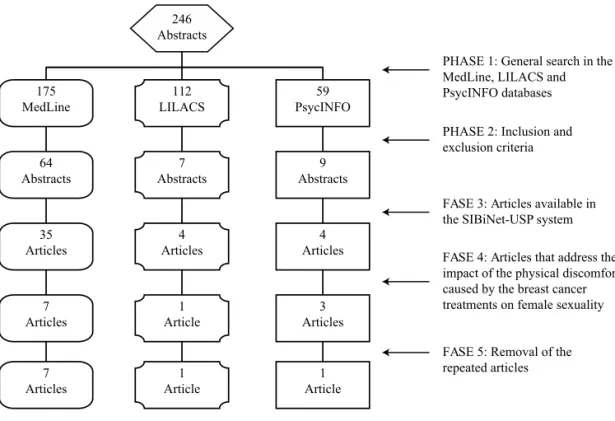
Figure 1 - Flowchart of the stages of the integrative review - Ribeirão Preto, 2009
Ater reading the abstracts, the aricles selected, accord
-ing to the inclusion and exclusion criteria, were retrieved. Ater reading the aricles in full the data of interest for the review was extracted. The informaion was recorded on a
previously prepared ideniicaion form based on the litera
-ture(15,18-19). The form was completed for each aricle of the
sample, allowing the systemaizaion of the data that were
later organized into a folder and listed in ascending numeri
-cal order according to the year of publicaion. Ater sum
-marizing the aricles in their enirety, works that focused on the physical discomforts or sexuality were separated, which
formed the corpus of the study.
246 Abstracts
175 MedLine
112 LILACS
59 PsycINFO
64 Abstracts
7 Abstracts
9 Abstracts
35 Articles
4 Articles
4 Articles
7 Articles
1 Article
3 Articles
7 Articles
1 Article
1 Article
PHASE 1: General search in the MedLine, LILACS and PsycINFO databases
PHASE 2: Inclusion and exclusion criteria
FASE 3: Articles available in the SIBiNet-USP system
FASE 5: Removal of the repeated articles
RESULtS
The inal sample consisted of aricles indexed in the selected databases and which met the inclusion criteria for the literature search. Of the 246 studies listed in the preliminary search, 43 met these criteria. Among these, nine were related to physical discomfort caused by the
breast cancer treatment as an interfering factor in the sex
-ual life of the women, ive from the database MEDLINE, one from LILACS, one from PsycINFO and two found in the MEDLINE and PsycINFO databases. These aricles formed
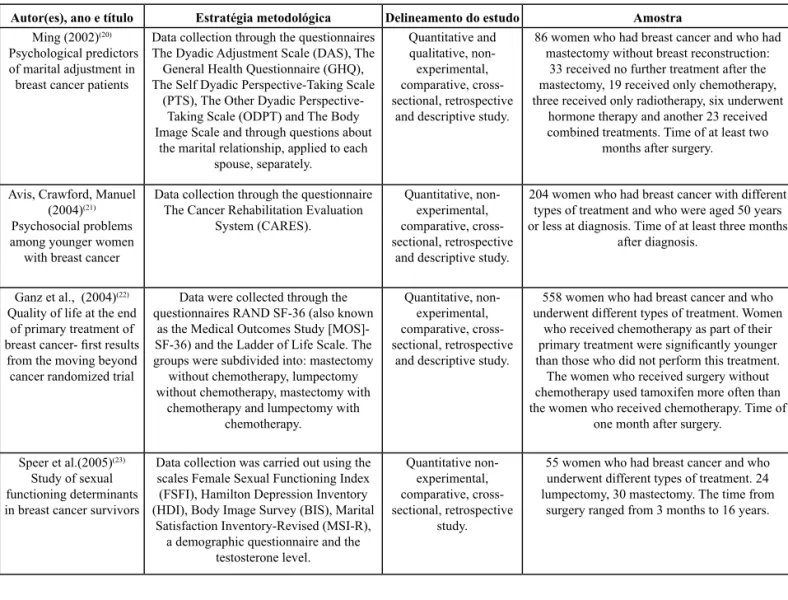
the corpus of this study. Table 1 shows the authors, year
of publicaion and aricle itles that form the corpus of
the study and summarizes the type of methodological ap
-proach used, the study design and the populaion studied.
The main topics related to physical discomfort were: vagi
-nal dryness, pain, faigue and hot lushes resuling from the breast cancer treatment and from treatment-induced
early menopause. The physical discomforts were men
-ioned as reasons for the decrease in sexual desire and the frequency of sexual relaions(20-26).
The selected aricles were published in nine difer
-ent journals: Files of Health Science, Journal of Interna
-ional Medical Research, Journal of the Na-ional Cancer Insitute, Palliaive & Supporive Care, Psychology, Health & Medicine, Psycho-oncology, Social Science & Medi
-cine, The Breast Journal, and Tumori. When the area(s) that the journals of origin of the aricles focused on were invesigated, it was found that seven (77.8%) were
from muli/interdisciplinary journals, where the prior
-ity themes focused on the health-disease interface. The mulidisciplinary character could also be evidenced in the authorship of the aricles, published by professionals from diferent areas of healthcare (nursing, medicine, and
psychology, among others). This shows that there is an in
-creasing interest in the exchange of informaion between the various healthcare professions who work to provide care in the breast cancer area.
Table 1 - Distribution of the articles that comprise the corpus of the study according to authors, year of publication, title, methodolo-gical approach, study design and sample - Ribeirão Preto, 2009
Autor(es), ano e título Estratégia metodológica Delineamento do estudo Amostra
Ming (2002)(20) Psychological predictors
of marital adjustment in breast cancer patients
Data collection through the questionnaires The Dyadic Adjustment Scale (DAS), The General Health Questionnaire (GHQ), The Self Dyadic Perspective-Taking Scale
(PTS), The Other Dyadic Perspective-Taking Scale (ODPT) and The Body Image Scale and through questions about
the marital relationship, applied to each spouse, separately.
Quantitative and qualitative,
non-experimental, comparative, cross-sectional, retrospective
and descriptive study.
86 women who had breast cancer and who had mastectomy without breast reconstruction:
33 received no further treatment after the mastectomy, 19 received only chemotherapy, three received only radiotherapy, six underwent
hormone therapy and another 23 received combined treatments. Time of at least two
months after surgery.
Avis, Crawford, Manuel (2004)(21) Psychosocial problems among younger women
with breast cancer
Data collection through the questionnaire The Cancer Rehabilitation Evaluation
System (CARES).
Quantitative, non-experimental, comparative, cross-sectional, retrospective
and descriptive study.
204 women who had breast cancer with different types of treatment and who were aged 50 years or less at diagnosis. Time of at least three months
after diagnosis.
Ganz et al., (2004)(22) Quality of life at the end
of primary treatment of
breast cancer- irst results
from the moving beyond cancer randomized trial
Data were collected through the questionnaires RAND SF-36 (also known
as the Medical Outcomes Study [MOS]-SF-36) and the Ladder of Life Scale. The groups were subdivided into: mastectomy without chemotherapy, lumpectomy without chemotherapy, mastectomy with
chemotherapy and lumpectomy with chemotherapy.
Quantitative, non-experimental, comparative, cross-sectional, retrospective
and descriptive study.
558 women who had breast cancer and who underwent different types of treatment. Women
who received chemotherapy as part of their
primary treatment were signiicantly younger
than those who did not perform this treatment. The women who received surgery without chemotherapy used tamoxifen more often than the women who received chemotherapy. Time of
one month after surgery.
Speer et al.(2005)(23) Study of sexual functioning determinants in breast cancer survivors
Data collection was carried out using the scales Female Sexual Functioning Index (FSFI), Hamilton Depression Inventory (HDI), Body Image Survey (BIS), Marital
Satisfaction Inventory-Revised (MSI-R), a demographic questionnaire and the
testosterone level.
Quantitative non-experimental, comparative, cross-sectional, retrospective
study.
55 women who had breast cancer and who underwent different types of treatment. 24 lumpectomy, 30 mastectomy. The time from
surgery ranged from 3 months to 16 years.
suling from this symptom so recurrent in women and not part of the focus of the healthcare professionals at that moment. These indings have relevance for the pracice, showing that professionals should invesigate this kind
of discomfort and be aware of the need to prescribe ini
-mate lubricants and to recommend the use of condoms to
reduce the vulnerability caused by the immunosuppres
-sion in women undergoing chemotherapy.
The physical symptoms were a major concern of the
women surveyed in another study(25), with speciic com
-plaints that included joint pain, diiculty sleeping, hot lushes, and symptoms suggesive of factors related to
menopause. The physical deterioraion from the treat
-ment was menioned as a reason for decreased sexual
interest in two studies(20-21). Many women reported a lack
of sexual interest due to physical complicaions, such as general faigue and delayed operaive wound healing. These reasons were highlighted to explain why the wom
Autor(es), ano e título Estratégia metodológica Delineamento do estudo Amostra
Takahashi e Kai (2005) (24) Sexuality after breast
cancer treatment: changes and coping
strategies among Japanese survivors
Data collection through semistructured interviews.
Qualitative, non-experimental, cross-sectional, retrospective
and descriptive study.
21 Japanese women who had breast cancer and who underwent different types of treatment. The majority of the respondents had undergone
modiied radical mastectomy or breast
conserving surgery. Time of four to 123 months after surgery.
Fatone et al. (2007)(25) Urban voices: the quality-of-life experience
among women of color with breast cancer
Data collection through semistructured interviews.
Qualitative, non-experimental, cross-sectional, retrospective
and descriptive study.
20 women over 18 years of age who had breast cancer who underwent different types
of treatment. 36% self-identiied themselves as
black or African American.
Talhaferro, Lemos, Oliveira (2007)(26) Mastectomy and its consequences in the life
of the woman
Data collection through semi-structured questionnaire, directing questions toward
aspects of sexuality.
Qualitative, non-experimental, cross-sectional, retrospective
and descriptive study.
10 women who had breast cancer and who underwent mastectomy. Women who had no steady partner were excluded. Maximum time of
three months after surgery.
Alicikus et al. (2009)(27) Psychosexual and body image aspects of quality of life in Turkish
breast cancer patients: a comparison of breast conserving treatment and
mastectomy
Data collection through a questionnaire composed of 42 questions.
Quantitative non-experimental, comparative, cross-sectional, retrospective
and descriptive study.
112 women who had breast cancer and who underwent any type of treatment. After surgery, all the patients underwent adjuvant radiotherapy,
with or without chemotherapy and hormone therapy. Time of at least two years after surgery.
Gorisek, Krajnc, Krajnc (2009)(28)
Quality of life and the effect on social status among Slovenian women after breast cancer treatment
Data collection through the European Organization for Research and Treatment of Cancer core questionnaire and breast module 23 (EORTC QLQ-C30/+BR23).
Quantitative non-experimental, comparative, cross-sectional, prospective and descriptive study.
382 women diagnosed with breast cancer who had undergone a surgical intervention: 198 patients underwent mastectomy with axillary lymphadenectomy and 184 patients underwent conservative surgery with local axillary lymphadenectomy. Time of six months after surgery.
continuation...
DiScUSSion
One study showed that women who underwent mas
-tectomy reported higher scores regarding diiculty with
vaginal lubricaion than those who underwent conserva
-ive surgery(27).
Another study demonstrated that, considering the
various breast cancer treatments, 37% of the women in
-terviewed experienced vaginal dryness and 24% reported
they felt pain during sexual intercourse(28). Vaginal lubri
-caion problems were more severe among women who received chemotherapy than those who did not undergo
this treatment. Approximately 50% of the women who re
-ceived chemotherapy reported that the breast cancer had
had a negaive efect on their sex life, a staisically signii
-cant diference compared to 18-25% of women who did
not receive chemotherapy(22). Vaginal dryness was men
en resisted the resumpion of sexual relaions. Decreased sexual desire was reported by 50% of the respondents. A decline in sexual acivity was oten menioned, but was
not regarded as paricularly problemaic(25).
One study found that physical stress was the main reason for the decrease in sexual arousal(24). In a study
conducted with 558 women, 23.4% reported a moderate to severe lack of sexual interest, more frequently among women of the two chemotherapy groups (mastectomy
and lumpectomy)(22). These results suggest that profes
-sionals should turn their atenion to research issues relat
-ed to the resumpion of the sexual life of women, ofering advice and guidance.
A study in which women with breast cancer, women with sexual dysfuncion and “normal” women were compared, the paricipants with breast cancer had signiicantly lower scores in all areas of sexual funcioning (desire, arousal, lubricaion,
orgasm, saisfacion and pain) compared with the normal con
-trol group, but higher scores than those reported by women with sexual dysfuncion in all areas except sexual desire and
pain(23). The older women were signiicantly more suscepible
to pain and lack of vaginal lubricaion. Even when there is an intense and saisfying sexual life before the disease, the combi
-naion of emoional stress, pain, faigue, damage to the body image and low self-esteem, resuling from the breast cancer treatments, can disrupt the sexual funcioning of the couple(26).
Nursing professional must use listening strategies and provide advice directed toward the needs of the women afected by the disease, which focus on the relaionship with the partner.
The literature also shows that only a minority of study paricipants reported that the mastectomy did not cause changes in their sexual life or even noiced an improvement
ater the breast cancer(21,26). These apparent excepions show
the need to promote qualitaive studies for a deeper under
-standing of the trajectories (therapeuic and life) of these
women, so that the consequences of the breast cancer treat
-ments in the experience of sexuality of these women can be beter comprehended. Thus, nursing professionals must engage in a more dialogic communicaive pracice, avoiding
the unilinear hegemonic model sill prevalent in the health
-care pracices. Finally, the impact of breast surgery on female
sexuality was evidenced by the close relaionship found be
-tween physical discomfort and diiculies in resuming sexual acivity ater the surgical removal of the breast. The indings highlighted by this review are consistent with other studies in the area, indicaing the high suscepibility of women with breast cancer to physical stressors(10,29-30).
In future studies it will be important to consider the efects of the physical alteraions on the experiences of sexuality when analyzing the adjustment process of the women. The need was also noiced for more qualitaive studies that allow an understanding of the experiences of the women in their subjecive dimensions, in a way that provides contribuions for integral, individualized care, adapted to the needs of each paient. As the concern of this study is with improving the care to women afected by
breast cancer, especially in the area of sexuality, it is very important that further research be conducted for greater coverage of the indings to produce beter integraion of the care acions. There must be efecive incorporaion of scieniic knowledge into the health system.
It was evident that with the increase in ime since the surgery fewer problems with sexual interest are found, which is related to a decreased in the physical stressors. This fact indicates the need for more studies that invesigate women with a short ime since diagnosis and/or surgery up to the
end of the primary breast cancer treatment. The indings in
-dicate the need to incorporate some guidance and counsel
-ing strategies into the healthcare, aimed at the professionals themselves, helping them to raise their awareness regarding
the consideraion of the sexuality of women who have un
-dergone mastectomies. There is also a need to include the topic in the formaion of healthcare professionals.
Currently, cancer care is founded on the principles of mulidisciplinarity and has been incorporaing other healthcare professionals as well as physicians and nurses, including psychologists, social workers, physiotherapists and occupaional therapists. Learning to work as a team is acquiring a growing importance in the healthcare area, which increases the willingness to invest in developing health care strategies that include a host of aspects that transcend the strictly biological dimensions. The present
study has shown that, even when eminently physical as
-pects are involved, there are repercussions on the sexual
-ity and well-being of women with breast cancer.
concLUSion
The use of an integraive review as the methodologi
-cal strategy proved to be relevant to achieve the aim and to idenify gaps that indicate the need to aggregate new advances in knowledge producion, with implicaions for the transformaion of the care pracice in order to achieve integrality. The impact of the breast cancer treatment on the sexuality of the women afected, although being quite evident in the quoidian of the health professionals, is sill a relaively unexplored theme in care. Furthermore, this problem is also neglected in the literature, which was evidenced by the low number of aricles encountered.
Despite this lack of studies, it was conirmed that the im
-pact of physical discomforts caused by the treatment on female sexuality is empirically supported in the literature. Systemaic literature review studies are relevant to support health pracices and acions based on scieniic evidence. The limitaion of this study is that the evidence level ofered is moderate to weak, since it is a synthesis
of evidence from descripive or qualitaive studies in re
-sponse to the guiding quesion.Another key step is to in
REFEREncES
1. Brasil. Ministério da Saúde; Insituto Nacional do Câncer; Coor
-denação de Prevenção e Vigilância de Câncer. Esimaiva 2010: incidência do câncer no Brasil. Rio de Janeiro: INCA; 2009.
2. Rossi L, Santos MA. Repercussões psicológicas do adoeci
-mento e trata-mento em mulheres acomeidas pelo câncer de mama. Psicol Ciênc Prof. 2003;23(4):32-41.
3. Duarte TP, Andrade AN. Enfrentando a mastectomia: análise dos relatos de mulheres mastectomizadas sobre questões ligadas à sexualidade. Estud Psicol (Natal). 2003;(1):155-63.
4. Barton-Burke M, Gustason CJ. Sexuality in women with can
-cer. Nurs Clin North Am. 2007;42(4):531-54.
5. Andolhe R, Guido LA, Bianchi ERF. Stress e coping no perío
-do perioperatório de câncer de mama. Rev Esc Enferm USP. 2009;43(3):711-20.
6. Rasia JM. O doutor e seus doentes: solidão e sofrimento. Rev Bras Sociol Emoção. 2002;1(3):378-405.
7. Loi RCB, Barra AA, Dias RC, Makluf ASD. Impacto do trata
-mento de câncer de mama na qualidade de vida. Rev Bras Cancerol. 2008;54(4):367-71.
8. White CA. Body images in oncology. In: Cash TF, Pruzinsky T.
Body image: a handbook of theory, research, and clinical prac
-ice. New York: The Guilford Press; 2002. p. 379-86.
9. Servaes P, Verhagen C, Bleijenberg G. Faigue in cancer pa
-ients during and ater treatment: prevalence, correlates and intervenions. Eur J Cancer. 2001;38(1):27-43.
10. Lamino DA, Mota DDCF, Pimenta CAM. Prevalence and co
-morbidity of pain and faigue in women with breast can
-cer. Rev Esc Enferm USP [Internet]. 2011 [cited 2011 May 14];45(2):508-14. Available from: htp://www.scielo.br/pdf/ reeusp/v45n2/en_v45n2a28.pdf
11. Ressel LB, Gualda DMR. A sexualidade invisível ou oculta na enfermagem? Rev Esc Enferm USP. 2002;36(1):75-9. 12. Gozzo TO, Fusinoni SM, Barbieri M, Roehr WM, Freitas IA.
Sexualidade feminina: compreendendo seu signiicado. Rev Laino Am Enferm. 2000;8(3):84-90.
13. Gir E, Nogueira MS, Pelá NTR. Sexualidade humana na forma
-ção do enfermeiro. Rev Laino Am Enferm. 2000;8(2):33-40. 14. Whitemore R. Combining evidence in nursing research:
methods and implicaions. Nurs Res. 2005;54(1):56-62.
15. Broome ME. Integraive literature reviews in the develop
-ment of concepts. In: Rodgers BL, Knal KA. Concept devel
-opment in nursing: foundaions, techniques and applica
-ions. Philadelphia: W. B. Saunders; 2000. p. 231-50. 16. Sillwell SB, Fineout-Overholt E, Melnyk BM, Williamson KM.
Evidence-based pracice, step by step: asking the clinical quesion: a key step in evidence-based pracice. Am J Nurs. 2010;110(3):58-61.
17. Ganong LH. Integraive reviews of nursing research. Res Nurs Health. 1987;10(1):1-11.
18. Mendes KDS, Silveira RCCP, Galvão CM. Revisão integra
-iva: método de pesquisa para a incorporação de evidên
-cias na saúde e na enfermagem. Texto Contexto Enferm. 2008;17(4):758-64.
19. Whitemore R, Knal K. The integraive review: updated methodology. J Adv Nurs. 2005;52(5):546-53.
20. Ming VMW. Psychological predictors of marital adjustment in breast cancer paients. Psychol Health Med. 2002;7(1):37-51. 21. Avis NE, Crawford S, Manuel J. Psychosocial problems
among younger women with breast cancer. Psychooncology. 2004;13(5):295-308.
22. Ganz PA, Kwan L, Stanton AL, Krupnick JL, Rowland JH, Mey
-erowitz BE, et al. Quality of life at the end of primary treat
-ment of breast cancer: irst results from the moving beyond cancer randomized trial. J Natl Cancer Inst. 2004;96(5):376-87. 23. Speer JJ, Hillenberg B, Sugrue DP, Blacker C, Kresge CL,
Decker VB, et al. Study of sexual funcioning determinants in breast cancer survivors. Breast J. 2005;11(6):440-7.
24. Takahashi M, Kai I. Sexuality ater breast cancer treatment: changes and coping strategies among Japanese survivors. Soc Sci Med. 2005;61(6):1278-90.
25. Fatone AM, Moadel AB, Foley FW, Fleming M, Jandorf L. Urban voices: the quality-of-life experience among women of color with breast cancer. Palliat Support Care. 2007;5(2):115-25. 26. Talhaferro B, Lemos SS, Oliveira E. Mastectomia e suas
consequências na vida da mulher. Arq Ciênc Saúde. 2007;14(1):17-22.
27. Gorisek B, Krajnc P, Krajnc I. Quality of life and the efect on social status among Slovenian women ater breast cancer treatment. J Int Med Res. 2009;37(2):557-66.
28. Alicikus ZA, Gorken IB, Sen RC, Kentli S, Kinay M, Alanyali H, et al. Psychosexual and body image aspects of quality of life in turkish breast cancer paients: a comparison of breast conserving treatment and mastectomy. Tumori. 2009;95(2):212-8.
29. Silva G, Santos MA. Stressors in breast cancer post-treat
-ment: a qualitaive approach. Rev Laino Am Enferm. 2010;18(4):688-95.
30. Collins LG, Nash R, Round T, Newman B. Percepions of upper-body problems during recovery from breast cancer treatment. Support Care Cancer. 2004;12(2):106-13.
Acknowledgements