Abstract
The purpose of this article was to analyze the progress of social investments of Brazilian pharmaceutical industry. Studying social policies created by this major productive sector is important due to its strong inluence on a wide variety of health policies, among them the conlicting battleield between company’s patent protection and government’s compulsory li-cense for patent drugs. The 2006 social indicators of 62 pharmaceutical companies, published in the Social Panel by the Brazilian Federation of Pharmaceutical Companies (Febrafarma) in May 2007, were studied. This publication included information in three diffe-rent formats: general data on the number of programs; amounts invested and number of beneiciaries; general data categorized according to a predeined model com-prising ixed categories (health, education, community, quality of life, culture, environment, and other); and customized data for each company including a sum-mary of each program implemented. The purpose of the study was to assess whether these indicators allow a longitudinal follow-up of policies and proposals concerning social accountability of pharmaceutical companies.
Keywords:Pharmaceutical Market; Social Programs; Social Indicators.
Silvio Luiz Gonçalves Pereira
Pharmacist-biochemist. Doctorate degree in Social History. Researcher at the Contemporary Society Research Group, Depart-ment of Social Sciences and Public Health, School of Public Health - Universidade de São Paulo (USP).
Endereço: Rua José Alves Cunha Lima, 159, apto. 11, bloco 1, Butantã, CEP 05360-050, São Paulo, SP, Brasil.
E-mail: [email protected]
Investments of Brazilian Drug Companies in
Social Programs: an analysis of 2006 social
indicators
Resumo
O objetivo deste artigo é analisar a evolução dos in-vestimentos sociais praticados pelo setor industrial farmacêutico brasileiro. A importância do estudo das políticas sociais criadas por esse importante segmen-to produtivo deve-se à sua forte inluência nas mais variadas deinições sobre políticas de saúde, entre elas o conlituoso campo de disputa entre a defesa das patentes por parte das empresas e as tentativas de licenciamento compulsório de medicamentos, por parte do governo. Tomamos como fonte de pesquisa os indicadores sociais de 62 indústrias farmacêuticas, relativos ao ano de 2006, publicados pela Federação Brasileira da Indústria Farmacêutica (Febrafarma), em maio de 2007, sob o título Painel Social,
apresen-tados de três formas: dados gerais sobre o número de programas, valores investidos e o número de pessoas beneiciadas; dados gerais classiicados segundo um modelo pré-deinido e composto de categorias ixas (saúde, educação, comunidade, valorização da vida, cultura, meio ambiente, voluntariado e outros); e dados individualizados por empresa, com a indicação das ementas de cada programa criado. Buscamos com a relexão sobre esses indicadores averiguar se eles pos-sibilitam realizar um acompanhamento longitudinal das diretrizes e das proposições relacionadas às ações socialmente responsáveis praticadas pelas indústrias farmacêuticas.
Palavras-chave:Mercado farmacêutico; Programas sociais; Indicadores sociais.
Introduction
Economy globalization was accelerated through tech-nology development in the years after the World War II, more notably since the 1980s. It has set out a number of strategies such as technology transfer and con-centration by large corporations based on hegemonic inancial centers to countries where local conditions favored increased proitability through global rationa-lization of production processes and cost reduction due to, among other factors, low taxes, reduced workforce costs, easy access to commodities and product low, closeness to consumer markets.
Economy globalization has been greatly advan-tageous only to large companies and corporations of more industrialized rich countries as it has allowed huge capital accumulation in many different produc-tion industries. But these large proits conlict with profound wealth concentration and social inequality in less privileged countries. On one side, poverty and unemployment, on the other, transfer of dividends from highly specialized global production hubs to he-gemonic inancial centers. This situation of extreme inequality has been mitigated by the investment of a tiny share of these companies’ exorbitant proits in social programs, justiied by corporate businesses as essential to improve life conditions of people (eviden-tly, economically active people).
Corporate social accountability requires investing in areas other than productive spheres. The publication of results of social investments, the so-called social balances or indicators —deined by the Brazilian Insti-tute of Social Analyses (Ibase) as corporate statements “gathering a set of information about social projects, beneits, and actions targeting employees, investors, market analysts, shareholders, and the community” (Ibase, 2007) —, has been regarded by companies not only as philanthropic actions but as part of their stra-tegies to increase competitiveness, proitability, and strength of their brand names, products and institu-tions in the markets. In other words, it means low-cost investments where the largest share is allocated to the publicity of social programs rather than effective actions, and of guaranteed return.
1984, by Nitrofértil, a fertilizing company in the nor-theastern state of Bahia, today Fábrica de Fertilizantes Nitrogenados da Petrobras (Fafen); in the mid-1980s, by Sistema Telebrás, a mixed economy society establi-shed in July 1972 and linked to the Brazilian Ministry of Communications; and in 1992, by Banco do Estado de São Paulo (Banespa).
In 1997, the publication of social indicators gained visibility nationwide thanks to the sociologist Herbert de Souza’s efforts. Souza, then Ibase president, laun-ched a campaign for voluntary dissemination of this information, and created, in 1998, the Selo Balanço Social Ibase/Betinho (Ibase social balance certiicate), granting it to those companies that annually publish their social indicators following Ibase guidelines, methods and criteria (Ibase, 2007).
Almost 25 years later, after the irst annual reports were published in Brazil, the object of interest of the present article is to focus our attention on the assess-ment of the social balance of the Brazilian pharmaceu-tical industry. A total of 62 pharmaceupharmaceu-tical companies established in Brazil, which were uniformly involved in the dynamics of developing and supporting social programs and market visibility, presented their invest-ments in the social area for the year 2006, which lead to the publication of the Social Panel, coordinated by the Brazilian Federation of Pharmaceutical Companies (Febrafarma) in May 2007.
The analysis of the Brazilian pharmaceutical industry is a relevant one as drug companies have established a complex network of links that, in their turn, unfold into a series of central public health issues, notably, the monopolist practice of the pharmaceutical business conglomerate and its impediments to com-pulsory licensing for drugs of public interest; multiple variations of existing drug products with new patents and, needless to say, new prices; massive advertising including inadequate or even misleading information promoting self-medication and drug abuse; adultera-tions; large number of pharmacies and drug stores making it dificult health surveillance; inexistence of expert staff on the best practices of management; and growing “black markets” for drugs, among others.
José Augusto Cabral de Barros notes that, in the pos-twar years, as a result of the market logic, drugs have less and less served health purposes and reinforced “the disproportional non-critical belief of their power,”
thus supporting a genuine “pill culture,” predominant in modern society. At the same time medicine has taken a mechanicist and reducionist approach toward the health-disease process; for example, for depression management, doctors have chosen to prescribe anxio-lytic drugs, relegating to a lower level the notion that human beings are a complex of biological, emotional and social components (Barros, 2004, p. 21-22).
This author describes factors that contribute to strengthening behaviors and values that distort the actual role of drugs and promote a growing demand: • inexistence or breach of the regulations concerning the introduction of new products into the market; • inexistence of control mechanisms for drug marke-ting and dispensation, even when there are comprehen-sive laws;
• privileged position of drugs among users, medical practices and health services due to symbolic elements that reinforce drug eficacy;
• massive advertising strategies targeting both prescri-bers and consumers with no other unrelated sources of information available (Barros, 2004, p. 24).
Medicalization, deined as “a growing strong de-pendence of individuals and society on medical care services and goods and their increasingly excessive consumption,” and supported by drug advertising, is the most adequate term that describes this reducionist, me-chanicist biomedical model. Capitalism, by converting it all into goods for proit, has generated a “medical-industrial complex” and mercantilization of medicine that brought about a number of negative results such as non-universal unequal access to health services putting a large contingent of the population, as seen in Brazil, at the margin of drug consumption, many of them essential drugs (Barros, 2004, p. 50-51, 54).
three-element unit: a chemotherapy agent, a commo-dity, and a symbol,” that occurs all together: the drug cures, manages, and prevents (therapeutic aspect), alienates and dominates (health embodied in goods), represents and symbolizes (health represented in the drug product) (Lefèvre, 1991, p. 16-19).
In capitalist production mode, Health becomes a commodity providing health adjusted to the market logic, and transigured into drugs, medical-hospital systems, therapeutic procedures, health plans, etc., and deined, according to the health thinking, as “me-dicalization” of society. In this context, the commodity drug is a materialization or a symbol of health, a com-modity purchasable in the market, and an object of a social production process with its meaning devised by a particular existing social foundation; in other wor-ds, it is a symbol from which emanates discourses of health and disease. Drug is at the same time an object of meaning and a producer of meaning, a symbolic commodity that has a material facet (tablet, syrup, pill, etc.) and its consumption through different routes of administration materializes an abstract entity, Health (Lefèvre, 1991, p. 23, 31-32, 52-53).
Methods
A quantitative and qualitative study of pharmaceutical industry social programs was conducted based on data presented in the Social Panel published by Febrafar-ma in May 20071. The large amount of information
collected allowed to investigating major aspects that are key to understand drug industry’s stand on social responsibility. The report provided progress informa-tion regarding the period 2002-2006 on total number of programs, people, and amounts invested; distribution of programs by categories (Health, Education, Commu-nity, Quality of Life, Culture, Environment, Voluntary Work and Other); internal investments and number of beneiciaries (i.e. programs targeting employees and their families); as well as information on each parti-cipating drug company concerning their investments and number of beneiciaries.
The qualitative analysis of data presented in the Social Panel sought to further explore the goals of social investments of participating pharmaceutical
companies based on descriptive summaries of their social programs. In several instances, it was found that the typology used to describe social indicators, which were divided into ive groups – Social Work, Social Investment, Partnership, Cause-Related Marketing, and Voluntary Work –, did not take into consideration the wide variety of projects. Hence, we developed a new classiication because breaking down into further categories would allow a more in-depth analysis of data published. It included 18 categories: formal and vocational training; health programs; cash donations, donations of drugs and equipment; investments in culture, sports, and recreational activities; and various campaigns such as blood donation, warm clothing and Christmas campaigns.
It should be stressed that the Social Panel presents data provided by the participating drug companies and thus does not allow to characterizing their dynamics of program development and involvement. Many pro-grams are developed but are not implemented as their primary goal is to act in socially responsible ways as part of the modern corporate logic and to attain com-petitive gains through tax beneits.
Results
The Social Panel of drug companies in Brazil for 2002-2006 presented annual global data concerning the industry’s social programs and showed an ongoing gro-wth of investments. A comparison between resources invested in 2002 and 2006 revealed that social invest-ments increased by 343%. A total of 64.6 million reais (around 32.3 million dollars) were invested in 2006, accounting for 0.3% of proits with drug marketing in Brazil during the same period of time, which was approximately 11 billion dollars (Table 1).
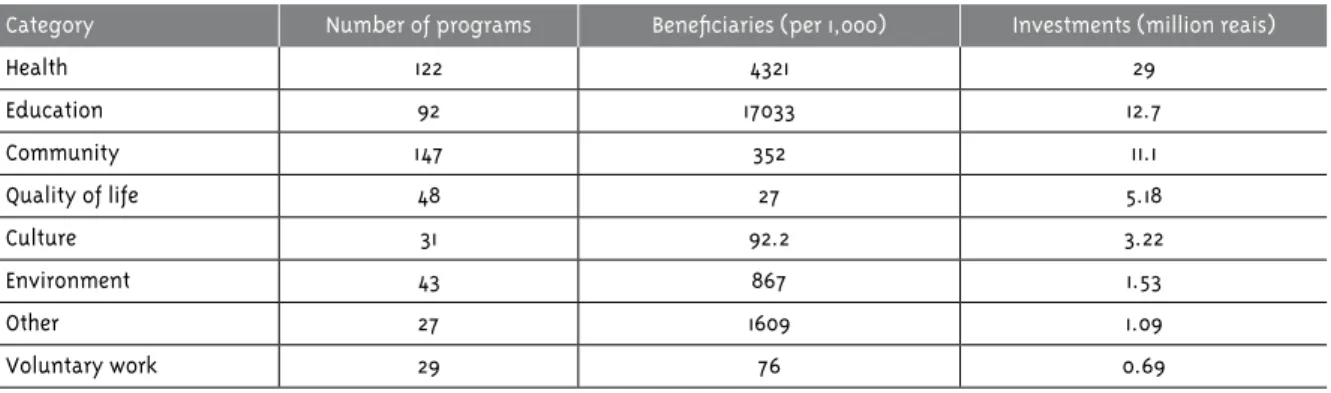
The three main categories with the largest invest-ments – health, education, and community – accounted together for 52.8 million reais (82%). The predominan-ce of these categories in their social goals suggest that drug companies invested largely in programs that would revert to their own beneit in the medium to long run. These were programs that tackled on basic con-ditions for improving quality of life of the industry’s employees, families, and environment (Table 2).
Investments of Brazilian drug companies in social programs: an analysis of 2006 social indicators
Table 1 - Social programs of drug companies between 2002 and 2006: number of programs, beneficiaries, total amounts invested (million reais) and investments per beneficiary (reais)
2002 2003 2004 2005 2006
Number of programs 197 297 407 455 539
Beneficiaries (million) 4.1 7.2 8.7 12.4 24.3
Investments (million reais) 18.8 30.8 42.5 44.6 64.6
Investments per beneficiary (reais) 4.49 4.28 4.88 3.60 2.66
Source: Febrafarma. Social Panel 2006. Available from <http://www.febrafarma.org.br/index.php?area=cs&secao=missao_social&modulo=painel_s>. Access on July 21, 2007.
Table 2 - Social programs of drug companies in 2006: categories, number of programs, beneficiaries, and amounts invested (million reais)
Category Number of programs Beneficiaries (per 1,000) Investments (million reais)
Health 122 4321 29
Education 92 17033 12.7
Community 147 352 11.1
Quality of life 48 27 5.18
Culture 31 92.2 3.22
Environment 43 867 1.53
Other 27 1609 1.09
Voluntary work 29 76 0.69
Source: Febrafarma. Social Panel 2006. Available from <http://www.febrafarma.org.br/index.php?area=cs&secao=missao_social&modulo=painel_s>. Access on July 21, 2007.
The distribution of investments by ranges shows that only a third of the drug companies allocated resources to social programs that amounted to more than one million reais. Only eight companies (13%), of which seven multinational (Alcon, Novartis, Schering do Brasil, Genzyme, Roche, Jansen Cilag, and Sanoi Aventis) and one national company (Aché) invested more than two million reais (Table 3).
Based on the qualitative analysis of programs of each drug company using project summaries, we developed a new classiication that was more adequa-te to examine the social indicators of this industry (Table 4).
Table 3 - Social programs of drug companies in 2006: investments by amount ranges and related number of companies
Amounts invested (reais x 1,000) Number of companies
1 to 100 18
101 to 500 12
501 to 1,000 14
1,001 to 2,000 10
2,001 to 5.000 5
The absolute numbers presented in the Social Panel apparently demonstrate a strong involvement of drug companies with socially responsible practices. Howe-ver, the amounts invested in the internal community are quite incomparable: 144.3 million reais, more than twice as much. It beneited a much smaller number of people (about 200,000 employees) at the rate of 720 reais per employee, which is 270 times more than that invested to beneit a person in the community that, in 2006, was 2.66 reais (Table 1).
The main programs targeting the internal commu-nity in 2006 had also a different nature: private securi-ty plan (investment of 66.3 million reais); commitment with employability and career advancement (28.7 million); and formal training programs (17.1 million). These actions accounted for 78% of all investments and they are crucial for the maintenance of the binomial optimization of production processes/maximization of proits. This logic is corroborated by reduced in-vestments in internal programs that focus more on social issues, such as prevention of moral and sexual
Table 4 - Social programs of drug companies in 2006: fields of action, number of programs and related percents
Fields of action Number of programs (%)
Vocational or college training 84 15.5
Health programs 64 11.8
Cash donation 63 11.6
Mixed donations (clothing, food stamps, computers, etc.) 57 10.5
Environment-related programs 51 9.4
Investments in culture, sports, and recreational activities 47 8.7
Supports other than financial investments 36 6.7
Donation of drugs 34 6.3
Formal education of children and adolescents 21 3.9
Christmas campaign 21 3.9
Advertisements for promotion of social programs 18 3.3
General programs for life quality improvement 15 2.8
Warm clothing campaign 10 1.8
Hunger programs 7 1.3
Contests/awards in health 6 1.1
Blood donation campaign 4 0.7
Advocacy of Indian people 2 0.4
Agriculture project 1 0.2
harassment (around 173,000 reais); appreciation and motivation of employees (480,000 reais); promotion of citizenship and empowerment (500,000 reais); and culture promotion (600,200 reais).
Discussion
According to Marilene Cabral do Nascimento, in the postwar years, the pharmaceutical industry had a great boom and become one of the most proitable segments of the modern industrial production. The coupled increase in consumption resulted from the populari-zation of industrialized drugs and their increasingly variety, economic development, and the creation of power structures between governments, health orga-nizations, and manufactures, inluencing more and more medical providers, patients, and researchers and increasing drug demand (Nascimento, 2005).
(1955–1960) developmental policy, Brazilian economy opened up to foreign investments and control (Coelho, 1980, p. 47-48). This policy was mainly supported by Regulation 113 of the Currency and Credit Authority (Sumoc), which was established in the beginning of 1955 by the end of Café Filho administration, and the ministry of Finance Eugênio Gudin, director of Bond & Share subsidiary companies in Brazil, authorized the import of machinery and equipment without any exchange cover and restrictions to comparable pro-ducts in Brazil.
The process of denationalization of Brazilian phar-maceutical industry gained momentum so that, by the end of the 1960s, 94% of them were controlled foreign companies. Foreign dominance was made possible by technology gap in the synthesis and production of drugs from highly complex chemical elements and opportunities offered by the Brazilian government to foreign capital. But technology transfer, managed in the hegemonic centers of international capitalism, disregarding the national economy demands, was misguided as production strictly served socioecono-mic interests of developed countries, and the type, level, and costs of the technology transferred relected the oligarchic nature of the strongly market-oriented multinational companies. In view of that, there were provided drugs that were inadequate to the Brazilian needs, extremely costly, and unequally distributed, whereas technology dependency was perpetuated (Coelho, 1980, p. 49-51).
In the light of the massive concentration of Brazi-lian pharmaceutical industry in the late 1950s and in the next 20 years, multinational companies progres-sively acquired local companies evidencing that the main goal of the well-known technology development was in fact market hegemony. Some joint ventures were established: Laborterápica and Bristol S.A. (1957), Moura Brazil and Merrell (1960), Endochimica and Mead Johnson (1960), Sintético and Searle (1967), Laboran and Syntex (1968), Procienx and BYK (1969), Kerato-Lok and Allergan (1972), Maurício Villela and Beecham (1972), Cissa and Alcon (1974), and Hiplex and Soesenius (1977) (Coelho, 1980, p. 58, 68).
Publicly-held pharmaceutical corporations aim to increase the value of their shares through proit ma-ximization and their achievements are impressive. In 1993, pharmaceutical companies in Brazil proited 5 billion dollars in sales. It grew to 8.2 billion in 1995 and to nearly 10 billion in 1996, whereas historical proi-tability of the industry has remained around 2 billion dollars over the 1980s. This extraordinary growth in proits has not been parallel by a proportional produc-tion growth; in other words, these inancial results were obtained through a huge rise of drug prices as a consequence of the neoliberal policy of open compe-tition and prices set by the market — while Brazilian inlation in 1992–1993 was 1.608%, uncontrolled drug prices grew by 2.600% — as well as of the progressive crumbling of the Central Drug Authority (CEME), in detriment of the implementation at any cost of gene-ric drug policy. Between 1992 and 1996, the Brazilian pharmaceutical industry grew around 30% through mergers of giant multinational companies such as Ro-che and Syntex, American Home and Cynamid, Hoechst Russel and Marion Merrell, Rhône-Poulenc Rorer and Fisons, Pharmacia and Upjohn, Ciba and Sandoz (now Novartis), and Glaxo and Wellcome (Oliveira, 1997, p. 47-49, 52, 55).
Data released by IMS Health Incorporated, a com-pany that provides consulting services to the phar-maceutical industry, show that, in 2006, global sales of prescription drugs reached 602 billion dollars. The sales of the 10 leading drug companies totaled around 275 billion dollars: Pizer, 45,083 billion dollars; Gla-xoSmithKline, 37,034; Sanoi-Aventis, 35,638; Novar-tis, 28,880; Hoffmann-LaRoche, 26,596; AstraZeneca, 25,741; Jonhson&Jonhson, 23,267; Merck & Co., 22,636; Wyeth, 15,683; and Eli Lilly, 14,8142.
A similar situation is seen in Brazil: after strong growth by the end of the 1990s and subsequent decline in the early years of the new century, between 2002 and 2006, pharmaceutical company sales doubled from ne-arly 5.2 billion dollars to 10.9 billion (before taxes). In January-May 2007 only they reached six billion dollars. Yet the increase in drug sales has not been parallel by an increase of units sold, which have remained
tically around one billion and 600 million since 2000. It means that, in the last seven years, productivity of pharmaceutical industry was steady and successive proit increases were not achieved through scale eco-nomy (low added value with high production volume) but rather dramatic production cost cuts: the average cost of a drug produced in 2002 was 3.22 dollars, in 2006, 6.54 dollars (more than doubled), and between January and November 2007, it reached 8.00 dollars3.
It is worth noting that the magnitude of proit of Brazilian drug companies is ininitely greater than their investments in social programs, 64.6 million reais in 2006, i.e., 0.3%. It is well below the allowable limit for corporate tax deductions. The Federal Act No. 9,249, of December 26, 1995, that rules on tax income of corporate bodies as well as social contributions of net proit, establishes this limit at 2% of due taxes, calcu-lated based on actual proit, up to 4% for donations to cultural programs, and 1% for donations to Child and Adolescent Funds (BNDES, 2000, p. 18).
Data presented in the Social Panel evidence consi-derable variability of the amounts invested in social programs of drug companies. Since the amounts inves-ted are budget percents, they are generally proportional to business proitability; the larger the company the greater their participation in social programs. As noted before, for example in Table 3, 18 small and medium-size companies with a small share of the pharmaceu-tical market (around 30% of participating companies) invested altogether only 624,000 reais (not quite 10% of the total). The number of programs also showed wide variations: 35% of participating companies invested in more than 10 social programs while the remaining implemented on average about six programs.
The data presented are apparently contradictory especially when compared to the amounts invested internally in actions targeting employees, clients, and partners. Besides being considerably higher, these in-ternal investments were directed to quite fewer people through sound education programs such as university training, specialization, and graduate programs, while in the community they targeted a large number of pe-ople expressing the notion of social action translated into scale economy applied to production processes:
the more comprehensive the programs, the more peo-ple will “change” and the greater result visibility will be achieved.
As for the goals of social programs developed by Brazilian drug companies, data presented in Table 4 show that investments were much diversiied. Howe-ver, resources were invested in ive main activities: professional training (15.5%), health programs (11.8%), cash donations (11.6%), mixed donations (10.5%), and environment (9.4%), reaching altogether almost 60% of all actions.
Several reasons may explain this concentration of socially responsible actions such as program visibility, fulillment of the proposed goals, comprehensiveness, convergence of product/company marketing strategies, and low investment per beneiciary. These results also showed that priority investments in professional trai-ning and health programs suggest a game of interests of pharmaceutical companies which allocate their resources to programs that can revert to their own beneit in the medium to long run, and that tackled on basic conditions for improving quality of life of the industry’s employees, families, and environment.
Professional training sponsored by pharmaceutical companies seeks to promote areas of knowledge consis-tent with their business interests: vocational (robotics, electric, chemical specialties) and college training (en-gineering, pharmacy). Similarly, investments are made in formal education but to a lesser extent, to provide operation staff skills for them to be able to perfectly read and interpret strict instructions and procedures for managing high-productivity machines.
Health programs were mostly developed focusing on common health problems in these companies such as hormone replacement drug therapies and breast cancer and women’s health programs, representing an extraordinary cost-beneit marketing investment. Following marketing strategies deined to their pro-ducts, pharmaceutical companies also invested in heal-th education and programs for physically and visually disabled people. The large number of social programs of cash donations, donations of drugs, equipment, food and clothing (154; 28%) suggest that a sizeable number of drug companies still see socially responsible actions
as aid and charity activities that do not call for effective social transformation.
The ive programs considered less important by the industry summed up only 4% of all invested, although their goals were of major relevance to society: hunger program (1.3%), contests/awards in health (1.1%), blood donation campaign (0.7%), advocacy of Indian people (0.4%), and agriculture project (0.2%).
It is remarkable in the analysis the attention given to the environment: this category ranked ifth with investments around 1.5 million reais in 43 programs from only 27 companies. Even with the creation of compensatory policies, which recognizably are not able to solve all problems, few resources were invested to improve environmental conditions considering the high-level hazard exposure in drug production opera-tions requiring handling of chemicals and production of environmentally toxic waste.
The analysis of data in the Social Panel published by Brazilian drug companies evidences that social indi-cators have limited interpretation since they only show total investments set in predeined models, rendering the inal report evasive and generic and thus cance-ling out its own purpose: enhancing transparency of pharmaceutical industry’s social actions. The improve-ment of these social indicators, broke down into more speciic categories with their related investments, will allow longitudinal follow-up of pharmaceutical industry’s social accountability. More accurate and clear deinitions, well-deined ields of action, and the presentation of investments in each area with actual results of the programs implemented can provide a more comprehensive picture of changes attained.
References
BARROS, J. A. C. Políticas farmacêuticas: a serviço dos interesses da saúde? Brasília, DF: Unesco, 2004. BNDES - BANCO NACIONAL DE
DESENVOLVIMENTO SOCIAL. Relatório setorial n° 1: empresas, responsabilidade corporativa e investimento social. Brasília, DF, 2000. COELHO, C. C. Contribuição para uma política nacional de medicamentos. 1980. Dissertação (Mestrado em Saúde Pública) - Faculdade de Saúde Pública da Universidade de São Paulo, São Paulo, 1980.
IBASE - INSTITUTO BRASILEIRO DE ANÁLISES SOCIAIS. Balanço Social. Disponível em: <http:// www.ibase.br>. Acesso em: 09 jul. 2007.
LEFÈVRE, F. O medicamento como mercadoria simbólica. São Paulo: Cortez, 1991.
NASCIMENTO, M. C. Medicamentos, comunicação e cultura. Ciência e Saúde Coletiva, Rio de Janeiro, v. 10, p. 179-193, set./dez. 2005. Suplemento. Disponível em: <http://www.scielo.br/pdf/csc/v10s0/a20v10s0. pdf >. Acesso em: 12 jul. 2007.