Original Article 241
-THE IDENTITY OF -THE NURSING ACADEMIC: BETWEEN EDUCATION
AND RESEARCH
1Mariela Aguayo González2, Montserrat Castelló Badia3, Carles Monereo Font4
1 Part of the doctoral dissertation - The identity of nursing academics: a process under construction, funded by a grant from Formació d’Investigació Blanquerna, to the Ph.D. candidate.
2 Ph.D. candidate, Facultad de Psicología y Ciencias de la Educación y del Deporte de la Universidad Blanquerna. Barcelona, Spain. E-mail: [email protected]
3 Ph.D. Senior Professor, Facultad de Psicología y Ciencias de la Educación y del Deporte de la Universidad Blanquerna, Ramón Llull. Barcelona, Spain. E-mail: [email protected]
4 Ph.D. Full Professor, Department of Psychology, Universidad Autónoma de Barcelona. Barcelona, Spain. E-mail:carles. [email protected]
ABSTRACT: This study aimed to analyze how nurses represent their role as nursing academics and their conceptions, strategies and feelings involved in teaching-learning and research in nursing. A qualitative study was conducted. To achieve this goal, a semi-structured interview was carried out with seven nurses who worked as teachers and researchers at a university in Barcelona, Spain. The data were analyzed through categories validated in a previous study with the support of The Atlas Ti program. The results evidenced that
nurses are less equipped to develop the researcher role, and that the profession is not justiied without a close relationship between
nursing theory and practice. The nursing academics look for a balance between teaching and research and they also wish to promote the development of models and theories in their own discipline.
KEYWORDS: Education, nursing. Research. Nurse’s role.
A IDENTIDADE DO ACADÊMICO DE ENFERMAGEM: ENTRE O ENSINO
E A PESQUISA
RESUMO: O estudo teve como objetivo analisar como as enfermeiras representam seu papel como acadêmicas de enfermagem, suas concepções, suas estratégias e seus sentimentos envolvidos nos processos de ensino-aprendizagem e pesquisa na enfermagem. Realizou-se uma pesquisa qualitativa. A coleta de dados foi através da entrevista semiestruturada aplicada a sete enfermeiras que trabalham como docentes e pesquisadoras em uma universidade de Barcelona, Espanha. Os dados foram analisados através de categorias validadas em um estudo anterior com o apoio do programa de ATLAS ti. Os resultados evidenciarem que as enfermeiras
sentem-se menos preparadas para desenvolver o papel de investigadoras e que a proissão não se justiica sem uma estreita relação
entre a teoria e a prática de enfermagem. As acadêmicas de enfermagem buscam equilíbrio entre a docência e a pesquisa e sentem-se
desaiadas a desenvolver teorias e modelos em sua disciplina.
PALAVRAS CHAVE: Educação em enfermagem. Pesquisa. Papel do proissional de enfermagem.
LA IDENTIDAD DEL ACADÉMICO DE ENFERMERÍA: ENTRE LA
DOCENCIA Y LA INVESTIGACIÓN
RESUMEN: El estudio tuvo como objetivo analizar cómo las enfermeras representan su rol como académicos de enfermería, sus concepciones, sus estrategias y los sentimientos involucrados en los procesos de enseñanza y aprendizaje e investigación en la enfermería. Se realizó un estudio cualitativo, y la recolección de datos fue a través de una entrevista semi-estructurada a siete enfermeras que trabajan como docentes e investigadoras en una universidad de Barcelona, España. Los datos se analizaron a través de categorías validadas en un estudio anterior con el apoyo del programa Atlas Ti. Los resultados evidenciaron que las enfermeras se sienten menos
preparadas para desarrollar el rol de investigador, y que la profesión no se justiica sin una estrecha relación entre la teoría y la práctica de la enfermería.Los académicos de enfermería buscan un equilibrio entre la docencia y la investigación y se sienten desaiadas a
desarrollar teorías y modelos en su propia disciplina.
PALABRAS CLAVE: Educación en enfermería. Investigación. Rol de la enfermera.
INTRODUCTION
The current and future challenges in the professionalization of nursing pose the need for an educational process based on suitability, excellence and quality, which allows nursing to establish itself as an autonomous profession among the health care disciplines.1 This process demands the creation of models and theories to sustain the profession, and the development of research to enhance knowledge in the discipline. Therefore, to achieve professionalization, nursing needs to offer knowledge on the area of study, scientiic foundations to sustain it, theories and models that integrate the knowledge bases and a considerable amount of studies on the study phenomenon, developed by members of the community.2
What characterizes nursing is the use of understanding, interested in discovering the intention of the interaction, further examining health rites and beliefs from individual and col-lective perspectives.3-4 Therefore, when consider-ing nursconsider-ing research, the qualitative paradigm is the most appropriate method to understand the studied phenomenon. The research problem is ap-proached comprehensively and from within, and the knowledge resulting from this kind of studies permits effective interventions that are truly based on people’s needs.5-6 Nevertheless, the nurses still lack knowledge on the use and application of this method in the discipline.
With regard to teaching, the literature agrees that integration between theory and practice is necessary with a view to enhancing students’ learning.7 In the current nursing course curricula, however, a strong inluence from the biomedical model is still perceived and, as a result, a clear disconnection between theory and practice.8 Con-sequently, curricular changes are needed to guide the teaching of this profession.
In this context, on October 30th 2007, the decree was published in Spain that ordered uni-versity teaching to comply with the European Higher Education Area. This decree enables nurses to obtain an undergraduate degree, increasing the number of credits from 180 to 240 and extend-ing the length of the program by one year.9 This puts an end to a three-year degree that did not permit further aspirations towards academic and
especially research qualiication, and provides an interesting impulse for nursing teaching and research. The roles of nurses are multiplied and made increasingly complex. As a result, more nurses engage in teaching, further research is developed and the need for complementary edu-cation emerges in the form of Master’s and Ph.D. programs in nursing.
Changing the view of what should be taught in nursing and how is not an easy task. A more or less in-depth relection on the facets patient care requires is not suficient; nor is the change of some teaching methods and strate-gies, aiming for a more global and systemic analysis of the patients’ reality. The analysis of the nurses’ own emotions and feelings associ-ated with being a competent professional is not enough either. To promote a nursing education that is less burdened by the tradition of nurse practitioners and more in accordance with the idea of a holistic and systemic care, nurse educa-tors need to be focused on, as well as all aspects that constitute their identity.8 In teaching, the teachers are continuously producing speciic, tacit, personal and non-systemized knowledge which, in relation to their implicit beliefs and theories, condition the construction process of their identity as teachers.10
The construction process of the nurse’s identity starts with the course, and is consoli-dated during professional practice; nevertheless, the construction of an identity as a nurse teacher supposed a less institutionalized trajectory, which starts with the access to college teaching, entailing new challenges, such as the need to cre-ate and dissemincre-ate advanced knowledge about the nurses’ role and functions. This implies the possibility to work in areas they were hardly prepared for in their undergraduate program. On the other hand, as mentioned, the researcher role strongly appears in nursing studies and, in the current context, constitutes a new dimension that adds up to teaching and, in turn, requires the construction and development of speciic identity elements.
and professional practice contexts, and which are expressed through discourse, procedures and emotions, before, during and after professional practice.11 From this perspective, the teacher’s and, by extension, the researcher’s identity, results from an interaction between personal ex-perience and the social, cultural and institutional environment in which it develops every day; and relates to the way in which teachers and research-ers deine themselves towards themselves and other people.12
Nevertheless, there is a lack of studies that have focused on the analysis of nursing academics’ identity* in the Spanish context at this time of change, and on how it is modiied or constructed to respond to the new challenges of the profession.
In this study, we intend to contribute to complete this lack of knowledge and to explore the identity of nursing students. More concretely, our objectives were to analyze how the nurses represent their role as nursing academics, their conceptions, strategies and feelings involved in the teaching and learning processes and in nurs-ing research.
METHOD
A qualitative and cross-sectional research with a descriptive-interpretative design was de-veloped in accordance with the principles of the Grounded Theory, based on the premises of Glaser and Strauss.
In addition, the research complied with the ethical principles of research involving human beings, in line with the Helsinki declaration, and received approval from the ethics committee at Facultat de Psicología, Ciències de l’Educació i l’Esport Blanquerna de la Universidad Ramon Llull on October 24th 2012, under registration number 241012/DP. The participants were
in-formed about the study characteristics and objec-tives and then signed the informed consent form to agree with their participation and with the anonymous use of their data for the sole purpose of this research.
Participants
The participants were seven nurse teachers and researchers from the school of nursing of a private university in Barcelona, who were selected according to the following inclusion criteria: be-ing an active nurse teacher at the university and having inished or being currently enrolled in Master’s or Ph.D. programs. Thus, the sample consisted of two novel nurses with less than ive years of teaching experience, and ive nurses who had been involved in academic functions for more than ten years.
The information was collected through a semistructured interview, including ive ques -tions to identify how the nurses deine them -selves in the role of nursing academics; how they describe their teaching, and what are the strategies and the main concerns in the teaching and learning processes and in nursing research. The interviews took between 45 and 60 minutes and were audio-recorded, followed by content analysis with the help of the atlas ti software.13 Therefore, a hermeneutical unit was elaborated which contained the seven interviews, which were irst coded based on three central categories that derive from the theoretical consideration of the teacher’s identity, including three dimen-sions: conceptions, strategies and feelings.14 The second phase resulted in a list of new codes deriv-ing from the previous phase, which was submit-ted to a triangulation process by two experts on the theme teacher identity. Based on these, two new categories were established, one related to the role of researcher and the other to the nursing teaching and learning process (Figure 1).
Figure 1 - Deinition of categories that emerge from the qualitative analysis. Barcelona, Spain, 2012
Categories Deinition Codes
Role of researcher The role the nursing academic with an M.Sc. or Ph.D. degree assumes and/or is developed or has participated in nursing research processes.
Conceptions about research.
Dificulties in the research process.
Research strategies. Concerns with research.
Feelings associated with research.
Teaching and learning process of nursing
Corresponds to teaching centered on care, in which neither the work nor the product but the process is prioritized. The teacher is interested in the student and what mat-ters most is to know who the student is and how (s)he will learn how to learn. Thus, the
inal goal of learning will be patient care.15
Conceptions about the students. Conception of teaching and learning. Link between theory and practice. Teaching strategies and resources. Concerns with teaching.
Role as nursing academic. Feeling associated with teaching.
RESULTS
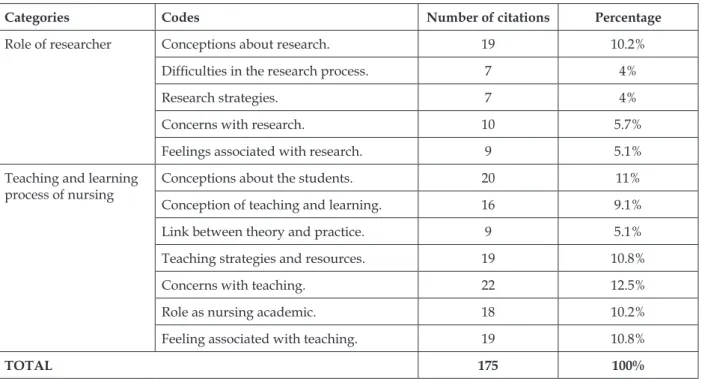
Based on the information, that is, the par-ticipants’ discourse in the interviews, in total, 12 codes were established for the abovementioned categories. Figure 2 shows the codes for each cat-egory, the total number of citations per code and the percentage it represents in each category. As
observed, the most frequent codes in the partici-pants’ discourse were related to the concerns with teaching, followed by the conceptions about the students. With regard to the role of the researcher, the conceptions about research stand out, which are closely linked to the concerns with the meeting of this role as well.
Figure 2 - Distribution of codes in relation to the categories. Barcelona, Spain, 2012
Categories Codes Number of citations Percentage
Role of researcher Conceptions about research. 19 10.2%
Dificulties in the research process. 7 4%
Research strategies. 7 4%
Concerns with research. 10 5.7%
Feelings associated with research. 9 5.1%
Teaching and learning process of nursing
Conceptions about the students. 20 11%
Conception of teaching and learning. 16 9.1%
Link between theory and practice. 9 5.1%
Teaching strategies and resources. 19 10.8%
Concerns with teaching. 22 12.5%
Role as nursing academic. 18 10.2%
Feeling associated with teaching. 19 10.8%
TOTAL 175 100%
Next, the most highlighted results for each category are presented in detail. The participants’ declarations are presented with the letter P, fol-lowed by a number from 1 to 7 for the sake of distinction.
Role of researcher
Conceptions about research
All of the interviewees value the need to incorporate research as a key activity in their work as nursing academics, but also agree that this role is still incipient and has hardly been deined. This supposes that research remains linked – or subject – to other professionals and epistemological spheres that make it dificult for nursing to advance towards professional auton-omy. The following citation clearly exempliies this consideration:
when we studied, we did not see the teachers doing research. Today, the students see us, so I think this referent is important, I’ve never seen my teachers doing research or participating in research, or adopt-ing that attitude, right?, today our students know that, today, all over the world, we are doing theses or Master’s programs or … there are research areas, and they know where we stand and, in addition, they know and we explain to them what we are doing, organizing meetings and there are also speciic subjects (P1).
Feelings associated with research:
The feelings associated with research the interviewees mention are mainly negative, and take the form of insecurity and uncertainty or fear. This insecurity is manifested in view of different aspects, such as the lack of methodological tools or lack of knowledge on scientiic terms, as shown in the following example.
As if it were fear of the unknown one could say, because actually research as a whole is unknown to me, although I have been involved for a year, but a year in research is like nothing (P4).
Research strategies
In general, all of the interviewees signaled the qualitative method as research strategies, given that it allows them to collect people’s experiences. It is clear to the nurses in our sample that the qualitative research strategies favor a relationship of help and proximity, and are useful to tighten the bond with the patient, differently from the quantitative methods, which they consider more appropriate for biomedical studies, besides the fact that they do not relect people’s needs. In the following citation, the interviewee represents this idea by signaling that she feels more qualitative than quantitative.
I am less quantitative and more qualitative, I think it’s very important to value well, my course help relation therapeutic communication attribute more value to the aspects of the disease experience than know-ing the disease itself, right? I think it is very important for nursing to move forward in that area because there is a lot of research at the biomedical level, many papers written but, from the qualitative perspective of the experience of the health and disease process, not much exists (P1).
Concerns and dificulties involving research
The relations with the tutor-director and the approval or acknowledgement of peers were the concerns and dificulties the interviewed nurses mentioned irst.
To a lesser extent, the general aspects of the research process, such as the organization of time, the availability of informants who comply with the proile or of suficient economic resources to reach the end of the process were also part of the common concerns, as evidenced in the following excerpts.
In my doctoral dissertation, what I was most concerned with was to ind informants, according to the proile I needed newly arrived people in situations that sometimes involved legal or job conlicts, their ad -ministrative situation in the country, I was concerned with that, in fact I had to change the data collection techniques, because my initial idea was to do, … was to organize focus groups and I had to do interviews and be very lexible (P1).
As regards the teaching and learning pro-cess, the interviewees’ answers are summarized in ive codes, represented next.
There are two postures related to the nurses’ conception about the students. The irst puts the students forward as responsible for their learning and also for their learning problems. The teacher stands at the margin and remains stable while the students have changed in recent years. The second posture implies the consideration that the teacher’s actions mediate the students’ learning and that, therefore, this is an interactive process that questions both.
negatively, but also freer to express their discomfort or disagreement, or they are more critical, perhaps neither coherently nor logically, but more critical, not construc -tive but more critical, and they express it, perhaps they used to be critical but remained silent, now they are more…. if they used to be passive, they’re more active now […] (P2).
The following citation exempliies the sec -ond posture we referred to: […] I think that, if the students talk, they may be talkative, but something is related to the feedback they receive from the teacher [...] (P3).
Conception of teaching and learning
As regards the conception of teaching and learning, the interviewed nurses manifested the importance of the connection between theory and practice in nursing teaching. From their per-spective, the profession is not justiied without a close relation between the theoretical contents and the hospital practices, which is why they are periodically updating their classes and use meth-odologies with clinical cases that favor authentic teaching. The following example illustrates this general conception that, in addition, entails the need for teachers to be in direct contact with the care reality.
[…] well, trying to work with many clinical cases and really cases that depart from the practice itself, right?, because that indicated that it’s important … [recycling], in my case it’s impossible now because of the management …, the mobility is very dificult to me, as I used to do earlier in recycling. Since I’m on the management board, I haven’t been able to do that but these contacts in practice are very useful to make it very clear that these cases have not been invented, it’s not purely theory, but they are actual situations in practice whose relections they can see [in class] (P1).
Feelings associated with teaching
The aspect that often makes them feel afraid and anguished is the ability to motivate the stu-dents. The answers showed that the nurses feel strongly responsible for complying with this objec-tive, as shown in the following citation:
man, I am concerned with not being able to moti -vate them enough, I am concerned because this, right? That it won’t make them suficiently interested, that the class won’t be suficiently motivating, right? (P3)
Teaching strategies and resources
The interviewed sample highlights the solu-tion of clinical cases as the most effective teaching and learning strategy to approximate the students with the hospital reality.
The cases, the reality, that is, after introducing the minimal theoretical knowledge they need to under-stand something, then we take real or simulated cases, it depends on the circumstances and the work to solve them (P3).
Role as nursing academic
The interviewed nurses clearly distinguished between the teaching and research branch in their academic role. The teaching role refers to the fa-cilitation of learning, to monitoring. Students are the main responsible for their learning but they mediate this process, offering the help needed to enhance it. The following excerpt evidences this conception:
well, the role is to facilitate learning eh… even though there are very big groups of students, but I think it’s not so much to give classes, but to try and make the student get involved and participate that is dificult, when there are so many people in the class -room (P1).
They clearly indicate the research branch as part of their academic role, a branch that is es-sential to develop studies that allow them to gain disciplinary and professional autonomy. […] and, so, I would like to grow in that sense and mainly make the discipline grow in that sense, to be able to do nurs -ing research and help other nurses with my example and that they say I pay attention to what that teacher taught me what nursing research is, but I’m just at the very start (P6).
potential in the qualitative paradigm to do nursing research, it is also true that, as they have developed research under the wings of other professionals, mainly physicians, for many years, it is dificult for them to uproot the feeling of inferiority this pro-fessional context creates. Nevertheless, it is clear that, from their perspective, the characteristics of the qualitative method are the most appropriate to approach the research problem, as they allow them to study the people’s experiences from a holistic perspective.
Concerning the teaching identity, the nurses’ conceptions, feelings and strategies in our sample can be summarized as follows. They acknowledge the presence of a gap between theory and practice, and signal that the profession is not justiied without a close relation between the theoretical and practical contents, a situation they see as a problem. Thus, one of the strate-gies that would allow them to reduce this gap would be the use of personal experiences and of clinical cases as learning methods. As regards the feelings teaching arouses, they mention anguish when they are unable to motivate the students. On the other hand, the need to teach classes in subjects they are not prepared for creates great insecurity and fear.
DISCUSSION
As mentioned, the lack of studies about the preparation of nurse teachers8,10 attest the need to go deeper into aspects of the teaching and learning process, but closely linked to what the nurse teach-ers think about this process. Promoting studies that favor the development of its own theories and models will enhance the consideration of nursing as an autonomous discipline, centered on satisfy-ing the real needs of people as a distinctive aspect of the profession. At bottom, our study intends to contribute to the progressive achievement of this challenge. In that sense, some earlier studies have highlighted the need for a solid nursing theory that challenges the medical models and that permits justifying the role of nurses.8,16 Similarly, the use of a theoretical framework in nursing teaching serves as the source of clinical knowledge, as well as the base for professional autonomy.6 Nevertheless, the interest in the creation of theories and models has also supposed, as a consequence, a heterogeneous development of nursing theory at the international level, which has irretrievably brought about a
transformation in the concept as well as the ap-plication of care practice.2
In our study, we intended to discover how the nurses represent their role as nursing academ-ics, as well as to analyze the conceptions, feelings and strategies used in the teaching and learning and research process in nursing.
As regards the practice of the research role, the results indicate that, for the nursing academics in our sample, research practice supposes a series of challenges that are related to the acknowledge-ment of the virtues of the qualitative paradigm to do nursing research, but also efforts to understand and take control of this method. This irm commit -ment to a research focus that favors the qualitative analysis as the most appropriate to understand the true needs of people who are vulnerable was also indicated by Victoria Henderson, who observed in the International Council of Nurses (ICN),“[…] that nursing looks into people’s subjectivity to identify their needs”.5:20-21 It is a profession that, like the qualitative method, works with an induc-tive method, putting it in a privileged position to explain the world of patients and their families to other people.5-6
Concerning the teaching role and every-thing involved in the teaching and learning pro-cess, the results manifested that the integration between theory and practice is fundamental for the participating nurses to raise the standards of the discipline. In that sense, they are willing to overcome what some authors have identiied as the metaphor of the “gap between theory and practice”. For a long time, this metaphor has inluenced nursing education, raising an obstacle for our students’ learning.17 Some initia-tives, such as the creation of a nursing role that combines the educative with the clinical role, can contribute to reduce this gap, besides the existence of curricular designs that permit the synchronization of theoretical contents and clini-cal practice, something that seems particularly relevant in our study.
of their teaching.4 In that sense, it seems that, for this sample as well, personal experiences and clini-cal cases seem to be the methods that most favor the achievement of student learning. Anecdotes, examples and analogies provide signiicant learn -ing when used as part of an interactive method in nursing teaching.10
CONCLUSION
In conclusion, the nursing academics who participated in our study build their identity between teaching and research, despite the dif-iculties this entails, as mentioned in the results. The application of the Bologna process and the creation of the European Higher Education Area allow them to position themselves as professionals with greater academic opportunities; nevertheless, it also entails further requirements to recycle and maintain a research level in accordance with the standards of other health professionals. Conse-quently, they consider that it is important to have continuing education as an essential condition for the proper practice of their role. In addition, as professionals who are reappearing with further attributions in the academic sphere, nursing re-search needs to grow through the development of theories and models that contribute to the de-velopment of autonomous professionals who are interested in the holistic wellbeing of both healthy and ill people.
We are aware that the study comes with limitations, deriving from the restricted number of participants as well as the method used, al-though it represents a irst advance in a practically unexplored research area. In that sense, future studies can not only broaden the sample to other contexts, but also look at the practices the profes-sionals develop in teaching as well as in research. Monitoring the aspects that most concern them or the critical incidents they discuss in their classes as well as in their research would be a comple-mentary approach to this study and would permit understanding how the academics’ identity is updated and materialized in speciic situations and activities.
REFERENCES
1. Gutierrez L. Formación profesional factor determinante en el ejercicio profesional con calidad en enfermería. Rev Enferm Inst Mex Seguro Soc. 2008 Sept-Dic; 16(3):121-25.
2. González E, Arras M, Moriel L. La profesionalización en enfermería: hacia una estrategia de cambio. Tecnociencia Chihuaha. 2012 Ene-Abr; 6(1):1-8. 3. Bernal M, Ponce G. Propuesta para la enseñanza
del cuidado en enfermería. ENEO-UNAM. 2009 Ene-Mar; 6 (1): 33-41.
4. Pinto A. El cuidado en el proceso de enseñanza y aprendizaje. In: Grupo de cuidado. El arte y la ciencia del cuidado. Colombia (CO): Universidad Nacional de Colombia; 2002. p. 45.
5. De la Cuesta C. Naturaleza de la investigación cualitativa y su contribución a la práctica de enfermería. Metas Enferm. 2006 Jun; 9(5):50-5. 6. De la Cuesta C. La investigación cualitativa y el
desarrollo del conocimiento en enfermería. Texto Contexto Enferm. 2010 Oct-Dic; 19 (4):762-6. 7. Hatlevik I. The theory-practice relationship:
relective skills and theoretical knowledge as key
factors in bridging the gap between theory and practice in initial nursing education. JAN. 2011Abr; 68(4):868-77.
8. Aguayo M, Monereo C. La enfermera formadora: la construcción de una nueva identidad profesional.
Invest Educ Enferm. 2012 Sept-Dic; 30(3):398-405.
9. España. Real decreto 1393/2007, del 29 de Octubre
2007 (ES). Se establece la ordenación de las
enseñanzas universitarias oiciales. Boletín oicial
del estado, España, 30 de Octubre, 2007. [acceso 5 Feb 2013]. Disponible en: http://www.boe.es/boe/ dias/2007/10/30/pdfs/A44037-44048.pdf
10. Backes VMS, Moyá JLM, Prado ML. Proceso de construcción del conocimiento pedagógico del docente universitario de enfermería. Rev Latino-Am Enferm [online]. 2011 Mar-Abr [acceso 14 Dic 2013]; 19(2). Disponible en: http://www.scielo.br/pdf/ rlae/v19n2/es_26.pdf
11. Monereo C, Badía A. Los heterónimos del docente: identidad, selfs y enseñanza. In: Monereo C, Pozo JL. La identidad en psicología de la educación: enfoques actuales, utilidad y límites. Madrid (ES): Narcea; 2011. p. 57-75.
12. Beijaard D, Verloop N, Vermunt JD. Teachers’ perceptions of professional identity: an exploratory study from a personal knowledge perspective. Teach Teacher Educ. 2000 Oct; 16(7):749-64.
13. Muñoz J, Sahagún M. Análisis cualitativo asistido por ordenador con Atla Ti. In: Izquierdo C, Perinat A. (Eds.) Investigar en psicología de la educación. Nuevas perspectivas conceptuales y metodológicas. Barcelona (ES): Amentia, 2011. p. 299-363: [acceso 10 Dic 2013]. Disponible en: https://www.academia. edu/1424153/Analisis_cualitativo_asistido_por_ ordenador_con_ATLAS.ti
29-1 Abril; Valladolid, Castilla y León. Valladolid (ES): UvA; 2011.
15. Waldow V. Enseñanza de enfermería centrada en el cuidado. Aquichán-Col. 2009 Dic; 9(3):246-56.
16. Carr G. Changes in nurse education: delivering the curriculum. NEDT. 2008 Jan; 28:120-7.
17. Gallagher P. How the metaphor of a gap between theory and practice has influenced nursing education. NEDT. 2004 May; 24(4):263-68.
Correspondence: Mariela Aguayo González Paseo de Sant Gervasi, 47, Torre la Tamarita 932533-187 – Barcelona, España
Email: [email protected]