Fuzzy expert system in the prediction
of neonatal resuscitation
1Informática Médica, Faculdade de Medicina, Universidade de São Paulo,
São Paulo, SP, Brasil
2Informática Médica, Departamento de Medicina, Universidade Regional de Joinville,
Joinville, SC, Brasil
3Departamento de Neonatologia, Maternidade Darcy Vargas, Joinville, SC, Brasil 4Decision System Group, Harvard/MIT, Health, Science and Technology,
Cambridge, MA, USA M.A.M. Reis1,2,3,
N.R.S. Ortega1
and P.S.P. Silveira1,4
Abstract
In view of the importance of anticipating the occurrence of critical situations in medicine, we propose the use of a fuzzy expert system to predict the need for advanced neonatal resuscitation efforts in the delivery room. This system relates the maternal medical, obstetric and neonatal characteristics to the clinical conditions of the newborn, providing a risk measurement of need of advanced neonatal resuscita-tion measures. It is structured as a fuzzy composiresuscita-tion developed on the basis of the subjective perception of danger of nine neonatologists facing 61 antenatal and intrapartum clinical situations which provide a degree of association with the risk of occurrence of perinatal asphyxia. The resulting relational matrix describes the association between clinical factors and risk of perinatal asphyxia. Analyzing the inputs of the presence or absence of all 61 clinical factors, the system returns the rate of risk of perinatal asphyxia as output. A prospectively collected series of 304 cases of perinatal care was analyzed to ascertain system performance. The fuzzy expert system presented a sensitivity of 76.5% and specificity of 94.8% in the identification of the need for advanced neonatal resuscitation measures, considering a cut-off value of 5 on a scale ranging from 0 to 10. The area under the receiver operating characteristic curve was 0.93. The identification of risk situations plays an important role in the planning of health care. These preliminary results encourage us to develop further studies and to refine this model, which is intended to implement an auxiliary system able to help health care staff to make decisions in perinatal care.
Correspondence N.R.S. Ortega Informática Médica Faculdade de Medicina, USP 05508-900 São Paulo, SP Brasil
Presented at the 1st Symposium on Advances in Medical Research, Institute of Medical Investigation Laboratories, HC-FMUSP, São Paulo, SP, Brazil, March 21-22, 2003.
Received June 12, 2003 Accepted February 3, 2004
Key words
•Fuzzy sets
•Risk analysis
•Medical expert systems
•Perinatal asphyxia
•Neonatal resuscitation
Introduction
The World Health Organization estimates that 3.6 million infants born every year in developing countries develop birth asphyxia, requiring resuscitation. Approximately 900,000 of these newborns die annually and an unknown number remain with long-term
frequently lead to the birth of a severely depressed baby who needs immediate skilled resuscitation in the delivery room. For this reason, it is common sense in neonatal resus-citation practice, and a strict recommenda-tion of the Neonatal Resuscitarecommenda-tion Program, that any birth should be assisted by a spe-cially trained and skilled professional to cor-rectly perform all the maneuvers necessary to rescue a severely asphyxiated newborn.
However, for operational and economi-cal reasons, it is rarely possible to follow this recommendation in low demand hospitals and in developing countries (2,3) where the prediction of delivery of an asphyxiated in-fant would be critically important to help plan and optimize patient care by the best skilled personnel available. Even in high complexity teaching hospitals in developed countries, which usually follow this recom-mendation, the anticipation of a high risk situation could automatically alert the best trained neonatal resuscitation team.
Researchers have been working on iden-tifying risk factors and creating ways of pre-dicting poor outcomes in perinatal medicine for a long time (4-7). Some important initia-tives were directed at assessment of risk for perinatal mortality (8) and very low birth weight (9). Efforts have been made to iden-tify the severity of neonatal illness and to create predictor systems of morbidity and mortality known as “neonatal risk scoring systems”, such as the score for neonatal acute physiology and the clinical risk for babies score (10,11), especially useful for severity of illness correction in the compar-ison of results obtained at different neonatal units. However, no published data are avail-able about predictor systems for perinatal asphyxia or neonatal resuscitation needs.
In fact, as observed in other areas, deci-sion support is a fecund substratum for the creation of systematic techniques in medi-cine. Impressive advances have been no-ticed in the development of the so-called expert or cognitive systems suggested for
diagnostic and decision making analysis, mimicking the mental procedures of human experts in specific areas of knowledge as a way to simulate the memory and judgment of specialists. The evident importance of such expert systems would be to make the specialists’ knowledge and experience avail-able any time in places where they are criti-cally needed but usually unavailable.
On the way to guarantee more precise and safer health care procedures, decision support systems are increasingly present in critical sets such as intensive care units and emergency departments (12).
The logical analysis of the diagnostic process makes medical diagnostic decision amenable to being mimicked by computer systems. The development of such systems is part of the investigation field called artifi-cial intelligence, which can be defined as “the branch of computer science that is con-cerned with the automation of intelligent behaviour” (13). Over the last decades, the increasing capacity of computers to process and store data and to carry out complex logical manipulations, in association with networks able to promptly make data and results available at a distance, has encour-aged the dissemination of medical knowl-edge (14). Mathematical and statistical tech-niques including decision trees, discrimi-nate analysis and cluster analysis, among others, have been already applied in many classic expert systems. More recently, the fuzzy sets theory has been successfully ap-plied in medicine, particularly in the devel-opment of fuzzy expert systems (15-20).
qualita-tively and quantitaqualita-tively deal with such ex-treme inexactness, specific tools should be available (12,19). The fuzzy sets theory rep-resents one of the most prominent progresses in this area.
Since developing and applying comput-ers as auxiliary diagnostic tools depend on a multidisciplinary approach, a brief review of some basic concepts of fuzzy theory is nec-essary for the sake of best understanding, as described below.
Fuzzy sets theory
The theory of fuzzy sets was introduced by Lotfi A. Zadeh, University of California, Berkeley, in the 1960’s as a means to model the uncertainty within natural language. The mechanics of fuzzy sets theory was set forth in 1965 (21), based on Zadeh’s key notion of graded membership, according to which a set could have members that belong to it only in part. Such fuzzy sets have imprecise bound-aries and therefore gradual transition from membership to non-membership of an ele-ment in its fuzzy set is observed. The ambi-tion of fuzzy sets is to provide interacambi-tion of natural language and numerical models (22). Thus, if we assume that X is a set serving as the universe of discourse, afuzzy subset A
of X is associated with a characteristic func-tion:
µA:X→ [0,1] Eq. 1 which is generally called membership func-tion. Then, for each x, µA(x) indicates to what extent x is a member of set A. This membership degree indicates the compatibil-ity degree of the assertion “x is A”. Using a clinical example: considering that someone has a fever when having a body temperature above 37.0ºC, it is easy to understand that a patient with 38ºC has a fever (membership degree of 1.0). But we could say, based on the fuzzy sets theory, that two patients with temperatures of 36.8ºC and 37.0ºC are mem-bers of the “febrile patient set” too, with a
membership degree of 0.8 and 0.9, respec-tively.
The classic set theoretical operations can be extended to fuzzy sets, which have mem-bership grades in the interval (0.1). So, if we assume that A and B are two fuzzy subsets of
X, their union is a fuzzy subset C of X, denoted C = A ∪ B identified by the maxi-mum (max) value between A(x) and B(x), such that for each x in X (22):
C(x)= max[A(x),B(x)] Eq. 2 In addition, their intersection is another fuzzy subset D of X, denoted D = A ∩ B
identified by the minimum (min) value be-tween A(x) and B(x), such that for each x in X
(22):
D(x)= min[A(x),B(x)] Eq. 3 Another important concept in fuzzy sets is fuzzy relations. A fuzzy relation R be-tween two crisp sets X = {x} and Y = {y} is defined as a fuzzy set in the Cartesian prod-uct X x Y, i.e.,
R = {µR(x,y)/(x,y)} Eq. 4
for each (x,y) ∈X x Y, where µR(x,y): X x Y →
[0,1]is the membership function of the fuzzy relation R, and µR(x,y) ∈ [0,1] gives the
composi-tion of fuzzy relacomposi-tion methods.
One of the most useful composition of fuzzy relations is the so-called max-min com-position. The max-min composition of two fuzzy relations R in X x Y and S in Y x Z, written Romax-minS is defined as a fuzzy
rela-tion in X x Z such that
µRomax-minS(x,y) = max[min(µR(x,y),µS(y,z))]
y∈Y Eq. 5 for each x∈X and z ∈Z. The mathematical operation expressed above is similar to a mul-tiplication of matrices, where each matrix rep-resents a fuzzy relation (22,23). The use of the above equation will be clarified with an ex-ample in the Material and Methods section.
The objective of the present study was to demonstrate the viability of using fuzzy sets theory to correlate the natural language used in perinatology with a numerical model which can be used in a decision support system to simulate the risk analysis made by expert judgment.
Material and Methods
Definition of risk factors
A list of antepartum and intrapartum con-ditions associated with overall risk to
new-borns presented in the medical literature (24) was reviewed and detailed by the neonatolo-gist researcher. The focus of this review was the identification of factors more strongly related to the occurrence of perinatal as-phyxia.
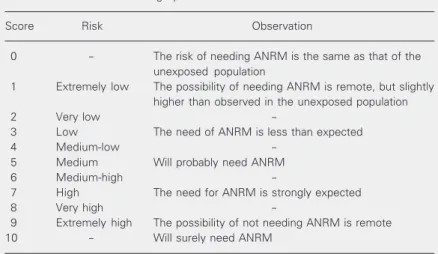
After the exclusion of four conditions (neurologic maternal illness, drug therapy, no prenatal care, and precipitous labor) and maintenance, for calibration purposes, of three low risk conditions (hypothyroidism, hyperthyroidism and anemia), a list of the 61 remaining conditions was submitted on pa-per to nine neonatologists specially trained and skilled in neonatal resuscitation accord-ing to international standards. These neona-tologists are part of a neonatology team regu-larly working in delivery room care with a previous experience of directly assisting more than 60,000 newborns over the last ten years. The experts were asked to analyze each of the 61 factors separately and to quantify (with scores from 0 to 10) the expected risk of needing advanced neonatal resuscitation in the delivery room for the newborn of a hypothetically exposed pregnant woman. The given score was assumed as a degree of association between the presence of the fac-tor and the risk of perinatal asphyxia, i.e., in the model context, this score represents the intensity of the fuzzy relation between clini-cal finding and perinatal asphyxia occur-rence. They were told to answer each topic as if that information was the only one avail-able during their ward activity. As a refer-ence guide to risk analysis, the neonatolo-gists were asked to consider the scoring sys-tem shown in Table 1.
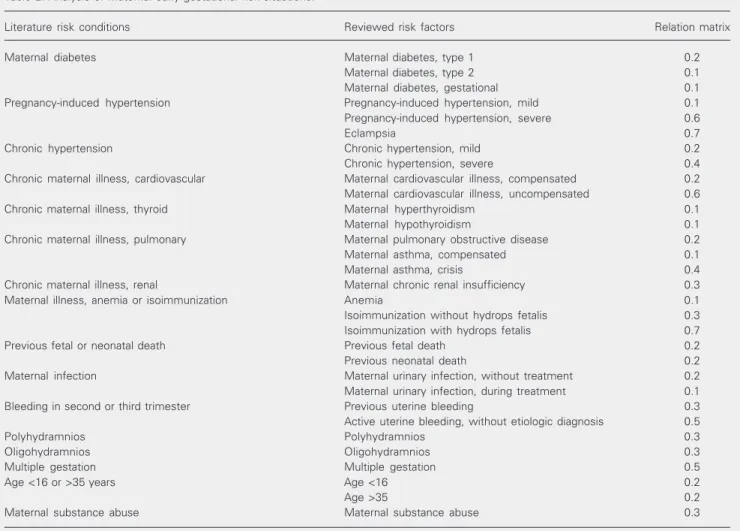
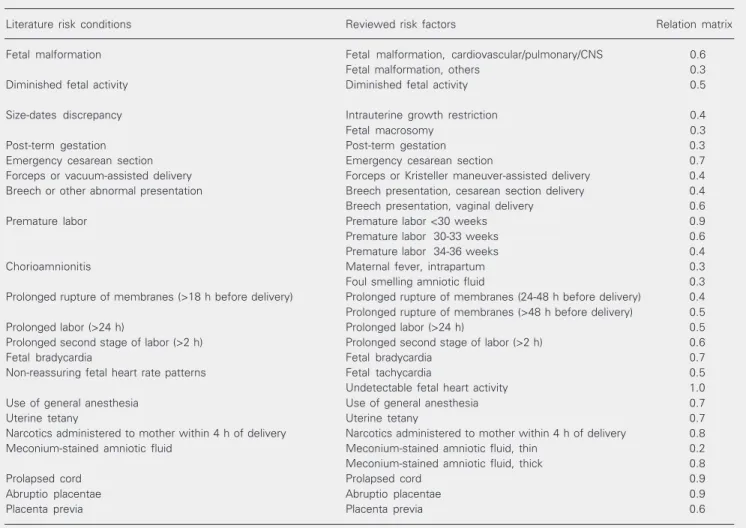
Tables 2 and 3 show the process of re-view and selection of risk factors analyzed by the experts. In the third column the degree of association explained above is presented, which was considered a fuzzy degree in the matrix of fuzzy relations.
For study purposes, we considered as need of advanced neonatal resuscitation measures (ANRM) any condition in which Table 1. Reference risk scoring system.
Score Risk Observation
0 - The risk of needing ANRM is the same as that of the unexposed population
1 Extremely low The possibility of needing ANRM is remote, but slightly higher than observed in the unexposed population 2 Very low
-3 Low The need of ANRM is less than expected 4 Medium-low
-5 Medium Will probably need ANRM 6 Medium-high
-7 High The need for ANRM is strongly expected 8 Very high
-9 Extremely high The possibility of not needing ANRM is remote 10 - Will surely need ANRM
positive pressure ventilation and/or endotra-cheal intubation and/or chest compression and/or medications were necessary during immediate postpartum neonatal care, requir-ing the presence of a specially skilled profes-sional. In this study, we did not include clinical situations which would need basic resuscitation efforts such as tactile stimula-tion and oxygen inhalastimula-tion, that could be executed by a less skilled professional.
Since the need of resuscitation efforts for a depressed delivered newborn has a close etiological relation to perinatal asphyxia, and its importance to the perinatal care planning, we chose the need for advanced neonatal
resuscitation maneuvers as the study marker of perinatal asphyxia. Since a score of 5 was related to medium risk according to the pro-posed Reference Risk Score System (Table 1), this score was defined as the theoretical cut-off value for the “highest risk of ANRM occurrence”.
Expert fuzzy system
The median of score assigned to each fac-tor was firstly divided by 10, transforming the possible range of values from 1 to 10, to 0.1 to 1.0 (Tables 2 and 3). The median of the given scores was used to minimize the effect of
Table 2. Analysis of maternal early gestational risk situations.
Literature risk conditions Reviewed risk factors Relation matrix
Maternal diabetes Maternal diabetes, type 1 0.2 Maternal diabetes, type 2 0.1 Maternal diabetes, gestational 0.1 Pregnancy-induced hypertension Pregnancy-induced hypertension, mild 0.1 Pregnancy-induced hypertension, severe 0.6
Eclampsia 0.7
Chronic hypertension Chronic hypertension, mild 0.2 Chronic hypertension, severe 0.4 Chronic maternal illness, cardiovascular Maternal cardiovascular illness, compensated 0.2 Maternal cardiovascular illness, uncompensated 0.6 Chronic maternal illness, thyroid Maternal hyperthyroidism 0.1 Maternal hypothyroidism 0.1 Chronic maternal illness, pulmonary Maternal pulmonary obstructive disease 0.2 Maternal asthma, compensated 0.1 Maternal asthma, crisis 0.4 Chronic maternal illness, renal Maternal chronic renal insufficiency 0.3 Maternal illness, anemia or isoimmunization Anemia 0.1 Isoimmunization without hydrops fetalis 0.3 Isoimmunization with hydrops fetalis 0.7 Previous fetal or neonatal death Previous fetal death 0.2 Previous neonatal death 0.2 Maternal infection Maternal urinary infection, without treatment 0.2 Maternal urinary infection, during treatment 0.1 Bleeding in second or third trimester Previous uterine bleeding 0.3 Active uterine bleeding, without etiologic diagnosis 0.5
Polyhydramnios Polyhydramnios 0.3
Oligohydramnios Oligohydramnios 0.3
Multiple gestation Multiple gestation 0.5 Age <16 or >35 years Age <16 0.2
Age >35 0.2
Maternal substance abuse Maternal substance abuse 0.3
input of the model. Note that the system input is a crisp rather than a fuzzy value in order to simplify the actual utilization of this system in a perinatal unit. Then, for each state matrix, the system computes the risk value through the fuzzy max-min composition described in the fuzzy sets theory section.
The system output is found through the composition between clinical findings and the respective risk matrix. The mathematical process is similar to a matrix multiplication when, in this case, the sum is changed by the minimum operator and the multiplication is changed by the maximum operator. The re-sult is a unitary matrix (one line and one column) whose value, normalized to 0 to 10, eventual discrepancies among the experts’
opinions and represented the grade of risk perceived by this group. As discussed above, these values represented the degree of associa-tion between clinical signs and risk of perina-tal asphyxia. The aggregation of all these val-ues forms the fuzzy relational matrix, a ma-trix with 61 lines and one column.
The fuzzy relational findings/risk matrix represents the knowledge of experts in the model. It is used by the system to compute the perinatal asphyxia risk for any case analyzed by the use of a state matrix built for each case. The state matrix that identifies the presence (value = 1) or absence (value = 0) of each of all the risk factors observed by the user is the
Table 3. Analysis of fetal and perinatal risk situations.
Literature risk conditions Reviewed risk factors Relation matrix
Fetal malformation Fetal malformation, cardiovascular/pulmonary/CNS 0.6 Fetal malformation, others 0.3 Diminished fetal activity Diminished fetal activity 0.5
Size-dates discrepancy Intrauterine growth restriction 0.4 Fetal macrosomy 0.3 Post-term gestation Post-term gestation 0.3 Emergency cesarean section Emergency cesarean section 0.7 Forceps or vacuum-assisted delivery Forceps or Kristeller maneuver-assisted delivery 0.4 Breech or other abnormal presentation Breech presentation, cesarean section delivery 0.4 Breech presentation, vaginal delivery 0.6 Premature labor Premature labor <30 weeks 0.9 Premature labor 30-33 weeks 0.6 Premature labor 34-36 weeks 0.4 Chorioamnionitis Maternal fever, intrapartum 0.3 Foul smelling amniotic fluid 0.3 Prolonged rupture of membranes (>18 h before delivery) Prolonged rupture of membranes (24-48 h before delivery) 0.4 Prolonged rupture of membranes (>48 h before delivery) 0.5 Prolonged labor (>24 h) Prolonged labor (>24 h) 0.5 Prolonged second stage of labor (>2 h) Prolonged second stage of labor (>2 h) 0.6 Fetal bradycardia Fetal bradycardia 0.7 Non-reassuring fetal heart rate patterns Fetal tachycardia 0.5 Undetectable fetal heart activity 1.0 Use of general anesthesia Use of general anesthesia 0.7
Uterine tetany Uterine tetany 0.7
Narcotics administered to mother within 4 h of delivery Narcotics administered to mother within 4 h of delivery 0.8 Meconium-stained amniotic fluid Meconium-stained amniotic fluid, thin 0.2 Meconium-stained amniotic fluid, thick 0.8
Prolapsed cord Prolapsed cord 0.9
Abruptio placentae Abruptio placentae 0.9
Placenta previa Placenta previa 0.6
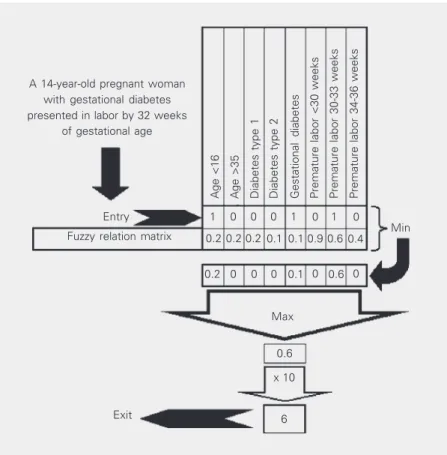
represents a score of the risk of needing ANRM associated with the case. Figure 1 shows an example of use of maximum-mini-mum composition during a hypothetical case analysis by the system. Observe that the first step is the selection of the minimum values between the paired input and the respective degree of association in the finding/risk ma-trix. The composition is completed with the selection of the maximum value of all the resulting (minimum) values. The range of the example presented does not show all the possible risk factors, but only those related to the case.
It is important to note how simple and fast the calculation of fuzzy relation compo-sition is. This makes it feasible to develop expert system software and to apply it to the real perinatal unity environment.
Experimental analysis
As a way of evaluating the performance of the developed fuzzy expert system in risk analysis, a prospective follow-up of a series of cases requiring perinatal care was done at a reference tertiary perinatal medical center in southern Brazil from October to Decem-ber 2002. The protocol was approved by the hospital Ethics Committee and written in-formed consent was obtained from the per-sons responsible for the subjects.
Each pregnant woman admitted to the hos-pital during the study period was invited to participate. Refusal to have her information included in the study, occurrence of abortion or stillbirths, and not giving birth during the study period were the exclusion criteria.
Data were collected by the same re-searcher from interviews of patients, health professionals and from patient medical records. Information was recorded from the time of patient admission to the first assis-tance of the newborn after birth, including aspects of previous maternal diseases and clinical conditions occurring during gesta-tion, labor and delivery. Special emphasis
was placed on medical interventions and mother and newborn outcomes. Twins were analyzed separately, so the occurrence of ANRM in either child was considered.
The collected cases were then analyzed by the developed fuzzy expert system to compare the estimated risks with the out-come observed and the sensitivity and speci-ficity of the model were determined based on the data analyzed. The operating charac-teristics were plotted and graphically ana-lyzed on the receiver operating characteris-tic (ROC) curve, which informs us about the estimated performance of the fuzzy expert model in predicting the need for ANRM in the data sample considered.
Results
The nine neonatologists had no
signifi-Figure 1. Example of fuzzy maximum-minimum (max-min) composition performance. A hypothetical clinical example shows the rationale of the model, using a small part of the knowledge bank for demonstration purposes.
0.2
Premature labor 34-36 weeks
Min A 14-year-old pregnant woman
with gestational diabetes presented in labor by 32 weeks
of gestational age
0 0 0 0.1 0 0.6 0 0.2 0.2 0.2 0.1 0.1 0.9 0.6 0.4
1 0 0 0 1 0 1 0
Premature labor 30-33 weeks
Premature labor <30 weeks
Gestational diabetes
Diabetes type 2
Diabetes type 1
Age >35
Age <16
Entry
Fuzzy relation matrix
Max
0.6
x 10
cant difficulties in scoring the factors, but all of them occasionally used the reference risk scoring system as a helping tool during risk analysis.
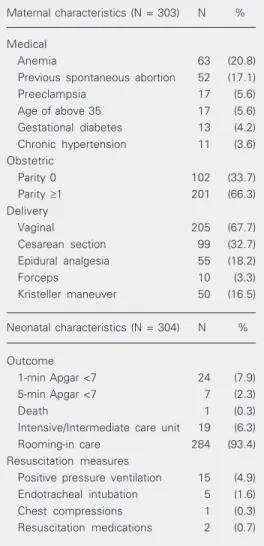
Information was collected about 303 preg-nant women who gave birth to 304 newborns (one twin gestation) during the study period. Mean maternal age was 25.18 ± 6.1 years (13 to 43). Most of the women were multiparous (66.3%) and 18.1% of them received epidu-ral analgesia during labor. The cesarean rate was 32.6%.
Table 4 summarizes the most important characteristics of the sample studied.
Only one mother needed intensive care after delivery as a consequence of her previ-ous disease. Of the 304 newborns, 273 were term and 31 (10.2%) were preterm babies (eight below 34 weeks of gestational age). Mean birth weight was 3,233.5 ± 614.7 g (525 to 5,045 g). Ninety-one (29.9%) infants received oxygen inhalation and 17 (5.6%) received ANRM immediately after birth. Only 7 (2.3%) newborns had a fifth minute Apgar score below 7. One extremely prema-ture infant died in the delivery room and 19 newborns (6.3%) needed special care (inter-mediate or intensive care) after first assis-tance in the delivery room.
The formerly proposed cut-off value of 5 Table 4. Characteristics of the study sample.
Maternal characteristics (N = 303) N %
Medical
Anemia 63 (20.8) Previous spontaneous abortion 52 (17.1) Preeclampsia 17 (5.6) Age of above 35 17 (5.6) Gestational diabetes 13 (4.2) Chronic hypertension 11 (3.6) Obstetric
Parity 0 102 (33.7) Parity ≥1 201 (66.3) Delivery
Vaginal 205 (67.7) Cesarean section 99 (32.7) Epidural analgesia 55 (18.2) Forceps 10 (3.3) Kristeller maneuver 50 (16.5)
Neonatal characteristics (N = 304) N %
Outcome
1-min Apgar <7 24 (7.9) 5-min Apgar <7 7 (2.3) Death 1 (0.3) Intensive/Intermediate care unit 19 (6.3) Rooming-in care 284 (93.4) Resuscitation measures
Positive pressure ventilation 15 (4.9) Endotracheal intubation 5 (1.6) Chest compressions 1 (0.3) Resuscitation medications 2 (0.7)
Cut-off value Sensitivity Specificity
0.0 100.0 27.9 0.1 100.0 41.8 0.2 100.0 59.6 0.3 94.1 72.5 0.4 76.5 92.0 0.5 76.5 94.8 0.6 47.1 96.9 0.7 29.4 98.3 0.8 23.5 99.3 0.9 0.0 100.0
1.0 0.9 0.8 0.7 0.6
0.5 0.4 0.3 0.2 0.1 0.0
0.0 0.2 0.4 0.6 0.8 1-Specificity
Sensitivity
for the system output score was reinforced by the results observed in the study sample, which conferred the fuzzy expert system a sensitivity of 76.5% and a specificity of 94.8% for the prediction of the need for ANRM. The plotting of the ROC curve (scores 0 to 10) is shown in Figure 2. The area under the ROC curve was 0.93 (95%CI: 0.90-0.96).
Discussion
Several good clinical articles have been published in the last decade regarding the risks and consequences of perinatal asphyxia and the benefits of implementing standards of neonatal resuscitation procedures in hos-pitals (24,25).
As appropriately observed by Stool and Measham (25), according to the World Health Organization, approximately 32% of all neo-natal deaths in developing countries - equiva-lent to about 4,500 daily deaths - are due to birth asphyxia and birth injury. And these events are not only frequent causes of mor-tality and long-term morbidity, but are po-tentially preventable.
The basis of the present study is the early identification of risky clinical conditions as a way to anticipate the necessity of skilled personnel for patient care. Quoting the Ameri-can Academy of Pediatrics from the interna-tional consensus on neonatal resuscitation, we could say: “Anticipation, adequate prepa-ration, accurate evaluation, and prompt ini-tiation of support are the critical steps to successfulneonatal resuscitation” and “Ap-propriate preparation for an anticipated high-risk delivery requires communication be-tween the person(s) caring for themother and those responsible for resuscitation of the newly born” (24).
It should be pointed out that risk factors dependent on the use of sophisticated and usually expensive antenatal or intrapartum semiologic techniques to assess fetal well-being (fetal blood flow by Doppler
ultra-sound, cardiotocography, fetal scalp blood pH measurement, etc.) were intentionally excluded from our system development as a way to make it useful to any health care team in hospitals providing care of any complex-ity level. The expected contribution of the present paper is the proposal of the use of an expert system to help decision making in perinatal care in places where highly skilled specialists and sophisticated equipment are not available. The system can be used even with a cheap outdated 486-processor per-sonal computer or with a portable hand-held notebook. In contrast to Bayesian systems, the fuzzy expert system described here can deal with any number of variables without loss of performance.
In addition to being used for care planning, the fuzzy expert model presented here could be used as a teaching or training tool, helping midwives, residents and medical students to identify and evaluate clinical risk factors.
To the best of our knowledge, this is the first study that proposes the use of the fuzzy sets theory to predict neonatal resuscitation. After an extensive search in the indexed litera-ture we were unable to find similar previously published studies, a fact that prevents compar-ison of the present findings to those obtained with other approaches. We also did not find any study of prediction of neonatal resuscita-tion using weighted risk factors.
In the analysis of the efficacy of our system in identifying the need for resuscita-tion in the cases studied, we considered the less than ideal sensitivity of 76.5% to be a possible reflex of the known unpredictability of some cases of perinatal asphyxia and a good challenge for future improvement of our model. Since this model was based on information related to risk factors alone, one of the possible ways of improving it would probably be the analysis of the impact of associations of these risk factors.
consid-eration. Eighteen of the factors studied were not tested by experimental analysis, for which testing in a multicenter study or over a very long period of time in a prospective study would be probably needed. However, the overall performance of the system seemed very promising, taking into account that some medical procedures (induction of labor and cesarean sections) probably modified the expected natural evolution of cases at risk, causing a reduction in the need for ANRM. For obvious ethical reasons, this issue can never be cleared up.
It is possible that characteristics of the
study population and regional obstetric clini-cal practice habits may affect the importance attributed to some variables, a fact that could be clarified by similar studies conducted at other centers.
These preliminary results suggest that fuzzy relations should be considered as a good method to deal with the imprecision of diagnostic and decision making procedures in perinatology and encourage us to conduct further studies and to refine this model, which is intended to implement an auxiliary system able to help health care staff to make deci-sions in the delivery room.
References
1. World Health Organization (1998). Basic newborn resuscitation: a practical guide. WHO/RHT/MSM 98.1 (online). WWW URL: http:// www.who.int/reproductive-health/publications/MSM_98_1/ MSM_98_1_abstract.en.html. Accessed February 2003.
2. Chandra S (1997). Perinatal asphyxia: multivariate analysis of risk factors in hospital births. Indian Pediatrics, 34: 206-212.
3. Kolatat T, Vanprapar N & Thitadilok W (2000). Perinatal asphyxia: multivariate analysis of risk factors. Journal of the Medical Associa-tion of Thailand, 83: 1039-1044.
4. Goodwin LK & Iannacchione MA (2002). Data mining methods for improving birth outcomes prediction. Outcomes Management for Nursing Practice, 6: 80-85.
5. Mahieu LM, De Muynck AO, De Dooy JJ, Laroche SM & Van Acker KJ (2000). Prediction of nosocomial sepsis in neonates by means of a computer-weighted bedside scoring system (NOSEP score). Criti-cal Care Medicine, 28: 2026-2033.
6. Saliba RM, Annegers FJ, Waller DK, Tyson JE & Mizrahi EM (2001). Risk factors for neonatal seizures: a population-based study, Harris County, Texas, 1992-1994. American Journal of Epidemiology,154: 14-20.
7. Shankaran S, Fanaroff AA, Wright LL et al. (2002). Risk factors for early death among extremely low-birth-weight infants. American Journal of Obstetrics and Gynecology, 186: 796-802.
8. DeCaunes F, Alexander GR, Berchel C, Guengant JP & Papiernik E (1990). Anamnestic pregnancy risk assessment. International Jour-nal of Gynecology and Obstetrics, 33: 21-27.
9. Gueorguieva RV, Sarkar NP, Carter RL, Ariet M, Roth J & Resnik MB (2003). A risk assessment screening test for very low birth weight.
Maternal and Child Health Journal, 7: 127-136.
10. Richardson DK, Gray JE, McCormick MC, Workman K & Goldmann DA (1993). Score for neonatal acute physiology: a physiologic sever-ity index for neonatal intensive care. Pediatrics, 91: 617-623. 11. Richardson DK, Corcoran JD, Escobar G & Lee SK (2001). SNAP-II
and SNAPPE-II: Simplified newborn illness severity and mortality risk scores. Journal of Pediatrics, 138: 92-100.
12. Mahfouf M, Abbod MF & Linkens DA (2001). A survey of fuzzy logic monitoring and control utilization in medicine. Artificial Intelligence in Medicine, 21: 27-42.
13. Luger GF & Stubblefield WA (1997). Artificial Intelligence: Structure and Strategies for Complex Problem Solving. 2nd edn. Addison Wesley Longman, Palo Alto, CA, USA.
14. Miller III MC, Westphal Jr MC & Reigart II JR (1981). Mathematical Models in Medical Diagnosis. Praeger Publishers, New York. 15. Massad E, Burattini MN & Ortega NRS (1999). Fuzzy logic and
measles vaccination: designing a control strategy. International Jour-nal of Epidemiology, 28: 550-557.
16. Ortega NRS, Sallum PC & Massad E (2000). Fuzzy dynamical sys-tems in epidemic modelling. Kybernetik, 29: 201-218.
17. Nascimento LFC & Ortega NRS (2002). Fuzzy linguistic model for evaluating the risk of neonatal death. Revista de Saúde Pública, 36: 686-692.
18. Boegl K, Adlassnig KP, Hayashi Y, Rothenfluh TE & Leitich H (2004). Knowledge acquisition in the fuzzy knowledge representation frame-work of a medical consultation systems. Artificial Intelligence in Medicine, 30: 1-26.
19. Teodorescu HN, Kandel A & Jain LC (1999). Fuzzy and Neuro-Fuzzy Systems in Medicine. CRC Press, Boca Raton, FL, USA.
20. Velasevic DM, Saletic DZ & Saletic SZ (2001). A fuzzy sets theory application in determining the severity of respiratory failure. Interna-tional Journal of Medical Informatics, 63: 101-107.
21. Zadeh LA (1965). Fuzzy sets. Information and Control, 8: 338-353. 22. Klir GJ & Folger TA (1988). Fuzzy Sets: Uncertainty and Information.
Prentice Hall, Englewood Cliffs, NJ, USA.
23. Pedrycz W & Gomide F (1998). An Introduction to Fuzzy Sets: Analysis and Design. MIT Press, London, UK.
24. American Academy of Pediatrics (2000). International guidelines for neonatal resuscitation - An excerpt from the Guidelines 2000 for Cardiopulmonary Resuscitation and Emergency Cardiovascular Care: International Consensus on Science. Pediatrics (online), 106. Available from: American Academy of Pediatrics. WWW URL: http: //www.pediatrics.org/cgi/content/full/106/3/e29. Accessed February 2003.