B
r
IE
F
CO
M
M
U
N
IC
A
T
IO
Authors
MustafaKemalCelen1
MehmetUlug2
CelalAyaz3
MehmetFarukGeyik4
SalihHosoglu5
1DicleUniversityMedical School,Departmentof InfectiousDiseasesand ClinicMicrobiology,21280 Diyarbakir,Turkey.
2BSKAnadoluHospital,
DepartmentofInfectious DiseasesandClinic Microbiology,43100 Kütahya,Turkey.
3DicleUniversityMedical
School,Departmentof InfectiousDiseasesand ClinicMicrobiology,21280 Diyarbakir,Turkey. 4DüzceUniversityMedical School,Departmentof InfectiousDiseasesand ClinicMicrobiology,81100 Düzce,Turkey.
5DicleUniversityMedical
School,Departmentof InfectiousDiseasesand ClinicMicrobiology,21280 Diyarbakir,Turkey.
Submittedon:07/23/2009 Approvedon:11/08/2009
Correspondence to:
Dr.MehmetUluğ
ÖzelBSKAnadolu Hastanesi,
EnfeksiyonHastalıkları veKlinikMikrobiyoloji Kliniği
AlipaşaMah.FSMBulvarı No:9,43100Kütahya. Mobilephone:(0532) 4475756,Fax:0274 2244433(Hospital) E-mail:mehmetulug21@ yahoo.com
Wedeclarenoconflict ofinterest.
ABSTRACT
Objective: thedifferentclinicalandlaboratoryfeaturesandresponsetotreatmentofpatientswith acutebrucellarepididymo-orchitis(BEO)reportingtothereferencehospitalinSoutheasternAnato-liaofTurkey.Material and methods:inthisstudy,27malepatientswithbrucellosis,whopresented withepididymitisorepididymo-orchitis(EO)attheuniversityhospitalinDiyarbakirfrom1998to 2006,wereincluded.Theywerecomparedwiththeothermalepatients.Positivebloodcultureor highagglutinationtitersof≥1/160andpositiveclinicalmanifestationsofbrucellosiswerethemain criteria for diagnosing brucellosis.Results: fourteen patients had unilateral EO. Leukocytosiswas presentin10patients;allofthemhadinitialagglutinationtitersof≥ 1/160and10patientshadaposi-tivebloodculture.Allpatientsreceivedcombinedtherapywithstreptomycinforthefirst21days(or oralrifampicinfor6-8weeks)withdoxycyclineortetracyclinefor6-8weeks.Allshowedimprovement, feversubsidedin3-7days,andthescrotalenlargementandtendernessregressed.Onlyonepatient hadarelapsewithinoneyear.Conclusion:inbrucellosis-endemicareas,cliniciansencounteringEO shouldconsiderthelikelihoodofbrucellosis.Inthisstudy,youngagewasthemostcommonriskfac-tor,andleukocytosisandhighCRPlevelwerethemostcommonlaboratoryfindings.Mostcaseswere unilateral.Allpatientsrespondedtomedicalmanagementverywell.Conservativemanagementwith combination antibiotic therapy was adequate for managing BEO. Conclusively, brucellosis must be consideredasacauseoforchitis,especiallyinendemicregionslikeTurkey.
Keywords: epididymo-orchitis,brucellosis,Turkey,medicaltreatment.
[Braz J Infect Dis 2010;14(1):109-115]©ElsevierEditoraLtda.
Brucellar epididymo-orchitis in southeastern
part of Turkey: an 8 year experience
INTRODUCTION
Brucellosis is a zoonosis widely distributed worldwide.Millionsofindividualsareatrisk throughouttheworld,especiallyindeveloping countriesinwhichinfectioninanimalsisnot undercontrol.Althoughthecurrentincidence ofbrucellosisindevelopedcountriesislow,it occurssporadicallyinoccupationallyexposed groups,includingfarmers,veterinarians,and laboratoryandslaughterhouseworkers.1,2
BrucellosisisanendemicdiseaseinTurkey. Theincidenceofthisdiseaseinourcountryis 23per100,000yearly.3Itisfrequentespecially in the rural areas of the middle and south-easternregions,andBrucella melitensisisthe most prevalent strain.4
The disease typically attacks young and middle-aged adults, with a low incidence among infants and elderly patients.5Ithashighdegreeofmorbidityfor humans, and has caused significant economic
loss,representingaseriouspublichealthprob-leminmanydevelopingcountries.6
Inhumans,brucellosisbehavesasasystem-ic infection with a very heterogeneous clini-cal spectrum. The most frequent symptoms are fever, chills or rigors, malaise, generalized ache, headache, and fatigue. The prevalence andpatternofcomplicationsdependonstrain ofbrucellainfectingtheindividual,ageofthe patient,anddurationofdisease.7 Gastrointesti-nal,skeletal,cardiovascular,genitourinary,and hematologicalmanifestationsarewellknown. Neurobrucellosis, peritonitis, pericarditis, and pancytopenia are unusual manifestations of brucellosis.8,9 If the disease is not well recog- nizedandnotincludedinthedifferentialdiag-nosis,atreatablediseasewillbemissed.9
tes-ticularabscess,andseminalvasculitishavebeenattributed to brucellosis. The most frequent genitourinary compli-cation of brucellosis is EO, affecting 2-20% of males with brucellosis,10-12anditwasfirstdescribedbyHardyasacause of granulamatous orchitis in 1928.13,14 The testes or epidi-dymisisinfiltratedwithlymphocytesandplasmacells,and thereisanatrophyoftheseminiferoustubules.8Although theprognosisofbrucellarepididymo-orchitis(BEO)isusu-allygood,delayindiagnosisorinappropriatemanagement may result in serious complications, such as testicular ab-scess,whichmayrequireorchiectomy.10
In the present study, the clinical characteristics, treat- ment,andfinaloutcomesof27patientswithBEOarepre-sentedandcomparedwithmalepatientswithoutEO.
MATERIAL AND METHODS
This study was retrospectively carried out at Dicle Uni-versity Medical Faculty Hospital, Department of Infec-tious Disease and Clinic Microbiology, between Janu-ary1998andDecember2006.Ourhospitalisthelargest (1090beds)inthecityofDiyarbakirinthesoutheastern AnatoliaregionofTurkey.
Definitivediagnosisofbrucellosiswasmadebyisolation ofBrucellaspp.frombloodcultures.Intheabsenceofpositive bloodculture,presumptivediagnosiswasmadeserologically by positive serum standard tube agglutination test together with compatible clinical signs and symptoms of brucello-sis, such as fever, sweating, arthralgia, hepatomegaly, and splenomegaly.8 Among these patients with brucellosis, the diagnosisofepididymitisorEOwasbasedonclinicalsymp-toms (scrotal enlargement, swelling, pain or tenderness not duetoothercauses),andultrasonographicexamination.
SignificanttitersweredeterminedtobeaWright’sag-glutination≥1/160.Thefollowingprotocolwasfollowed for blood cultures. Two samples of blood (10 mL each) were inoculated into BACTEC bottles and incubated in the non-radiometric semiautomatic BACTEC 9240 sys-tem(Becton-Dickinson,DiagnosticInstrumentSystems, USA)for30days.Whenapositivebottlewasdetected,a Gramstainofthebrothwasperformed,andaportionof thefluidwasculturedagainonto5%sheepblood,bru-cella and eosin-methylene blue agar. These subcultures were incubated at 37o C in 5% CO
2 atmosphere for 24-72 hours.Smearsfromcoloniesthatgrewwerestainedwith Gram stain. The isolates of Gram-negative coccobacilli wereidentifiedwithuseofconventionalbiochemicaltests (e.g., motility; oxidase, catalase, and urease tests; effect to glucose and production of H2S), and Sceptor system (Becton-Dickinson,Maryland,USA).
Mumps, testicular malignancies, and other bacterial infectionswereexcludedby:absenceofhistoryofparo-titis, genitourinary tract disease and manipulation, ure-
thraldischarge,andsexualexposure;normalserumamy-lase, lipase, alpha-fetoprotein and beta human chorionic gonadotropin levels and negative scrotal ultrasonographic findingscompatiblewithtestistumor.
Basedonthesystemicdiseasedurationfromthebe-ginningtoadmissiontohospital,patientswereclassified asacute(lessthantwomonths),subacute(2-12months) andchronic(>12months).16Age,durationofsymptoms at admission, history of ingestion of raw milk or milk products,clinicalsymptoms,resultsofphysicalexamina-tion,laboratoryresults,antibioticsadministered,andthe durationoftreatmentwererecorded.Inaddition,white bloodcellcount(WBC),erythrocytesedimentationrate (ESR),rheumatoidfactor(RF),C-reactiveprotein(CRP), blood chemistry profile, and urine analysis were per-formedinallpatients.
Several approaches were used for treatment in these patients:Tetracycline(500mg/6hPO)ordoxycycline(100 mg/12hPO)for45daysplusstreptomycin1g/dayIM)for the first 21 days. Doxycycline (100 mg/12h PO) plus ri-fampicin(15mg/kgPO)for45days.Weusedbothofthem intreatmentofourpatients.
Patientswerefollowedupfortnightlyuntiltheendofthe treatmentperiod,monthlyforthreemonths,andthereafter everythreemonthsforoneyear.Relapsewasassessedbya recurrenceofsymptomsandsignsofthedisease,apositive bloodcultureorrisingantibodytiteraftertreatment,inthe absenceofre-exposuretoinfection.
DataobtainedwereanalyzedusingtheStatisticalPack-agefortheSocialScience(SPSS)forWindows,version11.0 software (SPSS, Chicago, IL, USA). Student’s t-test was applied for comparison of means and chi-square test for comparison of proportions. A p value of < 0.05 was ac-ceptedassignificant.
RESULTS
Inthisstudy,302patientswithbrucellosis(159female,143 male)wereanalyzed,27ofthemhadEO,givinganincidence of EO among males with brucellosis of 18.8%. The clinical characteristics,treatment,andfinaloutcomesof27patientswith BEOarecomparedwithmalepatientswithoutEO(n=116). ThemeanageofpatientswithBEOandwithoutEOwas 28±8years(range,16-46)and36±14years(range,17-74), respectively. This was statistically significant (p = 0.005). Ofthe27patientswithBEO,51.7%livedinruralareasand 48.3%wereofurbanorigin.
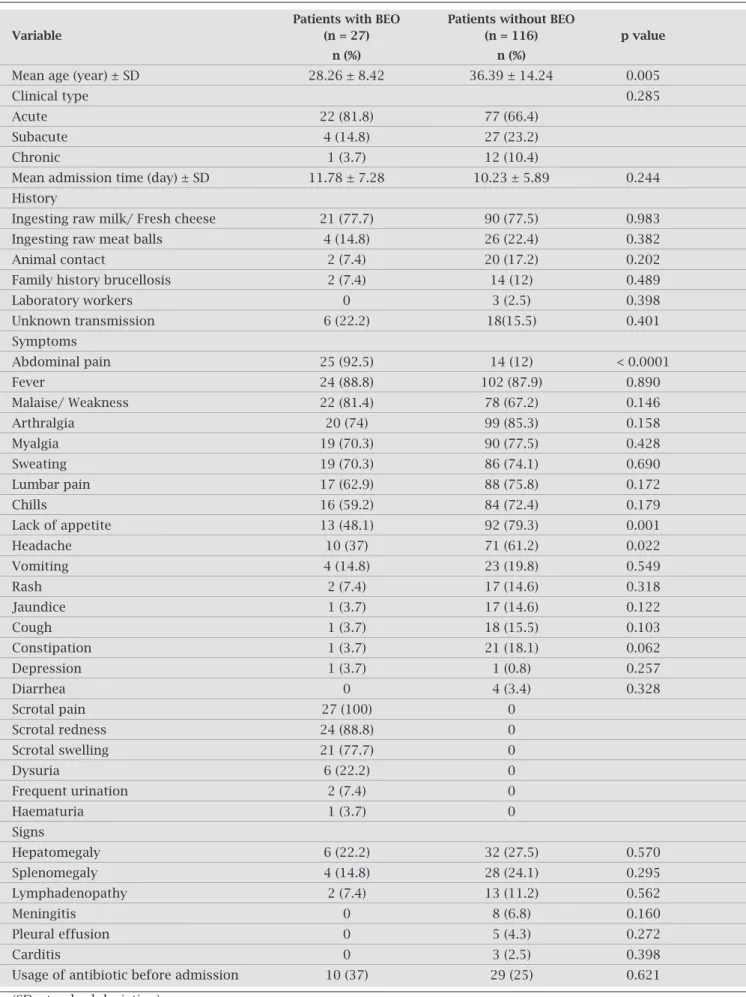
Table 1. Epidemiologic and clinical characteristics of patients with and without BEO
Patients with BEO Patients without BEO
Variable (n = 27) (n = 116) p value
n (%) n (%)
Mean age (year) ± SD 28.26 ± 8.42 36.39 ± 14.24 0.005
Clinical type 0.285
Acute 22 (81.8) 77 (66.4)
Subacute 4 (14.8) 27 (23.2)
Chronic 1 (3.7) 12 (10.4)
Mean admission time (day) ± SD 11.78 ± 7.28 10.23 ± 5.89 0.244
History
Ingesting raw milk/ Fresh cheese 21 (77.7) 90 (77.5) 0.983
Ingesting raw meat balls 4 (14.8) 26 (22.4) 0.382
Animal contact 2 (7.4) 20 (17.2) 0.202
Family history brucellosis 2 (7.4) 14 (12) 0.489
Laboratory workers 0 3 (2.5) 0.398
Unknown transmission 6 (22.2) 18(15.5) 0.401
Symptoms
Abdominal pain 25 (92.5) 14 (12) < 0.0001
Fever 24 (88.8) 102 (87.9) 0.890
Malaise/ Weakness 22 (81.4) 78 (67.2) 0.146
Arthralgia 20 (74) 99 (85.3) 0.158
Myalgia 19 (70.3) 90 (77.5) 0.428
Sweating 19 (70.3) 86 (74.1) 0.690
Lumbar pain 17 (62.9) 88 (75.8) 0.172
Chills 16 (59.2) 84 (72.4) 0.179
Lack of appetite 13 (48.1) 92 (79.3) 0.001
Headache 10 (37) 71 (61.2) 0.022
Vomiting 4 (14.8) 23 (19.8) 0.549
Rash 2 (7.4) 17 (14.6) 0.318
Jaundice 1 (3.7) 17 (14.6) 0.122
Cough 1 (3.7) 18 (15.5) 0.103
Constipation 1 (3.7) 21 (18.1) 0.062
Depression 1 (3.7) 1 (0.8) 0.257
Diarrhea 0 4 (3.4) 0.328
Scrotal pain 27 (100) 0
Scrotal redness 24 (88.8) 0
Scrotal swelling 21 (77.7) 0
Dysuria 6 (22.2) 0
Frequent urination 2 (7.4) 0
Haematuria 1 (3.7) 0
Signs
Hepatomegaly 6 (22.2) 32 (27.5) 0.570
Splenomegaly 4 (14.8) 28 (24.1) 0.295
Lymphadenopathy 2 (7.4) 13 (11.2) 0.562
Meningitis 0 8 (6.8) 0.160
Pleural effusion 0 5 (4.3) 0.272
Carditis 0 3 (2.5) 0.398
Usage of antibiotic before admission 10 (37) 29 (25) 0.621
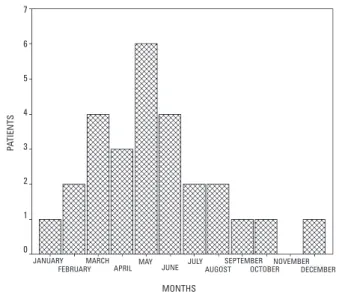
Nosourcewasidentifiedinsixpatients(22.2%)withBEOand 18patients(15.5%)withoutEO.Whenthedistributionofall caseswasexaminedaccordingtomonthsoftheyear,anincrease wasseeninMay(Figure1).Therewerenosignificantdifferences inthedistributionofmonthsamonganyofthem.
Of the 27 patients with BEO, the onset of symptoms wasacutein22patients(81.8%),subacuteinfourpatients (14.8%),andchronicinonepatient(3.7%).Themeanad-missiontimewas11.8±7.3daysinpatientswithBEOand 10.2±5.9daysinpatientswithoutEO,whichisnotstatis-tically significant (p = 0.244). The symptoms reported at admissionareshowninTable1.Noneofthepatientswas asymptomatic.Fever,scrotalpainandswelling,andscrotal rednesswerethemostcommonsymptoms.Headache,lack ofappetite,abdominalpainwereseeninpatientswithBEO more than without EO (p = 0.022, p = 0.001, p < 0.0001 respectively).Urinarysymptoms(dysuria,haematuria,fre-quencyorurgency)wereseeninsixpatients(22.2%).
LaboratoryfindingsofpatientsareshowninTable2.ESR, WBC, and CRP levels were measured in all patients. ESR ranged from 9-81 mm/h (median, 44 mm/h), 25 patients (92.9%)hadESR>20mm/handtwohadESR<20mm/h. CRPlevelswerehigh(mean71±21.7mg/dL;range,9-140
Table 2. Hematological findings of patients with and without BEO
Patients with BEO Patients without BEO
Variable (n = 27) (n = 116) p value
n (%) n (%)
WBC /mm3 < 0.0001
<4600 2 (7.4) 22 (19)
4600-10200 15 (55.6) 84 (72.4)
10200< 10 (37) 10 (8.6)
Hematocrit <37.7g/dL 10 (37) 40 (34.5) 0.802
Platelet < 142000 6 (22.2) 26 (22.4) 0.983
ALT > 45 IU/L 9 (33.3) 42 (36.2) 0.779
AST > 45 IU/L 8 (29.6) 41 (35.3) 0.573
GGT > 80 IU/L 4 (14.8) 10 (8.6) 0.329
ALP > 279 IU/L 5 (18.5) 23 (19.8) 0.877
Total bilirubin > 1.2mg/dL 8 (29.6) 22 (19) 0.220
Ferritin > 220ng/mL 7 (25.9) 28 (24.1) 0.846
CK > 226 IU/L 1 (3.7) 9 (7.8) 0.457
ESR > 20mm/h 25 (92.6) 16 (13.8) 0.368
CRP > 8mg/dL 26 (96.3) 87 (75) 0.014
Positive RF 1 (3.7) 7 (6.3) 0.538
Positive blood culture 10 (37) 42 (36.2) 0.936
Positive urine culture 0 0
(ALT: alanine aminotransferase, AST: aspartate aminotransferase, ALP: alkaline phosphatase,
GGT: γ-glutamyl transpeptidase, CK: creatine kinase, RF: rheumatoid factor)
Figure 1: Distribution of BEO by months of the year.
P
A
TIENTS
JANUARY FEBRUARY
MARCH
APRIL OCTOBER DECEMBER
NOVEMBER SEPTEMBER AUGOST JULY JUNE MAY
MONTHS 7
6
5
4
3
2
1
0
treatmentinallcases;insix,theanalysiswasabnormal.All patients underwent the Rose-Bengal test; the results were positive for all of them. Also standard tube agglutination testingofinitialsampleswascarriedoutinallpatientsandallof themwerepositiveforbrucellaantibodies(titer,≥1/160). Twoormorebloodculturesweredrawnunderidealcondi-tionsin17patients(62.9%).Culturesofbloodspecimens from10(37%)ofthe27patientswithEOwerepositivefor Brucellaspp. and 12 patients with negative blood cultures had received antibiotic therapy previously. Routine urine cultures were taken from all patients in order to rule out othergenitourinaryinfections.Nogrowthwasdetectedin urinecultures.
Whenwecomparedclinicalandlaboratoryfindingsof the patients; young age, high CRP level, and leukocytosis werestatisticallysignificant(p=0.005,p=0.014,p<0.0001 respectively).
Scrotalultrasonographywasperformedonallpatients. Of the 27 patients, 14 patients (51.8%) had unilateral in- volvementoftestisandepididymis,sevenpatientshaduni-lateral involvement of testis and only four had univolvementoftestisandepididymis,sevenpatientshaduni-lateral involvement of epididymis. Twopatientshadbilateralin-volvement.Testisenlargementwasfoundin10patients,and six presented hydrocele. Increased vascularization was de-tectedin22patients(81.8%).
All patients received combined antibiotic therapy. Be- forethediagnosisofBEO,fourpatients(14.8%)weretreat-ed with different antimicrobial treatments. Eight patients (29.6%) had been given antibiotic for brucellosis before admission.Oncethediagnosiswascorrectlyestablished,all the patients were treated for 45 days. Duration of therapy variedaccordingtoclinicalresponseandthepresenceoffo- caldisease.Atotalof16patients(59.2%)receivedacombi-nationoforallyadministereddoxycycline(200mg/day)for 6-8weeksplusstreptomycin(1g/day)fortheinitial21days. Elevenpatients(40.8%)receivedacombinationofdoxycy-cline (200 mg/day) plus rifampicin (600-900 mg/day) for 6-8 weeks. There was an improvement in all patients; the feversubsidedin3-7days,andtherewaslocalregressionof thescrotalenlargement.
Forthe20patientswhowereadmittedasinpatients,the mediandurationofhospitalstaywas9.1±4.2(range,5-21) days; most (17 patients, 62.9%) stayed for 6-10 days and fourpatients(14.8%)hadahospitalstayof>10days.Or-chiectomywasnotrequiredforanyofthepatients.Relapse occurredinonepatientwhowasdiscontinuinghistherapy.
DISCUSSION
The incidence of brucellosis has increased during recent yearsduetotheinabilitytocompleteitseradicationamong theanimalsofTurkey,especiallysheepandgoats.4 Inourre-gionthemostcommonetiologicalagentforbrucellosisisB. melitensis.17OurhospitalislocatedinsoutheasternAnatolia
ofTurkey,wherethemajorityofthepopulationusuallycon-sumesunpasteurizeddairyproductscollectedfromvillages. Human brucellosis is diagnosed on the basis of epide- miologicalandclinicalfindings,andbacteriologicalandse-rological tests. Symptoms of the disease may mimic many ofthediseaseandshowvariedmanifestationsofacuteand chronic infection. Complications of brucellosis sometimes mayleadtomisdiagnosis.
GenitourinaryinvolvementisrareandEOisoneofthe manifestationsofbrucellosis.Brucellosisisarelativelycom-moncauseofBEOingeographicareaswhereB. melitensisis endemic.18TheincidenceofBEOisestimatedat2-20%.10,11,14 In the endemic regions this rate is high,14,19 Khanet al.20 reported that 35% of the cases of EO in their series were causedbybrucellosis.Patilet al.21reportedarateof6%and thestudiesfromTurkeyreportedthattheratewas5.5%and 12.7%intheirseries,respectively.18,22InanotherstudyKhan investigated100patientswithbrucellosisandfoundarate of 6%.23 In the present study, EO occurred in 8.9% of all patientsandin18.8%ofthemalepatientswithbrucellosis. Thisresultwassimilartothatreportedbyothers.22-24
Whenthedistributionofcasesaccordingtothemonths oftheyearwasexamined,anincreasewasseeninthespring andsummermonths,possiblyduetoincreasedconsump-tionofmilkandfreshcheeseinspring.Severalstudieshave reportedaseasonalvariationinbrucellosisinTurkey.4,17As canbeseeninFigure1,ofthe27patientswithBEO,77.7% wereseeninspringandsummer.
Brucellosiscanoccuratanyagebutthemostcommon agegroupinvolveadolescentsandyoungadults.12,17Inthe present study, the mean age of patients with EO was 28.2 yearsandtheyweresignificantlyyoungerthanthepatients withoutEO,andthiswassimilarwithotherstudies.11,13,14,20,22 ItappearsthatBEOoccursmostcommonlyinyoungmales. Thisresultclearlyshowshowtheagerangereflectsthemag- nitudeofthesocio-economicandculturalimpactofbrucel-losisinourregionandinTurkey.
Most of our patients (81.8%) had an acute brucel-losis when EO occurred and this was similar with other studies,11,13,22exceptone.25Scrotalpainandswelling,scrotal rednessandfeverwerethemostcommonsymptomsand theseweresimilartotheliterature.11,13,20,22,25 Urinarysymp-tomswereseenin22.2%ofourpatients,thisratewas31% in Colmeneroet al.,2 47% in Akinciet al.,22 and 69% in Kahnet al.20studies.Ontheotherhand,theratewaslower inotherstudies.10,11,13,25
itwaspresentedasanimportantfeatureofBEOinsome studies.20,26 On the other hand, leukocytosis was detected atlowerratesinsomestudies.10,13,22HighCRPlevelisalso significant in Akinciet al. study.22 However, as far as we know, no studies have investigated CRP level except this studyintheliterature.
Since most patients had used antibiotics effective on brucella infection before they were admitted to our hos-pital, the rate of isolation of microorganism from blood culturewasfoundtobelow.Only37%ofourpatientshad positivecultureforBrucellaspp.,mostlybeingB. meliten-sis.ThisratewassimilartoYurdakulet al.10study,butlower thantheotherstudies.2,11,22,24
Thisstudywasnotdesignedtoanalyzetheultrasound features of BEO but ultrasonography plays an important role in the diagnosis, assessment, and management of pa-tients.26Itisusefultoenabletheexclusionofthepossibility ofabscessortumorbeforeestablishingtheprimaryclinical diagnosis.UnilateralEOisthemostcommongenitourinary complicationofbrucellosis.Infectionthatislimitedtothe testisisrare;theepididymisisusuallyinvolvedinpatients whohaveacuteinflammation.Ofthe27patients,92.5%had unilateralinvolvementandmostofthemhadEO.Thisresult werecompatiblewiththeliterature.11,13,14,20,22,27,28
Thepercentageoftherapeuticfailureorrelapseranges from0%to40%10,11,13,20andtheneedfororchiectomyfrom 0%to5.1%.10,11,13,24Theoverallpercentageoftherapeutic failure or relapse in the present study was 3.7%, with no patient requiring surgery. Our results were similar to the literature.Ontheotherhand,wedidnotfindsignificant differencesintherateoftherapeuticfailureorrelapsebe-tween the patients treated with doxycycline plus strepto-mycinandthosetreatedwithdoxycyclineplusrifampicin, asintheotherstudies.2,11
CONCLUSION
Thefrequencyofbrucellacomplicationsisvariableindif-ferent age groups in Turkey. The most frequent complica-tionofbrucellosisisosteoarticular,followedbycutaneous, genitourinary,nervous,andothercomplications.Brucellosis mustbeconsideredasacauseoforchitisinespeciallyen- demicregionslikeTurkey.UnilateralEOisthemostcom- mongenitourinarycomplicationandmostofthecasesoc-curbetweenthesecondandthirddecade.Headache,lackof appetite,abdominalpain,leukocytosisandhighCRPlevels arethesignificantfindings.Allpatientsrespondtomedical managementverywell.
Since brucellosis is a preventable disease, knowledge and early diagnosis of the complications are especially important.Therefore,populationeducationandmedical precautionsarenecessarytopreventtheharmfuleffects of brucella and its complications. In addition, primary healthcarephysiciansinendemicregionsmustrecognize
that brucellosis is an infection which may involve almost anyorgansystemandwhichmayvarymarkedlyinitsclini-calpresentation.
ACKNOWLEDGEMENTS
Theauthorsgratefullyacknowledgethetechnicalassistance of Dr. Nuray Can Ulug and thank Fehmi Özturan for his helpwiththeEnglishlanguageversionofthetext.
REFERENCES
1. Corbel MJ. Brucellsis: an overview. Emerg Infect Dis 1997; 3:213-21.
2. ColmeneroJD,Munoz-RocaNL,BermudezP,PlataA,Villa-lobosA, Reguera JM. Clinical findings, diagnostic approach,
andoutcomeofBrucella melitensisepididymo-orchitis.Diagn
MicrobiolInfectDis2007;57:367-72.
3. URL: http://www.saglik.gov.tr/extras/istatistikler/temel2004/ tablo52.htm
4. GurA,GeyikMF,DikiciBet al.Complicationsofbrucellosis
indifferentagegroups:astudyof283casesinsoutheastern AnatoliaofTurkey.YonseiMedJ2003;44:33-44.
5. WiseRI.BrucellosisintheUnitedStates:past,presentandfu-ture.JAMA1980;244:2138-42.
6. KadriSM,RukhsanaA,LaharwalMA,TanvirM.Seropreva-lence of brucellosis in Kashmir (India) among patients withpyrexiaofunknownorigin.JIndianMedAssoc2000; 98:170-1.
7. MemishZ,MahMW,AlMahmoudS,AlShaalanM,KhanMY. Brucellabacteraemia:Clinicalandlaboratoryobservationsin 160patients.JInfect2000;40:59-63.
8. YoungEJ.Brucellaspecies.InMandellGL,BennetGE,Dolin Reds.PrinciplesandPracticeofInfectiousDiseases.Philadel-phia:ChurchillLivingstone;2000:2386-93.
9. HatipogluCA,YetkinA,ErtemGT,TulekN.Unusualclini-cal presentation of brucellosis. Scand J Infect Dis 2004; 36:694-7.
10. Yurdakul T, Sert U,AcarA, Karalezli G,Akcetin Z. Epididy-moorchitis as a complication of brucellosis. Urol Int 1995; 55:141-2.
11. Navarro-MartinezA,SoleraJ,CorredoiraJet al
.Epididymo-orchitisDuetoBrucella melitensis:aretrospectivestudyof59
patients.ClinInfectDis2001;33:2017-22.
12. Colmenero JD, Reguera JM, Martos Fet al. Complications
associatedwithBrucellamellitensisinfection:astudyof530 cases.Medicine1996;75:195211.
13. MemishZA,VenkateshS.Brucellarepididymo-orchitisinSau-di-Arabia:aretrospectivestudyof26casesandreviewofthe literature.BJUInt2001;88:72-6.
14. KadikoyluG,TuncerG,BolamanZ,SinaM.Brucellarorchitis inInnerwestAnatoliaRegionofTurkey.Areportof12cases. UrolInt2002;69:33-5.
15. OzturkR,MertA,KocakFet al.Thediagnosisofbrucellosisby
useofBACTEC9240bloodculturesystem.DiagnMicrobiol InfectDis2002;44:133-5.
16. KhateebMI,ArajGF,MajeedSA,LuluAR.Brucellaarthritis: studyof96casesinKuwait.AnnRheumDis1990;49:994-8.
17. GeyikMF,GurA,NasKet al.Musculoskeletalinvolvementof
18. Ertek M, Yazgi H, Kadanali A, Ozden K, Tasyaran MA. Complications of Brucella infection among adults: An 18 year retrospective evaluation. Türk J Med Sci 2006; 36(6):377-81.
19. Hasanjani MR, Mohrez M, Smailnejad SM, Soleimani MJ, HajiahmadiM.Epidemiologicalfeaturesandclinicalmanifes- tationsin469adultpatientswithbrucellosisinBabol,north-ernIran.EpidemiolInfect2004;132:11014.
20. KhanMS,HumayoonMS,AlManeeMS.Epididymo-orchitis andbrucellosis.BrJUrol1989;63:87-9.
21. Patil CS, Hemashattar BM, Nagalotimah SJ. Genito-urinary brucellosisinman.IndianJPatholMicrobiol1986;29:364-7.
22. AkinciE,BodurH,CevikMAet al
.AcomplicationofBrucel-losis:Epididymo-orchitis.IntJInfectDis2006;10:171-7.
23. KhanMY.Brucellosis:Observationson100patients.AnnSau-diMed1986;6:19-23.
24. Papatsoris AG, Mpadra FA, Karamokzis MV, Frangides CY. Endemicbrucellarepididymo-orchitis:A10yearexperience. IntJInfectDis2002;6:309-13.
25. IbrahimAI,AwadR,ShettySD,SaadM,BilalNE.Genito-uri-narycomplicationsofbrucellosis.BrJUrol1988;61:294-8. 26.
AfsarH,BaydarJ,SirmatelF.Epididymo-orchitisduetobru-cellosis.BrJUrol1993;72:1045.
27. PatelPJ,KolawoleTM,SharmaNet al.Sonographicfindings
inscrotalbrucellosis.JClinUltrasound1988;16:483-6. 28. Bayram MM, Kervancioglu R. Scrotal gray-scale and color