Submitted29 April 2016
Accepted 2 July 2016
Published18 August 2016
Corresponding author
Niklaus J. Grünwald, [email protected], [email protected]
Academic editor
Blanca Landa
Additional Information and Declarations can be found on page 10
DOI10.7717/peerj.2279
Copyright
2016 Tabima et al.
Distributed under
Creative Commons CC-BY 4.0
OPEN ACCESS
Microbe-ID: an open source toolbox
for microbial genotyping and species
identification
Javier F. Tabima1, Sydney E. Everhart1,5, Meredith M. Larsen2,
Alexandra J. Weisberg1, Zhian N. Kamvar1, Matthew A. Tancos3,
Christine D. Smart3, Jeff H. Chang1,4and Niklaus J. Grünwald1,2,3,4
1Department of Botany and Plant Pathology, Oregon State University, Corvallis, OR, United States
2Horticultural Crops Research Laboratory, USDA Agricultural Research Service, Corvallis, OR, United States
3Plant Pathology and Plant-Microbe Biology Section, School of Integrative Plant Science, Cornell University, Geneva, NY, United States
4Molecular and Cellular Biology Graduate Program and Center for Genome Biology and Biocomputing, Oregon State University, Corvallis, OR, United States
5Current affiliation: Department of Plant Pathology, University of Nebraska, Lincoln, NE, United States
ABSTRACT
Development of tools to identify species, genotypes, or novel strains of invasive organisms is critical for monitoring emergence and implementing rapid response measures. Molecular markers, although critical to identifying species or genotypes, require bioinformatic tools for analysis. However, user-friendly analytical tools for fast identification are not readily available. To address this need, we created a web-based set of applications called Microbe-ID that allow for customizing a toolbox for rapid species identification and strain genotyping using any genetic markers of choice. Two components of Microbe-ID, named Sequence-ID and Genotype-ID, implement species and genotype identification, respectively. Sequence-ID allows identification of species by using BLAST to query sequences for any locus of interest against a custom reference sequence database. Genotype-ID allows placement of an unknown multilocus marker in either a minimum spanning network or dendrogram with bootstrap support from a user-created reference database. Microbe-ID can be used for identification of any organism based on nucleotide sequences or any molecular marker type and several examples are provided. We created a public website for demonstration purposes called Microbe-ID (microbe-id.org) and provided a working implementation for the genus Phytophthora(phytophthora-id.org). InPhytophthora-ID, the Sequence-ID application allows identification based on ITS or cox spacer sequences. Genotype-ID groups individuals into clonal lineages based on simple sequence repeat (SSR) markers for the two invasive plant pathogen speciesP. infestansandP. ramorum. All code is open source and available on github and CRAN. Instructions for installation and use are provided athttps://github.com/grunwaldlab/Microbe-ID.
SubjectsAgricultural Science, Bioinformatics, Microbiology, Mycology, Taxonomy
Keywords Taxonomy, Identification, Molecular diagnostics,Phytophthora, Genotyping, Pathogen
BACKGROUND
sudden oak death (Grünwald, Goss & Press, 2008),Hymenoscyphus fraxineuscausing ash dieback (Gross et al., 2014),Aphanomyces astacicausing crayfish plague (Holdich et al., 2009),Cryptococcus gattiicausing cryptococcosis and meningitis (Byrnes III et al., 2010), or Methicillin-resistantStaphylococcus aureuscausing invasive MRSA disease (Klevens et al., 2007). Molecular markers provide a rapid means for identification, but require various bioinformatics tools for identification of species and/or novel genotypes. In eukaryotes, sequences from the rRNA internal transcribed spacer (ITS) region and various mitochondrial DNA regions are used to separate discrete species (Coleman, 2003;Coleman, 2007). ITS and mtDNA markers are now the most widely used markers in plants (Coleman, 2007;Coleman, 2009), fungi (James et al., 2006), corals (Grajales, Aguilar & Sánchez, 2007), and oomycetes (Cooke et al., 2012;Robideau et al., 2011) and have been coined ‘‘DNA barcodes’’ because of their broad ability to distinguish species (Schoch et al., 2012). Classification of individuals using various molecular markers has recently increased. Multi-locus sequence types (MLST) are being widely used by researchers working with bacterial taxa to reveal the identity of samples by classification relative to known reference strains (Maiden et al., 2013). Other molecular markers or methods used to distinguish genotypes might include microsatellites (or simple sequence repeats) to identify strains and clonal lineages (Cooke et al., 2012;Ivors et al., 2006), DNA sequences for specific genic regions (Maiden et al., 2013), single nucleotide polymorphism (SNP) genotyping using reduced representation approaches (Grünwald, McDonald & Milgroom, in press) such as RAD-seq (Etter et al., 2010) or genotyping by sequencing (GBS,Elshire et al., 2011), or genome wide SNP genotyping (Huang et al., 2009).
In addition to the molecular methods developed, different types of online databases have been implemented to identify species using these molecular methods within groups of organisms. Examples of these databases are FungiDB for fungi and fungal-like organisms (Stajich et al., 2011), EuPathDB for eukaryotic organisms (Aurrecoechea et al., 2013), and thePhytophthoradatabase which allows entries by experts in thePhytophthoracommunity from different labs or countries for different species of the genus (Park et al., 2008). We previously reported on our development of a database for Phytophthoraspecies and genotype identification using web tools to identify species using common barcodes, enabling the conjunction of modern laboratory techniques with highly curated databases for species identification (Grünwald et al., 2011).
diversity of microorganisms, the following three examples were included: codominant microsatellite data (SSR/Microsatellite) for the oomycete P. ramorum(Grünwald et al., 2009), concatenated Multi Locus Sequence Type (MLST) or individual locus sequences for the bacteriumClavibacter michiganensissubsp.michiganensis(Tancos, Lange & Smart, 2015,Fig. S3), and dominant Amplified Fragment Length Polymorphism (Binary (AFLP) data, Fig. S4) for the oomycete Aphanomyces euteiches (Grünwald & Hoheisel, 2006). Moreover, Genotype-ID can be expanded to include other marker systems including gene sequences for resistance to antibiotics or fungicides as well as presence/absence polymorphisms for effector genes or other adaptive loci. Two sequence databases were developed that help us demonstrate the utility of Microbe-ID. These databases are for the genusPhytophthora(Phytophthora-ID) with two sequence databases containing over 110 species that are mostly plant pathogens (Kroon et al., 2012), and two genotyping databases for populations of the potato late blight pathogen,P. infestans, and the sudden oak death pathogen,P. ramorum(Genotype-ID) (Grünwald, Goss & Press, 2008;Kamoun et al., 2015). All of these tools are readily customizable and open source (http://www.github. com/grunwaldlab/microbe-ID), provided as a demonstration site (http://microbe-id.org/), and a working implementation of Sequence-ID and Genotype-ID that we use in our own work for the genus Phytophthora(phytophthora-id.org). Finally, a companion paper describes application of Microbe-ID for the implementation of a new website, Gall-ID, with novel tools for identification of gall-forming bacteria (Davis II et al., 2016).
The Microbe-ID toolbox
We developed a template website named Microbe-ID (http://microbe-id.org/) with two separate modules, Sequence-ID and Genotype-ID, for sequence-based species identification and genotyping, respectively. The website is written using bootstrap (http://getbootstrap.com/), a HTML, CSS, and JS framework for developing responsive, mobile first projects on the web. Specific instructions, code, and resources necessary for implementation of Microbe-ID are provided on the GitHub repository (http: //www.github.com/grunwaldlab/microbe-ID). The server currently hosting Microbe-ID is running Centos Linux release 6.6, NCBI BLAST 2.2.28+(Altschul et al., 1990), MAFFT
version 7.221 (Katoh et al., 2002), and R version 3.1.2. Below we describe specific tools required for customization of each module.
Navigating and using Microbe-ID
Sequence-ID
We created a module called Sequence-ID that uses BLAST analysis of common sequence loci for species identification (Fig. S1). Sequence-ID includes a PERL_CGI script that permits the communication between a user interface form (implemented in HTML5) and a BLAST database for the desired sequence data. The form recognizes the input in FASTA format and uses BLASTN to search for the most similar DNA sequences in the marker database. The PERL-CGI script receives the information of the HTML tabulated output from BLAST and displays a table of hits to the end user. Sequence-ID is customizable as the FASTA data file can readily be updated using the makeblastdb program of the BLAST suite. It can also similarly be implemented for BLASTP analysis of amino acid sequences.
In the Sequence-ID webpage, the user will find two main tabs: A ‘‘Blast’’ tab in which the web-app is contained, and a ‘‘Help’’ tab which contains a link to a ‘‘Site Help’’ prompt. This ‘‘Site Help’’ prompt shows an example of the FASTA sequence format recognized by Sequence-ID. The user can copy the FASTA sequence and paste it in the ‘‘Blast’’ tab text form to perform a BLAST search on the example query, or can download the database in FASTA format. After the BLAST is performed, the web page will provide a table including the BLAST search results for the query of interest using the BLAST alignment format.
Genotype-ID
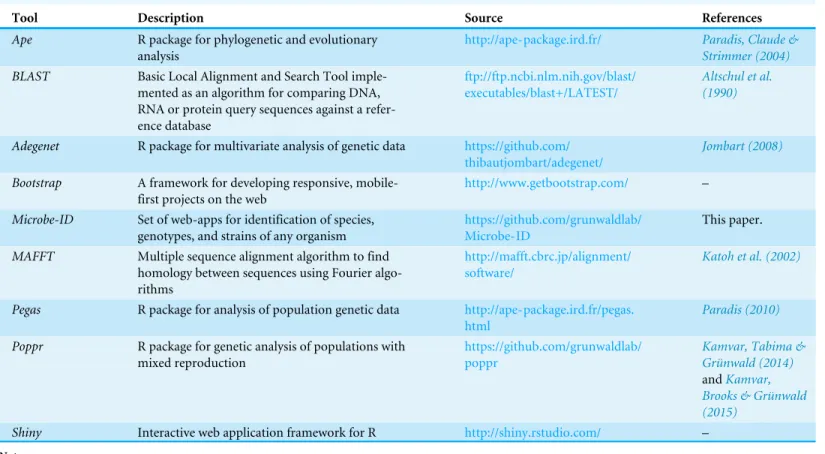
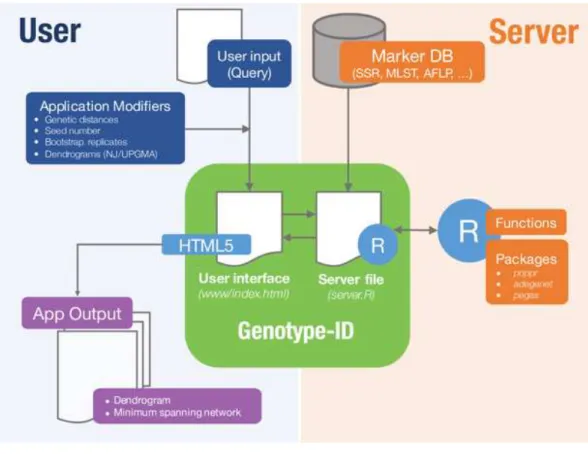
Genotype-ID is a web application designed to be user-friendly, and to facilitate the interac-tion with R using the set of tools listed inTable 1(Fig. 1). To develop the web application, we used the R package ‘shiny’ (RStudio Team, 2015). Shiny facilitates the interactions between user, server, and R (Fig. 1). The shiny web framework relies on reactive programming, which allows dynamic deployment of traditional R scripts in response to data input through a website console whereby results generated in R are subsequently pushed to the end user. Thus, ordinary R packages, which otherwise require familiarity with the language, can be deployed behind a user-friendly interface. Genotype-ID interacts principally with the R packages ‘poppr’ (Kamvar, Tabima & Grünwald, 2014), ‘adegenet’ (Jombart, 2008), ‘ape‘ (Paradis, Claude & Strimmer, 2004), and ‘pegas’ (Paradis, 2010) (Table 1).
Table 1 Open source computational tools required to install and deploy Microbe-ID on a server.
Tool Description Source References
Ape R package for phylogenetic and evolutionary analysis
http://ape-package.ird.fr/ Paradis, Claude & Strimmer (2004) BLAST Basic Local Alignment and Search Tool
imple-mented as an algorithm for comparing DNA, RNA or protein query sequences against a refer-ence database
ftp://ftp.ncbi.nlm.nih.gov/blast/ executables/blast+/LATEST/
Altschul et al. (1990)
Adegenet R package for multivariate analysis of genetic data https://github.com/ thibautjombart/adegenet/
Jombart (2008)
Bootstrap A framework for developing responsive, mobile-first projects on the web
http://www.getbootstrap.com/ –
Microbe-ID Set of web-apps for identification of species, genotypes, and strains of any organism
https://github.com/grunwaldlab/ Microbe-ID
This paper.
MAFFT Multiple sequence alignment algorithm to find homology between sequences using Fourier algo-rithms
http://mafft.cbrc.jp/alignment/ software/
Katoh et al. (2002)
Pegas R package for analysis of population genetic data http://ape-package.ird.fr/pegas. html
Paradis (2010)
Poppr R package for genetic analysis of populations with mixed reproduction
https://github.com/grunwaldlab/ poppr
Kamvar, Tabima & Grünwald (2014) andKamvar, Brooks & Grünwald (2015)
Shiny Interactive web application framework for R http://shiny.rstudio.com/ –
Notes.
−, reference not available; see website provided for information.
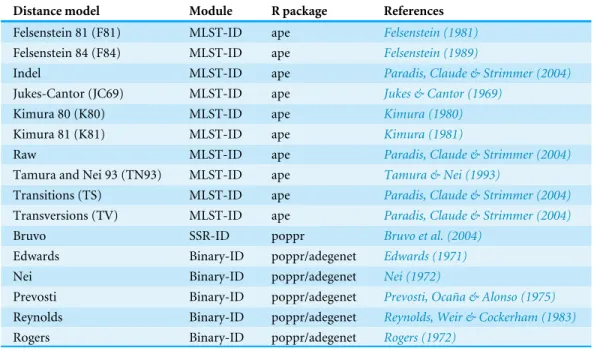
database. It then concatenates all separate alignments, calculates the genetic distance for the alignment, and reconstructs distance dendrograms and minimum spanning networks. Lastly, the binary tool uses molecular markers such as AFLPs or RFLPs to reconstruct relationships. This tool uses binary data (coded as 1 and 0) and different genetic distances (Table 2) to reconstruct the UPGMA or NJ dendrogram and the minimum spanning network.
The Microbe-ID implementation
Figure 1 Diagram representing implementation of Genotype-ID, which is comprised of a user in-terface file (index.html) and a server file (server.R).Each file communicates with the R framework (via shiny) and user (via HTML5). On the user side (left side), user input is provided by copy/paste of a query and selects/specifies the desired application modifiers (seed number, genetic distance calculation). This in-formation is subsequently received and processed by the server file, prompting the application to run in R. On the server side (right side) a database file (Marker DB), R packages, and functions are retrieved and ex-ecuted. When the run is complete, the server file provides output to the user interface file and displayed on the app output.
the user inputs the query and runs the web application, the web page will proceed to the Analysissection, where the user can choose between two different visualizations, a distance tree with bootstrap support values or a minimum spanning network. If the distance tree is selected, the user can change the tree algorithm (either neighbor joining or UPGMA) and number of bootstrap replicates. The user can also download results as a PDF or in NEWICK format. For the minimum spanning network, the user can adjust the grey scale for edge distances and download results as a PDF file. Implementations for other genetic data and different visualizations can be added.
Phytophthora-ID implementation
Table 2 Genetic distances implemented in the Genotype-ID module of Microbe-ID.Each of the dis-tances included in Microbe-ID are specific to a given molecular marker used in the web application.
Distance model Module R package References
Felsenstein 81 (F81) MLST-ID ape Felsenstein (1981)
Felsenstein 84 (F84) MLST-ID ape Felsenstein (1989)
Indel MLST-ID ape Paradis, Claude & Strimmer (2004)
Jukes-Cantor (JC69) MLST-ID ape Jukes & Cantor (1969)
Kimura 80 (K80) MLST-ID ape Kimura (1980)
Kimura 81 (K81) MLST-ID ape Kimura (1981)
Raw MLST-ID ape Paradis, Claude & Strimmer (2004)
Tamura and Nei 93 (TN93) MLST-ID ape Tamura & Nei (1993)
Transitions (TS) MLST-ID ape Paradis, Claude & Strimmer (2004) Transversions (TV) MLST-ID ape Paradis, Claude & Strimmer (2004)
Bruvo SSR-ID poppr Bruvo et al. (2004)
Edwards Binary-ID poppr/adegenet Edwards (1971)
Nei Binary-ID poppr/adegenet Nei (1972)
Prevosti Binary-ID poppr/adegenet Prevosti, Ocaña & Alonso (1975) Reynolds Binary-ID poppr/adegenet Reynolds, Weir & Cockerham (1983)
Rogers Binary-ID poppr/adegenet Rogers (1972)
Notes.
MLST-ID, Multilocus sequence typing; SSR-ID, SSR/microsatellite loci; Binary-ID, AFLP/SNP loci.
was substantially revised and upgraded from the first iteration and now includes a faster BLAST search implemented in Sequence-ID and a new genotype identification system implemented in Genotype-ID.
The current version ofPhytophthora-ID contains a Sequence-ID module customized for two molecular barcodes used forPhytophthoraspecies identification (ITS andcoxspacer). This particular version of the sequence identification tool was created in PERL-CGI, and permits the search of a FASTA sequence query against a curated database ofPhytophthora species. The PERL-CGI for Phytophthora-ID version 2.0 was also redesigned to run directly on the server to make the web application more stable and faster. In contrast, in Phytophthora-ID 1.0, the web application was designed as a communication wrapper to an external cluster, thus rendering functionality dependent on the external server.
We implemented the Sequence-ID module to use sequences from two genetic regions: the nuclear internal transcribed spacer (ITS) and mitochondrialcoxspacer region spanning the cox1andcox2loci. Databases were created using sequences from publishedPhytophthora species descriptions (Blair et al., 2008; Martin & Tooley, 2003) or those that belong to classicalPhytophthoraspecies described at least 25 years ago and are still recognized as valid (Erwin & Ribeiro, 1996).
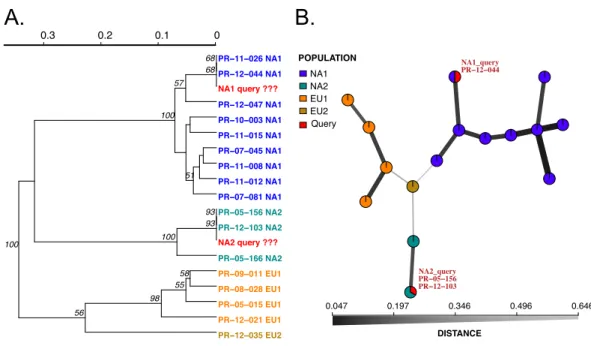
Figure 2 Results of SSR-ID for NA1 and NA2 queries ofP. ramorumprovided in the example data file. Each color represents a clonal lineage pre-assigned to each reference sample (NA1, NA2, EU1, EU2) with queries colored in red. (A) UPGMA tree with 1,000 bootstrap replicates and support values above branches. Queries are represented in red and all are correctly placed with reference samples of the pre-sumptive clonal lineage while also representing the relationship between clonal lineages in the reference dataset. (B) Minimum spanning network reconstruction. Edge shade and width are inversely propor-tional to Bruvo’s distance as shown in the horizontal scale bar. Queries are represented in red and placed in nodes with the most similar reference sample in the dataset, indicating the NA1 query is most similar to the 044 reference sample and the NA2 query is more closely related to the PR-05-156 and PR-12-103 samples, which also belong to the NA2 clonal lineage.
Phytophthoraspp. can be downloaded from the website. Documentation on updates to the databases is provided on the website.
We implemented two modules for genotype identification of twoPhytophthoraspecies: P. infestansthat causes potato late blight, andP. ramorumthat causes sudden oak death. P. infestanshas more than 18 reported clonal lineages (Hu et al., 2012), whileP. ramorum has 4 reported clonal lineages (Grünwald et al., 2009;Van Poucke et al., 2012). To establish a database with a wide representation of clonal lineages in each species, we obtained and prepared DNA samples fromP. infestansandP. ramorumthat were collected from various regions of the world. A total of 48P. ramorumisolates representing the 4 reported clonal lineages (NA1, NA2, EU1, EU2) were genotyped at nine SSR loci (Prospero et al., 2007;
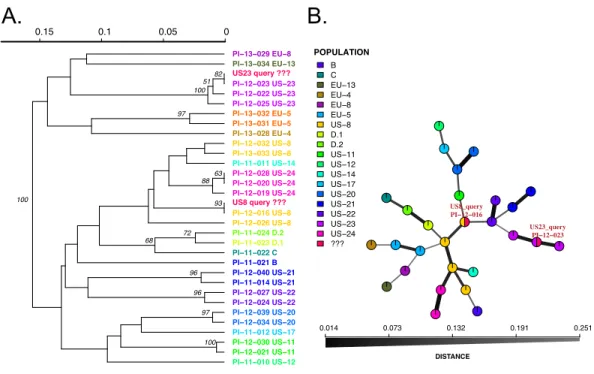
Figure 3 Results of SSR-ID queries for strains placed into the US8 and US23 clonal lineages of the potato late blight pathogen,P. infestans. Colors correspond to clonal lineages assigned to each reference sample (B, C, EU-13, EU-14, etc.) except for the queries which are colored in red. (A) UPGMA tree with 1,000 bootstrap replicates with support values above branches. Queries are represented in red and all are correctly placed with samples of the presumptive clonal lineage while also representing relationships be-tween clonal lineages in the reference dataset. (B) Minimum spanning network reconstruction. Edge shade and width are proportional to Bruvo’s distance shown in the horizontal scale bar. Queries are represented in red nodes and appear in legend as ‘???’. Queries placed in nodes with the most similar reference sample, indicating that the US8 query is most similar to the PI-12-016 reference sample (US-8 clonal lineage) and the US23 query is most closely related to the PI-12-023 sample, part of the US-23 lineage.
lineages US-23 and US-8 clonal lineages forP. infestans. All samples grouped with the corresponding reference lineages with high support values (Figs. 2and3), demonstrating functionality of the Microbe-ID tool to identify samples correctly.
CONCLUSIONS
We constructed a web framework that can use a wide array of molecular markers to rapidly determine identities of species and genotypes. This web framework is provided as open source code on GitHub (https://github.com/grunwaldlab/microbe-ID). We implemented a demonstration available at http://Microbe-ID.org. New implementations for any organisms require reference databases, scripts, and web pages including choices from the set of computational tools shown inTable 1. The Microbe-ID framework is currently implemented for two fully functional sites,Phytophthora-ID (http://Phytophthora-ID.org/) and Gall-ID (http://Gall-ID.cgrb.oregonstate.edu/;Davis II et al., 2016).
BLAST execution is dependent on size of the databases. For the Sequence-ID ITS region implementation forPhytophthora, each run was completed and loaded to the web-app in less than one second, with results shown as a BLAST output table.
Most innovative in this web framework is the Genotype-ID module, which permits the researcher to use, in a simple, web-based interface, any type of molecular marker with a corresponding and curated reference dataset. Use of a shiny server for strain identification is completely novel and modularity permits use of virtually any molecular marker suitable for existing R packages. For genotyping, population genetic markers demonstrated include SSR, MLST, and AFLP/RFLP data, but can also be expanded to presence/absence of genes or alleles or any other genetic features of interest. Custom implementations must include a reference dataset and custom R scripts. Implementations can be customized for virtually any organism and any molecular marker that can be analyzed in R.
Development of tools for species identification has increased in recent years; but lack of modularity and complicated methodological procedures make the process of species identification tedious and challenging for researchers without sufficient skills in computational biology. We developed an easy-to-set-up web framework, which permits quick and flexible deployment of species identification and genotyping tools using sequence, microsatellite/SSR, AFLP/RFLP, or MLST data for any organism. Given use of the bootstrap html framework, webpages are light in terms of computer resources required and are thus usable on any device including smartphones and tablets, and function with any browser. These tools have been deployed and used successfully for the genusPhytophthoraand gall-forming bacteria, providing examples of two curated websites (Grünwald et al., 2011;
Davis II et al., 2016).
ADDITIONAL INFORMATION AND DECLARATIONS
Funding
This research is supported in part by the US Department of Agriculture (USDA) Agricultural Research Service Grant 5358-22000-039-00D (NJG), USDA National Institute of Food and Agriculture (NIFA) Grant 2011-68004-30154 (NJG), the USDA ARS Floriculture Nursery Research Initiative (NJG), USDA NIFA Grant 2014-51181-22384 (JHC and NJG), and USDA NIFA 2012-67012-19844 (SEE). The funders had no role in study design, data collection and analysis, decision to publish, or preparation of the manuscript.
Grant Disclosures
The following grant information was disclosed by the authors:
US Department of Agriculture (USDA) Agricultural Research Service: 5358-22000-039-00D.
USDA National Institute of Food and Agriculture (NIFA): 2011-68004-30154. USDA ARS Floriculture Nursery Research Initiative.
USDA NIFA: 2014-51181-22384, 2012-67012-19844.
Competing Interests
Author Contributions
• Javier F. Tabima conceived and designed the experiments, performed the experiments,
analyzed the data, contributed reagents/materials/analysis tools, wrote the paper, prepared figures and/or tables, reviewed drafts of the paper.
• Sydney E. Everhart conceived and designed the experiments, analyzed the data, wrote
the paper, reviewed drafts of the paper.
• Meredith M. Larsen and Matthew A. Tancos performed the experiments, contributed
reagents/materials/analysis tools, reviewed drafts of the paper.
• Alexandra J. Weisberg and Zhian N. Kamvar performed the experiments, analyzed the
data, contributed reagents/materials/analysis tools, reviewed drafts of the paper.
• Christine D. Smart and Jeff H. Chang wrote the paper, reviewed drafts of the paper. • Niklaus J. Grünwald conceived and designed the experiments, wrote the paper, reviewed
drafts of the paper.
Data Availability
The following information was supplied regarding data availability:
https://github.com/grunwaldlab/Microbe-ID.
Supplemental Information
Supplemental information for this article can be found online athttp://dx.doi.org/10.7717/ peerj.2279#supplemental-information.
REFERENCES
Altschul SF, Gish W, Miller W, Myers EW, Lipman DJ. 1990.Basic local alignment
search tool.Journal of Molecular Biology215:403–410
DOI 10.1016/S0022-2836(05)80360-2.
Aurrecoechea C, Barreto A, Brestelli J, Brunk BP, Cade S, Doherty R, Fischer S, Gajria
B, Gao X, Gingle A, Grant G. 2013.EuPathDB: the eukaryotic pathogen database.
Nucleic Acids Research41:D684–D691.
Blair JE, Coffey MD, Park S-Y, Geiser DM, Kang S. 2008.A multi-locus phylogeny for
Phytophthorautilizing markers derived from complete genome sequences.Fungal Genetics and Biology45:266–277 DOI 10.1016/j.fgb.2007.10.010.
Bruvo R, Michiels NK, D’Souza TG, Schulenburg H. 2004.A simple method for the
calculation of microsatellite genotype distances irrespective of ploidy level.Molecular Ecology 13:2101–2106DOI 10.1111/j.1365-294X.2004.02209.x.
Byrnes III EJ, Li W, Lewit Y, Ma H, Voelz K, Ren P, Carter DA, Chaturvedi V, Bildfell
RJ, May RC, Heitman J. 2010.Emergence and pathogenicity of highly virulent
Cryptococcus gattiigenotypes in the northwest United States.PLoS Pathogens 6(4):e1000850DOI 10.1371/journal.ppat.1000850.
Coleman AW. 2003.ITS2 is a double-edged tool for eukaryote evolutionary
compar-isons.Trends in Genetics19:370–355DOI 10.1016/S0168-9525(03)00118-5.
Coleman AW. 2007.Pan-eukaryote ITS2 homologies revealed by RNA secondary
Coleman AW. 2009.Is there a molecular key to the level of ‘‘biological species’’ in eukaryotes? A DNA guide.Molecular Phylogenetics and Evolution50:197–203
DOI 10.1016/j.ympev.2008.10.008.
Cooke DE, Cano LM, Raffaele S, Bain RA, Cooke LR, Etherington GJ, Deahl KL, Farrer
RA, Gilroy EM, Goss EM, Grünwald NJ. 2012.Genome analyses of an aggressive
and invasive lineage of the Irish potato famine pathogen.PLoS Pathogens8:e1002940
DOI 10.1371/journal.ppat.1002940.
Davis II EW, Weisberg AJ, Tabima JF, Grünwald NJ, Chang JH. 2016.Gall-ID:
tools for genotyping gall-causing phytopathogenic bacteria.PeerJ4:e2222
DOI 10.7717/peerj.2222.
Edwards AWF. 1971.Distances between populations on the basis of gene frequencies.
Biometrics27:873–881 DOI 10.2307/2528824.
Elshire RJ, Glaubitz JC, Sun Q, Poland JA, Kawamoto K, Buckler ES, Mitchell SE.
2011.A robust, simple genotyping-by-sequencing (GBS) approach for high diversity
species.PLoS ONE6:e19379DOI 10.1371/journal.pone.0019379.
Erwin DC, Ribeiro OK. 1996.Phytophthora diseases worldwide. St. Paul: American
Phytopathological Society.
Etter PD, Bassham S, Hohenlohe PA, Johnson EA, Cresko WA. 2010.SNP discovery
and genotyping for evolutionary genetics using RAD sequencing.Methods in Molecular Biology 772:157–178DOI 10.1007/978-1-61779-228-1_9.
Felsenstein J. 1981.Evolutionary trees from DNA sequences: a maximum likelihood
approach.Journal of Molecular Evolution17:368–376DOI 10.1007/BF01734359.
Felsenstein J. 1989. PHYLIP- Phylogeny Inference Package. In:Cladistics. Version 3.2.
Vol. 5. 164–166.
Grajales A, Aguilar C, Sánchez JA. 2007.Phylogenetic reconstruction using secondary
structures of Internal Transcribed Spacer 2 (ITS2, rDNA): finding the molecular and morphological gap in Caribbean gorgonian corals.BMC Evolutionary Biology7:90
DOI 10.1186/1471-2148-7-90.
Gross A, Holdenrieder O, Pautasso M, Queloz V, Sieber TN. 2014.Hymenoscyphus
pseudoalbidus, the causal agent of European ash dieback.Molecular Plant Pathology 1:5–21DOI 10.1111/mpp.12073.
Grünwald NJ, Goss EM, Ivors K, Garbelotto M, Martin FN, Prospero S, Hansen
E, Bonants PJ, Hamelin RC, Chastagner G, Werres S. 2009.Standardizing the
nomenclature for clonal lineages of the sudden oak death pathogen,Phytophthora
ramorum.Phytopathology99:792–795DOI 10.1094/PHYTO-99-7-0792.
Grünwald NJ, Goss EM, Press CM. 2008.Phytophthora ramorum: a pathogen with
a remarkably wide host-range causing sudden oak death on oaks and ramo-rum blight on woody ornamentals.Molecular Plant Pathology9:729–740
DOI 10.1111/j.1364-3703.2008.00500.x.
Grünwald NJ, Hoheisel G-A. 2006.Hierarchical analysis of diversity, selfing and
genetic differentiation in populations of the oomyceteAphanomyces euteiches.
Grünwald NJ, Martin FN, Larsen MM, Sullivan CM, Press CM, Coffey MD, Hansen
EM, Parke JL. 2011.Phytophthora-ID.org: a sequence basedPhytophthora
identifica-tion tool.Plant Disease95:337–342DOI 10.1094/PDIS-08-10-0609.
Grünwald NJ, McDonald BM, Milgroom MG. 2016.Population genomics of
fungal and oomycete pathogens.Annual Review of PhytopathologyIn Press
DOI 10.1146/annurev-phyto-080614-115913.
Holdich DM, Reynolds JD, Souty-Grosset C, Sibley PJ. 2009.A review of the ever
increasing threat to European crayfish from non-indigenous crayfish species. Knowl-edge and Management of Aquatic Ecosystems11:394–395DOI 10.1051/kmae/2009025. Hu CH, Perez FG, Donahoo R, McLeod A, Myers K, Ivors K, Secor G, Roberts P, Deahl
KL, Fry WE, Ristaino JB. 2012.Recent genotypes ofPhytophthora infestansin the
eastern United States reveal clonal populations and reappearance of mefenoxam sensitivity.Plant Disease96:1323–1330DOI 10.1094/PDIS-03-11-0156-RE. Huang X, Feng Q, Qian Q, Zhao Q, Wang L, Wang A, Guan J, Fan D, Weng Q, Huang
T, Dong G. 2009.High-throughput genotyping by whole-genome resequencing.
Genome Research19:1068–1076DOI 10.1101/gr.089516.108.
Ivors K, Garbelotto M, Vries IDE, Ruyter-Spira C, Te Hekkert B, Rosenzweig N,
Bonants P. 2006.Microsatellite markers identify three lineages ofPhytophthora
ramorumin US nurseries, yet single lineages in US forest and European nursery pop-ulations.Molecular Ecology15:1493–1505DOI 10.1111/j.1365-294X.2006.02864.x. James TY, Kauff F, Schoch CL, Matheny PB, Hofstetter V, Cox CJ, Celio G, Gueidan C,
Fraker E, Miadlikowska J, Lumbsch HT. 2006.Reconstructing the early evolution of
fungi using a six-gene phylogeny.Nature443:818–822DOI 10.1038/nature05110.
Jombart T. 2008.Adegenet: a R package for the multivariate analysis of genetic markers.
Bioinformatics24:1403–1405DOI 10.1093/bioinformatics/btn129.
Jukes TH, Cantor CR. 1969.Evolution of protein molecules.Mammalian Protein
Metabolism3:12–132.
Kamoun S, Furzer O, Jones JDG, Judelson HS, Shad Ali G, Dalio RJD, Guha Roy S, Schena L, Zampounis A, Panabières F, Cahill D, Ruocco M, Figueiredo A, Chen X-R, Hulvey J, Stam R, Lamour K, Gijzen M, Tyler BN, Grünwald NJ, Tor M, Mukhtar SM, Tome D, Van den Ackerveken G, McDowell J, Daayf F, Fry WE, Lindqvist-Kreuze H, Meijer HJG, Petre B, Ristaino J, Yoshida K, Birch P, Govers
F. 2015.The top 10 oomycete pathogens in molecular plant pathology.Molecular
Plant Pathology 16:413–434DOI 10.1111/mpp.12190.
Kamvar ZN, Brooks JC, Grünwald NJ. 2015.Novel R tools for analysis of genome-wide
population genetic data with emphasis on clonality.Frontiers in Genetics6:208
DOI 10.3389/fgene.2015.00208.
Kamvar ZN, Tabima JF, Grünwald NJ. 2014.Poppr: an R package for genetic analysis of
populations with clonal, partially clonal, and/or sexual reproduction.PeerJ2:e281
DOI 10.7717/peerj.281.
Katoh K, Misawa K, Kuma KI, Miyata T. 2002.MAFFT: a novel method for rapid
Kimura M. 1980.A simple method for estimating evolutionary rates of base substitutions through comparative studies of nucleotide sequences.Journal of Molecular Evolution. 16:111–120DOI 10.1007/BF01731581.
Kimura M. 1981.Estimation of evolutionary distances between homologous nucleotide
sequences.Proceedings of the National Academy of Sciences of the United States of America78:454–458.
Klevens RM, Morrison MA, Nadle J, Petit S, Gershman K, Ray S, Harrison LH,
Lynfield R, Dumyati G, Townes JM, Craig AS. 2007.Invasive methicillin-resistant
Staphylococcus aureusinfections in the United States.JAMA298:1763–1771
DOI 10.1001/jama.298.15.1763.
Kroon LP, Brouwer H, De Cock AW, Govers F. 2012.The genusPhytophthoraanno
2012.Phytopathology102:348–364 DOI 10.1094/PHYTO-01-11-0025.
Lees AK, Wattier R, Shaw DS, Sullivan L, Williams NA, Cooke DEL. 2006.Novel
microsatellite markers for the analysis ofPhytophthora infestanspopulations.Plant Pathology55:311–319DOI 10.1111/j.1365-3059.2006.01359.x.
Li Y, Cooke DEL, Jacobsen E, Van der Lee T. 2013.Efficient multiplex simple sequence
repeat genotyping of the oomycete plant pathogenPhytophthora infestans.Journal of Microbiological Methods92:316–322DOI 10.1038/nrmicro3093.
Maiden MCJ, Van Rensburg MJJ, Bray JE, Earle SG, Ford SA, Jolley KA, McCarthy ND.
2013.MLST revisited: the gene-by-gene approach to bacterial genomics.Nature
Reviews Microbiology 11:728–736DOI 10.1038/nrmicro3093.
Martin FN, Tooley PW. 2003.Phylogenetic relationships amongPhytophthoraspecies
inferred from sequence analysis of mitochondrially encoded cytochrome oxidase I and IIgenes.Mycologia95:269–284DOI 10.2307/3762038.
Nei M. 1972.Genetic distance between populations.The American Naturalist
106:283–292DOI 10.1086/282771.
Paradis E. 2010.Pegas: an R package for population genetics with an integrated-modular
approach.Bioinformatics26:419–420DOI 10.1093/bioinformatics/btp696.
Paradis E, Claude J, Strimmer K. 2004.APE: analyses of phylogenetics and evolution in
R language.Bioinformatics20:289–290DOI 10.1093/bioinformatics/btg412. Park J, Park B, Veeraraghavan N, Jung K, Lee Y-H, Blair JE, Geiser DM, Isard S,
Mansfield MA, Nikolaeva E, Park S-Y, Russo J, Kim SH, Greene M, Ivors KL, Balci Y, Peiman M, Erwin DC, Coffey MD, Rossman A, Farr D, Cline E, Grünwald NJ,
Luster DG, Schrandt J, Martin F, Ribeiro OK, Makalowska I, Kang S. 2008.
Phy-tophthoradatabase: a forensic database supporting the identification and monitoring ofPhytophthora.Plant Disease92:966–972 DOI 10.1094/PDIS-92-6-0966.
Prevosti A, Ocaña J, Alonso G. 1975.Distances between populations ofDrosophila
subobscura, based on chromosome arrangement frequencies.Theoretical and Applied Genetics45:231–241DOI 10.1007/BF00831894.
Prospero S, Hansen EM, Grünwald NJ, Winton LM. 2007.Population dynamics of the
Reynolds J, Weir BS, Cockerham CC. 1983.Estimation of the coancestry coefficient: basis for a short-term genetic distance.Genetics105:767–779.
Robideau GP, De Cock AW, Coffey MD, Voglmayr H, Brouwer H, Bala K, Chitty DW,
Désaulniers N, Eggertson QA, Gachon CMM. 2011.DNA barcoding of oomycetes
with cytochrome c oxidase subunit I and internal transcribed spacer.Molecular Ecology Resources11:1002–1011DOI 10.1111/j.1755-0998.2011.03041.x.
Rogers JS. 1972.Measures of genetic similarity and genetic distance.Studies in Genetics
7:145–153.
RStudio Team. 2015.R Studio: integrated development for R. Boston: R Studio, Inc.
Available athttp:// www.rstudio.com/.
Schoch CL, Seifert KA, Huhndorf S, Robert V, Spouge JL, Levesque CA, Chen W. 2012. Nuclear ribosomal internal transcribed spacer (ITS) region as a universal DNA barcode marker for Fungi.Proceedings of the National Academy of Sciences of the United States of America109:6241–6246DOI 10.1073/pnas.1117018109. Stajich JE, Harris T, Brunk BP, Brestelli J, Fischer S, Harb OS, Kissinger JC, Li W,
Nayak V, Pinney DF, Stoeckert CJ. 2011.FungiDB: an integrated functional
genomics database for fungi.Nucleic Acids Research40:D675–D681
DOI 10.1093/nar/gkr918.
Tamura K, Nei M. 1993.Estimation of the number of nucleotide substitutions in the
control region of mitochondrial DNA in humans and chimpanzees.Molecular Biology and Evolution10:512–526.
Tancos MA, Lange HW, Smart CD. 2015.Characterizing the genetic diversity of
theClavibacter michiganensissubsp.michiganensispopulation in New York.
Phytopathology105:169–179 DOI 10.1094/PHYTO-06-14-0178-R.
Van Poucke K, Franceschini S, Webber JF, Vercauteren A, Turner JA, McCracken
AR, Heungens K, Brasier CM. 2012.Discovery of a fourth evolutionary lineage of
Phytophthora ramorum: EU2.Fungal Biology116:1178–1191
DOI 10.1016/j.funbio.2012.09.003.
Vercauteren A, De Dobbelaere I, Grünwald NJ, Bonants P, Van Bockstaele E, Maes
M, Heungens K. 2010.Clonal expansion of the BelgianPhytophthora ramorum
populations based on new microsatellite markers.Molecular Ecology 19:92–107