Growth hormone insensitivity with immune dysfunction caused by a STAT5B
mutation in the south of Brazil: evidence for a founder effect
Renata C. Scalco
1,2, Fernanda T. Gonçalves
3, Hadassa C. Santos
4, Mari M. S. G. Cardena
3,Carlos A.
Tonelli
5, Mariana F. A. Funari
2, Rosana M. Aracava
2, Alexandre C. Pereira
4, Cintia Fridman
3and Alexander
A. L. Jorge
11
Unidade de Endocrinologia Genética (LIM25), Faculdade de Medicina da Universidade de São Paulo
(FMUSP), São Paulo, SP, Brazil.
2
Unidade de Endocrinologia do Desenvolvimento, Laboratório de Hormônios e Genética Molecular
(LIM42), Faculdade de Medicina da Universidade de São Paulo (FMUSP), São Paulo, SP, Brazil.
3
Departamento de Medicina Legal, Ética Médica e Medicina Social e do Trabalho, Laboratório de
Imunohematologia e Hematologia Forense (LIM40), Hospital das Clínicas da Faculdade de Medicina da
Universidade de São Paulo (HC da FMUSP), São Paulo, SP, Brazil.
4
Laboratório de Cardiologia Genética e Molecular, Instituto do Coração (InCor), Faculdade de Medicina
da Universidade de São Paulo, São Paulo, SP, Brazil.
5
Universidade do Extremo Sul de Santa Catarina, Criciúma, SC, Brazil.
ABSTRACT
HomozygousSTAT5B mutations causing growth hormone insensitivity with immune dysfunction were described in
10 patients since 2003, including two Brazilian brothers from the south of Brazil. Our objectives were to evaluate the prevalence of theirSTAT5B mutation in this region and to analyze the presence of a founder effect. We obtained DNA samples from 1,205 local inhabitants, 48 relatives of the homozygous patients and four individuals of another affected family. Genotyping forSTAT5B c.424_427del mutation and for two polymorphic markers around it was done through fragment analysis technique. We also determined Y-chromosome and mtDNA haplotypes and genomic an-cestry in heterozygous carriers. We identified seven families withSTAT5B c.424_427del mutation, with 33 heterozy-gous individuals. The minor allelic frequency of this mutation was 0.29% in this population (confidence interval 95% 0.08-0.5%), which is significantly higher than the frequency of other pathogenicSTAT5B allele variants observed in public databases (p < 0.001). All heterozygous carriers had the same haplotype present in the homozygous patients, found in only 9.4% of non-carriers (p < 0.001), supporting the existence of a founder effect. The Y-chromosome haplotype, mtDNA and genomic ancestry analysis indicated a European origin of this mutation. Our results provide compelling evidence for a founder effect ofSTAT5B c.424_427del mutation.
Keywords:founder effect, growth hormone insensitivity, immune dysfunction, STAT5B.
Received: August 24, 2016; Accepted: December 16, 2016.
Introduction
STAT5B (OMIM 604260) is a key protein in the sig-naling pathway of substances that activate type I class cytokine receptors, such as growth hormone (GH), pro-lactin and interleukin 2 (IL2). Homozygous mutations in
STAT5Bgene cause growth hormone insensitivity (Hwaet
al., 2011; Scalcoet al., 2013), a syndrome characterized by the inability of target tissues to respond to growth hormone. The classic phenotype includes the same clinical signs found in growth hormone deficiency (for example, severe
short stature, saddle nose and abdominal obesity), low IGF1 levels and normal to high basal and stimulated GH levels. STAT5B deficient patients also present signs of im-mune dysregulation, such as recurrent infections, severe ec-zema and lymphoid interstitial pneumonia, a condition that is often associated to autoimmune diseases and that may evolve to progressive pulmonary fibrosis (Hwaet al., 2011; Scalcoet al., 2013). These immune dysfunctions are partly due to a compromised IL2 signaling, since this interleukin is an essential factor in regulatory T-cells development and T-cells activation (Jenkset al., 2013). Furthermore, hetero-zygous carriers were also shown to be significantly shorter (~ 3.9 cm) than population-matched controls, suggesting a
DOI: http://dx.doi.org/10.1590/1678-4685-GMB-2016-0231
Send correspondence to Alexander A. L. Jorge. Faculdade de Medicina da USP (LIM-25), Av. Dr. Arnaldo, 455, 5º andar sala 5340, 01246-903 São Paulo, SP, Brazil. E-mail: [email protected]
mild effect ofSTAT5B haploinsufficiency (Scalco et al., 2015).
Since the first case report in 2003, a total of ten pa-tients homozygous for seven different mutations in
STAT5Bwere described (Kofoedet al., 2003; Hwaet al., 2005, 2007; Bernasconiet al., 2006; Vidarsdottiret al., 2006; Pugliese-Pireset al., 2010; Scagliaet al., 2012), in-cluding two Brazilian brothers homozygous forSTAT5B c.424_427del mutation (Pugliese-Pireset al., 2010). These brothers were born at Criciúma, a city located in the south of Brazil (at 28°40’39” S 49°22’11” W), with an estimated population of 204,667 individuals according to the Brazil-ian Institute of Geography and Statistics (IBGE) 2014 cen-sus. Their parents, heterozygous for the same mutation, denied consanguinity. Moreover, they reported that an un-related family in the same city had two kids with similar clinical findings, deceased as a consequence of respiratory failure.
The absence of known consanguinity between the boys’ parents and the presence of other patients with simi-lar conditions in the city led us to hypothesize an increased prevalence of this mutation in the region of Criciúma and a possible founder effect explaining these cases. Further-more, studying the prevalence of STAT5B c.424_427del
STAT5Bmutation could enable the prediction of recurrence of homozygosity for it.
Subjects and Methods
Subjects
The local ethics committee approved this study and all individuals gave their written informed consent. We ob-tained oral swabs samples from 1,205 adult individuals whose parents or grandparents were born in Criciúma or in the neighboring cities. These subjects were randomly se-lected among the patients from a health care center in Criciúma. This number of individuals allowed us to evalu-ate a 0.2% frequency ofSTAT5Bc.424_427del allele with 0.99 statistical power. Additionally, we obtained blood samples from 48 relatives of the homozygous boys and from four individuals of the other family possibly affected by aSTAT5Bmutation, the parents and two sisters of the deceased children. We also genotyped two polymorphic markers around this mutation in all heterozygous carriers and in 53 randomly selected non-carriers to evaluate the presence of a founder effect. With the same purpose, we de-termined Y-chromosome and mtDNA haplotypes and ge-nomic ancestry in one heterozygous carrier from each family affected bySTAT5Bc.424_427del mutation.
STAT5Bgenotyping
We genotyped all samples forSTAT5Bc.424_427del mutation. Genomic DNA was isolated from oral swabs or from peripheral blood leukocytes using standard tech-niques. SinceSTAT5Bc.424_427del mutation is
character-ized by the loss of four nucleotides, it was possible to detect it through fragment analysis technique. The region around this mutation was amplified by polymerase chain reaction (PCR) using the following primers: forward 5’
CTCAGTCTTCCTCCCATTCG 3’ and reverse 5’
GGCTCTCCTGGTACTGGA 3’ (amplification conditions are available on request). The products were submitted to capillary electrophoresis in the ABI PRISM 3130 se-quencer and then analyzed by the GeneScan® software, both from Applied Biosystems (Foster City, CA, USA).
STAT5Bc.424_427del allele frequency analysis
We compared STAT5B c.424_427del allele fre-quency to the frefre-quency of other pathogenic allele variants identified in public population databases: Exome Aggrega-tion Consortium (ExAC - http://exac.broadinstitute.org/) and NHLBIGO Exome Sequencing Project (ESP -http://evs.gs.washington.edu/EVS/). We considered as pathogenic only the allele variants classified as stop gain or frameshift, since none of the missense variants described in these databases was evaluated by functional studies.
Microsatellite analysis
To evaluate if the presence of this mutation in differ-ent families was due to a founder effect, we genotyped two polymorphic markers located less than 1 centimorgan (cM) far fromSTAT5Bc.424_427del mutation. These markers, D17S1801 (0.04 cM from the mutation) and D17S932 (0.83 cM from the mutation), were analyzed in the two ho-mozygous patients, 33 heterozygous individuals from seven families harboring the sameSTAT5Bmutation and 53 randomly selected non-carriers from the region. They were studied through fragment analysis technique and the PCR products were submitted to capillary electrophoresis in the ABI PRISM 3130 sequencer and then analyzed by the GeneScan®software.
Evaluation of ancestry in individuals heterozygous for STAT5B c.424_427del mutation
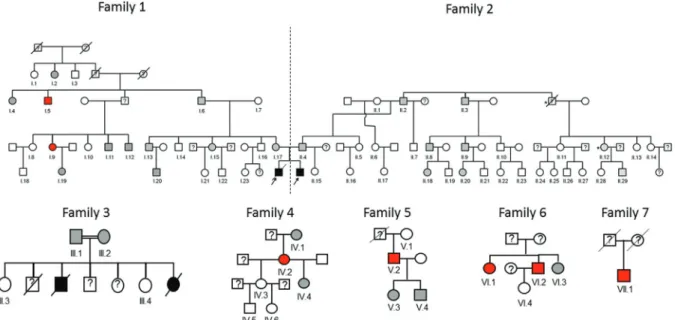
We assessed genomic, Y-chromosome and mtDNA ancestry in seven individuals (6 males) carryingSTAT5B c.424_427del mutation, one from each identified family (Figure 1 – subjects I.6, II.2, III.1, IV.2, V.2, VI.2 and VII.1).
Genomic ancestry analysis
Biosystems). We assumed as reference ancestral popula-tions: Pima and Maya as Amerindians (from the Human Genome Diversity Project - HGDP); YRI (Yoruba in Ibadan, Nigeria), LWK (Luhya in Webuye, Kenya) and ASW (Americans of African Ancestry in SW, USA) as Af-ricans (from the HapMap project); and CEU (Utah Resi-dents (CEPH) with Northern and Western European ancestry) and TSI (Tuscan in Italia) as European (from the HapMap project).
Y-chromosome haplotype analysis
The set of 17 Y-STRs was amplified using the AmpFlSTR® YfilerTM kit (Applied Biosystems) which contains the markers DYS19, DYS389 I, DYS389 II, DYS390, DYS391, DYS392, DYS393, DYS385 a/b, DYS438, DYS439, DYS437, DYS448, DYS456, DYS458, DYS635, Y GATA H4. Capillary electrophoresis was done in an ABI PRISM 3130 sequencer, and sizes were assigned to the different fragments using GeneMapper® software. The nomenclature of alleles followed the recommendations of the DNA Commission of the International Society of Fo-rensic Genetics, except for locus Y GATA H4, which was named on the basis of the allelic ladder supplied with the AmpFlSTR® YfilerTM kit. The classification of Y-chromosome haplogroup for each male participant geno-typed was done using haplogroup prediction program FTDNA 2.0 (http://www.hprg.com/hapest5/index.html).
Mitochondrial haplotype analysis
DNA samples were amplified by a single PCR to ana-lyze the entire sub-regions HV1, HV2 and HV3 of mtDNA control region, using primers L15879 (5’-AATGGG
CCTGTCCTTGTAGT-3 ‘) and H727
(5’-AGGGTGAACTCACTGGAACG-3’). These primers were designed using the Primer3 program (http:// www-genome.wi.mit.edu/cgi-bin/primer/primer3_www.c gi). PCR products were purified using EXO/SAP (Thermo Scientific Fermentas), and sequencing was done using the BigDye Terminator Cycle Sequencing Kit (Applied Biosystems) according to manufacturer’s protocol. Capil-lary electrophoresis was performed using the ABI PRISM 3130 sequencer and resultant sequences analyzed using
specific software BioEdit
(http://www.mbio.ncsu.edu/BioEdit/BioEdit.html). The sequences obtained were compared with the Cambridge Reference Sequence (rCRS) (Andrewset al., 1999) for fi-nal definition of haplotypes using the program Haplosite (http://www.haplosite.com/haplosearch/). Classification of mtDNA haplogroups was done using HaploGrep program (http://haplogrep.uibk.ac.at/).
Statistical analysis
We evaluated the differences between the allele fre-quency ofSTAT5Bc.424_427del mutation and the frequen-cies of each pathogenic allele identified in ExAC and ESP
databases by using chi-square test. A p value less than 0.05 was considered statistically significant. All statistical cal-culations were carried out using SigmaStat version 3.5 (Systat Software Inc. Chicago, IL).
Results
STAT5Bgenotyping
Among the 1,205 evaluated individuals from the local population, seven were identified as heterozygous for
STAT5Bc.424_427del mutation. Two of them were later found to be 3rdand 4thdegree relatives of the previously de-scribed homozygous patients (Figure 1). The other five were from four apparently unrelated families. Moreover, in the family who lost two children with a similar phenotype to the homozygous boys, the parents were first cousins and heterozygous forSTAT5Bc.424_427del mutation. Conse-quently, it is possible to infer that their deceased son and daughter were homozygous for this mutation and died of progressive pulmonary fibrosis.
In total, we identified seven apparently independent families withSTAT5Bc.424_427del mutation in Criciúma (Figure 1), with 33 heterozygous individuals. Therefore, the minor allelic frequency of this mutation at Criciúma was 0.29% (Confidence interval (CI) 95% of 0.08 to 0.5%). This allele frequency was significantly higher than the fre-quency of other pathogenic STAT5B allele variants ob-served in public databases (p < 0.001, Table 1 and Supplementary Table S1). Six of these families had ances-tors born in Tubarão, a city located 60 km from Criciúma. In one family it was not possible to trace its geographic ori-gin.
Microsatellite analysis
Eleven different alleles were identified for D17S932 marker, ranging from 178 to 202 base pairs (bp), and nine alleles were identified for D17S1801 marker, ranging from 220 to 244 bp. The alleles 188 bp for D17S932 and 232 bp for D17S1801 were the most frequent alleles, with allele frequencies of 24% and 53%, respectively.
The analysis of these markers around STAT5B
Ancestry analysis
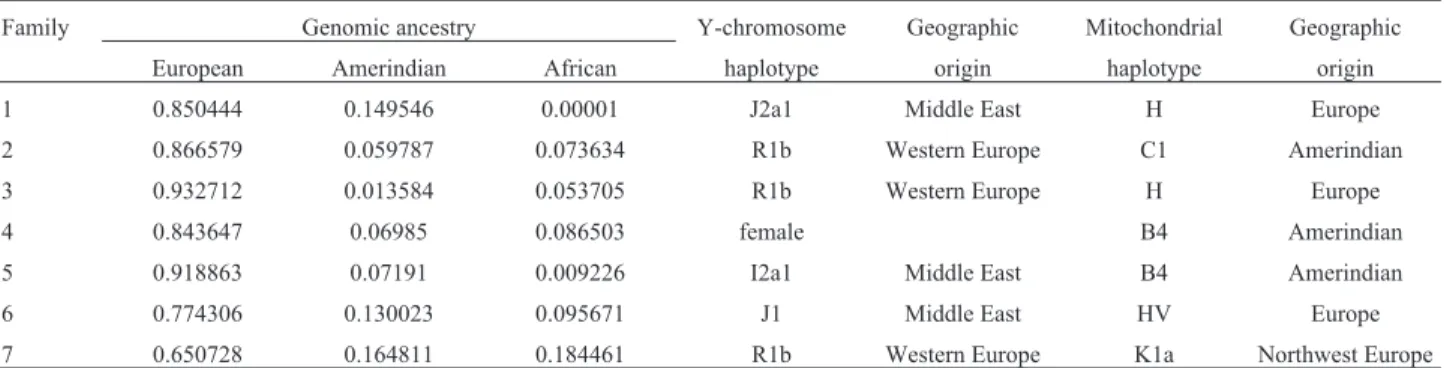
The ancestry in all heterozygous subjects evaluated (one from each affected family) was predominately as-signed to a cluster defined by its maximum frequency in European populations (median 85%, p25-p75 80.9-89.3%). African and Amerindian ancestries represented 7.4% (p25-075 3.1-9.1%) and 7.2% (p25-p75 6.5-14%) of the genomes analyzed (Table 2).
Regarding the paternal lineage origin, the haplogroup R1b, which is predominantly found in Western Europe, was present in three of them. Two of them had the haplo-group J (J1 e J2a1), found mainly in the Middle East, and one individual had the rare haplogroup I2a1 (Table 2). About the maternal lineage origin, the haplotypes B4 and C1, found in indigenous peoples of the Americas, were present in three subjects. The haplotype H, the most com-mon maternal lineage in Europe, was found in two other in-dividuals. One subject had the haplotype K1a, present in all Europe but more prevalent in Northwest Europe, and the
last one had the haplotype HV, present in the Middle East, Italy and Eastern Europe.
Discussion
Growth hormone insensitivity with immune dysfunc-tion (OMIM 245590) caused bySTAT5Bmutations is a rare but life threatening disease in which severe short stature is accompanied by the burden of recurrent infections, autoim-mune diseases and progressive pulmonary fibrosis. Four out of 10 described patients died of respiratory failure, in-cluding one of them who was submitted to lung transplanta-tion when he was 17.5 years old. There is no treatment available at present, but some researchers consider that early bone marrow transplantation could prevent the pul-monary disease. Inheritance is autosomal recessive and none of the described patients had compound heterozygous mutations. Family history was available in eight cases and consanguinity was not identified in half of them
(Bernas-Table 1- Allele frequencies of pathogenicSTAT5Bvariants in the present study and in public databases.
Database Allele variant Allele frequency (%) Total alleles p
Present study 17:40375522 TGGAG/T; p.Leu142Argfs*19 0.29 2,410
ESP 17:40370236:C/T; p.Gln368* 0.008 13,006 < 0.0001
ExAC 17:40384025 G/A; p.Gln41* 0.001 121,406 < 0.0001
17:40370235:T/TG; p.Gln368Profs*9 0.08 118,824 0.001
17:40370235 TG/T; p.Gln368Argfs*2 0.03 118,824 < 0.0001
17:40379567 G/GC; p.His89Alafs*11 0.001 121,240 < 0.0001
ESP: NHLBI-GO Exome Sequencing Project; ExAC: Exome Aggregation Consortium.
coniet al., 2006; Vidarsdottiret al., 2006; Pugliese-Pireset
al., 2010).
Regarding the Brazilian family, the absence of con-sanguinity and the finding of another affected family in the same city motivated us to investigate the frequency of
STAT5Bc.424_427del mutation in the region of Criciúma. We found thatSTAT5Bc.424_427del allele frequency in this region is 0.29%, more than three times higher than the frequency of the most frequent pathogenic allele variant identified in public population databases (Table 1). Con-sidering this mutation frequency and the birth rate at Cri-ciúma (according to 2013 IBGE census), it is possible to estimate the incidence of new homozygous cases as 1 every 40 years. However, if we consider the highest possible inci-dence according to the confiinci-dence interval, this inciinci-dence may reach 1 every 13 years.
The presence of the same haplotype in all evaluated
STAT5B c.424_427del mutation carriers and the relative rarity of the same haplotype in non-carrier individuals from the same region indicate a common origin of this mutation and the existence of a founder effect justifying its relatively high prevalence in Criciúma. Studies analyzing other de-fects in GH/IGF1 axis presented similar findings, in which a founder effect explained the presence of the same muta-tion in families apparently not related (Kamijoet al., 2004).
Criciúma was founded in 1880 with the arrival of 22 families of Italian immigrants from the Veneto region, which was followed by the arrival of Portuguese, German and Polish immigrants. It was originally a part of Tubarão, the city where most families withSTAT5Bc.424_427del mutation had their origin. Tubarão was first occupied in 1774 by Portuguese and Azoreans immigrants and Brazil-ians of mixed ancestry; it then received Italian, German and Polonese immigrants at the end of the 19thcentury.
The genomic ancestry analysis indicated a European origin of this mutation. The Y-chromosome haplotype analysis showed Western European and/or Middle East ori-gin ofSTAT5Bc.424_427del mutation. This finding sug-gests a probable Portuguese/Spanish origin, although it is not possible to rule out completely an Italian origin of this mutation. The maternal lineage origin analysis by mtDNA presented both European and Amerindian haplogroups,
showing the existence of marriages among European de-scendants, but also between them and Native Americans, as observed in other Latin American populations (Alves-Silva
et al., 2000).
In conclusion, our findings provide evidence to the existence of a founder effect explaining a relatively ele-vated prevalence ofSTAT5Bc.424_427del mutation in the south of Brazil. According to Y-chromosome haplotype analysis, we hypothesize that Portuguese immigrants or de-scendants carried this mutation to Tubarão and from there to Criciúma. Health professionals from Criciúma and its neighboring cities, including Tubarão, should be aware of the increased risk of homozygosity for this mutation in the region so that new cases are early diagnosed.
Acknowledgments
This work was financially supported by Grants 2013/03236–5, 2010/19809-6 (to A.A.L.J.), 2011/15078-0 and 2016/03318-0 (to R.C.S) from the São Paulo State Re-search Foundation (FAPESP); and Grant 301871/2016-7 (to A.A.L.J.) from the National Council for Scientific and Technological Development (CNPq). The authors thank Dr. Julio Cezar Cechinel from Laboratorio Pasteur – Cri-ciúma, SC, Brazil for performing laboratory tests in indi-viduals from families with STAT5B c.424_427del mutation.
References
Alexander DH, Novembre J and Lange K (2009) Fast model-based estimation of ancestry in unrelated individuals. Ge-nome Res 19:1655-1664.
Alves-Silva J, da Silva Santos M, Guimarães PE, Ferreira AC, Bandelt HJ, Pena SD and Prado VF (2000) The ancestry of Brazilian mtDNA lineages. Am J Hum Genet 67:444-461. Andrews RM, Kubacka I, Chinnery PF, Lightowlers RN,
Turn-bull DM and Howell N (1999) Reanalysis and revision of the Cambridge reference sequence for human mitochondrial DNA. Nat Genet 23:147.
Bernasconi A, Marino R, Ribas A, Rossi J, Ciaccio M, Oleastro M, Ornani A, Paz R, Rivarola MA, Zelazko M,et al.(2006) Characterization of immunodeficiency in a patient with growth hormone insensitivity secondary to a novel STAT5b gene mutation. Pediatrics 118:e1584-1592.
Table 2- Summary of genomic ancestry analysis and Y-chromosome and mitochondrial DNA haplogroups.
Family Genomic ancestry Y-chromosome Geographic Mitochondrial Geographic
European Amerindian African haplotype origin haplotype origin
1 0.850444 0.149546 0.00001 J2a1 Middle East H Europe
2 0.866579 0.059787 0.073634 R1b Western Europe C1 Amerindian
3 0.932712 0.013584 0.053705 R1b Western Europe H Europe
4 0.843647 0.06985 0.086503 female B4 Amerindian
5 0.918863 0.07191 0.009226 I2a1 Middle East B4 Amerindian
6 0.774306 0.130023 0.095671 J1 Middle East HV Europe
Hwa V, Little B, Adiyaman P, Kofoed EM, Pratt KL, Ocal G, Berberoglu M and Rosenfeld RG (2005) Severe growth hor-mone insensitivity resulting from total absence of signal transducer and activator of transcription 5b. J Clin Endo-crinol Metab 90:4260-4266.
Hwa V, Camacho-Hubner C, Little BM, David A, Metherell LA, El-Khatib N, Savage MO and Rosenfeld RG (2007) Growth hormone insensitivity and severe short stature in siblings: a novel mutation at the exon 13-intron 13 junction of the STAT5b gene. Horm Res 68:218-224.
Hwa V, Nadeau K, Wit JM and Rosenfeld RG (2011) STAT5b de-ficiency: lessons from STAT5b gene mutations. Best Pract Res Clin Endocrinol Metab 25:61-75.
Jenks JA, Seki S, Kanai T, Huang J, Morgan AA, Scalco RC, Nath R, Bucayu R, Wit JM, Al-Herz W,et al.(2013) Differenti-ating the roles of STAT5B and STAT5A in human CD4+ T cells. Clin Immunol 148:227-236.
Kamijo T, Hayashi Y, Seo H, Yamamoto M, Ogawa M, Choski CS, Sawant NJ, Colaco MP and Desai MP (2004) A non-sense mutation (E72X) in growth hormone releasing hor-mone receptor (GHRHR) gene is the major cause of familial isolated growth hormone deficiency in Western region of In-dia: founder effect suggested by analysis of dinucleotide re-peat polymorphism close to GHRHR gene. Growth Horm IGF Res 14:394-401.
Kofoed EM, Hwa V, Little B, Woods KA, Buckway CK, Tsubaki J, Pratt KL, Bezrodnik L, Jasper H, Tepper A,et al.(2003) Growth hormone insensitivity associated with a STAT5b mutation. N Engl J Med 349:1139-1147.
Pugliese-Pires PN, Tonelli CA, Dora JM, Silva PC, Czepielewski M, Simoni G, Arnhold IJ and Jorge AA (2010) A novel STAT5B mutation causing GH insensitivity syndrome asso-ciated with hyperprolactinemia and immune dysfunction in two male siblings. Eur J Endocrinol 163:349-355.
Santos HC, Horimoto AV, Tarazona-Santos E, Rodrigues-Soares F, Barreto ML, Horta BL, Lima-Costa MF, Gouveia MH, Machado M, Silva TM,et al.(2016) A minimum set of
an-cestry informative markers for determining admixture pro-portions in a mixed American population: the Brazilian set. Eur J Hum Genet 24:725-731.
Scaglia PA, Martinez AS, Feigerlova E, Bezrodnik L, Gaillard MI, Di Giovanni D, Ballerini MG, Jasper HG, Heinrich JJ, Fang P,et al.(2012) A novel missense mutation in the SH2 domain of the STAT5B gene results in a transcriptionally in-active STAT5b associated with severe IGF-I deficiency, im-mune dysfunction, and lack of pulmonary disease. J Clin Endocrinol Metab 97:E830-839.
Scalco RC, Pugliese-Pires PN amnd Jorge AA (2013) STAT5B deficiency: a new growth hormone insensitivity syndrome associated to immunological dysfunction. Arq Bras Endo-crinol Metabol 57:333-338.
Scalco RC, Hwa V, Domene HM, Jasper HG, Belgorosky A, Ma-rino R, Pereira AM, Tonelli CA, Wit JM, Rosenfeld RG,et al.(2015) STAT5B mutations in heterozygous state have negative impact on height: Another clue in human stature heritability. Eur J Endocrinol 173:291-296.
Vidarsdottir S, Walenkamp MJ, Pereira AM, Karperien M, van Doorn J, van Duyvenvoorde HA, White S, Breuning MH, Roelfsema F, Kruithof MF,et al.(2006) Clinical and bio-chemical characteristics of a male patient with a novel ho-mozygous STAT5b mutation. J Clin Endocrinol Metab 91:3482-3485.
Associate Editor: Maria Luiza Petzl-Erler
Supplementary Material
The following online material is available for this article: Table S1 - Allele frequency comparison of the present study with ExAC data.