A contract-based approach to describe and deploy non-functional
adaptations in software architectures
Orlando Loques
1, Alexandre Sztajnberg
2, Romulo Curty
1& Sidney Ansaloni
11
Instituto de Computa¸c˜ao
Universidade Federal Fluminense (UFF)
Niter´oi - RJ - Brasil, CEP 24210-240
2
Instituto de Matem´atica e Estat´ıstica
Universidade do Estado do Rio de Janeiro (UERJ)
Rio de Janeiro - RJ - Brasil CEP 20559-900
{
loques, curty, ansaloni
}
@ic.uff.br, [email protected]
Abstract
This paper presents a comprehensive approach to describe, deploy and adapt component-based appli-cations having dynamic non-functional requirements. The approach is centered on high-level contracts as-sociated to architectural descriptions, which allow the non-functional requirements to be handled separately during the system design process. This helps to achieve separation of concerns facilitating the reuse of modules that implement the application in other sys-tems. Besides specifying non-functional requirements, contracts are used at runtime to guide configuration adaptations required to enforce these requirements. The infrastructure required to manage the contracts follows an architectural pattern, which can be directly mapped to specific components included in a support-ing reflective middleware. This allows designers to write a contract and to follow standard recipes to in-sert the extra code required to its enforcement in the supporting middleware.
Keywords: contracts, non-functional requirements,
software architectures, dynamic configuration adapta-tion, separation of concerns, middleware
∗Romulo Curty is supported by Petrobras. Orlando Loques
is partially supported by CNPq (grant PDPG-TI 552137/2002). Alexandre Sztajnberg is partially supported by CNPq (grant PDPG-TI 552192/2002 and Faperj APQ1 E26/171430-02). The authors would like to thank the anonymous referees and the Editors for their critics and suggestions that have contributed to improve the paper presentation.
1
Introduction
The traditional notion of quality of service (QoS) was bound to communication system level concerns. However, a more recent view of QoS includes char-acteristics associated to application’s non-functional requirements, such as availability, reliability, secu-rity, real-time, persistency, coordination and debug-ging support [27]. The specification, setup and adap-tation concerns associated to non-functional require-ments are generally embedded in the application pro-gramming modules in an ad-hoc manner, mixed with the application’s specific code. This lack of modularity hinders software evolution and code reuse, also making difficult its verification and debugging. In this context, there is a growing interest for handling non-functional requirements in a specific abstraction level [4, 10, 20]. This approach would allow to single out the resources to be used and the specific mechanisms of the native system that will be required by the application, and, if possible, turn automatic the configuration and man-agement of those resources.
Non-functional requirements can be handled by reusable services provided by middleware infrastruc-tures or native systems support. This makes it feasi-ble to design a software system based on its architec-tural description, which includes the functional com-ponents, the interactions among those comcom-ponents, and requirements regarding the behavior of system re-sources. To this end, it has to be provided a means to specify those requirements in the context of the
application’s architecture description and, also, there has to be available an environment that allows to de-ploy those requirements over the system resources. In some applications, such environment has to include mechanisms to monitor the resources and to manage adaptations, according to the availability of those re-sources, in order to guarantee that the non-functional requirements are met at runtime. Among the avail-able techniques to specify non-functional constraints, we highlight the concept of contract as proposed in [13]. This kind of contract establishes a formal rela-tionship among the parts that use or provide resources, where constraints and negotiation rules over the used resources are expressed.
In the previously described context, this work presents the CR-RIO framework (Contractual Reflec-tive -Reconfigurable Interconnectable Objects) [10, 1] which includes concepts and mechanisms conceived to specify and support QoS contracts, associated to the architectural components of an application. The set of concepts included in the framework helps to achieve separation of concerns [18] facilitating the reuse of modules that implement the computation in other ap-plication systems, and allows the non-functional re-quirements to be handled separately during the system design process. The framework includes a contract description language, which allows the definition of a specialized view of a given software architecture. The supporting infrastructure required to impose the con-tracts at runtime follows an architectural pattern that can be implemented by a standard set of components included in a middleware. The results of our inves-tigation point out that the code generation of these components can be automated, except for some ex-plicit parts of code related to specific contract and resources classes. In this way, contracts and their re-spective supporting infrastructures can be reused in different applications.
In the two initial sections of this paper we describe the framework composed by the key elements of the approach, including an architecture description lan-guage with support to QoS contracts. Next, aiming to demonstrate the flexibility of the approach, we present three use-cases, and in the sequel we describe the com-ponents of the contract’s support middleware. Con-cluding the article, we comment on some related pro-posals and provide some conclusions.
2
Framework Elements
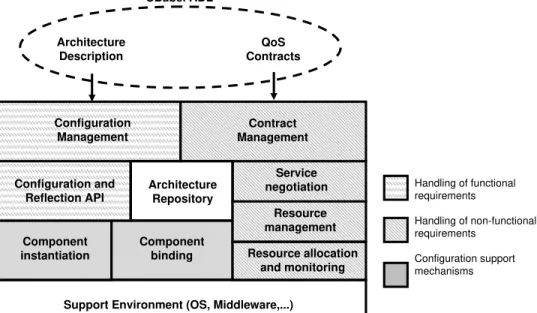
The CR-RIO framework (Figure 1) integrates the software architecture paradigm centered on an
archi-tecture description language (ADL), with concepts such as reflection and dynamic adaptation capability [18], which are generally provided in an isolated fash-ion in other related proposals described in the litera-ture [e.g., 23, 14, 28, 20, 16]. This integration facili-tates the achievement of separation of concerns, soft-ware component reuse and dynamic adaptation capa-bility of applications. CR-RIO includes the following elements:
a) CBabel, an ADL used to describe the functional components of the application and the interconnection topology of those components, which follow the CR-RIO model. CBabel also caters for the description of some non-functional aspects, such as coordination and distribution, and planned reconfigurations. A CBabel specification corresponds to a meta-description of an application that is available from a repository, and is used to deploy the architecture in a given operating environment. While the application is running this meta-description repository provides the basic infor-mation required to guide and manage architectural adaptations.
Resource allocation and monitoring
Service negotiation Configuration and
Reflection API
Component instantiation
Configuration Management
Contract Management
Architecture Repository Architecture
Description
QoS Contracts
Handling of functional requirements
Handling of non-functional requirements
Configuration support mechanisms
Support Environment (OS, Middleware,...) CBabel ADL
Component binding
Resource management
Figure 1: The CR-RIO framework
c) A simple software design methodology that stim-ulates the designer to follow a straightforward meta-level programming discipline [18], where functional re-quirements are concentrated in modules (base level en-tities) and non-functional requirements are encapsu-lated in connectors (meta-level entities). In this con-text, ports have a role similar to reification points used in meta-level programming approaches and, similarly, can be associated with different code boundary trans-fer mechanisms, e.g., method, procedure or messaging passing primitive invocations. It is worth to point out that some common non-functional requirements can be directly mapped into connectors, which are equiv-alent to meta-level components, and can be immedi-ately configured in an application’s architecture. For example, the access to real-time communication mech-anisms, such as a real-time RMI [5], could be encap-sulated into a connector and configured in different architectures.
d) The Configurator, a reflective element that provides services to manage applications with dis-tributed configurations. The Configurator provides two APIs: configuration and architectural reflection, through which these services are used, and a persis-tency mechanism for the architecture meta-level de-scription repository, where the two APIs reflect their operations. The configuration API permits to instan-tiate, bind, stop and replace components of a run-ning application dynamically changing its configura-tion. These operations are atomically performed and
are causally connected, i. e., the applied changes are serially reflected in the architecture description repos-itory. The architectural reflection API allows query-ing the configuration repository. This information can be used to guide configuration changes under certain conditions, for instance, in face of changes in the QoS support level.
e) Architectural contracts, a concept proposed to specify non-functional aspects, which provide a de-scription where components of the architecture can express their static and dynamic non-functional re-quirements. This is achieved by defining the set of services (and their associated parameters) that can be used by an application, service negotiation rules and architectural adaptation policies for different op-erational contexts. In addition, the CR-RIO frame-work provides the required infrastructure to impose and manage the contracts during running time. More specifically, we propose an architectural pattern that simplifies the design and coding of specific components of the infrastructure, consistently establishing the re-lationship between the Configurator and the contract supporting entities (please see Section 5).
3
The QoS Contract Language
intercon-nection topologies, with requirements that generally do not admit negotiation [4]. Non-functional or QoS services are defined by restrictions associated to spe-cific non-functional requirements of an application, and can admit some negotiation including the used resources. A contract regulating non-function requiments can describe, at design time, the use of the re-sources that the application will make, and acceptable variations regarding the availability of these resources, at runtime. Our proposal incorporates concepts from QML (QoS Markup Language) [13], which were refor-mulated for the context of software architecture de-scriptions [10]. A QoS contract includes the following elements:
a) QoS Categories are used by the designer to ag-gregate properties related to specific non-functional re-quirements; they are named and described separately from the components. For example, if processing and communication performance characteristics are criti-cal to an application, associated QoS categories, Pro-cessingandTransport, could be described as in Figure 2.
01 QoScategory Processing {
02 utilization: decreasing numeric %; 03 clockFrequency: increasing numeric MHz; 04 priority: increasing numeric;
05 memReq: increasing numeric Mbytes; 06 }
07
08 QoScategory Transport {
09 delay: decreasing numeric ms; 10 bandwidth: increasing numeric Mbps; 11 technology: enum {CDLS, GSM, WiFi}; 12 slidingWindowSize: increasing numeric; 13 send-buf-size: increasing numeric; 14 recv-buf-size: increasing numeric; 15 MSS: increasing numeric;
16 } 17 ...
Figure 2: Processing and Transport QoS Categories
The Processing category (lines 1-6) can represent a processing resource where the utilization property express the required percentage of the CPU time (low values are preferred - decreasing), the clockFre-quency property represents the processor’s operating frequency (high values are preferred -increasing), pri-orityrepresents a priority for processor utilization, and memReq represents the amount of memory required
to run a process. TheTransportcategory (lines 8-16) illustrates properties commonly associated to trans-port resources used by clients and servers components to communicate. For example, the bandwidth prop-erty represents the available bandwidth for the client-server connection and the delay property represents the transmission delay of one bit between a client and a server. The specific use of these categories, and of the other elements of the language to be described next, will be illustrated through the examples presented in Section 4.
b) A QoS profile quantifies the specific set of prop-erties of a QoS Category that are relevant in a given application. This quantification restricts each prop-erty according to its description, working as an in-stance of acceptable values for a given QoS Category. A component, a connection, or a part of an archi-tecture, can define particular QoS profiles in order to constrain its operational context. For example,
transport.delay <= 10,express the maximum com-munication delay required in a given context. The de-sign decisions for defining a specific profile are based on the requirements of the application to be imple-mented by the architecture being described, and can be constrained by the available support to manage the used resources.
c) A set of services can be defined in a contract. A service defines a set of non-functional requirements that should be deployed in the architectural level; these non-functional requirements can be associated to either (i) the application’s components or (ii) the interaction mechanism used by these components. In QoS terms, a service is differentiated from others by the desired or tolerated QoS characteristics required by the application, in a given operational context. A non-functional QoS constraint can be defined by asso-ciating a specific value of a property to an architecture declaration or associating a specific profile to that dec-laration.
desirable policy. Currently, we are investigating how to consider syntactically and semantically the avail-able options.
4
Use-Cases
During our research we developed some prototype examples to evaluate and refine the approach. Here we present three of these experiments and raise dis-cussions of some issues in their context. Additional implementation details are discussed in Section 5.1.
4.1
Communication Technology
Adapta-tion
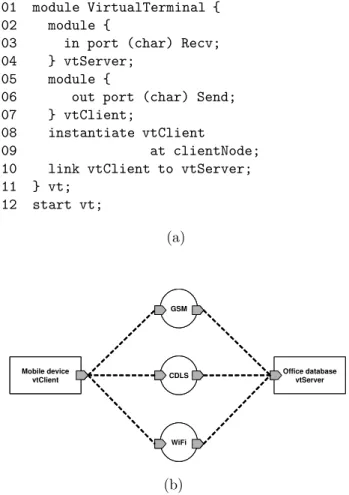
In [11] a simulated virtual terminal application was used to evaluate security and communication aspects in the context of a mobile network. Specifically, a first contract was used to specify an initial choice be-tween secure and unsecure protocol options (telnetor ssh, and cipher types) and a second contract was used to specify communication channels that can be dy-namically reconfigured during running time. The lat-ter contract considers a mobile device that supports three communication channels each one using a differ-ent technology, as follows:
CDLS: in the range of a cordless base station, this channel operates over a regular wired telephone line; GSM: on the move, this channel operates over a cel-lular network; WiFi: when immerse in a wireless net-work, this channel uses the available communication protocols.
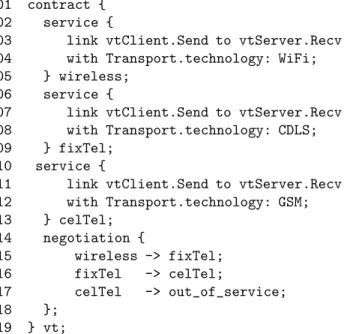
Figure 3.a presents the architecture description; note that the client-server connector does not ap-pear explicitly in this configuration. Also, it is as-sumed that the server is already instantiated. Figure 3.b presents the application’s overall architecture; the dashed lines represent the links that can be dynam-ically established, guided by the contract negotiation policy and depending on resource availability. The sec-ond contract for this use-case (Figure 4) defines three different transport services, each one associated to a specific communication channel. The support required for each service (defined in lines 2-5, 6-9 and 10-13, re-spectively) is encapsulated in a specific connector as-sociated to the link construct (showed in lines 3-4, 7-8 and 11-12, respectively), as described by the associ-ated profiles, which were defined directly using the specific Transport.technology property. For each available channel option there is an associated com-munication interface and a specific sensor that detects
if the corresponding channel is available or not. Dur-ing operation the supportDur-ing middleware tries to keep a communication link using the best among the avail-able channels; to establish the link it just configures the corresponding connector. Other non-functional as-pects could be considered in this architecture. For example, seamless communication could be achieved encapsulating the access to a reliable communication protocol (e.g., [30]) into a connector and configuring it in the application architecture.
01 module VirtualTerminal { 02 module {
03 in port (char) Recv; 04 } vtServer;
05 module {
06 out port (char) Send; 07 } vtClient;
08 instantiate vtClient
09 at clientNode; 10 link vtClient to vtServer; 11 } vt;
12 start vt;
(a)
Mobile device vtClient
Office database vtServer GSM
WiFi CDLS Mobile device
vtClient Mobile device
vtClient
Office database vtServer GSM
GSM
WiFi WiFi CDLS CDLS
(b)
Figure 3: Mobile application basic architecture
The negotiation clause (lines 14-18) defines that the best service is the wireless transport service; if this service is not available, afixTelservice should be tried and so on. Transitions between services depend on their availability. Either when the currently used link fails, or a preferable service becomes available, a service adaptation can take place. Other adaptation policies could be used, e.g., based on a reduced-cost or bandwidth criterion.
non-01 contract { 02 service {
03 link vtClient.Send to vtServer.Recv 04 with Transport.technology: WiFi; 05 } wireless;
06 service {
07 link vtClient.Send to vtServer.Recv 08 with Transport.technology: CDLS; 09 } fixTel;
10 service {
11 link vtClient.Send to vtServer.Recv 12 with Transport.technology: GSM; 13 } celTel;
14 negotiation {
15 wireless -> fixTel; 16 fixTel -> celTel;
17 celTel -> out_of_service; 18 };
19 } vt;
Figure 4: Mobile device QoS contract
functional requirements (in the same or in different applications) are orthogonal when it is not necessary to combine states of their respective sets of services in the same negotiation chain, because they do not interfere with each other. Composing orthogonal con-tracts is immediate: their services, profiles and nego-tiation clauses would make independent parts of the composed contract; their negotiation clauses are liter-ally combined. The unified negotiation clause combin-ing the two contracts used in this use-case is presented in Figure 5.
In the general case, the composition process can lead to conflicts on the use of shared scarce resources. Conflicts can be handled applying a suitable decision policy to the set of involved contracts; already assigned resources could then be retaken in order to satisfy the preferred contracts.
In this example, additional virtual terminal client instances can be instantiated during running time without any apparent conflict caused by the server’s sharing. However, in order to deal with more general configurations we are investigating the description of individual contracts for clients and servers [25]. This intends to allow each client to specify what it requires and each server to specify what it is committed to provide. This capability would permit to make de-cisions regarded to a component instantiation taking into account the availability of resources at its
instan-tiation time. Besides providing the flexibility required for the support of dynamic architectures, this would allow managing conflicts through lower granularity in-terventions.
01 negotiation {
02 secure -> unsecure; 03 unsecure -> out_of_service;
04 wireless -> fixTel; 05 fixTel -> celTel;
06 celTel -> out_of_service; 07 }
Figure 5: Combining contracts
4.1.1 Client-Server Adaptation
4.1.2 Single Server Configuration
Figure 6 presents the CBabel description of the ap-plication’s architecture, composed by a client (client - lines 3-5), a server (server - lines 6-8), and their interconnection topology. Interaction is performed through the client’s procDataSet out port and the server’sprocDataSet in port (line 10). Note that this interconnection could be statically defined using a spe-cific connector to mediate the client-server interaction, encapsulating the required communication or inter-action mechanism. However, as the non-functional requirements can include communication, processing and replication aspects, the use of connectors in the architecture will be defined separately in a contract; the specific connector can be automatically selected by the contract support middleware.
01 module Client_Server { 02 port procDataSet; 03 module Client {
04 out port procDataSet; 05 } client;
06 module Server {
07 in port procDataSet; 08 } server;
09 instantiate client, server; 10 link client.procDataSet to
server.procDataSet; 11 } capture_images;
12 start capture_images under <contract_name>
Figure 6: CBabel description of the application’s ar-chitecture
In this first context, we assume that the client and server components are deployed in the same node and that the client execution requirements are easily met. In this case, to meet the application’s requirements, processing and storage resources have just to be re-served for the server module, as described in the sin-gleServercontract presented in Figure 7. TheprioProc service (lines 14-16) states that the instantiation of the server module at the host1 node is associated to the PProcMem processing profile (lines 19-22). Accord-ing to this contract, the server module instantiation is conditioned to the availability of enough storage capa-bility (at least 200 Mbytes) and of a processing slice of at least 0.25 (25%) of the processor’s time, as defined byPProcMem.
13 contract { 14 service {
15 instantiate server at host1
with profile PProcMem; 16 } prioProc;
17 negotiation {prioProc -> out-of-service;}; 18 } singleServer;
19 profile {
20 Processing.cpuSlice >= 0.25; 21 Processing.memReq >= 200; 22 } PProcMem;
Figure 7: Single server contract description
4.1.3 Distributed Server Configuration
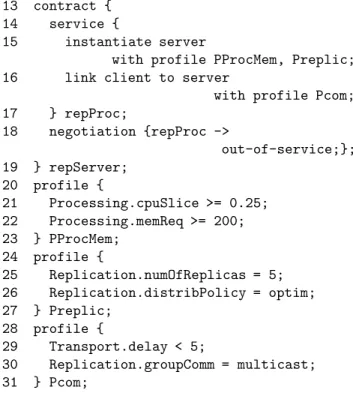
Now, the servers are replicated in order to distribute the processing load. To this end a Replication QoS category (Figure 8) is introduced. When this category is used, a special connector is selected to provide the services related to the group communication protocol, selected by the value of thegroupCommproperty (line 22). The numberOfReplicasand maxReplicas proper-ties (lines 19-20) describe, respectively, the number of replicas to be deployed and the maximum number of replicas allowed. This last property can be used with replicaMaint (line 21) in the case of a contract that will dynamically handle the creation of replicas. The distribPolicyproperty (line 23) indicates a policy to be adopted for the distribution of replicas (in this exam-ple, driven by the best memory, CPU and transport delay values).
18 QoScategory Replication {
19 numberOfReplicas: increasing numeric; 20 maxReplicas: numeric;
21 replicaMaint: enum (add,
remove, maintain); 22 groupComm: enum (p2p, multicast,
broadcast, loadbalance); 23 distribPolicy: enum (bestMem, bestCpu, bestTransp, optim); 24 }
Figure 8: Replication category
A number of five replicas was selected (line 25) and the distribution policy will try to optimize resources (line 26). For all the established client-replica inter-connections a connector (groupCon) is used to pro-vide a selected group communication mechanism. In this example, we consider that the computation of the service requested can be split among the replicated servers and a multicast protocol is selected (line 30). In a case where the service requests can be processed independently, a policy to distribute the load among the servers would be more suitable (loadbalance, line 22 in theReplication category); a heuristic aiming to optimize load balancing in this context is presented in [2]. Note that this use-case architecture can evolve to accommodate additional clients. For this, each new client has just to be started under therepServer con-tract in order to be automatically linked to the servers with thePCom profile.
13 contract { 14 service {
15 instantiate server
with profile PProcMem, Preplic; 16 link client to server
with profile Pcom; 17 } repProc;
18 negotiation {repProc ->
out-of-service;}; 19 } repServer;
20 profile {
21 Processing.cpuSlice >= 0.25; 22 Processing.memReq >= 200; 23 } PProcMem;
24 profile {
25 Replication.numOfReplicas = 5; 26 Replication.distribPolicy = optim; 27 } Preplic;
28 profile {
29 Transport.delay < 5;
30 Replication.groupComm = multicast; 31 } Pcom;
Figure 9: Contract for the distributed-replicated server configuration
Again, as the requests have to be processed at a given rate, the overall deadline within which the server task has to be performed should not be violated. In a distributed environment, where the message transport time to the server adds to the total preprocessing ex-ecution time, the overall deadline should include this
parameter. In order to express this requirement, the contract includes a message transport time parame-ter (Figure 9, line 29); the latparame-ter aggregated with the previous processor reservation parameter will provide a trustful means to impose the application timing re-quirement at runtime.
In an application where the processing requirements can increase or decrease along the application run-ning time, the number of replicated servers could be dynamically controlled, according to a strategy pre-scribed in a contract. For example, when the process-ing demand increases, the number of servers could be increased in order to reduce each one individual com-putation time, aiming to achieve an overall speed-up. Accordingly, the number of servers can be reduced in order to free system resources when the processing de-mands decreases (see [19] for more details).
We have also experimented with server replica-tion techniques to achieve fault-tolerance [17]. In this context, diverse reliable message multicast pro-tocols, based on a reliable group communication sup-port, were implemented to ensure server’s state consis-tency. These protocols are encapsulated into connec-tors, which can be configured to select a specific failure semantics more suitable to meet the requirements of a given application. These connectors also encapsulate the access to the group membership service, which was used to implement module failure detection and recov-ery mechanisms. In a recent work [1], we investigated the use of CR-RIO contracts to express this kind of non-functional requirement.
We note that components of our contract support middleware can encapsulate the access to different available resources and mechanisms, in order to obtain the information required to enforce the non-functional requirements. In our fault-tolerance experiment, the reliable multicast protocol and the group membership service provided a clear example. For the architectural contracts presented in this section, parameters such as CPU utilization, available storage capacity, network bandwidth, and resource discovery are required to as-sist the allocation of server replicas. This kind of sup-port can be provided by available platforms such as the NWS framework [29].
4.2
Video on Demand (VoD) Application
to workstations, in which the availability of resources required for video exhibition, such as available CPU capacity and communication bandwidth, can vary. In this context it is necessary to adapt the application’s architecture configuration, depending on the specific operational environment, in order to have the video being exhibited with the expected quality. The ba-sic architecture of the example should fit two types of client: (i) high processing availability, with high-speed access to the server and (ii) medium processing availability, with dial-up modem access to the server. In principle, clients of type (i) have enough process-ing and communication resources to exhibit the video in the original MPEG-2 format; of course, they also can deploy the less demanding H.261 format. Clients of type (ii), with limited resources, can only exhibit the video in the H.261 format. Note that a type (i) client can degrade to type (ii), depending on the avail-ability of the supporting resources. Figure 10 presents the CBabel description of the application’s architec-ture, composed by a client (player - line 3) and a server (videoSrv - line 4), and their connection topol-ogy; communication is effected through the player’s requestport and the video-server’sprovide port (lines 6-8). Following the previous examples, as the non-functional restrictions include interaction aspects, the use of connectors in this architecture will be defined explicitly in a contract.
01 module Client_Server { 02 port provide, request;
03 module Client { out port request; } player; 04 module Server { in port provide; }
videoSrv; 05
06 instantiate videoSrv at serverHost; 07 instantiate player;
08 link player.request to videoSrv.provide; 09 } vod;
10 start vod;
Figure 10: VoD application Architecture Description
The QoS categories for processing and transport used to specify the VoD application contract are those presented previously in Figure 2. In this example it is considered that the client has to run on a CPU with a minimum operating frequency of 700 MHz, and can require up to 50% of the available CPU time to ex-hibit videos in the MPEG-2 format. By its turn, the
exhibition of videos in the H.261 format will demand a CPU with a minimum clock of 266 MHz and can require a maximum CPU usage of 30%.
For video transmission, the MPEG-2 format re-quires a bandwidth greater than 1.5 Mbps and a trans-port delay lower than 50 ms to sustain an acceptable video stream, while the H.261 format requires a mini-mum bandwidth of 56 Kbps and can tolerate transport delays up to 200 ms. Other transport properties could be taken into account in this case, such as thejitteror data loss rate; for the sake of simplicity they were not included in theTransport QoS category.
The QoS contract of this example considers that two services can be used: the exhibition of the video (i) in the MPEG-2 format or (ii) in the H.261 for-mat, according to the availability of resources at the specific client platform. In the client’s node, to de-ploy any of these services, the resources to be handled are those related to the host’s processing character-istics and to the client-server communication channel properties. Based on the previous requirements, the application’s contract can be described as in Figure 11.
TheMPEG_videoservice (lines 2-5) defines the QoS constraints for the architecture parts that participate in the MPEG video exhibition. The creation of a playercomponent instance (line 3) in a client machine is associated to the cpu_01 processing QoS profile. The interconnection of the player and videoSrv ports are bound to the network_01 QoS profile (lines 28-31), being the communication provided by a connec-tor that encapsulates the required mechanisms (line 4). The mentioned profiles specify, respectively, the constraints to theProcessingandTransportQoS Cat-egories properties relevant to this contract. In this case, to create the player instance theclockFrequency of the node has to be at least 700 MHz and then the CPU utilization has to be less or equal than 50%.
The H-261_video service description follows a similar procedure. The cpu_02 (lines 23-26) and network_02(lines 33-36) profiles represent the require-ments for the H.261 video exhibition. Note that, for this service, the interaction of the components is me-diated by a connector that encapsulates the MPEG-2 to H-261 conversion mechanism. Additionally to the MPEG-2 and H.261, other formats could be supported by using specific codecs, encapsulated in connectors; e.g., thebitmapformat that can be exhibited on PDAs and cell-phone video matrixes.
01 contract { 02 service {
03 instantiate player at clientHost with cpu_01; 04 link player to videoSrv
by comTransport with network_01; 05 } MPEG_video;
06
07 service {
08 instantiate player at clientHost with cpu_02; 09 link player to videoSrv
by H-261.comTransport with network_02; 10 } H-261_video;
11
12 negotiation {
13 MPEG_video -> H-261_video; 14 H-261_video -> out_of_service; 15 }
16 } vod; 17
18 profile {
19 Processing.clockFrequency >= 700; 20 Processing.utilization <= 50; 21 } cpu_01;
22
23 profile {
24 Processing.clockFrequency >= 266; 25 Processing.utilization <= 70; 26 } cpu_02;
27
28 profile {
29 Transport.delay <= 50; 30 Transport.bandwidth >= 1.5; 31 } network_01;
32
33 profile {
34 Transport.delay <= 200; 35 Transport.bandwidth >= 0.056; 36 } network_02;
Figure 11: VoD application QoS Contract
relation to the H-261_video service. If there are no resources available to attend any of these services, an out-of-servicestate is reached and the application can-not run. Initially a negotiation is performed to es-tablish the basic configuration. However, additional negotiations are plausible. For example, if the MPEG service is operational and either thenetwork_01or the cpu_01profiles cannot be sustained; in either case the video service could be continued in a degraded mode using the H.261 encoding. Note that in a dynamic context, even if a CPU reservation mechanism is used to ensure thecpu_01 profile, a contract service could be invalidated by the instantiation of another contract with higher priority.
5
Supporting Middleware
it concludes that a preferred service became available again. When the negotiation finishes the GCM uses the Configurator to deploy the components required for the selected service.
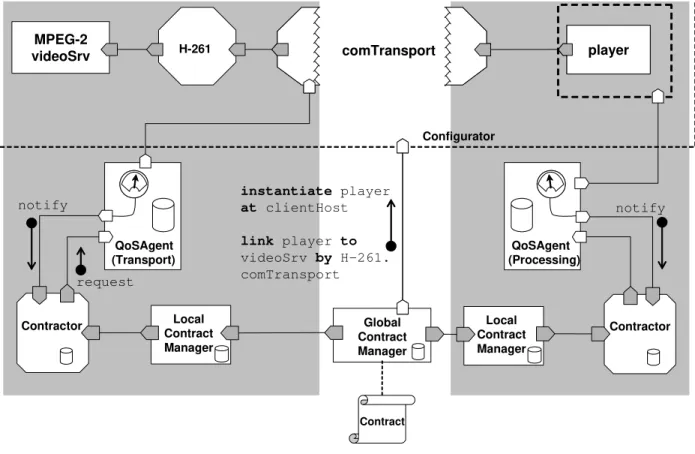
For each particular contract, a specific Contractor instance is created. Basically, it takes care of concerns associated to local profiles related to the contract’s ser-vices. Contractors are built from a generic class, which is specialized for the profiles of a given service. More specifically: (i) When one or more property profiles are related to a local primitive service of the support system, it performs a request on behalf of this service (with the required parameters) to the corresponding QoS Agents; from then on, it can receiveout-of-spec notifications from the QoS Agents, containing relevant values related to these profiles. (ii) When a property profile requirement can be implemented by a specific connector, it just interact with this connector that also acts like a QoS agent; for example, this happens in the case presented in Section 4.1. The content of anout-of -specspec notification is compared against the associ-ated profile and, in some cases, the Contractor can try to make (local) adjustments to the resource that pro-vides the primitive service. For instance, in the VoD application, the priority of a streamer, encapsulated in the connector, could be raised in order to maintain a given frame generation rate; note that this requires an explicit intervention of the programmer. In a case where local adjustments are not possible, an out-of -profilenotification is sent to the associated LCM.
QoS Agents are also specialized. They can just pro-vide access to architectural level resources information or encapsulate the access to system level mechanisms, providing adequate interfaces to perform requests to local primitive services, initialize system resources and monitor the actual values of the required properties. According to the values to be monitored (that can include threshold limits), which were registered by a Contractor, a QoS Agent can issue anout-of-spec no-tification, which includes relevant resource-related in-formation (that may be forwarded all the way to the GCM), allowing the respective Contractor to verify if a resource is no more available or if it does not meet the specification defined in the profile.
5.1
Implementation Details
The implementation of the contract of the appli-cation presented in Section 4.3 using the described architectural pattern is depicted in Figure 12. Each participant node has an instance of theLocal Contract Manager, the specific Contractor for the VOD appli-cation and theQoS Agentassociated to the resources
to be controlled in each specific platform. TheH-261 connector only takes part of the configuration when the H-261_video service is deployed. It can also be observed that the comTransport connector has a dis-tributed implementation; in this experiment the codifi-cation related to the video flow transport mechanisms were encapsulated in thiscomTransportconnector, e.g, RTP and RTCP protocols. In a more network-aware context some kind of resource reservation mechanism could be also employed, e.g., the RSVP protocol.
In the contract negotiation phase, the middleware tries to establish the required profiles and the associ-ated support required for them. If the GCM concludes that the negotiation was successful the service can be established. The next step is to start the application’s functional components, in the context of the estab-lished support; this is performed using the services provided by the Configurator (described in Section 2). All the presented case studies were implemented in Java. TheJava Media Framework was used to imple-ment the functional modules of the VoD application. Java objects were mapped to configurable components through the Configurator, which is implemented fol-lowing the Architecture Configurator design pattern described in [7]. In particular, the structure of CR-RIO’s connectors follows a standard pattern which im-plementation could be supported by a tool. Basically, at the invoker side, after being identified, each method invocation is serialized and, in the sequel, at the tar-get object side a dynamic invocation of the concerned method is performed. We have not put much effort in optimizing our connector’s implementation. How-ever, we made a set of measurements [26] that show a small overhead when compared to the cost associ-ated with the basic machinery required to perform dynamic method invocations in Java, which is con-siderably greater than the normal method invocation cost. The connector’s performance can be optimized either using precompiled stubs (loosing the dynamic context reflective capability - see section 2-b) or using a specialized JVM, e.g, [22] (though loosing portabil-ity).
5.2
Additional remarks
fed-Contract
player player
instantiate player
at clientHost
link player to
videoSrv by H-261. comTransport
Configurator
Global Contract Manager Local
Contract Manager Contractor
QoSAgent (Transport) MPEG-2
videoSrv H-261
notify
request
Local Contract Manager
Contractor QoSAgent
(Processing)
notify
comTransport
Figure 12: Mapping the VoD application contract in the architectural pattern
eration of GCMs, which would have to negotiate to implement the contract management functionality.
In our current implementation we did not consider the issue of failures affecting the configurable enti-ties required to impose a given service for a contract. This could be tackled extending the GCM to treat as an atomic transaction the set of configuration ac-tions required to impose a QoS service. Another re-lated issue regards the application behavioral (and state) consistency during QoS service transitions. On this regard we do not think there is an application-independent solution; the specific application and the relative time span required to effect the configuration changes are among the factors to be considered. In some cases, consistency-related issues could be treated at the application realm, and the programmer should be aware of the intended use of the functional com-ponents within a given domain. In other cases, some system-level solution could be provided, e.g., to mask disruptions using a special communication protocol as mentioned in section 4.1. Available studies make very restricted assumptions to provide transparent so-lutions to the application consistency issue, e.g., [15].
Additional research is required to clarify the practical aspects of both failure and consistency issues.
Some other optimizations are feasible. For instance, when a Contractor sends anout-of-profilenotification this could be followed by the set of QoS profiles that could be attended at that moment. Receiving this composed information, the GCM can filter out the ser-vices with unattended profiles, and immediately select the next service to be activated. Another optimization could be applied when a set of services uses resources restricted to a given node. In this case the node’s LCM can receive the information of all services and profiles related to the set and manage them locally. In some cases, the GCM can incorporate the functions of the other components, as the LCM, or services provided by existing middleware systems to optimize its implemen-tation, as discussed in Section 4.2. In specific cases, it is even possible to collapse all the support to a single node, managing all the contract concerns locally; this would be suitable in the use-case presented in Section 4.1.
their intrinsic semantics, as happens with some spe-cialized communication protocols. For these cases, resource re-adaptation can be locally managed by a Contractor, using the interface provided by the QoS Agents, as mentioned in the beginning of this section. As an interim solution, we are investigating how to treat this kind of concern in the contract level. How-ever, in our research we found a clear need for explicit separation of resource status and availability monitor-ing functions from resource allocation and manage-ment functions. Due to historical reasons these two functions are embedded in most QoS aware protocol suites and can not be separately used. This makes dif-ficult to a designer to take advantage of each of them to write a contract. We hope that this situation changes in the next generation systems.
The presented use-cases showed us that the com-ponents of the CR-RIO middleware follow a recurrent architectural pattern in those different applications. In particular, in our experiments we observed that the interactions between the middleware components fol-low standard sequence diagrams, which facilitate im-plementations based on object-oriented principles. In addition, the behavior of these elements is parameter-ized by the contract of the specific application; at this level the manipulated information is symbolic. It ap-pears that the GCM and the LCM overall codification can be generalized, being identified as frozen spots of the pattern. On the other hand, the QoS Agent and the Contractor were identified as hot spots and have to have specific implementations, although part of their code can be automatically generated from the related contracts. Each QoS Agent has dependencies related to the specific resource being managed. However, we note that a QoS Agent needs to be programmed once for a given resource; from then on, it can be reused in other applications that have operational requirements dependent on the same kind of resource. By its turn, the Contractor’s implementation is dependent on the services and profiles to be imposed, which depend on the resources to be managed via QoS Agents. The Contractor can also contain the code implementing specific policies to perform local adaptations, as al-ready discussed in this section. Finally, we note that the implementation of the interaction between a Con-tractor and a QoSAgent is based on the Observer de-sign pattern, which can simplify the codification of these components.
6
Related Work
The proposal presented in [13], which was the main inspiration of our contract description language, is ap-plied in the class-object design stage and does not dis-cuss implementation level issues. Here we comment on some works directly related to our proposal. More detailed comparisons are available in [1].
The reflective middleware approach [16] allows for the provided services to be configured to comply with the non-functional properties of the applications. However, the proposal does not provide clear abstrac-tions and mechanisms to help the use of such features in the design of the architectural level of an applica-tion. This leads to the middleware services being used in an ad-hoc fashion, usually through pieces of code intertwined with the application’s program.
The Quality Objects (QuO) [20] provides a frame-work for the development of distributed applications with QoS requirements, based on CORBA. In QuO, the specification of such requirements is associated with method invocations through a contract descrip-tion language, allowing only adaptadescrip-tions at this level. Our proposal considers services with differentiated quality in diverse levels, from the interface (or con-nection) level, in which services are encapsulated into connectors (similarly to the QuO approach), to the architectural level, in which the service provision can involve the reconfiguration of the application’s topol-ogy.
Cazzola proposes the concept of using architec-tural reflection to adapt non-functional properties of base-level architectural configurations [8], describing a switching mechanism activated by logical rules for this purpose. The proposal described in [14] includes basic mechanisms to collect status information asso-ciated to non-functional services. It also suggests an approach to manage non-functional requirements in the architectural level, in a way similar to ours. CR-RIO complements both proposals providing an explicit methodology based on contracts and proposing extra mechanisms to deploy and manage these contracts.
approach, that includes configuration-programming mechanisms, is more transparent regarding the access to the source code of the application. Considering their similar aims, it would be very interesting to in-vestigate further the correspondence between the two proposals.
As mentioned in Section 2(c), our approach is re-lated to meta-level programming proposals described in the literature [24, 21, 12, 3]. Regarding this point, we observe that most of these proposals do not provide clear concepts and mechanisms for describing and sup-porting static and dynamic architectural adaptations, leading to ad-hoc solutions on this level of concern; more comparisons are available in [18]. Our contracts cater for this need by providing architectural level de-scriptions that act as specifications and can be used to guide implementations. In addition, the approach allows us to take advantage of formalisms for proving properties of the application’s architecture [6].
It is interesting to note that many of the elements separately presented in the previously commented pro-posals have a counterpart in our proposal that tries to consider these elements comprehensively.
7
Conclusions
We presented a unified approach to specify, de-ploy and manage applications having non-functional requirements. The approach helps to achieve separa-tion of concerns and software reuse by allowing non-functional requirements of an application to be speci-fied separately using high-level contracts expressed in an extended ADL. Being centered on an ADL-based configuration framework, the approach inherits the benefits mentioned in Section 6, among them the ca-pability of reconfiguration, which facilitates to execute dynamic architectural adaptations on behalf of a con-tract. In addition, part of the codification, required to fulfill some non-functional requirements, can be encap-sulated into connectors, which can be (re)configured during running time in order to cater for the imposi-tions defined by the associated contract.
The approach has been partially evaluated through use-cases, which showed that the infrastructure re-quired to enforce the contracts follows an architectural pattern that can be implemented by a standard set of components of a middleware. It was also verified that the code of these components could be automat-ically generated, except some localized pieces related to some specificity of the particular non-functional re-quirement under consideration. However, we should notice that the treatment of this kind of detail always
has to be considered in any QoS-aware application. In this sense, our approach can help to identify the inter-vening hot spots and make the required adaptations more systematic.
It should be noticed that CBabel descriptions can be used to configure application systems based in dif-ferent component implementation environments. This would also allow reusing QoS contracts in these envi-ronments, provided that the required supporting com-ponents are also made available. In this research, we found that the process of mapping architecture-level defined contracts to implementations could be better understood by exposing the internal structures of these components. We intend to follow this path in order to refine the framework and to identify useful optimiza-tions for different implementation and application do-mains.
Finally, the reader can observe that the three case studies presented in Section 4 exhibit the same archi-tectural style. In principle, with some changes, their individual contracts could be combined into a hyper-contract representing a fully adaptable and distributed VoD system. We believe that our proposal can con-tribute towards transforming such a visionary goal into sound engineering practice.
References
[1] S. Ansaloni. An Architectural Pattern to Describe and Implement QoS Contracts. Masters Disserta-tion, Instituto de Computa¸c˜ao, UFF, May 2003.
[2] A. M. Barroso, J. Leite and O. Loques. Treating Uncertainty in Distributed Scheduling. Journal of Systems and Software, Elsevier, Vol. 63/2 pp. 51-58, November 2002.
[3] L. Bergmans, and M. Aksit. Composing Crosscut-ting Concerns Using Composition Filters. Com-munications of the ACM, Vol. 44, N. 10, pp. 51-57, October 2001.
[4] A. Beugnard, J.-M. J´ez´equel, N. Plouzeau, and D. Watkins. Making Components Contract Aware. IEEE Computer, Vol. 32, N. 7, pp. 38-45, July 1999.
[5] A. Borg, and A. Wellings. A Real-Time RMI Framework for the RTSJ. In Proceedings of the 15th Euromicro Conference on Real-Time Sys-tems, Porto, Portugal, July 2003.
Language. Electronic Notes in Theoretical Com-puter Science, Elsevier, Vol. 95, pp. 148-168, May 2004.
[7] Carvalho, S. T, Lisbˆoa, J. and Loques, O. A De-sign Pattern for Software Architecture Configura-tion. 2nd Latin American Conference on Pattern Languages of Programming, Itaipava, RJ, Brazil, August 2002.
[8] W. Cazzola, A. Savigni and A. Sosio. Architec-tural Reflection: Concepts, Design, and Evalua-tion. Technical Report RI-DSI 234-99, DSI, Uni-versity degli Studi di Milano, May 1999.
[9] J. K. Cross and D. Schmidt. Quality Connector: A Pattern Language for Provisioning and Manag-ing Quality-Constrained Services in Distributed Real-Time and Embedded Systems. 9th Confer-ence on Pattern Language of Programs, Monti-cello, Il, U.S.A., September 2002.
[10] R. C. Cerqueira. A Methodology to Describe and Implement Contracts for Services with Differenti-ated Quality in Distributed Architectures. Mas-ters Dissertation, Instituto de Computa¸c˜ao, UFF, 2002.
[11] R. C. Cerqueira, R., S. Ansaloni, O. Loques, and A. Sztajnberg. Deploying Non-Functional As-pects by Contract. 2nd Workshop on Reflective and Adaptive Middleware, Middleware2003 Com-panion, pp.90-94, Rio de Janeiro, Brasil, June 2003.
[12] T. Elrad, A. Aksit, G. Kiczales, K. J. Lieberherr and H. Ossher. Discussing Aspects of AOP. Com-munications of the ACM, Vol. 44, N. 10, pp. 33-38, 2001.
[13] S. Frolund and J. Koistinen. Quality-of-Service Specifications in Distributed Object Systems. IEE Distributed Systems Engineering, N. 5, pp. 179-202, UK, 1998
[14] D. Garlan, B. R. Schmerl and J. Chang. Us-ing Gauges for Architecture-Based MonitorUs-ing and Adaptation. Working Conference on Com-plex and Dynamic Systems Architecture, Bris-bane, Austrlia, December 2001.
[15] I. Georgiadis, J. Magee and J. Kramer. Self-Organizing Software Architectures for Dis-tributed Systems. Proceedings of the first Work-shop on Self-healing Systems (WOSS’02), pp. 33-38, Charleston, SC, U.S.A., November 2002.
[16] F. Kon, F. Costa, G. Blair and R. H. Campbell. The Case for Reflective Middleware. Communi-cations of the ACM, Vol. 45, N. 6, pp. 33-38, June 2002.
[17] O. Loques, R. A. Botafogo and J. C. B. Leite. A Configuration Approach for Distributed Object-Oriented System Customization. In Proceedings of the Third IEEE Workshop on Object-Oriented Real-Time Dependable Systems, pp. 185-189, Newport Beach, California, U.S.A., February 1997.
[18] O. Loques, A. Sztajnberg, J. Leite and M. Lo-bosco. On the Integration of Configuration and Meta-Level Programming Approaches. In Reflec-tion and Software Engineering, LNCS, Vol. 1826, pp. 191-210, Springer-Verlag, Heidelberg, Ger-many, June 2000.
[19] O. Loques and A. Sztajnberg. Customizing Component-Based Architectures by Contract. In 2nd International Working Conference on Com-ponent Deployment (CD 2004), LNCS, V. 3083, pp. 18-34, Springer-Verlag, Edinburgh, Scotland, UK, May 2004.
[20] J. P. Loyall, P. Rubel, M. Atighetchi, R. Schantz and J. Zinky. Emerging Patterns in Adaptive, Distributed Real-Time, Embedded Middleware. 9th Conference on Pattern Language of Programs, Monticello, Il, U.S.A., September 2002.
[21] J. A. D. Pace and M. R. Campo. Analyzing the Role of Aspects in Software Design. Communi-cations of the ACM, Vol. 44, N. 10, pp. 66-73, October 2001.
[22] A. Popovici, A. Frei, and G. Alonso. A Proac-tive Middleware Platform for Mobile Computing. InMiddleware 2003 Proceedings, LNCS 2672, pp. 454-473, Springer-Verlag, Rio de Janeiro, Brasil, June 2003.
[23] F. Siqueira and V. Cahill. Quartz: A QoS Archi-tecture for Open Systems. InProceedings of the 18o Simp´osio Brasileiro de Redes de Computa-dores, pp. 553-568, Belo Horizonte, MG, Brasil, May 2000.
[25] A. Sztajnberg and O. Loques. Bringing QoS to the Architectural Level. ECOOP 2000 Workshop on QoS on Distributed Object Systems, Cannes France, June 2000.
[26] A. Sztajnberg and O. Loques. Software Connec-tors Performance Evaluation. InCadernos do IME - S´erie Inform´atica, Rio de Janeiro (UERJ), V. 14, pp. 7-18, 2003.
[27] A. Tripathi. Challenges Designing Next-Generation Middleware Systems. Communica-tions of the ACM, pp. 39-42, Vol. 45, N. 6, June 2002.
[28] R. West and K. Schwan. Quality Events: A Flex-ible Mechanism for Quality of Service Manage-ment. Seventh IEEE Real-Time Technology and Applications Symposium (RTAS ’01), pp. 95-104, Taipei, Taiwan, May-June 2001.
[29] R. Wolski. Spring, T. Neil and J. Hayes. The Net-work Weather Service: A Distributed Resource Performance Forecasting Service for Metacom-puting. Future Generation Computer Systems, Vol. 15, N. 5-6, pp. 757-768, 1999.