CODE GENERATOR FOR BLUETOOTH LOW ENERGY
SERVICES
ABSTRACT
The Bluetooth Low Energy (BLE) is an important part of the revolution that started around the internet of things, namely to connect smartphones to all kind of devices, like watches. The BLE is a service-‐oriented architecture, where one of the devices assumes the role of server (also designated by central) and the other assumes the role of slave (also designated by central). The server is the device that contains the data and the slave, the one that requests data to the server. The smartphones typically play the central role, motorizing and controlling one or more peripheral devices. The BLE standard includes a set of profiles, each one defining a service, and the idea was to promote a normalize set of services, that should be supplied by the hardware manufacturers, to promote the fast adoption of the BLE technology by the software developers community, namely the developers of the Android, iOS, Windows Phone and others mobile devices operating systems. As consequence, it was quite fast to the market be invaded by a significant number of software applications, even when most of the smartphones, tablets and computers available on the market are not yet prepared for this technology. But the expectations are very high and the number of profiles included on the standard is restricted and, of course, does not cover all the necessities. The implementation of new services is not a simple task. The technology is too fresh (there are few examples, documentation, support and experts available on the market); the implementation is very dependent of the chip characteristics and resources; the BLE specification is not very accessible and uses a wide range of technologies; the available implementations of the BLE stack use very distinct architectures, implying distinct ways of implement the services; and all the code is implemented at a very low level, with all the natural constrains and difficulties common to this level. Confronted with all these problems, the authors of the paper implemented a code generator to assist on the development of BLE services. Presently, the generator, which is a prototype, produces C code for only one family of chips, the nRF51 -‐ one of the most used BLE chips of the market. But the code generator architecture, based on the builder design pattern, ensures that the expansion of the generator, to produce code for other chips, is possible and not difficult to do. The implementation details of this generator are explained along this paper.
KEYWORDS
Code generation, Bluetooth Low Energy, Builder pattern
1.
INTRODUCTION
The internet of things, the ubiquitous computing and the sensor networks are the new technological revolution that already started and that will change our world. In less than ten years the expectation is that almost everything around us will be interconnected. It will not be only the computer, the mobile or TV. The dog, the garbage collector, the car, the wallet, the kids, everything will be connected, transparently for us and using smart solutions that will put the technology to our service in a way never achieved before. Our world will suffer deep changes that will increase our life quality as individuals, but also as society. It is expected to reach unparalleled levels of efficiency, in all aspects of our reality. This revolution already started. There are many cases of success in the industry, agriculture, public services, security, leisure, and on many other areas.
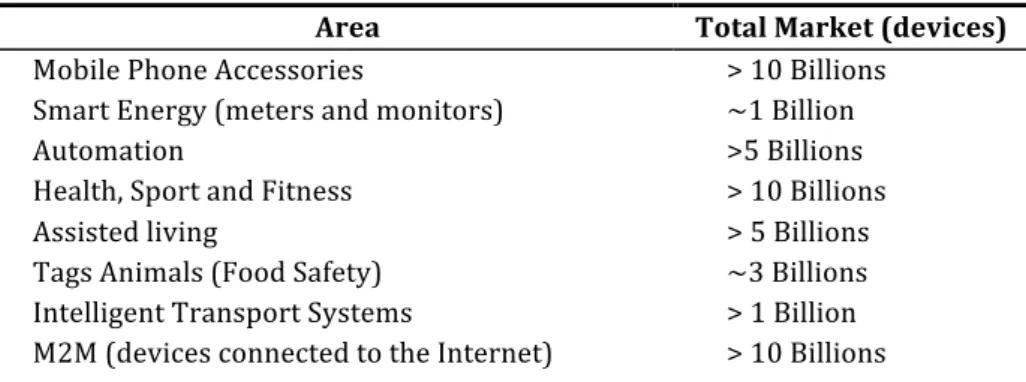
Table 1. BLE market values (Decuir, 2010)
Area Total Market (devices)
Mobile Phone Accessories
Smart Energy (meters and monitors) Automation
Health, Sport and Fitness Assisted living
Tags Animals (Food Safety) Intelligent Transport Systems
M2M (devices connected to the Internet)
> 10 Billions ~1 Billion >5 Billions > 10 Billions > 5 Billions ~3 Billions > 1 Billion > 10 Billions
Recent studies point to more than 50 billion devices connected until 2020. A market that represents, in the next 10 years, 14.4 trillion dollar (J. Bradley, 2013)of net profit for the companies positioned in these technological areas. The Bluetooth Low Energy (BLE) (Anon., n.d.) also known by Bluetooth Smart, is part of this technological revolution. It is increasing the number of chips with this technology, however, the implementation of solutions is not trivial, because the standard involves many details and the implementation is done to a very low level, being necessarily constrained by the resources available, like timers, memory, real-‐time clocks and others. By the author’s experience, achieve a satisfactory level of expertise to produce functional and consistent solutions, can take several weeks or even months. The technology is also very recent and as consequence there is a natural lack of documentation and technical support. This paper presents the implementation details of a code generator for BLE services. This code generator, that is presently a prototype, can produce the C files with all the necessary code to implement BLE services for the SoftDevices (nRF51 SDK, 2014) software stack, used on the family of chips nRF51. The code generator was conceived based on the builder design pattern enforcing the separation of the parsing process from the generation process. This solution has several advantages, as it is explained in Section 4. The paper is organized as follows: section 2 introduces the BLE, namely the GATT level that supports the services; section 3 introduces the syntax defined for the code generator; section 4 explains the architectural design of the generator; and section 5 wraps up the paper with the conclusions.
2.
BLUETOOTH LOW ENERGY
that the battery life may be many times larger than the device, allowing solutions that would otherwise be unfeasible. The standard also requires that the physical devices operate at very low voltages allowing the use of simple watch batteries. The manufacturers are also providing this technology at a low cost and in very compact solutions, which allows the existence of devices slightly larger than a coin. Being a standard accepted by most manufacturers, including the main smartphones manufactures, assures high levels of integration and interoperability.
Pairing, connection and transmission
The type of communication is master-‐slave, the master being responsible for the establishment of the network connection. To establish a connection between devices, the master device sends a discovery message, using broadcast for devices in range, switching between the frequencies used by Bluetooth. All slave devices, with the active mode of discovery hear the discovery messages, and send a response to the master device, containing the address and device class. A connection request can exist depending on the desired (A. Huang, 2007).
The BLE Protocol Stack
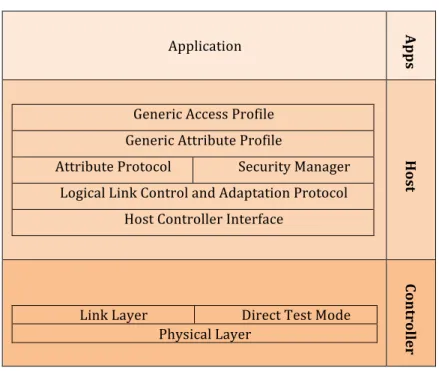
The BLE protocol stack is partitioned into controller and host. The controller is responsible for managing the lower layers of the stack, particularly the capture of physical packages and control of the RF circuit. The other components are: logic control layer connection and adaptation (L2CAP), Generic Access Profile (GAP), Security Manager (SM), Attribute protocol (ATT) and the Generic Attribute Profile (GATT). For a better understanding, the entire stack can be seen in the following Table 2.
Table 2. Bluetooth Low Energy Stack Architecture
Application
Ap
p
s
Generic Access Profile
Generic Attribute Profile
Attribute Protocol Security Manager
Logical Link Control and Adaptation Protocol
Host Controller Interface
Ho
s
t
Link Layer Direct Test Mode Physical Layer
Cont
r
ol
le
r
GATT
The Generic Attribute Profile (GATT), which is responsible for describing the different frameworks of services and is an extension of ATT that is specific to the BLE 4.0. It provides the interface to the application layer through the application profiles. Each application profile defines the formatting of data and how they can be interpreted by the application. The profiles increase energy efficiency by reducing the amount of data to be exchanged. These are designed for specific functionality, e.g. there are heart rate, glucose, notification alerts and several other profiles. This makes it easier for developers to create applications for purposes of specific features by using pairs of default values/attributes found in each profile.
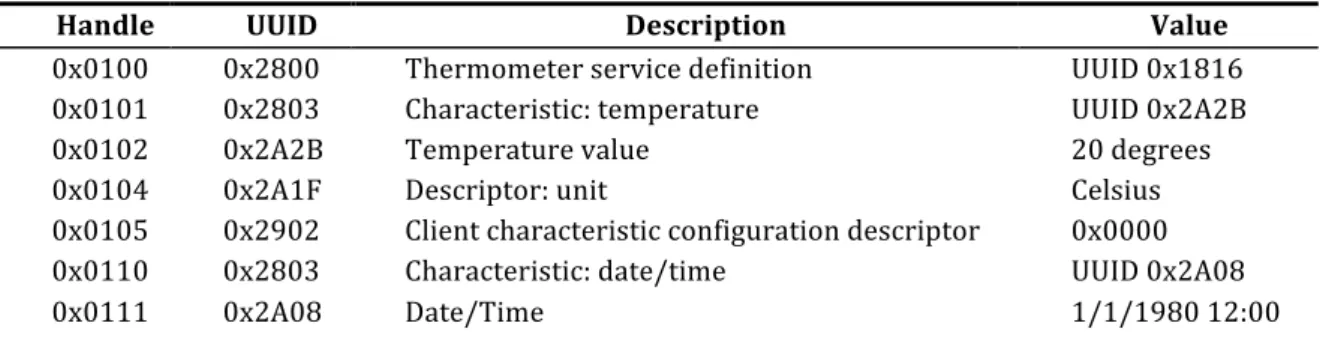
A GATT service it is a collection of related characteristics that work together to perform a specific function. Each GATT service has a number of characteristics. The characteristics storing useful values for services and its permissions. For example, the thermometer service includes characteristics for a temperature measurement value that is read-‐only, and a time interval between the measurements to be read/written. An example of a GATT service as well as their characteristics is shown in the Table 3.
Table 3. Example of a GATT service
Handle UUID Description Value
0x0100 0x0101 0x0102 0x0104 0x0105 0x0110 0x0111
0x2800 0x2803 0x2A2B 0x2A1F 0x2902 0x2803 0x2A08
Thermometer service definition Characteristic: temperature Temperature value
Descriptor: unit
Client characteristic configuration descriptor Characteristic: date/time
Date/Time
UUID 0x1816 UUID 0x2A2B 20 degrees Celsius 0x0000 UUID 0x2A08 1/1/1980 12:00
Each characteristic has at least two attributes: the main (0x2803), which defines the universally unique identifier (UUID), and the attribute value. They may also be other extra attributes called descriptors, which serve, for example, to identify the measurement unit or any other information relevant of the characteristic. The GATT knows that the handle 0x0104 is a descriptor that belongs to feature 0x0101, because this is not the attribute value, as the attribute value is known to be 0x0101. Each service may define their own descriptors, but the GATT defines a standard set of descriptors that cover most of the cases, for example: numeric and presentation format, readable description, the valid range or extension properties.
Table 4. GATT structure
Handle UUID Permissions Value
Service Characteristic Characteristic Descriptor
0x0001 0x0002 0x0003 0x0004
Service CHAR HRM DESC
READ READ READ/NOTIF READ
HRS HRM 80 bpm NOTIFY
3.
THE LANGUAGE SPECIFICATION
Before explain the details that involve the language specification, it is important to say that the present prototype does not include solutions for all available features of the BLE stack. The support for new features will require some changes on the syntax, on the build routine and on the concrete builders. But the essential of the syntax and architecture will remain untouched. Each service is identified by an address composed by 32 hexadecimal digits. To make the generated code more legible, it is used a name that works like a prefix for the functions, structures and other elements. These two elements are specified as it is illustrated on Figure 1.
Syntax:
service –> BLESERVICE ( prefix, address){ predef dis_connection characteristics }
Example:
BLESERVICE("WGEN", 0x2D26000057377FEE961BA8DB441BC2AC){ ...}
Figure 1. Service definition
Associated to the service, it is possible to have pre definitions (predef), which are described as C code surround by %\{ // C code }% and procedures that must be executed on the connection and on the disconnection events (dis_connection). These procedures should be defined using C code, like it is showed on Figure 2.
dis_connection –> connection | disconnection connection –> ONCONNECT:%{ // C Code %}
disconnection –> ONDISCONNECT:%{ // C Code %}
Figure 2. OnConnect and OnDisconnect procedures definition
For each characteristic, it is request a prefix to be used as distinctive element on the structures, functions and other components. Each characteristic has also an address with 32 digits that only differs from the service address in four digits. To avoid the introduction of the 32 digits, the user only has to supply these four digits (as a hexadecimal value). The BLE supports five distinct access types to the characteristics: read (r); write (w), write without response (o), notify (n) and indicate (i). The read and
write are, respectively, to read and write the characteristic; the write without response} is similar to the write but there is not any confirmation at the application level; the notify access is used to notify the slave whenever the value of the characteristic is changed on the stack; and the indicate access is similar to the notification, but there is a confirmation of the message deliver. The user can use several access types for each characteristic. It is also necessary to define the type of value associated to the characteristic and the interval of accepted number of values. The type of value is defined using the equivalent identifier of C language (uint8_t, float, char, ...). The interval is defined based in two integer or using C expressions surround by %{ //C expression }%, as it is illustrated at Figure 3.
Syntax:
// C code }%
Example:
temperature( 0x20AA, [rn], uint8_t, 1, %{len}%)%{ ... }%
Figure 3. Characteristic definition
At the end of the definition (see Figure 3) there can be zero or more blocks of C code surrounded by
%{ //C code }%, one per type of access used for the characteristic. Each one corresponds to the code that will be executed when is done the access by the correspondent type. Notice however that some access types, like the notify, indication and sometimes the read, do not execute any kind of procedure. But once defined one, the user should define all the others, even when they do not use it (using an empty block). Figure 4 shows a full example of a BLE service specification that will result, after being processed, into two files (*.h and *.c) with more than 250 lines of code.
BLESERVICE ("WGEN", 0x2D26000057377FEE961BA8DB441BC2AC){ PREDEF:%{
typedef struct per{ uint8_t var1;
uint8_t var2; } Period; }%
ONCONNECT:%{counter=0;}% CHARACTERISTICS:
temp1( 0x20AA, [w], uint8_t, 1, 1)%{x=10;}% temp2( 0x30BB, [rn], Period, 1, %{len}% ); }
Figure 4. Example of a BLE service specification
4.
THE ARCHITECTURE OF THE GENERATOR
Figure 5. Code generator architecture
The main function, which is a real function and not a method like it is represented at the Figure 5 (the implementation was done using bisonc++ (Brokken, n.d.) and C++), calls the parser to collect all the necessary information from the specification and fulfill the data structures (represented at the Figure 5 by the List of Service objects). Afterward, based on the argument target, instantiates the concrete builder that is able to generate the code for the desired chip/stack. Then it calls the
buildBLE() method, of the created Builder object, passing the require data structures.
The Builder class, which is an abstract class, defines the method buildBLE() that drives the building process. It also imposes that the concrete builder classes, like nRFBuilder and XBuilder, implement the methods required for the building process (represented at the Figure 5 by genInit() and genServDef()). Each of these methods is responsible for the generation of part of the final code.
5.
CONCLUSIONS
and server). For example, the BLE is based on the client-‐server architectural pattern, but does not allow to directly pass parameters to the server, the requests are based only in the server id. The implementation of a solution that simulates requests with parameters is possible but requires more than one characteristics and a small protocol. The proposed generator can easily supply this kind of solution, hiding all the complexity and unnecessary details.