Value Engineering
Master in Product Design Engineering
Eduardo Cerda Tolentino
Master’s internship report held under the guidance of Doctor Fábio Simoes, Professor of the Higher School of Technology and Management of the Polytechnic Institute of Leiria.
Originality and Copyright
This internship report is original, made only for this purpose, and all authors whose studies and publications were used to complete it are duly acknowledged. Partial reproduction of this document is authorized, provided that the author is explicitly mentioned, as well as the study cycle, i.e., Master in Product Design Engineering, 2018/2019 academic year, of the School of Technology and Management of the Polytechnic Institute of Leiria.
Acknowledgement
I would like first to thank my report advisor Fábio Simoes of the Escola Superior de Tec-nologia e Gestao at the Intituto Politecnico de Leiria. He was always open whenever I ran into trouble spot or had a question about my research or writing. He consistently allowed this paper to be my own work, but steered me in the right direction whenever he thought I needed it.
I would also like to thank the expert who was involved in the validation for this project. Value Engineering Leader, Christian Eppich. Without his passionate participation and in-put, this report could not have been successfully conducted.
Finally, I must express my very profound gratitude to my parents Eduardo Cerda and Enriqueta Tolentino and to my partner Melissa Marquez for providing me with unfailing support and continuous encouragement throughout my years of study and through the process of writing this report. This accomplishment would not have been possible without them.
Thank you all.
Sincerely,
Eduardo Cerda Tolentino
Abstract
MAN Truck and Bus AG is a leading international provider of commercial vehicles as well as well-known producers of diesel and natural-gas engines. This report focuses on the products manufactured in MAN Nuremberg assembly plant, which produces a wide variety of engines designed and developed for different applications for customer needs. As any other company in the industry, MAN has high expenses while producing their engines.
In response for this need, the PKO+ project was born. This project follows the VE ideology of improving the value of the goods or products by reducing the cost of the raw material, seeking of low cost suppliers, optimizing the product with or without customer perception, supply chain optimization, etc.
VE techniques have been applied to coordinate properly the communication between the different departments involved in this project.
The basics of this project and the starting process can be found in this report. These foundations consist of generating a support team, establishing long term targets, and pro-cesses to achieve such targets.
At the end, the results from period January 1st 2019 to August 1st 2019 are shown in this report.
Keywords: Value Engineering, Diesel Engine, Natural-Gas Engine, PKO+, Supply Chain Optimization, Cost Reduction.
List of Figures
2.1 D08 Engines (Source: MAN Internal Documents) . . . 4
2.2 D20 & D26 Engines (Source: MAN Internal Documents) . . . 5
2.3 Volkswagen Group (Source: MAN Internal Documents) . . . 8
3.1 PKO+ Targets - Whole Project (Source: MAN Internal Documents) . . . 11
3.2 2019 PKO+ Powertrain Targets (Source: MAN Internal Documents) . . . 11
3.3 Idea sheet used by MAN (Source: MAN internal documents) . . . 18
3.4 Process for PKO+ (Source: MAN internal documents) . . . 18
3.5 Benchmarking process (Source: Cost analysis and benchmarking) . . . 20
3.6 Polarix approach (Source: Polarix Benchmark Analysis) . . . 23
4.1 Concept of Project House (Source: Own Elaboration) . . . 27
4.2 Stacey Matrix Concept (Source: MAN Internal Documents) . . . 28
4.3 Agile Values and Principles (Source: MAN Internal Documents) . . . 29
4.4 Factors Influencing MAN (Source: MAN Internal Documents) . . . 29
4.5 Design Thinking Procedure (Source: Own Elaboration) . . . 30
4.6 Scrum Procedure (Source: MAN Internal Documents) . . . 32
4.7 Kanban Flow Chart (Source: MAN Internal Documents) . . . 33
4.8 RASI Analysis for PKO+ (Source: Own Elaboration) . . . 35
4.9 MAN NUE, Layout Distribution ((Source: MAN Internal Documents) . . . 36
4.10 PKO+ Layout Rooms (Source: Own Elaboration) . . . 37
4.11 PKO+ Workflow Process Concept (Source: Own Elaboration) . . . 38
5.1 Project House Workshop 1,1 (Source: Own Elaboration) . . . 41 viii
List of Figures ix
5.2 Project House Workshop 1,2 (Source: Own Elaboration) . . . 41
5.3 Project House Workshop 2,1 (Source: Own Elaboration) . . . 42
5.4 Project House Workshop 3,1 (Source: Own Elaboration) . . . 43
5.5 Team Members Availability (Source: Own Elaboration) . . . 43
5.6 Minute Example (Source: Own Elaboration). . . 44
5.7 Updated Wrap-Up Board - D08 Example (Source: Own Elaboration) . . . 47
5.8 Initial Concept for New PKO+ Room (Source: Own Elaboration) . . . 48
5.9 Layout for New PKO+ Room (Source: MAN Internal Documents) . . . 48
5.10 Part Number Logic (Source: MAN internal documents) . . . 49
5.11 Current Assembly for Fuel and Oil Lines (Source: Own Elaboration) . . . 55
5.12 Panduit Double Clamp Tie (Source: Panduit Website) . . . 56
5.13 Air Compressor for TRATON Synergy Project. (Source: MAN Internal Documents) . . 56
List of Tables
2.1 Market Segment (Source: MAN Internal Documents). . . 4
2.2 MAN Engine Ranges (Source: MAN Internal Documents) . . . 6
3.1 Truck Classes according their general weight (Source: American Automotive Manufac-tures Association) . . . 15
3.2 Diesel Engine Advantages[6] (Source: Own Elaboration) . . . 15
3.3 Diesel Engine Disadvantages[6] (Source: Own Elaboration) . . . 16
3.4 Main Parts of a Diesel Engine[8] (Source: Own Elaboration) . . . 17
3.5 Description of Process Phases (Source: MAN internal documents) . . . 19
4.1 PKO+ Team Members (Source: Own Elaboration). . . 34
5.1 Retrospective Summary (Source: Own Elaboration) . . . 46
5.2 Part Number Logic Examples (Source: Own Elaboration) . . . 50
5.3 Tests Performed on Parts (Source: MAN Internal Documents) . . . 51
5.4 BOM Analysis (Source: Own Elaboration). . . 52
5.5 LCC Sourcing based on Benchmark Analysis (Source: Own Elaboration) . . . 54
5.6 Savings in % per Air Compressor (Source: Own Elaboration) . . . 57
6.1 White Spot Analysis Topics (Source: Own Elaboration) . . . 61 6.2 Tracking List for Cross Functional Components Tandem (Source: MAN Internal Documents) 63
List of Acronyms
Value Engineering (VE)
Horse Power (hp)
Low Cost Countries (LCC)
Cross-Functional Teams (CFTs)
Nuremberg (NUE)
Exhaust Gas Recirculation (EGR) Selective Catalytic Reduction (SCR)
Bill of Materials (BOM)
Produkt Kosten Optimierung Plus (PKO+)
Contents
Originality and Copyright ii
Acknowledgement iv
Abstract vi
List of Figures ix
List of Tables xi
List of Acronyms xiii
1 Introduction 1
2 MAN Truck & Bus AG 3
2.1 MAN Engines . . . 3 2.1.1 D08 Engine . . . 4 2.1.2 D20 Engine . . . 5 2.1.3 D26 Engine . . . 5 2.2 Value Engineering . . . 6 2.2.1 VE Methodology[2] . . . 6
2.3 Synergies Between MAN Group . . . 7
3 Product Cost Optimization (PKO+) 10 3.1 Business Goals . . . 10
3.2 Targets . . . 11 xv
Contents xvi
3.3 PKO+ Classification . . . 12
3.3.1 PKO . . . 12
3.3.2 Internationalization . . . 12
3.3.3 Decontenting . . . 13
3.3.4 Supply Chain Optimization . . . 13
3.4 Tandems . . . 13
3.5 Product Examination . . . 14
3.5.1 Introduction to Diesel Engines . . . 14
3.6 Powertrain Backlog . . . 17
3.7 Benchmark . . . 20
3.7.1 External Support for Benchmarking Analysis . . . 22
4 Project House 25 4.1 Benefits of Project House . . . 26
4.2 Concept of Project House . . . 27
4.3 Agile Methods . . . 28 4.3.1 Design Thinking . . . 30 4.3.2 Scrum . . . 31 4.3.3 Kanban . . . 33 4.4 Team Members . . . 34 4.5 RASI Analysis . . . 35
4.6 Layout Distribution for PKO+ . . . 36
4.7 Workflow Process Concept . . . 37
5 Developed Activities 40 5.1 Project House Workshop . . . 40
5.1.1 Kick-Off Meeting . . . 40
5.1.2 Project House Results . . . 43
5.2 Project House Optimization . . . 44
5.2.1 Preparation of Retrospective . . . 45
Contents xvii
5.2.3 Implementation of Improvements . . . 47
5.3 BOM Analysis . . . 49
5.4 White Spot Analysis . . . 53
5.5 Preparation of Benchmark Workshop . . . 53
5.6 LCC Sourcing Throughout Benchmarking . . . 54
5.7 Cross Functional Components Tandem Ideas . . . 55
5.7.1 Replace Current Clamps with Tie Straps . . . 55
5.7.2 Air Compressor Carry Over with Adaptor . . . 56
5.7.3 Removal of EOL Testing . . . 57
6 Conclusions 59
Annexes 61
Chapter 1
Introduction
A main concern of any company is how to improve profit and reduce its costs, since any cost reduction is directly correlated to profit. The problem is how to carefully get rid of unnecessary costs since these ones cannot impact customers loyalty or reduce products quality[1]. For this reason, companies need to implement new and improved methods to reduce inessential expenses, and PKO+ shows how to achieve this. It describes a variety of tools and techniques used by the value engineering department to coordinate activities between the departments involved such as logistics, quality, engineering design, purchasing, controlling and validation, finance, and more.
Since MAN Truck and Busses announced that by year 2023 the company should reach a target saving of millions of euro, this cost reduction project was created to help in the process. This report describes the steps followed for PKO+ and the conclusions obtained during the internship period. PKO+ is a complex project, for that reason is necessary a full team organization.
Cost reduction is the easiest way to increase profit, and it is possible by removing waste-ful elements from design and internal processes. Keeping in mind that quality or service cannot be sacrificed. The selection of a cost reduction target is key, since cost reduction in the long term cannot undercut a company, but the opposite, it makes sure to pare away not profitable expenses[1].
The main objectives of PKO+ is to save large amounts of money in a long term pe-riod and the product optimization of the series product. For that reason, this report is structured in a way that the reader can understand the company vision as well as the methodologies and tools used in the VE department. Afterwards, the activities performed in the internship are described to finally let the reader know the obtained conclusions.
Chapter 2
MAN Truck & Bus AG
The intention of this chapter is to relate the reader with MAN, Nuremberg plant products and how the value engineering department can support such a big project as it is PKO+.
2.1
MAN Engines
MAN is recognized for being efficient producers of diesel and gas engines in performance ranges that goes from 50 hp to 2.000 hp. MAN develops, manufacture and sell pioneering products of excellent quality for different applications, assembly situations and load pro-files. This translates into products that have been developed, modified and tested precisely. This company relies on the latest technology and sophisticated components from large-scale production. Whether product applications can be for commercial vehicles, power genera-tion and co-generagenera-tion, or drives for agricultural machinery, rail, water, or special-purpose vehicles for customized solutions.
The assembly plant that focuses on engineering development and production of engines is located in Nuremberg, Germany. Place where all the Powertrain PKO+ project takes place. Within a total plant surface of 355,253 squared meters.
However, Powertrain PKO+ focuses on the three most fabricated engines with com-mercial vehicles purposes, which are: D08, D20 (soon replaced by D15), D26, and external engines, mainly for marine applications. These models starts with a "D" since this letter stands for "Diesel", meaning that PKO+ is putting effort only in this type of engines.
2.1. MAN Engines 4
Table 2.1: Market Segment (Source: MAN Internal Documents)
2.1.1
D08 Engine
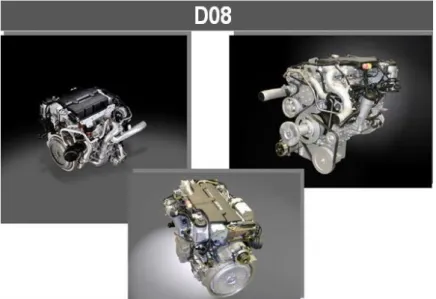
This type of engines have an inline type of 4 or 6 cylinder, depending on the model D0834 or D0836, respectively. These engines are designed mainly for on-road applications such as busses and special purposes vehicles, for example street sweepers, airport busses, trolley busses, fire engines, etc.
Power ranges varies depending on the model. For example, D0834 has a power range of 37-162 kW and a displacement of 4,6 liters. Meanwhile, model D0836 power range varies from 56-251 kW, with a displacement of 6,9 liters.
Figure 2.1: D08 Engines (Source: MAN Internal Documents)
2.1. MAN Engines 5
2.1.2
D20 Engine
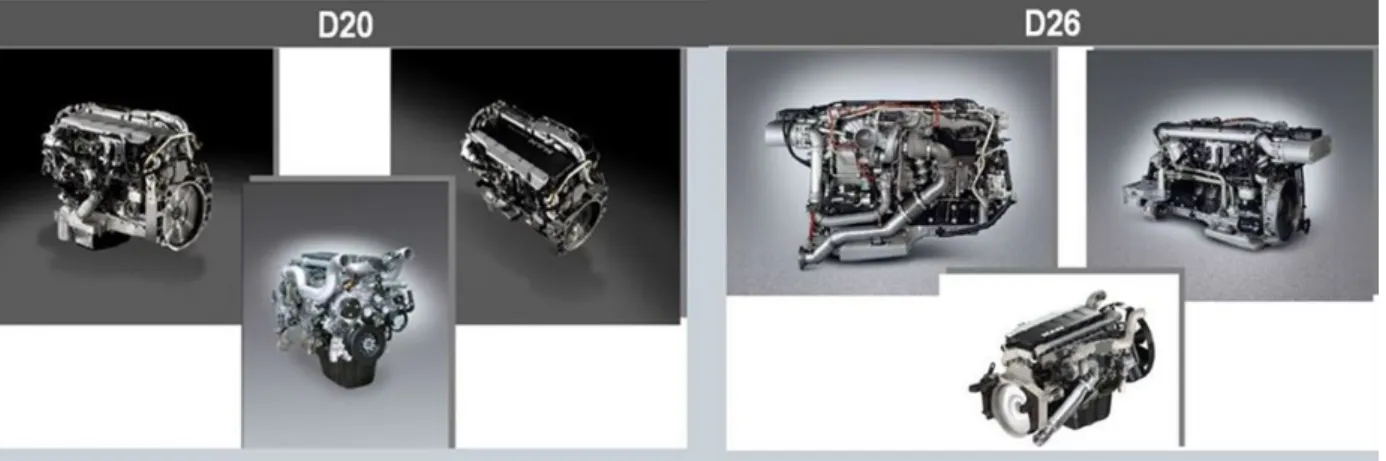
The D20 model is a 6 cylinder engine used for off-road applications such as, agriculture (tractors, harvesters, cutters and crushers), industry (construction equipment, commercial machinery), and railway (rail cars, locomotives, metro).
Power range for this type of engine can vary between 118 kW to 328 kW and a dis-placement of 10,6 liters.
2.1.3
D26 Engine
The heavy duty engine model is the D26. It is a 6 cylinder engine that is used not only for on-road and off-road applications, but also can be used in marine applications.
D26 has a 12,4 liter displacement and a power range that goes from 140 kW - 588 kW.
Figure 2.2: D20 & D26 Engines (Source: MAN Internal Documents)
2.2. Value Engineering 6
Table 2.2: MAN Engine Ranges (Source: MAN Internal Documents)
2.2
Value Engineering
Value Engineering is an organized effort directed at analyzing the function of goods and services for the purposes of achieving basic functions at the lowest overall costs, consistent with achieving essential characteristics.
The goal of the value engineering department is to utilize the materials in the most economical way to better the most economical project. VE is a team effort, requiring contributions from all disciplines. All of these parties have a interest in common, which is to improve the product so that the entity can be more successful[2].
In other words, VE is a process using multi-disciplined teams to review projects and standards to identify high costs functions with improvement potential. The teams follow the VE plan to establish an optimum value for selected functions[2].
PKO+ has assigned the Value Engineering team as responsible for internationalization, de-contenting, product cost optimization and voice leader to coordinate all the parties involved in the project.
2.2.1
VE Methodology[2]
VE can look at ways to utilize resources (people, time, money, material) better and still accomplish the same function. In fact, behind VE there is a powerful methodology to problem solving, reduce costs, improve quality and performance, and maintain intended functions[2].
2.3. Synergies Between MAN Group 7
General: Before actual work begins, a foundation should exist consisting of good hu-man relations, teamwork, and hu-management support so that an effective interaction can take place and work can focus on specifics.
Information: Secure facts, determine costs, and fix costs on specifications and require-ments.
Function: Define the function, evaluate functions relationships, and identify costs for these functions.
Creativity: Establish positive thinking and develop creative ideas in a team setting. Evaluation: Refine and combine ideas, establish costs on all ideas, develop function alternatives, and evaluate by comparison.
Development: Develop and present proposals that resolve the study issues and moti-vate to action.
Implementation: This is the phase of the job plan in which the proposal is implemented and the product is improved by acceptance of the VE recommendations.
2.3
Synergies Between MAN Group
Business firms in many industries currently pursue the realization of synergies with high priority to increase corporate performance. The main advantages of a cross-functional synergy are the raise of efficiency in the products as well as the reduction of components cost. In addition to these advantages, companies focus on achieving profitable corporate growth by collaboration across their international business. For many companies is a way of growth in their saturated markets[3]
Strategic management have recognized and emphasized the importance of synergies for decades. Synergies are the prime rationale for alliances and for international firms. How-ever, the realization of synergies into a coherent whole is costly and require resources, for that reason, it needs to be properly managed[3].
2.3. Synergies Between MAN Group 8
According to the definition, cross-functional synergies exist if the net present value of the combined firms is greater than the sum of the net present values of the individual firms. Therefore, from the perspective of a corporate manager, every cross-business activity that increases the net present value of the combined firms leads to cross-business synergies.
For PKO+, these alliances are essential because companies can join together to get some cost reduction savings. To have a better approach on MAN Truck and Bus synergies, it is important to know that MAN is a sub-company from the Volkswagen Group. The Volkswagen group comprises twelve brands from seven European countries.
To illustrate, figure 2.3 show these brands.
Figure 2.3: Volkswagen Group (Source: MAN Internal Documents)
It is true that the Volkswagen Group is huge and is one of the main automotive influ-ences worldwide. Inside this group you can find important brands like Volkswagen, Audi, Seat, Skoda, Bentley, Bugatti, Lamborghini, Porsche and Ducati. However, these brands are not really good alliances when referring to MAN since the structure of a car is totally different as the interface of a truck or bus.
In the other hand, TRATON is the truck and bus group created by Volkswagen. This group is conformed by brands like MAN, Scania, MAN Latinamerica, and RIO. Recently, has made a new alliance with Navistar. TRATON aims to become a global champion of the commercial vehicle industry and drive the transformation of the logistic sector[4].
TRATON leads the truck market in the European and Brazilian sectors and consider-ably increased unit sales by 13.7%. The name TRATON stands for tradition, transport, transformation, tonnage, among other meanings[4].
Chapter 3
Product Cost Optimization (PKO+)
PKO+ comes from the German meaning of Produkt Kosten Optimierung Plus, which means, "Product Cost Optimization, Plus" and it is a cross-functional cost management program to intensify the identification and realization of cost potential for serial products in a long term. It need to be taken seriously since it involves a lot of resources and has really big targets. The main categories under PKO+ are product cost optimization, internationalization, de-contenting, and supply chain optimization. It is important to clarify that PKO+ do not include new product development but only current production.
3.1
Business Goals
The main goals of the PKO+ project are:
- Money savings in a long term period
- Product optimization of series product
In order to reach these objectives it is necessary that all the parties involved joint responsibilities, and most important is that all the cost reduction ideas are not judged. Every idea needs to be challenge and everything need to reach top management and have a top priority.
3.2. Targets 11
3.2
Targets
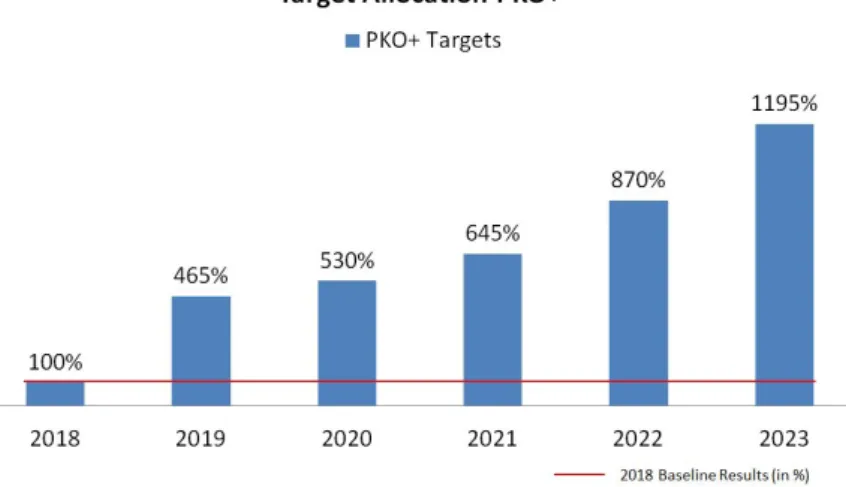
The aim of MAN Truck and Bus is to save a high quantity of millions of euro in the period of 5 years. However, for the first year (2019), the target is 4,65 bigger compared with the savings obtained in 2018, from which, Nuremberg’s engine plant, in charge of the power-train system has to double the savings in comparison with 2018.
Figure 3.1: PKO+ Targets - Whole Project (Source: MAN Internal Documents)
Figure 3.2: 2019 PKO+ Powertrain Targets (Source: MAN Internal Documents)
3.3. PKO+ Classification 12
3.3
PKO+ Classification
3.3.1
PKO
This term refers to the continuous process of obtaining the best pricing/cost with no im-pact or reduction of scope of the product and ensuring the customer satisfaction scores are maintained. Some common practices to achieve PKO targets can be:
1. Identify potential by:
-Benchmarking
-Reference calculation
2. Reductions such as:
-Implement new technology
-Internal sourcing to LCC
-Optimizing existing parts
3.3.2
Internationalization
Internationalization in PKO+ means the seeking of new low cost suppliers in low cost countries, for instance, China, India, Mexico, Brazil, among others. It can be considerably cheaper to get parts done in low cost countries and pay importation fees rather than pro-ducing parts in Europe.
Currently a wide range of MAN products are made in Germany and the intention is to start sourcing more parts to LCC. To achieve this task it is necessary to be in constant com-munication with the purchasing team to close negotiations with the new prospect suppliers.
It is not easy to accept new suppliers in MAN. They need to meet all legal require-ments and to migrate from one supplier to another a lot of validation tests need to be done.
3.4. Tandems 13
The first phase to achieve 2019 goals is to source only the parts that do not require testing. At this point is not feasible to source parts like the cylinder block or the crankshaft for the short period time. In the other hand, bearings and other common parts are a good way to begin.
3.3.3
Decontenting
Decontenting can be understand as the removal of features in the engine with customer perception in order to sell it more cheaply. This is a though task, however, it is possible to gather all the engine engineers together and some external support experts to deeply talk about components that can be sold separately as options.
There is also a term called "reductive decontenting" in which the objective is to reduce the weight of many components to get an overall engine weight reduction.
For example, if the engine gets lighter, that translates to smaller brakes, smaller shocks, better fuel consumption performance, and cheaper shipping costs. At the end, the overall vehicle and process gets benefited by applying reductive decontenting.
3.3.4
Supply Chain Optimization
SCO is the reduction of cost regarding supply chain. Nowadays, supply chain has become a very complex system of people, processes and technologies[5].
To reach the targets, MAN is forced to optimize its supply chain process taking in con-sideration that this process needs to remains lean, manages costs, and capable to respond fluctuations[5].
3.4
Tandems
The meaning of Tandem in this context refers to the group of experts from the purchasing and engineering department. There exist one Tandem per engine category, which are the following: Tandem D08, Tandem D15, Tandem D26, and Tandem Cross-Functional Components. To achieve a successful result for PKO+, these Tandems need to be supported by validation, controlling, quality and production & logistic.
3.5. Product Examination 14
3.5
Product Examination
It is necessary to understand the product and know where the team is positioned. Support from the different members to get design details and engineering drawings are going to be crucial. Another important task is the coordination between the PKO+ team and the benchmark department to disassemble the engine and observing the sequence.
In today’s competitive market, customer requirements on engine product functionality are increasing. Better fuel performance, higher power, faster acceleration, lower noise, and longer reliability life are a few examples. On the other hand, the supplier industry is trying to provide engine manufactures with advanced or luxury components, but it may not be financially viable at all.
There is a pressing need for system cost integration and control during engine develop-ment in order to design the least expensive product while meeting customer requiredevelop-ments. Although cost reduction opportunities exist in almost all engine components, there are main aspects that drive a high product cost, for example, emissions compliance, fuel econ-omy improvement, and advanced features[6].
3.5.1
Introduction to Diesel Engines
In principle, a diesel engine is a type of compression-ignition engine using diesel fuel. According to emission standards and engine applications, diesel engines are classified as on-road, off-road and stationary. The on-road applications include trucks, buses and au-tomobiles. The off-road applications include marine, agricultural, industrial and locomo-tive[7].
The American Automotive Manufacturers Association emissions certification methods for on-road applications, diesel engines are classified as heavy duty, medium duty, and light duty. Heavy duty applications include trucks, buses, certain off-road vehicles, marine engines, generator sets, etc. Light duty applications include passenger cars, sport utility vehicles and light trucks, like some pick-up trucks[7].
The American Automotive Manufactures Association divide these classifications in 8 classes, which can be seen in Table 3.1:
3.5. Product Examination 15
Table 3.1: Truck Classes according their general weight (Source: American Automotive Manufactures Association)
According to different fuel injection methods, diesel engines are classified as direct and indirect injection. By air charging method, diesel engines are divided as naturally aspirated, mechanically supercharged and aerodynamically turbocharged. By cooling medium, diesel engines are divided into water-cooled and air-cooled. According to the after-treatment technology diesel engines can be classified into EGR (exhaust gas re-circulation) engine, non-EGR engine, SCR (selective catalytic reduction) engine, and non-SCR engine.
Comparison between diesel engines and gasoline engines
Understanding the fundamental characteristics of diesel engines is very important for en-gine system design and powertrain technology assessment. Compared to gasoline enen-gines, diesel engines have the following advantages:
Table 3.2: Diesel Engine Advantages[6] (Source: Own Elaboration)
3.5. Product Examination 16
However, there are several design challenges for diesel engines compared with their gasoline counterparts as follows:
Table 3.3: Diesel Engine Disadvantages[6] (Source: Own Elaboration)
The above challenges are important system characteristics of diesel engines although they are inherently unfavorable. The best is to enhance the advantages of diesel engines and minimize, or at least not to increase, the disadvantages.
Main parts of a diesel engine
The main components of this type of engine are listed in Table 3.4
However, components like the aftertreatment, turbocharger, EGR system, fuel injec-tors, cylinder heads, piston, piston rings and the crankcase have a high impact regarding major cost increase for low emission engines.
Each of the mentioned items has a heavy weight on overall engine product cost. If each of them is not planned and controlled carefully, the entire engine will be at a risk of high cost. In diesel engine design there is a need to plan the integrated cost roadmap and to coordinate the cost structure.
3.6. Powertrain Backlog 17
Table 3.4: Main Parts of a Diesel Engine[8] (Source: Own Elaboration)
3.6
Powertrain Backlog
The powertrain backlog refers to an ordered list of ideas generated by each tandem. This backlog lists all the features and requirements that constitute the changes to be made to the engines in future releases. The backlog items have the attributes of a description, estimate values, images, savings, volume, among others[9].
The powertrain backlog refinement is the act of adding detail, estimates and order to the powertrain backlog. This is an ongoing process in which the PKO+ coordinator and the development team, collaborate on the detail of the powertrain backlog items. During the refinement, items are reviewed and revised. Higher ordered backlog items are usually clearer and more detailed than lowered ordered ones.
3.6. Powertrain Backlog 18
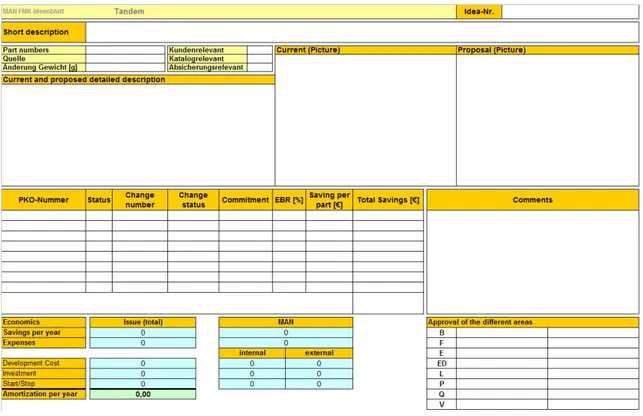
Idea Sheet
The idea sheet is what MAN uses to document all the generated ideas. This idea sheet need to be constantly updated since more information is added on it when going through the different process phases.
Figure 3.3: Idea sheet used by MAN (Source: MAN internal documents)
Process Phases for PKO+
As mentioned above, the idea sheet pass through different phases. This is what MAN Truck & Bus call as "H" logic.
Figure 3.4: Process for PKO+ (Source: MAN internal documents)
3.6. Powertrain Backlog 19
This logic consist on filling certain type of information depending on which phase the idea is standing in a particular moment. This is mainly to avoid wasting time in case of an early discover of a non-potential idea.
In general, the development team generates a new idea and fill out basic information based on assumptions. Later on, more and detailed information is required for the next phases. The detailed description of the phases can be find in the table below:
Table 3.5: Description of Process Phases (Source: MAN internal documents)
3.7. Benchmark 20
3.7
Benchmark
Benchmarking is a systematic approach to identify standards for comparison. It reveals the gaps in design attributes and provide ideas for design improvement. Benchmarking should include best-in-class objective attribute measures and research into how this attribute is achieved. It tends to be a business-based process used to measure and the improve perfor-mance. It can be effective in developing an understanding of the market and generating competitive advantage through increased efficiency[10].
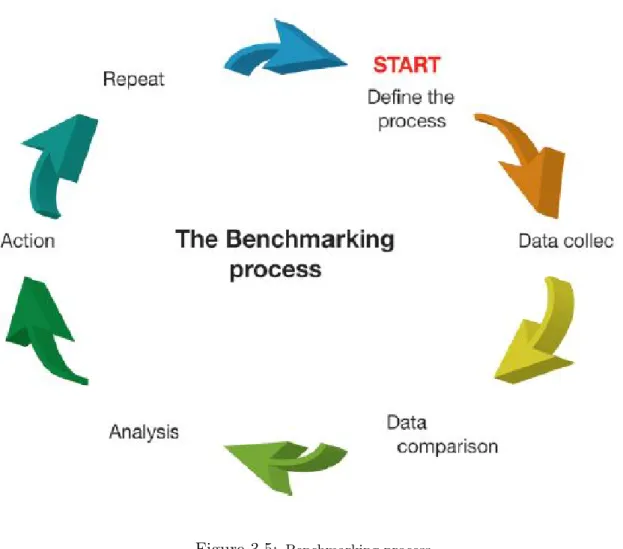
A great technique is to perform a competitive benchmark design analysis. This tech-nique analyses one fundamental design parameter against other by using a large amount of different engines. As benchmark may well form part of a business process, which will include a number of steps as illustrated in Figure 3.5:
Figure 3.5: Benchmarking process (Source: Cost analysis and benchmarking)
3.7. Benchmark 21
It is also worth considering the following before starting out on a benchmarking exercise:
1. Establishing a baseline with consistent use of measurement and cost breakdown. The baseline in this case are MAN engines and the intention is to compare it with other competitors engines.
2. Make sure the process to be follow is clear and define responsibility for data collec-tion while keeping a simple structure.
3. Use appropriate technology to collect, manage and model data to get accurate re-sults and ensure they are interrogated and reported.
Basic engine system design parameters are very important for analyzing performance and durability at an overall system level. Some common engine system parameters are presented as follows:
- The number of cylinders, which affects the torque balance.
- Engine cylinder bore diameter, which affects engine weight and wear.
- Cylinder centerline distance, conrod length, and piston compression height.
- Engine stroke, which affects mean piston and engine speed, and engine friction.
- Engine weight, among many others.
The benchmarking exercise will reveal the construction cost broken down into elements. An element is a major physical part of the engine that full fills a specific function or func-tions irrespective of its design. Then it is much easier to compare collected cost analysis data which can then feed into the estimating cost planning process.
Since MAN does not have enough resources to perform a benchmarking analysis, a con-sulting company has been reached out to provide engineers to perform such studio, gather data and share the results. This benchmarking process is not completed until the resulting data is analysed and neccesary action taken.
3.7. Benchmark 22
3.7.1
External Support for Benchmarking Analysis
Polarix is a consultancy company that aims to help external companies in the automo-tive, aerospace, engineering sectors. They coordinate solutions for different areas including benchmarking[11].
Polarix is a good option for MAN Truck and Bus since they have worked with bench-marking before for brands like Tesla and Scania and their work seems to be promising.
Background and Content
- MAN is planning a reduction in cost and technical improvement initiative called PKO+.
- Based on the current D08 design MAN would like to benchmark its own technical solution against suitable competitors solution.
- Main target of this benchmark is to understand the technical specifications of suitable competitors, to identify possible technical improvements as well as to set up derivations to full-fill the internal costing targets.
- Further target of the benchmark is, to understand the cost balance between MAN and the competitor solution on single parts but also in functional level.
Objectives
- Identify suitable competitors solution for an effective benchmark based on similar re-quirements for medium engines in the market.
- Preparation and moderation of structured competitors benchmarks.
- Detailed disassembly and evaluation of all engine components in the benchmark and documentation of results and findings.
- Bottom-up calculation of the engines as baseline and reference for cost out potentials.
3.7. Benchmark 23
Polarix Approach
Polarix suggests a project with 5 main phases, which are illustrated in Figure 3.6:
Figure 3.6: Polarix approach (Source: Polarix Benchmark Analysis)
where;
1. Project Set Up, Selection and Decision: An approach, a team, a project plan and the competitors engines to evaluate are defined. Also common alignments such as the evaluation, calculation premises and the form of documentation are decided.
2. Tear Down: Disassembly of MAN engine and competitors engines happen in this phase with the intention of viewing the first specifications highlights such as weight and dimensions. The tear down also helps to identify technical potentials by comparing the engines. Finally, the documentation of the findings for evaluation and clarification.
3. Bottom-up Calculation: The project team aligns the calculation results and documents the cost information in MAN standardized bill of materials.
4. Benchmark and Evaluation: In this phase, the team compares and visualizes the calculation results. The generation and documentation of cost saving ideas is done, just to discuss the further development of workshops for such cost saving ideas. At the end, the team gathers to determine and evaluate the technical and commercial potential for the ideas generated.
5. Documentation and Presentation: Final overall documentation of the bench-mark results. The final phase is to deliver MAN the substantial recommendations of possible actions and next steps for MAN design and engineering department. Handover of all calculations, documentations, etc.
Chapter 4
Project House
Project House refers to the working space and the working methodologies that are used inside this working space to ensure that functions like Engineering and Purchasing iden-tify, pursue, optimize, and implement the cost of the current products in the organization system and in the assembly line.
In Project House, the use of Cross-Functional Teams (CFTs) are key since they es-tablish a closer link between functions and are considered to be a key factor to successful innovation. These teams are composed of those individuals from departments that are essential in achieving an optimal evaluation. PKO+ CFTs are structured as temporary teams because are not build in the organization structure. However, time and resources are being assigned to set up development, analysis and problem-solving studies[12].
The interaction of team members, from diverse backgrounds and experiences enhance to creativity which leads to new ideas and solutions. CFTs transforms work from sequen-tial process to more simultaneous ones. The early and synchronized cooperation of all relevant functions helps to recognize potential problems in advance and allows for early countermeasures[12].
Creating CFTs for PKO+ have benefits not only in the way people interact to achieve the companies goals, but also creates some team spirit, which motivates people to make a good effort on their daily tasks. All the team members can get benefited from such team since everyone is continue learning from each other and broad the skills in the department. Having all the members in the same room creates transparency, which sooner or later transforms into trust.
4.1. Benefits of Project House 26
4.1
Benefits of Project House
The potential advantages attributed to CFTs can be summarized in the following points:
Controlling Complexity
The increasing complexity of innovative tasks exceeds the information processing and coor-dination capabilities of individuals or functional groups. The combined expertise of CFTs is expected to add to the accomplishments of these tasks.
Efficiency
CFTs are expected to better perform certain activities simultaneously, wich otherwise would be performed sequentially.
Creativity
A greater variety of specialists offer a broader knowledge giving rise to more varied in-terpretations of the same information. These more varied inin-terpretations are expected to result in more ideas being generated.
Communication
The communication is improved since it becomes clear, concise and constant. These leads to a fast alignment between functions and address problems more quickly. However, some-times conflict can occur but is expected that this occur in a constructive matter.
Team Spirit
PKO+ gives the opportunity to make a team of high performers to take a big challenge and bring out a huge performance.
4.2. Concept of Project House 27
4.2
Concept of Project House
The intention of the project house can be summarized as follows:
Figure 4.1: Concept of Project House (Source: Own Elaboration)
Where;
Ideation
This step is focused on the generation of ideas to meet PKO+ targets. If necessary, exter-nal support can be provided such as a benchmarking team.
Evaluation
Once the ideas are generated, it is time to prioritize them by due dates. It is necessary at this point to know all feasible options for year 2019. The evaluation consists of idea description, savings, assigned resources, efforts, timeline, etc.
Decision
In this stage, the Tandem presents idea to decision-making board. This committee needs to approve or provide feedback in case of rejection.
Implementation
The implementation consists of tracking the idea through the whole workflow process until it is implemented on the assembly line.
4.3. Agile Methods 28
4.3
Agile Methods
Agile working means that self-organized teams steer through an environment of permanent change and constantly improve themselves.
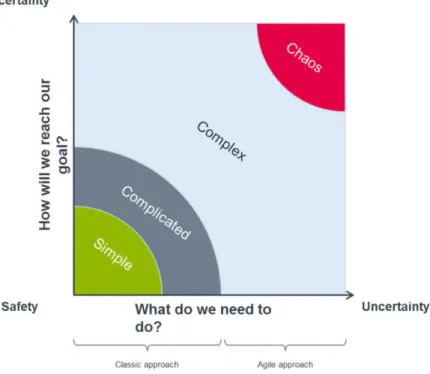
Stacey Matrix
The Stacey Matrix is a decision-making tool to find the best approach for various projects and processes. This tool helped to determine that Agile is the correct approach for PKO+.
In the simple and complicated areas, the overall picture is already fixed and can be il-lustrated. It is about understanding the goal and the way to achieve it (Classical approach).
In the complex or chaotic areas, the overall picture is still unclear. Neither the goal nor the way to get there is clear. However, it is already clear that they will continue to change and therefore cannot be illustrated at the present time. You have to act or react until you have gained clarity (Agile approach).
Figure 4.2: Stacey Matrix Concept (Source: MAN Internal Documents)
4.3. Agile Methods 29
Agile Values and Principles
To guarantee the success of agile working it is necessary to follow some values and principles and prioritize them since they need to meet MAN Truck and Bus working culture.
Figure 4.3: Agile Values and Principles (Source: MAN Internal Documents)
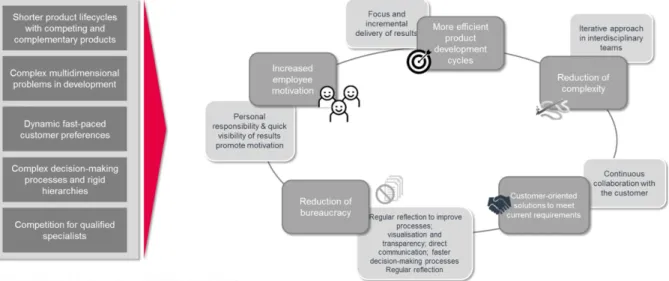
Factors Influencing MAN
Figure 4.4 shows the agile factors that influence MAN.
Figure 4.4: Factors Influencing MAN (Source: MAN Internal Documents)
4.3. Agile Methods 30
4.3.1
Design Thinking
Through Design Thinking, the needs of the customer are responded in a structured way in order to generate innovative solutions. It constantly examine the problem and its possible solution through an iterative approach[13].
It is commonly use for problem-solving situations or customer need analysis. It is com-mon to find the following roles in this type of agile working: Presenter, Customer, and Interdisciplinary Team[13].
Presenter: The presenter takes over the content related and methodological organi-zation of workshops. Makes sure that no one loses sight of the design challenge.
Customer: This role must not necessarily be physically present during development, but it would increase the speed of iterations. If present, it would always be a great help too.
Interdisciplinary Team: Here, experts of different departments that require a multi-functional, flexible point of view are in high demand. The more different point of views are represented, the more successful the process for generating ideas.
Procedure
Design Thinking procedure is not complicated. It follows a series of events that goes from understand the customer requirements up to the final step which is testing.
Figure 4.5: Design Thinking Procedure (Source: Own Elaboration)
4.3. Agile Methods 31
4.3.2
Scrum
Scrum is used for projects that are too large and complex to plan individual phases in de-tail in advance. The solution is self-determined and interdisciplinary teams that organise themselves according to defined guidelines, prioritize tasks and provide functions early on to include customer feedback[14].
Roles
There are three main roles in Scrum, which are: The Product Owner, The Scrum Master, and The Development Team.
Product Owner: Is the link to the customer, communicates his requirements to the team and prioritizes them. The product owner is responsible for maximizing the value of the product as well as the work of the development team and is the only person responsible for managing the product backlog.
Scrum Master: Is responsible for the understanding of Scrum and ensures that the Scrum Team follows the theory, practices and rules of Scrum Agile Work. He is a servant leader for the Scrum Team and helps to optimize the collaboration between the Scrum Team.
Development Team: Generates solutions from the requirements, plans them inde-pendently and implements them.
Artefacts
There are two types of backlog that need to be understand if PKO+ choose to work with Scrum.
Product Backlog: The product backlog is a list of customer requirements for the product. For PKO+ means, it is the list of ideas that need to be processes to meet the 2019 targets.
4.3. Agile Methods 32
Procedure
Prescribed events are used in Scrum to create regularity and to minimize the need for meetings not defined in Scrum. All events are time-boxed, such that every event has a maximum duration.
Sprint: Cycle of 1-4 weeks, at the end of which a deliverable result is presented to the customer. The customer in this case means to the committee board.
Sprint Planning: The product owner communicates the goal to the development team, then the team works out how the goal will be achieved and plans the next sprint.
Daily Scrum: During the sprint, the team synchronizes daily for 15 minutes.
Review: The customer, in this case, the committee board, received a function based on which they can give feedback.
Retrospective: The team discusses how they can improve.
Backlog Refinement: The items in the product backlog are prepared for the upcom-ing sprint by beupcom-ing refined by the product owner together with the team.
Figure 4.6: Scrum Procedure (Source: MAN Internal Documents)
4.3. Agile Methods 33
4.3.3
Kanban
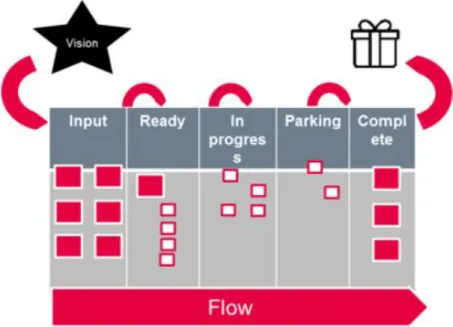
Kanban is an agile tool designed to help visualize work, limit work-in-progress and max-imize flow process. It offers transparency in the department environment and thus offers an extremely high degree of flexibility. As flexible as Kanban may be, the focus must be maintained. This means the task started must be finished before starting a new one. With a maximum number of tasks coordinated in the team, this way, the team is protected from overload, quality is ensured and a fast pace is maintained. It also prevents tasks from remaining unfinished on the board[15].
This Agile tool is frequently used to manage projects, departmental activities, and meetings. The versatility is the major advantage Kanban offers, because this methodology is a comprehensive approach, which in principle can be applied to any existing process, whether Agile or not[15].
Kanban does not provide for explicit roles or fixed events. It is, however, important that there is at least one person who understands the principles of Kanban and feels re-sponsible for the process. This may be the project lead, product manager, a Scrum Master, a department manager or an external coach. It is recommended the regular performance of retrospective to ensure harmony and constant optimization of the process.[15].
Figure 4.7: Kanban Flow Chart (Source: MAN Internal Documents)
4.4. Team Members 34
4.4
Team Members
At this point, the benefits of creating a cross-functional team were reviewed and briefly discussed some fundamentals concepts of the work methodology. However, it is time to formalize the project by assigning names to this cross-functional team.
As you may know by know, a cross-functional team gathers together a group of spe-cialists with different backgrounds, and it is expected an innovative work from it. The following areas were considered for this project: Engineering, Validation, Purchasing, Ma-terials, Controlling, Quality, Production, Logistics, and PKO Coordinators.
Table 4.1: PKO+ Team Members (Source: Own Elaboration)
4.5. RASI Analysis 35
4.5
RASI Analysis
Once we know the team members, it is important to define their roles in the project and assign responsibilities. Otherwise, work can be done twice, or nobody feels responsible for doing certain tasks.
The RASI Matrix is an integrated view of who is involved and in which role across all project activities from start to end of the project. RASI stands for, Responsible, Approv-ing, SupportApprov-ing, and Informed. It is important that only one role can be responsible per activity[16].
Figure 4.8: RASI Analysis for PKO+ (Source: Own Elaboration)
In Figure 4.8 can be noticed that more than one role is assigned as responsible for an activity. The reason for this, is that inside that activity there are some sub-activities which have different responsible. For example, under "Evaluation of Idea" there are activities such as, technical documentation, get quotes, get supplier lead times, timeline and define resources, and the Tandem is the responsible for these activities. You can also find tasks like quality and production & logistics efforts/timelines, which the quality expert and production & logistics expert are the main responsible. Finally, the evaluation of the business case is a task that the controlling specialist needs to make.
4.6. Layout Distribution for PKO+ 36
4.6
Layout Distribution for PKO+
MAN Truck and Busses, plant Nuremberg is a huge place. Where you can find areas of production, logistics, R&D, Administration, among others.
Figure 4.9: MAN NUE, Layout Distribution ((Source: MAN Internal Documents)
For that reason, as owners of the PKO+ projects, it is necessary to provide a working space for the participants, where they can join together and discuss PKO+ issues and work on solutions.
The following image shows the assigned rooms to each Tandem. All rooms are located in the same floor and in the same building V1, which is the administrative building.
4.7. Workflow Process Concept 37
Figure 4.10: PKO+ Layout Rooms (Source: Own Elaboration)
4.7
Workflow Process Concept
It is important to define a workflow process in order to create structure and operate with a great deal of efficiency. Operating with a loose process structure can be costly when dealing with correcting errors and managing damage control.
Figure 4.11 shows the workflow process concept that PKO+ demands.
Tandem
In charge of generating ideas including estimation feasibility and evaluating measures, such as, savings, timelines, etc.
Premeeting
Evaluation and confirmation of idea feasibility.
Powertrain Steering
4.7. Workflow Process Concept 38
Figure 4.11: PKO+ Workflow Process Concept (Source: Own Elaboration)
Tandem
If Tandem receives back the proposed changes, in this stage, they make the final adjust-ments and prepares for next level.
Fachgruppe
Makes a decision if budget does not reach 100.000,00 Euros.
SteerCo
Makes a decision if budget does not reach 500.000,00 Euros.
Entscheider Kreis
Chapter 5
Developed Activities
5.1
Project House Workshop
This workshop consisted on three activities. The first one was to generate and discuss the first ideas, the second one was to create a working model and the last one was to propose their own schedules for PKO+.
To accomplish these tasks, the value engineering team provided markers, papers, pin-boards, kanban pin-boards, monitors, and more objects to the Tandem Teams.
5.1.1
Kick-Off Meeting
The objective of the kick off meeting for project house was to introduce everybody, explain the project house concept, explain the targets to the team and make a workshop to keep things dynamical.
Create and Prioritize Ideas
The first thing was to assign the tandems to their working rooms and start working on the first ideas. The purpose is to generate as many ideas as they can. In a further step the Tandems need to prioritize and work first on the ones that can be done for 2019.
5.1. Project House Workshop 41
Figure 5.1: Project House Workshop 1,1 (Source: Own Elaboration)
Figure 5.2: Project House Workshop 1,2 (Source: Own Elaboration)
Discuss Working Model
The workflow was discussed in detail by all Tandems and PKO+ Coordinators as a basis for structuring the weekly schedule and align the new ideas with the current workflow process.
5.1. Project House Workshop 42
Figure 5.3: Project House Workshop 2,1 (Source: Own Elaboration)
Tandem Schedules
The purpose of this activity was to assign some working time to this project. At the mo-ment, Tandems will not focus on PKO+ a 100%. The intention was to gather everyone together to discuss what will be the best time to meet.
Blank schedules were provided and Tandems needed to fill them out with glued spots. The only fixed times are the Stand Up meetings, which happens every Monday from 9:00 to 10:00 and the PT Steering meeting, which happens every Friday from 10:00 to 12:00.
5.1. Project House Workshop 43
Figure 5.4: Project House Workshop 3,1 (Source: Own Elaboration)
5.1.2
Project House Results
Team Members Availability
The tandem schedules were analyzed and the conclusion can be observed in the image below:
Figure 5.5: Team Members Availability (Source: Own Elaboration)
5.2. Project House Optimization 44
PT Steering Meeting
The PT Steering is a meeting where the progress of the tandems is evaluated by top manage-ment. Top management can give feedback and direction to the Tandems in these meetings.
The duration of this meeting is 2 hours, where, 30 minutes are spent per Tandem (D08 - D15 - D26 - Cross Functional Components) and this events happens once a week, in this case, on Fridays from 10:00am - 12:00pm. At the end of the PT Steering meet-ing, a minute is sent to all the team members to have in mind their tasks for the next week.
Figure 5.6: Minute Example (Source: Own Elaboration)
5.2
Project House Optimization
After 6 weeks running the PKO+ Project House, the team is finally working and collaborat-ing together, sharcollaborat-ing ideas, documentcollaborat-ing and implementcollaborat-ing. However, it is easy to identify that the team is having issues adapting to the new system. Some of the initial impressions are that people is working on their tasks but not participating as expected. At this point, they are coming to the project house without laptop or IT equipment. It is like they do not have a clear idea of what PKO+ consists nor a defined term of "cross-functional" team.
For that reason, a meeting was planned to gather every member together in a room and ask them for feedback in order to optimize the PKO+ Project House. This meeting it is a chance for the whole team to reflect on a period of time. A blame-free look back to capture actionable items that help everyone to improve their work, the team and the working en-vironment. Also it is an opportunity to define some clear rules regarding the Project House.
5.2. Project House Optimization 45
To have a successful retrospective, it is necessary the presence of the PKO+ Coordi-nators, each Tandem, Controlling, Quality and Production & Logistics. As well as some materials such as; pin wall, markers, sticky notes, and a timer.
5.2.1
Preparation of Retrospective
Step 1 - Set the Stage
Welcome everyone with positive spirit, set discussion boundaries and embrace the team for improvement.
Step 2 - What went well?
Have each team member use a green sticky note to write down what they feel went well and discuss the ideas briefly as a team. If discussions are dominated by 2 people it is necessary to find an opportunity to step in and encourage one of the quieter teammates to say something on the topic.
Step 3 - What needs improvement?
Same structure as step 2, but using red sticky notes. It is necessary to remind the team that the activity is about actions and outcomes, not about specific people.
Step 4 - Next Steps
Use yellow sticky notes to place ideas on the board. Discuss and agree which actions are going to be taken care.
5.2.2
Results of Retrospective
The workshop was well received and there was a lot of participation from the team members.
The feedback received from the team needs to be analyzed and implemented step by step. A brief summary of the retrospective results can be shown in Table 5.1
5.2. Project House Optimization 46
Table 5.1: Retrospective Summary (Source: Own Elaboration)
PKO+ Project House Rules
This meeting was used to state some rules for PKO+ Project House too. Those can be described as the following:
- PKO+ is a high priority project that required the participation of the team members.
- Open and honest. Team resolve issues with dialogue.
- Pay attention to the colleagues and take care of loud noises and odorous food.
- Punctual attendance, if not possible to assist, well-founded justifications are needed.
- To work efficiently, team members need to bring their laptops and cellphones.
5.2. Project House Optimization 47
5.2.3
Implementation of Improvements
Standardization of Boards
The board have been updated and standardized for all the Tandems in the PKO+ Power-train. As a next step, these boards are going to be introduced to the München colleagues in charge of the vehicle cost reduction ideas.
The new structure of the boards consist of different columns with relevant information. This way is easy for people outside the team, for example, top management, to get in-formed quickly and clear.
These rows shows information regarding the priority of the idea, the idea sheet with relevant information on it, the phase, the request change number to find detailed infor-mation, a feedback column in order to keep things dynamic, a column of decision needed when an idea gets blocked for some reason, a column for a commit date, and finally, the person responsible for such actions.
Figure 5.7: Updated Wrap-Up Board - D08 Example (Source: Own Elaboration)
It was defined that comments and/or decisions needed from top management are noted in red, comments from the premeeting such as quality, production, logistics and controlling are noted in green. The yellow ones are noted by the same tandem team. The priority is split into 1 and 2, meaning low and high priority respectively.
5.2. Project House Optimization 48
New PKO+ Powertrain Room
Based on a initial concept and some modifications to it, a new room for PKO+ was ob-tained to gather all the team members in one single place. The purpose of this is to be in constant communication and optimize the alignment between departments. Now, it is easier to communicate information from tandem to tandem and generate more cost reduc-tion ideas.
The official layout room is divided in 3 main sections. From left to right they are: the working area, coffee and exchange of ideas area, and the meeting and appointments area. This divisions will easily integrate the teams to work faster and in a more efficient way.
The room is equipped with tables, chairs, sound-proof walls, televisions, drawers and cabinets, and phones. The team will have everything they need for daily work and now the team spirit seems to have increase significantly.
Figure 5.8: Initial Concept for New PKO+ Room (Source: Own Elaboration)
Figure 5.9: Layout for New PKO+ Room (Source: MAN Internal Documents)
5.3. BOM Analysis 49
5.3
BOM Analysis
The BOM analysis is an idea aimed for 2019 that consists on reviewing the entire bill of materials of the light duty, medium duty and heavy duty engines to discover potentials on the internationalization workstream. The BOM analysis concept is to start sourcing parts to low cost countries and stop sending quotes to the current European suppliers to generate some cost savings.
Since the engine is a critical component for MAN Trucks Buses, there is a huge quan-tity of parts that require testing and validation approvals before introducing a new supplier for serial production. Usually these tests take a couple of years, for that reason, the BOM analysis is a task that evaluates every single part of the bill of material for each engine to determine which parts could be sourced to a low cost country without making any valida-tion or test.
To find out if a test is required on certain part number it is necessary to understand the logic behind the numeration of the part number since it is directly related with the type of test.
Part Number Logic
All of the MAN part numbers consists of 11 numerical digits. Each of these numbers mean something to the part number, and could be easily explained with the figure 5.10
Figure 5.10: Part Number Logic (Source: MAN internal documents)
5.3. BOM Analysis 50
All of the part numbers evaluated on this idea start with 51 since this is the code as-signed to the engine assembly plant in Nuremberg, Germany.
The main components of the vehicle can be divided in 9 groups, which consists of:
- 0: Engine
- 1: Fuel and Exhaust System
- 2: Electronic System
- 3: Gear box, Clutch, Driven Axle, Propeller Shaft
- 4: Chassis
- 5: Brake, Compressors
- 6: Body Truck
- 7: Bus Body
- 9: General Components
From which 57% of the total bill of material comes from group 0 (Engine), 17% comes from group 1 (Fuel and exhaust systems), general components represents a 13% (group 9) and electronical systems (group 2) represent the 8% of the total of parts. Chassis, brake, and compressor parts just conforms the rest 5%.
In table below just a few examples for reference:
Table 5.2: Part Number Logic Examples (Source: Own Elaboration)
5.3. BOM Analysis 51
Tests Performed on Parts
Now, it is possible to easily known what parts require complex tests and parts that only need small validation or can be sourced directly without any testing. The reason of this is because the test needed is directly linked to the main function groups in the part number.
Table 5.3: Tests Performed on Parts (Source: MAN Internal Documents)
Three main groups have been assigned:
1- No testing required: In this group are parts that do not require any testing at all or parts that only need small dimensions and tolerance or material validation.
2- Test and validation is required: The parts under this group need tests or validation that are not very complicated, but still it could take time to perform it. The tests involved in this group are component strength and component function.
3- Complex tests and validation: In this group the parts need to be testes with complex tests with a long duration for validation, the reason of this is because the performed tests are regarding durability and on-road.
5.3. BOM Analysis 52
Procedure of the BOM Analysis
With help of the list of tests and double checking the information with the engineering responsible for each of the engines, now, a complete list of parts has been classified as group 1, group 2 or group 3. As currently the team is aiming to goals for 2019, group 2 and group 3 are left behind for the moment and the team focuses only on those parts that do not require testing or only require small validation.
All the parts listed with group 1 are now delivered to the purchasing department, that way, the purchasing specialists can start looking for low cost countries that can produce these parts and deliver to MAN before the year ends.
A total of 164 parts have been identified as group 1. These parts have been already addressed to India for quoting.
Table 5.4: BOM Analysis (Source: Own Elaboration)
5.4. White Spot Analysis 53
5.4
White Spot Analysis
The white spot analysis is a tool used to identify product or technology field gaps, which could lead to new business opportunities. This tool has a matrix form, and its purpose is to guide in a simple and visual way the high economic attractiveness potentials[17].
The detailed white spot analysis shows an overview of the relevant and not relevant potentials. The matrix form help us to understand if the efforts of performing any changes in the different tandems are worth.
After creating the template, with help of the different Tandems, the white spot analysis was filled out to determine potentials and generate more cost reduction ideas for specific components. More detailed information regarding the white spot analysis topics can be found in Table 6.1 in the annexes section.
5.5
Preparation of Benchmark Workshop
A lot of benchmark workshops will be occurring during the PKO+ project since it is a way to generate ideas in means of constructive discussion or practical work on a specific subject in which a group of people share their knowledge or experience.
In MAN the workshop process is not well defined and to cover that need, a template was generated. These template has the intention to be used as a guide or instructions.
The first step is to get the basic information, for example, filling out the objective of the workshop, people needed, duration and location. Second, it is needed to prepare the benchmark workshop for the team, that means, to get similar engines in one place in order to compare with the competitors, this will help to the brainstorming of ideas. It is recom-mended that before the workshop, the user generate a discussion list with interesting topics to have an organized and fluid technical analysis. The user can provide the team with tech-nical drawings and a cost break down analysis to see in a structured way why the price has certain cost. This could be for different reasons, such as, material, process, design, tooling, etc. After the brainstorming sessions is done, it is needed to document all the ideas gener-ated and record them in an idea sheet in order to continue with the normal PKO+ process.
5.6. LCC Sourcing Throughout Benchmarking 54
5.6
LCC Sourcing Throughout Benchmarking
Sourcing to LCC is very important because it is a very straight forward procedure and implement in general terms can be considered as easy. It require legal procedure, but if a low cost country can produce serial parts that MAN require it is something that is worth to perform.
The task here was to evaluate and sort from the Benchmarking performed by Polarix, which ideas have potential to be sourced to LCC and share these ideas to the purchasing department in order to start the process.
Table 5.5 show some examples of these ideas.
Table 5.5: LCC Sourcing based on Benchmark Analysis (Source: Own Elaboration)
5.7. Cross Functional Components Tandem Ideas 55
5.7
Cross Functional Components Tandem Ideas
During the internship period, I worked closely with the Cross Functional Components Tan-dem taking care of some cost reduction ideas and giving support with tracking activities. Currently have around 25 ideas on-going and 10 in the backlog. Table 6.2 in annexes shows the tracking list of these ideas.
5.7.1
Replace Current Clamps with Tie Straps
The supplier Panduit came to visit MAN engine plant and the intention was to look for cost reduction potentials during this time.
Currently, MAN hold the fuel and oil hard lines with two metallic p-clamps, using in total 3 parts for the assembly if we include the bolt that need to be installed to hold both p-clamps.
Figure 5.11: Current Assembly for Fuel and Oil Lines (Source: Own Elaboration)
The proposal is to replace both metallic p-clamps with a single plastic double clamp tie from Panduit, which will reduce the amount of assembled parts from 3 to 2, and hopefully will reduce the price too.
5.7. Cross Functional Components Tandem Ideas 56
Figure 5.12: Panduit Double Clamp Tie (Source: Panduit Website)
A business case needs to be performed to determine if the idea will reduce the costs. Unfortunately, the offer obtained by Panduit for this double clamp tie is 9% more expensive than the current solution. For that reason, this idea needs to documented and cancelled.
5.7.2
Air Compressor Carry Over with Adaptor
A new common engine is being developed within the TRATON Group. To leverage from the low part price, due to high volume, common components such as the air compressors should be carried over to other brand unique engines. To be able to realize the carry-over the interfaces have to be identical and therefore an adapter solution to fit the current air compressor to the new engine was developed. With an adapter the air compressor from the common engine can be re-used and resulting in a lower part price.
Figure 5.13: Air Compressor for TRATON Synergy Project. (Source: MAN Internal Documents)