An Eclipse Plug-in for Metamodel Driven
Measurement
Pedro Janeiro Coimbra
A Dissertation presented in partial fulfilment of the Requirements for the Degree of Master in Computer Science and Business Management
Supervisor:
Fernando Brito e Abreu, PhD, Associate Professor, DCTI/ISCTE-IUL
In this dissertation, we present a new plug-in for the Eclipse integrated development environ-ment that calculates software quality metrics using a metamodel driven approach to software measurement.
Metamodel driven measurement is a technique that surged with the popularization of object-oriented systems and model-driven approaches to software design. It involves of in-stantiating software designs according to a language metamodel and calculating metrics with formalized queries over the obtained data.
Our objectives consisted of creating a new Eclipse plug-in to analyse software developed in Java that, thanks to the metamodel driven approach, would allow users to easily define new software metrics without having to change a single line of Java code. To achieve our goals, we devised the Eclipse Java Metamodel, a new Java metamodel based on data provided by Eclipse’s Java Development Tools and implemented it on a prototype Eclipse plug-in. We have also formalized certain software metrics and an existing library for metrics extraction called FLAME, as sets of queries over our developed metamodel using the Object Constraint Language, which can be used directly on our prototype.
Keywords: Software Engineering; Software Measurement; Software Metrics; Metamodel Driven Measurement; Java; Java Model; Eclipse IDE; Abstract Syntax Tree
Nesta dissertac¸˜ao apresentamos uma nova extens˜ao para o ambiente de desenvolvimento in-tegrado Eclipse para o c´alculo de m´etricas de qualidade de software atrav´es da medic¸˜ao por metamodelos.
Medic¸˜ao por metamodelos ´e uma abordagem `a medic¸˜ao de software que surgiu com a popularizac¸˜ao de sistemas orientados por objectos e design de software atrav´es de mode-los. Esta t´ecnica consiste em medir software atrav´es de definic¸˜oes formalizadas de m´etricas como queries sobre um metamodelo representativo da linguagem sobre a qual o software foi conceptualizado ou desenvolvido.
Os nossos objectivos consistem em criar uma nova extens˜ao para Eclipse para analisar software desenvolvido em Java que, grac¸as ao uso de metamodelos, permite a utilizadores calcular novas m´etricas de software facilmente sem ter que programar uma ´unica linha de c´odigo em Java. Para concretizar estes objectivos, desenvolvemos o Eclipse Java Metamodel, um metamodelo da linguagem Java baseado nas Java Development Tools oferecidas pelo Eclipsee implement´amos uma extens˜ao prot´otipo. Tamb´em formaliz´amos certas m´etricas de softwaree uma biblioteca existente para o aux´ılio de c´alculo de m´etricas chamada FLAME, como conjuntos de queries sobre o metamodelo feitas com a Object Constraint Language, que podem ser usadas directamente no nosso prot´otipo.
Palavras-chave: Engenharia de Software; Medic¸˜ao de Software; M´etricas de Software; Medic¸˜ao por Metamodelos; Java; Java Model; Eclipse IDE; Abstract Syntax Tree
Coming as a surprise to no one, work on this dissertation has been toiling, stressful and exhaustive over my youthful and inexperienced self. And like many others, I feel like my success was due to the help of those around me.
Firstly, I thank my supervisor. Throughout this year, often have I found myself lost or uncertain of the quality of my work and just as often have I relied on his direction and as-surance. I relied, perhaps too many times, on his knowledge of Software Engineering and abilities as a researcher to aid my work.
Secondly, I must thank my family and closest friends, for their constant support and understanding, during times I could give nothing in return.
Thirdly, I thank my MIG classmates, invaluable friends who egged me on and offered me precious advice to help my work.
Finally, I must thank the marvels of modern digital entertainment. As the anxieties of work creeped my mind ever closer to the fringes of sanity, occasional oases of relaxation allowed to keep it focused and content.
1. Introduction . . . 2
1.1 Regarding terminology . . . 4
2. Related Work . . . 6
2.1 Introduction . . . 6
2.2 Studies in M2DM and MDE-based measurement . . . 6
2.3 Existing Eclipse metrics plug-ins . . . 9
2.3.1 Open-source plug-ins . . . 10
2.3.2 Commercial plug-ins . . . 14
2.3.3 Other . . . 15
2.4 The Eclipse JDT . . . 16
2.5 USE: The UML-based Specification Environment . . . 18
3. The Eclipse Java Metamodel . . . 20
3.1 Introduction . . . 20
3.2 Metamodel presentation . . . 20
3.3 Reverse engineering information . . . 26
3.4 Metaclass presentation . . . 26
3.5 Methods and constraints . . . 35
3.5.1 Operations . . . 35
3.5.2 Constraints . . . 38
4. OCL Applications of the EJMM . . . 40
4.1 Introduction . . . 40
4.2 EJMM navigation . . . 40
4.3 FLAME for EJMM . . . 41
4.4 Other Operations and Metrics . . . 43
5. Eclipse Plug-in for M2DM . . . 46
5.1 Introduction . . . 46
5.2 Tool architecture . . . 46
5.3 Tool presentation . . . 47
5.4 Instantiation process . . . 49
5.4.1 First instantiation phase . . . 49
5.5 Tool validation . . . 54
5.5.1 Transparency . . . 54
5.5.2 Extensibility . . . 55
5.5.3 Scalability . . . 55
5.5.4 Accuracy . . . 58
6. Conclusions and Future Work . . . 62
6.1 Discussion . . . 62
6.2 Future work . . . 63
Appendix 70 A. The Eclipse Java Metamodel Appendix . . . 71
A.1 EJMM USE Specification . . . 71
B. OCL Applications Appendix . . . 87
B.1 FLAME for EJMM specification . . . 87
C. Tool Architecture Appendix . . . 109
C.1 Common Meta-objects . . . 109
C.2 Tool Scalability Validation . . . 113
C.3 Tool Accuracy Validation . . . 119
3.1 Eclipse Java Metamodel - Java Project Structure . . . 22
3.2 Eclipse Java Metamodel - Type Components . . . 23
3.3 Eclipse Java Metamodel - Annotations . . . 24
3.4 Eclipse Java Metamodel - Abstract Syntax Tree Components . . . 25
5.1 Selecting the MD2M prototype view . . . 48
5.2 The M2DM prototype view . . . 49
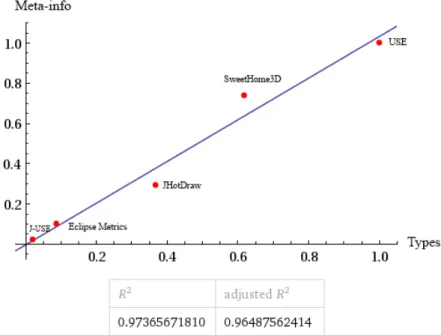
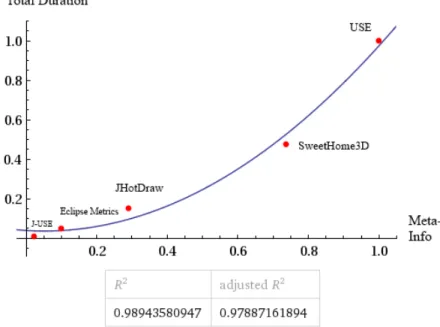
5.3 Typequantity to project size plot . . . 56
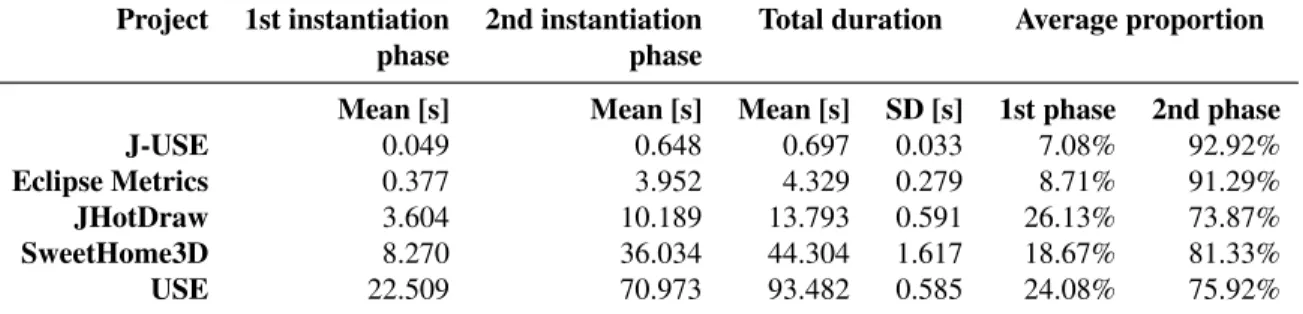
5.1 Scalability tests: project sizes . . . 55
5.2 Scalability tests summary . . . 57
5.3 M2DM to Eclipse Metrics comparison: initial results . . . 59
Software quality has long been a subject of much research in the area of software engineer-ing. From the need of applying quantitative research over software, a new field of study, of software metrics and measurement, arose.
Over the last four decades, this research on software measurement resulted in not only software metrics such as McCabe’s cyclomatic complexity [1], the Chidamber and Kemerer metrics [2] and Abreu’s MOOD2 set [3] for object-oriented systems, that have been applied to asses software quality characteristics such as a system’s overall reliability [4], but also several measurement techniques.
With the popularization of object-oriented software and model-driven engineering (or MDE, for short) for software development, several approaches to measurement equally took a model-driven perspective. Prevalent especially in the last decade and a half, several stud-ies detailing model-driven approaches to software measurement and respective tools applying such techniques have been presented. Within these studies, the term model”, or ”meta-model”, was often found [3, 5, 6, 7, 8], referring to the model defining the structure of the language in which a system is constructed, as opposed to the structure of the system itself -which in turn can be viewed as the ”instantiation” of the metamodel. The term ”metamodel-driven measurement”, commonly and hereinafter referred to as M2DM, was coined by Abreu [3] for the specific act of using metamodels to describe both the systems to be measured and the metrics themselves. Several other studies, using techniques similar or equivalent to M2DM were also proposed, but often used other naming. Authors often claimed several ad-vantages for these metamodel-driven approaches, such as achieving easier and more exact metrics formalizations [3, 6], providing easier opportunities to measure systems constructed with different but similar languages or add new metrics to measurement tools [5], or simply to take away the complex code or compiler perspective into a more readable model-oriented logic [7]. These advantages were achieved not only because of the construction of formal metamodels, but also because of the use of specific languages that can query the said meta-models, such as the Structured Query Language, SQL [5], XQuery [9] or, more commonly, the Object Constraint Language, OCL [3, 6, 10, 7, 8]. The full findings of M2DM and such
similar studies can be found in section 2.2 of the following chapter.
Unfortunately, despite several studies detailing accompanying tools for software mea-surement, few have become or stayed available online at the time of this writing. In fact, we recognized a certain vacuum regarding existing MD2M tools. From this vacuum, we identified the need for a new research effort in this area.
According to the ”Transparent Language Popularity Index” available online and perma-nently updated [11], Java is the most widely used object-oriented programming language with circa 20% of the market share of all programming languages. Meanwhile, Eclipse [12] is the second most widely used IDE globally and by far the first used by open source com-munities. With the popularity of Eclipse, several plug-ins capable of metrics extraction have been developed and made available in the Eclipse Marketplace [13], making use of the IDE’s own project and code interpreting tools - the Eclipse Java Development Tools [14] (or JDT, for short). These plug-ins offer extensive measuring and reporting capabilities, but none have yet implemented the M2DM approach to metrics definition, and the advantages that come with it. Yet, the tools the JDT offer can be easily be utilized to aid our own research - and two of them in particular: the Java Model (from here on referred to as EJM) and the Abstract Syntax Tree (commonly referred to as AST).
We started the development of a M2DM plug-in for Eclipse, borrowing from the JDT to create a new Java metamodel and project-crawling mechanisms to instantiate it with data representative of a Java project to analyse. In the future, we aim to implement our developed M2DM tools for Java into existing plug-ins, making use of their established interface and reporting capabilities - namely, the popular open-source Eclipse metrics plug-in by Frank Sauer [15].
The contributions of this dissertation consist of the work completed to this date of this M2DM project: the resulting Java meta-model created from JDT components, the method of transforming a Java project in Eclipse into a meta-model instance and the first functioning metrics plug-in prototype capable of M2DM functionalities.
This document has been organized as follows: Chapter 2 explores the current situation regarding M2DM and MDE-based metrics research, as well as provides an overview of ex-isting Eclipse plug-ins capable of metrics extraction and an introduction to the tools used to aid the development of our goal plug-in, including the JDT itself. In chapter 3, we present the Eclipse Java Metamodel (hereinafter referred to as EJMM) and detail several aspects of its structure, components and origins. Then, in chapter 4, we provide examples of the use of the developed EJMM with a series of OCL functions that traverse the metamodel to extract metrics or aid metrics extraction. Next, in chapter 5, we provide an overview of the developed
prototype. We describe its architecture, the chosen rules pertaining to the EJMM instantiation and the validation methods for the tool. Finally, we draw some conclusions on chapter 6 and forecast future work.
1.1 Regarding terminology
Since this dissertation aims to create a representation of the Java language as described by the existing JDT, there will be several cases of having different concepts with the same term in the following text. For instance, a Java statement in code is represented by the Statement class of the JDT which in turn is reflected by a Statement metaclass in the EJMM. The dif-ference is that a statement, non-capitalized and non-italicized, refers to a generic occurrence of a statement in code (and much like statements, the same can be said of packages, types, methods, etc.) as opposed to its abstract representation as a Java class in the JDT or as a metaclass in the EJMM, in which case they are capitalized in the same way they are declared in code or in the metamodel and italicized. Still, JDT component names and EJMM compo-nent names may conflict, in which case the concepts of ”class” - or in some cases, ”interface” - and ”metaclass” will help to differentiate what the text refers to. For instance, a ”metaclass” refers to a class of the metamodel, a class to represent all classes. Thus, components of the JDT are specific Java classes or interfaces and are called as such when mentioned in text to aid comprehension. In some cases, JDT components are accompanied by the package in which they can be found.
2.1 Introduction
Development of model-driven metrics tools has been the subject of much research for over a decade. In this chapter we will describe related work on tools that have some similarities to our proposed metrics plug-in, while highlighting the key differences between them. Then, we will review the state of the art regarding existing Eclipse metrics plug-ins that can be found online. Finally, we will present a brief overview of the tools chosen to help create a M2DM plug-in, such as the Eclipse Java Development Tools, and the UML-based Specification En-vironment.
2.2 Studies in M2DM and MDE-based measurement
M2DM studies originated as a natural progression from previous studies on software rics formalization. Abreu first employed M2DM techniques to formalize the MOOD2 met-rics over the GOODLY design language metamodel [3] using OCL. Since then, the use of OCL for M2DM has been popularized within the QUASAR research group. First ef-forts consisted of formalizing MOOD2 [6, 16] and MOOSE [10] metrics extraction for the UML metamodel, but over the following years, M2DM practices were used for more spe-cific goals. This includes studies such as a means to formalize quality metrics for object-relational database schemas using OCL over SQL ontologies [17], to introduce quantitative approaches to component-based design by formalizing metrics for component-based systems over extended versions of the CORBA Components Metamodel and UML metamodel [18], to define OCL metrics over the System Definition Model for IT infrastructure evaluation [19], to compare modularity between aspect-oriented and object-oriented designs [20] over the QUASAR-developed PIMETA metamodel and to define complexity metrics for process models over the BPMN metamodel [21].
Regarding studies on for metrics calculation tools, Java Metrics Reporter (JMR) [23] was a pioneer software in its use of a Java Model to calculate metrics. In their paper, the
authors present a newly-developed Java Model much akin to the EJM supplied by the Eclipse JDT, sharing even a similar hierarchical structure and the existence of a single node class from which all Java elements inherit (in this case, called JElement). Extensions to the Java Model and implementation of further metrics calculation capabilities would be done through typical OO subclassing of the JMR Java Model. Though this approach is stated to be much simpler to handling directly with parser logic, it would still entail more programming (and building) work than by using the OCL-based metrics paradigm [3, 16, 10, 7]. This technique of handling a Java Model for data extraction is similar to what is commonly found in existing Eclipse metrics plug-ins, such as Frank Sauer’s metrics tool [15], using EJM-supplied data. The JMR would be a considerable alternative to the Eclipse Java Development Tools for the construction of a M2DM tool, but unfortunately, at the time of writing, we have not been able to find it available online.
The Extensible Metrics toolBench for Empirical Research (EMBER) was introduced in [5]. Unlike the JMR, it used a metrics approach much more similar to the OCL-based paradigm. It used a database schema to represent a metamodel aimed at OO languages such as C++ and Java, parsed software to load the database and SQL queries were used to cal-culate metrics. This method is analogous to our own attempt at metamodel representation through UML, loading through the USE tool and then using OCL statements to calculate metrics. However, since the database schema aims to be fitting for several OO languages, it is much simpler than the EJMM proposed in this article. This simplicity certainly allows the tool to have a larger breadth in terms of languages supported, but does not offer the detail that our proposed EJMM provides for Java. One example is considering annotations used and type parameters. Another, more metrics-focused example is recording the statements of a method, allowing, for instance, to calculate the weighted methods per class [2] using McCabe’s cyclomatic complexity metric [1] to determine the complexity of each method.
The Jade Bird Object Oriented Metrics Tool (JBOOMT) [24] also takes a model-based approach to calculate metrics of C++ software. In this case, however, the MDE approach involves creating metrics models rather than using metamodels to represent the software’s model language and extracting data from their instantiation. JBOOMT thus requires a dif-ferent model for each metric, storing software data and metrics calculations. This approach allowed their authors to create hierarchies among metrics, such as aggregated metrics or as-sociation between related measures. For instance, having a method’s cyclomatic complexity [1] being a factor to determine the software’s overall complexity. To further illustrate such relations between metrics, authors introduce the concepts of “internal attributes” like the method’s complexity and “external attributes” as software-wide measures such as
complex-ity or flexibilcomplex-ity.
Antoniol et al. [7] proposed a tool that navigates Java AST objects using OCL expres-sions. The authors use a metamodel based on the JavaCC compiling rules and exemplify its functionalities by formalizing a small set of software metrics. All in all, the purpose and method of their tool is essentially the same as ours, though using a different metamodel with different capabilities. Their presented AST metamodel retains a node tree structure, whereas our current EJMM aims to capture more directly a Java project’s structure (despite internally, the EJM and Eclipse AST also having similar node tree structures). Furthermore, since the metamodel presented by Antoniol et al. comprises only the AST, it can only represent the code of a software system; from the class declaration to its contents, leaving out the soft-ware’s overall structure and composition, such as folders and packages. With the lack of visibility of interactions between modules, structural analysis might become difficult.
Still, the work of Antoniol et al. is clearly a precursor to our own, and the use of OCL reveals another advantage of the inherent portability, as the metrics defined in these authors’ paper can easily be applied to our EJMM with little effort.
The Design-Metrics Crawler [9] was a proposed tool to measure software designs spec-ified in XMI files. Aiming to support UML diagrams and MOF-based software design lan-guages, the DM Crawler used the XQuery language to formalize and calculate metrics. Un-like a language meant to define constraints such as OCL, the authors claim that XQuery’s queries would be more appropriate for execution and would allow the definition of more complex metrics more easily since it is possible to define variables and control flow. While the first version of OCL had some limitations regarding those aspects, OCL2 has removed those limitations. We found no evidence that this tool could be used with Java.
The Metrino tool [25] is a metrics tool that aimed to measure any software devised in any Domain Specific Language with metamodels based on the Meta Object Facility, using OCL for the definition of domain rules. OCL is also used for the definition and calculation of metrics, under OMG’s Software Metrics Meta-model. Currently, it is available online and affiliated with the ModelBus tool [26]. Their authors claim that Metrino can be used for UML models, as well as for any Domain Specific Modeling Language (DSL) based on MOF, but not for Java.
Finally, McQuillan [8], also aiming to achieve a MDE approach to software measurement, created a MOF-compliant metamodel for metrics extraction for Java and UML models. Met-rics formalization took the form of OCL expressions over the metMet-rics metamodel. To test and implement this technique, the author claims to have developed the Defining Metrics at the Meta-Level (dMML) tool, capable of measuring Java programs. Unfortunately this seems to
have been a research prototype only, for academic purposes, since it is not available online for evaluation.
2.3 Existing Eclipse metrics plug-ins
Currently, there are several plug-ins for the Eclipse IDE that support software metrics extrac-tion. In this section, we will present a few existing plug-ins that can be found on the Eclipse Marketplace [13] and the Yoxos marketplace [27], as well as Frank Sauer’s [15] plug-in. Using the sites’ respective search engines, we used the keyword ”metrics” and selected plug-ins that offered software metrics extraction capabilities. Our main interests when testing these plug-ins were which metrics they supported and their extension capabilities. Although the open-source solutions provided a way to extend their metrics calculation capabilities by changing their source code, we found that no tool provided a front-end solution to incorporate new software metrics.
2.3.1 Open-source plug-ins
Name: Eclipse Metrics plugin 1.3.6
By: Frank Sauer et al.
Project site: http://metrics.sourceforge.net/
License: CPL
Last update: 2005-07-08 (plug-in); 2013-04-24 (site)
Downloads: 99.533 total from last plug-in update until 2013-09-05; 11.728 total from 2012-09-05 to 2013-09-05; 774 total from 2013-08-05 to 2013-09-05
Description: Frank Sauer’s plug-in, though having nearly a decade of age, is still one of the more proven and popular options regarding open-source metrics plug-ins for Eclipse. Though there is a separate continued version [28], Sauer’s still has a fairly active commu-nity, going so far as to having community-created patches as re-cent as November 2012. The plug-in itself offers a simple inter-face and reporting capabilities with which users can define op-timal ranges and issue warnings for certain metrics, as well as being able to export calculated metrics to XML files. Being one of the most popular, this plug-in was our first choice for a target in which to implement M2DM features.
Metrics supported: Abstractness; Afferent Coupling; Cyclomatic Complexity; Depth of Inheritance Tree; Efferent Coupling; Instability; Lack of Cohesion of Methods; Method Lines of Code; Nested Block Depth; Normalized Distance; Number of Attributes; Number of Children; Number of Classes; Number of Interfaces; Number of Methods; Number of Overridden Methods; Number of Pack-ages; Number of Parameters; Number of Static Attributes; Num-ber of Static Methods; Specialization Index; Total Lines of Code; Weighted Methods per Class;
Extension capabilities: Requires the editing of the plugin.xml file to declare new metrics (name, abbreviation, level and propagation settings and calcula-tor) and extension of a Calculator class to define how the metrics are calculated.
Name: Eclipse Metrics plugin (Continued) 1.3.8 By: Guillaume Boissier et al.
Marketplace site: http://marketplace.eclipse.org/content/ eclipse-metrics-plugin-continued
Project site: http://metrics2.sourceforge.net/
License: CPL
Last update: 2010-07-30 (plug-in); 2013-04-24 (site)
Downloads: 6.185 total from last plug-in update until 2013-09-05; 2.598 total from 2012-09-05 to 2013-09-05; 216 total from 2013-08-05 to 2013-09-05
Marketplace installs: 0 from 2012-10 to 2013-09
Description: Continuation from Frank Sauer’s plug-in led by Guillaume Boissier. Though from a user perspective, the plug-in functions very much the same, its source code has been fairly revamped and improved, including in the way metrics are calculated. Though it is an update to its widespread predecessor, it does not enjoy as much popularity, and in result, visibility. As far as targets for M2DM implementation, Boissier’s version has become as much of an alternative as Sauer’s and though our current choice has been unaltered, it might easily change if any issues surface dur-ing the time of implementation.
Metrics supported: Abstractness; Afferent Coupling; Cyclomatic Complexity; Depth of Inheritance Tree; Efferent Coupling; Instability; Lack of Cohesion of Methods; Method Lines of Code; Nested Block Depth; Normalized Distance; Number of Attributes; Number of Children; Number of Classes; Number of Interfaces; Number of Methods; Number of Overridden Methods; Number of Pack-ages; Number of Parameters; Number of Static Attributes; Num-ber of Static Methods; Specialization Index; Total Lines of Code; Weighted Methods per Class;
Extension capabilities: Extension to calculate new metrics is done the same way as in version 1.3.6.
Name: Eclipse Metrics 3.12.0
By: Lance Walton/State of Flow
Marketplace site: http://marketplace.eclipse.org/content/ eclipse-metrics
Project site: http://eclipse-metrics.sourceforge.net/
License: CPL
Last update: 2011-04-10 (plug-in); 2013-05-02 (site)
Downloads: 8.313 total from last plug-in update until 2013-09-05; 3.891 total from 2012-09-05 to 2013-09-05; 345 total from 2013-08-05 to 2013-09-05
Marketplace installs: 5.264 from 2012-10 to 2013-09
Description: This plug-in offers more extensive exporting capabilities com-pared to Frank Sauer’s, including XML, HTML and CSV ex-porting, as well as integration with Eclipse’s Problems view to issue warnings regarding certain metrics. However, though open-source, extending it to support more metrics is a more difficult task, due to its lack of documentation on the matter.
Metrics supported: Cyclomatic Complexity; Efferent Couplings; Feature Envy; Lack of Cohesion in Methods (Chidamber & Kemerer, Henderson-Sellers, Pairwise Field Irrelation and Total Correla-tion); Lines of Code in Method; Number of Classes; Number of Fields; Number of Levels; Number of Locals in Scope; Num-ber of Packages; NumNum-ber of Parameters; NumNum-ber of Statements; Total Lines of Code; Weighted Methods Per Class;
Extension capabilities: Requires the creation of new calculator classes. Current plug-in contaplug-ins several abstract calculator classes for specific data extraction tasks (for instance, inspecting an AST).
Name: Project Usus 0.7.2
By: Stefan Schuerle et al.
Marketplace site: http://marketplace.eclipse.org/content/ project-usus
Project site: http://www.projectusus.org; http://github.com/usus/ usus-plugins (source code only)
License: EPL
Last update: 2013-01-27
Downloads: 35 total from plug-in release until 2013-09-06 Marketplace installs: 222 from 2012-10 to 2013-09
Description: Project Usus is a set of Eclipse plug-ins to facilitate project mon-itoring, calculating metrics, identifying “hotspots” that deserve more attention and creating graphs for module dependencies, among other functionalities.
Metrics supported: Average Component Dependency; Class Size; Cyclomatic Com-plexity; Lack of Cohesion of Classes; Method Length; Mud-holes; Number of Fields (non-static, non-final and public) ; Pack-age Size; PackPack-ages with Cyclic Dependencies; Unreferenced Classes;
Extension capabilities: Features an extension collector to join user-created extension points to the Project Usus environment. Includes abstract classes and interfaces to structure how new calculators present their met-rics data.
Name: Java Metrics 0.9.4
By: Devon Carew
Marketplace site: http://yoxos.eclipsesource.com/yoxos/node/org. dcarew.javancss.feature.feature.group
Project site: http://code.google.com/p/ eclipse-plugin-potpourri/ License: Apache License 2.0
Last update: 2010-06-22
Downloads: N/A
Description: As of now, this is a simple plug-in that calculates a small selec-tion of metrics on a project level.
Metrics supported: Cyclomatic Complexity; Non-Commenting Source Statements; Number of Files; Number of Packages; Total File Size
2.3.2 Commercial plug-ins
Name: inCode Helium 2.0.1
By: Intooitus
Marketplace site: http://marketplace.eclipse.org/content/incode-helium Project site: http://www.intooitus.com/products/incode
License: Commercial (Free trial available)
Description: Plug-in version of inFusion (see subsection 2.3.3). Although reduced in functionality compared to its stand-alone version, it still retains several of its features, including metrics calculation. Overall, inCode Helium is a tool with extensive graphical capabilities to aid detection of design flaws in code.
Metrics supported: Average Function Weight; Access to Local Data; Average Method Weight; Access to Foreign Data; class Overriding Ratio; Base-class Usage Ratio; Capsules Providing Foreign Data; Class Weight; Cyclomatic Number; Depth of Inheritance Tree; Dispersion Ratio; Fan-In; Fan-Out; Foreign Data Providers; Height of Inheritance Tree; Incoming Coupling Dispersion for an Operation; Incoming Cou-pling Dispersion for an Operation; Locality of Data Accesses; Loose Capsule Cohesion; Lines of Code; Lines of Comments; Maximum Nesting Level; Number of Added Services; Number of Attributes; Number of Abstract Classes; Number of Accessor Methods; Num-ber of Abstract Methods; NumNum-ber of Accessed Variables; NumNum-ber of Classes; Number of Children; Number of Global Functions; Num-ber of Global Variables; NumNum-ber of Incoming Calls; NumNum-ber of Lo-cal Variables; Number of Methods; Number of Modules; Number of Outgoing Calls; Number of Packages; Number of Parameters; ber of Protected Attributes; Number of Protected Attributes; Num-ber of Public Attributes; NumNum-ber of Public Methods; NumNum-ber of Overriding Methods; Outgoing Coupling Dispersion for an Opera-tion; Outgoing Coupling Intensity for an OperaOpera-tion; Outgoing De-pendency on Delegators; Percentage of Newly Added Services; Tight Capsule Cohesion; Weighted Operation Count;
Name: STAN - Structure Analysis for Java 2.1.1
By: Odysseus Software GmbH
Marketplace site: http://marketplace.eclipse.org/content/ stan-structure-analysis-java
Project site: http://stan4j.com/ License: Free for non-commercial use Last update: 2013-06-26
Downloads: N/A
Marketplace installs: 597 from 2012-10 to 2013-09
Description: STAN is a general tool for analysing a project’s structure, showing module composition and couplings, as well as calculating distances and pollution. Furthermore, it has a dedicated metrics view show-ing several different software metrics. STAN is available as both an Eclipse plug-in or as a stand-alone application.
Metrics supported: Abstractness; Afferent Coupling; Average Absolute Distance; Av-erage Component Dependency between Libraries, between Pack-ages and between Units; Coupling between Objects; Cyclomatic Complexity; Depth of Inheritance Tree; Distance; Efferent Cou-pling; Estimated Lines of Code; Fat for Library Dependencies, Package Dependencies and Class Dependencies; Fat; Instability; Lack of Cohesion in Methods; Number of Children; Number of Fields; Number of Instructions; Number of Libraries; Number of Member Classes; Number of Methods; Number of Packages; Number of Top Level Classes (Units); Response for a Class; gled for Library Dependencies and Package Dependencies; Tan-gled; Weighted Methods per Class;
2.3.3 Other
Name: inFusion Hydrogen 1.7
By: Intooitus
Marketplace site: http://marketplace.eclipse.org/content/ infusion-hydrogen
Project site: http://www.intooitus.com/products/infusion License: Commercial (Free trial available)
Description: inFusion Hydrogen is actually not a plug-in for Eclipse, but instead a stand-alone application using the Eclipse framework and with its own page in the Eclipse Marketplace.
Notes: Due to compatibility issues, we have not been able to test this applica-tion in time for publicaapplica-tion.
Name: ScertifyTMProfessional 1.10
By: Tocea
Marketplace site: http://marketplace.eclipse.org/node/626557 Project site: http://tocea.com/shop/professional-edition/
scertify-professional-edition License: Commercial (Free trial available)
Notes: Due to incompatibility issues, we have unfortunately not been able to test this tool in time for publication.
Name: IntoJ Suite
By: intoJ Team, University of Hagen
Marketplace site: http://yoxos.eclipsesource.com/yoxos/node/org.intoJ. suite.feature.feature.group
Project site: http://wiki.fernuni-hagen.de/intoj/index.php/ Hauptseite
License: CPL
Notes: Since the IntoJ Suite wasn’t available for installation in time for pub-lication, we have unfortunately not been able to test its metrics calcu-lation capabilities.
2.4 The Eclipse JDT
The Eclipse Java Development Tools, or JDT [14], are a series of plug-ins for Eclipse that provide developers access to several functions commonly associated with an IDE, such as code interpretation and Java project building. Several of the previously mentioned metrics
plug-ins make use of the JDT to extract the data required to calculate software metrics. In our M2DM plug-in, the usefulness of the JDT is two-fold: first, it provides a series of components from which to base the construction of a Java metamodel, and second, it provides ways to turn Java projects into abstract data as instances of the metamodel.
From the JDT, two components were of special interest to the construction of the EJMM: the Java Model (EJM) and the Java Abstract Syntax Tree (AST).
The EJM, defined by a series of interfaces located in the org.eclipse.jdt.core, of-fers a representation of a Java project and all its components, such as its folders, packages, compilation units, etc. Though it also provides a vision of a compilation unit’s or class file’s contents, such as its enclosed types and the type’s members, it does not offer a full view of the Java code contained.
The AST, on the other hand, provides tools to analyse a block of source code and construct an abstract representation of it. It is contained in the org.eclipse.jdt.core.dom package as a series of classes representing different types of statements supported by the Java language (e.g. type declaration statement, field declaration statement, method invocation or comments in code).
Both the AST and the EJM have tree structures where nodes are connected to each other by hierarchical, parent-child, links. For the AST, all classes inherit from the ASTNode class. As for the EJM, all the interfaces inherit from the base IJavaElement interface. This means that traversing their trees can be done in a top-down approach, beginning from a single node that is parent to all other nodes.
In sum, the great advantage of using both the AST and the EJM in conjunction is the fact that they provide complementary views of a system. Whereas the EJM can present the structure and hierarchy of files of a Java project, the AST provides the structure and contents of the actual code. Thus, they both were our source of inspiration while designing the EJMM. However, it should be noted that the EJMM, although including representative metaclasses for ASTNode and IJavaElement, is not meant to inherit the tree structure of the AST and EJM functionally. Therefore, there are no generic parent-child connections in the EJMM, just unique meta-associations between specific metaclasses.
Specific information regarding how the EJM and AST were used to form the EJMM can be found in chapter 3 and further information on how the JDT was used by the M2DM plug-in to instantiate the EJMM can be found in chapter 5, section 5.4.
2.5 USE: The UML-based Specification Environment
Developed in the University of Bremen, the UML-based Specification Environment (USE, for short), is a Java, open-source tool that allows the creation of UML class models and in-stantiate them with objects to create a simulated system state [29] [30]. Adding to these functionalities, USE allows the use of the Object Constraint Language (OCL) [31] - a lan-guage specified by the Object Management Group (OMG) to complement UML diagrams with textual descriptions of a system’s constraints - to declare both constraints of a model as well as use the language for querying model instances. Furthermore, USE also allows the definition of model operations using OCL as well.
This powerful solution was our choice to provide an environment where the EJMM could be declared, instantiated with concrete data and inspected. Being open-source and developed in Java, this means that our M2DM plug-in can also easily handle USE objects with little intermediation.
Despite the available graphical capabilities, USE class models must be declared textually. Embedded in the model components description, it is possible to define operation bodies and to declare OCL constraints (class invariants, as well as pre and post-conditions on operations). Furthermore, there is a possibility of incremental loading of model files, each being extended by the next. What this means is that although the EJMM could be defined within a single file, extensions could be made to add operations to respective metaclasses and expand their functionality. This would allow for users to be able to define their own metrics-calculating operations for specific metaclasses in separate files, load them in the M2DM tool and then query for their returned values. This simple method is the one that would substantiate the aforementioned advantages of M2DM regarding to the ease of adding new metrics.
To facilitate our integration of USE capabilities, we made use of a fac¸ade component interface named J-USE, produced within the QUASAR group [32], that provides a Java API for USE services.
3.1 Introduction
The EJMM was obtained by reverse engineering and composing two Eclipse JDT compo-nents: the Eclipse Java Model (from now on referred to as EJM) and the Eclipse Abstract Syntax Tree (or AST for short). The EJM contains several interfaces that provide a vision over a Java project’s structure under a tree architecture. The AST, on the other hand, deals with parsed source code. It allows the analysis of a source code file represented also as a tree, down to each statement and expression that compose the methods of a class [14, 33]. Although the EJM already provides a fairly complete vision of the software’s structure (in-cluding, for instance, which classes are declared, as well as their fields and methods), the AST provides the minutia of a software application that can only be found within the code itself. The two components complement each other to create a highly detailed Java meta-model. However, the EJMM does not employ the EJM’s and the AST’s tree structures. In-stead, we have opted for a simpler and more direct representation of a Java project, with meta-associations connecting specific metaclasses that would be otherwise represented as connected nodes of a tree. The node metaclasses remain, but purely as a means to generalize different metaclasses and to distribute the information they contain.
In this chapter, we will present only the most notable aspects regarding the EJMM specifi-cation. For the full EJMM specification, as a USE specification file, please refer to Appendix A.1.
3.2 Metamodel presentation
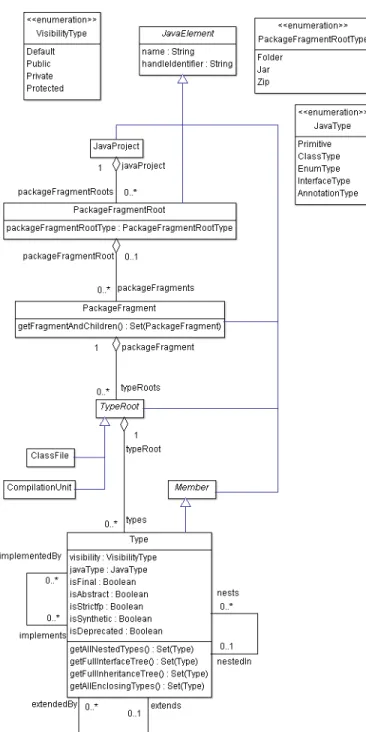
In this section, we will present the EJMM in its current form, as a set of class diagrams. Figure 3.1, represents the basic structure of a Java project and its hierarchical structure, in-cluding type inheritance and interface implementations. All the metaclasses present in Fig. 3.1 inherit, directly or indirectly, from the base JavaElement metaclass. The latter represents any node of a Java project tree, confers it a name (equal to the name declared in the source
code) and a unique identifier. Also included in this diagram are the three enumerations used by the metamodel: visibility types, Java types and package fragment root types. The first determines the visibility of an element, such as whether a method is public, private, protected or has default visibility (the default is the containing package and is applicable when the vis-ibility keyword is omitted). The Java types enumeration serves to identify different kinds of a Type meta-object (Java class, interface, annotation type or enumeration). Package fragment roots can be folders or archives and the latter can be either .jar files or .zip files.
Figure 3.2 shows the contents of the Type metaclass, such as fields, methods, static ini-tializers and type parameters. These components are referred to as members in the EJM and such is reflected by the abstract metaclass Member from which they inherit. The LocalVari-ablemetaclass is a special case - since a local variable can only be located in one place, the meta-associations between it and either Method or Initializer are mutually exclusive. In terms of instantiation, this means that only one of these meta-associations would be defined. The attributes arrayDimensions and returnTypeArrayDimensions determine the number of array dimensions a LocalVariable, Field or a Method’s returnType has.
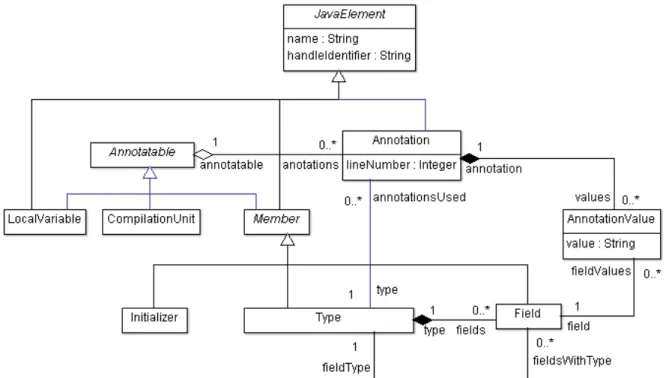
Figure 3.3 focuses on presenting another component of the EJM - annotations. These are attached to Annotatable meta-objects, such as local variable declarations, Java members or package declarations. Since we do not include package declarations in the EJMM, to repre-sent package declaration annotations, we have instead made CompilationUnit an Annotatable metaclass, meta-associations between it and Annotations represent the package declaration annotations. Besides the occurrences of annotations in code, the metamodel also registers which class declares the annotation in question and the parameter values of each occurrence (currently under the form of strings as a generalized measure to deal with different field types) and the annotation class field that each value refers to.
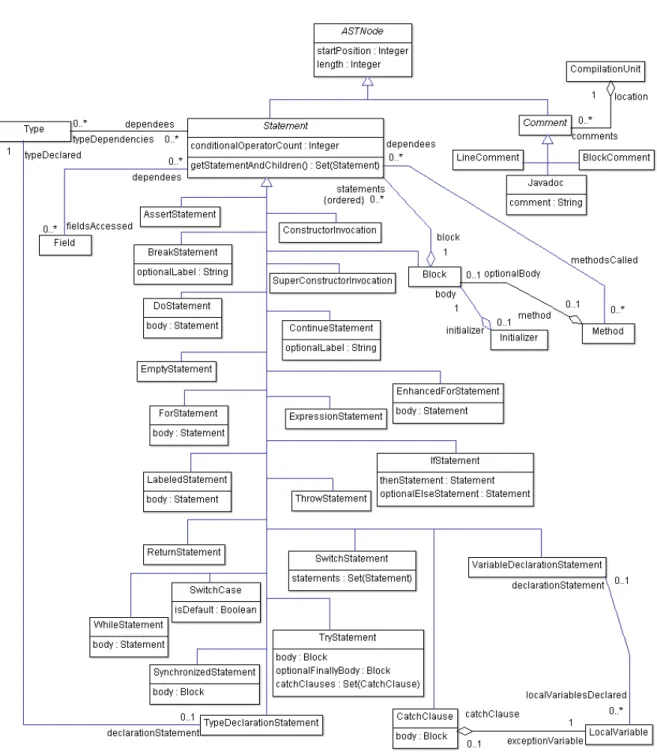
In the final diagram (Fig. 3.4), the AST metaclasses are depicted. Inheriting from a base ASTNodemetaclass, only comments and statements have been chosen to be included in the EJMM. Comments are directly linked to compilation units through a single meta-association. Statements can take several forms, but only Block statements are meta-associated to initializ-ers or methods. Much like local variables, the Block’s meta-associations are mutually exclu-sive - it can only be associated with either an Initializer or a Method, or none at all.
All other statement types can only be found as aggregate parts of blocks, directly, or as part of other statements within the aggregation. Furthermore, there are extra meta-associations to represent dependencies between a Statement and a Type (typeDependencies), Field (field-sAccessed) or Method (methodsCalled). The latter represents the types, fields and methods that are used or invoked and used by the expressions that compose the statement in question.
Fig. 3.3: Eclipse Java Metamodel - Annotations
The field startPosition of the ASTNode metaclass indicates the first character byte of the piece of code that a node represents within the entire block of code from which the AST was gen-erated (thus, when analyzing the code of a compilation unit, the startPosition indicates the location of the node in the source file). The length attribute indicates the size of the piece of code in bytes. The Statement metaclass also contains a conditionalOperatorCount attribute. This attribute was specifically created for metrics extraction - it represents the number of conditional expressions contained in the statement plus the number of conditional operators used by the expressions contained in the statement (specifically, ”and” operators, ”or” oper-ators and conditional expressions), to aid calculating a method’s cyclomatic complexity [1]. It was included in the EJMM and not as an extension due to the necessity of capturing new information during the moment the metamodel is instantiated.
Operations declared in the metamodel metaclasses are purely auxiliary, aiming to aid the definition of OCL statements. They are recursive operations that return all the hierarchical children or parents of a given meta-object (for instance all the statements contained in a block, or all the components of a type’s superclass hierarchy).
3.3 Reverse engineering information
As previously stated, the EJMM is the result of reverse engineering the EJM and AST pro-vided by the Eclipse JDT. Metaclasses that inherit from the JavaElement metaclass have their origins in homonymous interfaces of the EJM package (org. eclipse. jdt. core ). Meta-classes that inherit from the ASTNode metaclass have their origins in homonymous Meta-classes of the AST package (org. eclipse. jdt. core. dom ). Thus, it is safe to say that meta-classes are representations of the EJM and AST interfaces and meta-classes. The exception is the AnnotationValuemetaclass, which is built from the values obtained through the IAnnotation interface. A complete overview of the metaclass origins can be found in the following section. Meta-associations are representations of getters found in the metaclasses’ origin. A spe-cial case was found in the relation between PackageFragmentRoot and PackageFragment, as the original IPackageFragmentRoot provides IPackageFragments through the generic Java model child getter, rather than a specific one for package fragments. For most statement types, fields have translated to attributes in their respective metaclass. The biggest excep-tion is the Block metaclass, as its contents have been translated into a single aggregaexcep-tion of Statement.
Metaclass attributes are also derived from original attributes or getters. However, several attributes of the Type, Method and Field are derived from a special integer flag their original interfaces provide. The flags, as defined by the class org.eclipse.jdt.core.Flags, are used to differentiate a Java member’s visibility (reflected on the enumeration VisibilityType) or differ-ent Java types (enumeration JavaType). Flags were also used to create the isFinal, isSynthetic, isDeprecated, isStatic, isSynchronized, isNative, isBridge, hasVarargs, isVolatile, isTransient and isStrictfp attributes. Furthermore, as mentioned previously, the conditionalOperator-Count is calculated at the moment of instantiation by counting the number of conditional ”and” and ”or” operators and conditional expressions contained inside a statement.
Metaclass name: JavaElement
Origin: org.eclipse.jdt.core.IJavaElement
Description The original interface is implemented by all EJM tree nodes and trans-lates to an abstract class on the metamodel that is inherited, directly or indirectly, by all metaclasses that originate from the EJM. Unlike IJavaElement, the JavaElement metaclass is not used for building a tree structure, but instead to generalize data into meta-objects such as element name or handle. The name attribute is the one used to store the element name (generally from the getElementName() method). han-dleIdentifieris a special identifier string that provides the complete lo-cation of the element. No two different JavaElements have the same handleIdentifier.
Metaclass name: JavaProject
Origin: org.eclipse.jdt.core.IJavaProject
Description: Represents the folder that holds the Java project. Metaclass name: PackageFragmentRoot
Origin: org.eclipse.jdt.core.IPackageFragmentRoot
Description Represents a folder within the Java project that may contain packages. Since packages can be contained in either folders or archive files, the metaclass includes a specific attribute that dictates the type of pack-age root in question (see the description of the Packpack-ageFragmentRoot- PackageFragmentRoot-Typeenumeration for further information). A PackageFragmentRoot’s name is actually the name of its respective resource (obtained from the getResource() method), such as the folder or archive name, since the getElementName() method for IPackageFragment instances returns empty strings.
Metaclass name: PackageFragment
Origin: org.eclipse.jdt.core.IPackageFragment Description: Represents a single package.
Metaclass name: Annotatable
Origin: org.eclipse.jdt.core.IAnnotatable
Description: Abstract metaclass class that represents any object that can have an-notations attached. Concrete metaclasses that may have anan-notations extend this metaclass.
Metaclass name: TypeRoot
Origin: org.eclipse.jdt.core.ITypeRoot
Metaclass name: ClassFile
Origin: org.eclipse.jdt.core.IPackageFragment
Description: Represents a binary class file containing a single type declaration in bytecode.
Metaclass name: CompilationUnit
Origin: org.eclipse.jdt.core.ICompilationUnit
Description: Represents a source file that may contain several type declarations.
Metaclass name: Member
Origin: org.eclipse.jdt.core.IMember
Description: Members represent any Java elements that are components of a Java type, such as methods, fields, the type itself, as well as inner types. Concrete members inherit from this metaclass.
Metaclass name: Type
Origin: org.eclipse.jdt.core.IType
Description: Represents a single Java type. This may be a class, an interface, an an-notation definition, an enumeration or a primitive type (such as integers and booleans). See the enumeration JavaType for more information.
Metaclass name: TypeParameter
Origin: org.eclipse.jdt.core.ITypeParameter
Description: Represents a parameter for a single type. Not to be confused with type arguments, that are concrete instantiations of parameters. Parameter bounds are defined by a meta-association between parameter (bound-sIn) and the bound type (bounds).
Metaclass name: Field
Origin: org.eclipse.jdt.core.IField
Description: Represents a field declared within a type. The attribute arrayDimen-sionsindicates the number of array dimensions this Field has (zero, if not an array).
Metaclass name: Initializer
Origin: org.eclipse.jdt.core.IInitializer
Description: Represents a static initializer of a class. Initializers have no name, but within the same type, they can be identified by the order in which they are declared.
Metaclass name: Method
Origin: org.eclipse.jdt.core.IMethod
Description: Represents a method declared in a type. It is linked to its body through a meta-aggregation with the Block metaclass unless it is an abstract method. The shortKey attribute contains only the method and parame-ter section of the method’s full key, representing the method signature - essentially, a substring of key. The shortKey exists mainly to aid the comparison between two methods belonging to different types, since the key contains also the location of the method. The hasVarargs at-tribute determines whether or not the Method has a variable number arguments (notice that only the last parameter in a method’s parameter list can be used multiply). The attribute arrayDimensions indicates the number of array dimensions this Method’s returnType has (zero, if the method doesn’t return an array).
Metaclass name: LocalVariable
Origin: org.eclipse.jdt.core.ILocalVariable
Description: Represents a single local variable contained in either a method body, an initializer body or a method parameter. Its meta-associations with Methodor Initializer mutually exclusive - only one can be defined, de-noting the location where the local variable is declared. The attribute arrayDimensionsindicates the number of array dimensions this Local-Variablehas (zero, if not an array).
Metaclass name: Annotation
Origin: org.eclipse.jdt.core.IAnnotation
Description: Represents a single occurrence of an annotation within source code. If the aforesaid occurrence has annotation arguments, they are saved as AnnotationValueinstances.
Metaclass name: AnnotationValue
Origin: org.eclipse.jdt.core.IMemberValuePair
Description: Unlike other metaclasses derived from EJM components, Annotation-Value is not a direct conversion of an EJM interface. Instead, it is a metaclass created from data obtained from IAnnotation. Values are saved as strings and are meta-associated with the corresponding field of the annotation type.
Metaclass name: ASTNode
Origin: org.eclipse.jdt.core.dom.ASTNode
Description: Base abstract node metaclass for AST nodes. Much like the JavaEle-ment metaclass, the main purpose of ASTNode is to generalize data such as the starting byte of the node inside the source text (useful for ordering) and its length in bytes.
Metaclass name: Comment
Origin: org.eclipse.jdt.core.dom.Comment
Description: Abstract metaclass representing a comment in the source code of a compilation unit.
Metaclass name: LineComment
Origin: org.eclipse.jdt.core.dom.LineComment Description: Concrete metaclass for single line comments.
Metaclass name: BlockComment
Origin: org.eclipse.jdt.core.dom.BlockComment
Description: Concrete metaclass for single block comments.
Metaclass name: Javadoc
Origin: org.eclipse.jdt.core.dom.Javadoc
Metaclass name: Statement
Origin: org.eclipse.jdt.core.dom.Statement
Description: Abstract metaclass for Java statements. To generalize type references in concrete statements, we have included a typeDependency meta-association. To generalize method calls, we have the methodsCalled meta-association and to generalize access to a field, we have fieldsAc-cessed. In the cases of statement types that cannot depend on any type, method or field (for instance, EmptyStatement), the meta-associations are not instantiated. The auxiliary method getStatementAndChildren() is a recursive method that returns the statement and all statements in-cluded in it, directly or indirectly. The conditionalOperatorCount at-tribute represents the number of conditional expressions and condi-tional operators contained in the statement.
Metaclass name: AssertStatement
Origin: org.eclipse.jdt.core.dom.AssertStatement
Description: Concrete Statement metaclass to represent ”assert” statements.
Metaclass name: Block
Origin: org.eclipse.jdt.core.dom.Block
Description: Concrete statement type that represents a block of code which may contain more statements, defined by a meta-composition.
Metaclass name: BreakStatement
Origin: org.eclipse.jdt.core.dom.BreakStatement
Description: Concrete Statement metaclass to represent ”break” statements. Metaclass name: ConstructorInvocation
Origin: org.eclipse.jdt.core.dom.ConstructorInvocation
Description: For ConstructorInvocation statements, the depended types include con-structor arguments, the type that the concon-structor refers to and the type arguments used. The methodsCalled meta-association is also used to link the ConstructorInvocation with its respective constructor Method. Metaclass name: ContinueStatement
Origin: org.eclipse.jdt.core.dom.ContinueStatement
Description: Concrete Statement metaclass to represent ”continue” statements. Metaclass name: DoStatement
Origin: org.eclipse.jdt.core.dom.DoStatement
Description: Concrete Statement metaclass to represent ”do” statements. Metaclass name: EmptyStatement
Origin: org.eclipse.jdt.core.dom.EmptyStatement
Description: Concrete Statement metaclass to represent empty statements. Metaclass name: EnhancedForStatement
Origin: org.eclipse.jdt.core.dom.EnhancedForStatement
Description: Concrete Statement metaclass to represent enhanced ”for” statements. Metaclass name: ExpressionStatement
Origin: org.eclipse.jdt.core.dom.ExpressionStatement
Description: Concrete Statement metaclass representing regular statements contain-ing an expression.
Metaclass name: ForStatement
Origin: org.eclipse.jdt.core.dom.ForStatement
Description: Concrete Statement metaclass to represent ”for” statements. Metaclass name: IfStatement
Origin: org.eclipse.jdt.core.dom.IfStatement
Description: Concrete Statement metaclass to represent ”if” statements. Metaclass name: LabeledStatement
Origin: org.eclipse.jdt.core.dom.LabeledStatement
Metaclass name: ReturnStatement
Origin: org.eclipse.jdt.core.dom.ReturnStatement
Description: Concrete Statement metaclass to represent ”return” statements.
Metaclass name: SuperConstructorInvocation
Origin: org.eclipse.jdt.core.dom.SuperConstructorInvocation
Description: Much like a ConstructorInvocation, the typeDependencies of a Su-perConstructorInvocation consist of the declaring type, the type ar-guments used and dependencies found in the constructor arar-guments. The methodsCalled meta-association is also used to link the Super-ConstructorInvocationwith its respective constructor Method
Metaclass name: SwitchCase
Origin: org.eclipse.jdt.core.dom.SwitchCase
Description: Statementmetaclass to represent a statement beginning with the key-word ”case”. Not to be confused with SwitchStatement. In Java, SwitchCasesare part of the contents of a SwitchStatement.
Metaclass name: SwitchStatement
Origin: org.eclipse.jdt.core.dom.SwitchStatement
Description: Concrete Statement metaclass to represent ”switch” statements.
Metaclass name: SynchronizedStatement
Origin: org.eclipse.jdt.core.dom.SynchronizedStatement
Description: Concrete Statement metaclass to represent ”synchronized” statements.
Metaclass name: ThrowStatement
Origin: org.eclipse.jdt.core.dom.ThrowStatement
Description: Concrete Statement metaclass to represent ”throw” statements.
Metaclass name: TryStatement
Origin: org.eclipse.jdt.core.dom.TryStatement
Description: Concrete Statement metaclass to represent ”try” statements.
Metaclass name: TypeDeclarationStatement
Origin: org.eclipse.jdt.core.dom.TypeDeclarationStatement
Description: The type declared in this statement also contributes for its dependen-cies.
Metaclass name: VariableDeclarationStatement
Origin: org.eclipse.jdt.core.dom.VariableDeclarationStatement
Description: VariableDeclarationStatementsmay contain several fragments for each variable declared within the same statement, thus leading to the in-stantiation of the corresponding meta-association with the LocalVari-able metaclass. The initializer expression contained within a Vari-ableDeclarationStatement is scanned to instantiate dependency meta-associations and to obtain the value of the conditionalOperatorCound attribute.
Metaclass name: WhileStatement
Origin: org.eclipse.jdt.core.dom.WhileStatement
Description: Concrete Statement metaclass to represent ”while” statements.
Metaclass name: CatchClause
Origin: org.eclipse.jdt.core.dom.CatchClause
Description: The base AST class CatchClause does actually not inherit from the Statementclass. However, for simplification purposes, it does so in the EJMM.
Enumeration name: JavaType
Description: Used to differentiate types of the Type metaclass. A type may be a class, an enumeration, an interface, an annotation definition or a primitive type. Primitive types include: int, boolean, long, double, float, byte, short, char and, for simplification purposes, void (not to be confused with null values).
Enumeration name: VisibilityType
Description: Used to define the visibility of a Java member. Default visibility refers to the visibility given to members in which the visibility key-word is omitted (it is visible only inside the package where it is declared).
Enumeration name: PackageFragmentRootType
Description: Package fragment roots may be either folders or archive files. In the latter case, .zip files and .jar files are differentiated.
3.5 Methods and constraints
As shown in the metamodel presentation section, the EJMM includes certain restrictions and already declares some operations for ease of use. In this section, we shall present the OCL expressions that define both invariants used and operations declared in the EJMM.
3.5.1 Operations
Type operations
Operation: getAllNestedTypes()
Description: Recursive operation that returns all types nested inside self.
Definition: getAllNestedTypes() : Set(Type) = self.nests ->union(self.nests.getAllNestedTypes()) ->asSet Operation: getAllEnclosingTypes()
Description: Recursive operation that returns all types in which self is nested.
Definition: getAllEnclosingTypes() : Set(Type) = if(self.nestedIn->isUndefined) then Set{} else Set{self.nestedIn}-> union(self.nestedIn.getAllEnclosingTypes()) ->asSet endif
Operation: getFullInterfaceTree()
Description: Recursive operation that returns all interfaces implemented by the type, directly or indirectly. Definition: getFullInterfaceTree() : Set(Type) = if(self.javaType = #InterfaceType) then Set{self} ->union(self.implements.getFullInterfaceTree()) ->asSet else self.implements.getFullInterfaceTree() ->asSet endif Operation: getFullInheritanceTree()
Description: Recursive operation that returns the full inheritance chain of all super-classes of the Type.
Definition: getFullInheritanceTree() : Set(Type) = if(self.extends.oclIsUndefined) then Set{} else Set{self.extends} ->union(self.extends.getFullInheritanceTree()) ->asSet endif Initializer operations Operation: getAllStatements()
Description: Returns all statements contained in the Initializer’s body, ordered by occurrence in the source.
Definition:
getAllStatements() : OrderedSet(Statement) = body.getStatementAndChildren()
->sortedBy(startPosition)->asOrderedSet
Operation: getAllStatements()
Description: Returns all statements contained in the Method’s body, if any, ordered by occurrence in the source.
Definition: getAllStatements() : OrderedSet(Statement) = if(optionalBody.isDefined) then optionalBody.getStatementAndChildren() ->sortedBy(startPosition)->asOrderedSet else OrderedSet{} endif
The getStatementAndChildren() operation
The Statement metaclass declares the getStatementAndChildren() operation, a recursive method to return itself and all other Statements included in it, directly and indirectly. The concrete definition varies among the several Statement sub-metaclasses. This does not include the statements contained inside types declared inside a Statement.
Context: Statement
Definition: getStatementAndChildren() : Set(Statement) =Set{}
Context: AssertStatement, BreakStatement, ConstructorInvocation, ContinueS-tatement, EmptySContinueS-tatement, ExpressionSContinueS-tatement, ReturnSContinueS-tatement, Su-perConstructorInvocation, SwitchCase, ThrowStatement, TypeDeclara-tionStatement, VariableDeclarationStatement
Definition: getStatementAndChildren() : Set(Statement) = Set{self}
Context: Block, SwitchStatement
Context: DoStatement, EnhancedForStatement, ForStatement, LabeledState-ment, SynchronizedStateLabeledState-ment, WhileStateLabeledState-ment, CatchClause
Definition: getStatementAndChildren() : Set(Statement) = if(body.isDefined) then Set{self}->union(body.getStatementAndChildren()) else Set{self} endif Context: IfStatement Definition: getStatementAndChildren() : Set(Statement) = Set{self} ->union(thenStatement.getStatementAndChildren()) ->union(if(optionalElseStatement.isDefined) then optionalElseStatement.getStatementAndChildren() else Set{} endif) Context: TryStatement Definition: getStatementAndChildren() : Set(Statement) = Set{self} ->union(if(body.isDefined) then body.getStatementAndChildren()->asSet else Set{} endif) ->union(catchClauses.getStatementAndChildren() ->asSet) ->union(if(optionalFinallyBody.isDefined) then optionalFinallyBody.getStatementAndChildren() ->asSet else Set{} endif) 3.5.2 Constraints
We mentioned previously two restrictions to the EJMM - specifically, two invariants for the LocalVariableand Block metaclasses. These invariants have been translated as OCL
con-straints as follows:
LocalVariable - A LocalVariable may only be inside an Initializer, a Method or be a Method’s parameter. It can be in one and only one of these locations.
context LocalVariable
inv localVariableExclusiveLocation:
self.parameterLocation.isDefined() xor self.method.isDefined() xor
self.initializer.isDefined()
Though this condition can be already observed in the class diagrams, declaration of an OCL constraint is needed for the USE specification of the EJMM.
Block - A Block may only serve as a body to either a Initializer or a Method, but not both at the same time. Note that a Block may not be necessarily linked directly to a Method or Initializer. It may, instead, be a part of another Statement (for instance, a Block may be the thenStatementof an IfStatement), in which case both meta-associations will be undefined.
inv blockExclusiveLocation:
not(self.method.isDefined() and self.initializer.isDefined())
We have chosen to only create constraints that would help maintain the metamodel in-tegrity and cannot be specified by the metamodel itself. This means we have not chosen to verify for Java syntactical correctness, as we can already determine whether or not a Java project has compile errors through Eclipse. Thus, the guarantee that an EJMM instance is representative of a correct Java project comes from the plug-in itself, as it will only allow instantiations of projects in which compiling errors cannot be found.
4.1 Introduction
While developing the M2DM plug-in, we have identified the need to create certain artefacts containing OCL expressions to navigate the EJMM and extract data. The main concern was the implementation of the Formal Library for Metrics Extraction (FLAME) [6] over the EJMM. With the FLAME translated, current OCL formalizations for metrics could be applied with little to no modification. In this chapter, we will include a few OCL expressions to demonstrate basic EJMM navigation. In a second section, we will present the OCL methods that comprise the newly-developed FLAME for the EJMM. The FLAME is an extension of the EJMM and is defined in a seperate file. Finally, in the last section, we will present a few more operations required for calculating specific metrics found in literature.
4.2 EJMM navigation
Querying the EJMM is a fairly easy matter thanks to the simplicity of OCL. Traversing the metamodel can be done by accessing to metaclasses’ associations (and the meta-associations’ meta-associations until finding the desired metaclasses or meta-objects). For instance, the following expression returns all the Statements that depend on the Type int:
int.dependedStatements
To retrieve all the length values of the Statements, we simply need to append the length attribute, like so:
int.dependedStatements.length
And to calculate the total length:
Please note that meta-association navigations that take a single step and with multiplicity higher than 1 (such as from Type to dependendStatements), return a Set of the target meta-class. However, when navigating through two or more metaclasses, a Bag is returned instead, as there might be repeated instances. Operations return their respective return type, but when being called after a meta-association, the results are also collected in a Bag of the return type. The same occurs for attributes used after a meta-association.
There might be times when the user does not have access to a meta-object’s specific name, but has knowledge of its declared name in Java. For these occasions, the name attribute can be used to retrieve a specific meta-object from all instances of its metaclass. For example, to access all the Types included in the ”Foobar” JavaProject, we can use the following expres-sion:
JavaProject.allInstances->any(name = ’Foobar’).packageFragmentRoots .packageFragments.typeRoots.types
Note that while our M2DM tool only instantiates one project at a time, the previous ex-pression always returns results different from the exex-pressionType.allInstances, since external and basic Types are contained in TypeRoots and PackageFragments that are not part of an analysed JavaProject.
These last few OCL expressions can serve as queries for the OCL evaluator in USE or our M2DM prototype plug-in. Defining OCL operations in a USE specification is a similar process. Here is an example of an operation defined for the Method metaclass that returns true if a Method is either abstract or part of an interface:
isAbstactOrInterface() : Boolean =
self.isAbstract or self.type.javaType = #InterfaceType
Note that it is possible to give use to the ”self” keyword to refer to the current instance of a metaclass, much like the ”this” keyword in Java, and then navigate the EJMM from there. Several more examples of operations can be found in Subsection 3.5.1 in chapter 3, and more are to follow in the following two sections of this chapter.
4.3 FLAME for EJMM
The Formal Library for Aiding Metrics Extraction (FLAME) [6, 16] is an OCL library de-vised to help implement existing M2DM metrics (such as the MOOD [34] and Chidamber
& Kemerer metrics set [2]) over the UML metamodel. For the sake of portability of those metrics sets we decided to implement the FLAME upon the EJMM. The original FLAME specification defined upon the UML metamodel and, as such, we had to rewrite it for com-pliance with existing EJMM metaclasses.
The process of conversion is mostly a matter of translating UML concepts into Java ones, with several UML generalized elements translating to specific EJMM metaclasses. Rules of visibility, inheritance and overriding have also been revised to what is dictated in the Java tutorials [35]. This conversion process also incurred to the formalization of ”client” and ”supplier” concepts for Java constructs.
The following aspects regarding the FLAME for EJMM are of note:
• Operations that deal specifically with ”classes” in the UML FLAME (especially those defined at the PackageFragment level) deal only with Types that are classes - their javaTypeequals ClassType.
• We use the Member metaclass as a representative of a ”feature”. However, we did not consider all Member types to be features - Initializers in particularly. Nested Types are still considered features of their enclosing Type.
• Regarding overriding, we decided that only Methods override and Fields do not. This is due to the distinction found in the Java tutorials [35], where methods can override, but fields can only become hidden.
• The clients of a Field are all the Types which access the Field in the bodies of its declared Initializers or Methods. Likewise for Methods.
• Clients of a Type, however, are a more complex matter. To aid the definition of a Type’s clients, we first determined what Type suppliers a given Type needs. We figured out that the suppliers of a type are the types it inherits from, the types of its fields, return types of its methods, the types of the annotations used for it and its members, the types of all local variables found in its methods or initializers and the types invoked in the bodies of all of its methods and initializers.
The first version of the FLAME for EJMM can be found in Appendix section A.1. All names of pre-existing FLAME operations have been preserved except for the client operation, changed to the clearer clients name.