http://www.uem.br/acta ISSN printed: 1806-2636 ISSN on-line: 1807-8672
Doi: 10.4025/actascianimsci.v34i4.13745
Nutritional value of Marandu grass, under grazing by three
sampling methods
Hellen Leles Lima1, Rafael Henrique de Tonissi e Buschinelli de Goes1*, Sara Letícia Nocchi
Cerilo1, Euclides Reuter de Oliveira1, Kelly Cristina da Silva Brabes1 and Ana Lúcia Teodoro2
1
Faculdade de Ciências Agrárias, Universidade Federal da Grande Dourados, Rod. Dourados-Itahum, km 12, 79804-970, Dourados, Mato Grosso do Sul, Brazil. 2
Universidade Estadual de Maringá, Maringá, Paraná, Brazil. *Author for correspondence. E-mail: [email protected]
ABSTRACT. To evaluate the grass B. brizantha cv. Marandu, under grazing, we use three sampling methods: total availability (TA), hand plucked (HP) and extrusa (EXT) in a completely randomized design with four replications. The hand plucked method was collected manually after observing the behavior of grazing animals. TA was determined by cutting at ground level, using a metallic square (0.25 m²) and EXT was collected by rumen evacuation. The values for dry matter (DM), neutral detergent fiber (NDF) and acid detergent fiber (ADF), were 27.20, 88.52 and 43.70% in the treatment and HP, and 25.53, 87.70 and 45.50% in TA. The extrusa had the lowest DM content (15.88%) and higher crude protein (CP) (15.22%), possibly due to the presence of saliva. The levels checked for extrusa NDF, ADF and in vitro digestibility of dry matter were 81.98, 36.90 and 79.10%, demonstrating the selectivity of the animals. The high levels of FDA for TA reflect the composition of the forage with the high proportion of senescent material. The samples obtained by the total availability were not representative of the diet consumed by cattle. The different sampling methods influence the chemical composition of B. Brizantha cv. Marandu.
Keywords:Brachiaria brizantha, chemical composition, extrusa, hand plucking, total availability.
Valor nutricional da pastagem de capim Marandu, sob pastejo, por três métodos de
amostragem
RESUMO. Objetivou-se avaliar o capim B. brizantha cv. Marandu, sob pastejo, utilizando-se os métodos de coleta: disponibilidade total (DT), pastejo simulado (PS) e extrusa (EXT). O pastejo simulado foi colhido manualmente após observação do comportamento de pastejo dos animais. A DT foi determinada por meio de corte rente ao solo, com uso de um quadrado metálico (0,25 m²) e a EXT foi coletada por esvaziamento ruminal. Utilizou-se um delineamento inteiramente casualizado com quatro repetições. Os teores de matéria seca (MS), fibra em detergente neutro (FDN) e fibra em detergente ácido (FDA), foram de 27,20; 88,52 e 43,70% no tratamento PS e 25,53; 87,70 e 45,50% no tratamento DT. A extrusa apresentou o menor teor de MS (15,88%) e o maior teor de proteína bruta (PB) (15,22%), possivelmente em função da presença de saliva. Os teores verificados na extrusa para FDN, FDA e digestibilidade in vitro da matéria seca foram de 81,98; 36,90 e 79,10%, demonstrando a seletividade dos animais. Os altos teores de FDA no tratamento DT refletem a composição da forragem que apresentou elevada proporção de material senescente. As amostras obtidas pela disponibilidade total não foram representativas da dieta ingerida pelos bovinos. Os diferentes métodos de amostragem influenciam na composição bromatológica da B. Brizantha cv. Marandu.
Palavras-chave:Brachiaria brizantha, composição bromatológica, extrusa, pastejo simulado, disponibilidade total.
Introduction
The Brazilian cattle industry is mainly focused on the production of cattle, and most of these animals is sustained by tropical grasses, representing one of the most economical feed resources for animal production (SILVA et al., 2009a). Among the forage as the main source of nutrients for grazing animals, are the grasses of genus Brachiaria spp., occupying about 60 million hectares of cultivated pastures in Brazil (SÁ et al., 2011).
The B. brizantha cv. Marandu appears as an option
for farmers, due to its agronomic and zoothecnic characteristics, such as nutritional value, less seasonality in production, higher leaf / stem ratio, pasture spittlebug resistance, adaptation to acid soils and high forage mass production (EMBRAPA, 1985).
actually ingested by the animal, being truly representative sample (EUCLIDES et al., 1992).
Forage intake is based on a series of activities, including seek for food, selection, apprehension, chewing and swallowing the food bolus (FISCHER et al., 2002). Thus, the technique of hand plucking method has been used as an indication of the material ingested by the animal, providing an replacement alternative to the collection of extrusa (GOES et al., 2003, MORAES et al., 2005), and such sampling method would forage actually ingested by animals; but this technique requires specific care, such as the use and maintenance of animals fistulated in the rumen. The total availability would be the total available supply of forage to the animal considering the whole plant and would be not a representative of the forage eaten by the animal due to the selectivity of the same.
Several papers discuss the use of evaluation methods (GOES et al., 2003; MORAES et al., 2005; SILVA et al., 2011), but with other grasses. Thus, the objective of this work was to evaluate the nutritive value of Brachiaria brizantha cv. Marandu under grazing, using different sampling methods.
Material e methods
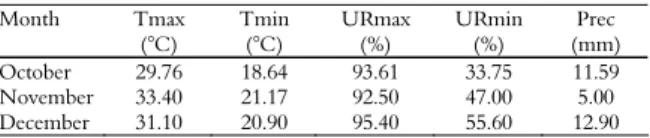
This experiment was developed in the sector of Ruminant Nutrition, of Agricultural Sciences College, of Federal University of Grande Dourados (UFGD), located in the city of Dourados, Mato Grosso do Sul State, between the months of October / December 2009. Table 1 shows the weather information of the region during the experimental period.
The experimental area was two acres, divided into four paddocks of 0.5 ha each, surrounded with electric fence, equipped with water troughs and feeders, subjected to continuous grazing method, with support capacity of 1 AU h-1. Each paddock was
uniformly covered with B. brizantha cv. Marandu, where forage was established in 2008, through crop livestock integration system after planting the corn.
Table 1. Maximum (Tmax) and minimum (Tmin) temperature, maximum and minimum (URmin) relative moisture (URmax) and precipitation (Prec) for city of Dourados, Mato Grosso do Sul State during the months of October and December 2009.
Month Tmax (°C)
Tmin (°C)
URmax (%)
URmin (%)
Prec (mm) October 29.76 18.64 93.61 33.75 11.59 November 33.40 21.17 92.50 47.00 5.00 December 31.10 20.90 95.40 55.60 12.90 Source: FCA - UFGD - Meteorological data 2009.
The experiment consisted of 52 days, divided into four periods of 13 days, with a sampling in each experimental period. We evaluated three sampling
methods: collection of the total availability of dry matter (TDM), hand plucking method (HP) and extrusa (EXT), obtained by ruminal emptying the rumen of steers.
On the first day of each experimental period, we measured the height of the pasture and cutting close to the ground samples of 10 metal squares (0.25 m2)
randomly into each paddock. The samples were weighed for calculate the total availability of forage. The samples were individually weighed and then homogenized; retiring two samples from each paddock, one for determine a morphological composition and other for the determination of the quality of total availability of dry matter method. They were then placed in plastic bags, identified and kept in cool boxes, avoiding the loss of moisture and fermentation of the same. The collected samples were transported to the Animal Nutrition Laboratory for further analysis. To determine the morphological composition (leaf, stem and senescent material), there was the separation of the parts by hand, with subsequent weighing of proportions to determine the percentages.
The Hand plucking method was determined by observing the behavior of grazing animal and identifying the type of material consumed in the same way that Moraes et al. (2005). The animals were accompanied on the picket line to observe their grazing habits (part of the plant collected, grazing height, lot size etc.). Based on these observations was held on the third day experimental harvest of forage. Manual harvesting was performed by a single sampler throughout the experimental period, in order to avoid variations (GOES et al., 2003; MORAES et al., 2005).
Collection of extrusa by ruminal emptying was held on the last experimental day (13th day), using four crossbred steers, castrated, weighing approximately 285 kg fitted with ruminal cannula. Prior to collection, the animals were fasted for 12 hours. The rumen was emptied at 8:00 hour, and then dried with cotton cloth. After emptying the rumen, the animals returned in their respective paddocks and grazed for about 30 minutes. After that time an average 400 g of material ingested were collected, identified and placed in plastic bags inside cool box.
After collection the samples were transported to the laboratory of Animal Nutrition of the FCA / UFGD, where was dried in a forced air oven at 65°C for 72 hours and subsequently processed in a mill with sieve at 1.0 mm and packed in plastic containers identified.
(CP), ether extract (EE), neutral detergent fiber (NDF), acid detergent fiber (ADF), hemicellulose (HCEL) cellulose (CEL), lignin (LIG) and ash (CZ), determined by the sequential method, according to methods described by Silva and Queiroz (2002). To determine the NDF and ADF was used Tecnal® equipment (TE-149), with
modification of the bag material used (5.0 x 5.0 cm) made of TNT with gramature of 100 g m-2
(CASALI et al., 2008).
The in vitro digestibility of dry matter (IVDMD)
was determined according to the method described by Tilley and Terry (1963), modified according to Silva and Queiroz (2002), through the use of the in
vitro incubator Tecnal® (TE-150), with modification
of the bag material used (5.0 x 5.0 cm), made using TNT (100 g m-2). The total carbohydrates (CHT)
were calculated according to Sniffen et al. (1992) and the non-fiber carbohydrates (NFC) according to Hall (2003), in which CHT (% DM) = 100 - [CP (% DM) + EE (% DM) + ash (% DM)]; NFC (% DM) = 100 - [% NDFap (% DM) +% CP (% DM) +% EE(% DM) + ash (% DM)], where CP is crude protein and EE is ether extract and NDF NDFap is devoid of ash and protein.
Was used to a completely randomized design with three treatments and 16 repetitions. The results were analyzed using ANOVA and "F" test, using the Statistical Analysis System and Genetics, SAEG 9.1 (SAEG, 2007) and the averages compared by Tukey test (α = 0.05); using the model: Yˆij = µ + ti + eij,
where: Yˆ ij = value observed in the experimental
unit that received the i sampling method, the j repetition, µ = overall average; ti = effect of
sampling method i, where i = 1, 2, 3 and eijk =
random error associated with each observation.
Results and discussion
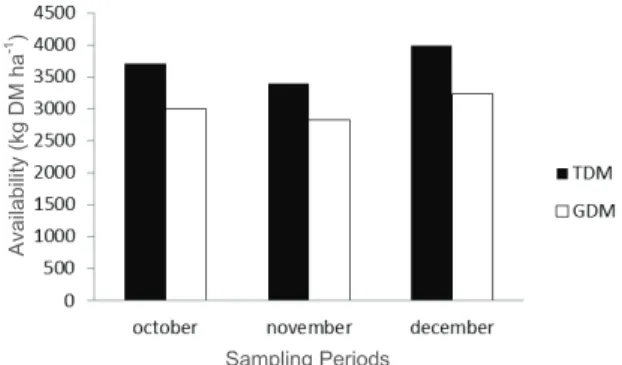
During the experimental period, the average of total dry matter (TDM) was 3666.11 kg ha-1 and of
dry matter and green (GDM) of 2999.52 kg ha-1
(Figure 1). According to Silva et al. (2009b), the pasture of B. brizantha cv. Marandu should be 4500 kg ha-1 of TDM and 1200 kg ha-1 of GDM in
order to enable the animal selectivity. In this work the availability of dry matter and green were higher of the limits proposed by Silva et al. (2009b) and Euclides et al. (1992) as limiting the selective grazing. Forage availability favored the selective grazing, due to the low stocking rate presented during the trial period, offering no limitation on the selective capacity of animals throughout the experimental period and enabling the maximization of consumption of dry matter (DM).
Figure 1. Average of total dry matter availability (TDM) and dry matter and green (GDM) of B. Brizantha cv. Marandu, in sampling periods.
The lowest values of DM, for extrusa (EXT) may resulted from saliva contamination or based in an animal selectivity (Table 2), with intake of younger plants portions with better quality and lower DM content (SILVA et al., 2011). The same authors found DM to the extrusa sampling method of 13.6% in rotational grazing of pastures of B. decumbens
with stocking rate fixed. Among the hand plucked method (HP) and total availability (TDM) did not occur significance, which is associated with the presence of stem + senescent material of 49.49%. The reduction of leaf and increase of stem and senescent material contributes to the increase in DM content of the pasture (SILVA et al., 2011).
Saliva has Ca, K, Cl, phosphate and bicarbonate ions that are essential for the buffering of the rumen and recycling of minerals (VAN SOEST, 1994). Even with the presence of saliva that provided lower DM content, the ash contents in the extrusa (EXT) did not differ from the hand plucked method (HP) and total availability of dry matter (TDM). Moraes et al. (2005) and Gomes et al. (2006), emphasize that the determination of minerals in samples extrusa are overestimated due to salivary contamination.
Table 2. Average contents of dry matter (DM), crude protein (CP), ether extract (EE) and ash (CZ) as a percentage of dry matter (DM), by the sampling methods.
Samplig methods DM (%)
CP (%DM)
EE (%DM)
CZ (%DM)
Extrusa 15.88b 15.22a 5.17a 2.87a
Hand Plucked 27.20a 10.07b 4.04a 2.73a Total Availability of Dry Matter 25.53a 9.14b 4.54a 2.56a
CV(%) 28.29 27.25 39.09 68.51
Means followed by different letters in the column differ (p < 0.05) by Tukey test.
The highest content of crude protein (CP) was obtained for the EXT, which is in agreement with Lima et al. (1998), Goes et al. (2003) and Moraes et al. (2005). According to Van Soest (1994), the higher CP content of forage is present in the leaves, in this trial the forage had 50.51% of leaves, providing greater ability to select the animal diet
Availabi
lity (kg
DM ha
-1)
(MORAES et al., 2005); the highest content of crude protein found on extrusa (EXT) can also be explained mainly by nitrogen salivary contamination (GOMES et al., 2006). Urea and mucins presents in saliva can be incorporated into forage at the time of intake, increasing the CP content of the extrusa (EXT) (LIMA et al., 1998).
Unlike the results found in this work, some authors like Goes et al. (2003) working with grass
Brachiaria arrecta found no difference in CP
concentration for the hand plucked method (8.22%) and extrusa (9.20%), the same occurred with Moraes et al. (2005) that working with Brachiaria decumbens, found similar levels of CP for the two sampling methods, which may be related to lower proportion of leaves, although this information was not provided by the authors. However, Moraes et al. (2005) reported availability of dry matter and green of 1515 kg ha-1, whereas in this study the average
was 2999.52 kg ha-1. The advance of the
phenological stage of the species and the highest proportions of stem and senescent material in the pasture, may limit the animal selectivity (CAVALCANTI FILHO et al., 2008).
The ether extract (EE) were not influenced by sampling methods, with average of 4.58%. Goes et al. (2003) evaluated the Tanner-grass, during the rainy season, also found no differences in the EE among different sampling methods (EXT, HP and TDM). The selection of green fractions for animals may have influenced the levels of EE, as the pasture had only 15.28% of senescent material.
The IVDMD of the extrusa (EXT) was higher than the others sampling methods (Table 3). This result is due to the animals have the ability to select the best quality forage. The lower contents of NDF and ADF presented by the extrusa influenced the higher in vitro digestibility of dry matter, because the FDA is composed mainly of cellulose and lignin, since the hemicellulose is solubilized with action of the acid detergent. Highs in the content of hemicellulose and reductions of cellulose become interesting because ruminants through the ruminal microbiota unfold these components in short-chain fatty acids (SCFA), mainly acetic, propionic and butyric, which represent the largest source of energy when these animal feeding on forage (PARIZ et al., 2010).
But there is strong evidence that cell wall polysaccharides (cellulose, hemicellulose and pectates), when isolated, are at increased degradation by rumen microorganisms or enzymes (PARIZ et al., 2010). However, the degradation of these polysaccharides in cell wall composition, is rarely complete and varies according to the lignin content,
type and age of the plant (SILVA; QUEIROZ, 2002). Another factor that may have contributed to higher in vitro digestibility of dry matter, associated with the selective capacity of animals is high availability of leaves present in the forage.
Table 3. Average contents of lignin (LIG), neutral detergent fiber (NDF), acid detergent fiber (ADF), non-fiber carbohydrates (NFC), total carbohydrates (TCHO), cellulose (CEL) and hemicellulose (HCEL) and in vitro digestibility of dry matter (IVDMD) by sampling methods.
Sampling Methods
(%DM) EXT HP TDM CV (%)
LIG 6.93a 6.80a 7.78a 26.46
NDF 81.98b 88.52a 87.70a 5.39
ADF 36.90b 43.70a 45.05a 19.16
NFC 18.00b 22.22a 20.09ab 20.90
TCHO 76.97b 83.45a 83.36a 21.91
CEL 30.55a
26.37b
30.27a
11.51 HCEL 42.15a 38.43b 38.66ab 10.73
IVDMD 79.10a 72.37ab 68.11b 11.16
Means followed by same letters in the line do not differ by Tukey test (p < 0.05).
The IVDMD was lower for TDM, and may be associated with a higher proportion of stem (average 34.40%), and high ADF (Table 3). The proportions of leaf and senescent material were 50.51 and 15.16%. The TDM does not represent the total diet selected by the animal (GOES et al., 2003), overestimating the fibrous content and underestimating the CP of pasture (MORAES et al., 2005).
The NDF and ADF were superior for HP and TDM, which demonstrates the ability to select the animal's diet (Table 3). When the forage available to animals consists of physiologically mature tillers, there is a predominance of these constituents, which have a negative influence on the nutritive value of forage (MORAES et al., 2005).
The lignin in B. brizantha tends to increase from the apex to the base of the plant (ALVES DE BRITO et al., 2003). Thus, it was expected that the extrusa (EXT) present lower lignin content than the methods HP and TDM, which did not occur. As extrusa collection was carried directly into the rumen, both the material more and less fibrous were collected. With this, more lignified tissues attached to the structure of the plant, may be present. Alves de Brito et al. (2003) found that B. Brizantha cv. Marandu has a higher NDF content on the stem than leaves, and higher crude protein on leaves, taking it to an animal selectivity.
have lower levels of NFC. Unlike Goes et al. (2003) evaluating B. arrecta, found that higher levels of TCHO for TDM (90.32%). But there was no difference in levels between samples obtained in the TDM and EXT methods.
For calculation of TCHO, the tenor of CP, EE and ash, were discounted; therefore, the differences between the sampling methods are related to animal selectivity, justifying the lower TCHO for extrusa (EXT). The sampling methods influenced the levels of NFC, being higher for HP and TDM regarding extrusa, different of Moraes et al. (2005) who found higher NFC in the samples collected via extrusa compared to HP.
The levels of cellulose (CEL) and hemicellulose (HCEL) from extrusa (EXT) were higher in comparison with other methods (Table 3). The greatest concentration of HCEL occurred due to the higher leaf ratio in the sample, which was equal to TDM (38.66%).
Conclusion
The chemical composition of the pasture of B.
Brizantha cv. Marandu confirm that extrusa present
the highest quality in the diet ingested by animals. The methodology of hand plucked did not differ from total availability of dry matter. Therefore, these methods didn't represent the diet selected by the animal, overestimating the fiber content and underestimating the crude protein of pasture.
Acknowledgements
The Conselho Nacional de Desenvolvimento Científico e Tecnológico (CNPq) and Fundação ao Apoio ao Desenvolvimento do Ensino Ciência e Tecnologia do Mato Grosso do Sul (Fundect) for financially supporting this work, the Federal University of Grande Dourados (UFGD) and CNPq by scholarships granted. To Maria Gizelma de Menezes Gressler for their assistance in the laboratory.
References
ALVES DE BRITO, C. J. F.; RODELLA, R. A.; DESCHAMPS, F. C. Chemical profile of cell wall and its implications on Brachiaria brizantha and Brachiaria humidicola digestibility. Revista Brasileira de Zootecnia, v. 32, n. 8, p. 1835-1844, 2003.
CASALI, A. O.; DETMANN, E.; VALADARES FILHO, S. C.; PEREIRA, J. C.; HENRIQUES, L. T.; FREITAS, S. G.; PAULINO, M. F. Influence of incubation time and particles size on indigestible compounds contents in cattle feeds and feces obtained by in situ procedures. Revista Brasileira de Zootecnia, v. 37, n. 2, p. 335-342, 2008.
CAVALCANTI FILHO, L. F. M.; SANTOS, M. V. F.; FERREIRA, M. A.; LIRA, M. A.; MODESTO, E. C.; DUBEUX JÚNIOR, J. C. B.; FERREIRA, R. L. C.; SILVA, M. J. Characterization of Brachiaria decumbens pastures in the coastal region of Pernambuco. Archivos de Zootecnia, v. 57, n. 220, p. 391-402, 2008.
EMBRAPA-Empresa Brasileira de Pesquisa Agropecuária. Centro Nacional de Pesquisa de Gado de Corte.
Brachiaria brizantha cv. Marandu. Campo Grande: Embrapa/CNPGC, 1985. (Documentos, 21).
EUCLIDES, V. P. B.; MACEDO, M. C. M.; OLIVEIRA, M. P. Avaliação de diferentes métodos de amostragem (para se estimar o valor nutritivo de forragem) sob pastejo.
Revista Brasileira de Zootecnia, v. 21, n. 4, p. 691-702, 1992.
FISCHER, V.; DESWYSEN, A. G.; DUTILLEUL, P.; DE BOEVER, J. Ingestive behavior nycterohemeral patterns of dairy cows, at the beginning and at the end of lactation, fed a corn silage based diet. Revista Brasileira de Zootecnia, v. 31, n. 5, p. 2129-2138, 2002.
GOES, R. H. T. B.; MANCIO, A. B.; LANA, R. P.; VALADARES FILHO, S. C.; CECON, P. R.; QUEIROZ, A. C.; COSTA, R. M. Quality evaluation of the Tanner Grass (Brachiaria arrecta) pasture, by three different collection methods. Revista Brasileira de Zootecia, v. 32, n. 1, p. 64-69, 2003.
GOMES, S. P.; LEÃO, M. I.; VALADARES FILHO, S. C.; PAULINO, M. F. Saliva contamination in the extrusa in steers fed with different forages, supplemented or not.
Arquivos Brasileiros de Medicina Veterinária e Zootecnia, v. 58, n. 6, p. 1199-1205, 2006.
HALL, M. B. Challenges with non fiber carbohydrate methods. Journal of Animal Science, v. 81, n. 12, p. 3226-3232, 2003.
LIMA, J. A.; NASCIMENTO JÚNIOR, D.; QUEIROZ, A. C.; REGAZZI, A. J. Grazing selectivity by steers in a natural pasture. 2. Nutritive value. Revista Brasileira de Zootecnia, v. 27, n. 3, p. 444-452, 1998.
MORAES, E. H. B. K.; PAULINO, M. F.; ZERVOUDAKIS, J. T.; VALADARES FILHO, S. C.; MORAES, K. A. K. Qualitative evaluation of differed pasture of Brachiaria decumbens Stapf., under grazing, in the dry season, using three sampling methods. Revista Brasileira de Zootecia, v. 34, n. 1, p. 30-35, 2005. PARIZ, C. M.; ANDREOTTI, M.; AZENHA, M. V.; BERGAMASCHINE, A. F.; MELLO, L. M. M.; LIMA, R. C. Massa seca e composição bromatológica de quatro espécies de braquiárias semeadas na linha ou a lanço, em consórcio com milho no sistema plantio direto na palha.
Acta Scientiarum. Animal Sciences, v. 32, n. 2, p. 147-154, 2010.
SÁ, J. F.; PEDREIRA, M. S.; SILVA, F. F.; FIGUEIREDO, M. P.; REBOUÇAS, G. M. N.; SOUZA, D. R. Cinética da fermentação in vitro do capim-Marandu em diferentes idades de corte. Acta Scientiarum. Animal Sciences, v. 33, n. 3, p. 225-231, 2011.
SAEG-Sistema de Análises Estatísticas e Genéticas.
SILVA, D. J.; QUEIROZ, A. C. Análise de alimentos: métodos químicos e biológicos. 3. ed. Viçosa: UFV, 2002. SILVA, C. C. F.; BONOMO, P.; PIRES, A. J. V.; MARANHÃO, C. M. A.; PATÊS, N. M. S.; SANTOS, L. C. Morphogenetic and structural characteristics of two grasses submitted to different nitrogen doses. Revista Brasileira de Zootecnia, v. 38, n. 4, p. 657-661, 2009a. SILVA, F. F.; SÁ, J. F.; SCHIO, A. R.; ITAVO, L. C. V.; SILVA, R. R.; MATEUS, R. G. Grazing supplementation: availability and quality x supplementation levels x performance. Revista Brasileira de Zootecnia, v. 38, p. 371-389, 2009b.
SILVA, A. M.; MODESTO, E. C.; LIRA, C. C.; SANTOS, M. V. F.; BRASIL, L. H. A.; DUBEUX JUNIOR, J. C. B. Caracterização do pasto e da extrusa de novilhas Girolanda, em pastagem de Brachiaria decumbens, submetidas a diferentes taxas de lotação. Acta Scientiarum. Animal Sciences, v. 33, n. 2, p. 115-122, 2011.
SNIFFEN, C. J.; O'CONNOR, J. D.; VAN SOEST, P. J.; FOX, D. G.; RUSSELL, J. B. A net carbohydrate and protein system for evaluating cattle diets: II Carbohydrate and protein availability. Journal of Animal Science, v. 70, n. 11, p. 3562-3577, 1992.
TILLEY, J. M. A.; TERRY, R. A. A two-stage technique for the in vitro digestion of forage crops. Journal of British Grassland Society, v. 18, n. 2, p. 104-111, 1963.
VAN SOEST, P. J. Nutritional ecology of the
ruminant. 2nd ed. Ithaca: Cornell University Press, 1994.
Received on June 17, 2011. Accepted on November 28, 2011.