Dietary protein levels in Piaractus brachypomus submitted
to extremely acidic or alkaline pH
Níveis de proteína na dieta de Piaractus brachypomus submetidos a pH extremamente ácidos ou alcalinos
Luciano de Oliveira GarciaI Mariana Gutiérrez-EspinosaII Walter Wásquez-TorresII Bernardo BaldisserottoIII
ISSN 0103-8478
ABSTRACT
The objective this study was to evaluate the effects of dietary protein levels in pirapitinga, Piaractus brachypomus, submited to extremely acidic or alkaline pH. Juveniles were fed for 20 days with three diets with different crude protein (CP) levels (25.3, 32.4 and 40.0%) and then separated in fi ve groups (n=10, three replicates each) which were kept in 60 L aquaria and exposed to pH 3.0, 3.5, 7.0, 10, or 10.5. Fish were removed from aquaria when they showed loss of swimming balance, and then blood was collected and plasma separated for measurement of Na+, Cl- and K+ levels. The increase
of dietary protein levels (up to 40.0% CP) provided some protection for pirapitinga at pH 3.5 or 10.0 because the time to lose equilibrium increased after acute exposure, but was not effective for compensating ion loss at very acidic (Na+ and Cl-) and alkaline (Cl-) pH.
Key words: pirapitinga, fi sh, ionoregulation, extreme pH.
RESUMO
O objetivo deste estudo foi avaliar o efeito dos níveis de proteína na dieta de pirapitinga, Piaractus brachypomus, submetidas a pH extremamente ácido ou alcalino. Os juvenis foram alimentados durante 20 dias com três dietas com diferentes níveis de proteína bruta (PB) (25,3; 32,4 e 40,0%) e, em seguida, foram separados em cinco grupos (n=10, três repetições cada), os quais foram colocados em aquários de 60L e expostos aos pH 3,0; 3,5; 7,0; 10 ou 10,5. Os peixes foram removidos dos aquários quando apresentaram perda de equilíbrio natatório, o sangue foi então coletado e o plasma separado para determinação dos níveis de Na+, Cl- e K+. O aumento dos níveis de proteína na dieta (até 40%
PB) forneceu alguma proteção para pirapitingas em pH 3,5 ou 10,0, porque o tempo para perder o equilíbrio natatório aumentou após a exposição aguda, mas não foi efetivo para compensar a perda de íons em pH muito ácido (Na+ e Cl-) ou alcalino (Cl-).
Palavras-chave: pirapitinga, peixe, ionorregulação, pH extremos.
INTRODUCTION
Fish exposed to acidic pH presented net Na+, K+ and Cl- ef
fl uxes, with consequent decrease of ion plasma levels (D’CRUZ & WOOD, 1998; PARRA & BALDISSEROTTO, 2007). Exposure of rainbow trout Oncorhynchus mykiss to alkaline waters also reduced branchial uptake and plasma Na+
and Cl−levels, with no effect on branchial diffusive efflux (YESAKI & IWAMA, 1992; WILKIE et al., 1996), and silver catfi sh Rhamdia quelen presented higher net Na+ loss (COPATTI et al., 2011). The ion
loss in fi sh exposed to acidic and alkaline pH can be compensated by ion dietary uptake because when fi sh are fed adequately this ionoregulatory disturbance is minimized (DOCKRAY et al., 1996; D’CRUZ & WOOD, 1998; COPATTI et al., 2011).
The pirapitinga, Piaractus brachypomus, is a native fi sh from the Amazon and Orinoco river basins (Latin America) and can be found in acidic waters (VÁSQUEZ-TORRES, 2005). This species is a rustic, fast-growing species, prized for its meat and offering excellent conditions for culture (MELARD et al., 1993). It has considerable economic importance on a commercial scale in Colombia, Brazil, Peru, Venezuela and Central America (VÁSQUEZ-TORRES et al., 2002). Pirapitinga is an omnivorous species and thus its diet includes leaves, fruits, tiny
IInstituto de Oceanografi a (IO), Estação Marinha de Aquacultura (EMA), Universidade Federal do Rio Grande (FURG), 96210-030, Rio
Grande, RS, Brasil. E-mail: [email protected]. Autor para c orrespondência.
IIInstituto de Acuicultura de la Universidad de los Llanos (IALL), Villavicencio, Departamento de Meta, Colombia.
IIIPrograma de Pós-graduação em Zootecnia (PPGZ), Departamento de Fisiologia e Farmacologia, Universidade Federal de Santa Maria
fi sh, and small crustaceans. Nutritional protein requirements for pirapitinga should be approximately 32%, lipid 4 to 6% and carbohydrates above 36% to achieve the best performance (VÁSQUEZ-TORRES, 2005; VÁSQUEZ-TORRES et al., 2011).
Dietary salt supplementation is very important to maintain ion homeostasis in fi sh exposed to low pH (D’CRUZ & WOOD, 1998; COPATTI et al., 2011). However, to our knowledge, there are no studies regarding dietary protein levels and ionoregulation in fi sh exposed to acidic and alkaline pH. In addition, no studies related to ionoregulation of pirapitinga exposed to extreme pH were performed. Therefore, the objective of this study was to evaluate the effects of dietary protein levels on ionoregulation and time to loose equilibrium in pirapitingasubmitted to extremely acidic or alkaline pH.
MATERIAL AND METHODS
Piaractus brachypomus juveniles were obtained from the Institute of Aquaculture at the Universidad de los Llanos, in Villavicencio, Colombia. The fi sh were kept in nine 200L tanks (n=20 per tank) in a closed system consisting of four biofi lters in series, continuous fl ow of 2L min-1 tank-1. The water
quality was maintained in: oxygen close to saturation (7.9±0.2mg L-1), temperature 25.2±1.2°C, pH 6.5±0.3
and total ammonia levels <0.02mg L-1. These parameters
were recorded weekly using a multiparameter probe Orion 5 Star (Thermo Electron Corporation) and total ammonia levels were measured with Ammonium test (Merck® Spectroquant 1.14752.0001).
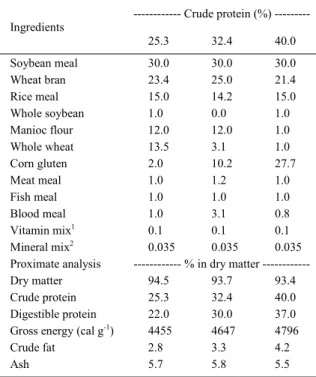
One hundred eighty fi sh were separated in three treatments (n=60 each) and fed for 20 days with formulated experimental diets with different crude protein (CP) levels (25.3, 32.4 or 40.0%) (Table 1). Juveniles were fed twice a day to apparent satiety and the uneaten food as well as other residues and feces were siphoned out 30min after feeding.
At the end of feeding period, each treatment was subdivided in fi ve groups of fi ve fi sh each (10.4±0.4cm and 9.7±1.2g), that were kept in 60L aquaria with 6.4±0.4mg L-1 dissolved oxygen
levels and temperature of 25.2±0.2ºC. Each group was exposed to a different pH (3.0, 3.5, 7.0, 10, or 10.5, in duplicate). The pH was adjusted by adding either H2SO4 or NaOH (1M). In all treatments juveniles were maintained under observation and were not fed throughout exposure to the experimental pH.
Fish were collected from the aquaria when they showed loss of equilibrium and absence of opercular movements or at the end of the experiment
(8h of exposure), the blood was rapidly collected from the caudal vein with heparinized syringes and centrifuged at 2,000rpm for 5min to separate the plasma. After sampling, all fi sh were euthanized by section of the spinal cord. All procedures were conducted according to rules of the Brazilian Council of Animal Experimentation Control (CONCEA). Plasma samples were stored at -20°C until use. Ion plasma levels were analyzed as described by BOLNER & BALDISSEROTTO (2007).
Data are reported here as mean ± SEM (N). The homogeneity of variances between groups was tested with the Levene test. Comparisons of plasma ion levels between different treatments were made by a two-way ANOVA (pH X CP) and a Tukey test. All tests were performed with the software Statistica 7.0 (1997; StatSoft Inc., Tulsa, OK, USA). The linear relationships between dietary protein levels and time to lose equilibrium at the different pH were calculated with Sigma Plot 11.0 software (Systat Software Inc., San
Table 1 - Diet composition used for Piaractus brachypomus
juveniles in the experimental period.
--- Crude protein (%) ---Ingredients
25.3 32.4 40.0
Soybean meal 30.0 30.0 30.0
Wheat bran 23.4 25.0 21.4
Rice meal 15.0 14.2 15.0
Whole soybean 1.0 0.0 1.0
Manioc flour 12.0 12.0 1.0
Whole wheat 13.5 3.1 1.0
Corn gluten 2.0 10.2 27.7
Meat meal 1.0 1.2 1.0
Fish meal 1.0 1.0 1.0
Blood meal 1.0 3.1 0.8
Vitamin mix1 0.1 0.1 0.1
Mineral mix2 0.035 0.035 0.035
Proximate analysis % in dry matter
---Dry matter 94.5 93.7 93.4
Crude protein 25.3 32.4 40.0
Digestible protein 22.0 30.0 37.0
Gross energy (cal g-1) 4455 4647 4796
Crude fat 2.8 3.3 4.2
Ash 5.7 5.8 5.5
1Rovimix Vitamins Lab. Roche S.A: Vit A 8.0*106UI, Vit D3,
1.8*106UI, Vit E 66.66g, Vit B1 6.66g, Vit B2 13.33g, Vit B6 6.66g, Ca pantothenate 33.33g, Biotin 533.3mg, folic acid 2.66g, ascorbic acid 400.0g, nicotinic acid 100.0g, Vit B12 20.0mg, Vit K3 6.66g, vehicle csp 1.0kg.
2Premix microminerals Lab. Roche S.A.: composition for 100g:
Jose, CA, USA).The minimum significance level was set at P<0.05.
RESULTS
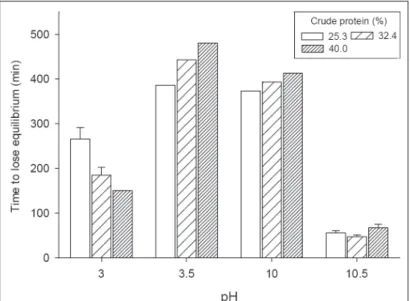
The increase of the dietary protein level provided to pirapitinga increased proportionally to the time to lose equilibrium when exposed to pH 3.5 or 10.0, but decreased with the time to lose equilibrium after exposure to pH 3.0 and did not affect the time to lose equilibrium after exposure to pH 10.5 (Figure 1). The relationships between time to lose equilibrium (y – in min) and dietary crude protein levels (x – in %) are expressed by pH 3.0 y=455.88-7.85x (r²=0.939), pH 3.5 y=228.66+6.38 (r²=0.980) and pH 10.0 y=304.42+2.72 (r²=0.999).
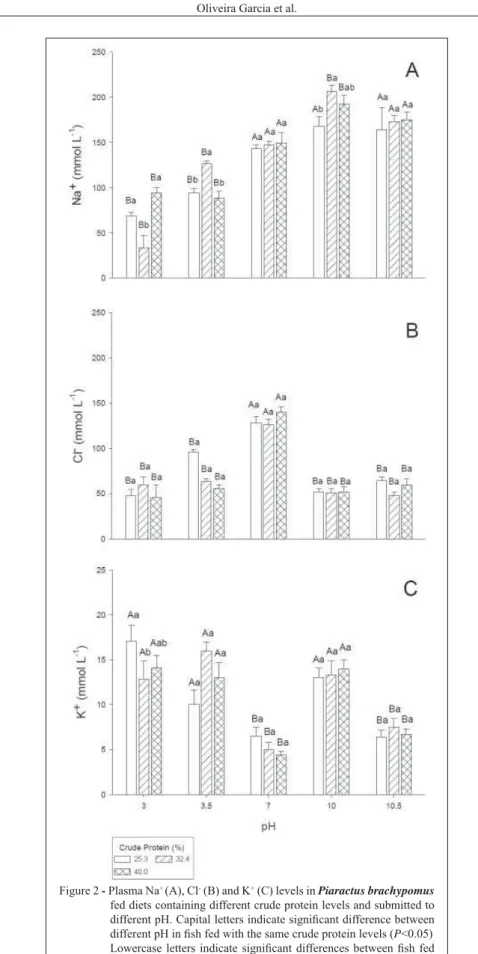
Irrespective of experimental diet, juveniles exposed to acidic water (3.0 or 3.5) showed plasma Na+ levels signi
fi cantly lower than those exposed to pH 7. However, only juveniles fed the higher dietary protein levels (32.4 and 40.0%) and transferred to pH 10.0 presented signifi cantly higher plasma Na+ levels
in relation to those kept at pH 7.0 and fed the same experimental diets. Exposure to pH 10.5 did not change plasma Na+ levels. At pH 3.0 and 3.5 the juveniles
fed with 32.4% CP had was signifi cantly lower and higher plasma Na+ levels, respectively, compared to
those fed with 25.3 and 40.0% CP at these same pH. Juveniles fed 32.4% CP and transferred to pH 10.0 showed plasma Na+ levels signi
fi cantly higher than those fed with 25.3% CP (Figure 2A).
Juveniles fed with all experimental diets and transferred to both acidic and alkaline pH showed signifi cantly lower plasma Cl- levels than
those maintained at pH 7.0 (Figure 2B). Juveniles exposed to acidic (3.0 and 3.5) and alkaline (10.0) pH presented signifi cantly higher plasma K+ levels than
those maintained at pH 7.0 and 10.5 irrespective of experimental diets. The plasma K+ levels of the juveniles
exposed to pH 3.0 and fed with the diet containing 32.4% CP were signifi cantly lower than those fed with with 25.3% CP at the same pH (Figure 2C).
DISCUSSION
The increase of dietary protein levels increased the time for pirapitinga to lose equilibrium at pH 3.5 or 10.0. This result indicates that a higher dietary protein level could be tested to improve survival and/or growth of this species at less acidic or alkaline waters. However, as the diet with higher protein level also presented around 7% higher gross energy, it is not possible to exclude that dietary energy may also contribute to this variation. In agreement with the present study, rainbow trout fed with 39% digestible protein (energy content 16.3Mj kg-1) presented
higher growth and food conversion effi ciency than those fed with 23% digestible protein (energy content 9.8Mj kg-1) when maintained at pH 5.2 (D’CRUZ &
WOOD, 1998).
Pirapitinga juveniles submitted to acute acidic exposure (pH 3.0 or 3.5) presented Na+ and
Cl- loss in comparison with
fi sh exposed to neutral
Figure 2 - Plasma Na+ (A), Cl- (B) and K+ (C) levels in Piaractus brachypomus
pH. The same was described for other species exposed to acidic pH: common carp Cyprinus carpio (pH 4.0) (CHEZHIAN et al., 2011), pupfi sh Cyprinodon variegatus variegatus (BRIX et al., 2013) zebrafi sh Danio rerio (KWONG & PERRY, 2013)and silver catfi sh (pH 4.0 and 5.5) (ZAIONS & BALDISSEROTTO, 2000; COPATTI et al., 2011). In acidic waters the uptake of Na+ and Cl- is
probably inhibited due to a competition of H+ with
Na+ transport sites (PARRA & BALDISSEROTTO,
2007). In addition, high H+ disrupt the tight junctions
of gill epithelia causing greater ionic loss by paracelullar route (KUMAI et al., 2011; KWONG & PERRY, 2013), and the net H+ excretion by the H+
-ATPase observed in neutral waters is reduced (BRIX et al., 2013). Higher plasma K+ levels after exposure to acidic pH (pH 5.0) was also observed in common carp (MATHAN et al., 2010). These authors supposed that this elevation is due to intracellular K+ release
from muscles as H+ enters.
In alkaline waters, ion loss probably occur due to an inhibition of branchial Na+/H+ and Cl-/
HCO3 exchangers (PARRA & BALDISSEROTTO, 2007), which would explain the lower plasma Cl
-levels in pirapitinga at pH 10.0 and 10.5. Ions loss after exposure to alkaline waters also occurred in silver catfish at pH 9.4-10.0 (ZAIONS & BALDISSEROTTO, 2000), O. mykissat pH 9.0-10.5 (YESAKI & IWAMA, 1992; McGEER & EDDY, 1998) andOncorhynchus clarki henshawi at 10.0-10.5 (WILKIE et al., 1994). However, exposure of pirapitinga to alkaline pH did not change or increased (at pH 10.0 in fi sh fed the higher dietary protein levels) plasma Na+ levels. Apparently alkaline water
has a different effect on Na+ and Cl- transporters.
Similar effects on Na+ and Cl- plasma levels were
observed in silver catfi sh exposed to pH 9.0 for 24h (BOLNER & BALDISSEROTTO, 2007).
The increase of dietary protein (and energy) levels did not improve the ionoregulatory response of pirapitinga against acidic or alkaline pH exposure. Higher dietary energy and protein level also did not improve the ionoregulatory response in rainbow trout exposed to pH 5.2 (D’CRUZ & WOOD, 1998).
In conclusion, the increase of dietary protein levels (with a possible contribution of dietary energy) increased the time for pirapitinga to lose equilibrium at pH 3.5 or 10.0, but was not effective for compensating ion loss at very acidic (Na+ and Cl-)
and alkaline (Cl-) pH.
ACKNOWLEDGMENTS
B. Baldisserotto received a Conselho Nacional de Desenvolvimento Científico e Tecnológico (CNPq) research fellowship.
REFERENCES
BOLNER, K.C.S.; BALDISSEROTTO, B. Water pH and urinary excretion in silver catfi sh Rhamdia quelen. Journal of Fish Biology, v.70, p.50-64, 2007. Available from: <http://onlinel ibrary. wiley.com/doi/10.1111/j.1095-8649.2006.01253.x/pdf>. Accessed: out. 10, 2012. doi:10.1111/j.1095-8649.2006.01253.x.
BRIX, K.V. et al. Measuring titratable alkalinity by single versus double endpoint titration: an evaluation in two cyprinodont species and implications for characterizing net H+
fl ux in aquatic organisms.
Comparative Biochemistry and Physiology Part A, v.164, p.221-228, 2013. Available from: <http://www.sciencedirect.com/ science/article/pii/S1095643312004734>. Accessed: jul. 22, 2013. doi: 10.1016/j.cbpa.2012.09.010
CHEZHIAN, A. et al. Infl uence of different calcium levels and low pH of water on the plasma electrolyte regulation of a fresh water teleost fi sh Cyprinus carpio var. communies, (Linnaeus, 1958). Current Research Journal of Biological Sciences, v.3, n.2, p.147-154, 2011. Available from: <http://maxwellsci.com/ print/crjbs/v3-147-154.pdf>. Accessed: may. 10, 2013.
COPATTI, C.E. et al. Dietary salt and water pH effects on growth and Na+
fl uxes of silver catfi sh juveniles. Acta Scientiarum - Animal Science, v.33, n.3, p.261-266, 2011. Available from: <http://periodicos.uem.br/ojs/index.php/ActaSciAnimSci/article/ view/11192/11192>. Accessed: out. 10, 2012. doi: 10.4025/ actascianimsci.v33i3. 11192.
D’CRUZ, L.M.; WOOD, C.M. The infl uence of dietary salt and energy on the response to low pH in juvenile rainbow trout.
Physiological Zoology, v.71, n.6, p. 642-657, 1998. Available from: <http://www.jstor.org/stable/10.1086/515987>. Accessed: out. 10, 2012.
DOCKRAY, J.J. et al. Effect of elevated summer temperatures and reduced pH on metabolism and growth of juvenile rainbow trout (Oncorhynchus mykiss) on unlimited ration. Canadian Journal of Fisheries and Aquatic Science, v.25, p.2752-2763, 1996. Available from: <http://www.nrcresearchpress.com/doi/ pdf/10.1139/f96-232>. Accessed: out. 10, 2012. doi: 10.1139/ f96-232.
KUMAI, Y. et al. Strategies for maintaining Na+ balance in
zebrafi sh (Danio rerio) during prolonged exposure to acidic water.
Comparative Biochemistry and Physiology Part A, v.160, n.1, p.52-62, 2011. Available from: <http://www.sciencedirect.com/ science/article/pii/S1095643311001310>. Accessed: jul. 22, 2013. doi: 10.1016/j.cbpa.2011.05.001.
KWONG, R.W.; PERRY, S.F. Cortisol regulates epithelial permeability and sodium losses in zebrafi sh exposed to acidic water.
Journal of Endocrinology, v.217, n.3, p.253-64, 2013. Available from: <http://joe.endocrinology-journals.org/content/217/3/253. short>. Accessed: jul. 22, 2013. doi: 10.1530/JOE-12-0574.
MATHAN, R. et al. Alterations in plasma electrolyte levels of a freshwater fi sh Cyprinus carpio exposed to acidic pH.
Toxicological and Environmental Chemistry, v.92, n.1, p.149-157, 2010. Available from: <http://www.ingentaconnect. com/content/tandf/gtec/2010/00000092/00000001/art00017>. Accessed: may 22, 2013. doi: 10.1080/02772240902810419.
freshwater of pH 10.5. Physiological Zoology, v.71, n.2, p.179-190, 1998. Available from: <http://www.jstor.org/ stable/10.1086/515895>. Accessed: out. 10, 2012.
MELARD, C.H. et al. Comparative growth rate and production of
Colossoma macropomum and Piaractus brachypomus(Colossoma bidens) in tanks and cages using intensive rearing conditions. In: BARNABE, G.; KESTEMONT, P. (Eds.). Production, environment and quality. Ghent: European Aquaculture Society, 1993. Cap.39, p.433-442. (Special Publication 18).
PARRA, J.E.G.; BALDISSEROTTO, B. Effect of water pH and hardness on survival and growth of freshwater teleosts. In: BALDISSEROTTO, B. et al. (Ed.). Fish osmoregulation. New Hampshire: Science Publishers, 2007. Cap.5, p.135-150.
VÁSQUEZ-TORRES, W. et al. Estudos para composição de uma dieta referência semipurifi cada para avaliação das exigências nutricionais em juvenis de pirapitinga, Piaractusbrachypomus
(Cuvier 1818). Revista Brasileira de Zootecnia, v.31, p.283-292, 2002. Available from: <http://www.scielo.br/pdf/rbz/ v31n1s0/10307.pdf>. Accessed: out. 10, 2012. doi: 10.1590/ S1516-35982002000200001.
VÁSQUEZ-TORRES, W. A Pirapitinga, reprodução e cultivo. In: BALDISSEROTTO, B.; GOMES, L.C. (Ed.). Espécies nativas para piscicultura no Brasil. Santa Maria: UFSM, 2005. Cap.9, p.203-223.
VÁSQUEZ-TORRES, W. et al. Optimum dietary crude protein requirement for juvenile cachama Piaractus brachypomus. Ciência
Rural, v.41, n.12, p.2183-2189, 2011. Available from: <http:// www.scielo.br/pdf/cr/v41n12/a21011cr5219.pdf>. Accessed: out. 10, 2012. doi: 10.1590/S0103-84782011001200023.
WILKIE, M.P. et al. Physiological adaptations of rainbow trout to chronically elevated water pH (pH 9.5). Journal of Experimental Zoology, v.274, p.1-14, 1996. Available from: <http://onlinelibrary. wiley.com/doi/10.1002/(SICI)1097-010X(19960101)274:1% 3C1::AID-JEZ1%3E3.0.CO;2-T/pdf>. Accessed: out. 10, 2012. doi: 10.1002/(SICI)1097-010X(19960101)274.
WILKIE, M.P. et al. The physiological adaptations of the Lahontan cutthroat trout (Oncorhynchus clarki henshawi) following transfer from well water to the highly alkaline waters of Pyramid Lake, Nevada (pH 9.4). Physiological Zoology, v.67, p.355-380, 1994. Available from: <http://www.jstor.org/stable/30163853>. Accessed: out. 10, 2012.
YESAKI, T.Y.; IWAMA, G.K. Survival, acid-base regulation, and ammonia excretion in rainbow trout in highly alkaline hard water.
Physiological Zoology, v.65, n.4, p.763-787, 1992. Available from: <http://www.jstor.org/stable/30158538>. Accessed: out. 10, 2012.
ZAIONS, M.I.; BALDISSEROTTO, B. Na+ and K+ body levels
and survival of juveniles of Rhamdia quelen (Siluriformes,