Spatial and temporal distribution of cotton squares and small cotton
bolls fallen on ground after damage by boll weevil and the
efficiency of the equipment used to collect them
Distribuição espacial e temporal dos botões florais e pequenas maçãs de algodão caídas ao solo danificadas pelo bicudo e eficiência de equipamento para coletá-los Carlos Alberto Domingues da Silva1*,2 Marília de Macêdo Freire Duarte2
Suziane Gomes Gonçalves2 Eduardo Domingos Vasconcelos1
ISSNe 1678-4596
INTRODUCTION
Cotton crop (Gossypium hirsutum L.) is attacked by a wide variety of phytophagous arthropods with potential to cause serious damage to culture (RIBEIRO et al., 2015). Among these, the boll weevil Anthonomus grandis Boheman (Coleoptera: Curculionidae) is a key pest of cotton in the new world (SALVADOR et al., 2014). This insect has spread throughout the cotton-producing regions of Brazil, which has led to a severe increase in the cost of production due to economic losses arising from the
insect feeding behavior and oviposition on the cotton squares and bolls (SILVA & RAMALHO, 2013).
The boll weevil is mainly controlled by application of chemical insecticide during the
flowering period to protect cotton squares (SILVA
& RAMALHO, 2013; SILVA & SILVA, 2015). Important alternatives to cotton insecticides include various types of cultural control tactics, as suggested elsewhere (GREENBERG et al., 2010).
The collection of cotton squares and cotton bolls damaged by weevil and fallen on the ground is one such tactic that promises to be of great value to
1Empresa Brasileira de Pesquisa Agropecuária (EMBRAPA), Centro Nacional de Pesquisa de Algodão, Rua Oswaldo Cruz, 1143, Centenário,
58428‑095, Campina Grande, PB, Brasil. E-mail: [email protected]. *Corresponding author. 2Universidade Estadual da Paraíba (UEPB), Campina Grande, PB, Brasil.
ABSTRACT: In this study, we determined the spatial and temporal distribution of fallen cotton squares and small cotton bolls fallen damaged by boll weevil and the efficiency and time interval of the equipment used to collect cotton samples. Spatial and temporal distribution of cotton squares and small cotton bolls fallen on the soil damaged by boll weevil among cotton rows was determined in an experimental design of randomized blocks in a factorial arrangement of 4x3, represented by soil surface tracks located at 1-11cm, 12-22cm, 23-33cm, and 34-44cm away from the planting row of cotton plants 70, 85, and 100 days of age. Efficiency and collection time interval of the cotton samples fallen on the soil infested by boll weevil by plastic rakes that were straight or fan-shaped, big broom, collector instrument model CNPA and aspirator of leaves ‘Trapp’ were determined in randomized block design with five treatments, 10 repetitions for each. Results demonstrated that the collection of cotton samples must be performed with greater attention to soil strips located below the cotton top projection and aspirator ‘Trapp’ of leaves was more appropriate for the operation as it used less time of collection with similar efficiency to other available equipment.
Key words: Anthonomus grandis, Gossypium hirsutum, punctured squares by oviposition and feeding.
RESUMO: Neste estudo, determinou-se a distribuição espacial e temporal dos botões florais e pequenas maçãs de algodoeiros caídas ao
solo danificadas pelo bicudo e a eficiência de equipamentos para coletá-las. A distribuição espacial e temporal dos botões florais e pequenas maçãs de algodoeiros caídas ao solo danificadas pelo bicudo entre as fileiras de algodão foram determinadas em delineamento experimental de blocos ao acaso em arranjo fatorial 4x3, representado por faixas de superfície de solo localizadas entre 1-11cm; 12-22cm; 23-33cm e 34-44cm de distância da fileira de plantio em algodoeiros com 70, 85 e 100 dias de idade. A eficiência de coleta dos botões florais e pequenas maçãs caídas ao solo danificado pelo bicudo pelos rastelos plásticos em leque e reto, vassourão, catador modelo CNPA e aspirador de folhas “Trapp” foi determinado em delineamento de blocos ao acaso com cinco tratamentos e 10 repetições. Os resultados demonstraram que a coleta dos botões florais e pequenas maçãs caídas ao solo devem ser realizadas com maior atenção nas faixas de solo localizada abaixo da projeção da copa do algodoeiro e que o aspirador “Trapp” se mostrou mais adequado para essa operação porque gastou menos tempo para coletar essas estruturas vegetais, embora tenha apresentado eficiência semelhante aos demais equipamentos.
Palavras-chave: Anthonomus grandis, Gossypium hirsutum, botões florais com orifício de oviposição e alimentação.
reduce the population of the first generation of this pest when applied in the initial stage of flowering
as well as delay and/or reduce the infestation of the crop by later generations (NEVES et al., 2013; 2014). Researchers have attempted to mechanize the collection of these fruiting structures infested by cotton boll weevil. COAD & MCGEHEE (1917) built a machine to collect boll weevil adults and squares of infested cotton plants, but their attempts to control the boll weevil were unsuccessful. Efforts have been made to develop an experimental machine mounted on
tractor (the flail type) to destroy the squares damaged
by cotton boll weevil and fallen on the ground. This machine was tested under various conditions and demonstrated promising results in the control of boll weevil when applied in the initial period of formation of reproductive structures (BURT et al., 1969).
In Brazil, inspired by the beach paper collectors at the end of the 1990s, the agronomist José Eymard do Nascimento of EMATER-CE idealized a small collector of cotton squares fallen on the soil, which was further
improved by Embrapa Cotton after several field studies
(BELTRÃO et al., 1997). Despite functioning well, this collector was little used by small cotton producers, perhaps because the practice of collecting and destroying cotton squares fallen on the soil was little known by cotton farmers and/or was characterized as a hard work, dependent on hand labor, and questionable regarding their
viability depending on the size of the field area (SANTOS
et al., 2013). Therefore, the accumulation of data on the improvement of this farming practice may be of great importance for small cotton farmers.
The objective of this study was to determine the spatial and temporal distribution of cotton squares and small cotton bolls fallen on the
soil damaged by weevil as well as the efficiency of
equipment to collect these plant structures.
MATERIALS AND METHODS
The study was conducted between 18
July and 23 October 2014 in the experimental field
of Embrapa Cotton in Campina Grande, Paraiba, Brazil, covering an area of 180m2 (12×15m) that was historically infested by cotton boll weevil. The average temperature and relative humidity of the study area were 21.9°C and 82.4%, respectively, during the study period.
Cultivar
We used the ‘cultivar cotton BRS 8H’, planted
under dry land soil conditions classified as eutrophic
Entisol, spaced 0.90m between rows and 0.10m between
plants, leaving one plant per hole after thinning. At 35
days after germination (DAG), when the first cotton
squares appeared, the experiments were initiated.
Spatial and temporal distribution of fallen
reproductive structures to the ground
The spatial and temporal distribution of reproductive structures [cotton squares of large (6-8mm diameter), medium (3-6mm diameter), and small bolls size (5-8mm diameter)] fallen on the soil damaged by boll weevil between cotton rows were determined in a randomized block design with a factorial arrangement of 4x3, represented by soil surface tracks located at 1-11cm, 12-22cm, 23-33cm, and 34-44cm away from planting row on cotton plants at 70, 85, and 100 days of age.
Plots consisted of a soil surface strip between the rows of cotton crop measuring 0.9m x 3.0m, subdivided into eight smaller strips (four sub-strips
located immediately after the first row of cotton and the
other four immediately before the second row) of 0.1m width, parallel to one another and located at different distances from the cotton row in treatments as described.
We quantified the distance, number, and
percent of reproductive structures of cotton fallen on the ground with punctures of the feeding and/or oviposition by boll weevil by using soil strip every fortnight. Cotton squares and small cotton bolls fallen on the soil due to natural abscission were not considered in the data analysis.
Equipment collection efficiency
The efficiency of equipment to collect
cotton squares and small cotton bolls fallen on the soil after damaged by boll weevil was determined in
a design of randomized blocks with five treatments
(10 repetitions each). Treatments consisted of the use of straight plastic rakes, a fan-shaped, big broom, collector instrument model CNPA, and leaves aspirator ‘Trapp’ (Trapp, Jaraguá do Sul, Santa Catarina, Brazil) to collect the aforementioned reproductive structures.
Collection operation using the big broom and plastic fan rakes and straight rakes included the step of sweeping the fallen reproductive structures on the ground between rows of cotton plantation and making a mound in the end of experimental street, followed by manual collection and packaging in cloth bags.
for disposal. The study was conducted in the same
area of the first experiment, taking advantage of the
information generated to orientate the positioning of equipment for collection.
The evaluations were made every 2 weeks
during the appearance of the first cotton squares until the formation of firm bolls, by counting the cotton
squares and small bolls fallen on the soil before and after collection of these structures using the mentioned equipment. Number of cotton squares and small cotton bolls fallen on the soil due to the damage caused by
boll weevil, the efficiency of collection, and the time
spent in collecting these reproductive structures of the cotton plant were determined. Cotton squares and small cotton bolls fallen on the soil due to attack by other insect pests or by natural abscission of the cotton squares were not considered in the evaluation.
Data analysis
The data of spatial distribution and the time of collecting the cotton squares and small cotton bolls damaged by boll weevil and then fallen on the
soil and the efficiency of collection equipment were
subjected to analysis of variance and the means were compared by Tukey’s test at 5% probability using the System of Analysis Statistics and Genetics (SAEG) of the Universidade Federal de Viçosa.
RESULTS AND DISCUSSION
The abscission of cotton reproductive structures (squares and small bolls) can be attributed to several factors unrelated to pest infestations (GUINN, 1982; SHOWLER, 2008). In this study, most of the abscission of cotton squares and small bolls of the cultivar BRS 8H were due to physiological factors of the plant (51%) followed by injury for oviposition of the boll weevil females (42%). Abscission of reproductive
structures by other unidentified factors was 7%. There
was no abscission of cotton squares and small bolls due to the attack of other insect pests. These results are similar to those obtained for natural abscission of reproductive structures in cotton (PEREIRA et al., 2004); however, it was higher than 27% of abscission attributed by the authors to adult boll weevil.
Among the abscissions due to boll weevil injuries, it was observed injuries due to other reasons amounted to 7% of total reasons. Squares and small bolls fallen on the soil had at least one puncture by oviposition, but the reproductive structures with only punctures of feeding remained attached to the plant. In addition, various bolls, especially large-sized ones (>15mm diameter) with punctures of feeding and
oviposition produced cotton fibers. These results
corroborated those obtained by SHOWLER et al.
(2005) and SHOWLER (2008), confirming that the
punctures by feeding in the cotton squares and small bolls are not associated with your abscission.
Spatial and temporal distribution of fallen
reproductive structures to the ground
The distance means between cotton squares and small bolls fallen on the soil with punctures due to feeding and/or oviposition by boll weevil and the lap of cotton plant (cultivar BRS 8H) did not differ with
the age of the plant within the first (1-11cm), second
(12-22cm), third (23-33cm), and fourth (34-44cm) strips of ground surface and were 7.51, 15.31, 27.65, and 37.74cm, respectively. Results indicated that the measured distance was not affected by phenological development of the cotton plant, probably because of the phenotypic characteristics of the canopy of the cotton cultivar BRS 8H, which features cotton
squares and positions of the flowering and fruiting,
concentrated mostly around the main stem. Studies conducted with the cotton cultivars NuOpal, DeltaOpal FMT-701, FMX-910, and FMX-993 have revealed that the production and size of the fruit and its agronomic characteristics greatly depend on the location of the plant and the positions of the fruiting
body both in the regions of vertical flowering and the regions of horizontal flowering, with more than 80% of the production defined at the regions of the bottom and middle-third of the cotton plant and at the first and
second position of fruits (GRIGOLLI et al., 2013). The amount of cotton squares and small bolls with punctures of feeding and/or oviposition by boll weevil and then fallen on soil in relation to the planting row showed
with increased formation of cotton squares and bolls (SHOWLER et al., 2005).
Irrespective of the cotton plant age, more number of cotton squares and small bolls with punctures of feeding and/or oviposition by boll weevil fell near the lap of the plant at a distance of 0.01m to 0.11m away from the planting row, followed by the distance of 0.12m to 0.22m away from the planting row (Table 1). Greater numbers of cotton squares on the soil surface strips near the plant’s lap corresponds
to the first, second, and third position of the fruitful
or sympodial branch until the sixth node of main axis, where most of these reproductive structures are located (GRIGOLLI et al., 2013). Therefore, if we considered one distance of the soil surface from the planting row until 0.22m, the percent of reproductive structures fallen on the soil with punctures of feeding and/or oviposition by boll weevil was 85.20%, which corresponded to the percent projection of cotton canopy of the cultivar BRS 8H. This result was >70% of cotton squares fallen on the soil at a distance of 0.25m from the planting row observed by SMITH (1977), which can be attributed to the differences in the methodology applied and the cultivars and cultivation practices used as well as the climatic conditions (GUINN, 1982).
Equipment collection efficiency
Significant interaction observed
between equipment and age of the culture for
collection efficiency (F8:42=2.71, P<0.02) of the fallen reproductive structures on soil damaged by
boll weevil indicated that the efficiency to collect
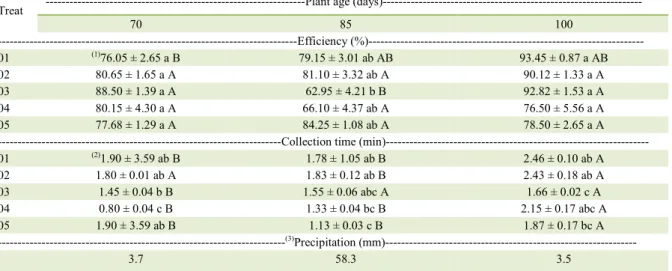
them was affected by the type of equipment used in a certain age of cotton plant (Table 2). This can
be attributed to less efficient sweeping of cotton
squares and small bolls fallen on the ground by using big broom between rows of cotton plants aged 85
days because rainfall occurred 5 days prior to the experiment. Rainfall probably increased the moisture of soil and cotton squares and small bolls fallen on the soil, which consequently increased the weight and grip of these structures on the soil surface, reducing
the sweep and efficient relocation and collection processes (SMITH, 1977). Collection efficiency was
only little affected by rainfall.
The collection efficiencies of cotton
squares and small bolls fallen on the soil between the cotton rows using plastic fan rakes and straight rakes, big broom (collector instrument CNPA model), and aspirator of the leaves ‘Trapp’ ranged from 76% to 88% for all plants despite their age (Table 2). Results
are similar to the variations in the collection efficiency
of the cotton squares fallen on the ground from 69% to 89.2% by manual collection and by using collector instrument CNPA model, big broom, and metal broom in cotton crops of the municipality of Sousa, Paraíba, Brazil (BELTRÃO et al., 1997). Conversely,
it was higher than the collection efficiency variations
from 59% to 74.2% observed by the authors in the study with cotton in Palmas de Monte Alto, Bahia, Brazil using the hands and collection equipment (same as in this study), and, also, the collection
efficiency variations of 49.7% to 69.1% obtained by a flail-type suction machine mounted on the tractor
in experimental area with cotton crops in Columbia, Missouri, United States (SMITH, 1977).
The time required to collect the reproductive structures damaged by boll weevil and then fallen on the soil between the cotton plant rows showed
a significant interaction between age and culture
equipment (F8:42=3.44, P<0.01) (Table 2), indicating that the time taken to collect them was affected by the type equipment in a certain age of the plant. The greatest time spent for the collection of these
Table 1 - Mean numbers ± standard error (SE) and percent of cotton squares and small bolls of cultivar BRS 8h fallen on the soil after damage by boll weevil using distance strip (DS) on the soil surface in relation to row of cotton plants of different ages.
Trat ---Plant age (days)---
---70--- ---85--- ---100--- Mean numbers ± SE (%) Mean numbers ± SE (%) Mean numbers ± SE (%) DS1 42.75 ± 02.87 ab1C2 48.72 155.25 ± 17.22 aB 53.21 216.25 ± 11.91 aA 46.78
DS2 30.25 ± 04.39 abc C 34.47 99.75 ± 04.80 bB 34.19 176.75 ± 06.64 bA 38.24 DS3 12.00 ± 02.27 bc B 13.68 27.50 ± 05.42 cB 09.43 53.25 ± 05.45 cA 11.52 DS4 02.75 ± 00.48 c A 03.13 09.25 ± 01.31 cA 03.17 16.00 ± 02.27 dA 03.46
Ʃ 87.75 100.00 291.75 100.00 462.25 100.00
Treat. (Treatments) = (DS1) from 1 to 11cm; (DS2) from 12 to 22cm; (DS3) from 23 to 33cm (DS4) from 34 to 44cm. (1)Means followed
by the same letter in the column are not different by Tukey test (P<0.05).(2)Means followed by the same capital letter in the line are not
reproductive structures between cotton rows were observed with rakes (fan and rectum) for plants aged 100 days and lowest with aspirator ‘Trapp’ between cotton rows aged 70 days. These larger collection times with rakes was also recorded by BELTRÃO et al. (1997) and can be attributed to the greater effort by the operator to manually collect cotton squares and small bolls piled up at the end of the street, because of the increased amount of these reproductive structures at 70-100 days after emergence.
Our results showed that the collection of cotton squares and small bolls fallen on the soil must be performed with greater attention to the soil strips located below the cotton canopy projection and that the aspirator ‘Trapp’ was more suitable for this operation as it spent less time in collecting these reproductive structures,
albeit with similar efficiency to other equipment.
CONCLUSION
The distance between the cotton squares and small bolls fallen on the soil after infestation with boll weevil until planting row did not differ with the age of the plant within each strip of the soil surface. However, the number of cotton squares and small bolls fallen on the soil differ with the distance and the age of the plants, with the highest number of these reproductive structures fallen on strips of soil next to the rows of older cotton plants.
All tested equipment showed similar
collection efficiency for cotton squares and small
bolls damaged by boll weevil that has fallen on the soil. However, the greatest time of collection of cotton squares and small bolls on the soil were spent using rakes (fan and rectum) at 100 days of plant age, while the least time was spend with aspirator ‘Trapp’ at 70 days of plant age.
ACKNOWLEDGMENTS
To Conselho Nacional de Desenvolvimento Científico
e Tecnológico (CNPq) and Coordenação de Aperfeiçoamento de
Pessoal de Nível Superior (Capes) for financial support. Global Edico Services corrected and edited the English in this manuscript.
REFERENCES
BELTRÃO, N.E.M. et al. Desenvolvimento e avaliação de um catador
de botões florais atacados pelo bicudo e caídos no solo. Campina Grande: Embrapa Algodão, 1997. 7p. (Pesquisa em Andamento, 37).
BURT, E.C. et al. Control of the boll weevil by mechanically destroying fallen infested cotton squares. Journal of Economic Entomology, v.62, p.862-865, 1969.
COAD, B.R.; McGEHEE, T.F. Collection of weevils and infested squares as a means of control of the cotton boll weevil in the Misssissippi Delta. Washington: U.S. Department of Agriculture 1917. 51p. (Bulletin, 564). Available from: <http://dx.doi. org/10.5962/bhl.title.64494>. Accessed: Oct. 10, 2016.
Table 2 - Mean ± standard error (SE) of efficiency and time interval required to collect cotton squares and small bolls fallen on the soil damaged by boll weevil between rows of different ages.
Treat ---Plant age (days)---
70 85 100
---Efficiency (%)---
01 (1)76.05 ± 2.65 a B 79.15 ± 3.01 ab AB 93.45 ± 0.87 a AB
02 80.65 ± 1.65 a A 81.10 ± 3.32 ab A 90.12 ± 1.33 a A
03 88.50 ± 1.39 a A 62.95 ± 4.21 b B 92.82 ± 1.53 a A
04 80.15 ± 4.30 a A 66.10 ± 4.37 ab A 76.50 ± 5.56 a A
05 77.68 ± 1.29 a A 84.25 ± 1.08 ab A 78.50 ± 2.65 a A
---Collection time (min)---
01 (2)1.90 ± 3.59 ab B 1.78 ± 1.05 ab B 2.46 ± 0.10 ab A
02 1.80 ± 0.01 ab A 1.83 ± 0.12 ab B 2.43 ± 0.18 ab A
03 1.45 ± 0.04 b B 1.55 ± 0.06 abc A 1.66 ± 0.02 c A
04 0.80 ± 0.04 c B 1.33 ± 0.04 bc B 2.15 ± 0.17 abc A
05 1.90 ± 3.59 ab B 1.13 ± 0.03 c B 1.87 ± 0.17 bc A
---(3)Precipitation (mm)---
3.7 58.3 3.5
Treat. (Treatments) = (01) fan-like rake; (02) straight rake; (03) big broom; (04) collector instrument model CNPA, and (05) leaves aspirator ‘Trapp’. (1)Mean of equipment efficiency followed by the same letter minuscule in column and same capital letter in line are not different by
Tukey’s test (P<0.05). (2)Mean of collection time followed by the same letter minuscule in column and same capital letter in line are not
GREENBERG S.M. et al. Insect population trends in different tillage systems of cotton in South Texas. Subtropical Plant Science, v.62, p.1-17, 2010. Available from: <https://www.researchgate.net/ publication/44922345_Insect_Population_Trends_in_Different_Tillage_ Systems_of_Cotton_in_South_Texas>. Accessed: Nov. 15, 2016.
GRIGOLLI, J.F.J. et al. Within plant distribution of Anthonomus-grandis (Coleoptera: Curculionidae) feeding and oviposition damages in cotton cultivars. Ciência e Agrotecnologia, v.36, p.78-84, 2013. Available from: <http://www.scielo.br/scielo.php?script=sci_arttext>. Accessed: Dec. 20, 2015. doi: 10.1590/S1413-70542013000100009.
GUINN, G. Causes of square and boll shedding in cotton. Washington: U.S. Department of Agriculture Technical, 1982. 21p. (Bulletin, 1972).
NEVES, R.C.S. et al. Rational practices to manage boll weevils colo-nization and population growth on family farms in the Semiárido re-gion of Brazil. Insects, v.5, p.818‑831, 2014. Available from: <http:// www.mdpi.com/journal/insects/>. Accessed: Mar. 21, 2016. doi: 10.3390/insects5040 818.
NEVES, R.C.S. et al. Reducing boll weevil populations by clipping terminal buds and removing abscised fruiting bodies. Entomologia Experimentalis et Applicata, v.146, p.276-285, 2013. Available from: <http://www-periodicos-capes-gov-br.ez103.periodicos.capes. gov.br/index.php?>. Accessed: Apr. 18, 2016. doi: 10.1111/eea.12026.
PEREIRA, F.F. et al. Causas de abscisão e destruição de estruturas reprodutivas de plantas de algodoeiro. Revista Brasileira de
Oleaginosas e Fibrosas, v.8, p.779-784, 2004.
RIBEIRO, E.B. et al. Métodos de destruição de restos de cultura do algodoeiro e sobrevivência do bicudo. Pesquisa Agropecuária Brasileira, v.50, p.993-998, 2015. Available from: http://seer.sct. embrapa.br/index.php/pab/article/view/21649/13112>. Accessed: Feb. 20, 2016. doi: 10.1590/S0100-204X2015001100001.
SALVADOR, R. et al. Transcriptomic survey of the midgut of Anthonomus grandis (Coleoptera: Curculionidae). Journal of Insect Science, v.14, p.1-9, 2014. Available from: <http://jinsectscience.oxfordjournals.org/>. Accessed: May 10, 2016. doi: 10.1093/jisesa/ieu081.
SANTOS, R.L. et al. Parasitoides do bicudo Anthonomus
grandis e predadores residentes em algodoeiro pulverizado com
caulim. Semina: Ciências Agrárias, v.34, p.3463-3474, 2013. Available from: <http://www.uel.br/revistas/uel/index.php/ semagrarias/article/view/12795>. Accessed: Feb. 21, 2016. doi: 10.5433/1679-0359.2013v34n6Supl1p3463.
SHOWLER, A.T. et al. Effects of planting dates on boll weevils (Coleoptera: Curculionidae) and cotton fruit in the subtropics. Journal of Economic Entomology, v.98, p.796-804, 2005.
SHOWLER, A.T. Relationships of abscised cotton fruit to boll weevil (Coleoptera: Curculionidae) feeding, oviposition, and development. Journal of Economic Entomology, v.101, p.68-73, 2008.
SILVA, A.L.A. de L.; SILVA, C.A.D. Determinação da concentração
de caulim eficiente e econômica para a proteção de algodoeiro contra
o bicudo. Pesquisa Agropecuária Brasileira, v.50, p.763-768, 2015. Available from: <http://seer.sct.embrapa.br/ index.php/pab/ article/view/21080>. Accessed: Feb. 23, 2016. doi: 10.1590/S0100-204X2015000900004.
SILVA, C.A.D.; RAMALHO, F.S. Kaolin spraying protects cotton plants against damages by boll weevil Anthonomus grandis
Boheman (Coleoptera: Curculionidae). Journal of Pest Science, v.86, p.563‑569, 2013. Available from: <http://link.springer.com/ art
icle/10.1007%2Fs10340-013-0483-0>. Accessed: Jan. 16, 2016. doi: 10.1007/s10340‑013‑0483‑0.