E U G L O S S I N E B E E S ( H Y M E N O P T E R A : A P I D A E ) O F B U R I T I C U P U , A M A Z O N I A OF M A R A N H Ã O , B R A Z I L1
Francinaldo Soares SILVA2, José Manuel Macário REBÊLO3
ABSTRACTzyxwvutsrqponmlkjihgfedcbaZYXWVUTSRQPONMLKJIHGFEDCBA — Male euglossine bees attracted to cineole, vanillin, methyl salicylate, eugenol
and benzyl benzoate, were collected from October 1995 to September 1996, twice a month, between 06.00 and 12.00 hours, at the Companhia Vale do Rio Doce Forest Reserve,
Buriticupu-MA. It were sampled 1740 individuals, 37 species and 4 genera.zyxwvutsrqponmlkjihgfedcbaZYXWVUTSRQPONMLKJIHGFEDCBA Euglossa was the most abundant genus (23 species), followed by Eufriesea (8), Eulaema (4) and Exaerete (2). The most
frequent species were Euglossa pleosticta (33% of the collected individuals), Euglossa truncata (12,7%), Euglossa avicula (6,3%), Eufriesea superba (5,2%), Euglossa fimbriata (4,8%) Euglossa
violaceifrons (4,4%), Eulaema nigrita (4,1%), Euglossa cordata (4,0%), Eulaema meriana (3,4%).
Cineole attracted 66% of males and 70% of species, vanillin (20%; 59%), methyl salicylate (7,4%;
54%), eugenol (5,6%; 44%) and benzyl benzoate (0,7%; 10,8%). The highest abundance of individuals (78,3%) and species (34) occurred in the rainy season (January-June). The species of the genus Eufriesea occurred only in this period. Regarding the hourly activity, the euglossine
bees were more frequently found between 10.00 and 11.00 hours, accounting for 3 3 , 5 % of the individuals and 86,4% of the species.
Key-words: bees, Euglossinae, Amazonia of Maranhão
Abelhas Euglosssinac (Hymenoptera: Apidae) de Buriticupu, Amazônia maranhense, Brazil
RESUMO — Machos de Euglossinae atraídos por cineol, vanilina, salicilato de metila, benzoato de benzila e eugenol, foram coletados de outubro de 1995 à setembro de 1996, quinzenalmente, das 06:00 às 12:00 horas, na Reserva Florestal da Companhia Vale do Rio Doce (CVRD), em Buriticupu-MA. Foram coletadas um total de 1740 indivíduos pertencentes a 37 espécies de 4 gêneros. Euglossa foi o mais comum (23 espécies), seguido por Eufriesea (8), Eulaema (4) e
Exaerete (2). As espécies mais frequentes foram Euglossa pleosticta ( 3 3 % dos indivíduos
coletados), Euglossa truncata (12,7%), Euglossa avicula (6,3%), Eufriesea superba (5,2%),
Euglossa fimbriata (4,8%) Euglossa violaceifrons (4,4%), Eulaema nigrita (4,1%), Euglossa cordata (4,0%), Eulaema meriana (3,4%). Cineol atraiu 6 6 % dos machos e 70% das espécies,
vanilina (20%; 59%), salicilato de metila (7,4%; 54%), eugenol (5,6%; 44%) e benzoato de benzila (0,7%; 10,8%). A maior abundância de indivíduos (78,3%) e espécies (34) ocorreu na estação chuvosa (janeiro-junho). As espécies do gênero Eufriesea ocorreram somente neste período. O intervalo com maior atividade foi entre 10 e 11 horas (33,5% dos indivíduos e 86,4% das espécies).
Palavras-chave: abelhas, Euglossinae, Amazônia maranhense
1. Financial support: Companhia Vale do Rio Doce - CVRD and CNPq (Conselho Nacional de Desenvolvimento Científico e Tecnológico)
2. Biologist - Departamento de Biologia, Universidade Federal do Maranhão-Brazil
3. Entomologist - Departmento de Patologia, Universidade Federal do Maranhão - Praça Madre Deus, n° 02 CEP 65.025-560 São Luís, Maranhão-Brazil
I N T R O D U C T I O N
Euglossine bees are known as "the orchid bees", due to the behavior of taking up aromatic substances
mainly from the orchids (Dodson et
al, 1969) probably as part of their
mating procedure (Vogel, 1966; Wil-liams & Witthen, 1983 ).
been identified and isolated from the orchid fragrances (Dodson & Hills,
1966; HillszyxwvutsrqponmlkjihgfedcbaZYXWVUTSRQPONMLKJIHGFEDCBA eta/., 1968, 1972; Dodson et al., 1969; Dodson, 1970; Williams
& Dodson, 1972) and some of these compounds have been utilized, as scent baits, in the faunistic inventories carried out in different areas of the neotropical region, such as Panamá (Ackerman, 1983, 1989; Roubik & A c k e r m a n , 1987; Z i m m e r m a n & Madrinan, 1988), Costa Rica (Janzen
et al., 1982), P e r u ( P e a r s o n &
Dressier, 1985) including Brazil where our understanding about euglossine is based upon researches performed in Central Amazonia (Powell & Powell,
1987; Becker et al., 1991; Morato et al, 1992; Oliveira & Campos, 1995), Bahia (Raw, 1989), Paraíba, (Bezerra pers. inf.), Northern Sâo Paulo (Rebelo & Garófalo, 1991, 1997) and Rio Grande do Sul (Wittman et al, 1988).
In Maranhão the standardized s t u d i e s ( i n c l u d i n g m o n o g r a p h i c works) have been initiated only within the last decade, providing a consistent information on the composition of euglossine species in the northern sec-tion of the state (Gonçalves et al,
1996; Rebelo & Cabral, 1997). This study consists of a survey on euglossine bees fauna undertaken at the Companhia Vale do Rio Doce (CVRD) Forest Reserve in Buriticupu, Amazonia of Maranhão, in agreement with a series of researches planned to be done in the e n t i r e State of Maranhão. This work is focused on studying the species richness, seasonal variation and the association between
the males and the collected fragrances. zyxwvutsrqponmlkjihgfedcbaZYXWVUTSRQPONMLKJIHGFEDCBA
M A T E R I A L A N D M E T H O D S
Study site
The municipality of Buriticupu is situated between 4°-5° LS and 45° 3 0 ' - 4 7 ° LW, in the A m a z o n i a of Maranhão. The mean altitude is 200m. The region is characterized by a transi-tional weather between the amazonian wet and the semi-arid northeastern cli-mate, with a 6-month dry (July-Decem-ber) and 6-month rainy season (January-June), with an annual mean precipitation of 1800mm (DNPM, 1973).
The kind of soil in the surveyed area is the yellow latosoil, occurring in both Terciaries and Cretaceous pla-teaus. The texture varies according to topographic situation and original material. The old, acid, good-drained and permeable soils are composed of argilous, sandy or sandy-clay sedi-ments (DNPM, 1973).
The original vegetation, which is constituted by Dense Perennial Sta-tionary Forest, has been devastated by timber exploration and agricultural projects and, to date, is represented by fragments of forests on some plateaus (DNPM, 1973).
The actual study area was the
bound-ary of an uncovered section (600zyxwvutsrqponmlkjihgfedcbaZYXWVUTSRQPONMLKJIHGFEDCBA ml)
lo-cated at the CVRD Forest Reserve, ap-proximately 45 km from Buriticupu, at MR-006 highway which links BR-222 to the "Arame" community. The reserve goes through 10,000 hectares of Amazonian Forest surrounded by deforested areas due to wood exploration and
agricul-tural activities. zyxwvutsrqponmlkjihgfedcbaZYXWVUTSRQPONMLKJIHGFEDCBA
Scent baits
Cineole, methyl salicylate, van-illin, eugenol and benzyl benzoate were the scent baits used to attract male euglossine bees. Five pellets of cotton suspended by a string were hooked in the branches, about 1,50m over the ground, and dampened with the respective compounds every hour. The scent baits were kept 6 meters distant from one another.
Sample
The inventory was undertaken from O c t o b e r 1995 to S e p t e m b e r 1996, twice a month, between 6.00 and 12.00 hours. The attracted males were captured using an entomological net, killed in a recipient containing ethyl acetate ( C4HR02) and finally stored in plastic bags. All collected specimens were identified by the au-thors and is deposited in the entomo-logical collection of the Department of B i o l o g y , F e d e r a l U n i v e r s i t y of M a r a n h ã o , B a c a n g a C a m p u s , São Luís, Maranhão, Brazil.
RESULTS
Numbers of species, individuals
and attractivity to baits
Males of 37 species, belonging to four genera, were attracted to the scent baits (table 1). Euglossa was the most common genus represented by 23 species, followed by Eufriesea (8),
Eulaema (4) and Exaerete (2). Euglossa pleosticta (33% of the
i n d i v i d u a l s ) , Euglossa truncata (12,7%), Euglossa avicula (6,3%),
Eufriesea superba (5,2%), Euglossa fimbriata ( 4 , 8 % ) Euglossa
violaceifrons (4,4%), Eulaema nigrita
(4,1%), Euglossa cordata ( 4 , 0 % ) ,
Eulaema meriana (3,4%) were the
most abundant species. The others males together represented 22,1% of the total sample. Euglossa sp.l, Euglossa sp.2,
Euglossa s p . 3 , Euglossa sp.4 and Euglossa sp.5 have been studied and
appear to be new species.
Cineole was the most visited scent bait, attracting 66% of the males and 70%> of all the species sampled (Tab. 1). Euglossa pleosticta, Euglossa
truncata, Euglossa fimbriata, Euglossa cordata, Euglossa
violaceifrons and Eulaema nigrita,
were the species which preferably vis-ited this bait.
Vanillin attracted 2 0 % of the males and 59% of the species. Among the species found at vanillin, Euglossa
pleosticta was the most frequent,
how-ever, when taking all baits into ac-count, it preferred cineole. On the o t h e r h a n d , Eufriesea superba,
Euglossa avicula and Eulaema cingulata were more commonly found
at vanillin than at the others. Euglossa
TablezyxwvutsrqponmlkjihgfedcbaZYXWVUTSRQPONMLKJIHGFEDCBA 1.zyxwvutsrqponmlkjihgfedcbaZYXWVUTSRQPONMLKJIHGFEDCBA Frequency of male Euglossinae bees collected at cineole (CI), eugenol (EG), methyl salicylate (MS), vanillin (VN) and benzyl benzoate (BB), in Buriticupu-Μ A, from October 1995
to September 1996. zyxwvutsrqponmlkjihgfedcbaZYXWVUTSRQPONMLKJIHGFEDCBA
E U G L O S S I N A E C I Ε G zyxwvutsrqponmlkjihgfedcbaZYXWVUTSRQPONMLKJIHGFEDCBAΜ S V Ν Β Β T O T A L
Ε u t r i e sea a If . m a c r o g Io s s a 0 1 1 3 0 1 1 5
Ε u t r i e sea e b υ r n e o c i n c l a 0 1 0 1 0 1 0 3
Ε υ t r i e sea el e g a η s 0 2 0 2
Ε υ t r i e sea η i g r e s c e η s 0 2 0 7 0 9
Ε u t r i e sea ο r n a l a 0 6 0 5 1 1
Ε u t r i e sea ρ υ Ic h r a 1 1 0 1 0 4 1 6
Ε u t r i e sea super ba 2 3 0 1 0 2 6 5 9 1
Ε υ t r i e sea s υ r i n am β η s i s 0 1 0 7 0 8
Ε υ g Io s s a a u g a s ρ i s 0 6 1 9 1 0 1 5 5 η
Ε ug l ossa a ν i c u l a 2 3 η 2 8 4 1 0 9
Ε υ g Io ssa b i d e η l a l a 0 1 C 1 0 1 0 1 C -1
Ε ug Io s sa c h a l y b e a l a 2 5 0 1 1 2 3 8
Ε υ g Io ssa cog η a l a 2 9 2 9
Ε υg l ossa cor dat a 6 8 o 1 0 1 7 0
Ε ug l o ssa t i m b r i a t a 8 3 0 1 8 4
Ε u g Io s s a g a i a η II 0 3 C 6 0 9
Ε u g Io s s a i m ρ e r i a l i s 3 7 1 2 0 5 5 4
Eugl ossa l i o poda 0 5 0 1 0 8
Ε u g l ossa m o d β s t i o r 0 3 0 1 η 9
Eugl ossa ρ i l i v e η t r i s 1 0 1 0
Ε ug Io ssa pi e o s t i c t a 4 6 7 1 4 0 1 9 5 5 7 7
Eugl ossa s β c υ r i g e r a G 6 0 3 0 9
Eugl ossa s ρ . 1 0 1 0 1
Ε ug l ossa sp . 2 0 1 0 1
Ε u g Io s s a s ρ . 3 0 1 0 1
Ε u g Io s s a s ρ . 4 0 1 0 1
Ε u g Io s s a s ρ .5 0 1 0 1
Ε u g Io s s a t o wn s β η d i η 5 0 5
Ε u g Io s s a t r u η ca t a 1 8 5 2 8 0 1 0 7 2 2 1
Ε ug l ossa V Io l ace i l r o η s 7 5 0 1 7 G
Eugl ossa ν i r i d i s 0 1 G 1
Ε υ l a e m a c i n g u Ia t a 1 3 0 1 2 7 4 1
Ε u l a e m a r n e r i a η a 3 3 0 1 2 2 0 3 5 9
Ε u l a e m a m o c ε a r y i 0 1 0 1
Ε u l a e m a η i g r i t a 6 8 0 4 7 2
Ε χ a e r e t e t r o η t a l i s 0 8 η 4 0 1 0 1 1 4
Ε χ a e r e t e s m a r a g d i n a 1 4 0 3 1 2 0 3 3 2
were attracted exclusively to vanillin. Methyl salicylate attracted 7,4% of the males and 54% of the species. Although visiting others baits, the fol-lowing species showed a given
pref-e r pref-e n c pref-e for M pref-e t h y l s a l i c y l a t pref-e : zyxwvutsrqponmlkjihgfpref-edcbaZYXWVUTSRQPONMLKJIHGFEDCBA
Eufriesea aff. macroglossa, Eufriesea pulchra, and Euglossa gaianii. The
exclusivity was shown by Euglossa
cognata, Euglossa viridis and Euglossa sp.2.
Eugenol attracted 5,6% of the males and 4 4 % of the species. This odor was not specific to any of the s p e c i e s . Euglossa augaspis and
Eufriesea ornata were the most
regu-lar species at this chemical bait. Benzyl benzoate was the least attractive compound, where 0,7% of the males and 10,8% of the species visited this odor. The species which visited this bait with more frequency were Eufriesea ornata, Eufriesea
pulchra, Exaerete smaragdina and Euglossa cordata. No euglossine males
were attracted preferably to this bait.
Seasonal fluctuation and hourly activity
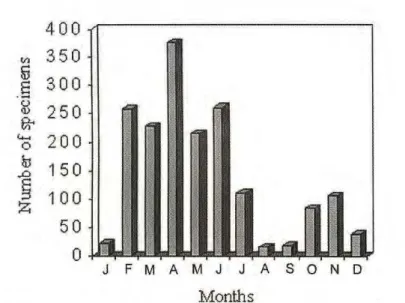
The highest abundance of male euglossine bees has been found be-tween January and June, during the rainy season (Tab. 2; Fig. 1). April and June (21,6% and 15%, respectively) were the months which showed the highest peak of individuals. The great-est number of species was found in February (72,9%), followed by March and June, both presenting 59,4% of the species sampled.
The males frequency at the baits was higher in the rainy season
(Janu-ary-June) than in the dry one (July-December). Only Euglossa securigera,
Eulaema nigrita and Eulaema cingulata
showed to be more frequently found in the dry period. August (0,9%) and Sep-tember (1,1%)) were the less visited months throughout the year of study.
Eufriesea species occurred only
in the rainy season (Tab. 2). Males of
Eufriesea ornata visited the baits in
May and June. Eufriesea nigrescens,
Eufriesea pulchra, Eufriesea surinamensis, Eufriesea aff. macroglossa and Eufriesea elegans
visited the scent baits early in the wet season. The high number of individu-als collected in March is associated with Eufriesea superba which a c -counted for 29%) of the specimens. This species appeared in the entire rainy season and peaked in March (72,5%) of the individuals).
During the course of the study the following species were always present: Euglossa pleosticta, Euglossa
truncata, Euglossa fimbriata, Euglossa violaceifrons, Euglossa augaspis and Eulaema nigrita. The
others were abundantly found in the wet season. The highest abundance of
Euglossa imperialis and Euglossa violaceifrons took place in February; Euglossa pleosticta, Euglossa avicula, Euglossa cognata and Euglossa gaianii, in April; Euglossa truncata
was more frequent in May; Euglossa
chalybeata and Euglossa piliventris in
June; Euglossa fimbriata and Euglossa
cordata had their abundance peak in
July. Euglossa townsendi visited the scent baits late in the wet season.
activ-TablezyxwvutsrqponmlkjihgfedcbaZYXWVUTSRQPONMLKJIHGFEDCBA 2. Seasonal fluctuation of Euglossinae bees collected at scent baits in Buriticupu-MA from
October 1995 to September 1996. zyxwvutsrqponmlkjihgfedcbaZYXWVUTSRQPONMLKJIHGFEDCBA
EU G L O SSI N A E J A N F E B M A R A PR MA Y J U N JUL A U G S E P O C T N OV D E C T OT AL zyxwvutsrqponmlkjihgfedcbaZYXWVUTSRQPONMLKJIHGFEDCBA
Euf r i esea aff. macr ogl ossa 0 3 12 15
Eul r i esea ebur neoci ncl a oi 01 01 0 3
Euf r i esea el egans 0 1 0 1 0 2
Eul r i esea ni gr escens 05 02 02 09
Euf r i esea or nat a 01 0 1 02
Euf r i esea pul chr a 02 01 06 06 0 1 16
Euf r i esea super ba 0 1 05 66 11 06 01 01 91
Euf r i esea sur i namensi s 0 7 01 08
Eugl ossa augaspi s 08 08 0 3 04 05 05 01 02 02 05 06 50
Eugl ossa avi cul a 63 11 32 02 01 109
Eugl ossa bi dent at a 0 1 02 01 04
Eugl ossa chal ybeat a 0 3 05 04 07 05 09 02 01 02 38
Eugl ossa cognat a 07 01 09 07 04 0 1 29
Eugl ossa cor dat a 02 01 05 22 0 3 02 15 . 17 0 3 70
Eugl ossa f i mbr i at a 01 02 01 09 31 0 3 02 12 19 04 84
Eugl ossa gai ani i 03 01 0 1 01 02 09
Eugl ossa i mper i al i s 15 06 03 08 08 06 06 02 54
Eugl ossa l i opoda 03 01 o i 01 06
Eugl ossa modest i or 01 01 0 1 02 0 3 01 09
Eugl ossa pi l i vent r i s 04 05 01 10
Eugl ossa pl eost i ct a 01 70 65 240 59 123 13 01 o i 04 577
Eugl ossa secur i ger a 01 01 01 01 03 02 09
Eugl ossa sp. 1 01 01
Eugl ossa sp. 2 o i 01
Eugl ossa sp . 3 01 01
Eugl ossa sp. 4 01 01
Eugl ossa sp . 5 01 01
Eugl ossa t omsendi 02 02 01 05
Eugl ossa t r uncat a 0 3 18 29 27 80 38 11 01 02 11 01 221
Eugl ossa vi ol acei f r ons 01 14 07 04 12 11 06 02 04 09 06 76
Eugl ossa vi r i di s 01 01
Eul aema ci ngul at a o i 05 05 02 01 08 01 06 09 03 41
Eul aema mer i ana 07 06 16 10 0 5 04 02 05 04 59
Eul aema mocsar yi 01 01
Eul aema ni gr i t a 02 0 1 08 09 08 02 04 24 13 01 72
Exaer et e f r ont al i s 0 3 02 06 01 02 14
6-7 7-8 8-9 9-10 10-11 11-12 Periods
FigurezyxwvutsrqponmlkjihgfedcbaZYXWVUTSRQPONMLKJIHGFEDCBA 1.zyxwvutsrqponmlkjihgfedcbaZYXWVUTSRQPONMLKJIHGFEDCBA Seasonal fluctuation of euglossine bees collected at scent baits in Buriticupu-MA from October 1995 to September 1996.
ity, the euglossine bees showed in-creased active between 10.00 and
11.00 hours (33,5% of the individuals and 86,4% of the species) followed by the period between 11.00 and 12.00 hours (27,7% of the individuals and
78,3% of the species) (Tab. 3; Fig. 2). zyxwvutsrqponmlkjihgfedcbaZYXWVUTSRQPONMLKJIHGFEDCBA
Eufriesea superba, Eulaema nigrita
and Eulaema cingulata occurred in all intervals (from 06.00 to 12.00 hours). The abundance peak of Eufriesea
superba was between 10.00 and 11.00. Eulaema nigrita were more frequent
between 09.00 and 10.00, Eulaema
cingulata between 08.00 and 09.00. Euglossa chalybeata and Eulaema cingulata between 08.00 and 09.00
and Eufriesea surinamensis, Eufriesea
aff macroglossa, Euglossa truncata
and Eulaema nigrita between 09.00 and 10.00 (Tab. 3).
D I S C U S S I O N
ft-J2. zyxwvutsrqponmlkjihgfedcbaZYXWVUTSRQPONMLKJIHGFEDCBA
J F M A M J J A S O N D
Months
Figure 2. Frequency of euglossine bees collected at scent baits in Buriticupu-MA, in relation to daily activity (from 06.00 A.M. to 12.00 A.M.), from October 1995 to September 1996.
current study although utilizing only 5 scent baits and carried out at the boundaries of an open area in the for-est environment, sampled 37 species, of which 15 were not found in the Central Amazonia. These differences may be due to the transitional position occupied by Maranhão among the macro-regions (Amazonian Forest, Cerrado and Caatinga) which character-ize Brazil, since the fauna encountered in Buriticupu, although dominant by Amazonian species, also possesses com-mon elements from the northeast and central-south Brazil fauna, as already observed by Rebelo & Cabral (1997).
Among bees,zyxwvutsrqponmlkjihgfedcbaZYXWVUTSRQPONMLKJIHGFEDCBA Euglossa is the
most diversified genus holding a large variety of species spread all over the Neotropics. This variety was present in Buriticupu where Euglossa was rep-resented by several species occurring all year round. Euglossa pleosticta was the most abundant species and has
previously been found only in south-southeast Brazil (south Bahia down to northeast São Paulo, Rio de Janeiro, Espírito Santo, Minas Gerais). There-fore, this work presents the first data of this species in the north Brazil.
Euglossa violaceifrons and Euglossa truncata also follows this distribution
pattern, since they have been de-scribed from the semidecidual forest of northeast São Paulo State (Rebelo & Moure, 1995) with no records, thus far, on these euglossine bees has been found rather than south Brazil. To-gether with the two latter species is
Euglossa avicula which former reports
comes from north (Oliveira & Cam-pos, 1995) and south Brazil (Dressier,
al-TablezyxwvutsrqponmlkjihgfedcbaZYXWVUTSRQPONMLKJIHGFEDCBA 3 . Frequency of Euglossinae males collected at scent baits in Buriticupu-MA, in relation
to daily actvity (from 06.00 A.M. to 12.00 A.M.), from October 1995 to September 1996. zyxwvutsrqponmlkjihgfedcbaZYXWVUTSRQPONMLKJIHGFEDCBA
E U G L O S S I N A E 0 6 - 0 7 0 7 - 0 8 0 8 - 0 9 0 9 - 1 0 1 0 - 1 1 1 1 - 1 2 T O T A L zyxwvutsrqponmlkjihgfedcbaZYXWVUTSRQPONMLKJIHGFEDCBA
Ε u t r i e se a af f . m acr ogl ossa 0 1 0 2 0 7 0 4 0 1 1 5
Ε u t r i e sea ebur neoci ncl a 0 1 0 2 0 3
Eul r i esea el egans 0 2 0 2
Ε υ t r i e sea ni gr escens 0 1 0 1 0 4 0 3 0 9
Ε υ t r i e sea or nat a 0 2 03 04 0 2 11
Ε u t r i e se a pul chr a 0 1 02 0 7 0 6 1 6
Ε u t r i e se a super ba 0 1 0 2 0 5 22 3 3 2 8 9 1
Ε u t r i e sea Sur i nam ensi s 03 04 0 1 0 8
Εugl ossa augaspi s 03 0 5 06 1 6 2 0 5 0
Εugl ossa avi cul a 0 2 0 7 1 1 4 6 4 3 1 0 9
Ε ugl ossa bi deη t a t a 0 4 0 4
Ε ugl ossa chal ybeat a 11 1 3 0 5 0 5 0 4 3 8
Ε ugl ossa cognat a 0 1 0 1 0 2 1 6 0 9 2 9
Ε ugl ossa cor d a t a 04 1 4 2 9 2 3 7 0
Ε ugl ossa Ur n br i a t a 04 2 7 2 9 2 4 84
Ε ugl ossa gai a ni l 0 1 0 4 0 4 0 9
Eugl ossa i mpe r i a l i s 0 1 04 0 9 1 4 26 5 4
Ε ugl ossa l i o pod a 0 5 o i 0 6
Eugl ossa m o d est i or 04 0 4 0 1 0 9
Ε ugl ossa pi l i vent r i s ο 1 0 2 0 7 1 0
Ε ugl ossa pl eost i ct a 2 7 7 1 1 4 6 2 1 3 1 4 0 5 7 7
Ε ugl ossa secur i ger a 03 0 4 0 2 0 9
Eugl ossa s p. 1 0 1 0 1
Ε ugl ossa sp. 2 o i 0 1
Ε ugl ossa sp . 3 0 1 0 1
Ε ugl ossa sp . 4 0 1 0 1
Ε ugl ossa s ρ . 5 0 1 0 1
Ε ugl ossa t own send i 0 3 0 2 0 5
Ε ugl ossa t r uncat a 0 1 2 5 7 3 6 5 5 7 2 2 1
Ε ug l ossa vi ol acei t r ons 0 1 05 1 2 2 7 3 1 76
Ε ugl ossa vi r i di s 0 1 0 1
Εul aem a ci ngul a t a 0 1 0 6 1 3 1 1 0 6 0 4 4 1
Ε u l a cm a m c nan a 0 4 0 9 08 0 7 1 5 1 6 5 9
Ε ul aem a m ocsar yi 0 1 0 1
Ε ul aem a ni gr i t a 0 3 1 6 11 2 1 1 0 11 7 2
Exaer et e f r ont al i s 0 2 0 8 0 4 1 4
Exaer et e sm ar agdi na 0 7 1 0 0 6 0 9 3 2
ready performed, thus restraining their occurrence to south and north Brazil
(Buriticupu region in the case of zyxwvutsrqponmlkjihgfedcbaZYXWVUTSRQPONMLKJIHGFEDCBA
Euglossa pleosticta and Euglossa truncata). As the four
above-men-tioned species, Euglossa augaspis,
Euglossa bidentata, and Euglossa viridis are found for the first time in
Maranhão State. The three latter bess are A m a z o n i a n s p e c i e s w i t h o u t records to sub-amazonian areas in Brazil, which a drier weather is char-acteristically found, forcing them to have a limited occurrence in the ama-zon basin. The others species have a large distribution in Brazil.
Attention is given to the occur-rence in Buriticupu of Euglossa sp. 1,
Euglossa sp.2, Euglossa sp.3, Euglossa
sp.4 and Euglossa sp.5, which apparently represent undescribed species. Interest-ingly, as the field works are intensified new species and a increasing distribution of the known species may be found. Therefore, a frequent and extensive census work should be done so that the richness and distribution of male euglossine bees can be accurately predicted.
Several Eufriesea species have already been found in Maranhão, such as E. surinamensis, E. pulchra and E.
ornata. T h e f o r m e r is a
pan-neotropical, occurring in Alcântara, setentrional zone of Maranhão State (Gonçalves et al, 1996). The second occurs in Panama (Ackerman, 1983; R o u b i k & A c k e r m a n , 1987) and Amazonia (Braga, 1976; Oliveira & Campos, 1995). The latter species has been recorded only in the Amazon Basin (Braga, 1976; Oliveira &
Cam-pos, 1995), Atlantic Forest in south B r a z i l ( K i m s e y , 1982) and in B a r r e i r i n h a s , c o a s t a l z o n e of Maranhão State (Rebelo & Cabral,
1997). The following amazonian spe-cies have been recorded for the first t i m e in M a r a n h ã o : Ε. aff.
macroglossa, E. eburneocincta, E. elegans, E. nigrescens. Only Eufriesea nigrescens ranges beyond the
amazo-nian domain, going as far as Paraguay. The others species studied in this paper (Tab. 1) were found in different ecosystems in Maranhão State (see Rebelo & Cabral, 1997). Curiously,
Eulaema nigrita was one of the most
frequent species sampled in CVRD Forest Reserve, the entrance area to the Amazonian Forest. Thus far, no record regarding this species was reg-istered for this kind of environment, since Eulaema nigrita has been char-acterized as a typical species of open and relatively dry areas (Ducke, 1902; Zucchi et al, 1969), that is why it is not recorded in the census works per-formed in the central Amazonia using scent baits (Braga, 1976; Powell & Powell, 1987; Becker et al, 1991; Morato et al, 1992; Oliveira & Cam-pos, 1995). However, in the sub-ama-zonian areas E. nigrita is frequently found associated with northeastern dry areas, as well as in the wet forests of São Luís (Gomes, pers. inf.), Bahia (Raw, 1989) and semidecidual forests of São P a u l o State ( R e b e l o & Garófalo, 1991). The occurrence of
Eulaema nigrita in the CVRD Forest
placed between the Cerrado areas and the Amazonian Forest. The remaining
species of the genuszyxwvutsrqponmlkjihgfedcbaZYXWVUTSRQPONMLKJIHGFEDCBA Eulaema sampled
in this survey, such as E. meriana, E.
mocsaryi and E. cingulata, are common
in south America. Eulaema meriana belongs to a mimetic complex encoun-tered in the Amazon basin, in such a group are included E. bombiformis and
E. seabrai, not studied in this paper. Eulaema meriana occurs in the
Amazo-nian region and in the coastal forests from Pernambuco down to Paraná, Bra-zil, but completely absent in the north-eastern drought area named "sertão nordestino".
Regarding the Exaerete species, E.
smaragdina and females of E. dentata
have been found in Barreirinhas-MA (Rebelo & Cabral, 1997). The former are common in the north State. E. fron
talis, as well as the others Exaerete are
pan-neotropical species.
Cineole was the most visited scent bait at the CVRD Forest Re-serve, corroborating the numerous works carried out with this chemical compound in Maranhão State and in several regions of Brazil (Raw, 1989; Rebelo & Garófalo, 1991; Morato et
al, 1992). Vanillin also attracted a
large number of individuals being the second most visited bait by euglossine species. The others utilized c o m -pounds were less attractive.
T h e h i g h e s t a b u n d a n c e of euglossine bees was detected during the rainy season. The occurrence of bees in a given season is influenced by either nesting and emerging periods which in turn are influenced by
tem-perature and moisture (Ackerman, 1983; 1989).
The species of Eufriesea exhib-ited a rigorous seasonal distribution ap-pearing either in the wet season or in the dry season, depending on the involved species, according to the observations of others researchers in distinct areas of the Neotropics (Pearson & Dressier, 1985; Roubik & Ackerman, 1987; Wittman et
al, 1988; Rebelo & Garófalo, 1991, Χ99Ί). Eufriesea pulchra was more
fre-quent in the wet season with a sole in-dividual in the dry period. Ackerman (1983) also verified the presence of this species in similar seasonal periods.
In August, the driest month of the study year, a low humidity, high tem-perature weather was detected and a low number of individuals and species vis-ited the scent baits within this month. The captured species in this period were as follow: Euglossa cordata, Euglossa
fimbriata, Euglossa securigera, Euglossa truncata, Euglossa violaceifrons and Eulaema nigrita. Such
species visited the baits during all the year exhibiting a fluctuation only in the abundance of individuals.
In conclusion, the Buriticupu re-gion is represented by a diversified and overlaid euglossine bees fauna which is formed by species commonly found ei-ther in the Amazonian basin and in dis-tinct ecological Brazilian areas.
A K N O W L E D G E M E N T S
Doce-CVRD for supporting this research. zyxwvutsrqponmlkjihgfedcbaZYXWVUTSRQPONMLKJIHGFEDCBA
Literature cited
Ackerman, J. .D. 1983. Diversity and season-ally of male E u g l o s s i n a e bees
(Hy-menoptera: Apidae) in Central Panama. zyxwvutsrqponmlkjihgfedcbaZYXWVUTSRQPONMLKJIHGFEDCBA
Ecology, 64: 274-283.
Ackerman, J. .D. 1989. Geographic and sea-sonal variation in fragrance choices and preferences of male Euglossinae bees.
Biotropica. 2 1 : 340-347.
Becker, P; Moure, J.S.; Peralta, F. J. A. 1991. More about euglossine bees in Amazo-nian Forest Fragments. Biotropica, 2 3 : 586-591.
Braga, P.I.S. 1976. Atração de machos de abelhas polinizadoras de Orchidaccae com auxílio de iscas-odores na campina, campinarama c floresta tropical ümida d a r e g i ã o d e M a n a u s . Ciências e
Cultura. 28: 767-773.
DNPM - Projeto RADAM. 1973. Mapas de geologia c geomorfologia. Vol. 3: Folha 23 - Teresina e parte da Folha SB24 Jaguaribe. Vol. 3: Folha SA 23 São Luís e parte da Folha SA 24 -Fortaleza, Rio de Janeiro.
Dodson, C. H. 1970. The role of chemical at-t r a c at-t a n at-t s in o r c h i d p o l l i n a at-t i o n . In: Chambers, K.L. (ed.). Biochemical Co
evolutioiL Corvallis, OR: Oregon State
Univ., p. 83-1077.
Dodson,C.H.; Hills, H.G. 1966. Gas chroma-tography of orchid fragrances. Amer.
Orchid Soc Bull., 35: 720-725.
Dodson, C.H.; Dressier, R.L.; Hills, H.G.; Adams, R.M.; Williams, N.H. 1969, Biologically active compounds in orchid fragrances. Science, 164: 1243-49.
Ducke, A. 1902. As espécies paraenses do gênero Euglossa Latr. Bio. Mus. Goeldi, 3: 561-575.
Dressier, R. L. 1982. Biology of orchid bees (Euglossini). Ann Rev. Ecol. Syst., 13: 373-94.
Gonçalves, S.deJ.M.; Rego, Μ. ; Araújo, Α .
1996. Abelhas sociais (Hymenoptera:
Apidae) c seus recursos florais em uma região de mata secundária, Alcântara, MA, Brasil. Acta Amazônica, 26: 55-68.
Hills, H.G.; Williams N.M.; Dodson, C.H. 1968. Identification of some orchid fra-grances components. Amer. Orchid Soc.
Bull., 37: 967-971.
Hills, H.G., Williams, Ν.Η. ; Dodson, C.H.
1972. Floral fragrances and isolating mechanisms in the genus Catasetum (Orchidaceae). Biotropica, 4: 61-76.
Janzcn, D.H., De Vries, P.G., Higgins, M.L.; Kimsey, L.S. 1982. Seasonal and site variation in Costa Rican Euglossine becs at chemical baits in lowland deciduous and evergreen forests. Ecology, 63: 66-74.
Morato, E.F; Campos, L.A.; Moure, J. S. 1992. A b e l h a s E u g l o s s i n i ( H y m e n o p t e r a , Apidae) coletadas na Amazônia Central.
Rev. Bras. Ent., 36: 767-771.
O l i v e i r a , M . L . ; C a m p o s , L.A. O . 1 9 9 5 . Abundância, riqueza c diversidade de abelhas E u g l o s s i n a e ( H y m e n o p t e r a , Apidae) em florestas contínuas de terra firme na Amazônia Central, Brasil. Revta
Bras. Zooi, 12: 547-556.
Pearson, D.L.; Dressier, R.L. 1985. Two-year study of male orchid bee (Hymenoptera: Apidae: Euglossini) attraction to chemi-cal baits in lowland south-eastern Peru.
J. Tropical Ecol., 1: 37-54.
P e r e i r a - M a r t i n s , S.R.; Kerr, W.E. 1 9 9 1 . B i o l o g i a dc Eulaema nigrita. 3 . Inferências evolutivas. Papeis Avulsos
Zooi, 37: 245-250.
Powell, A.H.; Powell, G.V.N. 1987. Population dynamics of male Euglossine bees in A m a z o n i a n F o r e s t f r a g m e n t s .
Biotropica, 19: 176-179.
Raw, A. 1989. The dispersal of euglossine bees between isolated patches of eastern Bra-zilian wet forest (Hymenoptera, Apidae, Euglossini). Rev. Bras. Ent., 33: 103-107.
Rebelo, J.M.R.; Cabral, A.J. 1997. Abelhas Euglossinae de Barrcirinhas, Zona do litoral da Baixada Oriental Maranhense.
R e b e l o , J . Μ . Μ . ; G a r ó f a l o , C A . 1 9 9 1 . Diversidade e sazonalidade de machos de Euglossini (Hymenoptera: Apidae) e preferências por iscas-odores em um fragmento de floresta no sudeste do
Brasil._/?ev.zyxwvutsrqponmlkjihgfedcbaZYXWVUTSRQPONMLKJIHGFEDCBA Brasil. Bioi, 5 1 : 787-799.
R e b e l o , J . M . M . ; G a r ó f a l o , C A . 1 9 9 7 . Comunidades de machos de Euglossini ( H y m e n o p t e r a : A p i d a e ) em m a t a s semidecíduas do nordeste do Estado de São Paulo. An. Soe. Entomol. Brasil. 26: 243-255.
R e b e l o , J . M . M . ; M O U R E , J . S . 1 9 9 5 . As e s p é c i e s de Euglossa L a t r e i l l e d o N o r d e s t e de S ã o P a u l o ( A p i d a e , Euglossinae). Revta. Bras. Zooi, 12: 445-466.
Roubik, D.W.; Ackerman, J.D. 1987. Long-term ecology of euglossine orchid-bees ( A p i d a e : E u g l o s s i n i ) in P a n a m a .
Oecologia, 73: 321-333.
Vogel, S. 1966. Parfümsammelnde Bienen ais bestaúber von Orchidaceen und Glox
inia. JJesterr. Bot. Zs., 113: 302-361.
Williams, N.H.; Dodson, C.H. 1972. Selective attraction of male euglossine bees to or-chid floral fragrance and its importance in long distance pollen flow. Evolution, 26: 84-95.
Williams, N.H.; Witthen, W.M. 1983. Orchid floral fragrances and male euglossine bees. Methods and advances in the last sesquidecade. Biol. Bull., 164: 355-395.
Wittman, N,D; Hoffmann, M.; Scholz, E. 1988. Southern distributional limits of euglossine bees in Brazil linked to habi-tats of the Atlantic and Subtropical rain forest ( H y m e n o p t e r a : A p i d a e : Euglossini). Entomol. Genet:, 14: 53-60.
Zimmerman, J.K.; Madrinan, S.R 1988. Age structure of male Euglossa imperialis (Hymenoptera: Apidae: Euglossini) at nectar and chemical sources in Panama.
Tropical Ecology, 4: 303-306.
Zucchi, R.; Sakagami, Sh.F.; Camargo, J.M.F. 1969. Biological o b s e r v a t i o n s on a n o t r o p i c a l parasocial b e e , Eulaema
nigrita, with a review on the biology of
Euglossinae (Hymenoptera, Apidae). A comparative study. J.Fac.Sci. Hokkaido
Univ. Serv. VI, Zooi, 17: 271-382. zyxwvutsrqponmlkjihgfedcbaZYXWVUTSRQPONMLKJIHGFEDCBA
Aceito para publicação cmzyxwvutsrqponmlkjihgfedcbaZYXWVUTSRQPONMLKJIHGFEDCBA 17/11/1999