J. res.: fundam. care. online 2013.dec. 5(6):240-247 240
Physical disability prevalence in leprosy assisted in Teresina city (PI) reference center from 2005 to 2010Prevalência de incapacidade física em hansenianos atendidos em centro de referência da cidade de Teresina (PI) no período de 2005 a 2010*
Prevalencia de pacientes con lepra discapacidad física sirve en el centro de referencia de Teresina (PI) para el período 2005 a 2010
Manuella Simplício Viana de Carvalho1, Maria do Carmo de Carvalho e Martins2, Paulo Humberto Moreira Nunes3, Telma Maria Evangelista de Araújo4
ABSTRACT
Objective: To review scientific literature regarding the factors that trigger stress in nurses in the hospital
environment. Method: This is a qualitative study, a literature review, in the databases, BVS in its sub-bases LILACS and BDENF, and in SCOPUS database. The articles were investigated in their entirety, in Portuguese, published between the years 2009 and 2013. Results: It was revealed that the most prevalent stressors in the hospital for nursing professionals are lack of professionalism, dissatisfaction with the profession, poor working conditions, lack of materials, scarce human resources and personal untrained, the division of labor, content of the task, the relations of power, hierarchy, and liability issues. Conclusion: To understand and analyze the factors that trigger stress is of great value to practitioners and institutions are essential for promoting worker health and improving the care provided by them.
Descriptors: Nursing, Occupational health, Mental health, Psychological stress. RESUMO
Objetivo: Analisar a produção científica quanto aos fatores desencadeadores de estresse em profissionais de
enfermagem no ambiente hospitalar. Metodologia: Trata-se de estudo de cunho qualitativo, do tipo revisão da literatura, nas bases de dados BVS, em suas sub-bases LILACS e BDENF, e na base de dados SCOPUS. Foram investigados artigos na íntegra, em português, publicados entre os anos de 2009 e 2013. Resultados: Revelou-se que os estressores mais prevalentes no ambiente hospitalar para os profissionais da enfermagem são a falta de profissionalismo, descontentamento com a profissão, falta de condições de trabalho, falta de materiais, recursos humanos escassos e pessoais não treinados, a divisão do trabalho, o conteúdo da tarefa, as relações de poder, a hierarquia, e as questões de responsabilidade. Conclusão: Conhecer e analisar os fatores desencadeadores de estresse é de grande valia para os profissionais e para as instituições sendo essenciais para a promoção da saúde dos trabalhadores e para a melhoria da assistência prestada por estes. Descritores: Enfermagem, Saúde do trabalhador, Saúde mental, Estresse psicológico
RESUMEN
Objetivo: Investigar la prevalencia de la discapacidad física en los pacientes con lepra atendidos en el centro de
referencia de Teresina-PI. Métodos: Estudio descriptivo basado en los registros médicos de 1.036 pacientes atendidos entre enero de 2005 y diciembre de 2010. Fueron analizados los parámetros edad, sexo, ocupación, clasificación operacional y la forma clínica de la enfermedad, grado de discapacidad física y región del cuerpo afectada por la discapacidad. Asociaciones entre las variables estudiadas fueron investigadas por medio de la prueba del chi-cuadrado.
Resultados: La prevalencia de la discapacidad fue 21,4% siendo 13,3% de grado I y 8,1% de grado II de y ambos
presentaron asociación significativa con el sexo masculino, edad mayor o igual a 30 años y virchowian y multibacilar. Las regiones más afectadas fueron los pies (Grado I y II) y manos (Grado II). Conclusión: La alta prevalencia de la discapacidad física indica la necesidad de un mayor cuidado para impedir mayores comprometimientos de la calidad de vida y capacidad productiva de los pacientes. Descriptores: Lepra, Enfermedades olvidadas, Discapacidad.
1 Physiotherapist. Master in Family Health at the University Center Uninovafapi, Teresina, PI, E-mail: [email protected]
2Nutritionist. PhD in Biological Sciences from UFPE. Professor of Professional Master's Program in Family Uninovafapi the University Health Center. Associate Professor, Department of Physiology and Biophysics, UFPI, Teresina, PI, E-mail: [email protected]
3 Doctor. PhD in Biotechnology by RENORBIO. Assistant Professor, Department of Physiology and Biophysics, UFPI, Teresina, PI, E-mail: [email protected]
4 Nurse. PhD in Nursing from UFRJ. Professor of the Master's Program in Nursing at UFPI, Teresina, PI, E-mail: [email protected]
5 Nurse. Coordinator of the Professional Masters in Family Uninovafapi the University Health Center. Associate Professor, Masters Program in Nursing UFPI. Teresina-PI, E-mail: [email protected] * Results Dissertation in Family Health Uninovafapi
J. res.: fundam. care. online 2013.dec. 5(6):240-247 241
Hanseniasis is an infectious disease that is manifested by signs neurological and and dermatologic including lesions on the skin and peripheral nerve symptoms. Occur initially changes in thermal sensitivity followed of loss of pain sensitivity and, finally, tactile sensitivity. It is a chronic disease in which functional disorders and severe deformities can be found when the disease is diagnosed late.¹ ²
In 2010, the prevalence rate of hanseniasis in Brazil was 15.6 cases per 100 thousand, a decrease of 8% compared to the value of the coefficient in 2004 (17 cases per 100 thousand inhabitants) .3 And year 2011, the prevalence rates and new cases of the disease were, respectively, 1.54 cases/10000 inhabitants and 17.6 / 100,000.²
Regarding physical disabilities related to leprosy detection rate of new cases diagnosed in Brazil with disability grade II reached 1.2 cases per 100 000 inhabitants in 2010.³ It is noteworthy that in Brazil, are recorded on average per year, 47,000 new episodes of leprosy, of which 23.3% with disability grades I and II. This situation affects the lives of thousands of people compromising the defense mechanisms, and affecting the ability to feel pain, vision and touch. Early diagnosis as well as treatment and prevention are priority actions to reduce disabilities and deformities.²
In the management of hanseniasis is important that the population be informed about the disease, its symptoms, diagnosis, treatment and cure, and also that patients and their family members are individually monitored throughout treatment and health professionals are trained to the realization of the service. Moreover, health services should conduct the evaluation and determination of the degree of disability of hanseniasis patients at diagnosis, during treatment and at discharge and must classify it in degrees
according to the intensity of involvement in eyes hands and feet.6
Considering that the physical disabilities constitute one of the serious problems that affect patients with hanseniasis is of fundamental importance to investigate its occurrence among users of the center of reference in the study. The objective of this research was to describe the epidemiology and evaluate the prevalence of disability in patients seen in a referral center for leprosy tracking the state of Piauí, in the period 2005-2010.
This is an exploratory, descriptive quantitative study with retrospective data collection in which the medical records of 1,036 patients treated at the center in the study period from 2005 to 2010 were reviewed.
The instrument used for data collection was a structured record of information about sex, age, occupation, operational classification of disease, degree of disability according to the World Health Organization (WHO), clinical form of the disease and form region affected.
Initially were analyzed the medical records of 1,085 patients seen at center study with a confirmed diagnosis of hanseniasis from January 2005 to December 2010. However, 49 records were excluded because information not included on the degree of disability of patients, were included in the study existing information on 1,036 records.
Data collection was conducted from March to June 2012 by the researcher assisted by two people trained and previously trained on medium level.
Data were tabulated using Excel application programs the Statistical Package for Social Science (SPSS) version 18.0. The associations between variables were tested by applying the chi-square test. Statistical significance was set at p <0.05.
INTRODUCTION
J. res.: fundam. care. online 2013.dec. 5(6):240-247 242
The results were presented in measures of absolute frequency and percentage.
The study was approved by the Ethics Committee in Research of the Faculty NOVAFAPI with the opinion CAAE 0456.0.043.000-11. Ethical presuppositions of research were seen in humans and maintained the confidentiality of information collected.
In table 1 presents sociodemographic and clinical leprosy patients treated at the referral center between 2005 and 2010 features. It was observed that 77.1% were adults, more than half were female (50.7%), 25% were students, 43.1% had borderline clinical form, more than half (50.7% ) had multibacillary operating class, and that approximately 25% of patients were admitted to the center in 2007. The prevalence of disability was 21.4%, and the proportion of patients with disability grade I and grade II, respectively, 13.3% and 8.1%.
The results revealed that 61.5% of patients were aged between 20 and 59 years, the age group most present in this study the 20 to 39 years. This result is worrying as it shows that higher proportions of people with the disease treated at the referral center were in the productive phase of life and economically active, which could harm the economy of the household and the municipality, since this band people can come to develop disabilities, injuries, reactional states and away from productive activity, generate high social cost.
When comparing the proportion of individuals aged 20 to 39 years was observed also in a study on the profile of hanseniasis in the Federal District in the period 2000 to 20051 the age group with the highest reported cases was between 20 and 39 years, although the proportion of patients in this age group was higher (47.8% of total) to that found in the present study (34.7%). Moreover, in a study of patients with hanseniasis
treated at the Health Centre in São Luís (MA)4 is the most affected age group was 16-30 years, corresponding to 35.5% of leprosy patients. Was also observed in this study that 21% of patients affected by the disease were aged less than or equal to 19, and 7.6% of treated leprosy patients were aged up to 10 years, indicating contagion in the first years of life, common in regions where transmission occurs intensively.
Regarding gender, although some studies have revealed a predominance of males, various studies in Brazil have found a higher proportion of females among hanseniasis patients. This finding could be related to greater identification of infected because they have more access to health services and are more concerned with self-image than men or women could be related to an increase in cases among women in some regions of country. In this sense, corroborating the results found here, a slight predominance in females was found in research conducted in a referral center in Fortaleza(CE)9, as well as census disabilities and physical disabilities by hanseniasis at a national reference center of Uberlândia (MG)10, and in another study conducted in Teresina, Piauí11 to describe the epidemiology of leprosy in the period 2001-2008, when there was a slight predominance of females compared to males, with a small percentage variation throughout the
RESULTS AND DISCUSSION
J. res.: fundam. care. online 2013.dec. 5(6):240-247 243
series.
The types of occupational activities were more observed were the student (22.1%) and domestic (21.1%).
The types of occupational activities were observed over the student (22.1%) and domestic (21.1%). Other studies12 have also shown high proportions of patients with such occupations. In this sense, a study conducted in Niterói (RJ) reported occupational activity of household was one of the three most frequent occupational activities, lower only than labor in agriculture, found in 45% of patients, and equal to the proportion of hanseniasis patients in construction labor (15%). And, in a study conducted in São Paulo (SP)8, household activities and students were considered, respectively, the third (17.4%) and fourth occupations (11.3%) more frequent among the patients, the first two being of the service
workers (21.8%) and workers of industrial goods and services (19.9%).
The most frequent clinical presentation in patients from a referral center for Teresina was borderline, which has great power transmission, reaching almost half of hanseniasis patients (43.1%). In other studies, the most prevalent clinical form of the disease was also dimorphic, although higher proportions were highlighted. In this sense, it is noteworthy that in the Health Centre in São Luís (MA)4 to dimorphous was found in 59.6% of patients. Even higher proportions were found in retrospective cohort of 595 patients enrolled in a health unit of the city of Belo Horizonte (MG), between 1993 and 20038, in which 81.1% of patients with this disease had a borderline form. Different results were reported in a study conducted in Buriticupu (MA), in which the most frequent clinical presentation was tuberculous, which affected 50% of hanseniasis patients.
The analysis of results concerning the operational classification of hanseniasis revealed that more than half of the cases attended between 2005 and 2010 in the reference center studied in Teresina were multibacillary, indicating that the diagnosis in a high proportion of cases being done after the evolution of initial phase (indeterminate) of the disease to dimorphous form. In contrast, predominance of paucibacillary form was found in a study that evaluated the clinical and epidemiological profile of patients with hanseniasis in the state of Piauí in the period 2003-2008, in which 53.53% had paucibacillary.
In studying the epidemiological profile of leprosy in Teresina, in the period 2001-2008, the distribution of hanseniasis cases according to the operational classification of the World Health Organization, the authors observed that although paucibacillary forms were predominant, there was a decrease over series with increased frequency of multibacillary 36.79% in 2001 to 42.07% in 2008.
The prevalence of disability found in this study, corresponding to 21.4% can be considered
J. res.: fundam. care. online 2013.dec. 5(6):240-247 244
high in terms of public health, being the prevalence of physical grade I (13.3%) disability was 1.64 times higher than for grade II (8.1%). When comparing the overall prevalence of disability and the proportions of disability grade I and II found here with those of other studies, it was observed that are similar to those described in a study conducted in Rio de Janeiro (RJ), where the prevalence of disability physical was 21.7%, with a proportion of disability grade I and II, respectively, 15% and 6.7%.
Furthermore, were lower than those observed in São Paulo (SP), where 60% of patients had physical disability, accounting for 34% of grade I and grade II 26%. Were also lower than those found in the Federal District, where 50.3% of patients had physical disabilities, with 33.9% of cases with grade I and grade II 8.8% with disability.
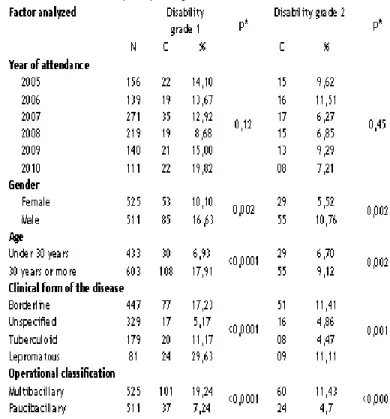
Table 2 presents the factors related to the degree of associated disability in leprosy patients treated at the center of reference. Based on the analysis, the prevalence of grade I disability were significantly associated with male gender, greater than or equal to 30 years old, virchowian and multibacillary operational classification. Regarding factors associated with disability grade II also statistically significant association was found with male gender, older age and older for 30 years and operational classification of multibacillary disease. However, in relation to clinical forms statistically significant association with borderline or lepromatous forms.
Similar to that found in the center of Teresina, in a research conducted in Campo Grande (MS) was also demonstrated association of disability grade II with the male. Furthermore, the association between physical disability grade I and II with age ≥ 30 years may in part be related to the slow evolution of the disease. And, with regard to clinical features, concordantly with what was observed in this study the presence of association of disability grade I and II with multibacillary cases was also demonstrated in a study conducted in
Araguaína (TO). Regarding clinical forms, similarly to that found in the present study, in patients from the Hanseniasis Control Program in Buriticupu (MA) reported that patients with borderline and Virchownian forms and had a higher prevalence of disability.
With regard to regions of the body affected by physical disability ( Table 3 ) , the regions most affected by disability grade I were the feet , no statistically significant differences between right and left ( p = 0.11) were found standing . About the inability of grade II , there was a statistically significant association with hands and feet , with no statistically significant difference between these regions . Few studies have evaluated the hanseniasis affected areas. Accordingly with the results found in hanseniasis patients reference center in Teresina, also on research in Uberlândia ( MG ) 10 and São Carlos ( SP ) areas most affected by physical disabilities were the feet . The presence of foot injuries can be explained by the involvement of the posterior tibial nerve, which can be partly explained by the lower self-care and
J. res.: fundam. care. online 2013.dec. 5(6):240-247 245
difficulty most visible perception , as well as due to the impacts received during ambulation.
The analysis of the results obtained here reveals the need for continuing education measures to inform, enlighten and educate not only patients affected by hanseniasis as well as the community at large. Knowledge about the prevention, diagnosis and treatment is of fundamental importance, since in general the population has little knowledge about the disease, making it difficult to accept the disease even by patients, contributing to the stigma, abandonment and refuses to perform the treatment, with increased emergence of disabilities and deformities. Furthermore, we highlight the need for expanding the coverage of care, with the assistance of the Family Health Strategy, improving the training of professionals working in this area, and also the pursuit, treatment and follow-up of families of hanseniasis.
In the present study, we found high prevalence of physical disability in hanseniasis patients attended at referral center studied, and disability was associated with male sex, age greater than or equal to 30 years and operational classification of multibacillary disease. Association was also demonstrated the presence of disability grade I virchowian form and disability grade II with borderline or lepromatous forms. Importantly, the
regions most affected by physical disability were hands and feet. It is noteworthy that the regions most affected by physical disability were hands and feet. These findings indicate the need to implement preventive, diagnostic, curative and surveillance with population served in order to avoid further compromises the quality of life and productive capacity of the patients, both from a personal and familiar sight, because of the increased involvement of males in the economically active and productive stage of life, as well as the high proportion of patients affected with dimorphous and multibacillary leprosy class.
1. Lima MAR, Prata MO, Moreira D. Perfil da hanseníase no Distrito Federal no período de 2000 a 2005. Comunicação em Ciências da Saúde, Brasília. 2008; 19(2): 163-70.
2. Brasil. Ministério da Saúde. Secretaria de Vigilância em Saúde. Departamento de Vigilância Epidemiológica. Manual de prevenção de incapacidades. 3ª ed. Brasília (DF): Ministério da Saúde (Brasil); 2008.
3. Ignotti E, Paula RC. Secretaria de Vigilância em Saúde. Revista Saúde Brasil. São Paulo (SP): Ministério da Saúde; 2010.
4. Lima HMN, Sauaia N, Costa VRL, Coelho Neto GT, Figueiredo PMS. Perfil epidemiológico dos pacientes com hanseníase atendidos em Centro de Saúde em São Luís, MA. Revista da Sociedade Brasileira de Clínica Médica. 2010; 8(4): 323-7.
CONCLUSION
J. res.: fundam. care. online 2013.dec. 5(6):240-247 246
5. Helene LMF, Leão VM, Minakawa MM. Perfis epidemiológicos e a avaliação de incapacidades físicas de hansenianos de uma UBS de São Paulo. Hansenologia Internationalis. 2001; 26(1): 5-13.
6. Bernardes CA, Santos AF, Padovani CTJ, Santos LF, Filho GH. Incapacidade física em hansenianos de Campo Grande – Mato Grosso do Sul. Hansenologia Internationalis. 2009; 34(1): 17-25.
7. Miranzi SSC, Pereira LHM, Nunes AA. Perfil epidemiológico da hanseníase em um município brasileiro, no período de 2000 a 2006. Revista da Sociedade Brasileira de Medicina Tropical. 2010; 43(1): 62-67.
8. Gonçalves SD, Sampaio RF, Antunes CMF. Fatores preditivos de incapacidades em pacientes com hanseníase. Revista de Saúde Pública. 2009; 43(2): 267-74.
9. Gomes CCD, Pontes MAA, Gonçalves HS, Penna GO. Perfil clínico-epidemiológico dos pacientes diagnosticados com hanseníase em um centro de referência na região nordeste do Brasil. An. Bras. Dermatol. 2005; 80(supl 3): 283-8.
10. Cunha ACSR. Censo de deficiências e incapacidades físicas por hanseníase e monitoramento pela escala de salsa do plano de autocuidado para prevenção de incapacidades de pacientes atendidos em um centro de referência nacional do Brasil [dissertação]. Uberlândia (MG): Mestrado em Ciência da Saúde, Universidade Federal de Urbelândia, Minas Gerais; 2012.
11. Pereira EVE, Nogueira LT, Machado HAS, Lima LAN, Ramos CHM. Perfil epidemiológico da hanseníase no município de Teresina, no período de 2001-2008. Anais Brasileiros de Dermatologia. 2011; 86(2): 235-40.
12. Vilela DA, Rocha JCT. Moradores do Hospital Colônia no Norte do Piauí: um estudo dos perfis de pacientes de hanseníase. Cadernos de Estudos e Pesquisas. 2011; 15(33): 55-60.
13. Silva AR, Matos WB, Silva CCB, Gonçalves EGR. Hanseníase no Município de Buriticupu, Estado do Maranhão: busca ativa de casos na população adulta. Revista da Sociedade Brasileira de Medicina Tropical. 2010; 43(6): 691-4.
14. Sousa MWG, Silva DC, Carneiro LR, Almino MLBF, Costa ALF. Epidemiological Profile of Leprosy in the Brazilian state of Piauí between 2003 and 2008. An. Bras. Dermatol., 2012; 87(3): 389-395.
15. Pedrazzani ES, Maluf AS, Pedroso M, Toyoda CY. Prevenção de incapacidades em hanseníase: realidade numa unidade sanitária. Hansenologia Internationalis. 1985; 10(1): 10-22.
16. Monteiro LD, Alencar CHM, Barbosa JC, Braga KP, Castro MD, Heukelbach J. Incapacidades físicas em pessoas acometidas pela hanseníase no período pós-alta da poliquimioterapia em um município no Norte do Brasil. Cad. Saúde Pública. 2013; 29(5): 909-20.
17. Aquino DMC, Caldas AJM, Silva AAM, Costa JML. Perfil dos pacientes com hanseníase em área
J. res.: fundam. care. online 2013.dec. 5(6):240-247 247
hiperendêmica da Amazônia do Maranhão, Brasil. Rev. Soc. Bras. Med. Trop. 2003; 36(1): 57-64.