Accumulation of nutrients and
agronomic performance of grafted seedless watermelon
1Joice Simone dos Santos2, Rita de Cássia Souza Dias3,
Leílson Costa Grangeiro2, Welson Lima Simões3, Magnus Dall’Igna Deon3
INTRODUCTION
Mineral nutrition is one of the factors that contribute directly to the yield and quality of watermelon fruits (Barros et al. 2012). Watermelon is relatively demanding in primary (nitrogen, phosphorus and potassium) and secondary macronutrients (calcium, magnesium and sulfur),
and benefits from the micronutrients application.
These nutritional demands may be suppressed by
ABSTRACT
RESUMO
equilibrated doses of fertilizers into the soil at sowing or as proper topdressing. The absorption of nutrients differs according to plant development, and is higher
at flowering, setting and fruit growth.
When watermelon is grafted with a compatible rootstock, and a vigorous root system is adopted,
the plants absorb nutrients more efficiently than
ungrafted plants (Pulgar et al. 2000, Lee et al. 2010). Watermelon grafts are used in 95 % of its cultivation areas in Japan, Korea and Spain, mainly to control
1. Manuscript received in Jan./2016 and accepted for publication in Sep./2016 (http://dx.doi.org/10.1590/1983-40632016v4639610). 2. Universidade Federal Rural do Semiárido, Departamento de Ciências Vegetais, Mossoró, RN, Brazil.
E-mails: [email protected], [email protected].
3. Empresa Brasileira de Pesquisa Agropecuária (Embrapa Semiárido), Petrolina, PE, Brazil. E-mails: [email protected], Chemical fertilizing is one of the main inputs that
increase watermelon production costs. Watermelon grafting with compatible rootstocks and a vigorous root system may
increase the efficiency of nutrients absorption. This study
aimed at determining the accumulation of dry matter and nutrients, as well as the agronomic performance of grafted watermelon. The triploid ‘Precious Petite’ watermelon was used as graft and the Line BGCIA941 (Citrullus lanatus var.
citroides) as rootstock. The experimental design consisted of randomized blocks, in a split-plot, with six replicates. The ‘Precious Petite’ grafted onto Line BGCIA941, ungrafted ‘Precious Petite’ and ungrafted Line BGCIA941 were evaluated in the plot, while the subplot corresponded to the sampling time (0, 10, 20, 30, 40, 50, 60 and 70 days after transplanting). ‘Precious Petite’ grafted onto Line BGCIA 941 accumulated more macro and micronutrients than the ungrafted plants,
increasing fruit yield, flesh firmness and rind thickness, but
it did not affect the soluble solids contents. The decreasing order for nutrient accumulation in the grafted plants was N > K > Ca > Mg > P > S > Fe > Mn > Zn > B > Cu, whereas for ungrafted ‘Precious Petite’ it corresponded to N > K > Ca > Mg > P > S > Mn > Fe > B > Zn > Cu.
KEY-WORDS: Citrullus lanatus; nutrient uptake; plant nutrition.
Acúmulo de nutrientes e desempenho agronômico de melancia sem sementes enxertada
A adubação química é um dos principais insumos que aumentam os custos de produção da melancia. A enxertia de melancia em porta-enxerto compatível e com sistema radicular vigoroso
pode aumentar a eficiência na absorção de nutrientes. Objetivou-se
determinar o acúmulo de massa seca e de nutrientes e o desempenho agronômico em melancia enxertada. Utilizou-se como enxerto a melancia triploide ‘Precious Petite’ e como porta-enxerto a Linha BGCIA941 (Citrullus lanatus var. citroides). O delineamento experimental foi em blocos casualizados, em parcela subdividida, com seis repetições. Na parcela, avaliou-se ‘Precious Petite’ enxertada na Linha BGCIA941, ‘Precious Petite’ sem enxertia e Linha BGCIA941 em pé franco, enquanto a subparcela correspondeu à época de amostragem (0, 10, 20, 30, 40, 50, 60 e 70 dias após o transplantio). ‘Precious Petite’ enxertada na Linha BGCIA 941 acumulou mais macro e micronutrientes que as plantas sem enxertia, incrementando
a produtividade de frutos, firmeza da polpa e espessura da casca, mas
soil pathogens, such as fusarium wilt (Yetisir & Sari 2003, Yetisir et al. 2007). However, over the years, other objectives have become important, such as resistance to low and high temperatures, tolerance to salinity and alkalinity, increase in the absorption of
nutrients, efficiency in water use and improvement of
fruit yield and quality (Cohen & Naor 2002, Rivero et al. 2003, Colla et al. 2010, Yetisir & Uygur 2010, Karaca et al. 2012).
The effects of rootstocks on the absorption, translocation and use of nutrients on plants have been documented in previous studies (Rouphael et al. 2008, Colla et al. 2010, Yetisir et al. 2013). The increase of nutrient absorption in grafted plants may be attributed mainly to the physical characteristics of the root system, such as the vertical and lateral development of the roots, which promote increased absorption of water and inorganic nutrients.
This study aimed at determining the effect of grafting on the accumulation of dry mass, absorption of nutrients and agronomic performance of triploid watermelon.
MATERIAL AND METHODS
The experiment was performed from June to August (2012), at the Bebedouro Experimental Field (9º9’S, 40º29’W and altitude of 365.5 m), which belongs to the Embrapa Semiárido, in Petrolina, Pernambuco State, Brazil.
The physical-chemical soil analyses of the experimental area showed the following results: sand = 83.60 %; silt = 12.25 %; clay (sandy soil) = 4.15 %; pH(H2O) = 6.7; organic matter = 6.6 g dm-3;
P(Mehlich) = 38.4 mg dm-3; K = 0.3 cmol c dm
-3, Ca =
2.2 cmolc dm-3; Mg = 0.7 cmol c dm
-3; Cu = 0.5 mg dm-3;
Fe = 19.2 mg dm-3; Mn = 12.6 mg dm-3; Zn =
3.3 mg dm-3; electrical conductivity = 0.65 dS m-1;
total base = 3.3 cmolc dm-3.
The experimental design consisted of randomized blocks, in a 3 × 8 split-plot arrangement, with six replications. The following was evaluated in each plot: ‘Precious Petite’ cultivar grafted onto Line BGCIA 941, ungrafted ‘Precious Petite’ and Line BGCIA 941 rootstock. In the subplots, the following sampling periods were analyzed: 0, 10, 20, 30, 40, 50, 60 and 70 days after transplanting (DAT). The experimental unit consisted of 30 plants per plot.
The triploid ‘Precious Petite’ watermelon cultivar was used as graft, and the Line BGCIA
941 was adopted as rootstock, originating from the introduction of PI244019 (Citrullus lanatus
var. citroides), which is conserved in the Active Cucurbitaceae Germplasm Bank of the Embrapa Semiárido.
The approach grafting method (Cushman 2006) was used at 9 days after sowing, when the
seedlings showed the first clear leaf. After grafting,
the seedlings were kept in a greenhouse (29 ºC ± 0.25 and 60 % RH ± 0.45). After 7 days of grafting, the root of the cultivar and the shoot of the rootstock were eliminated. On the eighth day after grafting, the surviving seedlings were transplanted to the
field. The spacing adopted was 2.5 m × 0.5 m. Plants
from the diploid ‘Sugar Baby’ cultivar were used in a 2:1 proportion, in alternate rows, as pollinators of the triploids.
The crop fertilization was carried out at 5 days prior to transplanting, based on the soil analysis and recommendations by Mendes et al. (2010), with 30 kg ha-1 of N, 120 kg ha-1 of P
2O5 and 60 kg ha -1
of K2O being applied, using a 06-24-12 commercial formulation of N, P and K, respectively. Topdressing fertilization was carried out with fertigation, using 50 kg ha-1 of N (calcium nitrate) and 30 kg ha-1 of K
2O
(potassium sulfate). The fertilization was performed three times a week up to 50 DAT. After the crop fertilization, the soil was covered with double-faced polyethylene (black within and white outside) to reduce weeding and maintain the soil humidity for a longer time.
After transplanting, the seedlings were placed in a low covered polypropylene tunnel, aiming at reducing the incidence of diseases at the initial development stage of the plants. At the beginning
of flowering, the polypropylene was removed to
allow pollination and the formation of fruits. Drip irrigation was performed and the amount of water applied daily was adjusted to the requirements of the crop, according to the climatic conditions, which were monitored by a meteorological station close to
the experimental field.
the cycle, at 70 DAT. Therefore, F. oxysporum was the reason why the ungrafted treatment was harvested ten days earlier, if compared to the grafted treatment.
At transplanting, 20 plants per treatment were sampled to determine the concentration of nutrients at time ‘0’. Subsequently, four plants per replicate were
sampled for the first two samplings (10 and 20 DAT),
because of the small size of the plants. But, for the subsequent samplings (30, 40, 50, 60 and 70 DAT), two plants per replicate were used. The plants were harvested without roots (cut at the base of the stem), fractionated into leaves, stem + branches and fruits (when present), and washed once under running water with detergent and again with distilled water. The samples were dried in a forced-air circulation oven at 65 ºC, for 7 days. After drying, the vegetative matter was ground and digested to determine the concentration of macro and micronutrients.
The levels of N, P, K, Ca, Mg, S, B, Cu, Fe, Mn and Zn were determined according to Embrapa (2009). Subsequently, the accumulation curves, in relation to the dry mass, were estimated in g plant-1.
The dry matter of each plant (g plant-1) was determined
by weighing the leaves, stems + branches and fruits (when present). The production of the grafted and ungrafted plants was assessed based on the number of fruits per plant and on the fruit weight (kg), being determined in tons per hectare, considering a plant density of 5,333.33. The following fruit quality characteristics of the grafted and ungrafted plants were examined: rind (exocarp + mesocarp) thickness (cm), by taking four measurements of the fruit (two on the side, one in the region of the stylar scar and one
at the stem region); flesh firmness (N), by taking three readings of the fruit flesh with a manual penetrometer
(FT327 model, 8.0 mm dial); and soluble solids
(ºBrix), examined in five representative fruits of the
plot by taking readings at three places in the fruit
flesh, using a portable optical refractometer (RFC
28 model, at 62 %).
The data were submitted to analysis of variance and the means compared by the Tukey test,
at 5 %. When the quantitative factor was significant
(* p < 0.05, ** p < 0.01 and *** p < 0.001), the variables were adjusted to logistic functions of the model: Y = a/{1 + e[-b (day-c)]} (Verhulst 1838), where
Y = mean value of the examined characteristic; a = asymptotic maximum (maximum quantity); b = mean increase rate of the accumulated quantity; day = time (days); c = time required to reach half of the maximum quantity.
RESULTS AND DISCUSSION
There was a significant effect of the interaction
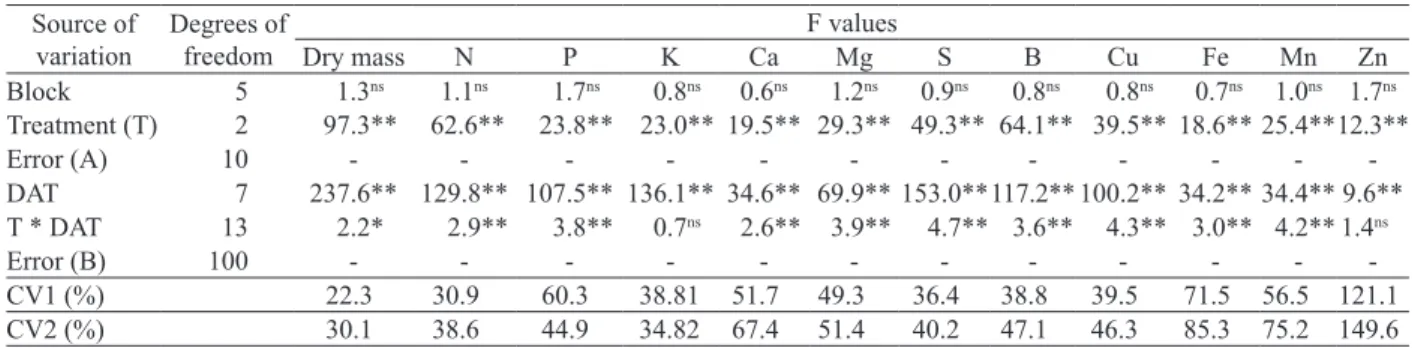
between the treatments (grafted/ungrafted) and days after transplanting, in the accumulation of dry mass and absorption of the nutrients N, P, Ca, Mg, S, B, Cu, Fe and Mn, in the total shoot (leaves + branches + fruits). The isolated effect of these factors was also significant. For the accumulation of K and Zn,
although a significant effect of the factors was found
independently, there was no interaction between them (Table 1).
Until 30 DAT, the ‘Precious Petite’ growth was similar to that observed for ‘Precious Petite’ grafted onto BGCIA 941, which accumulated 58.7 g plant-1
of dry mass. After this period, during the fruiting stage, the growth of ‘Precious Petite’ grafted onto BGCIA 941 (543.4 g plant-1) was greater than that
for ungrafted ‘Precious Petite’, from 34 to 70 DAT (Figure 1). The daily rate increased from 7 g plant-1
*, ** and ns: significant at p < 0.05 and p < 0.01and non-significant, respectively.
Source of variation
Degrees of freedom
F values
Dry mass N P K Ca Mg S B Cu Fe Mn Zn
Block 5 1.3ns 1.1ns 1.7ns 0.8ns 0.6ns 1.2ns 0.9ns 0.8ns 0.8ns 0.7ns 1.0ns 1.7ns Treatment (T) 2 97.3** 62.6** 23.8** 23.0** 19.5** 29.3** 49.3** 64.1** 39.5** 18.6** 25.4**12.3**
Error (A) 10 - - -
-DAT 7 237.6** 129.8** 107.5** 136.1** 34.6** 69.9** 153.0**117.2** 100.2** 34.2** 34.4** 9.6** T * DAT 13 2.2* 2.9** 3.8** 0.7ns 2.6** 3.9** 4.7** 3.6** 4.3** 3.0** 4.2** 1.4ns
Error (B) 100 - - -
-CV1 (%) 22.3 30.9 60.3 38.81 51.7 49.3 36.4 38.8 39.5 71.5 56.5 121.1
CV2 (%) 30.1 38.6 44.9 34.82 67.4 51.4 40.2 47.1 46.3 85.3 75.2 149.6
(ungrafted ‘Precious Petite’) to 15 g plant-1 (‘Precious
Petite’ grafted onto BGCIA 941). However, the growth of the Line BGCIA 941 was greater than that of the others up to 40 DAT, with an accumulation of 253.8 g plant-1,during that period. Subsequently, it
was surpassed by the ‘Precious Petite’ grafted onto Line BGCIA 941.
When watermelons start to develop, the accumulation of dry mass is usually slow, what can be related to the low absorption of water and nutrients to the small foliar area, and consequently reduces liquid carbon assimilation rates (Vidigal et al. 2009). Because the Citrullus lanatus var. citroides
line showed a nutrient absorption capacity greater than the seedless cultivar (Figures 2 and 3), this cultivar logically showed a greater accumulation of dry mass during the whole cycle. This might explain the increase in dry mass for grafted ‘Precious Petite’. Rouphael et al. (2008) also found a 61.2 % increase in dry mass for watermelons grafted onto a Cucurbita
spp. hybrid, when compared to ungrafted plants. An increase in the absorption rate of macronutrients was observed after the beginning of the fruiting stage (30 DAT), when the accumulation of dry mass increased (Figure 2). In the subsequent periods (at 30-60 DAT for ‘Precious Petite’, 30-70 DAT for ‘Precious Petite’ grafted onto Line BGCIA 941 and 20-70 DAT for Line BGCIA 941), there was a high demand for all macronutrients. Therefore, these are the ideal periods for topdressing fertilization.
It was observed that nitrogen accumulation in ‘Precious Petite’ and ‘Precious Petite’ grafted
onto Line BGCIA 941 increased from 32 DAT (Figure 2a). From 38 to 70 DAT, the level of nitrogen in ‘Precious Petite’ grafted onto BGCIA 941 was higher than in ungrafted ‘Precious Petite’ and Line BGCIA 941, reaching 28 g plant-1 at 50-60 DAT. This
trend was similar to that observed for the dry mass accumulation. The period of greatest absorption of N was 32-60 DAT for ‘Precious Petite’ and 20-70 DAT for BGCIA 941, when N reached 15 g plant-1 and
20.9 g plant-1, respectively. The highest increase in
nitrogen observed for ‘Precious Petite’ grafted onto Line BGCIA 941 was similar to that found by Colla et al. (2011), for ‘Minirossa’ watermelon grafted onto different rootstocks.
Phosphorus accumulated during the cycle for ‘Precious Petite’, ‘Precious Petite’ grafted onto Line BGCIA 941 and Line BGCIA 941 reached the greatest absorption rate at 33-60 DAT, 33-70 DAT and 30-70 DAT, respectively (Figure 2b). Phosphorus is the main nutrient involved in watermelon fruit yield, and the grafted plants in this study accumulated more phosphorus than the ungrafted ones. At 60 DAT, the accumulation of phosphorus in ‘Precious Petite’ grafted onto Line BGCIA 941 (1.8 g plant-1)
was 38.4 % greater than that for ‘Precious Petite’. These results differ from those observed for ‘Ingrid’ watermelon, which showed no difference in phosphorus accumulation between grafted and ungrafted plants (Rouphael et al. 2008). However, Yetisir et al. (2013) evaluated two watermelon cultivars grafted onto Lagenaria siceraria hybrids
and Cucurbita spp. hybrids and found different
amounts of phosphorus accumulation in watermelon.
They also observed an influence of the rootstock and
grafted cultivar on the accumulation of phosphorus. The period of highest demand for potassium by ‘Precious Petite’ grafted onto Line BGCIA 941, ‘Precious Petite’ and Line BGCIA 941 occurred at 25-20 DAT, until the end of the cycle, when 11.1 g plant-1, 7.3 g plant-1 and 9.0 g plant-1 were
respectively accumulated (Figure 2c). At 40 DAT, 50 DAT and 60 DAT, the accumulation of potassium for ‘Precious Petite’ grafted onto Line BGCIA 941 was greater than for ‘Precious Petite’. In watermelon, potassium plays an important role in fruit quality parameters such as color, size, acidity, resistance to transport and cracking of the rind, and the ‘Precious Petite’ grafted onto Line BGCIA 941 plants absorbed more potassium than ungrafted ‘Precious Petite’. The potassium accumulation in the present
Figure 1. Accumulation of dry mass per plant of ungrafted ‘Precious Petite’ watermelon ( Y1), ‘Precious Petite’ grafted onto Line BGCIA 941 ( Y2) and Line BGCIA 941 ( Y3) rootstock, at different sampling dates.
study differed from that for the Zaochunghongyu watermelon cultivar grafted onto Lagenaria siceraria
and Cucurbita maxima x Cucurbita moschata
hybrids, which showed no difference in potassium accumulation, in relation to the graft (Huang et al. 2012).
From 38 DAT, ‘Precious Petite’ grafted onto Line BGCIA 941 absorbed more calcium than the other treatments (Figure 2d). The periods of increased
calcium accumulation in ‘Precious Petite’, ‘Precious Petite’ grafted onto Line BGCIA 941 and Line BGCIA 941 were 28-60 DAT (10.1 g plant-1), 28-70 DAT
(12.9 g plant-1) and 20-70 DAT (9.4 g plant-1),
respectively. The degree of calcium accumulation by the plants is related to the blossom end rot of watermelon fruits. The increase in calcium absorption by the ‘Precious Petite’ grafted onto Line BGCIA 941 plants might reduce the incidence of this problem,
Figure 2. Accumulation of nitrogen (a), phosphorus (b), potassium (c), calcium (d), magnesium (e) and sulfur (f) in the total root of ungrafted ‘Precious Petite’ watermelon ( Y1), ‘Precious Petite’ grafted onto Line BGCIA 941 ( Y2) and Line BGCIA 941 rootstock ( Y3), at different sampling dates.
(a)
(f) (e)
(d) (c)
(b)
in addition to conferring increased resistance to fruit mechanical damage. For ‘Crimson Tide’ and ‘Crisby’ watermelons, the calcium content was affected by the rootstock, regardless of the Lagenaria siceraria or
Cucurbita spp. hybrids (Yetisir et al. 2013).
The period of greatest magnesium accumulation for ‘Precious Petite’ grafted onto Line BGCIA 941 and ‘Precious Petite’ occurred at 40-50 DAT, when 2.4 g plant-1 and 1.3 g plant-1 were respectively
absorbed (Figure 2e). The absorption of magnesium was higher in ‘Precious Petite’ grafted onto Line BGCIA 941 at 30-45 DAT and for ‘Precious Petite’ at 30-40 DAT, with a daily accumulation rate of 0.23 g plant-1 and 0.30 g plant-1, respectively. The
maximum estimated accumulation of magnesium in ‘Precious Petite’ grafted onto Line BGCIA 941 surpassed the ‘Precious Petite’. Similar results were found by Colla et al. (2010), who used a
Cucurbita spp. hybrid as rootstock. However, the
use of Lagenaria siceraria as a rootstock caused no difference between the grafted plants and the ungrafted ‘Ingrid’ watermelon.
The greatest accumulation of sulfur occurred from 30 DAT until the end of the cycle, for ‘Precious Petite’ grafted onto Line BGCIA 941 and ‘Precious Petite’, with a maximum of 1.5 g plant-1 and 0.8 g plant-1
and daily accumulation of 0.197 g plant-1 and
0.049 g plant-1, respectively (Figure 2f). At 38 DAT
and 60 DAT, the concentration of sulfur in ‘Precious Petite’ grafted onto Line BGCIA 941 was greater than that in ‘Precious Petite’, with 0.9 g plant-1 and
1.7 g plant-1, respectively.
The period of increased boron accumulation by ‘Precious Petite’ grafted onto Line BGCIA 941, ‘Precious Petite’ and Line BGCIA 941 occurred at 38-70 DAT (reaching 24.5 mg plant-1), 38-60 DAT
(10.4 mg plant-1) and 20-70 DAT (24.6 mg plant-1),
respectively (Figure 3a).
Until 38 DAT, the boron accumulation in ‘Precious Petite’ and ‘Precious Petite’ grafted onto Line BGCIA 941 was similar, but from 40 DAT and 60 DAT, the grafted plants accumulated more boron than the ungrafted ones. These results are
similar to the findings for ungrafted ‘Crimson Sweet’
watermelon, which showed a maximum accumulation of 30 mg plant-1 of boron (Vidigal et al. 2009).
Until 70 DAT, ‘Precious Petite’ grafted onto Line BGCIA 941 accumulated 4.9 mg plant-1 of copper,
with an absorption rate of 0.159 mg plant-1 day-1
(Figure 3b), whereas ‘Precious Petite’ and Line BGCIA
941 accumulated 2.8 mg plant-1 and 3.6 mg plant-1
of copper, respectively, with an absorption rate of 0.1 plant-1 day-1. In contrast to the results of this study,
the copper concentration for ‘Ingrid’ watermelon grafted onto Lagenaria siceraria and Cucurbita spp. hybrids was similar to that of the ungrafted plants (Colla et al. 2010).
At 60-70 DAT, the accumulation of iron in the total shoot was 91.0 mg plant-1, 50.0 mg plant-1 and
91.8 mg plant-1, respectively for ‘Precious Petite’
grafted onto Line BGCIA 941, ‘Precious Petite’ and Line BGCIA 941 (Figure 3c). In this period, the accumulation of iron in ‘Precious Petite’ grafted onto Line BGCIA 941 was greater than in ‘Precious Petite’, with 3.6 mg plant-1 at 30 DAT, 28.0 mg plant-1
at 40 DAT, 60 mg plant-1 at 50 DAT and 90 mg plant-1
at 60 DAT. For ‘Crisby’ watermelon, a reduction in the concentration of iron was found when it was grafted onto Lagenaria siceraria or Cucurbita spp. hybrid, whereas for ‘Crimson Tide’, the response varied according to the rootstock (Yetisir et al. 2013).
From 33 DAT to 55 DAT, ‘Precious Petite’ grafted onto Line BGCIA 941 showed a daily accumulation rate of manganese of 0.21 mg plant-1,
reaching a total accumulation in this period of 115 mg plant-1 (Figure 3d). For ‘Precious Petite’, a
more rapid accumulation of manganese was found from 40 DAT to 60 DAT (47.1 mg plant-1), with
0.07 mg plant-1 day-1. From 40 DAT, an increased
manganese accumulation was observed for ‘Precious Petite’ grafted onto Line BGCIA 941, ranging from 15.8 mg plant-1 to 67.0 mg plant-1 (in relation
to ‘Precious Petite’), and from 53.3 mg plant-1
to 74.6 mg plant-1 (considering the Line BGCIA
941). In contrast to the data obtained for ‘Precious Petite’ grafted onto Line BGCIA 941, for ‘Ingrid’ watermelon, no difference was observed in the manganese accumulation, regarding the graft (Colla et al. 2010).
At 30-60 DAT, the accumulation of zinc by the total shoot of ‘Precious Petite’ grafted onto Line BGCIA 941 was greater than that for ‘Precious Petite’ (Figure 3e). The concentration of Zn in ‘Precious Petite’ grafted onto Line BGCIA 941 increased from 34 DAT to 50 DAT, reaching an accumulation rate of 25.3 mg plant-1. The daily accumulation rate of Zn for
‘Precious Petite’ and the Line BGCIA 941 were similar, at 0.1 mg plant-1 day-1, resulting in 16.4 mg plant-1 and
19.6 mg plant-1 at the end of the cycle, respectively.
(c) (b)
BGCIA 941 had a faster accumulation. For ‘Crisby’ and ‘Crimson Tide’ watermelons, a reduction in zinc accumulation was observed with the graft onto
Lagenaria siceraria and Cucurbita spp. hybrids (Yetisir
et al. 2013). According to Pulgar et al. (2000), grafted
watermelon plants show an increased efficiency of
zinc integration into nitrogenous compounds, forming chelates, which may promote an increase in the foliar biomass of grafted plants.
The graft did not alter the decreasing order of macronutrient accumulation by the shoot of the plants, which was the same for ‘Precious Petite’ grafted onto Line BGCIA 941, ‘Precious Petite’ and Line BGCIA 941: N > K > Ca > Mg > P > S. However, there was a change in the order of accumulation, especially for Mn and Fe, for ‘Precious Petite’ and ‘Precious Petite’ grafted onto Line BGCIA 941, and Zn and B for Line BGCIA 941 (Table 2). The observed sequence was Mn > Fe > B > Zn > Cu in ‘Precious Petite’, Fe > Mn > Zn > B > Cu in ‘Precious Petite’ grafted onto Line BGCIA 941 and Fe > Mn > B > Zn > Cu in Line BGCIA 941.
At harvest (60 and 70 DAT), the fruits of ‘Precious Petite’ grafted onto Line BGCIA 941 contributed with 45.4 % for the dry matter of the plant. Among the nutrients extracted by ‘Precious Petite’
Figure 3. Accumulation of boron (a), copper (b), iron (c), manganese (d) and zinc (e) in the total shoot of ungrafted ‘Precious Petite’ watermelon ( Y1), ‘Precious Petite’ grafted onto Line BGCIA 941 ( Y2) and Line BGCIA 941 rootstock ( Y3), at different sampling dates.
(a)
(e) (d)
grafted onto Line BGCIA 941, only phosphorus accumulated more in the fruits than in the vegetative
parts (Table 2). There was a preferential flow of the
other nutrients to the vegetative parts. This contrasts with the data for ‘Precious Petite’, where N, P, K, S, B and Cu were accumulated more in the fruits, whereas Ca, Mg, Fe, Mn and Zn remained in the vegetative parts.
Similarly, for the Line BGCIA 941, Ca, Mg, B, Fe and Mn had higher concentrations in the vegetative parts, whereas N, P, K, S, Cu and Zn accumulated more in the fruits (Table 2). For grafted watermelon, it is recommended that chemical fertilization is reduced by one-half or two-thirds of the recommended dose for ungrafted plants (Lee & Oda 2010), in order to avoid excessive development of the shoots and promote a better distribution of these nutrients among the plant organs. For ‘Crisby’ and ‘Crimson Tide’ watermelons that were grafted onto Lagenaria siceraria and
Cucurbita sp. hybrids, nitrogen accumulated more
in the leaves than in the fruits, whereas phosphorus and zinc accumulated more in the fruits (Yetisir et al. 2013). Colla et al. (2006) found a greater
accumulation of potassium in the vegetative tissues than in the fruits of the grafted plants.
There was a significant effect of the graft on
the number of fruits, yield, fruit weight, rind thickness
and flesh firmness, whereas the soluble solids were
not affected (Table 3).
The number of fruits, total yield and marketable yield of ‘Precious Petite’ grafted onto Line BGCIA 941 were greater than that of ‘Precious Petite’ by 13.6 %, 54.9 % and 52.9 %, respectively (Table 4).
For ‘Precious Petite’ grafted onto Line BGCIA 941, a yield of 4.4 kg plant-1 was observed, which
corresponds to an increase of 62.9 %, when compared to the yield of ‘Precious Petite’ (2.7 kg plant-1). The
graft also promoted a 36.4 % reduction in the fruit weight of ‘Precious Petite’ (Table 4). An increase in production depending on the graft was found by Santos et al. (2014), for triploid ‘RWT8154’ watermelon grafted onto Citrullus sp., in agreement
with the findings in this study. Similarly, the reduction
in fruit weight observed for ‘Precious Petite’ grafted onto Line BGCIA 941 was also observed for ‘Crimson Sweet’ watermelon grafted onto Lagenaria
¹ Quantities of macro and micronutrients in the plant are expressed for grams and milligrams, respectively.
Dry mass (g) Nitrogen Phosphorus
PP PP/BGCIA BGCIA PP PP/BGCIA BGCIA PP PP/BGCIA BGCIA
Plant1 408.7 539.7 565.2 15.7 25.5 2.7 1.2 1.5 3.4
Vegetative part (%) 34.4 54.6 39.8 38.8 63.9 25.5 25.0 33.3 8.8
Fruit (%) 65.6 45.4 60.2 61.2 36.1 74.5 75.0 66.7 91.2
Potassium Calcium Magnesium
PP PP/BGCIA BGCIA PP PP/BGCIA BGCIA PP PP/BGCIA BGCIA
Plant 9.1 12.0 12.9 8.2 8.7 10.7 1.7 2.3 4.6
Vegetative part (%) 22.0 62.5 20.2 92.7 95.4 77.6 70.5 78.3 54.3
Fruit (%) 78.0 37.5 79.8 7.3 4.6 22.4 29.5 21.7 45.7
Sulfur Boron Copper
PP PP/BGCIA BGCIA PP PP/BGCIA BGCIA PP PP/BGCIA BGCIA
Plant 0.8 1.2 1.7 14.3 28.8 30.5 3.3 5.1 4.9
Vegetative part (%) 37.5 58.3 11.8 46.8 71.9 56.1 39.4 54.9 8.2
Fruit (%) 62.5 41.7 88.2 53.2 28.1 43.9 60.6 45.1 91.8
Iron Manganese Zinc
PP PP/BGCIA BGCIA PP PP/BGCIA BGCIA PP PP/BGCIA BGCIA
Plant 52.5 101.9 112.8 62.5 60.0 54.7 13.7 49.7 21.5
Vegetative part (%) 66.9 81.8 53.9 94.1 95.8 80.1 51.1 79.3 1.9
Fruit (%) 33.1 18.2 46.1 5.9 4.2 19.9 48.9 20.7 98.1
siceraria, whereas ‘Sugar Baby’ showed a fruit weight increase with these rootstocks (Petropoulos et al. 2012).
In grafted plants, the rind thickness and flesh firmness of ‘Precious Petite’ increased by 66.7 %
and 62.9 %, respectively (Table 4). However, the soluble solids were unaffected. An increase in rind thickness was found for the fruits of ‘Precious Petite’ grafted onto Line BGCIA 941 and also for ‘Crimson Tide’, ‘Dumara’ and ‘Farao’ submitted to grafting (Turhan et al. 2012). The increase in rind thickness and flesh firmness are attributed to increased calcium absorption (Rouphael et al. 2010). Another hypothesis was stated by Edelstein et al. (2014),
who attribute the increase in flesh firmness and rind
thickness of grafted watermelon to the presence of smaller and denser cells.
CONCLUSIONS
1. ‘Precious Petite’ cultivar grafted onto Line BGCIA 941 accumulates more nutrients than ungrafted plants, resulting in higher fruit yield and quality.
2. The decreasing order of macronutrient accumulation in grafted and ungrafted plants was N > K > Ca > Mg > P > S.
3. The micronutrient accumulation was Fe > Mn > Zn > B > Cu for grafted ‘Precious Petite’ plants and Mn > Fe > B > Zn > Cu for ungrafted ‘Precious Petite’ plants.
REFERENCES
BARROS, M. M. et al. Produção e qualidade da melancia submetida à adubação nitrogenada. Revista Brasileira de Engenharia Agrícola e Ambiental, v. 16, n. 10, p. 1078-1084, 2012.
COHEN, S.; NAOR, A. The effect of three rootstocks on water use canopy conductance and hydraulic parameters of apple trees and predicting canopy from hydraulic conductance. Plant, Cell and Environment, v. 25, n. 1, p. 17-28, 2002.
COLLA, G. et al. Effect of salinity on yield, fruit quality, leaf gas exchange and mineral composition of grafted watermelon plants. Journal HortScience, v. 41, n. 3, p. 622-627, 2006.
COLLA, G. et al. Nitrogen-use efficiency traits of mini-watermelon in response to grafting and nitrogen-fertilization doses. Journal of Plant Nutrition and Soil Science, v. 174, n. 6, p. 933-941, 2011.
COLLA, G. et al. The effectiveness of grafting to improve alkalinity tolerance in watermelon. Environment and Experimental Botany, v. 68, n. 3, p. 283-291, 2010.
CUSHMAN, K. Grafting techniques for watermelon. Gainesville: University of Florida, 2006.
EDELSTEIN, M. et al. Horticultural evaluation of exotic watermelon germplasm as potential rootstocks. Scientia Horticulturae, v. 165, n. 1, p. 196-202, 2014.
E M P R E S A B R A S I L E I R A D E P E S Q U I S A AGROPECUÁRIA (Embrapa). Manual de análises químicas de solos, plantas e fertilizantes. 2. ed. Brasília, DF: Embrapa Informação Tecnológica, 2009.
*, ** and ns significant at p < 0.05 and p < 0.01 and non-significant, respectively.
Source of variation
Degree of freedom
F values Number
of fruits
Total yield
Marketable
yield
Fruit weight
Rind thickness
Flesh
firmness Soluble solids
Block 5 1.5ns 1.4ns 0.5ns 2.0ns 1.2ns 2.7ns 0.3ns
Treatment 1 8.4* 6.7** 28.8** 2.1** 193.1** 110.1** 0.1ns
Error 11 - - -
-CV (%) 6.7 4.7 15.1 5.8 5.6 7.7 9.2
Table 3. Summary of analysis of variance for production and quality of grafted and ungrafted watermelon fruits.
Table 4. Production characteristics and fruit quality of grafted (PP/BGCIA 941) and ungrafted (PP) triploid ‘Precious Petite’ watermelon.
Treatment Fruitplant
-1 Total yield Marketable yield1 Fruit weight Rind thickness Flesh firmness Soluble solids
Number ________________ t ha-1 ________________ kg cm N ºBrix
PP 2.2 b 15.1 b 14.5 a 2.2 a 0.3 b 6.2 b 12.3 a
PP/BGCIA 941 2.5 a 23.4 a 23.1 a 1.4 b 0.5 a 10.1 a 12.2 a
HUANG, Y. et al. Grafting onto different rootstocks as a means to improve watermelon tolerance to low potassium stress. Scientia Horticulturae, v. 149, n. 1, p. 80-85, 2012.
KARACA, F. et al. Rootstock potential of Turkish Lagenaria siceraria germplasm for watermelon: plant growth, yield and quality. Turkish Journal of Agriculture and Forestry, v. 36, n. 1, p. 167-177, 2012.
LEE, J. M.; ODA, M. Grafting of herbaceous vegetable and ornamental crops. Horticultural Reviews, v. 28, n. 1, p. 61-124, 2010.
MENDES, A. M. S. et al. Adubação. In: DIAS, R. de C. S. et al. (Eds.). Sistema de produção de melancia. Petrolina: Embrapa Semiárido, 2010. Available at: <https:// sistemasdeproducao.cnptia.embrapa.br/FontesHTML/ Melancia/SistemaProducaoMelancia/adubacao.htm>. Access on: Dec. 15, 2015.
PETROPOULOS, S. A. et al. Evaluation of rootstocks for watermelon grafting with reference to plant development, yield and fruit quality. International Journal of Plant Production,v. 6, n. 4, p. 481-492, 2012.
PULGAR, G. et al. Improving the mineral nutrition in grafted watermelon plants: nitrogen metabolism. Biologia Plantarum, v. 43, n. 1, p. 607-609, 2000.
RIVERO, R. M. et al. Does grafting provide tomato plants and advantages against H2O2 production under conditions of thermal shock? Plant Physiology, v. 117, n. 1, p. 44-50, 2003.
ROUPHAEL, Y. et al. Impact of grafting on product quality of fruit vegetables. Scientia Horticulture, v. 127, n. 8, p. 172-179, 2010.
ROUPHAEL, Y. et al. Yield, mineral composition,
water relations, and water use efficiency of grafted mini watermelon plants under deficit irrigation. HortScience, v. 43, n. 3, p. 730-736, 2008.
SANTOS, J. S. et al. Compatibilidade com porta-enxertos, rendimento e qualidade de frutos em cultivares de melancia triploide. Revista Caatinga, v. 27, n. 2, p. 141-147, 2014.
TURHAN, A. et al. Influence of rootstocks on yield and fruit characteristics and quality of watermelon. Horticultural Environment and Biotechnology, v. 53, n. 4, p. 336-341, 2012.
VERHULST, P. F. Notice sur la loique la population suit
dans son accroissement. Correspondance Mathématique
et Physique,v. 10, n. 1, p.113-121, 1838.
VIDIGAL, S. M. et al. Crescimento e acúmulo de macro e micronutrientes pela melancia em solo arenoso. Revista Ceres, v. 56, n. 1, p. 112-118, 2009.
YETISIR, H. et al. Root-stock potential of Turkish Lagenaria siceraria germplasm for watermelon: plant growth, graft compatibility, and resistance to Fusarium. Journal of Agriculture and Forestry, v. 31, n. 4, p. 381-388, 2007.
YETISIR, H. et al. Rootstocks effect on plant nutrition concentration in different organs of grafted watermelon. Agriculture Science, v. 4, n. 5, p. 230-237, 2013.