Priming corn seeds with plant growth regulator
1Dryelle Sifuentes Pallaoro
2*, Anne Caroline Dallabrida Avelino
2,
Elisangela Clarete Camili
2, Sebastião Carneiro Guimarães
2,
Maria Cristina de Figueiredo e Albuquerque
2ABSTRACT - This study aimed to evaluate the plant growth regulator application, in different doses, on priming, with and without water restriction, in corn seeds. Evaluations were carried out in two periods (0 to 30 days of storage), with treatments consisting of seeds primed in water (0.0 MPa) and polyethylene glycol 6000 solution (-0.4 MPa), with or without plant growth regulator added in different doses, plus a control group. The amount of plant growth regulator was standardized by the gibberellic acid concentration in the commercial product, adopting the doses zero, 1, 2 and 3 mg of gibberellic acid. L-1 solution. After
priming, the seeds were dried in an oven with forced air circulation for nine hours, and evaluated for water content, percentage and first count of germination, percentage of abnormal seedlings and non-germinated seeds, cold test, seedling length and dry weight and vigor index. Priming with water restriction -0.4 MPa, in solution of polyethylene glycol 6000, improves the vigor; however, the addition of plant growth regulator in priming does not provide increase in corn seeds quality. Corn priming in water, regardless the addition of plant growth regulator, reduces the ability of the seeds to withstand storage.
Index-terms: auxin, cytokinin, gibberellic acid, polyethylene glycol.
Condicionamento de sementes de milho com reguladores vegetais
RESUMO - Objetivou-se avaliar a aplicação de regulador vegetal em diferentes doses via condicionamento fisiológico, com e sem restrição hídrica, em sementes de milho. Foram realizadas avaliações em dois períodos (0 e 30 dias de armazenamento), sendo os tratamentos compostos por sementes condicionadas em água (0,0 MPa) e em solução de polietilenoglicol 6000 (-0,4 MPa), com ou sem adição de regulador vegetal em diferentes doses, mais o controle. A quantidade de regulador vegetal foi padronizada pela concentração de ácido giberélico no produto comercial, adotando as doses zero, 1, 2 e 3 mg ácido giberélico. L-1 solução. Após o condicionamento as
sementes foram secas em estufa, por nove horas, e avaliadas quanto ao teor de água, porcentagem e primeira contagem da germinação, porcentagem de plântulas anormais e sementes não germinadas, teste de frio, comprimento e massa seca de plântulas e índice de vigor. O condicionamento fisiológico com restrição hídrica -0,4 MPa, em solução de polietilenoglicol 6000, melhora o vigor, entretanto, a adição de regulador vegetal no condicionamento fisiológico não proporciona aumento na qualidade das sementes de milho. O condicionamento de milho em água, independente da adição de regulador vegetal, reduz a capacidade das sementes resistir ao armazenamento.
Termos para indexação: ácido giberélico, auxina, citocinina, polietilenoglicol.
1Submitted on 05/12/2016. Accepted for publication on 06/28/2016.
2Departamento de Fitotecnia e Fitossanidade , UFMT, CEP 78060-900- Cuiabá, MT, Brasil.
*Corresponding author: <[email protected]>
Introduction
In the management of corn crop, new technologies are constantly used, including the employment of enhanced cultivars associated with fungicides, nutrients or plant growth
regulators application on the seeds (Silva et al., 2008), among
others. In order to avoid losses during storage, seed treatment occurs with seed processing, once corn seeds have high added value. When they are not used for sowing in the production year, they are repacked and stored until the next crop, since the
chemical treatment received impede the commercialization
for alimentary purposes. Due to a longer storing period, seeds will be more susceptible to deterioration, thus, the adoption of new techniques such as priming and the use of plant growth regulators can be used as important tools to increase the corn
seeds effectiveness in the second year.
Corn priming improves the vigor and viability increasing the germination speed and percentage, seedling length and dry
mass of corn (Dezfuli et al., 2008; Yasari et al., 2013) sweet
Filho, 2010), and other crops. Simultaneously to priming,
the seeds can be treated with plant growth regulators applied through soaking, so, in conditioning solution. Promising results
were obtained with wheat seeds (Ghobadi et al., 2012), castor bean (Peixoto et al., 2011), onions (Yarnia and Tabrizi, 2012), rye (Ansari et al., 2013) and sweet corn (Rivera et al., 2011).
When hormones are produced or absorbed by the seeds, they participate in many processes. Auxin stimulates the elongation of coleoptiles and root formation; gibberellin induces germination through the activation of the embryos growth,
mobilization of reserves and weakening of the endosperm
layer and; cytokinins acts mainly in the control of cell division, operating in the morphogenesis of the aerial part and the roots. However, the application of exogenous cytokinins may inhibit
hypocotyl elongation (Taiz and Zeiger, 2013). Regarding the
application of plant growth regulators, the interval between the optimal and inhibitory levels, is narrow, so slight variations on dosage may stimulate or inhibit these products performance.
To sum up, the use of priming associated to the addition of plant growth regulators may be an alternative to increase vigor, avoiding the corn seeds disposal as well as environmental contamination. The objective of this research
was to evaluate the use of plant growth regulators in different
doses through priming, with and without water restriction, in corn seeds.
Material and Methods
With the intention of reproducing the farmers reality, hybrid
corn seeds type DKB 390 VT PRO2 were used, chemically treated with deltamethrin, methyl primifol, metalaxyl, tiabendazole, fludioxonil, and polyoxyethylene alkyl phenol ether, yielded
by Monsanto company. The experiment was performed with
completely randomized design, double factorial scheme, with
two evaluation periods, before storage and 30 days after storage, eight treatments and a control. The plant growth regulator used in priming was the commercial product Stimulate®, constituted
by gibberellic acid (GA3) (50 mg. L-1), kinetin (90 mg. L-1) and
indolbutiric acid (50 mg. L-1).
The treatment consisted of seeds primed in water (0.0 MPa) and in polyethylene glycol 6000 (-0.4 MPa), with or
without the addition of plant growth regulator in different doses. To standardize the quantity of plant growth regulators,
the concentration of gibberellic acid in the commercial
product was used as reference, adopting a zero, one dose
lower and one higher than the recommended by Ghodrat and
Rousta (2012). Thus, doses zero (D0), 1 (D1), 2 (D2) and 3 (D3)
mg of gibberellic acid. L-1 solution were used.
The amount of PEG 6000 used in the preparation of the
polyethylene glycol solution was calculated according to
the Michael and Kaufmann equation (1973). Priming was
performed by immersing the seeds in non-aerated solution at 24
± 1 ºC, for 24 hours. Finally, the seeds were washed in running water, superficially dried with towel paper, transferred to Kraft paper bags for drying in forced air circulation at 40 ºC, for nine
hours and the control seeds were not submitted to drying. The drying period was determined in a pre-test.
Evaluation of water content were carried out by the oven method, before and after priming and after drying, using 4.5±0.5
g of seeds (Brasil, 2009) with three replications; first count and
germination percentage, by the germination test in towelpaper
roll, at 30 ºC, photoperiod of 12 hours, counting the amount of
normal seedlings in the 4th and 7th days after sowing, respectively
(Brasil, 2009). After germination test, the seedlings were classified
as normal (germination percentage), abnormal seedlings and non-germinated seeds. Cold test in towel paper roll were also
performed, where the seeds were exposed to 10 ºC temperature for
seven days. After this period, the rolls were transferred to BOD
at 30 ºC for germination count in the 4th day (Barros et al., 1999);
length and seedlings dry mass in towel paper roll, with 10 seeds
per roll, following the instructions of the germination test, with measuring on the 5th day after sowing (Nakagawa, 1999); and the
vigor index, calculated by the product between the germination percentage and the seedling average length (Abdul-Baki and
Anderson, 1973).
After the evaluations in time zero, the remaining seeds
were transferred to Kraft paper bags and stored in laboratory conditions, without the control of relative humidity and
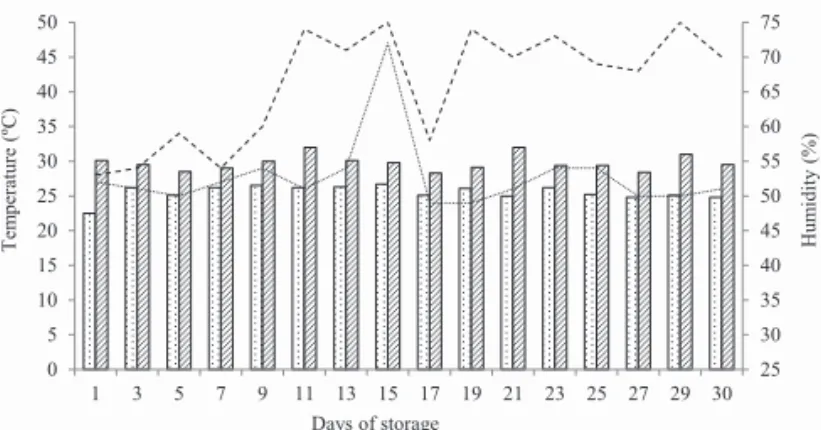
temperature (Figure 1), for 30 days, and were re-evaluated at
the end. The data obtained was submitted to variance analysis and the averages compared by the Scott-Knott test (P < 0.05).
25 30 35 40 45 50 55 60 65 70 75 0 5 10 15 20 25 30 35 40 45 50
1 3 5 7 9 11 13 15 17 19 21 23 25 27 29 30
Hu m id ity ( %) T em p er atu re (ºC)
Days of storage
Figure 1. Room temperature (T) and relative humidity of the
Results and Discussion
The water contents of the seeds after priming were higher in the treatments without the use of priming agent, indicating that
polyethylene glycol was efficient in reducing the water absorption speed, restricting imbibition (Table 1). Drying the seeds for nine hours at 40 ºC reduced the water levels, however, the amount varied
between the treatments, since the drying period was not enough to remove the water absorbed during priming completely. After the storage for 30 days, there was a decrease in the water level in all treatments primed with PEG, and the control had an increase in the water level, possibly by the hygroscopic balance. This situation occurs when the relative humidity of the environment is elevated, making the dry seeds to absorb water.
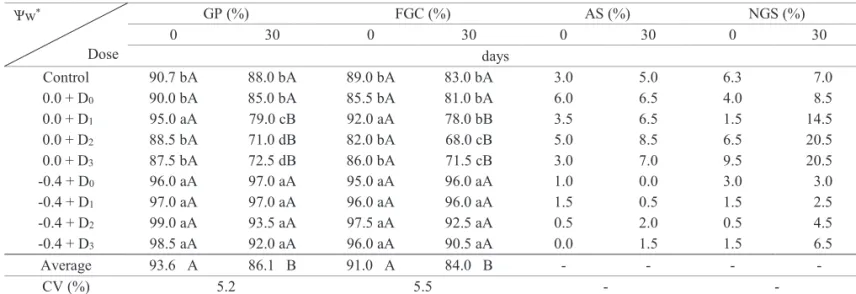
For the germination percentage and first counting, the
interaction of the treatments and the period of storage were
significant (Table 2). It was observed that, after storage, there was a reduction in the germination percentage and first count
after priming in water with plant growth regulator.
Table 1. Water level (%) of the corn seeds (Zea mays L.)
submitted to priming in different water potentials (Ѱw) through immersion in priming solution added
with plant growth regulators, right after (AP – after priming, without drying), after priming and drying (time 0) and after storage (30 days).
Ѱw*/Dose AP 0 (zero) 30 days
Control 9.7 9.7 10.3
0.0 + D0 32.3 20.6 11.3
0.0 + D1 32.8 20.7 11.4
0.0 + D2 32.0 21.1 11.0
0.0 + D3 33.5 19.7 11.5
-0.4 + D0 28.3 16.6 11.4
-0.4 + D1 28.8 16.9 11.3
-0.4 + D2 28.2 16.3 11.3
-0.4 + D3 29.9 17.2 11.1
*Ѱw: water potential in MPa.
Table 2.Percentage (GP) and first germination count (FGC), percentage of abnormal seedlings (AS) and non-germinated seeds (NGS) of corn (Zea mays L.) submitted to priming with plant growth regulators in different doses after priming and
drying (time zero) and after storage (30 days).
Ѱw*
Dose
GP (%) FGC (%) AS (%) NGS (%)
0 30 0 30 0 30 0 30
days
Control 90.7 bA 88.0 bA 89.0 bA 83.0 bA 3.0 5.0 6.3 7.0
0.0 + D0 90.0 bA 85.0 bA 85.5 bA 81.0 bA 6.0 6.5 4.0 8.5
0.0 + D1 95.0 aA 79.0 cB 92.0 aA 78.0 bB 3.5 6.5 1.5 14.5
0.0 + D2 88.5 bA 71.0 dB 82.0 bA 68.0 cB 5.0 8.5 6.5 20.5
0.0 + D3 87.5 bA 72.5 dB 86.0 bA 71.5 cB 3.0 7.0 9.5 20.5
-0.4 + D0 96.0 aA 97.0 aA 95.0 aA 96.0 aA 1.0 0.0 3.0 3.0
-0.4 + D1 97.0 aA 97.0 aA 96.0 aA 96.0 aA 1.5 0.5 1.5 2.5
-0.4 + D2 99.0 aA 93.5 aA 97.5 aA 92.5 aA 0.5 2.0 0.5 4.5
-0.4 + D3 98.5 aA 92.0 aA 96.0 aA 90.5 aA 0.0 1.5 1.5 6.5
Average 93.6 A 86.1 B 91.0 A 84.0 B - - - -
CV (%) 5.2 5.5 - -
* Ѱw: water potential in MPa; CV: coefficient of variation
Averages followed by the same letter, lower case in the column and upper case in the lines, do not differ statistically between themselves, by the Scott-Knott
test (P < 0.05).
Priming without water restriction associated with the use of plant growth regulators in the solution (0.0 + D1; 0.0 + D2; 0.0 + D3), possibly made the seeds more sensible to storage, once it has been a decrease in the germination percentage and
first count and an increase in the non-germinated seeds after 30 days of storage (Table 2). This effect was not observed
in the seed primed in water without plant growth regulator (0.0 + D0) showing that the decrease occurred due to the plant growth regulator addition.
Besides this, the quality decrease was intensified in
In jacaranda, it was observed that seed immersion in gibberellic acid solution caused a decrease in the seedlings
emergence percentage. The authors affirmed that after the
treatment and in the beginning of storage, the seeds probably had enough endogenous gibberellin, thus, the supplementation with plant growth regulator may have unleashed an inhibitory
effect (Scalon et al., 2006). Furthermore, the application of gibberellin may produce a contrary effect, accelerating the
deterioration process, compromising the seeds physiological
potential (Marcos-Filho, 2015).
In sweet corn, seed immersion in gibberellic acid solution generated improvements in viability and vigor until 60 days
of storage (Rivera et al., 2011). Beneficial effects were also observed in wheat seeds (Ghobadi et al., 2012) and rye (Ansari et al., 2013). In this study, however, priming without water
restriction, associated with the use of plant growth regulators,
caused decrease of the germination percentage and first count, with the effect being intensified after storage.
Regarding priming with water restriction, in polyethylene
glycol 6000 solution (-0.4 MPa) there was no differences
between the doses of plant growth regulators used and, after 30 days of storage, the treatments kept the germination
percentage and first count above 90%. Comparing the averages
after priming and after storage, all priming treatments in polyethylene glycol were higher than the control (Table 2)
showing gains in seed vigor and viability.
For the percentage of abnormal seedlings (Table 2) it was evident that the priming process with water restriction (PEG 6000 -0.4 MPa), regardless the addition of plant growth regulator, decreased the occurrence of abnormalities in seedlings. This may be associated to the reduction of water absorption speed of the seeds, decreasing the soaking damage. In this process, the risks of damage in the embryo axis caused by rapid water absorption are reduced, since the tissues develop
in a more organized way (Menezes et al., 2006). Studying corn
drying, Rosa et al. (2000) observed that the water absorption process in dry seeds may cause damage, and the damage intensity is related to the initial quality.
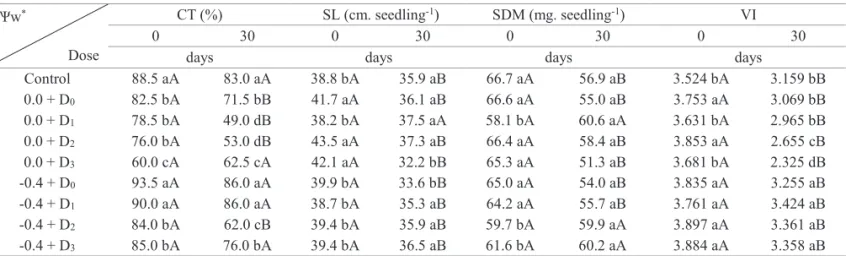
In the cold test, priming with polyethylene glycol, without plant growth regulators (-0.4 + D0), with regulator in the smallest dose (-0.4 + D1), and the control treatment were superior in both evaluated periods and the other treatments showed low germination, especially after storage (Table 3). Sweet corn seeds, primed in water with gibberellic acid and stored, when submitted to the cold test, showed drastic decrease in physiological potential. This possibly occurred
since gibberellic acid acts in the reserve mobilization and weakening of the endosperm layer (Rivera et al., 2011), and
it may accelerate the deterioration process (Marcos-Filho,
2015) reducing the seed capacity to withstand storage.
Table 3. Germination after cold test (CT), seedling length (SL), seedling dry mass (SDM) and vigor index (VI) in corn seeds
(Zea mays L.) submitted to priming with plant growth regulators in different doses after priming and drying (time
zero) and after storage (30 days).
Ѱw*
Dose
CT (%) SL (cm. seedling-1) SDM (mg. seedling-1) VI
0 30 0 30 0 30 0 30
days days days days
Control 88.5 aA 83.0 aA 38.8 bA 35.9 aB 66.7 aA 56.9 aB 3.524 bA 3.159 bB
0.0 + D0 82.5 bA 71.5 bB 41.7 aA 36.1 aB 66.6 aA 55.0 aB 3.753 aA 3.069 bB
0.0 + D1 78.5 bA 49.0 dB 38.2 bA 37.5 aA 58.1 bA 60.6 aA 3.631 bA 2.965 bB
0.0 + D2 76.0 bA 53.0 dB 43.5 aA 37.3 aB 66.4 aA 58.4 aB 3.853 aA 2.655 cB
0.0 + D3 60.0 cA 62.5 cA 42.1 aA 32.2 bB 65.3 aA 51.3 aB 3.681 bA 2.325 dB
-0.4 + D0 93.5 aA 86.0 aA 39.9 bA 33.6 bB 65.0 aA 54.0 aB 3.835 aA 3.255 aB
-0.4 + D1 90.0 aA 86.0 aA 38.7 bA 35.3 aB 64.2 aA 55.7 aB 3.761 aA 3.424 aB
-0.4 + D2 84.0 bA 62.0 cB 39.4 bA 35.9 aB 59.7 bA 59.9 aA 3.897 aA 3.361 aB
-0.4 + D3 85.0 bA 76.0 bA 39.4 bA 36.5 aB 61.6 bA 60.2 aA 3.884 aA 3.358 aB
Average 82.0 A 82.0 A 40.2 A 35.6 B 63.7 A 56.9 B 3.758 A 3.064 B
CV (%) 9.2 3.9
*Ѱwater potential in MPa; CV: coefficient of variation;
Averages followed by the same letter, lower case in the column and upper case in the lines, do not differ statistically between themselves, by the Scott-Knott test (P < 0.05).
Comparing seeds primed in PEG without plant growth regulator (-0.4 + D0), after cold test in time zero, with the control and the treatments -0.4 + D1, 0.0 + D0, it was observed
an absolute increase of five percentage points in germination,
that can be given to the restriction in water absorption velocity.
On the other hand, the addition of plant growth regulator
decreased this effect with the increase of the dose (Table 3).
The increment in germination may be related to a decrease in soaking damage during the water absorption process.
slowly, which allows more time to the plasmatic membrane for rearrange, avoiding the leakage of cellular content, reducing
the occurrence of soaking damage (Menezes et al., 2006).
In the seedling length, after priming, the seeds primed in water without plant growth regulator (D0) or with regulator in doses D2 and D3 showed bigger seedlings when compared to the other treatments (Table 3). After storage, all treatments had a decrease in seedling length, except priming in water with plant growth regulator in the smallest dose (0.0 + D1).
Observing the data of seedling dry mass, the priming in water and in polyethylene glycol with plant growth regulator (0.0 + D1;-0.4 + D2; -0.4 + D3) were lower than the others before storage, however, they kept the dry mass after 30 days, while the others showed reduction in mass.
In contrast with the data from this study, Ghodrat and
Rousta (2012) and Ghobadi et al., (2012), obtained increase
in seedling length and dry mass when priming corn and wheat seeds, respectively, in water and with addition of gibberellic
acid. Ghobadi et al. (2012) state that priming of wheat seeds in PEG -0.3 MPa for 12 hours elevates germination as well as
root and shoot length and dry mass. Similar results were found
by Chauhan et al. (2009) in Vigna mungo and Macrotyloma
uniflorum seeds.
Therefore, different responses obtained for seedling length and dry mass may have been influenced by the absence
of light and the exogenous amount of plant growth regulators in the treatments, since this test was performed in the dark and the product used was composed by gibberellin, auxin and
cytokinins in different concentrations. According to Taiz and Zeiger (2013), the level of endogenous auxin in the elongation
region of a healthy normal plant is near the optimum for growth, the plant sprinkling with exogenous auxin results in a modest and brief growth stimulus, sometimes even inhibitory, when growing in the dark.
For vigor index, in time zero, all treatments were higher
than the control, except for priming without water restriction with plant growth regulator in doses D1 and D3. After 30 days of storage, the higher vigor indexes were obtained in treatments with priming in polyethylene glycol regardless the addiction of plant growth regulators (-0.4 + D0; -0.4 + D1;-0.4 + D2; -0.4 + D3), however, all treatments showed decrease in
quality when confronted the vigor index data in time zero and
30 days of storage (Table 3).
According to the evaluations, priming with water restriction (-0.4 MPa) enabled improvements in the physiological quality of corn seeds regardless the addition of plant growth regulator in the polyethylene glycol 6000 solution. The seeds primed without water restriction showed decrease in the capacity of
resist the storage, and this effect was pronounced with the
addition of plant growth regulator to the priming.
Conclusions
Priming with water restriction -0.4 MPa, in polyethylene glycol 6000, increases corn seed vigor.
The addition of plant growth regulators in priming does not improve corn seed quality.
Priming of corn seeds in water, regardless the addition of plant growth regulators, reduces storage resistance capacity of the seeds.
Acknowledgements
CAPES, for the master’s scholarship.
References
ABDUL-BAKI, A.A.; ANDERSON, J.D. Vigour determination in soybean
seed by multiple criteria. Crop Science, v.13, p.630–633, 1973. https://
dl.sciencesocieties.org/publications/cs/pdfs/13/6/CS0130060630
ANSARI, O.; AZADI, M.S.; SHARIF-ZADEH, F.; YOUNESI, E. Effect of hormone priming on germination characteristics and enzyme activity of
mountain rye (Secale montanum) seeds under drought stress conditions.
Journal of Stress Physiology & Biochemistry, v.9, n.3, p.61-71, 2013. http://
www.jspb.ru/issues/2013/N3/JSPB_2013_3_61-71.pdf
BARROS, A.S.R.; DIAS, M.C.L.L.; CÍCERO, S.M.; KRZYZANOWSKI, F.C. Teste de frio. In: KRZYZANOWSKI, F.C.; VIEIRA, R.D.; FRANÇA- NETO, J.B. (Ed.). Vigor de sementes: conceitos e testes. Londrina:
ABRATES, 1999. 218p.
BRASIL. Ministério da Agricultura, Pecuária e Abastecimento. Regras para
análise de sementes.Ministério da Agricultura, Pecuária e Abastecimento.
Secretaria de Defesa Agropecuária. Brasília: MAPA/ACS, 2009, 395p. http:// www.agricultura.gov.br/arq_editor/file/2946_regras_analise__sementes.pdf
CHAUHAN, J.S.; TOMAR, Y. K.; SINGH, N. I.; ALI, S.; DEBARATI. Effect of growth hormones on seed germination and seedling growth of
black gram and horse gram. Journal of American Science, v.5, p.78-84, 2009.
http://www.jofamericanscience.org/journals/amsci/0505/10_0901_growth_
hormones_am0505.pdf
DEZFULI, P. M.; SHARIF-ZADEH, F.; JANMOHAMMADI, M. Influence of priming techniques on seed germination behavior of maize inbred lines
(Zea mays L.). Journal of Agricultural and Biological Science,v.3, n.3,
p.22-25, 2008. http://www.arpnjournals.com/jabs/research_papers/rp_2008/ jabs_0508_79.pdf
GHOBADI, M.; ABNAVI, M.S.; HONARMAND, S.J.; GHOBADI, M.E.; MOHAMMADI, G.R. Effect of hormonal priming (GA3) and osmopriming
on behavior of seed germination in wheat (Triticum aestivum L.). Journal
of Agricultural Science, v.4, n.9, p.244-250, 2012. http://www.ccsenet.org/
journal/index.php/jas/article/view/17829
GHODRAT, V.; ROUSTA, M.J. Effect of priming with gibberellic acid (GA3)
on germination and growth of corn (Zea mays L.) under saline conditions.
International Journal of Agriculture and Crop Sciences, v.4, n.13, p.882-885,
MARCOS-FILHO, J. Fisiologia de sementes de plantas cultivadas.
Piracicaba: FEALQ, 2015. 659p.
MENEZES, N. L.; ESPINDOLA, M. C. G.; PASQUALI, L. L.; SANTOS, C. M. R.; FRANZIN, S. M. Associação de tratamentos pré-germinativos
em sementes de alface. Revista da Faculdade de Zootecnia, Veterinária e Agronomia, v.13, n.1, p.1-11, 2006. http://revistaseletronicas.pucrs.br/ojs/
index.php/fzva/article/view/2334/1821
MICHAEL, B. E.; KAUFMANN, M. R. The osmotic potential of polyethylene
glicol 6000. Plant Physiology, v.51, p.914-916, 1973.
NAKAGAWA, J. Testes de vigor baseados no desempenho das plântulas. In: KRZYZANOSWKI, F.C.; VIEIRA, R.D.; FRANÇA-NETO, J.B. (Eds.).
Vigor de sementes: conceitos e testes. Londrina: ABRATES, 1999, p.2.1-2.24.
OLIVEIRA, A.B.; GOMES-FILHO, E. Efeito do condicionamento osmótico
na germinação e vigor de sementes de sorgo com diferentes qualidades
fisiológicas. Revista Brasileira de Sementes, v.32, n.3, p. 25-34, 2010. http://
www.scielo.br/pdf/rbs/v32n3/v32n3a03.pdf
OLIVEIRA, A.S.; SILVA-MANN, R.; SANTOS, M.F.; GOIS, I.B.; BARRETTO, M.C.V. Condicionamento osmótico em sementes de milho doce submetidas ao armazenamento. Revista Ciência Agronômica, v.38, n.4,
p.444-448, 2007. http://ccarevista.ufc.br/seer/index.php/ccarevista/article/ view/108/103
PEIXOTO, C.P.; SALES, F.J.S.; VIEIRA, E.L.; PASSOS, A.R.; SANTOS, J.M.S. Ação da giberelina em sementes pré-embebidas de mamoneira.
Comunicata Scientiae, v.2, n.2, p.70-75, 2011. http://comunicatascientiae.
com.br/comunicata/article/view/31/74
RIVERA, A.A.C.; PINHO, R.G.V.; GUIMARÃES, R.M.; VEIGA, A.D.; PEREIRA G.L.; PINHO, I.V. Efeito do ácido giberélico na qualidade fisiológica de sementes redondas de milho doce, sob diferentes condições de armazenamento.
Revista Brasileira de Milho e Sorgo, v.10, n.3, p.247-256, 2011. http://ainfo.
cnptia.embrapa.br/digital/bitstream/item/104328/1/Efeito-acido.pdf
ROSA, S.D.V.S.; PINHO, E.V.R.V.; VIEIRA, M.G.G.C.; VEIGA, R.D. Eficácia do teste de condutividade elétrica para uso em estudos de danos
de secagem em sementes de milho. Revista Brasileira de Sementes, v.22,
n.1, p.54-63, 2000. http://www.abrates.org.br/revista/artigos/2000/v22n1/ artigo09.pdf
SCALON, S.P.Q.; MUSSURY, R.M.; SCALON FILHO, H.; FRANCELINO, C.S.F.; FLORENCIO, D.K.A. Armazenamento e tratamentos
pré-germinativos em sementes de jacarandá (Jacaranda cuspidifolia Mart.).
Revista Árvore, v.30, n.2, p.179-185, 2006. http://www.scielo.br/scielo.
php?script=sci_arttext&pid=S0100-67622006000200004
SILVA, T.T.A.; PINHO, E.R.V.; CARDOSO, D.L.; FERREIRA, C.A.; ALVIM, P.L.; COSTA, A.A.F. Qualidade fisiológica de sementes de
milho na presença de bioestimulantes. Ciência e Agrotecnologia, v.32,
n.3, p.840-846, 2008. http://www.scielo.br/scielo.php?script=sci_ arttext&pid=S1413-70542008000300021
TAIZ, L.; ZEIGER, E. Fisiologia vegetal. 5 ed. Porto Alegre: Artmed, 2013. 954p.
YARNIA, M., TABRIZI, E.F.M. Effect of seed priming with diferente
concentration of GA3, IAA and kinetin on Azarshahr onion germination and
seedling growth. Journal of Basic and Applied Scientific Research, v.3, n.2,
p.2657-2661, 2012. http://www.textroad.com/pdf/JBASR/J.%20Basic.%20 Appl.%20Sci.%20Res.,%202(3)2657-2661,%202012.pdf
YASARI, E.; SORAKI, S.Y.; SARAVI, K.O. Appraisal of the effects of
osmo-priming and hydro-osmo-priming treatments on the seeds of corn (Zea mays L.)
cultivars. International Journal of Agronomy and Plant Production, v.4,