INFLUENCE OF NATIONAL CULTURE ON WEBSITE DESIGN
REPUBLIC OF TURKEY VS THE UNITED KINGDOM
Vedia Eskicioglu
Dissertationsubmitted as partial requirement for the conferral of Master in International Management
Supervisor:
Prof. António da Silva Robalo ISCTE Business School, Departamento de Marketing, Operações e Gestão Geral
IN
FL
U
E
N
CE
OF
N
A
T
IO
N
A
L
CULT
U
R
E
ON
W
E
BSIT
E
DE
SIG
N
RE
PU
BL
IC
O
F T
U
R
K
E
Y
VS
T
H
E
U
N
IT
E
D
KI
N
G
D
O
M
Vedi
a E
ski
ci
og
lu
i
TABLE OF CONTENTS
CHAPTER 1. INTRODUCTION ... 1
1.1 Problem Statement ... 1
1.2 Research Questions ... 2
1.3 Structure of the Thesis ... 2
CHAPTER 2. LITERATURE REVIEW ... 3
2.1 Culture ... 3
2.1.1 Definition of Culture ... 3
2.1.2 Cultural Dimensions ... 4
2.1.3 Importance of Culture in Web Design ... 5
2.1.4 Turkey vs. The United Kingdom ... 7
2.2 Website Design ... 10
2.2.1 Terminology ... 10
2.2.2 Elements of Website Design ... 11
2.2.3 Effects of Cultural Dimensions on UI and Web Design Elements ... 13
2.3 Development Of The Hypotheses ... 22
CHAPTER 3. METHODOLOGY ... 23 CHAPTER 4. RESULTS ... 28 CHAPTER 5. DISCUSSION ... 37 CHAPTER 6. CONCLUSION ... 40 BIBLIOGRAPHY ... 42 ANNEXES ... 46
ii
INDEX OF FIGURES
Table 1 Cultural Dimensions of the UK & Turkey ... 8
Table 2 Online sales in Europe ... 9
Table 3 Cultural dimensions and design components ... 16
Table 4 Hypotheses of Wang, V., Lou, H., Wang, Y., & Guo C. ... 17
Table 5 Relationship between Hofstede’s dimensions and UI design aspects ... 19
Table 6 Cultural factors on website design ... 20
Table 7 Criteria references in the Questionnaire ... 22
Table 8 Questionnaire for website content analysis ... 25
Table 9 Scores of website designs in Turkey and The United Kingdom, separated by cultural dimension types ... 29
Table 10 Scores of website types in UAI, Turkey vs The United Kingdom ... 30
Table 11 Scores of website types in Femininity, Turkey vs The United Kingdom ... 31
Table 12 Scores of website types in PDI, Turkey vs The United Kingdom ... 32
Table 13 Scores of website types in Collectivism, Turkey vs The United Kingdom ... 33
Table 14 Use of design features by country and website type ... 34
Table 15 Design features in the criteria, from most used to least, Turkey ... 34
Table 16 Design features in the criteria, from most used to least, the UK ... 34
Table 17 Design features in the criteria, e-commerce websites in Turkey ... 35
Table 18 Design features in the criteria, e-commerce websites in the UK ... 35
Table 19 Design features in the criteria, non e-commerce websites in Turkey ... 36
iii
Abstract
In this paper the influence of cultural dimensions on website design and their design features were examined through a comparative study of Turkey and the United Kingdom. Countries were chosen due to having opposite cultural dimensions scores when compare to each other. The purpose of the study was to learn more about the design features of websites and measure the effect of cultural dimensions on them. A questionnaire (composed of three criteria each for UAI, PDI, MAS and IDV dimensions of Geert Hofstede’s cultural model) was designed to content analysis of nineteen websites (highly ranked e-commerce and non e-commerce ones) from each country and applied by five experts. The statistical significance of the results was tested by Welch t-test. Findings showed that there is significant difference in power distance and masculinity features of the websites which are in accordance with the dimension scores of the countries. On the other hand, same significance was not seen in uncertainty and collectivism features in design due to the United Kingdom reflecting the same design features as Turkey.
Resumo
Neste trabalho, a influência das dimensões culturais sobre o design do site e as suas características foram examinadas através de um estudo comparativo da Turquia e Reino Unido. Estes países foram escolhidos devido a estarem em polos opostos nas pontuações das dimensões culturais. O objetivo do estudo foi saber mais sobre as características de design desses sites e medir o efeito das dimensões culturais sobre eles. Um questionário (composto de três critérios para a UAI, PDI, MAS e IDV, dimensões de Geert Hofstede) foi projetado para codificar as características de design de sites (classificados em e-commerce e em não e-commerce) de cada país e aplicado por cinco especialistas. A utilização do teste t de Welch permitiu concluir que há uma diferença significativa nas características relativas a distância de poder e relativas a masculinidade dos sites que estão em concordância com os scores das dimensões dos dois países. Por outro lado, as diferenças não se mostraram significativas relativamente ao controle de incerteza e individualismo no design.
1
CHAPTER 1. INTRODUCTION
1.1 Problem Statement
Differences among people have an impact on their perceptions and response styles. From demographic to economic, there are various differences that causing the same message cannot be delivered in the same way for everyone. One of the most significant of them emerges from culture. For entities, such miscommunication can cause the loss of success and profit, due to failure in the engagement with the target audience.
The era we live in today, technologically allows us to interact more globally, in a faster and easier way compared to previous generations. This globalization does not create a homogenous culture and make the world a global village since there is no empirical data to support that, but instead reveals the local cultures. That requires more recognition of the cultural differences. Therefore, considering them in any interaction is significant for an effective and successful communication and a better engagement with the target audience. The way to achieve this is the adaptation of these cultural differences into interaction tools.
Since the invention of internet and WWW (World Wide Web), people around the world had the ability to simultaneously reach and share the same information, products and services. Websites are one of the most effective interactive media tools used for that purpose. We believe a website responding to the cultural differences of its target audience, results in a higher success since it provides a better engagement with the user. Observing the design characteristics of the high ranked, successful websites would provide the necessary information on what design features are used and what is the impact of national culture on them.
Finding of these features would provide website owners the required information to adjust or develop their website design features accordingly, so to have more successful engagement with users.
2
1.2 Research Questions
a. What is the impact of national culture on websites design?
b. What are the differences in design features of websites in Turkey and the United Kingdom, and are they related to cultural dimensions?
1.3 Structure of the Thesis
This thesis is composed of six chapters. In the first chapter, Introduction, the problem statement and the research questions are explained. The second chapter, Literature Review, deals with culture and website design; including topics about culture, cultural dimensions, the importance of culture, Turkey vs the United Kingdom, web design and elements of it. The next chapter, Methodology, explains the created questionnaire and its application for the content analysis of the websites and also the chosen Welch t-test to determine the statistical significance of this gathered quantitative, primary data. The fourth chapter is the Results where findings are revealed. In the fifth chapter Discussion, interpretations of the results, references to previous works and limitations of the study are explained. The last chapter, Conclusion, has a final summary of the study and future suggestions such as adding the unused two dimensions, increasing the number of the criteria in the questionnaire or changing either the type or the size of the sample.
3
CHAPTER 2. LITERATURE REVIEW
2.1 CULTURE
2.1.1 Definition of Culture
Culture is a concept that has different definitions. Even though there is not a unique and globally accepted definition of it neither among academicians nor nations, yet there is a commonly shared ground. Here are some definitions by academicians.
Samovar (1995) claims that culture is the primary determination of human perception. Singer (1998) defines culture as a pattern of learned, group related perceptions; including both verbal and nonverbal language, attitudes, values, belief systems, disbelief systems and behaviors that are accepted and expected by an identity group. Shweder (1999) defines it as “community-specific ideas about what is true, good, beautiful and efficient that are…constitutive of different ways of life, and play a part in the self-understanding of members of the community”. According to Psychologists Markus and Hamedani (2007) culture is the patterns of representations, actions, and artifacts that are distributed or spread by social interaction. Hofstede defines the culture as “the collective programming of the mind which distinguishes the members of one group or category of people from another” (1991).
According to those definitions among the academicians, the perception which is related and unique to a group is a shared concept. Thus, it is right to say that perception styles of different human groups are highly defined by culture.
It is also important to know how a country defines the concept of culture according to itself, in order to have an insight of that nation. When we consider the definitions of culture in the United Kingdom and Turkey, who have opposing scores in Hofstede’s cultural model; definitions are not found significantly differ from each other. In the Turkish Language Association (Türk Dil Kurumu) dictionary and the English Oxford dictionary, concepts of intellectual works, ideas and values of one society and their collectiveness; are noticeable similarities in both nations’ descriptions rather than the concept of perception.
4
2.1.2 Cultural Dimensions
Various ways can be used to learn more about the characteristics of a culture. In intercultural studies, cultural dimensions are utilized. They provide the same standard measurements in the comparison of different cultures. So far there are different classifications in cultural models that had been done by the academicians. For instance, work of Fons Trompenaar and Charles Hampden-Turner, Edward T. Hall, Globe Project Team or Shalom Schwartz. They share some similarities besides their differences. Therefore, the one that suits more to the aim of the study need to be chosen. However, in order to see which one fits better, more of them can be applied to the same study as well. For instance, Baack & Singh (2007) used two cultural frame works (G. Hofstede’s and S. Schwartz’s) to measure their applicability for the same study. In the scope of this paper, only one cultural model which is Geert Hofstede’s, was used as the frame work regarding it is referred by many previous academic work and has the cultural dimensions of many countries.
Geert Hofstede’s Dimensions of National Culture
Geert Hofstede conducted an analysis between the years 1967-1973 among IBM workers in 50 countries and developed a cultural model. Power Distance (PDI), Uncertainty Avoidance (UAI), Masculinity vs. Femininity (MAS) and Individuality vs. Collectivism (IDV) were the first four cultural dimensions of Geert Hofstede’s original study. Later, a fifth dimension, Long-term orientation (LTO) was added based on research by Michael Harris Bond, supported by Hofstede and in 2010 the sixth dimension Indulgence versus Restraint (IND) was added by Michael Minkov’s research (Hofstede & Hofstede & Minkov, 2010). In this paper the first four dimensions are studied due to being the earliest ones, thus, the most studied ones in academic works. Hofstede defines them as below:
“Power Distance (PDI): This dimension expresses the degree to which the less powerful
members of a society accept and expect that power is distributed unequally. The fundamental issue here is how a society handles inequalities among people. People in societies exhibiting a
5 large degree of Power Distance accept a hierarchical order in which everybody has a place and which needs no further justification. In societies with low Power Distance, people strive to equalize the distribution of power and demand justification for inequalities of power.
Individualism vs. Collectivism (IDV): The high side of this dimension, called individualism,
can be defined as a preference for a loosely-knit social framework in which individuals are expected to take care of only themselves and their immediate families. Its opposite, collectivism, represents a preference for a tightly-knit framework in society in which individuals can expect their relatives or members of a particular in-group to look after them in exchange for unquestioning loyalty. A society's position on this dimension is reflected in whether people’s self-image is defined in terms of “I” or “we.”
Masculinity vs. Femininity (MAS vs. FEM): The Masculinity side of this dimension represents
a preference in society for achievement, heroism, assertiveness and material rewards for success. Society at large is more competitive. Its opposite, femininity, stands for a preference for cooperation, modesty, caring for the weak and quality of life. Society at large is more consensus-oriented. In the business context Masculinity versus Femininity is sometimes also related to as "tough versus tender" cultures.
Uncertainty Avoidance (UAI): The Uncertainty Avoidance dimension expresses the degree to
which the members of a society feel uncomfortable with uncertainty and ambiguity. The fundamental issue here is how a society deals with the fact that the future can never be known: should we try to control the future or just let it happen? Countries exhibiting strong UAI maintain rigid codes of belief and behavior and are intolerant of unorthodox behavior and ideas. Weak UAI societies maintain a more relaxed attitude in which practice counts more than principles.”
2.1.3 Importance of Culture in Web Design
The number of internet users increases every day around the world. Today the number of internet users is more than 3.4 billion and every year more than 200 million new users join that number (Internet Live Stat, 2016). This allows companies and organizations to easily reach to the different market groups just via websites. However, achieving success in those markets requires
6 more than just a website but a website that fulfills the expectations of the users in that targeted market. That fulfillment plays a crucial role in the success and existence of the website. For instance, potential sales are lost because users can't find information or users never return to a site when their first visit is a negative experience. An independent web usability research institute Baymard states that there is a potential to recover the $260 billion worth of lost in orders solely through a better checkout flow & design, in the combined e-commerce sales of $738 billion in the US and EU (Baymard, 2016). Cultural factors in website design increase the functional and aesthetic perceivability, quality and success of it. This is also because cultural identities affect individuals in knowledge acquisition and sensory perception processes (Davis & Wang & Lindridge, 2008; Dormann, 2006).
The relation between the culture and usability is termed perfectly by Barber and Badre by creating the term “culturability”. The term is used to emphasize the importance of the relationship between culture and usability in WWW design (Barber & Badre, 2001). According to them, the success of an interface base on whether a user interface design reflects the cultural characteristics of the target audience or not. Thus, culturability became a significant field of research. For instance, about the ease of use, Nantel and Glaser (2008) state that a website shows in greater ease of navigation and more positive attitude towards it, if it is culturally adapted. Marcus & Gould state the same, “The user-interface development process focuses attention on understanding users and acknowledging demographic diversity. But in a global economy, these differences may reflect world-wide cultures. Companies that want to do international business on the web should consider the impact of culture on the understanding and use of Web-based communication, content, and tools” (Marcus & Gould, 2000: 34). Otherwise, lack of cultural adaptation can bring failure to websites. Even successful international companies like Google have experienced that. In South Korea market, the western minimalist design failed against Asian complex design look of the local Naver.com (Reinecke & Bernstein, 2013).
Adaptation of culture in website design is important in many areas, especially for people in international business, technology professions and other work areas that require people from different cultures to interact online (Sapienza, 2008). For designers, understanding and respecting the cultural differences in the way how people communicate and use the internet, became more
7 important since the usage of WWW has been extending across the countries. In the study where he develops a methodology for website designers, Kirk St. Amant states that “As global online access grows, website designers find themselves creating materials for an increasing number of international audience. Cultural groups, however, can have different expectations of what constitutes acceptable website design. …prototype theory can serve as a methodology for analyzing websites designed for users from different cultures. Such analyses, in turn, can help individuals create more effective online materials for international audiences” (Amant 2005: 73).
Consequently, the literature review points out that cultural adaptation in website design makes it more engaging with their user, which impacts their success. For those reasons, it is important to know the impact of the cultural differences on website design. Exploring the design features of successful websites to see the relation they have between the cultural dimensions, would provide valuable information about this.
2.1.4 Turkey vs. The United Kingdom
In order to study the influence of cultural differences in website design, Turkey and the United Kingdom are chosen due to their opposing scores in cultural dimensions.
8
Table 1 Cultural Dimensions of the UK & Turkey, Source Geert Hofstede, 2015
According to Geert Hofstede’s cultural dimensions, Turkey has higher scores in power distance and uncertainty avoidance than the United Kingdom. That points out that in Turkey it is more commonly accepted to have inequalities about the distribution of power among people and avoid the ambiguity. The United Kingdom has higher scores in individualism and masculinity while Turkey scores low in them and which makes Turkey high in collectivism and femininity. Thus, in the United Kingdom it is more commonly seek to be independent and assertive when interests of the group and consensus prevail in Turkey.
Besides these differences in cultural dimensions, there is other information that should be known about the countries, which may contribute to evaluation of the study’s results afterward. One of them is the spoken languages and so the ethnic diversity. In Turkey, the official and mainly spoken language is Turkish. Kurdish and Arabic are also spoken by a small population. In UK (The United Kingdom of Great Britain and Northern Ireland) including England, Scotland, Wales, and Northern Ireland, English is the mainly spoken language; and with Welsh, they both have official status. Irish Gaelic and Scottish Gaelic are also spoken by a small population. In addition to that, 5.5% of the population speaks other community languages due to immigration. Based on these, The United Kingdom has more multi-cultural and multi-lingual social environment compared to Turkey.
Another difference lies in government forms. Turkey is a secular constitutional republic and The United Kingdom is governed by constitutional monarchy.
The internet usage and its historical background may need to be considered as well. In 2016 the internet users in the United Kingdom is around 60 million and in Turkey it is 46 million. The penetration of the population of this for Turkey is 58% of the population while for the United Kingdom it is 92,6% (Internet Live Stats, 2016). According to statistical institute of Turkey (Türkiye İstatistik Kurumu) in 2015 the internet is mostly used from the house, for social media. Online shopping was 33,1% and increasing. Use of internet, almost every day or once a week, is 94,2%. On the other hand, in the United Kingdom 74% of the population accessed the internet “on the go” (away from home or work). Online shopping among adults was 76% in 2015. Use of
9 internet, every day or almost every day, was 78% of adults (39.3 million) just in Great Britain (Office for National Statistics, 2016).
According to Centre for Retail Research, e-commerce is the fastest growing retail market in Europe and North America and the United Kingdom dominates the European online market with Germany and France (See table 2). In the United Kingdom the online sales in 2015 were £52.25 billion and growth rate was 16.2 % while sales in 2016 are £60.04 billion and the growth rate is 14.9 % (Center for Retail Research, 2016). In Turkey, e-commerce in 2014 worth €6.34 billion, a 35% growth from the year before while e-commerce in 2015 worth €8.5 billion and the growth rate was 13.7% (E-commerce News Europe, 2016).
Based on these, it is right to say the usage of internet and e-commerce website are much more ingrained in the United Kingdom comparing to Turkey.
Table 2 Online sales in Europe, Center for Retail 2016
However, Turkey is one of the largest and fastest growing B2C e-commerce markets in Eastern Europe and B2C e-commerce in Turkey is expected to more than double the 2014 sales value by 2019 according to market research company Ystats’s own forecast (Ystats, 2016).
Store based retail sales are still important in Turkey while they are slowly decreasing in the United Kingdom. The sales in the United Kingdom decreased 1.1% in 2014, 2% in 2015 and
10 3.4% in 2016. Similar decline exists in Europe (0.5 % in 2014, 1.4 % in 2015 and 1.5% in 2016) and the US (0.7% in, 1.9% in 2015 and 2.2% in 2016) as well (Center for Retail Research, 2016).
2.2 WEBSITE DESIGN 2.2.1 Terminology
It is important to know the terminology in website design in order to have a better understanding on its technicality. For this purpose, basics are explained below.
Website: A website is a related collection of World Wide Web (WWW) files that includes
a beginning file called a home page. A company or an individual tells you how to get to their website by giving you the address of their home page. From the home page, you can get to all the other pages on their site (Rouse, 2015).
Web Page: A web page is one single page of information, while a website is made up of a
number of different web pages connected by links (Fen Cust Help, 2015).
World Wide Web (WWW): The World Wide Web is a system of internet servers that
support specially formatted documents. The documents are formatted in a markup language called HTML (Hyper Text Markup Language) that supports links to other documents, as well as graphics, audio, and video files (Beal, 2015).
According to that, websites are special formatted HTML documents in WWW, made of web pages and the first one is called the home page.
HCI Design: The interaction, at which information is exchanged between a user and some
system via user interface (UI), is called Human Machine Interaction (HMI) or Human Computer Interaction (HCI). HCI Design is not the same as UI design in scientific concept but in industrial design context used that way (Heimgärtner, 2015).
User Interface Design: User Interface (UI) Design focuses on anticipating what users
11 understand, and use to facilitate those actions. UI brings together concepts from interaction design, visual design, and information architecture (Usability, 2016).
Web Design: Describes the tasks of designing HTML driven web pages to be displayed
over the World Wide Web. Web design encompasses a number of important elements including color, layout, and overall graphical appearance. Web designers consider the site's audience, function, and traffic to specific sections when deciding designs. (Business Dictionary, 2015)
Website Design: Briefly, website design means planning, creation and updating of
websites. Website design also involves information architecture, website structure, user interface, navigation ergonomics, website layout, colors, contrasts, fonts and imagery (photography) as well as icons design. (Ara Website Design, 2015)
According to these, UI is a part of HCI but when it comes to design, HCI Design and UI design are used in the same way in industrial design. Web design is a sub-branch of UI design and web design and website design are the same.
Interactive Media: A method of communication in which the program's outputs depend on
the user's inputs, and the user's inputs in turn affect the program's outputs. Interactive media engage the user and interact with him or her in a way that non-interactive media do not. Websites and video games are two common types of interactive media. (Investopedia, 2015)
According to that websites are a part of interactive media which is a method of communication.
2.2.2 Elements of Website Design
There are different classifications made by different authors for the components of User Interface (UI) and Web Design. Since website design is a sub-branch of UI design, UI design components are also utilized while defining the design components of websites. In the scope of this paper, during the content analysis of the websites, those criteria of previous works were also considered.
12 Classifications about the components of website design slightly differ among the academicians. The differences are mostly in the naming and grouping of the same design elements. That still allows a shared common ground on which elements are affected and needs to be adapted according to cultural dimensions.
According to Marcus, being able to understand the relationships of UI components to a particular culture dimension is a step to mapping particular user-interface designs to one or more cultures (2002). Marcus (2002) names five UI components for this, such as Metaphors, Mental Models, Navigation, Interaction and Appearance. Marcus (2007) also mentions them in his User Demographics and Technology study.
Daniel, Oludele, Baguma and van der Weide (2011) take another approach, which is influence of objective culture and subjective culture, to examine the cultural issues in web design and usability. For the influence of objective culture which is more observable and tangible, on web design and usability; they focus on Color, Metaphor, Language and Page Layout. Those share the similarity of Appearance element in Marcus’s work. For the influence of subjective culture on web design and usability, they base on cultural dimensions of Geert Hofstede and Marcus & Gould’s work (who also applied Hofstede’s frame work to web and UI design).
Eristi (2009) states that the Content & Type of website, Color, Typographical Features, Visual Information, Aesthetic & Functional Factors, Navigation & Interactions and Page Layout are the components which are affected by the culture in website design.
St. Amant (2005) mentions to look for characteristics in the areas of Menu bar, Buttons, Color, Hyperlinks, Body text, Search engine and Images in order to find out the effects of cultures on website design.
In Valerie Wang, Hao Lou, Yong Wang and Chiquan Guo (2015)’s study they create a theoretical frame work which they based on the previous works of Turban & Gehrke 2000 and Maldona & Minor 2003. They believe this frame work reflects the global dimension of website design and highly feasible for cross-cultural comparisons. It consists of three variables called navigation design variables (navigability attributes), visual design variables (audio, video and presentation attributes), and information design variables (hyperlinks, business content and site information).
13 These three design variables gather the same elements that mentioned above by other authors and simplifies them. The criteria used in this paper (See Chapter 3. Methodology for details) for the content analysis of the website designs, include elements from those previous works and can be grouped under these three design variables, such as:
Navigation design variables: Search box, Breadcrumbs, Navigation and Different user section/Login requirement.
Visual design variables : Pop-up Ads, Animation, Image to Text Ratio and number of Color types.
Information design variables: Content (as Message/Information from status owner, Superiority claim, Being a group) and Language.
2.2.3 Effects of Cultural Dimensions on UI and Web Design Elements
After determining the cultural frame work and design elements of the websites, another issue is to determine how they are affected by cultural dimensions. Knowing the difference in how same design components are affected by different dimensions or affected at all, is important. Cultural dimensions have different impacts on each website design elements and it is more observable on certain type of design elements. Following similar components of the previous works are useful in the sense of being tested already. Here are some of the main examples of previous works that are also utilized in the preparation of the questionnaire for the content analysis.
According to Aaron Marcus (2007) in his article Cultural Dimensions and Global Web User-Interface Design, it is believed that cultural dimensions of Geert Hofstede may influence the following aspects of UI and web design as follow:
“Power distance
• Access to information: highly (high PD) vs. less-highly (low PD) structured. • Hierarchies in mental models: tall vs. shallow.
14 • Emphasis on the social and moral order (e.g., nationalism or religion) and its symbols: significant/frequent vs. minor/infrequent use.
• Focus on expertise, authority, experts, certifications, official stamps, or logos: strong vs. weak. • Prominence given to leaders vs. citizens, customers, or employees.
• Importance of security and restrictions or barriers to access: explicit, enforced, frequent restrictions on users vs. transparent, integrated, implicit freedom to roam.
• Social roles used to organize information (e.g., a managers' section obvious to all but sealed off from non-managers): frequent vs. infrequent
Individualism vs. Collectivism
• Motivation based on personal achievement: maximized (expect the extra-ordinary) for individualist cultures vs. underplayed (in favor of group achievement) for collectivist cultures. • Images of success: demonstrated through materialism and consumerism vs. achievement of social-political agendas.
• Rhetorical style: controversial/argumentative speech and tolerance or encouragement of extreme claims vs. official slogans and subdued hyperbole and controversy.
• Prominence given youth and action vs. aged, experienced, wise leaders and states of being • Importance given individuals vs. products shown by themselves or with groups.
• Underlying sense of social morality: emphasis on truth vs. relationships. • Emphasis on change: what is new and unique vs. tradition and history.
• Willingness to provide personal information vs. protection of personal data differentiating the individual from the group.
Masculinity vs. Femininity
High-masculinity cultures;
• Traditional gender/family/age distinctions
• Work tasks, roles, and mastery, with quick results for limited tasks • Navigation oriented to exploration and control
• Attention gained through games and competitions
15 Feminine cultures;
• Blurring of gender roles
• Mutual cooperation, exchange, and support, (rather than mastery and winning) • Attention gained through poetry, visual aesthetics, and appeals to unifying values
Uncertainty Avoidance
High-UA cultures;
• Simplicity, with clear metaphors, limited choices, and restricted amounts of data • Attempts to reveal or forecast the results or implications of actions before users act • Navigation schemes intended to prevent users from becoming lost
• Mental models and help systems that focus on reducing "user errors" • Redundant cues (color, typography, sound, etc.) to reduce ambiguity. Low UA cultures;
• Complexity with maximal content and choices
• Acceptance (even encouragement) of wandering and risk, with a stigma on "over-protection" • Less control of navigation; for example, links might open new windows leading away from the original location
• Mental models and help systems might focus on understanding underlying concepts rather than narrow tasks
• Coding of color, typography, and sound to maximize information (multiple links without redundant cueing)”
16
Table 3 Cultural dimensions and design components, Marcus, 2002
High Low High Low High Low High Low High Low
IN D A c ti on-ori e nt e d, t ool s Re la ti ons hi p-o ri e nt e d P rod uc t- or t a s k-o ri e nt e d Ro le -ori e nt e d Ind ivi dua l pa ths ; po pul a r c hoi c e s , c e le bri ty c hoi c e s ; s ta bl e a c ros s rol e s ; c us tom iz a bl e G rou p-o ri e nt e d, o ffi c ia l c hoi c e s ; c ha nge s pe r ro le K e yw ord s e a rc he s ; a c ti ve -ori e nt e d; m ul ti pl e de vi c e s ; c us tom iz a bl e L im it e d, o ffi c ia l de vi c e s ; rol e -dri ve n Im a ge s of pro duc ts , pe opl e ; l ow c ont e xt ; hy pe rbo li c , dyn a m ic s pe e c h; m a rke t-dri ve n t opi c s , i m a ge ry, la ngu a ge ; c us tom iz a bl e ; di re c t, a c ti ve ve rbs Im a ge s of gro ups , or ga ni z a ti ons ; i m a ge s of rol e s ; hi gh c ont e xt ; off ic ia l, s ta ti c t e rm inol ogy ; i ns ti tut ion-dri ve n topi c s , i m a ge ry, la ngu a ge ; pa s s ive ve rbs MAS S por ts -ori e nt e d; c om pe ti ti on-ori e nt e d; w ork -ori e nt e d S hop pi ng c a rt s ; fa m il y-o ri e nt e d W ork /bus ine s s s truc ture s ; hi gh-le ve l, " e xe c ut ive vi e w s ;" go a l-S oc ia l s truc ture s ; de ta il e d v ie w s ; re la ti ons hi p-ori e nt e d L im it e d c hoi c e s , s ync hro ni c M ul ti pl e c hoi c e s ; m ul ti -t a s ki ng, pol yc hro ni c G a m e -ori e nt e d; m a s te ry-o ri e nt e d; indi vi dua l-ori e nt e d P ra c ti c a l, fu nc ti on-ori e nt e d; c o-ope ra ti on-ori e nt e d; t e a m M a s c ul ine " c ol ors , s ha pe s , s oun ds " F e m ini ne " c ol ors , s ha pe s , s oun ds ; a c c e pt a nc e of c ut e ne s s UA F a m il ia r, c le a r re fe re nc e s t o da il y l ife ; re pre s e nt a ti on N ove l, un us ua l re fe re nc e s ; a bs tra c ti on S im pl e , c le a r a rt ic ul a ti on; li m it e d c hoi c e s ; bi na ry l ogi c T ol e ra nc e for a m bi guo us ne s s , c om pl e xi ty; fuz z y l ogi c L im it e d o pt ions ; s im pl e , li m it e d c ont rol s M ul ti pl e op ti ons ; va ryi ng, c om pl e x c ont rol s P re c is e , c om pl e te , de ta il e d inpu t a nd fe e dba c k o f s ta tus G e ne ra l, l im it e d o r a m bi guo us inpu t a nd fe e dba c k o r s ta tus S im pl e , c le a r, c ons is te nt im a ge ry, te rm inol ogy , s oun ds ; hi ghl y re dun da nt c odi ng V a ri e d, a m bi guo us , l e s s c ons is te nt i m a ge ry, te rm inol ogy , s oun ds PD Ins ti tut ions , bu il di ngs , obj e c ts w it h c le a r hi e ra rc hy: s c hoo ls , go ve rnm e nt , m onu m e nt s , e tc . Ins ti tut ions , bu il di ngs , obj e c ts w it h e qua lt y, opt ions : S um m e rhi ll , pl a y/ ga m e s , pu bl ic s pa c e s , Re fe re nc e da ta w it h n o re le va nc y ra nki ng L e s s s truc ture d d a ta w it h re le va nc y. Im a ge s of pe opl e , da il y a c ti vi ti e s ; po pul a r m us ic ; info rm a l s pe e c h
Methaphors Mental models Navigation Interaction Appereance
Re s tri c te d a c c e s s , c hoi c e s ; a ut he nt ic a ti on; pa s s w ord s ; pre s c ri be d ro ut e s O pe n a c c e s s , m ul ti pl e opt ions , s ha ra bl e pa ths S e ve re e rror m e s s a ge s : " E nt ry F orb idde n," " Y ou a re w ron g; " w iz a rds or gui de s le a d u s a ge S upp ort ive e rror m e s s a ge s , c ue c a rds Im a ge s of le a de rs , na ti ons ; offi c ia l m us ic , a nt he m s ; form a l s pe e c h
17 Marcus also states that the cultural dimensions can be illustrated by examining not only the design of countries having opposite dimensional scores of each other but also types of websites. According to him, PD can be examined via university websites, IDV via national park websites and UA via airline websites. Although he does not explain the reasons of why specifically these website types reflect some of the dimensions better, he points out a relation between the type of the website and the reflection of dimensions.
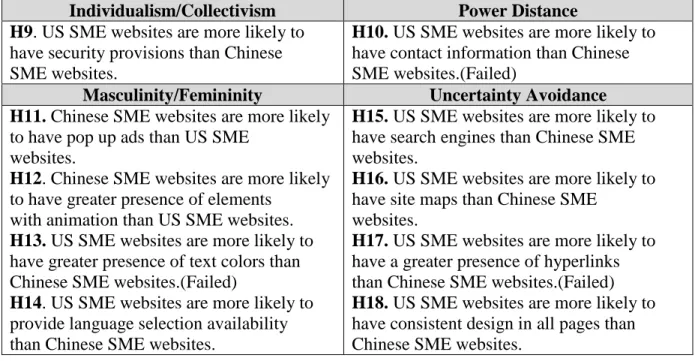
In their comparative study about the US and Chinese industrial SMEs, Valerie Wang, Hao Lou, Yong Wang and Chiquan Guo (2015) claim that the website design is affected by three different environments which are external, internal and consumer environment. In consumer environment part (where the last ten hypotheses based on), they claim that design differences determined by cultural characteristics and they use Hofstede’s dimensions as frame work (See table 4). In order to test their hypotheses, they develop items based on the navigation, visual and information design variables that were mentioned earlier.
Individualism/Collectivism Power Distance
H9. US SME websites are more likely to
have security provisions than Chinese SME websites.
H10. US SME websites are more likely to
have contact information than Chinese SME websites.(Failed)
Masculinity/Femininity Uncertainty Avoidance
H11. Chinese SME websites are more likely
to have pop up ads than US SME websites.
H12. Chinese SME websites are more likely
to have greater presence of elements with animation than US SME websites.
H13. US SME websites are more likely to
have greater presence of text colors than Chinese SME websites.(Failed)
H14. US SME websites are more likely to
provide language selection availability than Chinese SME websites.
H15. US SME websites are more likely to
have search engines than Chinese SME websites.
H16. US SME websites are more likely to
have site maps than Chinese SME websites.
H17. US SME websites are more likely to
have a greater presence of hyperlinks than Chinese SME websites.(Failed)
H18. US SME websites are more likely to
have consistent design in all pages than Chinese SME websites.
18 Katharina Reinecke and Abraham Bernstein (2011, 2013) introduce a method to implement cultural adaptability and demonstrate this method with a culturally adaptive system called MOCCA, so culturally adaptive user interfaces that adapt themselves to the user’s cultural preferences rather than having the user adapt to a more or less standardized interface. Before they create that system they summarize previous works based on Hofstede’s cultural dimensions in a table that shows which UI aspects are influenced by certain dimensions and their different score ranges (See table 5).
19
Table 5 Relationship between Hofstede’s dimensions and UI design aspects; Source: Reineckeö& Bernstein 2011, 2013
20 In another study that also followed the Geert Hofstede’s frame work for cultural dimensions, Eristi (2009) creates the criteria (See table 6) below for the cultural factors in web designs in order to analyze randomly chosen university websites from different parts of the world.
Cultural Factors High Low PD -More flashy -Formal layout -Limited access
-Prominent choices on use
-Interactions designed with strict and rigid rules
-A look with visuals, logos, sounds, colors, slogans, regime and page layout belonging to national culture
-Less flashy -Informal layout -Clear access
-Multiple choices on use
-Flexible interactions that guide in case of errors
-A look with universally popular images, symbols, sounds, page layout or colors
IDV -Individual success
-Individual goals
-Institutional success -Institutional goals
MAS
-Symbolic indicators of male roles -Visuals with male themes (contests, sports, soft colors)
-Indicators of result and objective -Indicators in which elaborative and masculine choices prominent
-Symbolic indicators of female roles
-Visuals with female themes (family, woman figure) -Vivid colors
-Indicators of social activity, interaction and process
-Functionality and practicality
UAI
-Messages, contents and visuals with direct meanings
-Simple, clear, prominent and limited choices
-Use, interaction and navigations stated with strict rules
-Existence of indicators relating to the use of the site (site map, search engine, information navigations etc.) -Institutional calendar
- Messages contents and visuals with indirect meanings
- Non-restrictive choices - Presenting original and extra ordinary expectations
- Interactions and navigations that present varying and alternative choices to the user
- Inexistence of indicators relating to the use of the site (site map, search engine, information navigations etc.)
LTO
-Long-term vision and mission of the university
-Long-term institutional goals
- Daily routine indicators of the university
- Short-term institutional goals
21 Our criteria in the questionnaire shaped by those previous works about the influence of cultural dimensions on website design elements. It is also designed among the ones that would require the least subjective opinion of the experts in order to exclude the possible influences of their differences (For more detailed information about the questionnaire see Chapter 3 Methodology). In table 7, each dimension with the relevant design element to test it are shown with their main references to previous works.
IDV
-C
O
L
L
Is BEING or belonging to a GROUP addressed in tab or section names (ex: About Us, XYZ Family, Our Team etc.) of the website?
Relationship oriented methaphors (Marcus 2002) High image to text ratio for collectvism (Reinecke & Bernstein 2011, 2013; Gould et al 2000)
Colorful interface vs monotonously colored
(Reinecke & Bernstein 2011, 2013; Barber & Badre 1998)
Is there a HIGH IMAGE to TEXT RATIO on the website?
Are there a use of many DIFFERENT TYPES of COLORS than
HOMOGENEOUS colors on the website?
PD
I
Is there a MESSAGE from the people that has status (ex: CEO, Owner, Dean, Editor, President etc.) or INFORMATION about their career on the website?
Focus on expertise, authority, experts, certifications, official stamps, or logos: strong vs. weak (Marcus 2007)
Prominence given to leaders vs. citizens, customers, or employees (Marcus 2007)
Importance of security and restrictions or barriers to access: explicit, enforced, frequent restrictions on users vs. transparent, integrated, implicit freedom to roam (Marcus 2007)
Social roles used to organize information (e.g., a managers' section obvious to all but sealed off from non-managers): frequent vs. infrequent (Marcus 2007)
Limited access and Interactions designed with strict and rigid rules (Eristi 2009)
Is there DIFFERENT SECTIONS for different users (ex: gold card members', graduate students' section etc.) or LOGIN, REGISTRATION requirements on the website?
Is there a presence of SUPERIORITY claim (ex: address to awards, certificates, titles of people, expertise and official stamps etc. that are owned)?
MAS
-FE
M
Are there any POP-UP ADS (*) on the website?
H11 on Pop-Ads (Wang, Lou, Wang & Guo 2015) H14 on Language (Wang, Lou, Wang & Guo 2015) H12 on Animation (Wang, Lou, Wang & Guo 2015) Is there a LANGUAGE section on the
website?
Are there elements with ANIMATION (*) on the website?
UAI
Is there a SEARCH box on the website? Navigation schemes intended to prevent users from becoming lost (Marcus 2007).
H15 on Search Engine and H18 on Navigation Are there a use of BREADCRUMBS 0n
the website?
22 NAVIGATION design of the website? (Wang, Lou, Wang & Guo 2015)
Existence of indicators relating to the use of the site (site map, search engine, information navigations etc.) (Erişti 2009).
Table 7 Criteria references in the Questionnaire
2.3 Development of the Hypotheses
The sum of the literature review shows that website designs that align with the culture of their users engage them better, thus, become more successful. According to that, high ranked websites should be reflecting their national culture. In order to test that, Turkey and the United Kingdom whose national scores are opposite of each other in Hofstede’s cultural model are chosen for comparison. Then, the hypotheses below were developed and applied to websites from these countries.
H1: Website designs in Turkey reflect higher UA features than the United Kingdom. H2: Website designs in Turkey reflect Feminine features, while the United Kingdom’s
reflect Masculine features.
H3: Website designs in Turkey reflect higher PD features than the United Kingdom. H4: Website designs in Turkey reflect Collectivistic features, while the United
23
CHAPTER 3. METHODOLOGY
In order to understand what is the influence of the national culture on website design in Turkey & the United Kingdom and also, the differences in design features based on the selected design elements and whether they are related to cultural dimensions; first, a content analysis been conducted. This method is extensively used for an objective and systematic examination of communication content, so in website design for coding the characteristics of the site as well (Cheng & Schweitzer 1996; Wootae, Singh, Benmamoun & Sobh 2015; Wang V., Lou, Wang Y. & Guo 2015). For that analysis, a questionnaire was designed based on the literature review (See table 8). This questionnaire is composed of three dichotomous style questions for each cultural dimension, twelve questions in total. All questions have “yes” or “no” as an answer depending on the existence of the asked design feature, with a value of “1” or “0”. Each question also had an instruction part with explanations for the experts, in order to create the same understanding on them. These questions aim to reveal some of the design features of the websites in Turkey & the United Kingdom and gathering the required quantitative data to test the hypotheses.
Five experts, who have the necessary language skills for both Turkish and English, applied the questionnaire to the whole sample. Using independent experts in the content analysis process is a commonly used method (Baack & Singh 2007; Wang V., Lou, Wang Y. & Guo 2015; Wootae, Singh, Benmamoun & Sobh 2015). This way reduces the errors relevant to technicality of the topic as well as the possible bias of project owner’s subjectivity. Additionally, as it mentioned before, the criteria in the questionnaire are chosen among the ones that can be more objectively decidable, to eliminate the subjectivity of the applier/expert in the answers. Also, five experts were chosen rather than a smaller number, to increase the reliability of the answers.
At the end in order to determine if the results were statistically significant, the data was evaluated using Welch t-test. Instead of using regular two sample t-test, Welch was chosen due to being also applicable when the variances are unequal. Additionally, to explain the usage amount of each design components, the data was presented in percentages divided by country and website type (See Chapter 4 Results for further details).
24 For Uncertainty Avoidance:
UAI
Is there a SEARCH box on the website?
If there is put "1", if there is not put "0".
Are there a use of
BREADCRUMBS 0n the
website?
If there is put "1", if there is not put "0".
How CONSISTENT is the
NAVIGATION design of
the website?
a: Navigation menus in the same location on all pages
b: The options in navigation menus are presented in the same order on all pages
c: All other standard elements (ex: search box) in the same location on all pages
If two or more of the options exist put "1", if less than two options or none of them exists put "0".
For Masculinity/Femininity:
M
AS
-FEM
Are there any POP-UP ADS (*) on the website?
If there is put "1", if there is not put "0".
(*) Pop-up Ads are new web browser windows to display advertisements.
Is there a LANGUAGE section on the website?
If there is not put "1", if there is put "0".
Are there elements with
ANIMATION (*) on the
website?
If there is put "1", if there is not put "0".
(*) Movements or audio in design (ex: slow in and slow out, timing) mostly saved as GIF, CSS, SVG, WebGL or video.
25
For Power Distance:
PD
I
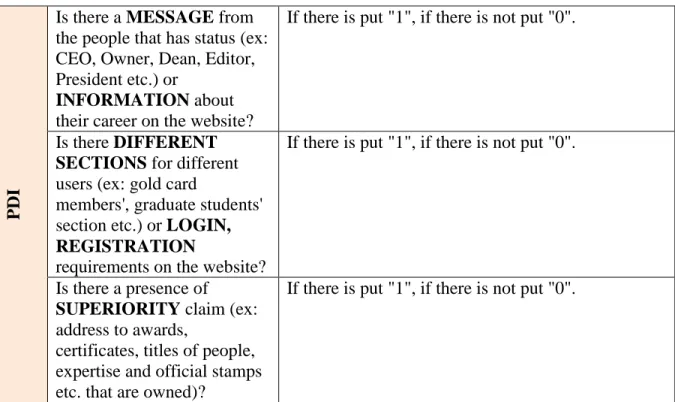
Is there a MESSAGE from the people that has status (ex: CEO, Owner, Dean, Editor, President etc.) or
INFORMATION about
their career on the website?
If there is put "1", if there is not put "0".
Is there DIFFERENT
SECTIONS for different
users (ex: gold card
members', graduate students' section etc.) or LOGIN,
REGISTRATION
requirements on the website?
If there is put "1", if there is not put "0".
Is there a presence of
SUPERIORITY claim (ex:
address to awards,
certificates, titles of people, expertise and official stamps etc. that are owned)?
If there is put "1", if there is not put "0".
For Individualism/Collectivism:
IDV
-COL
L
Is BEING or belonging to a
GROUP addressed in tab or
section names (ex: About Us, XYZ Family, Our Team etc.) of the website?
If it is addressed put "1", if it is not put "0".
Is there a HIGH IMAGE to
TEXT RATIO on the
website?
If more than the half of the visual content is image put "1", if half or less than the half of the visual content is image put "0".
Are there a use of many
DIFFERENT TYPES of COLORS than
HOMOGENEOUS colors
on the website?
If shades of one color are mainly used or three and less number of colors are used put "0", If more than three colors used and colors kind of create a visual structure put "1".
Table 8 Questionnaire for website content analysis
The questionnaire was designed to show that; a high score in UAI section of questionnaire reflects high uncertainty avoidance; a high score in PDI section of questionnaire reflects high
26 power distance; a high score in MAS-FEM section of questionnaire reflects high femininity and a high score in IDV-COLL section of the questions reflects higher collectivism features in that website’s design.
As it is mentioned previously, having high uncertainty avoidance simply results in avoiding the unknown future and unclear situations. In website design, it is easier to observe this through navigation elements. Due to allowing users to find out what they exactly search for, existence of a Search Box (Eristi 2009, Wang V., Lou, Wang Y. & Guo 2015) due to allowing the users to know where they are on the website and preventing them to get lost, existence of Breadcrumbs and Consistency in Navigation (Marcus 2007; Wang V., Lou, Wang Y. & Guo 2015) been chosen for the reflection of this cultural dimension on website design components.
In more feminine cultures aesthetics, fun and not being monotonous are important features of design. In this manner, observing the design of appearance/visual elements provides a lot of information. For this reason, existence of Animation and Pop-up Ads (Wang V., Lou, Wang Y. & Guo 2015) are checked due to making the website design lively and exciting. The non-existence of a Language Section (Wang V., Lou, Wang Y. & Guo 2015) is checked in website design components due to more introvert nature of feminine cultures.
Having a high score in power distance basically, means that it is accepted to have hierarchal differences between members. In website design, the information/content element reflects the features of this cultural dimension. Therefore, the content about the Information from/about the people who has the Status (Marcus 2007) in website and emphasis on Superiority (Marcus 2007, Eristi 2009) are checked, besides the Login Requirement/Different Sections in navigation for different users.
In cultures which score low in individualism (high in collectivism) index, importance is given to being related to others and maintaining that relation. In social life, this results in a group-oriented life. Therefore, information/content element that has emphasis on Being and Belonging to a Group (Marcus 2002) is observed. In terms of perception, collectivism results also in being able to relate and group a lot of things, and in different ways than individualistic cultures. Based on previous works, use of Different Types of Color (Reinecke & Bernstein 2011, 2013; Barber &
27 Badre 1998) and use of More Image to Text Ratio (Reinecke & Bernstein 2011, 2013; Gould et al 2000) in appearance are observed in website design features.
The sample consists of nineteen websites from each country. Twelve of them are e-commerce and seven of them are non e-commerce websites. The majority was given to e-commerce websites due to their increasing importance in today’s both national and international business world, as already mentioned in previous two chapters.
Among e-commerce websites of the sample, there are different branch types such as online fashion, technology, and food service. In order to learn about the relation between the success of a website and its design’s degree of cultural adaptation, the websites in the sample are chosen among top ranked ones. The rankings are attained from an international website named alexa.com which is widely sourced for its ranking system. Among non e-commerce websites, universities hold the majority due to their preference in literature to observe the influence of cultural dimensions. They are chosen among the top ranked ones either and rankings are attained from an international website named topuniversities.com.
28
CHAPTER 4. RESULTS
The purpose of this paper was to find out the impact of the cultural differences on website designs in Turkey and the United Kingdom, and the if the differences in their design features are related to cultural dimensions.
The information of the five experts was received and their scorings added so that a final aggregate score per dimension and website was created. Afterwards, they were used in the Welch t-test to find out about the significance of differences between the United Kingdom and Turkey. According to these test results,
H2: Website designs in Turkey reflect Feminine features while the United Kingdom’s reflect Masculine features,
H3: Website designs in Turkey reflect higher PD features compared to the United Kingdom, did show statistical significance and were verified.
On the other hand,
H1: Websites designs in Turkey reflect higher UA features than the United Kingdom,
H4: Website designs in Turkey reflect Collectivistic features while the United Kingdom’s reflect Individualistic features,
29
Table 9 Scores of website designs in Turkey and The United Kingdom, separated by cultural dimension types
The design features of all the websites for UAI were compared and the following results achieved: p-value=0.7659, mean TR=13.52632, mean UK=13.73684. Due to the p-value was higher than 0.05, H1 failed. We can conclude that there were no significant differences between United Kingdom and Turkey’s website features associated with Uncertainty Avoidance.
On the other hand, design features of the websites in general for Femininity were compared and H2 was verified due to p-value being less than 0.05 (p-value=0.01088, mean TR=6.736842, mean UK=4.578947). Turkey showed more feminine design features than the United Kingdom.
H3 was also verified; when the design features of all the websites were compared for PDI. P-value was less than 0.05 (p-P-value= 0.03059, mean TR=8.684211, mean UK=6.68421). Turkey showed higher power distance in design features than the United Kingdom.
However, H4 failed due to p-value was more than to 0.05 (p-value=0.4716, mean TR=8.368421, mean UK=7.473684). Both countries scored close to each other while Turkey was expected to show more collectivistic features in design than the United Kingdom.
30 The results are explained in further detail, according to website type and the dimension.
Uncertainty Avoidance Features
Table 10 Scores of website types in UAI, Turkey vs The United Kingdom
When the design features of the websites for UAI were compared in general, H1 failed. Same situation was observed among e-commerce websites (p-value=0.497, mean TR=14.00000, mean UK=13.33333) and non e-commerce websites (p-value=0.08803, mean TR=12.71429, mean UK=14.42857). The use of design features like Search Box, Breadcrumbs and Consistent Navigation which represent higher UAI, were highly observed in Turkish websites as in accordance with country’s score in that dimension. However, these design features were also highly observed in the United Kingdom’s websites, contrary to expectations. Turkey showed slightly more uncertainty avoidance in design features of commerce websites than its non e-commerce websites.
31
Masculinity vs Femininity Features
Table 11 Scores of website types in Femininity, Turkey vs The United Kingdom
When the design features of websites for MAS-FEM were compared in general, H2 verified. Both countries’ results were in accordance with their MAS-FEM score. However, when the design features of e-commerce and non e-commerce websites observed separately, H2 failed for e-commerce websites designs (p-value=0.2739, mean TR=6.333333, mean UK=5.250000) while it was verified for non e-commerce website designs (p-value=0.01357, mean TR=7.428571, mean UK=3.428571). The use of design features like Pop-up Ads, Animation and non-use of Language Section which represent a lower masculinity/higher femininity, were more observed in Turkish websites and more in its non e-commerce websites. They were less observed in the United Kingdom’s websites and also lesser in its non e-commerce websites.
32
Power Distance Features
Table 12 Scores of website types in PDI, Turkey vs The United Kingdom
When the design features of the websites for PDI were compared in general, H3 was verified. However, when the design features of e-commerce and non e-commerce websites observed separately, H3 was verified for e-commerce website designs (p-value=0.01887, mean TR=8.166667, mean UK=5.750000) while it failed among non e-commerce website designs (p-value=0.4673, mean TR=9.571429, mean UK=8.285714). The use of design features like Message/Information of statue owner, Login Requirement/Different User Section and Superiority Claim which represent a higher PDI, were mostly observed in Turkish websites and more in non commerce websites. It observed less in the United Kingdom’s websites and lesser in its e-commerce websites. Both countries’ results were in accordance with their score in PD dimension.
33
Individualism and Collectivism Features
Table 13 Scores of website types in Collectivism, Turkey vs The United Kingdom
When the design features of the websites for IDV-COLL were compared in general, H4 failed. Same situation was observed among the designs of e-commerce websites (p-value=0.4379, mean TR=9.833333, mean UK=8.750000) and non e-commerce websites (p-value=0.7653, mean TR=5.857143, mean UK=5.285714). The use of design features like High Image to Text Ratio, use of Different Colors and content of Being a Group which represent a lower individualism/higher collectivism, were represented in both countries’ websites. Turkey slightly showed higher collectivism than the United Kingdom and more in e-commerce websites.
Use of Design Features
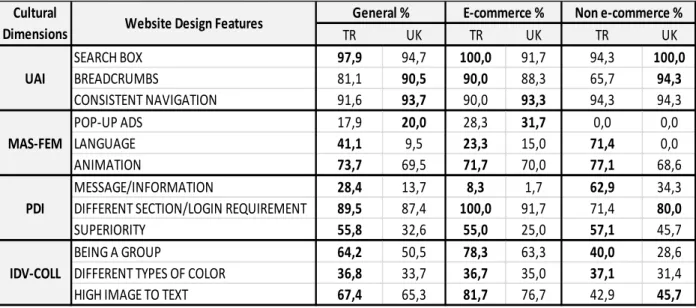
In order to show the results on the design elements of the sample, the percentage of their use is presented in table 13.
34
Table 14 Use of design features by country and website type
For further information about the elements see following tables.
Table 15 Design features in the criteria, from most used to least, Turkey Table 16 Design features in the criteria, from most used to least, the UK
Among twelve website design features, both countries’ top seven follow the same order in usage; except the Breadcrumbs and Different Section/Login Requirement elements change place among third or fourth. All three design elements about uncertainty avoidance dimension are in the top
TR UK TR UK TR UK SEARCH BOX 97,9 94,7 100,0 91,7 94,3 100,0 BREADCRUMBS 81,1 90,5 90,0 88,3 65,7 94,3 CONSISTENT NAVIGATION 91,6 93,7 90,0 93,3 94,3 94,3 POP-UP ADS 17,9 20,0 28,3 31,7 0,0 0,0 LANGUAGE 41,1 9,5 23,3 15,0 71,4 0,0 ANIMATION 73,7 69,5 71,7 70,0 77,1 68,6 MESSAGE/INFORMATION 28,4 13,7 8,3 1,7 62,9 34,3
DIFFERENT SECTION/LOGIN REQUIREMENT 89,5 87,4 100,0 91,7 71,4 80,0
SUPERIORITY 55,8 32,6 55,0 25,0 57,1 45,7
BEING A GROUP 64,2 50,5 78,3 63,3 40,0 28,6
DIFFERENT TYPES OF COLOR 36,8 33,7 36,7 35,0 37,1 31,4
HIGH IMAGE TO TEXT 67,4 65,3 81,7 76,7 42,9 45,7
Cultural Dimensions UAI MAS-FEM PDI IDV-COLL
General % E-commerce % Non e-commerce % Website Design Features
Website Design Features TR %
Search Box 97,9
Consistent Navigation 91,6
Different Section/Login Requirement 89,5
Breadcrumbs 81,1
Animation 73,7
High Image To Text 67,4
Being A Group 64,2
Superiority 55,8
Language 41,1
Different Types Of Color 36,8
Message/Information 28,4
Pop-Up Ads 17,9
Website Design Features UK %
Search Box 94,7
Consistent Navigation 93,7
Breadcrumbs 90,5
Different Section/Login Requirement 87,4
Animation 69,5
High Image To Text 65,3
Being A Group 50,5
Different Types Of Color 33,7
Superiority 32,6
Pop-Up Ads 20
Message/Information 13,7
35 four of both countries. In general, the least used design component in Turkey is Pop-Up Ads (17.9%) while in The United Kingdom it is Language section (9.5%).
Table 17 Design features in the criteria, e-commerce websites in Turkey
Table 18 Design features in the criteria, e-commerce websites in the UK
Among e-commerce website design features of the countries, same design elements do not follow the same usage order. However, the order of the elements does not differ significantly either. Such as in top four all three design elements of uncertainty avoidance exist. Two elements of the collectivism feature (High Image to Text Ratio and Being a Group) are in the next most used group with Animation element. The Language and Message/Information elements are the least used in the design features of the countries. Also, use of Search Box and Different Section/Login Requirement elements are observed in all e-commerce websites of Turkey.
E-commerce %
Turkey
Search Box 100
Different Section/Login Requirement 100
Breadcrumbs 90
Consistent Navigation 90
High Image To Text 81,7
Being A Group 78,3
Animation 71,7
Superiority 55
Different Types Of Color 36,7
Pop-Up Ads 28,3
Language 23,3
Message/Information 8,3
Website Design Features E-commerce %
United Kingdom
Consistent Navigation 93,3
Search Box 91,7
Different Section/Login Requirement 91,7
Breadcrumbs 88,3
High Image To Text 76,7
Animation 70
Being A Group 63,3
Different Types Of Color 35
Pop-Up Ads 31,7
Superiority 25
Language 15
Message/Information 1,7
36
Table 19 Design features in the criteria, non e-commerce websites in Turkey Table 20 Design features in the criteria, non e-commerce websites in the UK
Among non e-commerce website design features of the countries, the most used design feature is the Search Box element. In all non e-commerce websites of the United Kingdom it was observed. The use of Pop-Up Ads element does not exist in both countries. In the United Kingdom there is also no use of Language element in non e-commerce website designs. The usage order of the same elements differs more than it is in e-commerce websites. Elements about collectivism features used almost half times less in non e-commerce websites of both countries than they used in e-commerce websites. Non e-commerce % Turkey Search Box 94,3 Consistent Navigation 94,3 Animation 77,1 Language 71,4
Different Section/Login Requirement 71,4
Breadcrumbs 65,7
Message/Information 62,9
Superiority 57,1
High Image To Text 42,9
Being A Group 40
Different Types Of Color 37,1
Pop-Up Ads 0
Website Design Features Non e-commerce %
United Kingdom
Search Box 100
Breadcrumbs 94,3
Consistent Navigation 94,3 Different Section/Login Requirement 80
Animation 68,6
Superiority 45,7
High Image To Text 45,7 Message/Information 34,3 Different Types Of Color 31,4 Being A Group 28,6
Pop-Up Ads 0
Language 0