Management from the NOVA – School of Business and Economics
ASSESSING THE ‘WIN-WIN’ SITUATION CREATION OF THE SOCIAL IMPACT BOND MODEL: BALANCING STAKEHOLDER INTEREST
KATHRYN A CASSIBRY 40087
A Project carried out on the Masters in Management Program, under the supervision of: Antonio Miguel
Abstract
Advocates of the Social Impact Bond (SIB) model say that it creates a ‘win-win’ situation by promoting cross-sectoral collaboration, while some critics claim it creates an imbalance in stakeholder interest. This research explores this topic by defining what “success” means for each stakeholder and assessing all completed SIBs through a framework matrix and scoring methodology of critical success factors. I found that, while there is a statistically significant variance across stakeholder groups, there are several key common characteristics between the SIBs with the highest level of overall success and the lowest level of variance. This report will highlight these features.
Keywords: Social Impact Bonds; Cross-sectoral Collaboration; Balancing Stakeholder Interests; Impact Investing
This work used infrastructure and resources funded by Fundação para a Ciência e a Tecnologia (UID/ECO/00124/2013, UID/ECO/00124/2019 and Social Sciences DataLab, Project 22209), POR Lisboa (LISBOA-01-0145-FEDER-007722 and Social Sciences DataLab, Project 22209) and POR Norte (Social Sciences DataLab, Project 22209).
Table of Contents
2. BACKGROUND AND LITERATURE REVIEW ... 3
2.1. SOCIAL IMPACT BOND DEFINITION ... 4
2.2. CURRENT SOCIAL IMPACT BOND ECOSYSTEM ... 4
2.3. LITERATURE REVIEW ... 5
2.3.1. ADVANTAGESOFTHESOCIALIMPACTBONDMODEL ... 5
2.3.2. CRITICISMSOFTHESOCIALIMPACTBONDMODEL ... 6
2.4. THEORETICAL FRAMEWORK AND BASIS ... 7
2.4.1. NEWPUBLICGOVERNANCEMODEL ... 8
2.4.2. NETWORKGOVERNANCETHEORY ... 8
2.4.3. STAKEHOLDERTHEORYAND“KEEPINGSCORE” ... 8
3. METHODOLOGY AND RESEARCH DESIGN ... 9
3.1. CASE SELECTION CRITERIA ... 9
3.2. DATA COLLECTION METHODOLOGY ... 10
3.3. RESEARCH AND DATA ANALYSIS METHODOLOGY ... 10
3.4. EVALUATION DESIGN AND DEFINING “SUCCESS” ... 12
3.4.1. SCORINGMETHODOLOGY ...12
3.4.2. DEFININGSUCCESSFORTHEOUTCOMESPAYER ...13
3.4.3. MEASURINGSUCCESSFORTHEOUTCOMESPAYER ...15
3.4.4. DEFININGSUCCESSFORTHESERVICEPROVIDER ...16
3.4.5. MEASURINGSUCCESSFORTHESERVICEPROVIDER ...17
3.4.6. DEFININGSUCCESSFORTHEINVESTOR ...18
3.4.7. MEASURINGSUCCESSFORTHEINVESTOR ...19
4. RESULTS AND DISCUSSION ... 20
4.1. DESCRIPTIVE ANALYSIS RESULTS ... 20
4.1.1. OVERALLBALANCEINSTAKEHOLDERINTEREST ...20
4.1.2. TRENDSAMONGSIBSWITHGREATESTANDLEASTSTAKEHOLDER INTERESTBALANCE ...21
4.2. LIMITATIONS ... 23
4.3. DISCUSSION ... 24
5. RECOMMENDATIONS FOR FURTHER RESEARCH ... 25
6. CONCLUSION ... 25
7. REFERENCES ... 26
1. INTRODUCTION
Since its inception in 2009 with the HMP Peterborough intervention, the Social Impact Bond (SIB) model has been lauded by its proponents as an innovative financial tool that has the ability to promote collaboration across sectors and create a “win-win” situation for all stakeholders involved (Lehner, 2018; Wang et al 2013; Bolton, 2010). The public sector benefits because the risk is transferred to the private sector. The private sector benefits because they get the opportunity to invest in social innovation as well as see a return. And the social sector benefits because they receive working capital upfront without being subject to rigid government contracts.
Cross-sectoral collaboration has long been considered a solution to the most pressing social problems of today (Warner, 2012), and social impact bonds were expected to provide an evidence-base to confirm how coordination across sectors leads to increased positive impact. The common denominator for each SIB stakeholder is their desire for positive social outcomes to be achieved, but the wide variety of stakeholders involved also carries with it a wide variety of motivations and definitions of “success.”
The research question of this thesis is “to what extent to social impact bonds create a ‘win-win’ scenario for all stakeholders.” This report is focused on assessing the validity of this statement while keeping the outlined benefits, drawbacks, and limitations of the financing mechanism in mind. This question contains two sub-questions. One – aside from reaching the positive outcome targets, do “successful” social impact bonds create an advantageous situation for all stakeholders involved? Secondly – do some stakeholders benefit more or less than others?
2.1. SOCIAL IMPACT BOND DEFINITION
A social impact bond is a financial instrument used in impact investing in which private investors provide upfront capital to a social service provider or intermediary aimed at a specific measurable outcome, and the commissioner pays back that capital only if the target is achieved (Mulgan et al, 2010). More precisely, the set-up mechanism is normally initiated by a government that wants a specific positive social outcome, then a financial intermediary or a bond-issuing organization raises capital from foundations, companies, or private investors to support this positive social outcome. An intermediary identifies social service providers, outlines performance targets, and defines the price (Walsh, 2016). The funds are then given to service providers as upfront capital to cover operational costs. If the predetermined outcome is achieved, the government or commissioner pays back the initial investors plus a return on capital (OECD, 2016). The term “social impact bond” is known by different names in different countries – Payment-for-Success bonds in the US and Pay-for-Benefits bonds in Australia, for example (Gustafsson-Wright et al, 2015). It is also a bit of a misnomer in that it is not a “bond” in the financial security sense, but rather a “bond” in the “contract between multiple parties” sense. A “development impact bond” is a social impact bond that is commissioned by a foundation or other donor agency, rather than the government, and is implemented in developing countries (Gustafsson-Wright et al, 2015).
2.2. CURRENT SOCIAL IMPACT BOND ECOSYSTEM
As of April 2020, 174 impact bonds (both “social” and “developmental”) have been contracted in both the developed and developing world (Government Outcomes Lab, 2020). Of the total contracted, 39 have now completed service delivery, with 29 reporting at least some
repayment, 2 reporting no payment, and 15 either not yet public or evaluation ongoing. The United Kingdom and the United States represent most social impact bonds to date with 47 and 26, respectively (Gustafsson-Wright, 2020).
2.3. LITERATURE REVIEW
2.3.1. ADVANTAGESOFTHESOCIALIMPACTBONDMODEL
In the existing literature, the main advantages of social impact bonds are that they i) promote cross-sectoral collaboration, ii) provide an evidence base for innovative models, encourage rigorous data collection for outcome and performance management, iii) align private investor funding with positive social outcomes, and iv) equip service providers with stable and long-term income (Dear et al, 2016; OECD, 2013; Vennema, 2016; Disley et al 2011; Liebman, 2011).
Social impact bonds are designed to break down barriers between sectors by uniting all parties under one common goal. They are also intended to bring together existing complementary services that are siloed across sectors and different government agencies, driving the development of a holistic mix of services, which is strongly needed to address a problem (Paya et al, 2017).
Moreover, they are said to foster innovation by funding innovative models that the public sector would otherwise not finance by shifting the risk away from the commissioner toward the investor (Butler et al, 2013). If a model is proven successful, capital is in retrospect more expensive than government self-financing. Therefore, social impact bonds are only appropriate when success is uncertain. The evidence that comes out of the evaluation methods at the heart of a social impact bond is one of the clearest advantages to the SIB model and one of the clearest contributors to the financial instrument’s “win-win” reputation. This is because it, a) ensures that money is flowing to the correct interventions, effectively saving public sector money, b) provides a basis upon which
service providers can scale their interventions, and c) provides evidence for future public sector social policies (Butler et al, 2013).
Because demonstrating meaningful and measurable outcomes is an inherent part of social impact bonds, the collection of reliable and accurate data geared toward a carefully targeted population is an inevitable byproduct of the process, in theory (Mulgan et al, 2010). This benefits both the outcomes payer and the social service provider by promoting a build-up of institutional knowledge that the entities can implement in a straightforward way in the future, whether that be in the form of policy or a scale-up of service initiatives.
At their core, social impact bonds offer the potential for increasing the magnitude and quality of investment in improving social wellbeing. The investment landscape is characterized by a current shift in preferences, and SIBs allow the demand of private investors for social impact investments to be met (OECD, 2013). It also opens new market opportunities for private investors, including further portfolio diversification and uncorrelated assets. In theory, they make tax-payers’ money more efficient by increasing accountability and value for money achieved through public services and they correct poor incentives in the field of public policy (Kohli et al, 2012).
Social service providers are often beholden to annual revenue cycles in which they must constantly raise funds to maintain operations. Social impact bonds provide upfront working capital with continuity of funding over several years, allowing service providers to focus their efforts on service provision rather than fundraising (Dear et al, 2016).
2.3.2. CRITICISMSOFTHESOCIALIMPACTBONDMODEL
Despite the growing popularity of social impact bonds in certain circles, there are also many critics. A popular sentiment about SIBs is that they are a great idea on paper, but in practice they do little to further social sector innovation and are cost-prohibitive without the support of
large foundations and financial intermediaries that are proponents of the tool. They require a significant amount of investment, both in terms of time and money, to become operational and then effective (Roy, et al 2017). Due to their high complexity, they often demand a high level of commitment and capacity, two factors that are often not readily available to most public sectors and donor agencies (Government Outcomes Lab, nd).
As mentioned previously, social impact bonds are said to foster innovation because they allow the public sector to test out models without bearing the risk. However, there is also an argument that investors will not choose to finance an intervention unless it is a proven model. Rather than risky, innovative interventions, investors are much more likely to seek out SIBs that are most likely to provide secure and substantial returns (Roy, et al 2017). One study of the SIB ecosystem found that SIBs have been used to expand existing programs or those that have been known to produce positive results rather than funding innovative initiatives (Arena et al. 2016)
There are also many ethical issues related to social impact bonds related to perverse incentives. “Parking” and “creaming” are two such perverse incentives. “Parking” refers to excluding target populations that are the hardest to reach and “creaming” refers to picking the highest achievers in the target group, thereby increasing the likelihood of reaching the target outcome without actually making the substantive changes regarding client needs it purports to (OECD, 2013). Intuitively, attaching payment to the achievement of results reinforces this tendency (Roy, et al 2017).
2.4. THEORETICAL FRAMEWORK AND BASIS
There is no existing, universally accepted theoretical framework for evaluating social impact bonds from a stakeholder perspective. Further, because it is such a new social policy tool, there is very little theory regarding social impact bonds at all (Berndt et al, 2017). To this end, the
research question seeks inspiration from three theoretical models often linked to SIBs and balancing stakeholder interest in current literature – New Public Governance, Network Governance, and Stakeholder Theory. The theoretical approaches are related to the building of an attempt at a “win-win” scenario between the public sector, the private sector and society at large, so they are an appropriate lens through which to view this research question.
2.4.1. NEWPUBLICGOVERNANCEMODEL
New Public Governance (NPG) is a modern paradigm of public administration that places an emphasis on inter-organizational governance strengthened by trust and relational contracts (Osborne, 2006) and has long been linked to SIBs (Dayson et al, 2019; Joy and Shields, 2013). Importantly, it also highlights the relational organization of a “plural” state, in which “multiple inter-dependent actors contribute to the delivery of public services,” though each stakeholder may have fragmented needs.
2.4.2. NETWORKGOVERNANCETHEORY
The Network Governance theory is a related concept that highlights the importance of cooperation between stakeholders (Warner, 2015) under conditions of complexity, uncertainty and asset specificity (Jones et al, 1997). It also states that the creation of public value (ie social impact) is dependent on the strength of the relationship between key stakeholders (Jørgensen et al 2007; Stoker, 2006). Both theories, as they relate to the social impact bond model, support the need to assess the extent to which a beneficial scenario is created for each stakeholder involved so that the interrelational bond remains strong and positive impact can be assured.
2.4.3. STAKEHOLDERTHEORYAND“KEEPINGSCORE”
Finally, stakeholder theory addresses what none of the other theories do – the need to
that is based on the premise that all stakeholders – not just shareholders – should be considered when making decisions (Reynolds et al, 2006). It argues that managers can maintain the support of their stakeholders by considering and balancing their respective interests (Reynolds et al, 2006; Clarkson, 1998; Freeman, 1984; Jones and Wicks, 1999) depending on each stakeholder’s saliency, or their cumulative power over and interest in the issue (source). With roots in stakeholder strategies like Freeman’s “Keeping Score,” balancing stakeholder interest is arguably the most import aspect of stakeholder management theory because it is the main mechanism by which managers address stakeholders with disparate needs and wants (Reynolds et al, 2006, Freeman 1984). Further, theory suggests that the more equal the stakeholder salience, the more likely it is that managers will attempt to balance interest.
In the context of the social impact bond model, which is considered an inherently interdependent and co-creative model which lacks an explicit “manager” to decide how to balance stakeholder interest, these theories are all connected. Stakeholder theory holds that stakeholder interests should be balanced based on the stakeholder saliency, and the network governance theory and NPG model hold that each stakeholder is equally salient.
3. METHODOLOGY AND RESEARCH DESIGN
3.1. CASE SELECTION CRITERIAThis report will only analyze SIBs that have been completed and officially and publicly evaluated. As of May 2020, 39 SIBs have been completed globally. Of those 39 SIBs, 27 have been included in this report. The remaining 12 were omitted because their outcome results were not publicly available and therefore incapable of being analyzed by all critical success factors. Because the total population of completed and officially evaluated SIBs is small, the total population can be analyzed. Sampling is not necessary.
3.2. DATA COLLECTION METHODOLOGY
At the outset of this report, extensive data collection and familiarization was conducted on each of the considered SIB contracts. Most of the data collected for this report came from the Social Impact Bond Project Database of the Government Outcomes Lab of the Blavatnik School of Government of the University of Oxford, the Impact Bond Global Database from Social Finance UK, and a proprietary SIB mapping tool from Maze Impact.
Other data sources included the financial reports of social service providers to demonstrate sustained funding, independent final project evaluation reports to demonstrate safeguards against perverse incentives, and intermediary project impact reports to demonstrate IRR and improvement over time. When possible, semi-formal interviews were conducted with various stakeholders to expound on details and support findings.
The data collected was a mix of qualitative data, such as testimonials from stakeholders and project narratives in third-party case study reports, as well as quantitative data, such as financial returns and binary indicators from the online SIB databases.
To verify each piece of data, a method of triangulation was employed by cross-referencing different data sources (Suter, 2012). This was especially important when combining qualitative and quantitative data.
3.3. RESEARCH AND DATA ANALYSIS METHODOLOGY
The data was organized using an adaptation of the Framework Method to fit a mixed-method approach and analyzed using comparative descriptive results derived from the scoring methodology of the Multi-attribute Utility Theory (MAU) (Mason et al, 2018).
The Framework Method is a qualitative data analysis method used to structure research data and identify commonalities and differences by focusing on relationships between sections of
the data and drawing descriptive and/or explanatory conclusions (Byrne, 2017). It provides a “systematic model for managing and mapping data” (Gale et al, 2013). This report will focus exclusively on descriptive conclusions.
The methodology is not particularly aligned with any theoretical approach, so it is a flexible tool that can be adapted to various qualitative approaches (Gale et al, 2013). The method is often used to analyze semi-structured and structured interview transcripts, but can be adapted to other types of textual data, including documents and qualitative databases, as it is in this report (Pope et al, 2000). The Framework Method is usually intended to analyze purely qualitative data but can be adapted for a mixed-method approach, as it is in this report (Pope et al, 2000).
The main feature of the Framework Method is the matrix output, in which individual “cases” make up the rows, “thematic codes and categories” make up the columns, and “summarized data” make up each cell (Ritchie et al, 2018). This gives the researcher the ability to compare data both across cases and within cases (Gale et al, 2013). In this report, the “cases” are the individual SIBs and the “thematic codes and categories” are the critical success factors. Often, Computer Assisted Qualitative Data Analysis Software (CASDAQ) such as NVivo is needed to organize large sets of data, however, because the amount of data considered is small, an Excel spreadsheet was sufficient for the purposes of this research question.
Once the data was organized, coded and categorized using the Framework Method, the data was then quantitized in order to be scored and evaluated. Quanititizing refers to “the numerical translation, transformation, or conversion of qualitative data” (Sandelowski, 2003) and is very common in mixed method research in order to verify interpretations and/or transform data so it can be analyzed statistically. In the case of this report, the qualitative data was quantitized in order to be combined into one data set and analyzed using descriptive statistics.
3.4. EVALUATION DESIGN AND DEFINING “SUCCESS”
Determining the definitions of success – aside from the outcome targets - for each stakeholder is a challenging and somewhat subjective exercise. For this reason, this report aims to find markers of objective success, meaning markers that are measurable, accessible, coherent, and universally-accepted. These parameters, along with their respective weights, have been developed through interviews with various SIB experts from Social Finance UK, Social Finance Netherlands, Mustard Seed/Maze Impact, Third Sector Capital Partners, IDInsight, and the MaRS Center for Impact Investing.
The clear parameter for success across all stakeholders is whether the target positive outcome was reached. Because this is a measure of success for all parties involved and not a differential factor between stakeholders, it will be noted but not focused upon. Rather, only the SIBs which reached at least one of their outcome targets will be assessed.
The stakeholder groups this report will be specifically focusing on 1) outcome payers, 2) social service providers, and 3) investors.
3.4.1. SCORINGMETHODOLOGY
The scoring methodology was based on Multi-attribute Utility Theory (MAUT) approach to ranking and selection, which outlines an approach to ranking based on a comparisons of systems (i.e. contracts) and on multiple performance measures (Butler et al, 2001). These performance measurements are the “thematic categories” of the Framework Method and were established from an extensive review of the literature and the guidance of the SIB experts mentioned above.
The scoring function for conventional MAU is along a three-pronged constructed scale from 0 – 1, wherein a score of 0 is awarded if it does not meet the criteria, a score of .5 is awarded if it partially meets the criteria and a score of 1 is awarded if it fully meets the criteria (Mitre,
2013). The final step is to assign a weight – with guidance from the aforementioned experts – to each evaluation criteria using the paired comparison method.
This scoring methodology was developed with guidance from a former employee of the Nova SBE Data Science Knowledge Center.
3.4.2. DEFININGSUCCESSFORTHEOUTCOMESPAYER
For outcomes payers, the three parameters of success considered will be 1) whether the SIB produced an evidence-based mode from which policy can be built, 2) whether the learnings from the SIB resulted in retained institutional knowledge and 3) whether there were safeguards against perverse incentives.
The first parameter regarding evidence-based models is important to any social impact bond because, from the very beginning, SIBs were designed to “establish an evidence base which would lead government to adopt and scale these proven solutions” and potentially implement it into policy (Dear et al, 2016). Social impact bonds fall along an “innovation-replication-scale” spectrum (Dear et al, 2016). At one end of the spectrum lies completely novel interventions whose purpose is to test innovation. In these cases, the measurement methodology is often non-experimental, meaning there is no comparison group used. Data is collected, validated, and either compared pre- and post-intervention or using historical data. This measurement methodology is not inherently bad, but it does mean that it cannot provide a high level of confidence regarding the attributability of the intervention to the outcomes and that the outcomes were directly caused by that specific intervention (Reynolds et al, 2018).
On the other end of the spectrum is the “gold standard” of impact evaluation – the randomized control trial (RCT) (Brookings, 2017). In a randomized control trial, individuals are assigned randomly to either an intervention group or a control group (wherein they do not receive
the intervention) and the results of the two are compared. However, it should be noted that there are many valid reasons why a SIB would choose to use a non-experimental measurement methodology over an RCT. RCTs require a high degree of financial resources and time and can pose ethical questions surrounding withholding care from vulnerable individuals.
In these cases, quasi-experimental approaches can help build an evidence base and work toward replicability. A quasi-experimental approach involves finding a counterfactual group of individuals and matching them to the experimental group. These counterfactual groups could be comprised of similar individuals who were not able to participate in the intervention due to limited project resources or to a national comparison group (Reynolds et al, 2018).
The second parameter of success to measure for the outcome payer is whether the SIB fostered retention of institutional knowledge. In other words, was there an incorporation of learning that built capacity on the outcome payer side so that they could deploy these outcomes-based commissioning tools in a straightforward way? This parameter is a bit subjective, so a group of four proxies is considered. First, is the SIB part of a commissioner outcome fund? If so, this signifies that there is a commitment to apply these learnings in the future. Most of the SIBs that are funded through an outcome fund also use a rate card, which requires that the procurement team do a lot of background work to define, so this is the second variable. Third, who lead the initiative? If the government took an active role in specifying the intervention rather than taking a black-box approach–wherein the service provider, SPV, or intermediary lead the intervention and the outcome payer plays a passive, reactive role—this suggests a higher likelihood that the learnings will be used by the commissioner in the future. The fourth, and perhaps the most obvious, proxy is whether or not the commissioner created subsequent SIBs. If so, they developed the capacity to deploy their learnings to future projects.
The final parameter of success for an outcome payer is whether there were safeguards in place to protect against perverse incentives to ensure that the outcomes they are paying for are truly valid. As described previously in this report, these perverse incentives include mismanagements like “creaming” or “cherry-picking.” The proxies used to signify this parameter are 1) whether an independent evaluator was used for both final evaluation and performance management and 2) whether an intermediary was involved in the design of the SIB. The second proxy usually signifies that a rigorous feasibility study was conducted pre-launch.
3.4.3. MEASURINGSUCCESSFORTHEOUTCOMESPAYER
First, each SIB was coded using the Framework Method. Then, each code was “quantitized” and given a numerical equivalent.
CATEGORY OPEB OPRIK OPRIK OPRIK OPRIK OPPPI OPPPI
Variable / Proxy Variable
Evaluation Methodology OPRIK1 (Outcome Fund) OPRIK2 (Governme nt-Lead) OPRIK 3 (rate card) OPRIK4 (subsequen t SIBS) OPPPI1 (independent evaluator) OPPPI2 (intermediary involved in design) DWP Innovation Fund Round
I - West Midlands (The Advance Programme) non-experimental; outcomes achieved outcomes fund blackbox approach rate card subsequent SIBs independent evaluator intermediary
KEY: OPEB = Outcome Payer Evidence Base OPRIK = Outcome Payer Retention of Institutional Knowledge OPPPI= Outcome Payer Protection Against Perverse Incentives Table 1: Framework of coded data for the DWP Advance Programme SIB for the outcome payer stakeholder group. The other 26 SIB contracts are detailed in Appendix 2.
CATEGORY OP EB OP RI K OP PP I Variable/Proxy Variable OP EB We igh t OP RIK 1 OP RIK 2 OP RIK 3 OP RIK 4 OP RIK 5 Prox y Sum OP RI K We igh t OP PPI 1 OP PPI 2 OP PP I We igh t To tal
DWP Innovation Fund Round I - West Midlands (The Advance
Programme) 0.5 .4 1.0 0 1 1 0 3 1 0.4 Y Y 1 0.2
0. 8 KEY: OPEB = Outcome Payer Evidence Base OPRIK = Outcome Payer Retention of Institutional Knowledge OPPPI= Outcome Payer Protection Against Perverse Incentives
OPRIKY1 = outcome fund OPRIKY2 = Government-lead OPRIKY3 = rate card OPRIKY4 = subsequent SIBs OPPP1= independent evaluator OPPPI2 = intermediary Table 2: Scoring of quantitized data for the DWP Advance Programme SIB for the outcome payer stakeholder group. The other 26 SIB contracts are detailed in Appendix 5.
For the first parameter, while an RCT will undoubtedly provide a better basis from which to scale and integrate an intervention at policy-level, a stronger base of evidence is provided in a successful quasi-experimental design than a semi-successful RCT. For this reason, each SIB will
be measured on a 3-point scale, ranging from non-experimental (0) to quasi-experimental (.5), to randomized control trials (1), with allowances for strength of outcome metrics. More details can be found in Appendix 4 and 5.
For the “retention of institutional knowledge” parameter, the SIBs were again measured on a 3-point scale. SIBs that displayed no evidence of any of the four proxies will receive a 0, SIBs that displayed one or two out of the four proxies will receive a .5, and SIBs that displayed two or more proxies will receive a 1.
The “protection against perverse incentives” parameter was also measured on a 3-point scale, ranging from no proxies evident (0) to one proxy evident (.5), to both proxies evident (1).
Once all parameters were measured, each score was assigned a weight and compiled into a total percentage of score granted compared to score possible.
3.4.4. DEFININGSUCCESSFORTHESERVICEPROVIDER
For social service providers, the three parameters of success are 1) whether the SIB produced a scalable, evidence-based model, 2) whether the SIB resulted in sustained funding either from the outcomes payer or the investor and 3) whether they were able to build their performance management practices and display improvement over time.
The first parameter of success for a service provider is the same as for the outcome payer – creating an evidence-based model for their intervention. According to a Brookings Institute survey, “being able to scale an intervention that works” was listed as the leading motivation for social service providers in a SIB (Gustafsson-Wright, 2016). While the ultimate purpose for scale may not be the same for outcome payers as for social service providers (providers may not care if interventions are ultimately implemented into policy), it remains important for providers to have demonstrable evidence of success for their work.
The second parameter of success is whether or not the social service provider was able to receive sustained funding as a result of the SIB. A clear benefit of the SIB mechanism for a provider is that they receive upfront funding and working capital for their intervention, but this is a given. Instead, this parameter refers to the funding that comes outside of the SIB contract. This can come in the form of government procurement contracts from the outcome payer side, from grants or loans from the investor post-SIB, or from subsequent SIB contracts from either the same funder or the same commissioner.
Finally, the third parameter of success was whether the provider was able to prove an improvement over time due to heightened performance management. Developing a culture of monitoring and evaluation was deemed a top motivation for service providers (Gustafsson-Wright, 2016) and should, in theory, lead to evidence of increased impact over time. Most SIBs are structured with multiple outcome evaluation phases, which allows the provider to demonstrate this improvement. Demonstration of improvement over time is also a key aspect of the reputational benefits that a social service provider can achieve through a successful SIB-funded intervention.
3.4.5. MEASURINGSUCCESSFORTHESERVICEPROVIDER
As with the outcome payers, first, each SIB was coded using the Framework Method. Then, each code was “quantitized” and given a numerical equivalent.
CONTRACT SPEB SPSF SPIOT
Variable / Proxy Variable
Evaluation Methodology Evidence of Sustained Funding Evidence of Improvement over Time
DWP Innovation Fund Round I - West Midlands (The Advance Programme)
non-experimental; outcomes achieved
providers did not receive sustained funding
improvement in later phases
KEY: SPEB = Service Provider Evidence Base SPSF= Service Provider Sustained Funding SPIOT= Service Provider Evidence of Improvement over Time Table 3: Framework of coded data for the DWP Advance Programme SIB for the service provider stakeholder group. The other 26 SIB contracts are detailed in Appendix 3.
CONTRACT SPEB SPSF SPIOT
Service Provider Total Score
weight weight weight
DWP Innovation Fund Round I - West
Midlands (The Advance Programme) 0.5 0.33 0 0.33 1 0.33 0.495
KEY: SPEB = Service Provider Evidence Base SPSF= Service Provider Sustained Funding SPIOT= Service Provider Evidence of Improvement over Time Table 4: Scoring of quantitized data for the DWP Advance Programme SIB for the service provider stakeholder group. The other 26 SIB contracts are detailed in Appendix 6.
The first parameter of success was measured in the same way as with the outcome payers. The cells were simply copied over.
Evidence of sustained funding was measured on a binary scale. If there is evidence of sustained funding, it will be granted a 1. If there is no evidence of sustained funding, it will be granted a 0.
Evidence of improvement over time was also measured on a binary scale. If there is evidence of improvement over time, it will be granted a 1. If there is no evidence of improvement over time, it will be granted a 0.
Just as with the outcome payer scores, each score was assigned a weight and compiled into a total percentage of score granted compared to score possible.
3.4.6. DEFININGSUCCESSFORTHEINVESTOR
Finally, the parameters of success for the investors are twofold: 1) return on investment and 2) whether or not the outcomes helped further SIB development for a major proponent of the SIB model. Just as with all social investors, the motivation for a SIB funder is a combination of financial and social reasonings (Dear et al, 2016). Their parameters of success should, therefore, reflect this dual motivation.
For return on investment, Target IRR vs Actual IRR will be assessed. In instances where concrete numbers are not available, textual evidence of Actual IRR exceeding Target IRR in some capacity will be considered.
It should be noted that investor motivations differ greatly depending on the contexts. Investors in Portuguese SIBs, for example, have their returns capped at 0%. Portuguese investors do not consider return on investment to be a definition of success. In these cases, IRR will not be considered, and social motivation will be considered alone.
3.4.7. MEASURINGSUCCESSFORTHEINVESTOR
As with the other stakeholders first, each SIB was coded using the Framework Method. Then, each code was “quantitized” and given a numerical equivalent.
Contract IIRR IPSIBM
Variable / Proxy Variable Actual v Target IPSIBM
DWP Innovation Fund Round I - West Midlands (The Advance Programme)
actual did meet target
not particularly proponents
KEY: IRR: Internal Rate of Return IPSIBM = Investor Proponent of SIB Model
Table 5: Framework of coded data for the DWP Advance Programme SIB for the investor stakeholder group. The other 26 SIB contracts are detailed in Appendix 3.
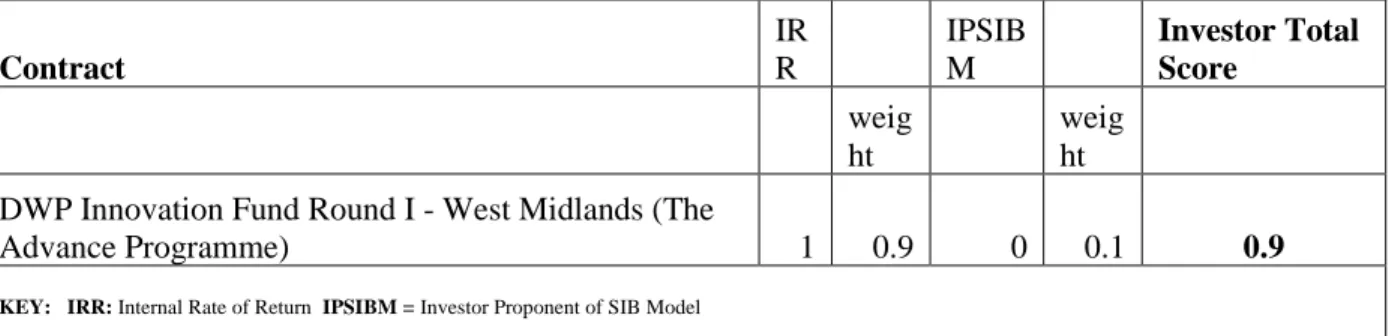
Contract IR R IPSIB M Investor Total Score weig ht weig ht DWP Innovation Fund Round I - West Midlands (The
Advance Programme) 1 0.9 0 0.1 0.9
KEY: IRR: Internal Rate of Return IPSIBM = Investor Proponent of SIB Model
Table 6: Scoring of quantitized data for the DWP Advance Programme SIB for the investor stakeholder group. The other 26 SIB contracts are detailed in Appendix 6.
The “target vs actual IRR” was measured on a binary scale. If Actual IRR meets or exceeds Target IRR, it was granted a 1. If not, it was granted a 0.
The second parameter was based on whether the investor was a major proponent of the SIB model. This was done on a binary scale. If they were proponents and the outcomes were achieved, they received a 1. If the outcomes were not achieved or if they were not particularly proponents, they received a 0.
Once the individual parameters have been measured, each score was assigned a weight and compiled into a total percentage of score granted compared to score possible.
4. RESULTS AND DISCUSSION
4.1. DESCRIPTIVE ANALYSIS RESULTS
Once all scores were calculated for each contract, stakeholder, and success factor, the combinded average was taken per each stakeholder using the assigned weights for each factors (Appendix 7). This was done for every SIB contract, resulting in a combined percentage success score for each stakeholder per case.
4.1.1. OVERALLBALANCEINSTAKEHOLDERINTEREST
If social impact bond contracts truly create “win-win” situations for all stakeholders involved, we could expect to see a relatively low variability of success scores between stakeholder groups. On average, outcome payers experienced a .648 success score, meaning that they achieved about 64.8% of their additional critical success factors (excluding outcome achievement, which is already assumed). Service providers experienced a lower average – about 54%. Investors, on the other end of the spectrum, achieved about 77% of their additional critical success factors.
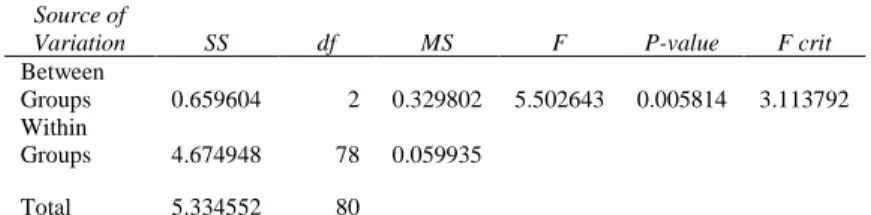
I ran an ANOVA to assess the overall significance of the test. The null hypothesis in this situation would be that the mean success score would not change depending on the stakeholder group. My hypothesis is that stakeholder group does, in fact, have an effect on overall success score. The results were as follows:
SUMMARY
Groups Count Sum Average Variance
Outcome Payers 27 17.5 0.648148 0.026439 Service Providers 27 14.685 0.543889 0.081287 Investors 27 20.65 0.764815 0.07208 ANOVA
Source of
Variation SS df MS F P-value F crit
Between
Groups 0.659604 2 0.329802 5.502643 0.005814 3.113792 Within
Groups 4.674948 78 0.059935
Total 5.334552 80
Table 7: ANOVA analysis of variance within the success scores of the three stakeholder groups
Here, we can see that the F value calculated in the test is 5.503, while the F statistic is 3.114. In statistics, if the F value calculated in a test is larger than the F critical value, you can reject the null hypothesis (Snedecor et al, 1989). Additionally, the p-value is less than the standard alpha of .05, meaning that it is statistically significant, which means we should reject the null hypothesis. Therefore, we can reject the hypothesis that the success of a SIB is equal for all stakeholder groups. In other words, stakeholder group does affect success.
The variance, which measures the variability of the data, for these three stakeholder groups was about .00837, and the standard deviation was .0915, meaning that on average the success scores are about .0915 points away from the average. This number was found using the cumulative average success score for each stakeholder group, so the total possible was 1 for each stakeholder. While the standard deviation is not zero as would be case under perfect conditions, this number doesn’t tell us much about relative variability. To calculate relative variability, we must find the coefficient of variation, which is about 14.1%. This means that, on average, the difference ration between the standard deviation and the average stakeholder success rates is about 14.1%.
4.1.2. TRENDSAMONGSIBSWITHGREATESTANDLEASTSTAKEHOLDER INTERESTBALANCE
Interestingly, when calculating for the variance of the most successful SIBs- i.e. the top 50%, where the total score across all stakeholders was at least 2 out of 3 – the variance was lower at 10.38%. On the other hand, the variation for the least successful SIBs – i.e. the bottom 50%, where the total score across all stakeholders was 1.9 out of 3 or below – the variance was
significantly higher – 43.58%. This suggests that as total success increases, the equitable distribution of the success increases.
Most Successful Least Successful All Mean 0.79548 0.29551 0.65228 Variance 0.00682 0.01659 0.00814 Standard Deviation 0.08258 0.12878 0.09024 Coefficient of Variance 0.10381 0.4358 0.13834
Table 8: Difference in variance between most successful and leas successful SIBs
In support of this relation, a correlation matrix between the overall average success score per contract and the coefficient of variance of each SIB was -0.29, meaning that there is a negative correlation between success and variability. In other words, as the degree of success changes, so does the dispersion of the data.
Average CV
Average 0.03089
CV -0.029 0.04694
Table 9: Correlation matrix of the mean success score and the mean coefficient of variance for each SIB
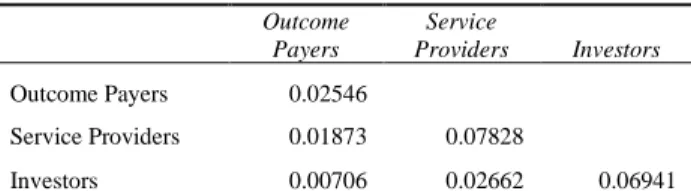
I also did a correlation matrix of the average of each stakeholder group to assess whether one group’s success negatively or positively correlated with the others. When I did so, it showed that all were positively correlated with each other. When one stakeholder group experiences success, the other stakeholder groups experience success.
Outcome Payers Service Providers Investors Outcome Payers 0.02546 Service Providers 0.01873 0.07828 Investors 0.00706 0.02662 0.06941
Table 10: Correlation matrix of the mean success scores for each stakeholder group
The five SIBs with the least amount of variance among stakeholder groups all belong to the same outcome fund – the Innovation Fund of the UK Department of Work & Pensions. The same five SIBs also have high total overall scores, with averages of 2.5 – 2.6 out of a possible 3. The consistencies across these five SIBs are strong evidence of retained institutional knowledge, strong evidence of protection against perverse incentives, evidence of sustained funding for the
service providers, strong performance management that demonstrates improvement over time, and an actual IRR exceeding the target.
The five SIBs with the highest variance among stakeholder groups have less in common, but the most striking similarity is a very low average success score for the service providers. Four out of the five SIBs with the highest variance have a service provider success score of less than .2. Three have service provider scores of 0. This meant that there was no sustained funding, no demonstration of improvement over time, and no evidence-based model with which to scale their intervention. At the same time, the majority have very strong outcome payer scores, with four out of five scoring full marks for the retention of institutional marks and three out of four with full protection against perverse incentives. It is also important to note that the Academico Codigo SIB from Portugal had a very low investor score because IRR is capped at 0%.
4.2. LIMITATIONS
Although an extensive amount of research was done into each SIB contract, the largest limitation on this research is the lack of information. Despite the hundreds of documents that were analyzed, there remained a good deal of information that was unavailable for public access.
Relatedly, the analysis would have certainly been stronger if more interviews could have been conducted with relevant stakeholders. Though the critical success factors were developed and validated by a number of relevant parties and experts in the field, the scores could have been strengthened by firsthand accounts of each stakeholders’ experience. Unfortunately, recent current events forced many offices to close and most people were very hard to contact.
The third significant limitation is the nature of subjectivity in choosing the critical success factors, the weights and the scores. Inevitably, the personal experiences of myself and the experts
who guided me will shape some of the analysis. However, every attempt was made at curtailing any bias.
Finally, there is a limitation on the critical success factors that can be measured quantitatively. For example, it is hard to measure the extent to which a service provider’s reputation was impacted by the outcomes of the social impact bond and the political risk taken by the outcome payer.
4.3. DISCUSSION
The results of the analysis suggest that the predominant assumption that the SIB model creates a win-win situation is not entirely true at the current moment. There is a significant, though not drastic, difference between each stakeholder group in terms of their calculated success scores. This is especially true among the lesser successful SIBs. This implies that, as overall success rises, so does the balance of stakeholder interest. Additionally, there is a positive correlation between stakeholder success scores, meaning that as the success of one stakeholder group rises, so do the others. The SIBs that had the highest success scores also tended to have low variances between stakeholder groups.
This suggests that the best way to balance stakeholder interest and promote success across the various parties involved to create a “win-win” situation is to pay attention not solely to the achievement of the outcome targets, but also to the various additional success factors. Additionally, extra attention should be paid to the needs of the service provider, as they are typically the ones who come up a bit short.
The primary recommendation is to focus on the success factors that SIBs with the lowest variance have in common: strong evidence of retained institutional knowledge, strong evidence of
protection against perverse incentives, evidence of sustained funding for the service providers, and strong performance management that demonstrates improvement over time.
5. RECOMMENDATIONS FOR FURTHER RESEARCH
Future development should be made to the analysis framework to make it more encompassing of all bonds. Additionally, as the Social Impact Bond model evolves, as all SIB experts spoken to during this research say that it will, the framework should also evolve. Only about 22% of all contracted SIBs have been completed and only about 15% have been evaluated here.
6. CONCLUSION
In conclusion, while the current Social Impact Bond ecosystem does not fully meet its promise to create a “win-win” situation in all current completed contracts, there is still a great potential. On the one hand, there is a statistically significant difference in comprehensive “success” between the stakeholder groups at the current moment. Service providers tend to fare worse in meeting their definition of success through the SIB model, while the investors tend to fare best.
On the other hand, the social impact bond model is still in an experimental phase and it is entirely possible that future SIBs will follow a path of the DWP Innovation Fund SIBs. It is a promising sign that, as the overall success of the impact bond increases, the difference between individual success scores decreases. Relatedly, as the success of one stakeholder increases, the success of the others tends to do as well. This suggests a brighter future of shared value and success for the Social Impact Bond model.
7. REFERENCES
Academia de Código. n.d. “Home Page” Retrieved from https://www.codeforall.io/
Advisa. 2015. “Adviza Partnership Consolidated Financial Statements for the Year Ended 31
March 2015.” Retrieved from
http://apps.charitycommission.gov.uk/Accounts/Ends01/0001132201_AC_20150331_E_ C.PDF
Andrews, Rhys, Tom, Entwhistle(2010). Does Cross-Sectoral Partnership Deliver? An Empirical Exploration of Public Service Effectiveness, Efficiency, and Equity. Journal of Public Administration Research and Theory, 20(3), 679–701. doi: 10.1093/jopart/mup045 Apeiros. N.d. “About Page.” Retrieved from https://apeiros-ev.de/
Apolitical. 2017. “Rotterdam gets young people off benefits with social impact bond.” Retrieved from https://apolitical.co/en/solution_article/rotterdam-gets-young-people-off-benefits-social-impact-bond
Azemati, Hanna, Michael Belinsky, Ryan Gillette, Jeffrey Liebman, Alina Sellman, and Angela Wyse. 2013. “Social Impact Bonds: Lessons Learned So Far.” Community Development Innovation Review, 2013, 23–33. https://www.frbsf.org/community-development/files/social-impact-bonds-lessons-learned.pdf.
Azemati, Hanna., Belinsky, Michael, Gillette, Ryan, Liebman, Jeffrey, Sellman, Alina, & Wyse, Angela. 2013. Social Impact Bonds: Lessons Learned So Far. Community Development Innovation Review, 23–33. Retrieved from https://www.frbsf.org/community-development/files/social-impact-bonds-lessons-learned.pdf
Belt, John. 2015. “Autonomous and sustainable cocoa and coffee production by indigenous Asháninka people of Peru: Field mission for the verification of impact indicators of the Development Impact Bond agreement.” KIT Sustainable Economic Development. Retrieved from http://www.common-fund.org/wp-content/uploads/2017/05/Verification_Report.pdf
Benckiser Stiftung Zukunft. 2016. “Blog / On target: The first German Social Impact Bond is completed.” Retrieved from https://www.eleven.ngo/blog/ziele-erreicht-der-erste-deutsche-social-impact-bond-ist-abgeschlossen
Benevolent Society. 2020. “Annual Report 2019 - Partners.” Retrieved from https://www.benevolent.org.au/about-us/annual-reports
Benevolent Society. N.d. “Resilient Families Social Benefit Bond (SBB).” Retrieved from https://www.benevolent.org.au/about-us/innovative-approaches/social-benefit-bond Berndt, Christian, and Manuel Wirth. 2018. “Market, Metrics, Morals: The Social Impact Bond as
Birmingham Disability Resource Centre. 2018. “Birmingham Disability Resource Centre Report of the Trustees and Financial Statements for the Year Ended 31 March 2018.” Retrieved from
http://apps.charitycommission.gov.uk/Accounts/Ends81/0001034581_AC_20190331_E_ C.PDF
Boggild-Jones, Izzy, and Emily Gustafsson-Wright. 2018. “World's first development impact bond for education shows successful achievement of outcomes in its final year.” Retrieved February 2020, from https://www.brookings.edu/blog/education-plus- development/2018/07/13/worlds-first-development-impact-bond-for-education-shows-successful-achievement-of-outcomes-in-its-final-year/
Bolton, Emily, and Louise Savell. 2010. “Towards a New Social Economy: Blended Value Creation through Social Impact Bonds.” Social Finance UK, London, UK. Retrieved from: http://www.socialfinance.org.uk/sites/default/files/Towards_A_New_Social_Economy_w eb.p df
Bridges Fund Management. 2018. “Bridges to support £1.8m Rough Sleeping SIB in Greater Manchester.” Retrieved from https://www.bridgesfundmanagement.com/bridges-support-1-8m-rough-sleeping-sib-greater-manchester/
Bryson, John M., Barbara C. Crosby and Melissa Middleton Stone. 2006. “The Design and Implementation of Cross-Sector Collaborations: Propositions from the Literature.” Public Administration Review, 66(s1), 44–55. doi: 10.1111/j.1540-6210.2006.00665.x
Butler, David, Dan Bloom, and Timothy Rudd. “Using Social Impact Bonds to Spur Innovation, Knowledge Building, and Accountability.” Community Development Investment Review, 2013, 57–62. https://ideas.repec.org/a/fip/fedfcr/00003.html.
Butler, John, Douglas J. Morrice, and Peter W. Mullarkey. "A Multiple Attribute Utility Theory Approach to Ranking and Selection." Management Science 47, no. 6 (2001): 800-16. Accessed May 20, 2020. www.jstor.org/stable/2661640.
Cabinet, Farrer Place, & Nsw. 2019. Evaluation of the social impact investments. Retrieved from
https://www.osii.nsw.gov.au/tools-and-resources/evaluation-of-the-social-impact-investment/
Career Connect. 2019. “Career Connect Report and Consolidated Financial Statements.” Retrieved from
http://apps.charitycommission.gov.uk/Accounts/Ends77/0001141077_AC_20190331_E_ C.PDF
Carter, Eleanor, Clare Fitzgerald, Ruth Dixon, Christina Economy, Tanyah Hameed, and Mara Airoldi. 2018. “Building the tools for public services to secure better outcomes: Collaboration, Prevention, Innovation.” Government Outcomes Lab, Oxford University. Retrieved from https://waystowellness.org.uk/site/assets/files/1317/2018-bsg-golab-evidencereport.pdf
Catch 22. 2018. “Catch 22 Charity Limited - Report and Financial Statements”. Retrieved from http://apps.charitycommission.gov.uk/Accounts/Ends27/0001124127_AC_20180831_E_ C.PDF
CCP. 2019. “Report of the Trustees and Audited Financial Statements for the Year Ended 31 March 2019 for Caring for Communities and People.” Retrieved from https://www.ccp.org.uk/Handlers/Download.ashx?IDMF=302b4269-6f70-415e-8644-b0c340b59eb2
Clarkson, M. B. E. 1998. The Corporation and its Stakeholders: Classic and Contemporary Readings (Toronto, Canada: University of Toronto Press).
Community Links. 2018. “Community Links Trust Limited - Reports and Financial Statements.”
Retrieved from
http://apps.charitycommission.gov.uk/Accounts/Ends17/0001018517_AC_20180831_E_ C.PDF
David Byrne. 2017. “Data analysis and interpretation.” Project Planner. 10.4135/9781526408570. Dayson, Chris, Alec Fraser, and Toby Lowe. 2019. “A Comparative Analysis of Social Impact Bond and Conventional Financing Approaches to Health Service Commissioning in England: The Case of Social Prescribing.” Journal of Comparative Policy Analysis: Research and Practice 22, no. 2 (February 2019): 153–69. https://doi.org/10.1080/13876988.2019.1643614.
Dear, Annie, Alisa Helbitz, Rashmi Khare, Ruth Lotan, Jane Newman, Gretchen Crosby Sims, and Alexandra Zaroulis. 2016. “Social Impact Bonds: The Early Years.” Social Finance, July 2016. https://socialfinance.org/wp-content/uploads/2016/07/SIBs-Early-Years_Social-Finance_2016_Final.pdf.
Denoël, N. 2014. “Developing Social Impact Bonds in Belgium” Louvain School of Management. Depaul. Nd. “Governance”. Retrieved from https://uk.depaulcharity.org/about-us/governance Depaul. Nd. “Partners.” Retrieved from https://uk.depaulcharity.org/our-work/partners
Disley, Emma, Chris Giacomantonio, Kristy Kruithof, and Megan Sim. 2015. “The payment by results Social Impact Bond pilot at Hmp Peterborough - Final process evaluation report.” RAND Europe. Retrieved from https://www.rand.org/pubs/research_reports/RR1212.html Disley, Emma, Jennifer Rubin, Emily Scraggs, Nina Burrowes, and Deirdre Culley. 2011. “Lessons learned from the planning and early implementation of the Social Impact Bond at Hmp Peterborough.” RAND Europe . Retrieved from http://www.ncvo.org.uk/images/documents/practical_support/public_services/social-impact-bond-hmp-peterborough.pdf.pdf
Duo for a Job. nd. “About us - our partners.” 2020. Retrieved from https://www.duoforajob.be/en/about-us-our-partners/
Educate Girls. 2018. “Educate Girls Annual Report 2018”
Educate Girls. 2019. “Educate Girls.” Retrieved March 2020, from https://golab.bsg.ox.ac.uk/knowledge-bank/case-studies/educate-girls/
Freeman, Richard E. 1984, Strategic Management: A Stakeholder Approach (Pitman, Boston). Fusion Housing. n.d. “Fusion Housing Kirkless Limited - Financial Statements - 31 March 2019.”
Retrieved from
http://apps.charitycommission.gov.uk/Accounts/Ends83/0001151483_AC_20190331_E_ C.PDF
Government Outcomes Lab - University of Oxford. “Benevolent Society Social Benefit Bond.” Retrieved from https://golab.bsg.ox.ac.uk/knowledge-bank/project-database/benevolent-society-social-benefit-bond/
Government Outcomes Lab - University of Oxford. 2019. “Case Study - London Rough Sleepers (Thames Reach).” Retrieved from https://golab.bsg.ox.ac.uk/knowledge-bank/case-studies/london-rough-sleepers-thames-reach/
Government Outcomes Lab - University of Oxford. 2019. “Case Study - Essex County Council Mst.” Retrieved from https://golab.bsg.ox.ac.uk/knowledge-bank/case-studies/essex-county-council-mst/
Government Outcomes Lab - University of Oxford. n.d. "Dwp Innovation Fund Round Ii - Greater Manchester (Teens and Toddlers)."" Retrieved from https://golab.bsg.ox.ac.uk/knowledge-bank/project-database/dwp-innovation-fund-round-ii-greater-manchester-teens-and-toddlers/
Government Outcomes Lab - University of Oxford. n.d. "Dwp Innovation Fund Round Ii - Thames Valley (Energise)."" Retrieved from https://golab.bsg.ox.ac.uk/knowledge-bank/project-database/dwp-innovation-fund-round-ii-thames-valley-energise/
Government Outcomes Lab - University of Oxford. n.d. "Dwp Innovation Fund Round Ii - Wales - Cardiff & Newport (3SC Capitalise)."" Retrieved from https://golab.bsg.ox.ac.uk/knowledge-bank/project-database/dwp-innovation-fund-round-ii-wales-cardiff-newport/
Government Outcomes Lab - University of Oxford. n.d. "Dwp Innovation Fund Round Ii - West London (Prevista)."" Retrieved from https://golab.bsg.ox.ac.uk/knowledge-bank/project-database/dwp-innovation-fund-round-ii-west-london-prevista/
Government Outcomes Lab - University of Oxford. n.d. "Essex County Council Multi-Systemic Therapy (Mst)."" Retrieved from https://golab.bsg.ox.ac.uk/knowledge-bank/project-database/essex-county-council-mst/
Government Outcomes Lab - University of Oxford. n.d. "Fair Chance Fund - Gloucestershire (Aspire Gloucester)."" Retrieved from https://golab.bsg.ox.ac.uk/knowledge-bank/project-database/fair-chance-fund-gloucestershire-aspire-gloucester/
Government Outcomes Lab - University of Oxford. n.d. "Fair Chance Fund - Leicestershire (Ambition East Midlands)."" Retrieved from https://golab.bsg.ox.ac.uk/knowledge-bank/project-database/fair-chance-fund-leicestershire-ambition-east-midlands/
Government Outcomes Lab - University of Oxford. n.d. "Fair Chance Fund - Liverpool (Local Solutions)."" Retrieved from https://golab.bsg.ox.ac.uk/knowledge-bank/project-database/fair-chance-fund-liverpool/
Government Outcomes Lab - University of Oxford. n.d. "Fair Chance Fund - Manchester, Rochdale, Oldham & Royal Borough of Greenwich (Depaul Uk)."" Retrieved from
https://golab.bsg.ox.ac.uk/knowledge-bank/project-database/fair-chance-fund-manchester-rochdale-oldham-royal-borough-greenwich-depaul-uk/
Government Outcomes Lab - University of Oxford. n.d. "Fair Chance Fund - West Yorkshire (Fusion Housing)."" Retrieved from https://golab.bsg.ox.ac.uk/knowledge-bank/project-database/fair-chance-fund-west-yorkshire-fusion-housing/
Government Outcomes Lab - University of Oxford. n.d. "Fair Chance Fund (Newcastle Home Group." Retrieved from https://golab.bsg.ox.ac.uk/knowledge-bank/project-database/fair-chance-fund-newcastle-home-group/
Government Outcomes Lab - University of Oxford. n.d. "Hmp Peterborough (The One Service)."" Retrieved from https://golab.bsg.ox.ac.uk/knowledge-bank/project-database/hmp-peterborough-one-service/
Government Outcomes Lab - University of Oxford. n.d. "London Homelessness Social Impact Bond (St Mungo's/Street Impact)." Retrieved from https://golab.bsg.ox.ac.uk/knowledge-bank/project-database/dclg-london-rough-sleepers-street-impact/
Government Outcomes Lab - University of Oxford. n.d. "London Homelessness Social Impact Bond (Thames Reach)." Retrieved from https://golab.bsg.ox.ac.uk/knowledge-bank/project-database/dclg-rough-sleepers-thames-reach/
Government Outcomes Lab - University of Oxford. n.d. "Youth Engagement Fund- Teens and Toddlers (Greater Manchester)." Retrieved from https://golab.bsg.ox.ac.uk/knowledge-bank/project-database/youth-engagement-fund-greater-manchester-teens-and-toddlers/ Government Outcomes Lab - University of Oxford. n.d. "Youth with Perspective."" Retrieved
from https://golab.bsg.ox.ac.uk/knowledge-bank/project-database/youth-perspective/ Government Outcomes Lab - University of Oxford. n.d. “Duo for a Job (Brussels).” Retrieved
from https://golab.bsg.ox.ac.uk/knowledge-bank/project-database/duo-job/
Government Outcomes Lab - University of Oxford. n.d. “Dwp Innovation Fund Round I - East London (Links for Life.” Retrieved from https://golab.bsg.ox.ac.uk/knowledge-bank/project-database/dwp-innovation-fund-round-i-stratford-other-parts-east-london/ Government Outcomes Lab - University of Oxford. n.d. “Dwp Innovation Fund Round I - Greater
https://golab.bsg.ox.ac.uk/knowledge-bank/project-database/dwp-innovation-fund-round-i-greater-merseyside-new-horizons/
Government Outcomes Lab - University of Oxford. n.d. “Dwp Innovation Fund Round I - Nottingham (Nottingham Futures).” Retrieved from https://golab.bsg.ox.ac.uk/knowledge-bank/project-database/dwp-innovation-fund-round-i-nottingham/
Government Outcomes Lab - University of Oxford. n.d. “Dwp Innovation Fund Round I - Scotland - Perthshire & Kinross (Living Balance).” Retrieved from https://golab.bsg.ox.ac.uk/knowledge-bank/project-database/dwp-innovation-fund-round-i-scotland-perthshire-kinross-living-balance/
Government Outcomes Lab - University of Oxford. n.d. “Dwp Innovation Fund Round I - West Midlands (The Advance Programme).” Retrieved from https://golab.bsg.ox.ac.uk/knowledge-bank/project-database/dwp-innovation-fund-round-i-west-midlands/
Government Outcomes Lab - University of Oxford. n.d. “Dwp Innovation Fund Round I- East London (Think Forward/Tomorrow's People).” Retrieved from https://golab.bsg.ox.ac.uk/knowledge-bank/project-database/dwp-innovation-fund-round-i-east-london-tomorrows-people/
Government Outcomes Lab n.d. "Buzinezzclub Programme (Rotterdam)."" Retrieved from https://golab.bsg.ox.ac.uk/knowledge-bank/project-database/buzinezzclub-programme-rotterdam/ Government Outcomes Lab. 2020. “April 2020 - Impact Bond Landscape,” https://golab.bsg.ox.ac.uk/community/news/april-2020-impact-bond-landscape/.
Government Outcomes Lab. 2019. “Colombia Workforce Development Social Impact Bond - EMPLEANDO FUTURO.” Retrieved February 2020, from https://golab.bsg.ox.ac.uk/knowledge-bank/case-studies/colombia-workforce-sib/
Government Outcomes Lab. 2020. “Impact Bonds.” The Government Outcomes Lab. Accessed March 2020. https://golab.bsg.ox.ac.uk/the-basics/impact-bonds/.
Government Outcomes Lab. N.d. “Asháninka – Peru Development Impact Bond.” (2019, October). Retrieved February 2020, from https://golab.bsg.ox.ac.uk/knowledge-bank/case-studies/asháninka-dib/
Gustafsson-Wright, Emily and Izzy Boggild-Jones. 2017. “Colombia leads the developing world in signing the first social impact bond contracts.” Brookings Institute. Retrieved from https://www.brookings.edu/blog/education-plus-development/2017/03/31/colombia-leads-the-developing-world-in-signing-the-first-social-impact-bond-contracts/
Gustafsson-Wright, Emily, Izzy Boggild-Jones, and Onyeka Nwabunnia. 2020. “The Global Impact Bond Market in 2019: A Year in Review.” Brookings Institute. https://www.brookings.edu/blog/education-plus-development/2020/01/06/the-global-impact-bond-market-in-2019-a-year-in-review/.
Gustafsson-Wright, Emily, Sophie Gardiner, and Vidya Putcha. 2015. “The Potential and Limitations of Impact Bonds: Lessons from the First Five Years of Experience Worldwide.” Accessed July 2015. https://www.brookings.edu/wp-content/uploads/2016/07/Impact-Bondsweb.pdf.
Home Group. N.d. “How we are funded.” Retrieved from https://www.homegroup.org.uk/Corporate/Regulators-lenders-and-funders/How-we-are-funded
Jones, Candace, William S. Hesterly, and Stephen P. Borgatti. 1997. “A General Theory of Network Governance: Exchange Conditions and Social Mechanisms.” Academy of
Management Review 22, no. 4: 911–45. https://doi.org/10.5465/amr.1997.9711022109.
Jones, T. M. and A. C. Wicks: 1999, 'Convergent Stakeholder Theory', Academy of Management Review 24, 206-221.
Jørgensen, Torben Beck, and Barry Bozeman. 2007. “Public Values.” Administration & Society
39, no. 3: 354–81. https://doi.org/10.1177/0095399707300703.
Joy, Meghan, and John Shields. 2013. “Social Impact Bonds: The Next Phase of Third Sector Marketization?” Canadian Journal of Nonprofit and Social Economy Research 4, no. 2. https://doi.org/10.22230/cjnser.2013v4n2a148.
Kitzmüller, Lucas, Jeffery McManus, Neil Buddy Shah, and Kate Sturla. 2018. “Educate Girls Development Impact Bond: Final Evaluation Report.” IDInsight. Retrieved from https://static1.squarespace.com/static/5b7cc54eec4eb7d25f7af2be/t/5dce708f3c7fd22c0b b30f1a/1573810490043/EG_Final_reduced.pdf
Koekoek, Ruben and Hanna Zwietering. 2015. “Opportunities and challenges in the Netherlands .
ABN-AMRO.” Retrieved from
https://www.abnamro.com/en/images/Documents/040_Sustainable_banking/ABN_AMR O_Rapport_Social_Impact_Bonds.pdf
Kohli, Jitinder, Douglas J. Besharov, and Kristina Costa. “What Are Social Impact Bonds?” Center for American Progress, March 22, 2012. https://www.americanprogress.org/issues/general/reports/2012/03/22/11175/what-are-social-impact-bonds/.
La Alcaldía de Cali. 2019. “Bono Impacto Social.” Retrieved from https://www.cali.gov.co/desarrolloeconomico/publicaciones/147437/bono-impacto-social/
Lehner, Othmar M. Routledge Handbook of Social and Sustainable Finance. Oxfordshire, UK: Routledge, 2018.
Liebman, Jeffrey. B. 2011. “Social Impact Bonds: A promising new financing model to accelerate social innovation and improve government performance.” Washington DC: American Progress.
Local Solutions. 2019. “Annual Report and Financial Statements for the Year Ended 31 March 2019 for Local Solutions.” Retrieved from http://apps.charitycommission.gov.uk/Accounts/Ends60/0000515060_AC_20190331_E_ C.PDF
Mahoney, Joseph T., Anita Mcgahan, and Christos Pitelis. 2009. “The Interdependence of Private and Public Interests.” SSRN Electronic Journal. doi: 10.2139/ssrn.1444874
Marika Arena, Irene Bengo, Mario Calderini and Veronica Chiodo. 2016. “Social Impact Bonds: Blockbuster or Flash in a Pan?”, International Journal of Public Administration, 39:12, 927-939, DOI: 10.1080/01900692.2015.1057852
Mason, Paul, Richard Lloyd and Fleur Nash. 2017. “Qualitative Evaluation of the London Homelessness Social Impact Bond - (Sib) Final Report Executive Summary.” UK Department for Communities and Local Government. Retrieved from https://assets.publishing.service.gov.uk/government/uploads/system/uploads/attachment_ data/file/658904/Qualitative_Evaluation_of_the_London_Homelessness_SIB_exec_sum mary.pdf
Mason, Will, Nughmana Mirza and Calum Webb. 2018. “Using the framework method to analyze mixed-methods case studies.” SAGE Research Methods Cases.doi:10.4135/9781526438683
Maze. 2018. “The Learnings and Outcomes of the Pilot Project “Social Impact Bond Junior Code Academy .” 2018. Retrieved from https://maze-impact.com/wp-content/uploads/2018/05/RESULTADOS_TIS_EN_v2.pdf
Mulgan, Geoff, Neil Reeder, Mhairi Aylott and Luke Bo’Sher. 2010. “Social Impact Investment: The opportunity and challenge of Social Impact Bonds.” London UK: The Young Foundation. Retrieved from: http://evpa.eu.com/wp-content/uploads/2011/06/11-04-11_Social_Impact_ Investment_Paper_2.pdf
North Star Ventures. N.d. “Social Investment Fund.” Retrieved from https://www.northstarventures.co.uk/funds/social-investment-fund
Nottinghamshire County Council. 2019. “Nottinghamshire County Council Annual Financial
Report” 2018/19. Retrieved from
https://www.nottinghamshire.gov.uk/media/1739487/soadraft6-300519.pdf
NSW Office of Social Impact Investment. 2017. “Resilient Families: Preventing children entering out-of-home care.” Retrieved from https://www.osii.nsw.gov.au/assets/office-of-social-impact-investment/The-Benevolent-Society-Factsheet-FINAL.pdf
OECD Leeds. 2016. Understanding Social Impact Bonds. Retrieved from https://www.oecd.org/cfe/leed/UnderstandingSIBsLux-WorkingPaper.pdf
Ormiston Families. 2015. “Ormiston Families Report of the Trustees and Financial Statements for the Year Ended 31 March 2015.” Retrieved from