Swallowing disorders in nursing home residents:
how can the problem be explained?
Dália Nogueira1
Elizabeth Reis2
1Speech Therapy Department, Escola
Superior de Saúde de Alcoitão, Estoril, Portugal; 2Department of Quantitative
Methods, Lisbon University Institute ISCTE/IUL, Lisbon, Portugal
Correspondence: Dália Maria dos Santos Nogueira
Rua Conde Barão-Alcoitão, 2649-506, Alcabideche, Portugal Email [email protected]
Background: The swallowing mechanism changes significantly as people age, even in the
absence of chronic diseases. Presbyphagia, a term that refers to aging-related changes in the swallowing mechanism, may be linked to many health conditions and presents itself in distinct ways. Swallowing disorders are also identified as a major problem amongst the elderly popula-tion living in nursing homes.
Methods: The study sought to determine the prevalence of swallowing disorders in nursing home
residents, to identify the relationship between self-perceived swallowing disorders, cognitive functions, autonomy, and depression, and also to analyze which variables explain the score of the Dysphagia Self-Test (DST). For this purpose, the researchers chose to apply a survey conveying questions on demographic aspects, general health, eating and feeding, as well as instruments to assess functional performance and the 3 ounce Water Swallow Test.
Results: The sample consisted of 272 elderly people living in eight nursing homes in Portugal.
Six did not sign the informed consent form. Of the total, 29% were totally dependent, 33% were depressed, 45% had cognitive impairment, and 38% needed help with feeding. About 43% of the individuals reported having problems related to eating. Regarding the DST, 40% showed signs of dysphagia. With respect to the 3 ounce Water Swallow Test, 38% revealed at least one of the symptoms, wet voice being the most prevalent. Correlation measures showed that age had no linear association with the DST score although correlation with the Barthel Index and Mini Mental State Examination was found to be significant. A linear regression model was estimated with the DST score as the dependent variable and the MMSE and BI scores, gender, age, education, the Geriatric Depression Scale score, 3 ounce Water Swallow Test, and diagnosed conditions (such as neurological disorder, dementia, and cardiorespiratory problems) as explaining variables.
Conclusion: Results showed a high prevalence of dysphagia signs amongst a nursing home
population. For the purpose of the present study, both a subjective and an objective assessment were applied. Results pointed to a significant statistical relation between objective and subjec-tive measures, thus indicating that a self-perception test should be included in the assessment of swallowing disorders in a nursing home population. Notwithstanding, it should not be used as a single or principal measure as it is influenced by the individuals’ cognitive condition.
Keywords: deglutition, deglutition disorders, elderly
Introduction
An understanding of normal swallowing is essential to identify swallowing disorders in older people. It is still unclear which impairments are related to primary aging and
which are the consequence of diseases.1,2 Aging effects on human deglutition have been
found in several studies and are known to affect both the oral and pharyngeal phases O R I g I N A L R E S E A R C h
open access to scientific and medical research
Open Access Full Text Article
Number of times this article has been viewed
This article was published in the following Dove Press journal: Clinical Interventions in Aging
of swallowing.3 As people age, the cortical hemispheric control of swallowing develops compensatory mechanisms commonly seen in other sensorimotor functions. The study
of Malandraki et al3 revealed that areas involved in
swallow-ing processes showed limited activity in older people. Other studies have found that healthy older people demonstrated decreased intraoral pressure, increased multiple swallows, and increased frequency of inspiration and coughing during swallow.1 According to McKee et al4 and Nicosia et al,5 aging is associated with a slowing of the swallow response in the pharynx, due to both central and peripheral factors, and this change may have an impact on the bolus drive. Overall, tongue pressure declines with age, and the impli-cations of these changes result in further efforts to produce
swallowing pressures;6 however, the required high activity
level of tongue muscles may play a role in their movement preservation when other skeletal muscles are more likely
to show functional effects of such changes.7 The study by
Higashijima8 points out that the swallowing function in the
aged is also influenced by bolus size.
Presbyphagia, a term that refers to aging-related changes in the swallowing mechanism, may present in several ways: as the lack of muscle strength, complicating the bolus propulsion; the diminished lingual pressure, obstructing bolus driving; halting of the bolus whilst swallowing, leading to a more difficult cleansing of residues; the decline of taste and smell, making it more difficult to initiate swallowing; dif-ficulty in controlling bolus from the anticipatory phase; the entering of the bolus into the lower airway; and finally, the lack of teeth and the wearing, or not, of complete dentures, which influence chewing. The disruption of the capacity to swallow in older adults has long-range consequences with severe health implications.9 It may result in dehydration,
malnutrition, airway obstruction, and aspiration pneumonia.10
Advancing age is also increasingly associated with comorbid situations, predisposing individuals to frailty that, in the event of an aspiration episode, may give rise to increased
morbid-ity and mortalmorbid-ity.11 Presbyphagia becomes clinically more
relevant from the age of 80 onwards, and frail older people
with dysphagia present higher mortality rates.12 According to
Cabre et al,13 oropharyngeal dysphagia is a highly prevalent
clinical finding in older people with pneumonia. Moreover, the repercussions of dysphagia are both physical and also emotional and social, leading to depression and social isola-tion, with a great impact on the quality of life.
Cognitive and perceptual changes are mostly present in older people, constituting an important risk factor in
swal-lowing disorders.14 Another important but often disregarded
issue can be the elderly person’s self-perception of his/her health status and sense of loss of well-being, which is
nor-mally associated with swallowing and eating impairments.15
A study conducted by Holland et al16 showed that dysphagia
was correlated with age and depression. However, there was no significant correlation with memory, recall, or mental performance.
There is a relatively high prevalence of dysphagia in the community-based geriatric population and a significant quality of life impairment related to eating and feeding
disorders.17 This same problem is even more prevalent in
nursing homes. Up to 40% of people in permanent-care
settings are dysphagic,9 and between 50% to 75% of
nurs-ing home residents have some difficulty in swallownurs-ing.18
A study by Wilkinson and de Picciotto19 investigated the
prevalence of subjectively reported swallowing problems, in a group of retirement village residents. Results revealed a prevalence of 44% of subjects who experienced swallowing problems that interfered with their day living functioning. Further, dementia is a major problem among older people living in nursing homes; Alzheimer’s is also the most common at-risk condition, as it is the cause of a loss of the
conscious part of mastication and nonreflex swallowing.20
In nursing care settings, individuals are often seen choking while they are eating and drinking. This situation not only poses difficulties for professionals but also interferes with
the quality of life of the individuals and their families.21
Community-acquired pneumonia is another major cause of morbidity and mortality in the elderly and is the leading cause of death amongst nursing home residents. Aspiration
is an important etiologic factor leading to pneumonia.22
Dysphagia can also be caused by many medical conditions commonly affecting older people as well as by the effects
of medication.23
To be effective, dysphagia management requires a mul-tidisciplinary team approach. Older people who are at risk should be evaluated in different ways, as some risks are caused by an acute condition and others by chronic disease or handicap. Management of dysphagia in nursing homes is sometimes curative but more often adaptive and/or pallia-tive and should not be restricted to meals, and it starts with changing some decubitus and head and trunk positions. Nevertheless, detecting older people at risk, through an accurate, specialized clinical and functional diagnosis, is
mandatory.20
This study intended to answer the research question: What is the nature of swallowing and eating impairment in a community of nursing home residents?
The study aimed to (1) determine the prevalence of swallowing and feeding disorders in a sample of nursing home residents; (2) identify the relationship between self-perceived swallowing disorders and cognitive and functional performance; and (3) identify the variables that best explain self-perceived swallowing disorders.
Methods
This is a cross-sectional, descriptive, and correlational study based on a sample of 272 senior residents of eight nursing homes. Six persons in the sample did not sign the informed consent. After the Nursing Home’s Ethics Committee approval, data were collected during face-to-face interviews with residents, and conducted by previously trained research-ers. All the residents at the eight nursing homes were initially eligible to participate, since no exclusion criteria were applied apart from the level of alertness, cooperation, and ability to comprehend that were necessary to complete the tests. When individuals were incapable of responding or when the information could not be collected, test items were marked as missing values. Individuals were excluded from each test after a preliminary approach by the interviewer (the Tables show the percentage of individuals evaluated in each test). In order to identify swallowing disorders, a combination of different instruments was applied to summarize crucial assessment domains. Six instruments were employed to characterize the elderly swallow profile: (1) a generic survey giving information about the demographic profile, diseases, and comorbid conditions as well as functional (motor and cognitive) performance; (2) the Barthel Index (BI) was used to assess activities of daily living; (3) the Mini Mental State Examination (MMSE) was applied to evaluate cognitive impairment; (4) swallow and eating profiles were assessed by a Speech and Language therapist, using the 3 ounce Water Swallow Test (3OZwst); (5) the Dysphagia Self-Test (DST) questionnaire was administered to the residents who were able to respond; (6) The Geriatric Depression Scale (GDS)
was used to assess depression symptoms.24–29
The BI is an ordinal scale used to measure performance in activities of daily living and is scored from 0 to 100. The lowest value means total dependency, and the highest value reveals total independence.
The MMSE is a 30-item questionnaire used to screen
cognitive impairment.25 It ranges from 0 to 30. The lowest
value indicates total cognitive impairment, and the highest indicates no signs of cognitive impairment (values are scored in accordance with education levels). The GDS was first
cre-ated by Yesavage26 and has been tested and used extensively
with older populations. Of the 15 items, the presence of ten
indicates depression. The DST27,28 is a questionnaire with
ten items that relies on self-assessment of symptoms and can help determine whether the individual feels that he/she is at risk of dysphagia/aspiration. The score ranges from 0 (no symptoms) to 10 (all symptoms). In accordance with
previous literature,27 one point was added for all the DST
items that can reveal risk of penetration and/or aspiration.
The 3OZwst, created by DePippo et al,29 is a sensitive
screen-ing tool to identify patients at risk. Individuals are required to drink 3 ounces of water without interruption. Those who stop, cough, choke, or show a wet-hoarse vocal quality during the test or for 1 minute afterwards are considered to have failed.
Statistical analysis included frequency distributions and descriptive measures, correlation coefficients, hypothesis tests for equality of means, and multiple regression modeling. As well, t-tests for equality of means were applied to compare two independent groups (males and females); in the presence of more than two groups (four education levels), one-way analysis of variance (ANOVA) and multiple comparison tests were chosen to compare means. Linear Regression was applied to estimate the coefficients of a linear equation, involving one or more independent variables that best pre-dicted the value of the DST score (the dependent variable). Linear regression modeling assumes that the dependent and independent variables are quantitative. Categorical variables, such as gender and education need to be recoded to binary (dummy) variables. When a regression model is estimated, reality is simplified, and all the independent variables not included in the model are included in the random error (which can also be the result of measuring error). Further assump-tions of the multiple linear regression models included the existence of linearity on the relationship between the depen-dent and the independepen-dent variables, normality of the random error with zero mean and constant variance, no correlation between the random error and the independent variables, and no collinearity between independent variables.
Stepwise estimation was used. At each step, the indepen-dent variable not in the equation with highest significance was included, if that probability was sufficiently high. Variables already in the regression equation were removed if their significance ceased to be high enough. The method terminated when no more variables were eligible for inclu-sion or removal.
If the data appeared to violate one or more assumptions (such as normality or constant variance), the alternative became the generalized linear model, which expanded the
general linear model, allowing the dependent variable to have a non-normal distribution and to linearly relate to the factors and covariates via a specified link function.
Results
The sample included 266 (six did not sign the informed
consent) residents, with an average age of 82 ± 10 years.
Of these, 75% were females, 48% had no formal education, 41% were single, and 41% were widowers. About 68% of the residents had more than one diagnosis identified. The most frequent disease was cardiopulmonary problems, followed by osteoarticular disease, dementia, and psychiatric diseases.
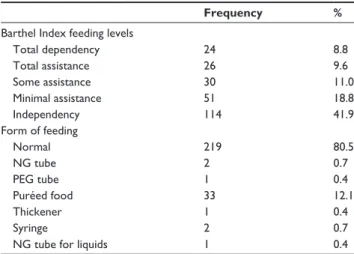
The results of the BI showed that 86.6% of the residents had some level of dependency, and 28.7% were totally depen-dent (Table 1). Residepen-dents showing some type of cognitive impairment totaled 44.9%. The results for the GDS indicated that 30.9% of the sample had symptoms of depression.
According to the BI item that assessed independence for feeding, almost half of the residents were in need of assistance. Nevertheless, 80.5% ate normal food (Table 2); regarding textures, the greatest difficulty was felt when eat-ing solids (22.8%).
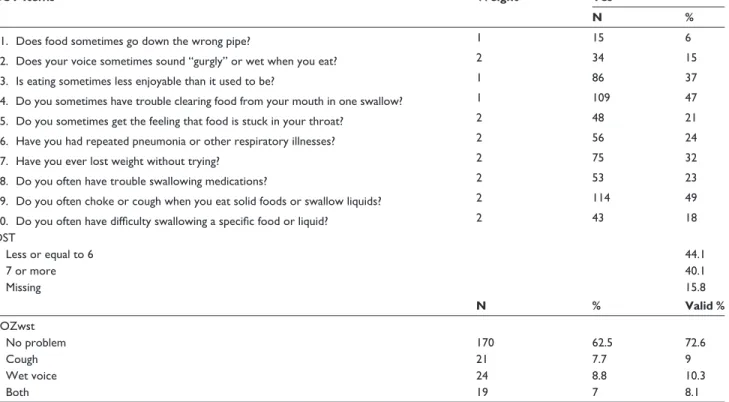
One point was added for all the DST items that revealed a risk of penetration and/or aspiration (Table 3). When the threshold “seven or more difficulties” was used, signs of dysphagia were present in 40.1% of the residents. The 3OZwst and the deviation from normal swallowing was also registered, namely the presence of cough, wet voice, or
Table 1 Scores for the BI, the MMSE, and the gDS
Frequency Percent Barthel index Total dependency 78 28.7 Severe dependency 39 14.3 Moderate dependency 41 15.1 Mild dependency 34 12.5 Minimal dependency 44 16.2 Independent 24 8.8 Total 260 95.6 Missing 6
Mini Mental State examination
Cognitive impairment 122 44.9
No cognitive impairment 119 43.8
Total 241 88,6
Missing 15
geriatric depression scale
Without depression signs 61 22.4
With depression signs 84 30.9
Total 145 53.3
Missing 121
Abbreviations: BI, Barthel Index; MMSE, Mini Mental State Examination; gDS,
geriatric Depression Scale.
Table 2 Barthel Index (independence for feeding) and feeding
profile
Frequency % Barthel Index feeding levels
Total dependency 24 8.8 Total assistance 26 9.6 Some assistance 30 11.0 Minimal assistance 51 18.8 Independency 114 41.9 Form of feeding Normal 219 80.5 Ng tube 2 0.7 PEg tube 1 0.4 Puréed food 33 12.1 Thickener 1 0.4 Syringe 2 0.7
Ng tube for liquids 1 0.4
Abbreviations: Ng, nasogastric; PEg, percutaneous endoscopic gastrostomy.
both, to obtain a more objective evaluation from a Speech and Language Pathologist: it was found that 38.2% of the residents had problems, of which “wet voice” was the most prevalent (Table 3).
The mean score of the DST was compared by gender and level of education. No significant differences were found between males and females, but a higher education level was found to have a positive effect on the DST. The Pearson correlation coefficient was used to identify the degree of linear association between the DST and age, the BI, the MMSE, and the BI feeding indicator. All correlations but one
were significant, though not strong: MMSE (r(272)= -0.221,
P , 0.001); BI(r(272) = -0.268, P , 0.001); BI feeding
(r(272)= -0.268, P , 0.001); the only exception was the
cor-relation with age, which was not significant (r(272)= 0.091,
P = 0.162) (Table 4).
ANOVA was applied to compare the DST mean scores between the groups defined by the self-perception of health status. The results showed significant mean differences. The group of residents with a poor self-perceived health status had the highest mean scores of DST (worst swallowing) (F(2,158)= 5.859, P = 0.004).
To identify the variables that best explain DST varia-tions, a regression model was estimated using the DST as the dependent variable and the MMSE and BI scores, gender, age, education, the GDS Score, 3OZwst, and predominant diseases as independent variables. The final adjusted model was significant and explained 47.2% of the DST score variation (F(7,115), adjusted R2 = 0.472, P , 0.001). Age, education, the 3OZwst, the MMSE, and GDS scores and also cardiorespiratory problems had significant effects (P , 0.05) on the DST score (Table 5). Education had a negative effect
Table 3 DST and the 3OZwst
DST Items Weight Yes
N %
1. Does food sometimes go down the wrong pipe? 1 15 6
2. Does your voice sometimes sound “gurgly” or wet when you eat? 2 34 15
3. Is eating sometimes less enjoyable than it used to be? 1 86 37
4. Do you sometimes have trouble clearing food from your mouth in one swallow? 1 109 47 5. Do you sometimes get the feeling that food is stuck in your throat? 2 48 21
6. have you had repeated pneumonia or other respiratory illnesses? 2 56 24
7. have you ever lost weight without trying? 2 75 32
8. Do you often have trouble swallowing medications? 2 53 23
9. Do you often choke or cough when you eat solid foods or swallow liquids? 2 114 49 10. Do you often have difficulty swallowing a specific food or liquid? 2 43 18 DST Less or equal to 6 44.1 7 or more 40.1 Missing 15.8 N % Valid % 3OZwst No problem 170 62.5 72.6 Cough 21 7.7 9 Wet voice 24 8.8 10.3 Both 19 7 8.1
Abbreviations: DST, Dysphagia Self-Test; 3OZwst, 3 ounce Water Swallow Test.
Table 4 Correlations between DST, and BI, MMSE, BI (feeding)
DST/BI r = –0.268, P-value , 0.001
DST/MMSE r = 0.221, P-value , 0.001
DST/BI (feeding) r = 0.268, P-value , 0.001 Abbreviations: DST, Dysphagia Self-Test; BI, Barthel Index; MMSE, Mini Mental
State Examination.
on the DST score ie, residents with lower levels of education had higher levels of self-perceived swallowing disorders. DST scores increased with age, with higher GDS scores, cardiorespiratory problems, and decreased in those with no risk detected by the 3OZswt.
However, a generalized linear model was also estimated to validate the previous results, due to the violation of some of the linear regression model assumptions (normality and homoscedasticity of residuals). The dependent variable was set to have a Poisson distribution (since the dependent vari-able has non-negative integer values, can be thought of as the number of occurrences of an event, and shows positive skewness). The log link function was appropriate for positive skewed distributions.
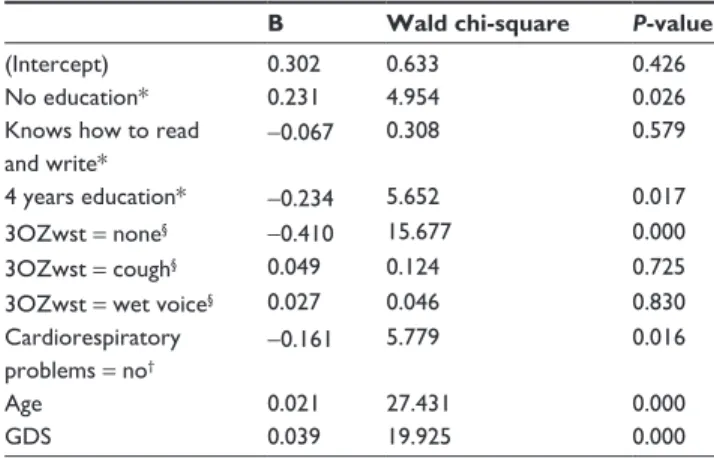
The results confirm the significant effect of education, age, the GDS score, and cardiorespiratory problems on the level of DST, but the MMSE index became nonsignificant and was excluded from the final model (Table 6). The DST score was found to be higher for those with no education and
lower for those with 4 years education, when compared with the group of residents with more than 4 years of education; lower for those with no problems in the 3OZwst when com-pared with those with both wet voice and cough; increased when age and GDS scores increased; and was lower for those with cardiorespiratory diseases (Table 7).
Discussion
The study sought to determine the prevalence of swallow-ing disorders in nursswallow-ing home residents and to identify the relationship between the DST score and a set of health and sociodemographic variables, cognitive functions, perfor-mance of activities of daily living, and depression.
Clinicians need to recognize the heterogeneity of health determinants and how these factors may influence approaches to dysphagia in different care settings. Current economic restraints are putting pressure on nursing home facilities to identify key issues that are associated with various out-comes, including the burden of respiratory infection resulting from aspiration. Neither the scope of the problem nor the prevalence of dependence and cognitive impairment in the elderly that were reported in this study surprised the authors. The functional profile identified in the present study points to higher prevalence of functional dependence in females, with cognitive impairment, and in the presence of signs of
depression or cognitive disorders. According to reported problems pointing to risk of dysphagia, about 40% of nursing home residents showed symptoms, as was similarly reported in the study of Humbert et al.9 The variables that best explain the total score of the DST were similar in both classic and generalized regression models. Education levels that tradi-tionally explain self-perceived health status also showed a high correlation with DST. Residents with a higher cognitive performance showed higher scores for the DST, which may indicate a greater awareness of the symptoms. The GDS score explains the greater difficulties reported in the DST and may be related to poor well being, which is in line with
Feinberg’s opinion;15 it may also be due to the consumption
of medication, but this variable was not introduced in the present study, due to the lack of information. The use of medication should be included as an explanatory variable, since many medical conditions and the use of medication
can cause dysphagia.23
According to the literature review,16 cognitive factors, such as memory recall, do not seem to influence dysphagia symptoms. On the other hand, depression is associated with dysphagia, which suggests a potential interaction effect. This could be linked to associations with quality of life or psychological factors. The 3OZwst also explains the DST
score, indicating that the 3OZwst can be a simple and easily applied method for obtaining basic information about
swal-low functions,29 even if not as a single measure.
Our own experience also showed that a more objective assessment should include the caregiver’s opinion. The DST applied to the elderly is influenced by many subjective fac-tors, including each individual’s ability to interpret his/her own symptoms. As many nursing home residents showed a substantial cognitive decline, the DST should be used only as an indicator and not as an objective evaluation instrument. This type of tool should be complementary, and the results should be regarded with caution especially in a population with high levels of cognitive impairment. Symptoms may, in many cases, be undervalued, putting the elderly at risk. However, it is important to include a subjective assessment of dysphagia symptoms, since the ability to perform a given function is closely linked to the individual’s perception of his/her own difficulties.
Table 6 generalized linear model – tests of model effects
Wald chi-square P-value
(Intercept) 0.123 0.726 Education 34.050 0.000 Test 3OZwst 40.540 0.000 Cardiorespiratory problems 5.779 0.016 Age 27.431 0.000 gDS score 19.925 0.000
Abbreviations: 3OZwst, 3 ounce Water Swallow Test; gDS, geriatric Depression
Scale.
Table 7 generalized linear model – parameter estimates
B Wald chi-square P-value
(Intercept) 0.302 0.633 0.426
No education* 0.231 4.954 0.026
Knows how to read
and write* -0.067
0.308 0.579
4 years education* -0.234 5.652 0.017
3OZwst = none§ -0.410 15.677 0.000
3OZwst = cough§ 0.049 0.124 0.725
3OZwst = wet voice§ 0.027 0.046 0.830
Cardiorespiratory problems = no†
-0.161 5.779 0.016
Age 0.021 27.431 0.000
gDS 0.039 19.925 0.000
Notes: *reference category: more than 4 years education; §reference category:
3OZwst: both; †reference category: yes.
Abbreviations: 3OZwst, 3 ounce Water Swallow Test; gDS, geriatric Depression
Scale; B, regression coefficient.
Table 5 Linear regression model to explain the variation of the DST score
Unstandardized coefficients Standardized coefficients t P-value
B SE Beta (Constant) -9.005 3.134 -2.873 0.005 Age 0.154 0.030 0.363 5.147 0.000 No formal education* 2.530 0.726 0.273 3.487 0.001 3OZwst = none§ -2.729 0.591 -0.310 -4.615 0.000 gDS score 0.300 0.073 0.279 4.113 0.000 Cardiorespiratory problems = yes† 1.257 0.532 0.159 2.362 0.020 4 years education* -1.414 0.611 -0.178 -2.313 0.023 MMSE 0.109 0.052 0.147 2.084 0.039
Notes: §reference category: 3OZ Water swallow test: cough and wet voice; †reference category: no cardiorespiratory problems; *reference category: more than 4 years education.
Abbreviations: DST, Dysphagia Self-Test; 3OZwst, 3 ounce Water Swallow Test; GDS, Geriatric Depression Scale; MMSE, Mini Mental State Examination; B, regression coefficient;
Clinical Interventions in Aging
Publish your work in this journal
Submit your manuscript here: http://www.dovepress.com/clinical-interventions-in-aging-journal
Clinical Interventions in Aging is an international, peer-reviewed journal focusing on evidence-based reports on the value or lack thereof of treat-ments intended to prevent or delay the onset of maladaptive correlates of aging in human beings. This journal is indexed on PubMed Central, MedLine, the American Chemical Society’s ‘Chemical Abstracts
Service’ (CAS), Scopus and the Elsevier Bibliographic databases. The manuscript management system is completely online and includes a very quick and fair peer-review system, which is all easy to use. Visit http://www.dovepress.com/testimonials.php to read real quotes from published authors.
Further development of specific screening tools for older people is necessary to efficiently and objectively identify problems and provide early intervention in nursing homes, where dysphagia is responsible for many acute and chronic respiratory diseases, increasing the state of dependency, and contributing to rates of morbidity and mortality.
Disclosure
The authors report no conflicts of interest in this work.
References
1. Nilsson H, Ekberg O, Olsson R, Hindfelt B. Quantitative aspects of swallowing in an elderly nondysphagic population. Dysphagia. 1996; 11(3):180–184.
2. Sura L, Madhavan A, Carnaby G, Crary MA. Dysphagia in the elderly: management and nutritional considerations. Clin Interv Aging. 2012;7: 287–298.
3. Malandraki GA, Perlman AL, Karampinos DC, Sutton BP. Reduced somatosensory activations in swallowing with age. Hum Brain Mapp. 2011;32(5):730–743.
4. McKee GJ, Johnston BT, McBride GB, Primrose WJ. Does age or sex affect pharyngeal swallowing? Clin Otolaryngol Allied Sci. 1998; 23(2):100–106.
5. Nicosia MA, Hind JA, Roecker EB, et al. Age effects on the temporal evolution of isometric and swallowing pressure. J Gerontol A Biol Sci
Med Sci. 2000;55(11):M634–M640.
6. Steele CM, Van Lieshout P. Tongue movements during water swal-lowing in healthy young and older adults. J Speech Lang Hear Res. 2009;52(5):1255–1267.
7. Bennett JW, van Lieshout PH, Steele CM. Tongue control for speech and swallowing in healthy younger and older subjects. Int J Orofacial
Myology. 2007;33:5–18.
8. Higashijima M. Influence of age and bolus size on swallowing function: basic data and assessment method for care and preventive rehabilitation.
Am J Occup Ther. 2010;64(1):88–94.
9. Humbert IA, Robbins J. Dysphagia in the elderly. Phys Med Rehabil
Clin N Am. 2008;19(4):853–866.
10. Allepaerts S, Delcourt S, Petermans J. Swallowing disorders in the elderly: an underestimated problem. Rev Med Liege. 2008;63(12): 715–721. French.
11. Hudson HM, Daubert CR, Mills RH. The interdependency of protein-energy malnutrition, aging, and dysphagia. Dysphagia. 2000;15(1): 31–38.
12. Rofes L, Arreola V, Romea M, et al. Pathophysiology of oropharyn-geal dysphagia in the frail elderly. Neurogastroenterol Motil. 2010; 22(8):851–858.
13. Cabre M, Serra-Prat M, Palomera E, Almirall J, Pallares R, Clavé P. Prevalence and prognostic implications of dysphagia in elderly patients with pneumonia. Age Ageing. 2010;39(1):39–45.
14. Elliott JL. Swallowing disorders in the elderly: a guide to diagnosis and treatment. Geriatrics. 1988;43(1):95–100, 104, 113.
15. Feinberg MJ. Swallowing versus eating impairment in nursing home residents. Dysphagia. 1997;12(1):51.
16. Holland G, Jayasekeran V, Pendleton N, Horan M, Jones M, Hamdy S. Prevalence and symptom profiling of oropharyngeal dysphagia in a community dwelling of an elderly population: a self-reporting questionnaire survey. Dis Esophagus. 2011;24(7):476–480. 17. Chen PH, Golub JS, Hapner ER, Johns MM 3rd. Prevalence of perceived
dysphagia and quality-of-life impairment in a geriatric population.
Dysphagia. 2009;24(1):1–6.
18. O’Loughlin G, Shanley C. Swallowing problems in the nursing home: a novel training response. Dysphagia. 1998;13(3):172–183.
19. Wilkinson T, de Picciotto J. Swallowing problems in the normal ageing population. S Afr J Commun Disord. 1999;46:55–64.
20. Rumeau P, Vellas B. Dysphagia, a geriatric point of view. Rev
Laryngol Otol Rhinol (Bord). 2003;124(5):331–333. French.
21. Kyle G. Managing dysphagia in older people with dementia. Br J
Community Nurs. 2011;16(1):6–10.
22. Marik PE, Kaplan D. Aspiration pneumonia and dysphagia in the elderly. Chest. 2003;124(1):328–336.
23. Logemann JA. Effects of aging on the swallowing mechanism.
Otolaryngol Clin North Am. 1990;23(6):1045–1056.
24. Mahoney FI, Barthel DW. Functional evaluation: the Barthel Index.
Md State Med J. 1965;14:61–65.
25. Guerreiro M, Silva A, Botelho M. Adaptação à população portuguesa na tradução do Mini Mental State Examination (MMSE). [Translation and adaptation of the MMSE to the Portuguese population]. Revista
Portuguesa de Neurologia. 1994;1:9–10. Portuguese.
26. Yesavage JA. Geriatric Depression Scale. Psychopharmacol Bull. 1988;24(4):709–711.
27. Logemann JA, Stewart C, Hurd J, et al. Dysphagia Care Among Seniors in Los Angeles County: Planning and Pilot Study. Presented at the California Speech-Hearing-Language Association Convention, Monterey, Calfornia: 2008 April.
28. Baker BM, Fraser AM, Baker CD. Long-term postoperative dysphagia in oral/pharyngeal surgery patients: subjects’ perceptions vs videofluo-roscopic observations. Dysphagia. 1991;6(1):11–16.
29. DePippo KL, Holas MA, Reding MJ. Validation of the 3-oz water swallow test for aspiration following stroke. Arch Neurol. 1992; 49(12):1259–1261.