2019
UNIVERSIDADE DE LISBOA
FACULDADE DE CIÊNCIAS
DEPARTAMENTO DE INFORMÁTICA
Blockchain Powered Platform for Consolidated,
Shared and Trusted Healthcare
João Marques de Barros Mendes Leal
Mestrado em Engenharia Informática
Especialização em Engenharia de Software
Dissertação orientada por:
iii
Acknowledgments
I would like to start by thanking my dissertation supervisor Professor Doutor Pedro Veiga for all the help and support provided during this dissertation. Whether it was in our weekly e-mail exchanges, the meetings in his office to discuss the progress of the work or for all the help in writing and improving this report, I am very grateful for all of it.
To the host organization I am every thankful for giving me the opportunity to explore and develop a system in this very promising new technology. I would like to give a special acknowledgment to Tiago Minchin and Álvaro Silva for their indispensable assistance during the dissertation. For the invaluable knowledge of the industries considered and for always being available to provide the help needed to resolve every issue that came up during the project.
To all of the professors I had at the Faculty of Sciences during my bachelor’s and first year of the master’s I would to thank all of you for teaching me all the necessary knowledge and skill I needed to successfully perform the work for this dissertation.
A final special thank you is needed to all of my friends and family who always believed and supported me not only during this project but since I can remember.
v
vii
Abstract
In recent years blockchain, has become a topic of much debate and interest. This is due to the increase in valuation of cryptocurrencies and has attracted the attention of the public, corporations and governments. Cryptocurrencies use blockchain as the underlying technology. Blockchain refers to a ledger that keeps a permanent and immutable record of transactions and is replicated amongst all nodes. It offers guarantees of trust, immutability and transparency of the data, decentralization and elimination of third parties of data storage.
The healthcare industry is one of the biggest and most valuable industries in the world. It encom-passes governments, public, private enterprises and citizens. However, there are some issues surround-ing the current way the industry operates. Heavy decentralization, lack of communication between pro-fessionals and lack of trust in the information are just some of the issues that plague the industry.
Considering these facts, the purpose of this dissertation is to create a platform to study the ap-plicability of blockchain the solve the problems of the healthcare industry. This platform will store med-ical data of patients, allow them to manage access to it and give medmed-ical professionals the capability to review, add or update the information of the person they are treating and medical labs the ability to use it to deliver analyses reports. The platform represents only a small use case of blockchain in healthcare, but it will allow the study of the feasibility of a larger system and its ability to solve the problems men-tioned above.
ix
Resumo
Nos últimos anos as criptomoedas, tornaram-se tema de muito debate e interesse. Esta atenção foi causada pelo aumento de valor das criptomoedas. Muitas indústrias ficaram interessadas nas aplicações possíveis da tecnologia subjacente, blockchain. Blockchain refere-se a um livro-razão que mantém um registo permanente e imutável de transações que é replicado em todos os nós. A tecnologia blockchain oferece garantias de integridade dos dados, confiança na sua validade, transparência, descentralização e remove a necessidade de terceiras partes.
O setor da saúde é uma das maiores e mais valiosas indústrias do mundo. Abrange governos, empresas públicas, privadas e cidadãos. No entanto, existem alguns problemas na maneira como a in-dústria opera atualmente. A grande descentralização, a falta de comunicação entre profissionais e a falta de confiança na informação são apenas alguns destes problemas.
Considerando estes factos, o objetivo desta dissertação é criar uma plataforma para estudar a apli-cabilidade da blockchain na solução dos problemas do setor de saúde. Essa plataforma armazenará dados médicos de pacientes, permitirá que eles controlem o acesso a esses dados, dará aos médicos a capaci-dade de aceder, adicionar e atualizar os dados da pessoa que estão a tratar e aos laboratórios médicos a possibilidade de entregar relatórios de análises. A plataforma representa apenas um pequeno caso de uso de blockchain na saúde, mas permitirá o estudo da viabilidade de um sistema maior e sua capacidade de resolver os problemas mencionados acima.
O trabalho foi desenvolvido na Accenture, uma consultora multinacional com grande foco na área da tecnologia. Outros dois colegas da Faculdade de Ciências também estavam a desenvolver projetos de
blockchain com o mesmo objetivo, mas para indústrias diferentes. O meu supervisor na Accenture foi o
Tiago Minchin, contando também com o Álvaro Silva na equipa da Accenture envolvida no projeto. Inicialmente, na fase de identificação de casos de uso, trabalhei em conjunto com os meus colegas da faculdade, mas quando ficou definido qual o caso de uso a desenvolver o trabalho tornou-se individual. Para além da identificação do caso de uso, estudei várias possíveis implementações de blockchain de modo a escolher a mais correta para construir a plataforma. No final decidi utilizar o Hyperledger
Fabric desenvolvido pela Fundação Linux. As razões para essa escolha foram o suporte de smart con-tracts, código que é usado para definir lógica de negócio na blockchain, e facto de o Fabric ser uma blockchain privada e poder ser permissionada, o que permite gerir as questões da privacidade dos dados.
Os smart contracts podiam ser escritos nalgumas linguagens das quais eu escolhi o Node.js, pois era a melhor documentada e utilizada para o Hyperledger Fabric. Decidi também desenvolver a interface de utilizador utilizando Angular.
Após identificado o caso de uso, a blockchain e a linguagem de programação, procedi para o desenvolvimento das user stories, levantamento de requisitos, partes interessadas e arquitetura.
Com tudo isto, iniciei o desenvolvimento da plataforma, seguindo os exemplos e tutoriais forne-cidos pelo Hyperledger. Em primeiro lugar criava os smart contracts e depois a interface de utilizador a funcionalidade. Em seguida fazia testes para tentar detetar erros, estes eram sempre funcionais. Quando estivesse tudo a trabalhar corretamente, repetia o processo para a funcionalidade seguinte. Quando ter-minei a implementação procedi à documentação de todo o código e à remoção de métodos, classes e módulos criados durante o desenvolvimento que já não eram necessários para a versão final.
Existem três tipos de utilizadores na plataforma: pacientes, médicos e laboratórios médicos. Os pacientes podem consultar o seu historial médico, consultas, relatórios de análises e controlar o acesso a estes. Os únicos dados que estão sempre visíveis são as informações essenciais para poderem ser usa-das em emergências. Os laboratórios usam a plataforma para adicionar relatórios de análises e podem consultar os relatórios que criaram. Os médicos, mediante autorização por parte do paciente, podem
iniciar consultas, nas quais vão poder registar a consulta, adicionar ou atualizar dados médicos e con-sultar o historial médico, de consultas e relatórios de análises.
A interface de utilizador é uma aplicação que corre num navegador. A comunicação com a
blockchain é feita através de um servidor, também ele escrito em Node.js. A blockchain como referido
anteriormente, é a Hyperledger Fabric versão 1.4.0. É sobre esta implementação que instanciei os smart
contracts, ou chaincode como são chamados no Fabric. Como referido anteriormente estes foram
escri-tos em Node.js. Existem cinco chaincodes, medical information, analyses reports, medical history,
con-sultation history e users. Medical Information é onde está definida a informação médica essencial e a
lógica de negócio associada a esta. Analyses Reports define os relatórios de análises, a sua lógica e implementa as regras de acesso e criação. Medical History define os três tipos de dados guardados: alergias, medicamentos e condições médicas, a lógica de negócio e implementa o acesso a estes. Na
consultation history está definida a consulta, as funcionalidades associadas a esta e as regras sobre o
acesso e criação da mesma. Users define os três tipos de utilizador, lógica de negócio e acesso. Os utilizadores do tipo paciente mantêm uma lista dos médicos e instituições médicas autorizadas com os respetivos níveis de acesso aos vários tipos de dados médicos. Esta lista é usada pelos outros chaincodes para o controlo de acesso aos dados. Toda a plataforma, aplicação de navegador, servidor e blockchain com os chaincodes, correm localmente em contentores Docker instalados numa máquina virtual Ubuntu. Este projeto foi a primeira vez que trabalhei com blockchain em geral e Hyperledger Fabric em particular, pelo que existem vários aspetos da minha implementação que faria de outra forma, agora que tenho mais experiência. O desenvolvimento do chaincode foi feito com base nos tutoriais disponibiliza-dos para o Fabric, contudo pelos motivos mencionadisponibiliza-dos anteriormente a organização do código não é a mais eficiente ou necessariamente a mais correta. Algo semelhante aconteceu na criação da interface de utilizador. Criação de interfaces gráficas de utilizador é algo que não foi o principal foco da minha instrução universitária pelo que esta foi também a primeira vez que utilizei Angular, o que levou a pro-blemas de estruturação de código semelhantes ao que aconteceu com o chaincode.
Durante todo o trabalho recebi input da equipa da Accenture sobre as funcionalidades que deve-riam ser implementadas e sugestões sobre a interface do utilizador e como estas devedeve-riam ser estruturas para serem mais intuitivas. Outra área onde houve bastante ajuda por parte da equipa da Accenture foi na identificação do caso de uso, providenciando conhecimento das áreas de negócios analisadas que ajudaram na seleção.
Com a plataforma terminada e usando todo o conhecimento que acumulei durante o estágio na Accenture, consegui concluir que existe utilidade para um sistema semelhante a ser implementado em maior escala e com mais funcionalidades. Possíveis casos onde isto seria vantajoso de implementar se-riam num sistema público de saúde, i.e., em todos hospitais públicos de um país ou num operador de saúde privado com múltiplos hospitais ou clínicas. Para ambos os casos, a implementação iria substituir os sistemas atuais e daria, entre outros benefícios, aos pacientes controlo sobre quais os médicos dentro dessa rede que teriam acesso aos seus dados. Numa maior escala este sistema poderia ligar sistemas públicos e privados, com cada operador, estado e diferentes empresas gestoras de hospitais teriam sub-redes que estavam ligadas entre si permitindo o acesso aos dados médicos dos pacientes, mediante au-torização, a todos os envolvidos. Esta solução ideal iria resolver os problemas mencionados anterior-mente.
Table of Contents
Table of Tables ... xvi
Table of Figures ... xviii
Chapter 1.
Introduction ... 1
1.1.
Motivation ... 1
1.2.
Host Organization ... 1
1.3.
Accenture Team ... 2
1.4.
Summary ... 2
1.5.
Contributions ... 3
1.6.
Structure of the Document ... 3
Chapter 2.
Overview ... 5
2.1.
Objectives ... 5
2.2.
Context ... 5
2.3.
Methodology ... 6
2.4.
Planned Work ... 7
2.5.
Planning ... 7
2.6.
Execution ... 8
2.7.
Planning vs Execution ...10
Chapter 3.
State of the Art ...13
3.1.
Important Concepts ...13
3.1.1.
Blockchain ...13
3.1.2.
Nodes ...13
3.1.3.
Transactions ...13
3.1.4.
Blocks ...13
3.1.5.
Ledger ...14
3.1.6.
Forks ...14
3.1.7.
Consensus Mechanisms ...14
3.1.8.
Smart Contracts ...15
3.1.9.
Permissionless Blockchains ...15
3.1.10.
Permissioned Blockchains ...15
3.1.11.
Public Blockchains ...16
3.1.12.
Private Blockchains ...16
3.1.13.
Advantages ...16
3.2.
Blockchain Implementations ...17
3.2.1.
Ethereum ...17
3.2.2.
Hyperledger Fabric ...17
3.2.3.
R3 Corda ...17
3.3.
Methodologies, Programming Languages and Tools ...17
3.3.1.
Agile ...17
3.3.2.
FURPS+ ...18
3.3.3.
JavaScript ...18
3.3.4.
Node.js ...18
3.3.5.
Angular ...18
3.3.6.
TypeScript ...18
xiii 3.3.7.
HTML ...19
3.3.8.
CSS ...19
3.3.9.
JSON ...19
3.3.10.
YAML ...19
3.3.11.
Docker ...19
3.3.12.
Visual Studio Code ...19
3.3.13.
IBM Blockchain Platform for Visual Studio Code ...19
3.3.14.
CouchDB ...19
3.4.
Related Work ...20
3.4.1.
MedRec ...20
3.4.2.
DokChain ...20
3.4.3.
Patientory’s Healthcare Platform ...20
3.4.4.
GemOs ...20
3.4.5.
KSI in Healthcare ...20
3.5.
Comparison to Discussed Solutions ...20
Chapter 4.
The Work ...23
4.1.
Use Case Selection ...23
4.1.1.
Identification ...23
4.1.2.
Evaluation ...23
4.2.
Selected Use Case ...24
4.3.
Stakeholders...25
4.4.
User Stories...26
4.5.
Selected Blockchain ...30
4.6.
System Requirements ...30
4.6.1.
Functionality...30
4.6.2.
Usability ...31
4.6.3.
Reliability ...33
4.6.4.
Performance ...33
4.6.5.
Supportability ...33
4.6.6.
Design Constraints ...34
4.6.7.
Implementation Constraints ...34
4.6.8.
Interface Constraints ...35
4.6.9.
Physical Constraints...35
4.7.
The Platform ...35
4.8.
Platform Architecture ...36
4.9.
Blockchain Network Setup ...37
4.9.1.
Hyperledger Fabric Concepts ...37
4.9.1.1. Chaincode ...37
4.9.1.2. Nodes ...37
4.9.1.3. Channel ...38
4.9.1.4. Organizations ...38
4.9.1.5. Membership Service Provider ...38
4.9.1.6. Certificate Authority ...38
4.9.1.7. State Database ...38
4.9.2.
Platform Network ...38
4.10.
Platform Development ...40
4.10.1.
Medical Information ...40
4.10.1.1. Chaincode ...40
4.10.1.2. Front-end...41
4.10.1.3. Server ...42
4.10.2.
Analyses Reports ...42
4.10.2.1. Chaincode ...43
4.10.2.2. Front-end...43
4.10.2.3. Server ...45
4.10.3.
Medical History ...45
4.10.3.1. Chaincode ...45
4.10.3.2. Front-end...47
4.10.3.3. Server ...47
4.10.4.
Consultation History ...47
4.10.4.1. Chaincode ...48
4.10.4.2. Front-end...49
4.10.4.3. Server ...50
4.10.5.
Users ...50
4.10.5.1. Chaincode ...51
4.10.5.2. Front-end...52
4.10.5.3. Server ...54
4.10.6.
Information Access Control ...54
4.10.6.1. Medical Information Contract Class ...55
4.10.6.2. Analyses Report Contract Class ...56
4.10.6.3. Medical History Contract Class ...56
4.10.6.4. Consultation History Contract Class ...57
4.10.6.5. Users Contract Class ...58
4.10.7.
Shared Front-end Components ...58
4.11.
Documents ...60
4.12.
Tests ...60
4.13.
Platform Evaluation ...61
Chapter 5.
Conclusion ...65
5.1.
Work Summary ...65
5.2.
Discussion...65
5.3.
Future Work ...66
Bibliography ...69
Table of Tables
Table 2.1: Planning ... 7
Table 2.2: Timeline ... 9
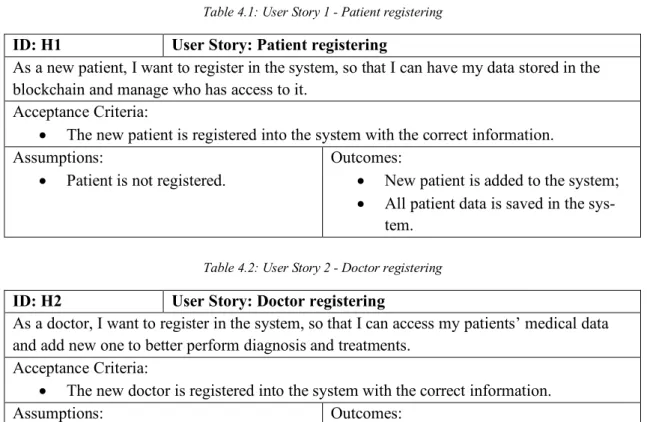
Table 4.1: User Story 1 - Patient registering ...26
Table 4.2: User Story 2 - Doctor registering ...26
Table 4.3: User Story 3 - Medical Lab registering ...26
Table 4.4: User Story 4 - Information control...26
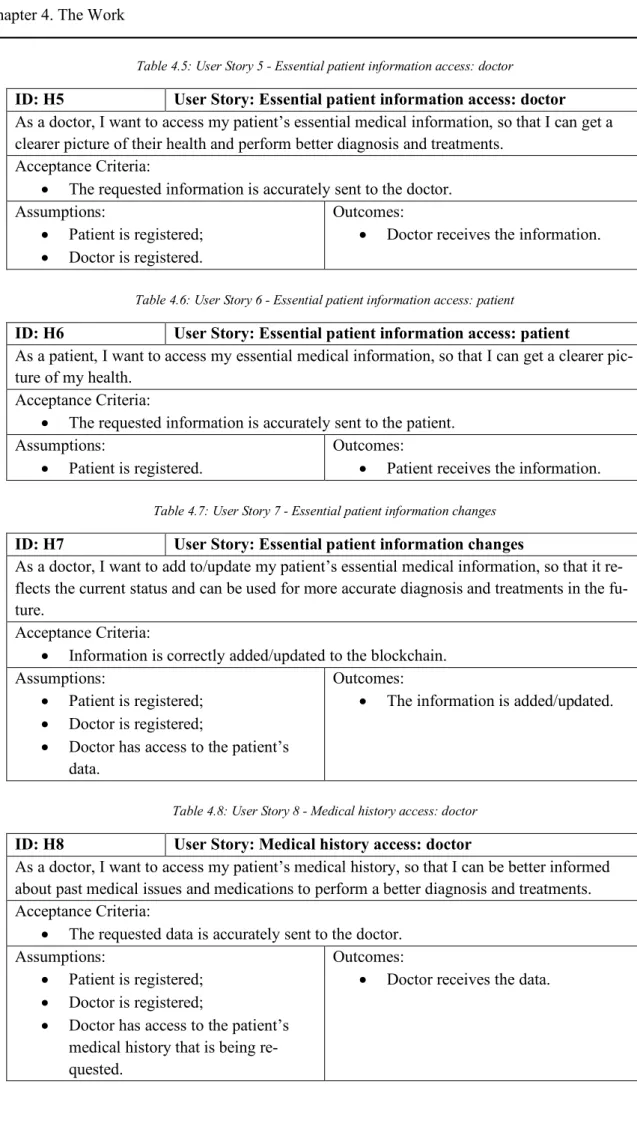
Table 4.5: User Story 5 - Essential patient information access: doctor ...27
Table 4.6: User Story 6 - Essential patient information access: patient ...27
Table 4.7: User Story 7 - Essential patient information changes ...27
Table 4.8: User Story 8 - Medical history access: doctor ...27
Table 4.9: User Story 9 - Medical history access: patient ...28
Table 4.10: User Story 10 - Medical history changes ...28
Table 4.11: User Story 11 - Consultation history access: doctor ...28
Table 4.12: User Story 12 - Consultation history access: patient...28
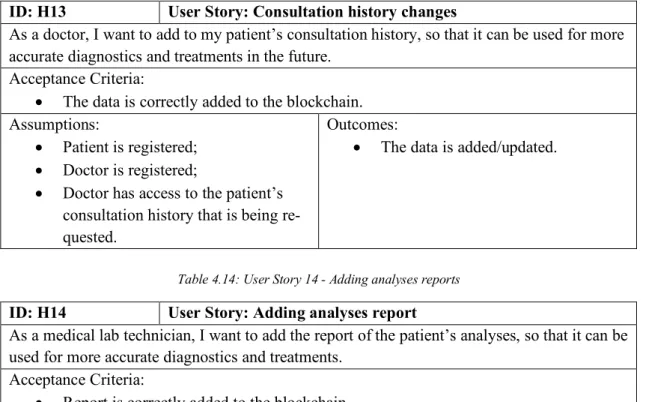
Table 4.13: User Story 13 - Consultation history changes ...29
Table 4.14: User Story 14 - Adding analyses reports ...29
Table 4.15:User Story 15 – Analyses report access: doctor ...29
Table 4.16: User Story 16 – Analyses report access: patient ...29
Table 4.17: User Story 17 – Analyses report access: medical lab ...30
Table 4.18: Functionality Requirements...30
Table 4.19: Usability Requirements ...31
Table 4.20: Reliability Requirements ...33
Table 4.21: Performance Requirements ...33
Table 4.22: Supportability Requirements ...33
Table 4.23: Design Constraints ...34
Table of Figures
Figure 2.1: Planning ... 8
Figure 2.2: Timeline ... 9
Figure 3.1: Example of a block [3]...14
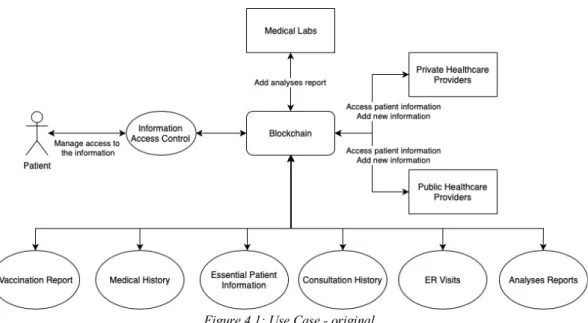
Figure 4.1: Use Case - original ...25
Figure 4.2: Use case – implementation ...25
Figure 4.3: Platform Architecture ...37
Figure 4.4: Peer ...39
Figure 4.5: Blockchain Network ...39
Figure 4.6: Medical Information Details Component ...42
Figure 4.7: Analyses Report Create Component ...44
Figure 4.8: Analyses Report Details Page Component ...44
Figure 4.9: Analyses Report Search Component ...45
Figure 4.10: Analyses Report Details Dialog Component...45
Figure 4.11: Medical History Details Component ...47
Figure 4.12: Medical History Search Component ...47
Figure 4.13: Consultation History Default Component ...49
Figure 4.14: Consultation History Details and Create Component ...49
Figure 4.15: Consultation History Details and Search Component...50
Figure 4.16: Consultation History Dialog Component ...50
Figure 4.17: User Register Component - Step 1 ...53
Figure 4.18: User Register Component - Step 2 ...53
Figure 4.19: User Register Component - Step 3 ...53
Figure 4.20: User Login Component ...53
Figure 4.21: User Profile Component...53
Figure 4.22: Patient Permission Component...53
Figure 4.23: Patient Add Doctor Permissions Dialog ...54
Figure 4.24: Patient Update Organization Permissions Dialog...54
Figure 4.25: Allergy Create Dialog ...59
Figure 4.26: Allergy Details Dialog ...59
Figure 4.27: Medical Condition Create Dialog ...59
Figure 4.28: Medical Condition Details Dialog ...59
Figure 4.29: Medication Create Dialog ...60
Chapter 1. Introduction
Chapter 1. Introduction
This chapter contains the motivation for the developed work, a short summary of it, contributions to both the healthcare industry and blockchain development, a contextualization of the work environ-ment and team, as well as the structure of the rest of the dissertation report.
1.1. Motivation
With the advance of technology more and more industries are changing their business models and updating their digital infrastructure, ending their reliance on paper documents and moving to digital documents. An industry that seems to be lagging is healthcare. Given the importance healthcare has in society and the money the industry moves around the world every year, the reliance on paper and lack of communication between different institutions and physicians makes some of the procedures look ar-chaic. This is in part due to governing regulations and laws that failed to keep up with new tools and technologies. However, there is considerable resistance to change by all involved members. Thanks to this it falls on the patients the responsibility to carry all their medical records and remember relevant information, like allergies or medication being taken. Given that, at times, interactions with medical professionals are made during duress, for example in a visit to an emergency room or after an accident, some of that information might not be properly transmitted which can cost someone their life.
Another problem people in healthcare have to deal with is individuals who falsify medical tests in order to receive prescription medicine. This causes doctors and other professionals to view results of tests they did not order with distrust.
Taking into consideration the issues presented above some in the healthcare industry have started to look into ways to modernize the industry. Some projects have been undertaken, trying to consolidate medical data. Though almost all of these projects rely on third party servers and systems to manages the data, which adds costs and creates privacy concerns about unwanted access to the information on the database.
The issue of data privacy is of the utmost importance for people. With scandals like Cambridge Analytica and others, many would be very skeptical of having their data added to yet another database where they cannot control who sees their private information.
Blockchain by its nature offers integrity guarantees, ensuring that no one can change data after the fact and authenticating the origin of that data, i.e. who added it. Since it is a distributed ledger and the copies of it are stored locally by every member of the network, this removes both the problems of cost to host the database and the lack of trust in this third party. Many blockchains also allow the imple-mentation of smart contracts, pieces of code that can be used to manage access to the data, along with other business logic.
Many consulting firms, technology companies and industry insiders began considering blockchain as a possible solution to modernize healthcare for all the reasons listed above. Among those companies is Accenture.
1.2. Host Organization
The work was conducted at Accenture. Accenture is multinational consulting firm offering ser-vices in strategy, consulting, technology, digital and operations. It operates in 120 countries working across 40 industries. [1]
Chapter 1. Introduction
2
1.3. Accenture Team
At Accenture I was working under the direction of Tiago Minchin, as well as, Álvaro Silva, both of whom from now on will be referred to as “Accenture team”. There was no co-supervisor from Ac-centure in the dissertation due to changes in the governing legislation of who can be a supervisor and co-supervisor. Along with me, two other colleagues from the Faculty of Sciences of the University of Lisbon were also developing blockchain solutions for other industries. Some of the first tasks undertaken were made in tandem with one another but as soon as each identified the use case our work became separate.
1.4. Summary
The work for the dissertation encompassed all phases of software development. Initially the use case needed to be decided, to that effect multiple industries and their problems were analyzed. This potential use cases were placed on a matrix and evaluated. In the end, healthcare was chosen. Still the scope of the problem was far too big and relied on multiple stakeholders which made it impossible to create a solution during the nine months of the dissertation. As such in conjunction with the Accenture team the scope was narrowed to one that could be developed in the allotted time and in the work context described above.
With the use case selected and scope well defined, the next phase was the selection of the block-chain implementation to be used for the platform. A study of blockblock-chain technology was also conducted concurrently with this and the previous stage of work. There were several requirements the for selection, it had to be a private and permissioned blockchain, there had to be support for smart contracts, the consensus mechanism had to be fault tolerant and it had to be open source. Other non-solution require-ments, related more with my personal inexperience with blockchain, were the supported smart contract implementation languages and the existence of an active developer community where difficulties and questions could be answered. With these requirements and a list of potential blockchains with their specifications, Hyperledger Fabric was selected.
Following the blockchain selection, the next step was the identification of the stakeholders, re-quirements, user stories and the development of the architecture. Some of the requirements and archi-tecture are not as detailed as they should due to the lack of experience with the technology and lack of good examples and resources to use as basis, due to the how recent blockchain development is.
Next the work moved to the implementation of the solution. To this effect, following the tutorials available on the Hyperledger Fabric website, the blockchain was setup. Then it was necessary to con-figure the network. With this last step, the network was ready to receive the chaincode (smart contract for Fabric). As such chaincode methods implementing each function were developed and instantiated on the blockchain. Simultaneously, the user interface was also being developed. After a new function was instantiated in the blockchain, the front-end that would allow users to interact with it was created. It was through this interface that the chaincode was tested. In order for the web-app to communicate with the blockchain a server was also created. When no more errors or bugs were detected, either on the front or back-ends, the next function would be developed. All the produced code was then documented. The final phase was the evaluation of the platform. This was done to try and understand whether or not there was a use for blockchain solutions in healthcare to solve the problems mention above. This was done theoretically, i.e., there was no actual implementation of the platform in any real-world envi-ronment. The platform was analyzed on whether or not it could perform all the required functions and solve the problems in its scope. With the information from this analysis a conclusion on if a larger system based on the one created could solve the industry problems was reached.
Chapter 1. Introduction
1.5. Contributions
The work conducted in this dissertation has potential contributions for both the healthcare industry and blockchain development.
The most direct contributions to the industry that can be taken from the dissertation are the its conclusions. These can be used in conjunction with other factors relevant to the specific case to decide on whether or not a blockchain solution is merited. The platform developed is a proof-of-concept and as such would be considered as a jumping for point for any real-world application of the technology in the industry. Despite the fairly small scope and scale of the platform it is still a practical implementation of a new solution implemented using innovative technology in an industry that is looking to modernize.
Much like the contributions for the industry, the field of blockchain development can also benefit from the conclusions of the dissertation. A fact that was observed during the use case identification stage is that, notwithstanding the interest in blockchain and the possible benefits of the technology for a myriad of industries almost all discussion is theoretical. This can be attributed to the fact that, the process of identifying a use case for implementation is not well defined and that leads to ideas where the cost of the technology would out way the benefits. Another problem is that the cases where it is advantageous to use blockchain are so large and complex that creating a proof-of-concept is too expensive and time consuming to interest developers, large and small. This was also a problem that appear during the initial stages of work, as alluded to previously. To solve this, the scope of the problem was reduced to an implementable solution. It is this that is necessary for the development of blockchain proof-of-concepts, smaller solutions to test the technology in the area in question. The reason that this is not a standard practice is because sometimes in the small proof-of-concept cases blockchain loses its usefulness. It has to be taken into account that it is for the larger problem that blockchain use has to make sense. The implemented solution is meant to show what the technology can do in the context of the problem and serve has a foundation for a future system. Besides explaining how the use cases considered were eval-uated and after selection how the scope was narrowed, the final product, the platform is an actual proof-of-concept that was implemented. While that might not seem like a valuable contribution, because of the mostly theoretical nature of potential solutions and ones that are not were created to test the technol-ogy without any specific use case in mind, a platform that can be as basis for future work is valuable for the field.
1.6. Structure of the Document
The document structure is as follows:
• Chapter 2 – describes the objectives of the work, its context, the methodology used, as well as, the planning, the final timeline and a discussion of the differences between the two;
• Chapter 3 – it includes the tools used, important blockchain concepts, related work and comparison between it and the developed solution;
• Chapter 4 – contains a detailed description/explanation of all the work from the use case selection to the evaluation of the final platform;
• Chapter 5 – summary of the work, it is conclusions, a critical commentary and discussion of future work that could be done to improve the platform.
Chapter 2. Overview
Chapter 2. Overview
In this chapter the objectives and context of the dissertation are presented. The methodology used is explained. Finally, the initial planning, the actual timeline of development and a comparison of the two are also included.
2.1. Objectives
The objective of the dissertation is to determine whether or not it is advantageous to use block-chain to solve the problems identified in the healthcare industry. To this effect a blockblock-chain powered platform was developed. It is used to store the medical history, essential information, consultation his-tory and analyses’ reports of patients. The patients have an interface through which they can manage who sees and can add/update their information. Doctors use the platform to access authorized infor-mation about their patients to perform better diagnosis and treatments, as well as to add to/update the existing information for better accuracy in future treatments. Medical laboratories deliver the reports of analyses via the platform to ensure that they are made immediately available to both doctor and patients. After being built, the platform was be evaluated to determine the usefulness of the underlying technology for solving the problems discussed earlier.
Another objective is the creation of a proof-of-concept that, if determined to be useful, can be used as a basis for future implementations of a blockchain solution for medical data storage and han-dling.
2.2. Context
Interest in blockchain has been increasing over the past years. This has created a wide array of ideas of how the technology can change almost everything. From voting to supply chain management, airplane maintenance and many others. Many of these supposed solutions are almost exclusively con-cepts without any sort of practical development. In some of them blockchain is not even required, being more costly or complex than more established technologies.
This lack of real-world implementation also generates uncertainty surrounding blockchain. While there seems to be plenty of evidence that it can in fact be transformative for some cases, appearances can be deceiving. It is entirely possible, though unlikely, that blockchain is just an interesting idea with no practical and commercially viable application.
The technology has also gained a somewhat bad reputation for being the basis for cryptocurren-cies. This created an association to the point where some think blockchain and bitcoin are interchange-able. The association is one that those promoting the technology are trying combat. This is because cryptocurrencies, and bitcoin in particular, are mostly known for their use in the Dark Web and illegal activities.
For many years it was this latter point that turned serious investors away from blockchain. How-ever, when bitcoin and other cryptocurrencies had a surge in valuation many companies, governments and ordinary people started paying attention. Attention which was soon turned to the possibilities of the technology. Accenture is one those companies that decided to invest in blockchain.
As alluded to before, evaluating if blockchain is the best option is not a straight forward issue. There are no standardized decision trees or equivalent to be used to make the choice. While some have tried to create them, a part of it is still guess work and assumptions. The uncertainty of the decision
Chapter 2. Overview
6
process coupled with the other issues discussed creates a problem for those that are trying to invest in the technology.
Potential clients are also reluctant to invest given that the cost would go further than the price tag of the system. The workforce would have to be trained to use this new paradigm and technology. The lack of experienced professionals in the area also means that hiring people with knowledge of the tech-nology is difficult. All of which is compounded with the aforementioned uncertainty around the useful-ness of blockchain. Meaning that those potential clients might decide against blockchain because they fear ending up with an expensive system based on a technology that was abandoned.
Since this is a relatively new technology, few courses offer classes on blockchain software devel-opment. This leads to a lack of credited professionals. Even the few courses or classes about blockchain that exist fail to give the necessary preparation. This creates a disparity in the quality of the work devel-oped. Considering the multiple different implementations of blockchain and the speed these are updated and changed, being proficient in a version of one does not guarantee knowledge of another or even other versions of the same implementation. The lack of certainty on the future of the technology is another factor for the scarcity of experienced developers. Since some might be reticent of becoming experienced in technology that might fade away.
It was considering all of these issues that the project was proposed by Accenture. With it, it is expected to create an understanding of the technology and create a proof-of-concept that can be used to evaluate the applications blockchain can have on an industry. In this case healthcare.
2.3. Methodology
Since I had no prior experience with blockchain, in particular Hyperledger Fabric, the tutorials available at the Fabric website were an invaluable resource. All the smart contracts and the server were created following the instructions on the site and based on the code of those tutorials. The first step in creating a new smart contract was the definition of the data type, for example, in the Analyses Report chaincode the first part was developing the AnalysesReport class that defines the attributes of that data type and methods to interacted with it, such as those to get a specific attribute. Next the development would move to the list class. This class stores a list of all objects of a type in the world state and is used to interact with the StateList via a set of methods with all possible requests. The StateList is the class that interacts directly with the ledger having methods for adding, updating and retrieving the data. The final class to be created was the contract class. Here all the functionalities that are to be available for a data type are defined in methods with the underlying business logic and access control.
Once the smart contract was created the server needed to be updated to include support for it. To that effect new methods were created that received user requests, forwarded them to the appropriate method on the contract.
With the server supporting requests to the new contract, user interfaces need to be created and updated to allow the user to interact with the new data type and functionalities added to the blockchain. Much like with blockchain, this was my first experience with Angular, so I followed online tutorials extensively. First the new services, modules and components were generated. Then a data interface rep-resenting the data type was created. Next in the development was the front-end interface. Followed by adding to the components methods for responding to user interactions and sending the requested actions to the service. On the service the methods that made the user requests to the server were added. Finally, the routing between the different modules and components in the web app was updated to include the newly created ones.
The final stage in the development was the testing. A series of functional test would be conducted to identify errors and bugs on the code, both front and back-end. When a problem was detected it would be debugged. After successfully resolving the issue, more tests would be conducted to make sure it was
Chapter 2. Overview
truly solved, and no new ones appeared. Once nothing was detected, the development of that data type and functionalities would be completed and the process would start again for a new type.
2.4. Planned Work
The original plan to build the platform consisted of:
• User Story Creation – development of user stories to represent features and functionalities of the platform;
• Blockchain Evaluation – small comparative analysis of blockchains and selection of the best one for developing the system;
• Architecture Definition – creation of a well-defined architecture for the solution;
• Environment Construction – setting up the development and operation environment for the platform;
• Blockchain Development – setting up the blockchain that will serve as a basis for the entire system;
• Information Control Development – developing the information control logic;
• Patient Interface Development – creating the user interface and back-end for information control, sign-up and login by the patient;
• Doctor Interface Development – creating the interface and back-end for doctor sign-up, login, data requests, information updates and additions as well as back-end logic; • Lab Interface Development – creating the interface and back-end for medical lab
regis-tration, login, adding reports and necessary logic;
• Document Production – production of supporting documentation;
• Tests, Platform Evaluation and Improvements – running functional tests on the platform, evaluating the platform and, time permitting, improving the system with new functional-ities.
Given the relatively novelty of blockchain development and my personal inexperience on the subject it was decided with the Accenture team to leave some of the tasks less defined in the planning phase to allow for more freedom to change some aspects if deemed necessary during development.
Another decision reached with the help from the Accenture team was leaving open the possibility of implementing more functions besides the ones mentioned on the planned tasks above. These extra features would only be considered if everything planned has been successfully completed and the re-maining time is deemed enough to even attempt. This is highly unlikely due to the reasons mentioned above.
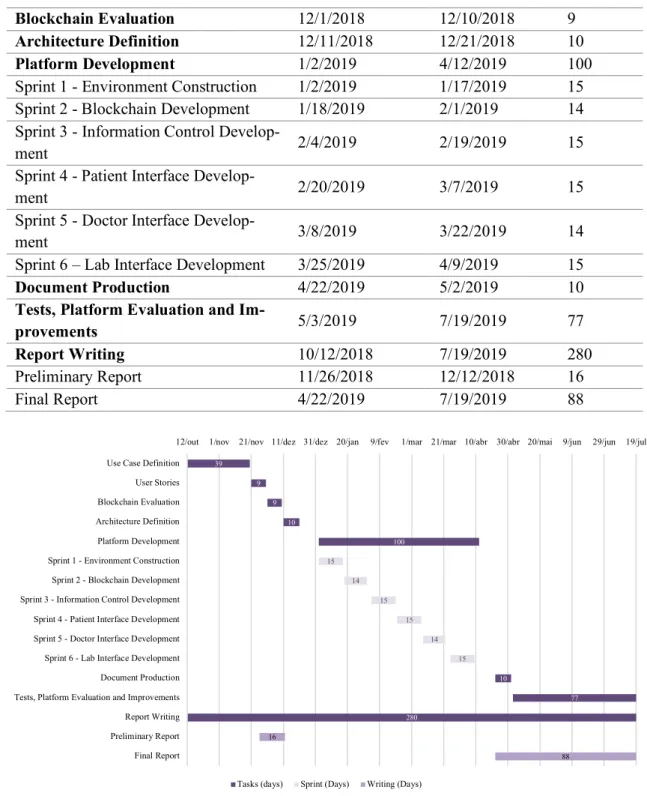
2.5. Planning
Table 2.1 details the planning from the start date of the project October 12, 2018 to the end date July 19, 2019. Due to the reasons mentioned above some of these dates are subject to change. The largest task, the prototype development purposely as a three-day gap to give the development of the sprints some slack for easier changes to the plan.
Table 2.1: Planning
Task Start Date End Date Duration
Use Case Definition 10/12/2018 11/20/2018 39
Chapter 2. Overview
8
Blockchain Evaluation 12/1/2018 12/10/2018 9
Architecture Definition 12/11/2018 12/21/2018 10
Platform Development 1/2/2019 4/12/2019 100 Sprint 1 - Environment Construction 1/2/2019 1/17/2019 15 Sprint 2 - Blockchain Development 1/18/2019 2/1/2019 14 Sprint 3 - Information Control
Develop-ment 2/4/2019 2/19/2019 15
Sprint 4 - Patient Interface
Develop-ment 2/20/2019 3/7/2019 15
Sprint 5 - Doctor Interface
Develop-ment 3/8/2019 3/22/2019 14
Sprint 6 – Lab Interface Development 3/25/2019 4/9/2019 15
Document Production 4/22/2019 5/2/2019 10
Tests, Platform Evaluation and
Im-provements 5/3/2019 7/19/2019 77 Report Writing 10/12/2018 7/19/2019 280 Preliminary Report 11/26/2018 12/12/2018 16 Final Report 4/22/2019 7/19/2019 88 Figure 2.1: Planning
2.6. Execution
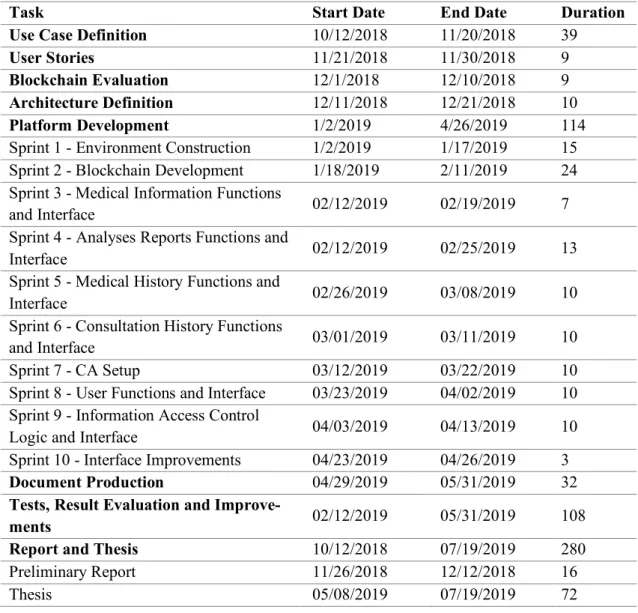
Table 2.2 presents the dates and duration of each task along with a chart of the timeline, figure 2.2.
While some the names of some tasks and sprints are different from the ones presented in the initial plan, they represent the same functions and actions as previously mentioned. The reason for the name, other changes and deviations from the original planning are explained in the next section of the report, Planning vs Execution. 39 9 9 10 100 10 77 280 15 14 15 15 14 15 16 88
12/out 1/nov 21/nov 11/dez 31/dez 20/jan 9/fev 1/mar 21/mar 10/abr 30/abr 20/mai 9/jun 29/jun 19/jul Use Case Definition
User Stories Blockchain Evaluation Architecture Definition Platform Development Sprint 1 - Environment Construction Sprint 2 - Blockchain Development Sprint 3 - Information Control Development Sprint 4 - Patient Interface Development Sprint 5 - Doctor Interface Development Sprint 6 - Lab Interface Development Document Production Tests, Platform Evaluation and Improvements Report Writing Preliminary Report Final Report
Chapter 2. Overview
Table 2.2: Timeline
Task Start Date End Date Duration
Use Case Definition 10/12/2018 11/20/2018 39
User Stories 11/21/2018 11/30/2018 9
Blockchain Evaluation 12/1/2018 12/10/2018 9
Architecture Definition 12/11/2018 12/21/2018 10
Platform Development 1/2/2019 4/26/2019 114 Sprint 1 - Environment Construction 1/2/2019 1/17/2019 15 Sprint 2 - Blockchain Development 1/18/2019 2/11/2019 24 Sprint 3 - Medical Information Functions
and Interface 02/12/2019 02/19/2019 7
Sprint 4 - Analyses Reports Functions and
Interface 02/12/2019 02/25/2019 13
Sprint 5 - Medical History Functions and
Interface 02/26/2019 03/08/2019 10
Sprint 6 - Consultation History Functions
and Interface 03/01/2019 03/11/2019 10
Sprint 7 - CA Setup 03/12/2019 03/22/2019 10
Sprint 8 - User Functions and Interface 03/23/2019 04/02/2019 10 Sprint 9 - Information Access Control
Logic and Interface 04/03/2019 04/13/2019 10
Sprint 10 - Interface Improvements 04/23/2019 04/26/2019 3
Document Production 04/29/2019 05/31/2019 32
Tests, Result Evaluation and
Improve-ments 02/12/2019 05/31/2019 108
Report and Thesis 10/12/2018 07/19/2019 280
Preliminary Report 11/26/2018 12/12/2018 16 Thesis 05/08/2019 07/19/2019 72 Figure 2.2: Timeline 39 9 9 10 114 32 108 280 15 24 7 13 10 10 10 10 10 3 16 72
12/out 1/nov 21/nov 11/dez 31/dez 20/jan 9/fev 1/mar 21/mar 10/abr 30/abr 20/mai 9/jun 29/jun 19/jul Use Case Definition
User Stories Platform Evaluation Architecture Definition Plarform Development Sprint 1 - Environment Construction Sprint 2 - Blockchain Development Sprint 3 - Medical Information Functions and Interface Sprint 4 - Analyses Reports Functions and Interface Sprint 5 - Medical History Functions and Interface Sprint 6 - Consultation History Functions and Interface Sprint 7 - CA Setup Sprint 8 - User Functions and Interface Sprint 9 - Information Access Control Logic and Interface Sprint 10 - Interface Improvements Document Production Tests, Result Evaluation and Improvements Report Writing Preliminary Report Final Report
Chapter 2. Overview
10
2.7. Planning vs Execution
As it was alluded to in the previous section and is observable after comparing the planning and execution sections there were deviations and alterations from the original plan during implementation. This project was my first time using and studying blockchain, as such there was no personal history that could be used to create the planning. Since this is a new technology there were no projects with a plan-ning to be studied at the host organization. Due to these factors, the plan was developed as that of any project for a similar non-blockchain platform, with slacks and enough room for change should it be required.
The first difference that can be observed is the increase in the duration of the second sprint of ten days. This is because to properly setup the blockchain, along with the correct Docker images, configu-ration of the network, more time was required. To do this, the tutorials offered on the Hyperledger Fabric website were followed. These tutorials covered not only setting up the network but also how to develop smart contracts. Besides these resources made available by the team behind Fabric, community pages and other online resources explaining how to setup and develop on Fabric were also consulted.
After doing the tutorials and learning more about Fabric and smart contract development it was clear that developing the access control as the first function would be impractical. This because it would complicate development and testing of all other features and also there would be no defined data or user types on the blockchain to take advantage of the features. As such, this sprint was moved to last. More-over, the sprint was also split into three:
• Sprint 7 - CA Setup: setting up the certificate authority to generate user credentials upon sign-up and changing the server and related methods to use these new credentials; • Sprint 8 - User Functions and Interface: developing the smart contracts for the user types
and related functions, the user interfaces for sign-up, login, changing all the front-end to adapt to the current user, based on its type, and adding support for these new user related requests to the server;
• Sprint 9 - Information Access Control Logic and Interface: implementing the information access control. This was done not by a specific smart contract but by adding code to pre-viously developed smart contracts. A front-end interface that allows patients to perform this control was also created.
With all of these new tasks the original fifteen-day sprint turned into three sprints totaling thirty days. During the planning phase the idea would be to develop the code, both back and front-end with a focus on the user. This meant implementing all functions and developing the user interface for a user type and then moving on to the next. However, much like for the access control, this strategy was soon proven incorrect. Instead software was developed based on the type of data. Given this, planning sprints four, five and six were replaced with sprints three, four, five and six as they appear in the timeline in the previous section. In more detail:
• Sprint 3 - Medical Information Functions and Interface: development of the medical in-formation smart contract, server support for requests and front-end interface for interac-tions with it;
• Sprint 4 - Analyses Reports Functions and Interface: development of the analyses reports smart contract, server support for requests and front-end interface for interactions with it; • Sprint 5 - Medical History Functions and Interface: development of the medical history smart contract, server support for requests and front-end interface for interactions with it; • Sprint 6 - Consultation History Functions and Interface development of the consultation history smart contract, server support for requests and front-end interface for interactions with it.
Chapter 2. Overview
Giving that some of the code developed for each of these smart contracts and front-end is very similar to one another the sprints sometimes overlapped.
A final short sprint to fix some bugs, implement a few features, such as saving the hash of the user password in the blockchain instead of the actual password, and make small adjustments to the front-end was also added to the front-end of the platform development task.
The document production task’s goal remained unchanged, documenting the entire code and cre-ating a presentation PowerPoint for Accenture with a short demonstrative video. This presentation was continuously improved with input from the Accenture team, which is the reason for this task to take up the entire month of May.
The testing task was also changed, to be concurrent to the development sprints of the smart con-tracts and front-end. After both were completed a series of functional tests were performed to spot bugs, errors and other problems. These would be fixed, and the tests repeated until no more issues were de-tected. After the end of the development task, a series tests with users were. It was decided not to im-plement any extra features because it would be too time consuming and the platform in its current state already permitted conclusions to be taken. This task was also ended in May to allow the remaining time to be dedicated to the production of this report. A decision that was made with the Accenture team.
Despite all the changes from the initial plan, all the features and functionalities of the platform were implemented, and the development task’s duration didn’t suffer an excessive increase.
Chapter 3. State of the Art
Chapter 3. State of the Art
In this chapter there is a presentation of important concepts regarding blockchain that are needed to understand the technology, as well as, the tools, programming languages and methodologies used. All the considered blockchain implementation are also described here. Related systems and a comparison between them and the one developed for the dissertation is also included.
3.1. Important Concepts
3.1.1. Blockchain
Blockchain or distributed ledger technology describes a set of transaction records grouped into blocks. Each block is linked to the previous one using cryptography. The entire chain is stored in every node.
3.1.2. Nodes
A node on a blockchain refers to a client running an application that allows it to access and act upon the network. These actions can be executing transactions, mining, etc. Nodes are also responsible for managing the blockchain using peer-to-peer protocols and consensus mechanisms.
3.1.3. Transactions
A blockchain transaction is an action taken by a node in the blockchain. This action can be the transfer of cryptocurrency between peers, trade of the ownership of tokens or the update of the data stored in the blockchain.
Like the structure of the blocks, the type of transactions is only limited by what the developers stipulated when creating the blockchain. [2]
The verification of each individual transaction is also dependent on implementation of the block-chain.
3.1.4. Blocks
When a predefined number of transactions have been validated they are grouped in a block and added to the blockchain. Every block contains the hash value of the previous one in the chain, a timestamp and the data of every transaction contained in it. The transaction data is stored in Merkel Trees. All three of these elements are in the block header. It is the fact that every block contains the hash of the previous block that creates the continuous chain and allows for the trace back of every transaction stored in the blockchain going back to the first one.
The first block of a blockchain is the genesis block. Since there is no block prior its data is hard coded by the developer.
Chapter 3. State of the Art
14
Figure 3.1: Example of a block [3]
In the image above, it is possible to see all the elements referenced as well as others like the block nonce. Given the numerous implementations of blockchain the structure of the blocks tends to differ.
After being create a block is only added to the chain after a consensus is reached by the nodes. This mechanism can vary depending on the blockchain implementation, examples of consensus are proof-of-work and proof-of-stake.
3.1.5. Ledger
A copy of the blockchain is kept by each node. It is because the copies of the ledger are distributed across the network that blockchain technology is also called distributed ledger technology (DLT).
This can cause issues, because different nodes can have different versions of the ledger which leads to problems and inconsistences when new blocks are being validated. Solving these problems is another of the reasons why consensus mechanisms are so important.
3.1.6. Forks
A blockchain fork happens when there is a divergence in the current status of the chain. This can be because nodes have different versions of the ledger. Usually this is resolved with consensus mecha-nisms. Forks come in two types, soft forks (when rules change but valid blocks under these rules are still valid under the old ones), and hard forks (when rules change but valid blocks under these rules are invalid under the old ones).
3.1.7. Consensus Mechanisms
To ensure that new blocks are not added by malicious nodes, there are consensus mechanisms to approve their addition to the chain. These mechanisms are also used to keep the most up to date version of the ledger in every node, by controlling the updates of those ledgers. Since blockchain is a decentral-ized system there is no owner or authority that can declare a certain version of the data the true and correct one. There are many advantages to this, namely that a malicious owner is not manipulating the data or resources of the network to their benefit. However, without this single source of truth, nodes need some way to agree on what is the correct version of the truth. This is where consensus mechanisms come in.
While the number and variety of consensus mechanisms is far too great to do an exhaustive anal-ysis, the following are some of the most common:
• Proof-of-Work: it is based on the idea of trying to solve a very complex mathematical problem with a highly verifiable result. Nodes have to solve a problem associated with a
Chapter 3. State of the Art
block to verify it. They do it by lending their computer’s CPU to making the calculation to solve the problem. This problem’s complexity is related to the difficulty of a block, an attribute set in the header of the block. The nodes that work to solve this problem are called miners and the process is called mining. The most famous example of proof-of-work application is Bitcoin, where miners are rewarded with a certain amount of the cryp-tocurrency if they contribute to the solution. The guiding principle is that the correct ver-sion of the ledger is the one with the most work done; [4]
• Proof-of-Stake: in this algorithm instead of being the node with the most work that gets to decide the most up to date version of the chain, it is chosen one of the nodes with the most stake in the decision. This stake is generally the amount of cryptocurrency held by a node. The more stake a node has, the more likely it is that it will be selected. There are some variations of this selection mechanism, such as randomized block selection, coin age-based selection, delegated proof-of-stake, randomized proof-of-stake; [4]
• Practical Byzantine Fault Tolerant Mechanism: blockchains like many other systems are vulnerable to byzantine failures. These happen when a certain number of nodes stop working properly or purposely act with malicious intent. As the name indicates, byzantine fault tolerant systems can function correctly despite the malfunctioning or malicious nodes, as long as they do not exceed a certain number. These mechanisms work by having nodes trade messages and comparing them. When a certain number of identical messages is reached, then the network achieved a consensus and the block is validated and added to the chain. [5]
All three of these mechanisms have some disadvantages, so blockchain developers have to be very careful in choosing them. Proof-of-Work’s hashing problems are extremely computationally and energy intensive creating a problem that could ultimately prevent blocks from being validated. In proof-of-stake, while it does not have the CPU and energy consumption of the previous system, in case of a fork in the blockchain nodes lose the incentive to keep stake in multiple chains, which would lead, in extreme cases to an impossibility in block validation. There is also a problem of double spending. [4] In the case of practical byzantine fault tolerant mechanisms, the message trading process can be slow which might lead to problems of slow block validation. [5]
3.1.8. Smart Contracts
Smart contracts are pieces of code that implement business logic on the blockchain. This can range from charging for the use of a resource, immediately sending updates to nodes when certain actions are performed on the chain, controlling access to information and data, to name a few. Not all blockchains support the implementation of smart contracts.
3.1.9. Permissionless Blockchains
A permissionless blockchain is one where anyone can sign up and fully participate without the need for approval by members. Bitcoin is the most obvious example of this type of implementation. In this blockchains all nodes can make transactions, create smart contracts (if supported), mine or invest stake in verifying blocks and be rewarded for those actions. [6]
3.1.10. Permissioned Blockchains
In contrast to permissionless blockchains, in permissioned blockchains entry into the network is restrict only to certain members. The actions nodes are allowed to perform also depend on what
Chapter 3. State of the Art
16
permissions they are given. Nodes in these chains can only see certain transactions. It is this ability to control who joints the chain, what operations each member can perform and the transactions they can see that makes permissioned blockchains the preferred type for corporations, governments and busi-nesses. [6]
3.1.11. Public Blockchains
Public blockchains refer to the ones where anyone can join without permission. While this might sound similar to permissionless blockchains, public is only about the ability to join the network. What a node can do and see will depend on the implementation. Though public blockchains tend to also be permissionless. [7]
3.1.12. Private Blockchains
A private blockchain is a network in which membership is controlled by some sort of authority, such as the creator of the chain. Like public blockchains, private networks have no obligation to be permissioned, though that is the norm. A private blockchain can allow every member to use all of its functions and access/see every transaction that occurs in it. Hyperledger Fabric is an example of a private blockchain. [7]
3.1.13. Advantages
DLTs have multiple advantages, namely:
• Immutability: once a block is added to the chain, changing the data of any of its transac-tions is virtually impossible. This happens because each block is cryptographically linked, so to change something, it’s hash value will also change and the next block’s header sec-tion with the hash of the previous block would no longer point to the changed block, making it easy to detect manipulation. To prevent this from happening it would be nec-essary to change the previous block hash of the next block for it to point to the changed block. However, this would also change that block’s hash, so the process would have to be repeated until the most recent block on the chain. While doable, the amount of com-puting power makes this a near impossibility.
• Transparency: regardless of the type of blockchain it is always possible for all or at least some of the members to access the records of every transaction. This allows for greater transparency because it is easy see what node made a certain transaction, making it easy to audit the chain.
• Trust: due to its guarantees of immutability and transparency blockchain gives nodes trust in the data and validity of the transactions. Not to mention that every node as the same source of truth.
• Data Access Control: using smart contracts and private permissioned blockchains it is possible to manage what nodes can see and do on the network.
• Decentralized: the decentralized nature of blockchain makes it far more resilient to attacks because unlike traditional databases there is no single point of failure.
• Eliminates Third Parties: since it creates trust in the authenticity and treatment of the data, while also allowing it to be processed in the network, blockchain removes the need for third parties to authenticate the data. Due to the fact that the ledger is stored in every node of the network, it also eliminates the need for third parties to store the data.
Chapter 3. State of the Art
3.2. Blockchain Implementations
3.2.1. Ethereum
Much like Bitcoin, Ethereum is also a public blockchain and it as its own cryptocurrency, the ether. While Bitcoin was designed around bitcoin, its namesake currency, Ethereum can be used to build a wide variety of distributed applications with or without cryptocurrencies. It even allows developers to create their own currency for trading publicly or only in a specific application. [8] Unlike Bitcoin, smart contracts are a feature of Ethereum greatly increasing the capabilities of what can be done with this blockchain. Its creators meant Ethereum to be simple, fast to use, modular, universal and agile. The consensus mechanism utilized is of-work, but the developers are working on implementing proof-of-stake to increase speed to which transactions and blocks are validated.
3.2.2. Hyperledger Fabric
Hyperledger Fabric is an implementation of Hyperledger, a DLT being developed by the Linux Foundation, whose objective is creating an open-source platform for businesses. Fabric is an IBM pro-ject and the main focus is the running of smart contracts, called chaincode. [9] It has a pluggable con-sensus mechanism, which gives developers greater freedom in choosing the system that better suits their solution. Currently it uses practical byzantine fault tolerant mechanisms to achieve consensus. Hy-perledger Fabric is private giving it even greater privacy, by controlling who can join the network. With smart contracts it can also be permissioned. Hyperledger has no native currency and none can be created. However, using chaincode it is possible to develop tokens, but these are very different form bitcoin or ether.
3.2.3. R3 Corda
Corda was developed for the financial services industry. Just like Fabric it is a private DLT im-plementation that supports smart contracts and can also use them to manage access and operations by its members, allowing it to be permissioned. [10] In terms of consensus mechanism, these are generally at an individual and not global level and are defined during the implementation of the network and not predefined by the framework. A unique feature of Corda, at least with regards to the other blockchains in this list, is the fact that the only parts privy to a transaction are the ones involved in validating it. It was design with highly regulated industries in mind and to allow for institutions to communicate and work with each other without a central authority in the middle. Another feature of its design is the ability to add special nodes for regulators and observers. Smart contracts are used to directly mirror regulations, legislation, procedures and legal documents. In a similar fashion to Hyperledger, Corda does not include any cryptocurrency.
3.3. Methodologies, Programming Languages and Tools
3.3.1. Agile
The planning of the work was made using the Agile method for software development, because it offers more freedom and tolerance to changes and problems. It is these characteristics that make Agile ideal for creating a plan for software development using new technologies.
Chapter 3. State of the Art
18
This methodology is based on the following ideas: greater importance in the people and interac-tions rather than the tools and processes; more focus on a working product than on extensive documen-tation; involving the customers during the development instead of relying only on what was negotiated in the contract; being responsive to changes and not being restricted by the plan. [11] The ideas men-tioned above, and twelve principles of Agile software were published in 2001 by a group of seventeen signatories. Their document the Agile Manifesto became the basis for this methodology.
It should not be interpreted with it that procedures, tools, plans and others are not important, but that they ought not restrict development nor restrict flexibility to that address problems.
In Agile work is divided in sprints, short work periods that produce a something “tangible” in the end. [12] This division into sprints is due to the incremental nature of the methodology, i.e. with each task’s conclusion the value of the currently completed solution will increase. The sprints also allow for a fast identification of problems ensuring that they will not go unnoticed until very late in the project where resolving them would be more expensive.
3.3.2. FURPS+
To identify and classify the requirements I used FURPS+. This model is helpful because it in-cludes not only the functional requirements, extracted from the user stories of the Agile method, but also the nonfunctional ones.
FURPS+ is a software quality attribute classifier model. It was developed by Hewlett-Packard. It stands for: functionality; usability; reliability; performance; supportability. The “+” refers to the follow-ing requirements: design constraints; implementation constraints; interface constraints; physical con-straints. [13]
3.3.3. JavaScript
JavaScript is an object-oriented programming language primarily used in the development of web pages. It is a client-side language that allows for the scripting of behavior of web sites and other web-based applications. [14] JavaScript is not a typed language, i.e. it does not have the rigid data types of Java or C.
3.3.4. Node.js
The smart contracts and server were written in Node.js. This was done due to the better support of the Node SDK for smart contracts in Hyperledger Fabric. Node.js has as its core JavaScript. It is ideal for developing network applications due it’s asynchronous event driven runtime nature. Node.js was developed to facilitate scalability of applications. [15]
3.3.5. Angular
The entire front-end of the platform was written using Angular. This is development platform for applications. The languages used were TypeScript for the logic and HTML for the user interfaces. [16]
3.3.6. TypeScript
TypeScript is a typed implementation of JavaScript. Syntactically there is no difference between the two, except the ability to add variable and attribute types on TypeScript. It was developed by Mi-crosoft. [17]

![Figure 3.1: Example of a block [3]](https://thumb-eu.123doks.com/thumbv2/123dok_br/18274517.880899/33.892.354.584.109.324/figure-example-of-a-block.webp)