In addition, the study discusses concepts and definitions related to modularity and the applicability of modularity thinking in the media industry. Also, people who have downloaded PopularScience+ in the US are not readers of the print version.
Objective of the study
All these different styles and platforms have their own logic in terms of content, technology, production, advertising and business models. The project examines the current state and future prospects of e-readers, as well as usage patterns and content-oriented business models for the devices.
Methods and Limitations of the study
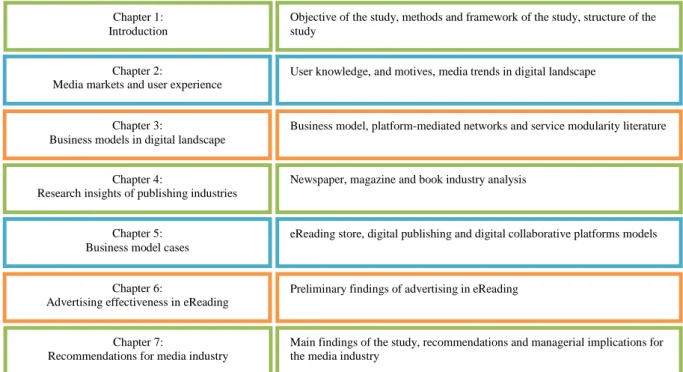
Structure of the study
A central trend in digital content production and reading is the increasing autonomy of the audience which has led to increasing possibilities and demands for interactivity with the content and between media users. The crucial basis for media innovations is to understand the meaning and motivation of media in the everyday life of the people.
Media use and media strategies are changing
The second driver concerns users and their contributions: ―The hope for reputation and fame, and sometimes even for financial compensation, compels citizens to produce and distribute media content. What matters in the future is how interesting the content you produce is, not what it says on your phone card.‖.

Media contents and audiences products
In the business models and value propositions, much more emphasis should be placed on the content from the point of view of media users and their practices. For example, nearly half of prime-time television leaves the room during commercial breaks in the United States.
Radical and design based innovations
The key question is "How could I make people's lives better?" The proposal is something people did not know until they saw it or used it in their everyday context, which is also changed by the new design innovations. Both approaches above have the idea variation in common: ―the world of variation is please fail – by making many small mistakes, the organization learns‖.
Interactivity
There has been a dramatic increase in the ability for readers to produce content for online across all the major press title sites. Domingo's findings suggest that interactivity in practice could be a myth on media title sites, as traditional inertia in the online newsroom prevents them from developing the ideals of interactivity.

Improving and funding digital journalism
In the early years of this decade newspapers experimented with chargeable content but soon reverted to the free model as customers were unwilling to pay (Kay and Quinn. The Sunday Times Wine Club is one of the largest wine merchants in UK.
Introduction
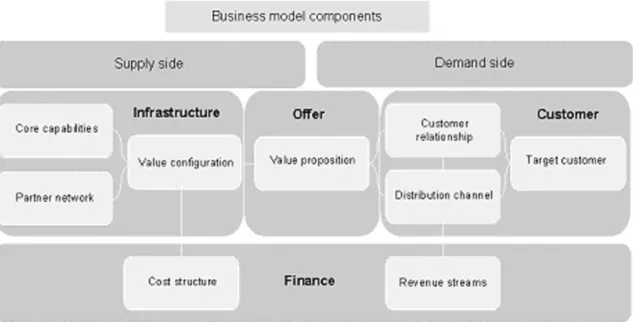
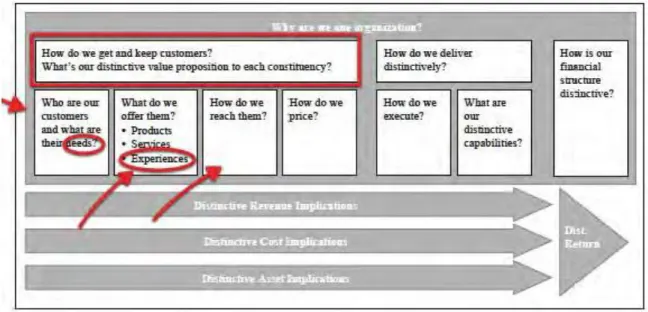
A company's business model is an important locus of innovation and a crucial source of value creation for the company and its suppliers, partners and customers (Amit & Zott, 2001). The primary purpose of understanding an organization's business model is to understand the company's business logic of making money (Tankhiwale, 2009).

Media business models
This means placing knowledge of the client practices at the center of the research agenda. In resource-based view, the customer is approached as a resource for the supplier and its production.
A new techno-economic paradigm is rupturing old media business models
However, it retained existing sales channels even though both business models are effective in competition (Wall, Jagdev & . Browne, 2007). In the late 1990s, eBusiness models were hailed as the opportunity to exploit new markets (Wall, Jagdev & Browne, 2007).
Modularity as a concept and its ―moral‖ for media industry
There are many other positive effects mentioned in the literature that have been seen to be achieved with modularity. Modularity challenges presented in the literature include the impact of modularity on companies' innovative capabilities.
Concepts and definitions related to modularity
The discussion of service modularity has been strongly influenced by the earlier discussion of product-related modularity (Bask et al., 2010). Topics related to the concept of service modularity include functionality packaging, interface standardization, and module reusability and interchangeability (Bask et al., 2010).
Modularity as a concept in the media industry
Modularity and platforms of business models
In that case, those processes that can be shared for all business models form the business model platform. The use of business model platform thinking for sketching optional future business models combined with scenario work is presented in the following figure.
Summary
Another example of using a business model platform is Amazon which has multiplied its business model after starting with books to many other products. In the following business model, platform thinking is exploited in the development of a business model framework for the media industry (see chapter 3.6).
Pricing strategies and alternative payment methods in electronic reading platforms
Two-sided markets
For a single media company, a modular business model makes it possible to outsource parts of its business model. From the platform's perspective, there are two levels of platform roles: platform owners and platform providers.
Network effects and pricing issues in eReading platforms
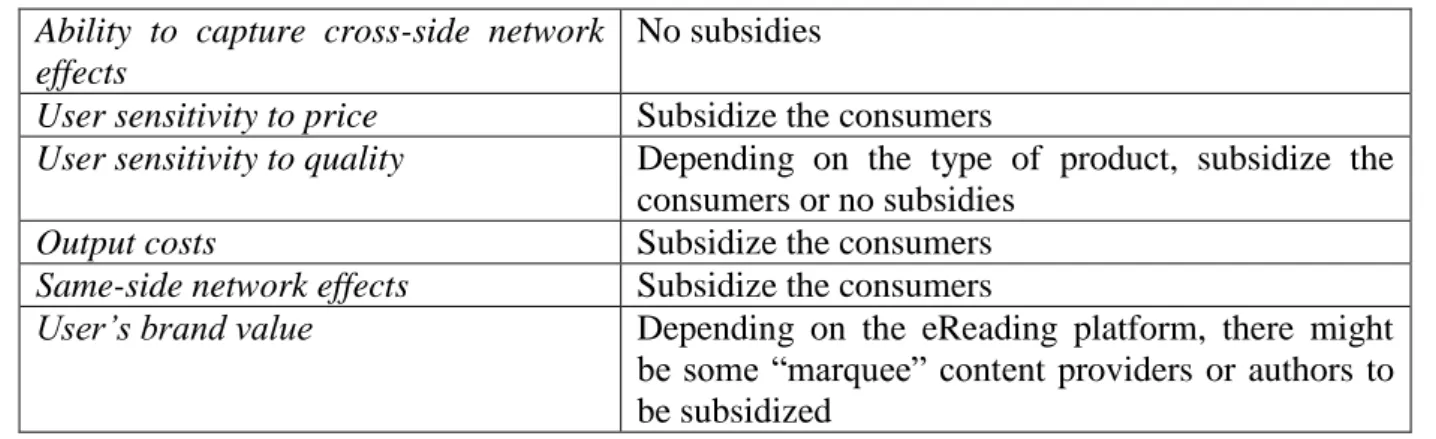
Charging content providers some small entry fee to the eReading platform and subsidizing consumers (eg in the form of free articles and books) makes sense and has actually already been implemented (eg in the iBooks app for iPad, the consumer gets some basic elements books such as ―Winnie the Pooh‖ for free). On eReading platforms, the product offered to consumers is reading material in digital format. On e-Reading platforms, there may be some content providers and high-profile authors who are simply required to be associated with the e-Reading platform in order to make the platform attractive to consumers.
Winner-take-all dynamics and multi-homing costs for consumers
In the case of e-reading platforms, preferences for special features may arise from the different usage patterns of consumers on the e-reading platform. To conclude, on the issues of winner-take-all dynamics and e-reading platforms converging into one single platform, the results are mixed. On the other hand, the multi-housing cost for the consumers is relatively low (provided that e-reading platforms can be installed on multiple e-reading devices), which indicates the possible coexistence of multiple e-reading platforms.
Payment methods in electronic reading devices
A third interviewee from the newspaper segment says that "the better a person has, the more likely he or she is to follow our online media." In addition, the Sony Reader Store provides information to customers about ―applicable content owners‖. The ePapers versions of Les Echos and the Financial Times are examples of generic closed business models—the content is the same for all customers and can be consumed in a specific format and through a specific platform.
In September, Les Echos launched its e-paper version – the world's first e-paper version. On the other hand, for newspaper and magazine publishers, the new situation also brings uncertainty, as the competition for ownership of customer information (ie, relationship) is intensifying. The most important question is the "spirit" of the business model, i.e. the logic that determines how the business model becomes successful.
Two models of multimedia news production – The cases of novotécnica and La Verdad Multimedia in Spain.

Development of a business model framework for the media industry
Overview of publishing industry; newspaper, magazine and book
- Roles in the value proposition
- The impact of cannibalization on print
- Key issue in digital landscape
- Target segments of digital media services
- Existing customer segments
- Current market
- Market growth
- Development phase
- Competition
- IPR issues
- Profitability of digital media services
- Pricing
- Current earning logic in the digital media services business
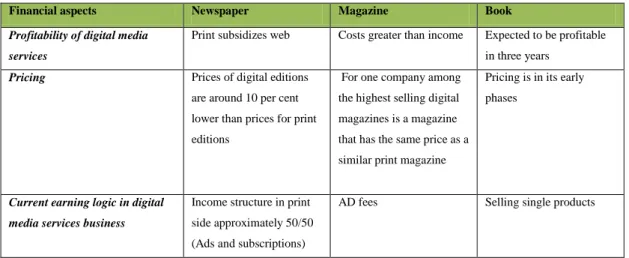
In the magazine industry, the market for digital media services is currently insignificant, measured in euros. Companies in the newspaper industry are at very different starting points in the production of digital media services. The business of digital media services in the book industry is expected to become profitable within three years.
Digital evolution in the music industry
Revenue on the print side of the newspaper industry is split roughly evenly, with about half of the revenue coming from advertising and half from subscriptions. By comparison, e-book sales accounted for only 1.5% of total book sales of the same content in 2009. Spotify has developed a business model that seems to solve some of the challenges of the legacy music industry business models from a consumer perspective.

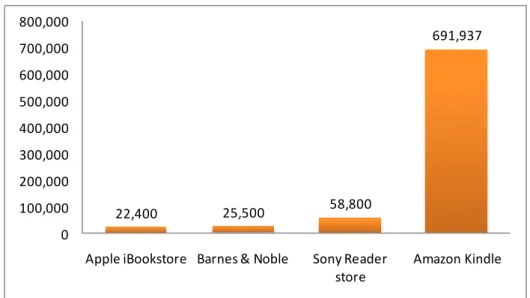
As with Amazon.com, Barnes & Noble has also released its own application for the iPad. Prices on the Sony Reader Store website are, on average, slightly higher than comparable e-book sites such as Amazon.com and Barnes & Noble. However, unlike Amazon.com or Barnes & Noble, only digital versions are available for purchase.
Digital publishing around the globe
- Single media company: Case, Les Echos
- Single media company: Case New York Times
- Single media company: Case Bonnier
- Single media company: Case Financial Times
In the electronic version, the New York Times has a nice layout very close to that of the print version. The changes are based on "propensity modeling," the ability to determine readership habits and their response to various content and pricing restrictions. Business news and data is emerging as one of the most competitive sectors in the information industry.

Digital collaborative platforms in media industry
Market-based collaborative platform: Case Next Issue Media
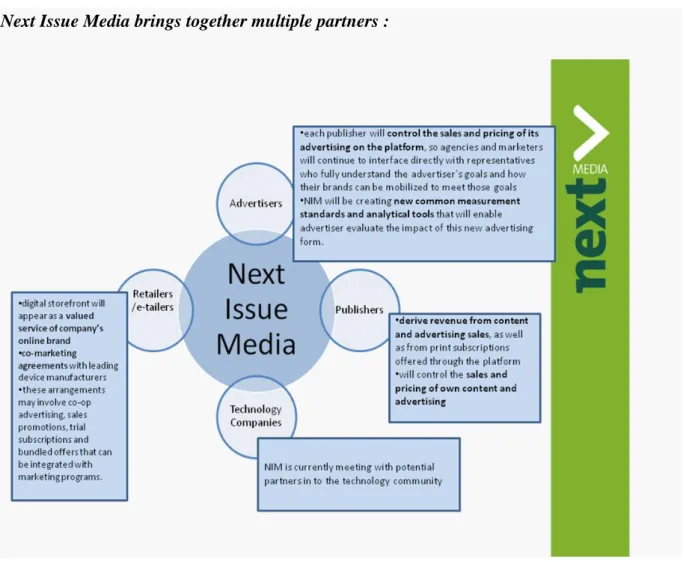
The Financial Times newspaper was established in 1888, and today is part of the Pearson Group. Publishers will control the sales and pricing of content and advertising and will not be restricted in any way from participating in other digital publishing initiatives. Technical solutions will be supported by the technical expertise and innovative resources of the technology community (Silicon Valley).
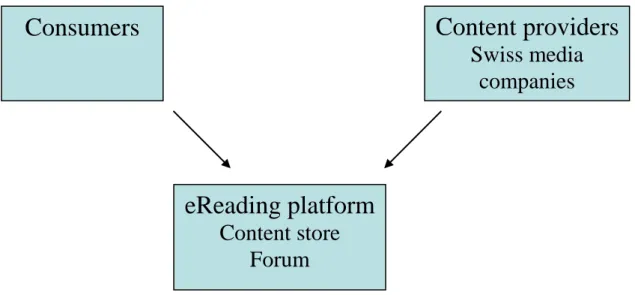
Cooperative / collaborative platform: Case Codex – Swiss joint venture for e-reading
The position of the future eKiosk in the two-way network is shown in the figure below. Test users in the pilot project used the iRex eReader which is an 8.1‖ black and white touchscreen device with stylus. One of the main challenges in the Swiss joint venture is how to create attractive offers that customers are willing to pay for.
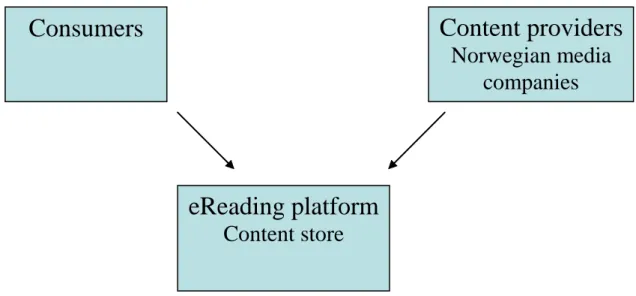
Co-operative collaborative platform: Case ―Lesebrettprosjektet‖
In the test project everything (content and hardware) is free, but only for test users. In the future, different models will be used and users will have to pay for the content. For users in the pilot project, eReaders have not been easy to work with.
Summary and evaluation of different business models in media industry
- Case Amazon
- Case Apple iBookstore
- Case Norway and Switzerland
- Case Les Echos
- Case New York Times
- Case Bonnier
- Pricing
- Highlights of business model cases
The electronic version of the New York Times has a pleasant layout very close to that of the printed version. The price of Popular Science+ is 511 percent of the price of the equivalent print version in the United States. Bonnier's iPad version is also more expensive: the price of Popular Science+ is 46€ when the price of the cheapest traditional version of Popular Science is only 9€ in the United States.

How can firms advertise on an eReader?
Challenges facing business model development for eReading
The interviews with people in the newspaper industry raised the following key development needs. IPR issues in the e-reading world are a new area and there are no established procedures. In many cases, consumers are used to not paying for the digital media services offered by companies in the publishing industry.
Towards future BM in media industry
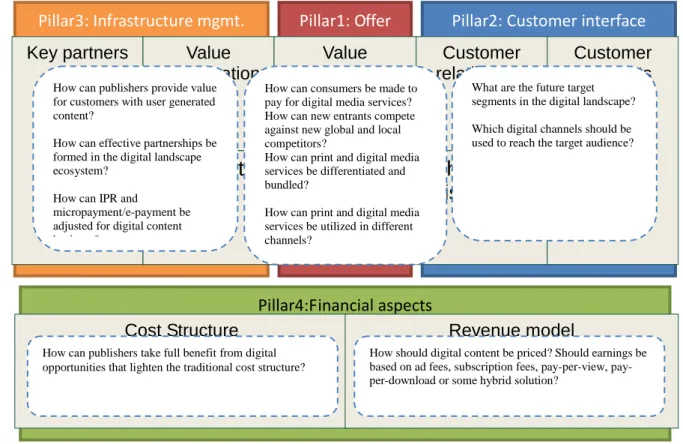
For example, book publishers cannot on their own decide on a certain business model and take a certain role in the value chain without paying attention to authors and others. This business model framework of four different business model options, presented in Figure 49, provides a tool to analyze current and planned e-reading business models and contrast them with competitors in the e-reading industry. Our identification of the most important internal and external factors that have an effect on the choice of business model will help publishers steer business model development in their chosen direction.
Towards development of business models for eReading
- Trends affecting the relationship between content providers and users
- Further drivers and probable consequences
- Realizing the new opportunities
- Issues to be discussed related to future eReading business models
As content will ultimately be aggregated only in the pocket of each content user, engaging personalization platforms, including discussion forums, are becoming essential. The theoretical implications of the two-sided network research suggest that the e-reading market may converge to one dominant platform in the future if the network effects of e-reading platforms are significant. Transforming organizations and workflows: Publishing interactive offers in a scalable and repeatable way will require a rethinking of workflows and organizations. Major changes in the mental models and business processes of media companies are likely to be necessary in order to take full advantage of the new opportunities.
Summary and next steps
Ad cutouts: All ad cutouts used in the first phase of the study (see experimental design) were tailor-made combinations of an ad and a piece of news text. As can be seen in Table 2, the ranking of the brands was relatively similar (Elisa and Nokia were exceptions) between groups 1 and 2. Revisiting 'mass communication' and the 'work' of the public in the new media environment Media, Culture & Society.