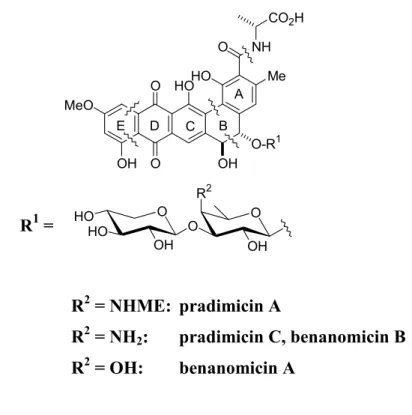
In this study, the α-analog of the disaccharide derivative of pradimicin A was synthesized in its protected form. The final coupling of the α-glycosyl fluoride with the D-xylose-derived thioglycoside donor by NBS yielded the protected α-analog of the disaccharide fragment of pradimicin A.
Introduction to pradimicins
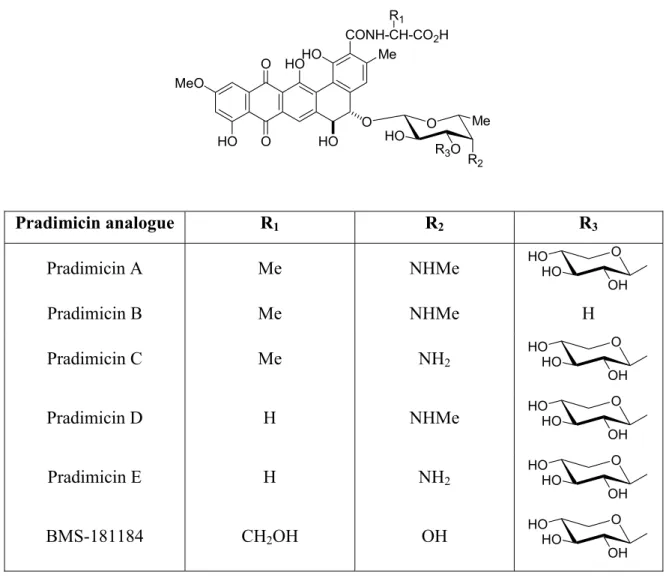
Structure of pradimicins
Biological activity
Only the free C-18 carboxyl group of pradimycin is thought to bind to calcium, whereas the C-5 disaccharide moiety is essential for stereospecific recognition and binding. BMS-181184 (Figure 1), a water-soluble D-serine analog of pradimycin A, whose amino functionality of the disaccharide unit is replaced by a hydroxy group20, is currently targeted for clinical drug development.
Synthesis of amino sugars from amino acids
Monoamino dideoxyhexoses
- Mycaminose
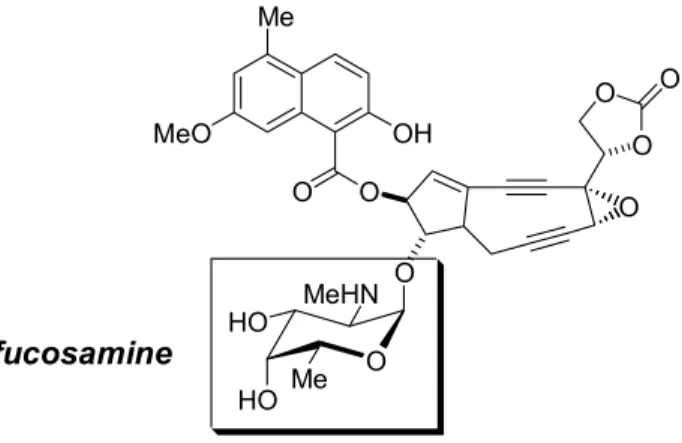
- Fucosamine
- Elsaminose
- Dideoxygulopyranoside
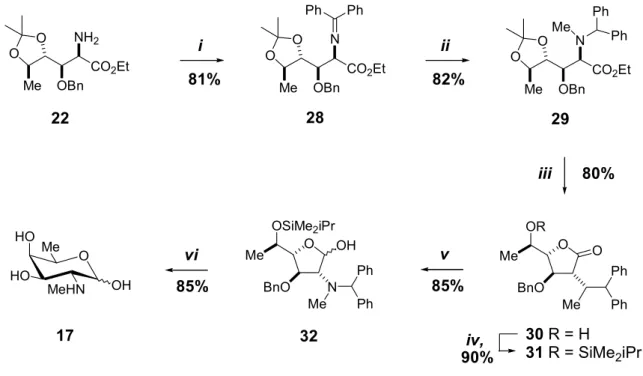
Reduction of 12 to the secondary amine followed by N -methylation and cleavage of the silyl protection afforded the primary alcohol 14 , which was converted to the α-aminoaldehyde 15 by Swern oxidation. Benzyl protection of the intermediate 20 followed by selective hydrolysis of the pyrazine moiety afforded the amino ester 22 .
Monoamino trideoxyhexoses
- Daunosamine
- Hollantosamine
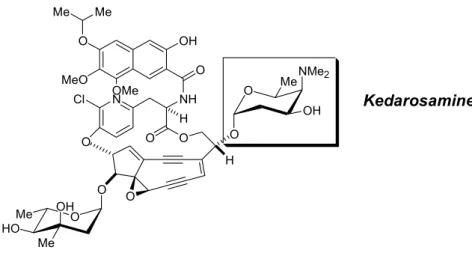
- Kedarosamine
Stereospecific addition of ammonia to the double bond and acid hydrolysis of the dioxolane ring followed by benzoylation led to the formation of lactone 52. Removal of the silyl protection and oxidation of the resulting free hydroxy group produced the L-homoserinal derivative 63.

Monoamino tetradeoxyhexoses
- Tolyposamine
Preparation of the target aminosugar 98 starting from an equivalent of L-allo-threonine 75 can be achieved via either acyclic 92 (Scheme 13) or cyclic 76 (Scheme 14) aldehyde intermediates. Cleavage of the PMP-group afforded primary alcohol 97, which was transformed into the target N-acetyl-L-tolyposamine 98 by oxidation and selective deacetylation in 16% overall yield from 75.

Miscellaneous deoxyaminohexoses
- Sibirosamine
- Purpurosamine
- Destomic acid
- Lincosamine
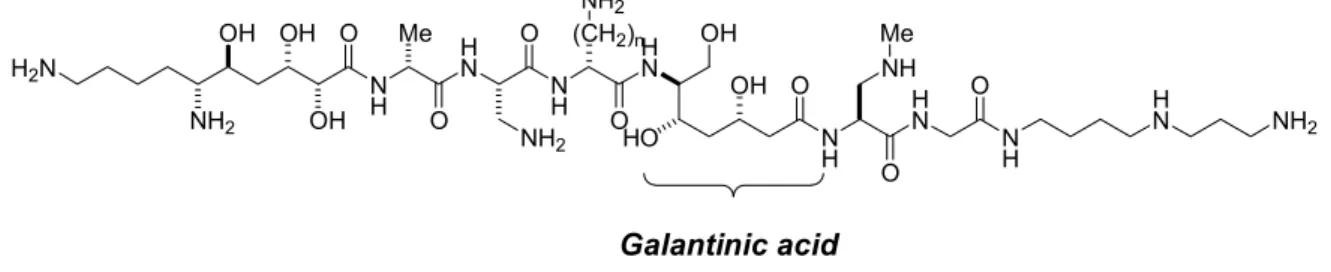
- Galantinic acid
Oxidation of the hydroxyl group at C3 in the corresponding ketone, followed by immediate reduction afforded a 3:1 mixture of stereoisomers (3S)-195 and (3R)-193, respectively. After protection of the ketals, oxidative Lemieux–Johnson cleavage of the double bond afforded the corresponding aldehyde 201 .
Pradimicin syntheses in the literature
Synthesis of the aromatic aglycon of pradimicin
- Suzuki
- Hauser
The first step in the synthesis of the aglycone moiety was the preparation of the A and CD rings. In the synthesis of the CD ring fragment 219, the known compound 213 was first regioselectively hydroxymethylated and then O-methylated, yielding the benzyl alcohol 214 (Scheme 26). Additional methylation of the mixture yielded the dimethyl ether 241, which upon bromination yielded the dibrominated product 242.
Design of the suitable disaccharide donor
The thioglycosyl donor 250 was derived from D-xylose, and the fluoride acceptor 251 was prepared from a D-glucose derivative in 8 steps (Scheme 33). After acetylation of 257, the anomeric position of 258 was fluorinated with HF.pyr complex and the acetate protection was cleaved to give the fluoride 259. The desired pradimicin disaccharide fragment 252 was obtained via NIS/TfOH glycosylation.71 Treatment of the thioglycosyl donor thioglycosyl and the glycosyl fluoride acceptor 251 with NIS and a catalytic amount of TfOH in CH2Cl2 at –40 °C for 2 h gave a 1:5 mixture of α- and β-glycosylated disaccharides, from which the required β-glycoside 252 was isolated by crystallization (Scheme 32).
Glycosylation study
- Stereochemical aspects
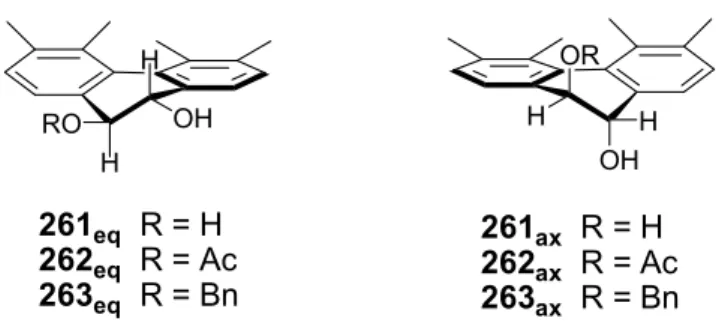
Attempted glycosylation of disaccharide 252 with BnOH using Lewis acids (BF3.OEt2 or TMSOTf) resulted in complete recovery of the starting material (Entries 1 and 2). Using the traditional SnCl2/AgClO4 activation procedure resulted in selective β-glycosylation but in low yield (Entry 3). In the case of diaxial 261 only β-glycosylation took place, although formation of the bis-glycosylated product was also observed.
Synthesis of the disaccharide fragment of pradimicin A
General
A glycosidic bond is usually formed by displacement of the leaving group at the anomeric position of the glycosyl donor with the free hydroxyl group of the glycosyl acceptor (Figure 15). When planning the synthesis of the disaccharide unit, the above factors had to be taken into account. The first step of the reaction mechanism consists of SN1-type cleavage of the leaving group (LG), leading to the formation of a glycosyl cation.

L-Threonine based approach to the synthesis of the amino sugar fragment
Formation of E- and Z-enoates via modified Horner-Wadsworth-Emmons
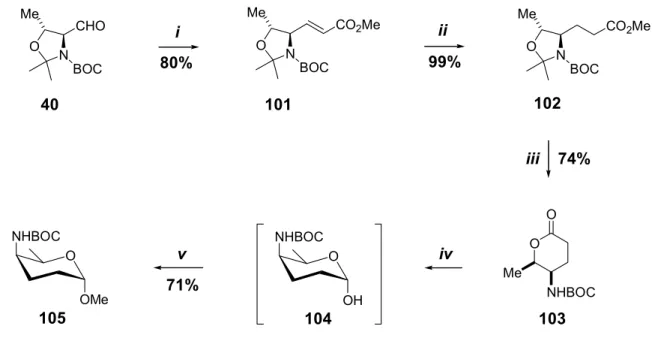
40 was achieved by the combined use of trimethylphosphonoacetate, potassium carbonate and 18-crown-6-ether in toluene, yielding an E/Z ratio of 19:1.34 However, to reduce the overall cost of the synthesis sequence by using To avoid a large excess (200 mol%) of the expensive 18-crown-6-ether in this specific step, we investigated the effect of different bases (especially the metal cation) on the E/Z selectivity in the absence of 18- crown-6. In a typical procedure, trimethylphosphonoacetate and the base were combined and stirred with the solvent for 1 hour at ~0°C before adding the aldehyde 40. The absence of 18-crown-6-ether resulted in modest stereoselectivities, and the differences between KHMDS and NaH as base were insignificant: the E/Z ratio of the olefination products with KHMDS was 6:1 and with NaH 5:1.
Ruthenium-catalyzed cis-dihydroxylation of the double bond
In conclusion, to obtain the E -olefin 101 in high stereoselectivity, the presence of 18-crown-6-ether in the reaction system was required. The other alternative was the awkward and time-consuming separation of the E/Z mixture by flash chromatography. The mechanism of the ruthenium-catalyzed dihydroxylation is not clear, but the cis stereochemistry of the resulting diols derived from cycloalkenes suggests a cyclic intermediate.86 Two basic mechanisms for the ruthenium- or osmium-catalyzed dihydroxylation have been proposed: the classical, concerted [3+2] cycloaddition mechanism and a stepwise [2+2] mechanism (Fig. 18).
Lactonization
The idea to form the bicyclic lactone 276 arose from the acid-mediated lactonization results reported for the L-serine derivative 278 in our group.89 Treatment of the Cbz-protected, L-serine-derived antialcohol 278 with camphorsulfonic acid at rt for 12 h had produced the bicyclic lactone 279 (scheme 40). Most of the methods tested had given a mixture of the open-chain product 281 and the lactone 42, but the reaction carried out in glacial acetic acid at 60 °C had produced the lactone 42 as the only product (Scheme 42). It is evident that the free hydroxyl groups in the diol interfered with the lactonization process and should be protected before cyclization.
Model oxidation studies by molecular oxygen
- Cobalt salen and pyrrolidine complexes in the oxidation of
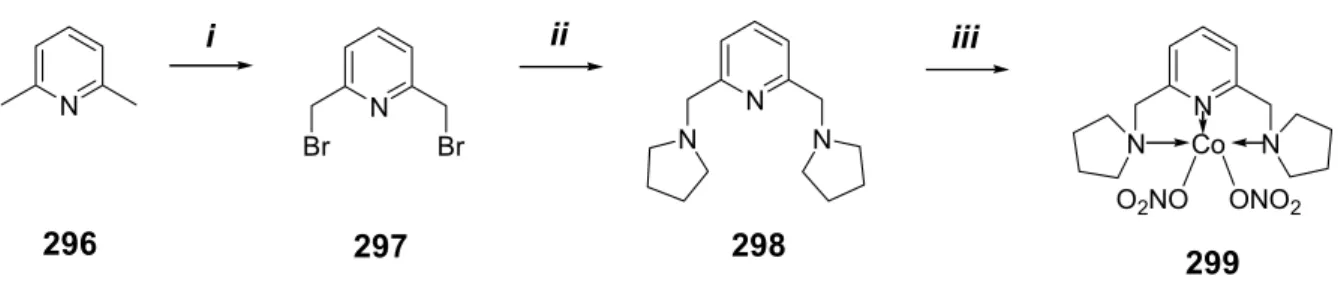
In the absence of any solvent or additive, the Co(py)2Br2 catalyst gave mainly allylic oxidation products while in the presence of IBAL and Co(py)2Br2, α-pinene was selectively oxidized to α-pinene oxide with no allylic signs. oxidation (Scheme 51). The influence of pyridine on the oxidation of α-pinene in the presence of IBAL was also examined. The reactions proceeded as usual in the absence of aldehyde, giving only cyclohexene allylic oxidation products viz.
N-Methylation attempts
Indeed, deprotection of the acetate can be achieved under basic reaction conditions,98 but cleavage of the hydrogen atom at position 2 followed by double bond formation was not expected. An interesting point of this reaction was the partial replacement of the acetate protection at position 2 with a methoxy group, since. Thus, the main problem of this route was no longer the cleavage of acetates, but rather the lactone functionality, which makes the α-hydrogen very acidic, leading to easy elimination.
Platinum-catalyzed hydrogenation of the lactone
It became clear that the introduction of the methyl functionality to the amine at the lactone stage through this pathway was not possible and a change in the synthetic strategy was required. Purification of the crude mixture by flash chromatography afforded a 1:1 mixture of α- and β-lactols 272 in 76% yield. By this simple and efficient procedure, the carbonyl group of the lactone ring was successfully reduced to a free lactol, keeping the acetate protection intact.
Preparation of the glycosyl fluoride by direct fluorination
Posner and Haines studied the effect of various solvents on the anomeric ratio of the direct fluorination of 2,3,5-tri-O-benzyl-D-ribofuranose 308 (Scheme 60).102b All solvents examined produced β-fluoride . 309 as the main product. A limitation to these experiments was the insolubility of the highly polar lactols 272 in aprotic solvents. As expected, the use of less polar solvents such as toluene or CH2Cl2 in the direct fluorination of lactols 272 by DAST resulted in the α/β ratio increasing from 1:3 to ∼1:1 (Entries 1 and 4).
N-Methylation of fluorides
- Attempted N-methylation by methyl iodide and sodium hydride
- N-Methylation by methyl iodide and silver oxide
- Attempted N-methylation by MeOTf and 2,6-di-tert-butyl-4-
If the reaction was allowed to proceed until all the starting material was consumed, the product mixture consisted mainly of side products. To reduce the formation of side products, the effect of the amount of MeI in the reaction system was examined. It was reasoned that the possible explanation for the formation of side products was the presence of moisture in the reaction system, although the reactions were carried out in distilled DMF under an argon atmosphere.
Indirect methods for the preparation of the glycosyl fluoride
Since the N-methylation of 314 actually resulted in an inseparable mixture of the product and the starting material and additionally involved a mixture of α- and β-anomers, I decided to first convert the acetyl intermediate 314 into the corresponding thioglycoside derivative 317 to find out whether the thioglycoside anomers could be separated from each other. Compound 314 was allowed to stir overnight at room temperature with excess thiophenol and BF3.OEt2, but according to TLC analysis mainly baseline material had formed, probably due to the cleavage of the BOC protection under the acidic reaction media (Scheme 68).
Deacetylation
The reaction was stirred at room temperature under argon for 4 hours until the starting material was largely consumed. The reaction was neutralized by filtration of the cold reaction mixture through a short layer of silica, followed by successive washes with cold MeOH. Deprotection for the α-anomer 274a was performed in a similar manner using a 0.1 M solution of NaOMe in MeOH (Scheme 70).
Regioselective benzoyl protection
- Attempts for the regioselective benzoylation by BzCl and
- Regioselective benzoylation via stannylene derivatives
Also in the case of the 3-O-benzoylated product 320 a similar transformation was observed: the BOC group (9H) split into two singlets (each ∼4.5 H), located at 1.24 and 1.13 ppm. In the case of the 2- O -benzoylated compound 275b , in which the benzoyl protection and the BOC group are positioned further apart, the single portion of the BOC functionality remained in its usual position at 1.45 ppm. Regioselective protection of the benzoyl at the 2-position of the α-fluorine 318a was performed in a similar manner as described for the β-anomer 318b ( Scheme 74 ).

Concluding steps
- Activation of the thioglycoside
The final step of the synthesis was the formation of the disaccharide fragment of pradimicin A. The goal of the synthesis of the disaccharide fragment of pradimicin A was to produce the 1,2-trans-linked β-glycoside 324 (Scheme 76). TLC analysis of the reaction mixture indicated that in addition to the unreacted starting materials 250 and 275b, some products among the acceptor 275b and the donor 250 had been formed.
Conclusions
Experimental
Oxidation of cyclohexene 284 in the presence of isobutyraldehyde
The ratio of epoxide to ketone depended on the catalyst used and the amount of catalyst.
Oxidation of cyclohexene 284 to 2-cyclohexen-1-ol 286 and 2-
Epoxidation of α-pinene 291 to α-pinene oxide 292
The products were identified by GC and GC/MS analysis by comparison with the authentic samples.
Allylic oxidation of α-pinene 291
The reaction was quenched with 1 M NH 4 Cl (5 mL) and the solution was extracted with ether (25 mL). The cooling bath was removed and the reaction mixture was stirred at room temperature for 30 min. After stirring the reaction mixture at room temperature overnight, 1 M NH 4 Cl was added and the solution was extracted with ether.
Attempts for disaccharide 324b
- NIS/TfOH-method
- NBS/TMSOTf-method
Attempted N-methylation for 273 by 2,6-di-tert-butyl-4-methylpyridine
Attempted N-methylation for 271 by 2,6-di-tert-butyl-4-methylpyridine