We also published our research in the book "Closer and Closer Energy Dialogue between the EU and China", which aimed to explore and compare the energy needs, regions of energy procurement and energy policies and strategies of the two great powers. The price of the energy we produce is not significantly different from the prices of fossil fuels. Thus, no trump card other than the offered price will remain in the hands of the EU vis-à-vis the energy supplier country, and China will be able to use it.
Thus, the EU is in a relatively better position in the international market and is better known in this regard. The EU remains "in the middle" of the West-East world order and can act as a mediator between the US and China in the international arena. At the same point, we can also say that China was not yet a member of international organizations in 2007, unlike the EU.
In 2007, China's energy consumption overtook EU energy consumption and was 1.4% higher for the first time in the history of Chinese consumption. Looking at the energy mix of the two actors, we can draw a very important conclusion. That said, in 2007 China was in a much better position than the EU in terms of interdependence.
The second level is the EU-China energy conference, which is held every two years. Sector dialogue is a constant communication between the EU and China: In 2007, 24 sector dialogues took place between the two powers. China's energy consumption exceeded that of the EU in 2007, and now China is the world's second largest consumer.
It is particularly important that Iran is a joint supplier of the EU and China: it accounts for 6.2 percent of Chinese imports and is thus the third largest. As a common importer we can present Russia, which was the number one importer in the EU and the number one importer in China in 2007. Moreover, Australia was the third largest importer in the EU and China the second.
The US has already recommended that the EU closely monitor China's actions in the Middle East. Significant amounts of Chinese FDI have arrived in the EU energy sector, mainly in the energy supply sector. Finally, it provides an overview of the use of common materials between the EU and China in different cooperation models.
And Angola was China's third largest importer in 2017 and does not ship to the EU.
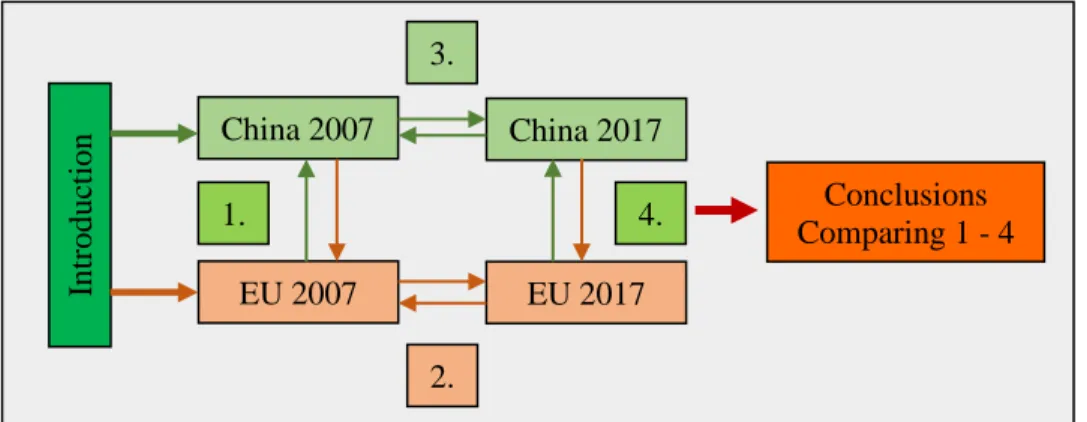
Conclusions
Although China's dependence on Russia will not reach the level of the EU, it will be one of China's most relevant suppliers. This will be the point where China's import dependence will be in line with the EU. This is also reflected in international environmental policy and the international conventions and environmental strategic goals that underpin it (2012 - Rio Earth Summit; 2015 - Sustainable Development Goals (SDG) - UN General Assembly resolution).
Currently, China is the world's largest emitter of greenhouse gases (CO2, CH4, N2O, fluorinated gases: hydrofluorocarbons (HFCs), perfluorocarbons (PFCs), sulfur hexafluoride (SF6) and nitrogen trifluoride (NF3), all synthetic industrial products), its energy producer and energy consumer . Therefore, examining energy-climate policy developments and international positions is critical to understanding and addressing global energy and climate governance barriers. With so many additives, fossil fuels still dominate the market, partly because of their current irreplaceability, but also against the backdrop of enormous economic interests.
This is evidenced by the dual-functional Silk Road and the EU's good energy relationship with MENA and African countries, so that trade relations can be built upon in the future. Energy supply regions and energy strategies have also undergone significant changes over the last 10 years, mainly in terms of increasing the share of renewable energy and energy saving, as well as reducing the use of more polluting and expensive fossil fuels. after their elimination later (mainly the use of coal and oil as conventional fuels). Taking into account changes in energy policy over the past ten years and exponential technological developments, the foreseeable evolution of the energy mix up to 2050 can be estimated, although questions remain unanswered to the best of our knowledge (such as future technological possibilities for the fusion energy ).
The significance of the circular economy for energy policy and its political reality are also remarkable, given the energy consumption of the resources that can be obtained in this way. Our third hypothesis also proved to be true, which is supported by the technological developments that have undergone significant development in the past decade and the greater emphasis on technology transfer. The political relationships between the major international powers have also changed, both in terms of energy supply and the distribution of international markets: in addition to the often worrying signs of one-sided economic and political dominance, there are new opportunities for common sustainable economic platforms, both globalization and mutual dependence based on the energy supply, where, in addition to energy sources, more and more energy technological developments and international knowledge transfer are emerging.
The movement of the two powers at the international level is also reflected in the emerging balance of power: China. During the period under review, only a rearrangement in the power structure of world politics began, where China plays an increasing role, although its development is not going smoothly, with serious environmental, economic and social problems. Based on our research, we also have to give a very answer even to the fourth hypothesis.
Further research findings
After all, it's no secret that China aims to be a major powerhouse for renewable energy innovation and production. Even in the MENA countries, the EU is trying to engage in joint developments with China, so that even more innovations pass to China. Our Chinese studies also suggest that it is possible to enter into a joint venture (that actually generates profit) with a Chinese person, but it is almost impossible for the partnership to survive in the long term.
The European Union has an interest in the extraction of fossil fuels in order to find even more energy suppliers through the diversification of service providers. While China is interested in the northern region in several ways, mainly for the acquisition of fossil fuels. China is also unpopular in the Nordic Council, but Russia is a very good ally.
The most likely scenario over the 15 to 20 year horizon is that fossil fuels will continue to dominate the energy mix of the two powers, with an increasing share of renewables. On the other hand, if a solution can be found for energy storage for the next 15 to 20 years, the share of renewable energy could reach 50% in the energy mix of both powers. Based on our research, we can say that in the case of China we thought we detected a strong “tactical” shift in its energy policy.
China is clearly planning the Silk Road for two functions, but the EU is also looking to use its energy partnerships for future trade purposes. In the relationship between the two great powers, asymmetric interdependence has also intensified greatly from 2007 levels, in favor of China. In the case of the two energy purchasing powers, we also discovered a difference that the reason for their dependence is not reciprocal according to our results.
And in their external dependence we have found a match that is beautifully detailed, especially in the case of China. China acquired a significant share of the EU's energy supply sector (FDI) during the global economic crisis and recovery period. We therefore found that a considerable degree of divergence in ownership of the energy sectors created an asymmetric dependence in favor of China to the detriment of the EU.
This is exactly what we said about oil, with the difference that consumption in the EU fell significantly. In China, the use of nuclear energy has increased, but in the EU it has decreased minimally.
Scientific publications, educational publications and lectures on the topic of the dissertation