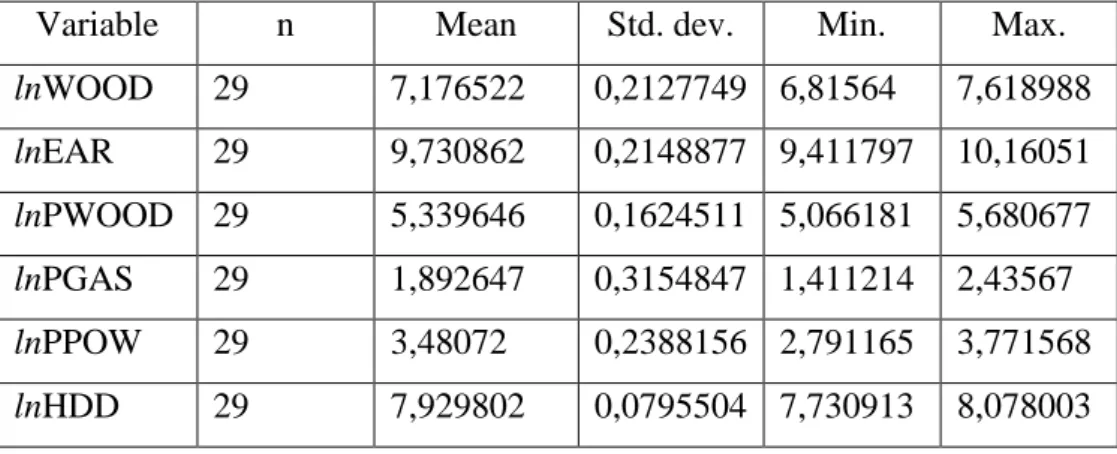
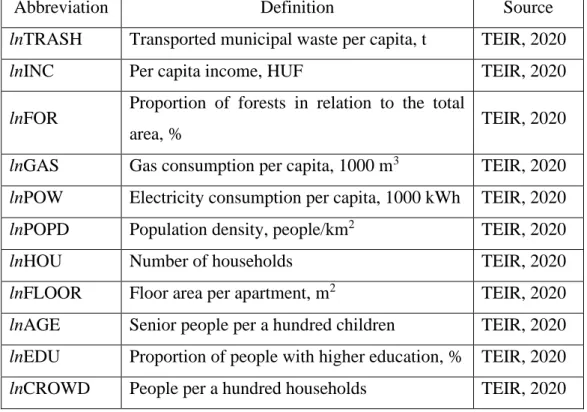
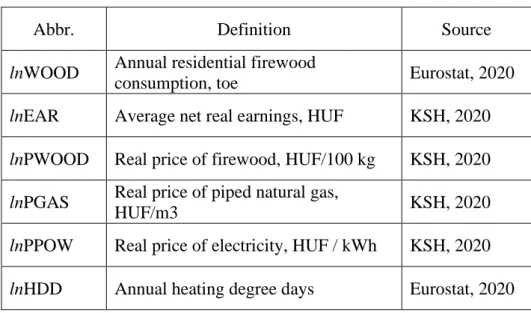
The complexity of the problem is also illustrated by the many different suggestions .. solutions available in print2. Planning the most effective interventions is not an easy task, and the tool of economics can help explore the causal side of the problem. The data used for the analysis were downloaded from the Internet interfaces of the National Statistical Office and Eurostat (Table 1).
The basic descriptive statistics of the data (number of observations, mean, standard deviation, minimum, maximum) are shown in Table 2.
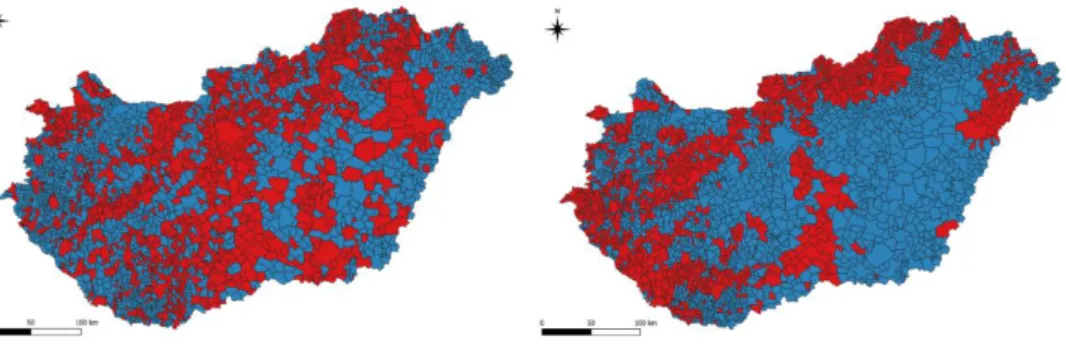
The map on the left in Figure 1 is intended to emphasize the spatial differences in the dependent variable (Horváthné Kovács - Nagy, 2015). I expect that income (INC) is positively related to disposed (ie "non-incinerated") waste and is one of the main explanatory factors. That is, if my first hypothesis were to prevail very strongly in reality, the coloring of the two cards should be very similar.
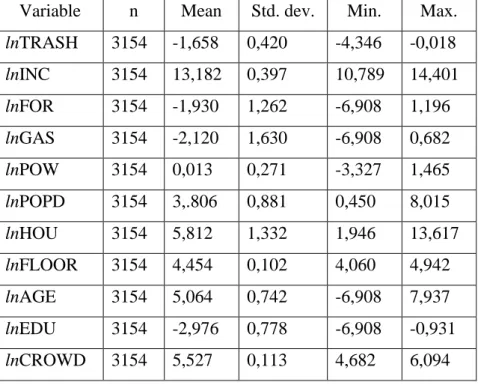
The age of the residents can also affect the amount of energy used, which is expressed in terms of the number of elderly people per hundred children (AGE) (Rahut et al., 2016). The descriptive statistics of the variables used in the analysis (number of observations, mean, standard deviation, minimum, maximum) are summarized in table 4. Due to the observability of elasticities, in this case I also work with the natural logarithmic transformation of the data.
The determination of the line of fit to describe the relationships is also performed by the method of ordinary least squares (OLS). The hypothesized correlation is that increased illegal waste burning causes higher sulfur dioxide concentrations, so it can be used as a proxy indicator of the phenomenon under investigation. Given the low number of observations, I use only three of the explanatory variables described earlier, namely per capita income (lnINC), forest cover (lnFOR), which is identified as the supply of the substitute product, and per capita gas consumption (lnGAS) ), which characterizes the demand, the "availability" of the substitute product.

Results and Discussion
Results and evaluation of firewood consumption estimates
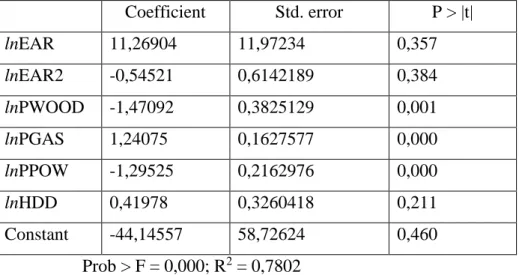
The direction of the relationship is the same as the direction of the relationships obtained in the studied documents. This helps me evaluate the second research question/dissertation hypothesis, which is about the distinct influence of the price of natural gas (in other words: the relative price of firewood). The biggest marginal effect is the own price of firewood: a change in the price of firewood by 1 percent.
This result is in accordance with the findings of several foreign authors who point out the prominent role of own price in their work, such as Hiemstra-vander Horst - Hovorka (2008), Kowsari - Zerriffi (2011), Couture et al. The second strongest effect is on the price of electricity, a one percent change in consumption results in a 1.25 percent change. The result is consistent with Leach (1992), Song et al. 2012a) and Karimu (2015), who (also) emphasize the importance of the relative price of energy.
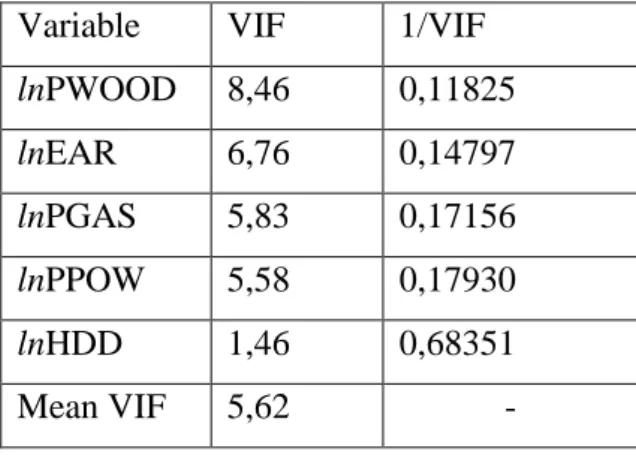
After extracting the results, I examine whether autocorrelation occurs, which would degrade the efficiency of the estimation (even if left unaddressed and consistent) (Ramanathan, 2003). The result of the test is shown in table 7, after which the null hypothesis can be accepted. The result of the test (d-statistic) is above the critical upper value (1.254), so I should not count autocorrelation according to this.
Results of trash incineration estimation and their evaluation
It is conceivable that the explanatory variables involved in the study have an effect not only on the dependent variable but also on each other, thus amplifying each other's effect, making it difficult/pointless to examine the separate effect of each explanatory variable ( Kovács, 2008) ). The relationship between the age of the population (lnAGE) and the municipal waste transported also contradicts my original assumption. It can be thought that the older generations did not have the characteristic of a big warm home as a child, and have not demanded it ever since.
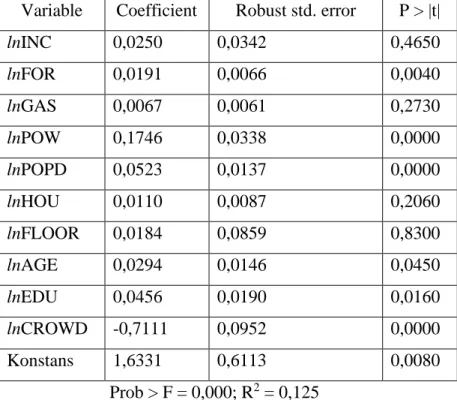
It is conceivable that although the specific energy demand in a more stressed household is lower, household waste appears to a greater extent in consumption. The burning of household waste (which not so long ago meant only natural materials) could also be part of the traditional heating culture developed here. The results of the second model used to investigate illegal waste incineration are shown in Table 11.
The dependent variable of this estimate is the logarithm of sulfur dioxide emissions per capita. We can see that from the results, only income can be considered significant (at 1 percent), which however shows a negative relationship between the two variables. This contradicts the result of the first assessment and confirms the third hypothesis, but due to the nature and size of the sample, we have to treat this calculation in place, no more serious conclusions can be drawn from it.
Conclusions and Recommendations
Conclusions and recommendations for reducing firewood consumption
Although the results show that an increase in the own price of wood will reduce demand, since its primary consumer is poorer people, any price increase is not recommended. In the case of Hungary, the regulator can operate not only with the tax content of the product, but also with its official price. Since the system of procedures for subsidizing gas prices allows the beneficiaries to make individual decisions according to their socio-economic characteristics, I believe that this form of intervention can be better directed to the places where it is most needed, i.e.
In general, it can be said that the form of intervention is likely to be more environmentally efficient, most of which can be directed to where the negative marginal effect of the subsidy on emissions is greatest. It is useless to have sufficient purchasing power and determination if the technical conditions (or the lack of gas pipelines) do not allow the use of natural gas. I believe that the demand for wood is also significantly determined by the urbanization of the consumer's place of residence.
There are many more variables to consider, but even these few show that the scope of the study can easily be expanded to include natural, social and technical factors - certainly at the level of theory. By comparing the results of research with different approaches, we can get a more thorough picture of the study area. It is therefore also a request to the authorities to record and publish the data needed for the research.
Conclusions and recommendations for reducing illicit trash inceneration
I also consider it worthwhile to conduct an analysis based on cross-sectional data of the repayment level in the future. Examining the problem with such scope can lead to much more reliable results, but this requires a thorough knowledge of the relevant elements of the countries' energy policies, statistical history and communication10. Successful implementation of these tools can indirectly change consumer behavior and improve environmental quality.
The pipeline network, which enables consumption, covers all settlements in the country, so there is no more room for maneuver in this area (KSH, 2019). The second most important hypothesis in the modeling seems wrong, but it reminds me of a number of important things: It seems that in areas with a lot of wood, the burning of trash can trigger wood. The complexity of the situation could be illustrated with many other examples, but these few thought experiments already indicate that we are facing an interdisciplinary issue that cannot do without the involvement of various aspects in the design of state interventions.
In addition to quantitative studies, we can really understand the behavior and heating habits of the specific consumer groups through qualitative research that can capture softer information (questionnaires, in-depth interviews). Knowing the importance of the subject, seeing the results of my research, it would be important to get more reliable data as soon as possible, with which I can make more accurate estimates. This contradicts the result of the first model that income has no direct effect on illegal waste incineration, but due to the nature and size of the analyzed sample I cannot say more than there is doubt about the reliability of the data, so it is appropriate to investigate the phenomenon with a better database.
Regulatory similarities and differences
We can also think of factors that cause indirect effects, such as the degree of urbanization and education. In the case of firewood, I have not been able to examine these variables, but it is likely that an urban environment away from forests may increase the price of wood through longer transport routes and scarce supply, which reduces consumption. Although higher incomes can be earned in cities and because of higher education increases the demand for wood, gas stoves installed in urban dwellings, as factors that drive gas consumption, can induce (force) the substitution of wood for fire.
Lower gas prices (and presumably any circumstances that make natural gas a more attractive alternative) will stimulate gas consumption, thereby reducing the demand for firewood. On the other hand, gas consumption (ie gas price policy) has no effect on waste incineration. In general, even if there are differences between the two energy sources, it seems true for both that their use will not decrease as a result of increased prosperity, but through policies to support urbanization and the consumption of modern (replaceable) resources. of energy.
These results confirm the fourth hypothesis of the dissertation (H4), according to which some factors have a similar effect on wood consumption and illegal burning of garbage, so we can achieve success in both areas by regulating them. Of course, the "perfect" evaluation of the hypothesis requires the safe availability and inclusion of additional variables in the analysis, which determines the direction for further research. With these data, the results of the two models can only be compared with great certainty and more reliable conclusions can be drawn from them.

New Research Results
Waste incineration can be effectively reduced by reducing electricity prices, urbanization and increasing education, while again drawing attention to the dependent variable used in the model as it can grossly simplify reality, which can lead to distorted results. In short, although there are differences between the two energy sources, for both their consumption can be reduced through policies that support urbanization and the consumption of modern, alternative energy sources, but not just by increasing incomes. My work has also highlighted that the data needed to study these areas is very scarce and sometimes even non-existent.
Because these are very serious problems, it is important to establish a reliable, comprehensive database as quickly as possible, with which researchers from different disciplines can study the connections.
Publications on the Topic of the Dissertation