Of the equipment used for this purpose, various types of ultrasound equipment have gained widespread use in the practice of animal reproduction. In addition to monitoring the developmental stages of the CL formed during the normal estrous cycle, I wanted to study. In addition to diagnosing retained placenta and possible subsequent development of metritis, I determined the time of onset of follicular growth waves, resumption of cyclic ovarian activity, occurrence of first ovulation, and incidence of any luteal ovarian structures. (cavitated corpora lutea, corpus luteum cysts, lutein cysts) that may occur.
In pregnant cows I checked the presence of CL and the incidence of CL with holes during an existing pregnancy. I treated a total of 217 CL cycle and 171 CL cavity with intramuscularly administered PGF2α (2 ml Estrumate injection, a total of 500 µg cloprostenol) at the time of the ultrasound examination. I then performed a weekly comprehensive ultrasound examination of the ovaries and uterus, recording milk production and body condition scores.
In addition, I have blood drawn twice a week for laboratory analysis of metabolic parameters. Four times during the experimental period (September 26, 2008, November 21, 2008, February 17, 2009, and April 9, 2009), we analyzed total mixed ration (TMR) samples from the dry feed trough, close-up, after calving groups of cows and high production output. The analysis of blood and feed samples was carried out in the Laboratory of the Department of Nutrition, Faculty of Agriculture and Environmental Sciences, Szent István University.
I used the Chi-square test to detect differences between cows affected with metritis and/or retained placenta and healthy cows in terms of the occurrence of irregular luteal structures.
RESULTS
- Study of the incidence of luteal structures in the postpartum period and after service
- Results of transrectal ultrasonography performed in the postpar- tum period
- Results of transrectal ultrasonography performed in the period after service
- Results of serum beta-carotene determinations and feed analyses performed in the postpartum period and after service
- Treatment of luteal structures occurring on the ovaries
- Treatment of corpora lutea and corpora lutea with cavity with PGF 2α
- Treatment of follicular and luteal cysts with PGF 2α
- Monitoring of the normal (hormonally not influenced) oestrous cy- cle
- Results of ultrasonographic cycle diagnosis
- Correlation of the success of fertilisation with milk production and the results of metabolic tests
- Results of ultrasonographic monitoring and metabolic tests of cows that had calved 90–120 days previously and were inseminated once
- Visual analysis of the cycle curves
- Correlations of the success of insemination with milk production and metabolic test results
This may indicate that corpora lutea with a cavity have a lower efficiency in maintaining pregnancy (i.e. they are not necessarily able to perform their function); at the same time, the presence of a cavity also does not exclude the maintenance of pregnancy, since in the pregnant cows it was found that the cavity of the CL disappears after a while. Seventy percent of the cows examined had cyclic ovarian activity at the beginning of the study (I detected a corpus luteum on at least one of their two ovaries). At the same time, in 20% of the cows a CL feature of the cycle appeared by postpartum day 45, while in one cow it only occurred on postpartum day 79 (Figure 3).
Luteal structures appeared by postpartum day 42 in 40% of cows, by postpartum day 60 in a further 30%, and only after postpartum day 60 in 20%. This period is extremely important because of the possible development of infertility, because in cows with a healthy estrous cycle, this period is the time of estrus, which manifests itself with clear clinical signs. Based on the visual analysis of the cyclic curves, it can be determined that those cows (n=4) that were conceived during the experimental period, in which at least one of the two ovaries constantly showed cyclic activity and in which the luteal ovarian structures (corpus luteum z cavity, corpus luteum cyst) were diagnosed only once or not at all.
Cows in which an irregular lutein structure on the ovaries was found several times and/or continuously for a varying period of time and in addition one of the ovaries was inactive or there was no regular cyclic ovarian activity, did not become pregnant during the period. study time. Correlation of fertilization success with milk production and the results of metabolic tests and the results of metabolic tests. No fertilization occurred in cows in which the beta-carotene concentration of the blood serum remained below 3 μmol/l during the entire experimental period.
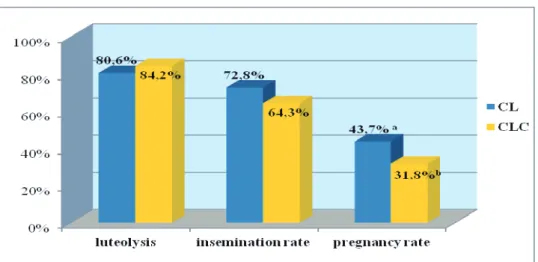
At the same time, cows with an average serum beta-carotene concentration above the upper limit of the physiological range showed a pregnancy rate of 50%. The fact that the mean value of FRAP, an indicator of the antioxidant capacity of blood plasma, was below the physiological limit of 150 μmol/l in a significantly higher proportion (17.4%) of cows that did not become pregnant during the experimental period. not surprising, as this was already predicted by the herd-level beta-carotene survey result. From the analysis of the cycle curves it can be concluded that the treatment with prostaglandin (intramuscular injection Dinolytic 5 ml, total 25 mg dinoprost) administered at the beginning of the study resulted in luteolysis of the structure in 50% of the cows in how the group defined non-pregnant cows with activity cyclic ovarian and in that determined Cow with luteal ovarian structures.
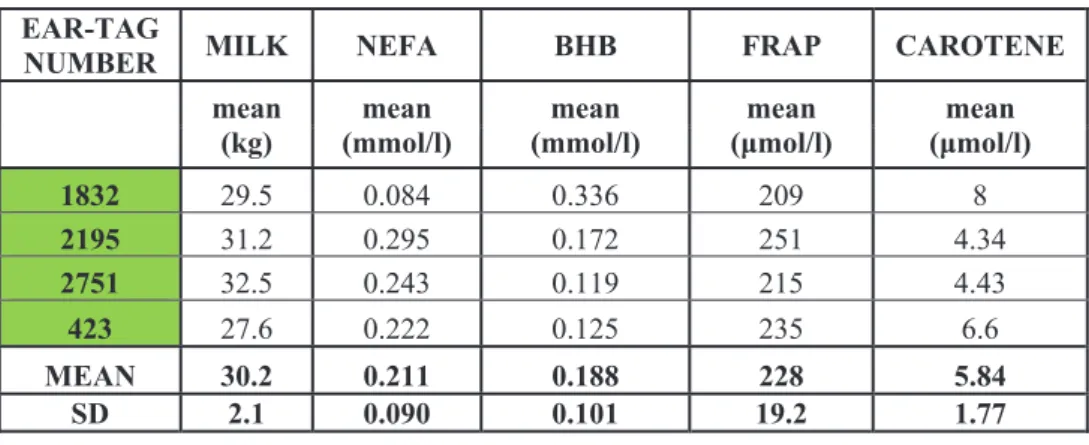
During the experimental period, 40% of the cows in the group 'non-pregnant cows with cyclic ovarian activity' and 50% of the cows in the 'cows with luteal ovarian structure' could be fertilized successfully. Correlations of insemination success with milk production and metabolic test results and metabolic test results. In the pregnant cows, none of the metabolic parameters deviated from the physiological limits, indicating that the measured parameters are probably good indicators of the metabolic status of pregnant animals (Table 3).
The concentration of beta-carotene in the serum of cows that were born in this group did not fall below the limit in any case, and the same applies to the FRAP values in the plasma. Based on the measurements, we can say that those cows with a luteal structure did not get pregnant during the experiment period.
CONCLUSIONS AND RECOMMENDATIONS
In our own experience, the highest pregnancy rate (66%) was achieved when cows were inseminated after day 120 postpartum, while none of the cows inseminated before day 60 postpartum were pregnant. Fifty percent of the cows included in the study were inseminated between days 60 and 120 postpartum, with a 40 percent pregnancy rate. At that time, the postpartum negative energy balance in highly productive dairy cows is resolved and the histological involution of the uterus is complete.
However, it should be noted that the desired time of first calving in cows should be determined based not only on biological but also on economic considerations. Examination of inseminated cows showed that luteal ovarian structures could be diagnosed in a significantly (P<0.001) higher proportion of cows that did not conceive. A similar result was obtained in the analysis of cyclic curves: those cows were more pregnant during the period of the experiment in which at least one of the two ovaries continuously showed cyclic activity and in which luteal ovarian structures (corpus luteum with cavity, corpus luteum cyst) were found just once or not at all.
At the same time, the presence of the cavity does not exclude the maintenance of pregnancy, since according to my observations the cavity disappeared after a certain time in cows that became pregnant. Lower than 16% TMR crude fiber content, measured in post-calving and high-production groups, represents the risk of acidosis. Of the metabolic parameters, NEFA has an extremely important role, as shown by the fact that in the two cows with the highest milk production I measured NEFA values that exceed the limit by 35-43% during the normal estrous cycle.
Analysis of the cycle curves of these two cows shows that one of the two cows failed to ovulate again for a long period. Based on the measurements of the concentration of NEFA in the plasma of cows that calved 90-120 days ago and were inseminated once, it can be said that those cows with a luteal structure failed to become pregnant during the experiment period which had an average of high pro milk. - duction, and in which the serum NEFA concentration exceeded the physiological limit (0.4 mmol/l) in some cases. It is difficult to distinguish animals in which the presence of the cavity is important from those in which it is unimportant; therefore, further investigations are needed to clarify this question.
It is known that the corpus luteum can have a cavity in the first days of the cycle, but this cavity usu-. After a single intramuscular PGF2α treatment of structures (follicular and luteal cysts) selected based on the currently most widely accepted categorization (Brito et al., 2004) we found that luteolysis often occurred even in the group of cows that had follicular cysts, but its rate was significantly higher in the group of cows with luteal cyst. This means that the previous categorization of cysts is not perfect and needs refinement.
NEW SCIENTIFIC RESULTS
PUBLICATIONS ON THE SUBJECT OF THE DISSERTATION
G. Gábor: Különböző petefészek szerkezetű tejelő tehenek ivarzásválasza és termékenysége egyszeri klórprosztenol kezelés után. Hatvani Csilla – Balogh Orsolya – Holló István: Az ultrahangos vizsgálatok szerepe a tejelő tehenek szaporodásbiológiai vizsgálatában. Hatvani Csilla – Balogh Orsolya – Holló István: Ultrahangos készülék alkalmazási lehetőségei a terepi gyakorlatban nagy tehenészeteken.
Hatvani Csilla – Balogh Orsolya – Holló István – Gábor György: Szokatlan lutein formulák megjelenésének és hatásának vizsgálata két holstein-fríz nagytejgazdaság állományszintű felmérésének tükrében. Hatvani Csilla – Balogh Gabriella Orsolya – Holló István: Petefészek ciszták diagnosztikája és kezelése tejelő tehenekben. Sándor Csilla – Balogh Orsolya – Gábor György – Holló István: Az ultrahangvizsgálat jelentősége a luteint tartalmazó kóros petefészek képletek diagnosztikájában.
Balogh Gabriella Orsolya – Hatvani Csilla – Gábor Petra – Túry Ernő – Gábor György: Szokatlan lutein képletek szövettani és anyagcsere hátterének vizsgálata tejelő szarvasmarhákban. Hatvani Csilla – Balogh Orsolya – Holló István: Abnormális petefészek-képletek hatása tejelő szarvasmarhák szaporodásbiológiai mutatóira és problémáira. Balogh Gabriella Orsolya – Hatvani Csilla – Gábor Petra – Túry Ernő – Gábor György: Tejelő szarvasmarhák petefészkein előforduló szokatlan mintázatok és kialakulásuk metabolikus hátterének szövettani vizsgálata.
A tejelő szarvasmarhák petefészkein előforduló szokatlan lutein készítmények klinikai megjelenési gyakorisága az ellés vagy Gy. Gábor: Tejelő szarvasmarhák luteális üregeinek és cisztáinak gyakorisága és lehetséges háttere. A metritis lehetséges hatása a corpus luteum (CL) szabálytalan formájának kialakulására ellés utáni tejelő tehenekben.