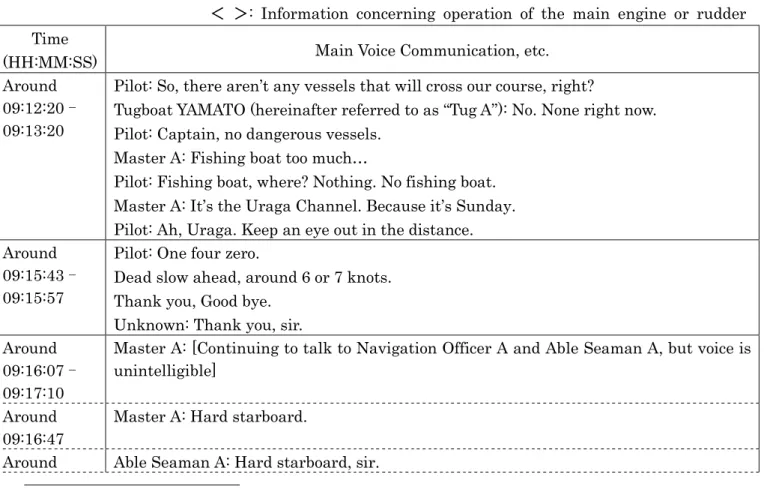
The accident is believed to have occurred when EASTERN PHOENIX (hereinafter referred to as "Vessel A") was sailing in a south-southwesterly direction and KEIHIN MARU No. The master of vessel A probably did not observe the surroundings properly because he was giving constant instructions regarding position reports and other matters to the navigation officer of vessel A and the qualified seaman. 8 (hereinafter referred to as "Vessel B") were as shown in Figure 1 in the Annex. See Figure 1 in Appendix Radar images from vessel A).
Captain B informed Navigation Officer B of the presence of ship A and, as ship A was heading towards the Uraga Channel, instructed him to avoid ship A by taking timely action.

Injuries to Persons
However, the two vessels were now in positions where a collision was inevitable, Master B ordered Navigation Officer B to leave the wheelhouse, disengaged the main engine clutch and then also left the wheelhouse. He contacted the Japan Coast Guard (JCG) by cell phone and ordered Navigation Officer B to prepare the life jackets. Navigation Officer B prepared the life jackets and also closed the cargo hold and hatch valves.
Tug B went out to rescue vessel B in response to a communication from Tokyo MARTIS and rescued all of vessel B's crew at approximately 09:48. The date and time of the accident was around 09:27:27 on August 7, 2016, and the location was about 170°, 1.5 M from the Kawasaki Higashi-Ogishima Breakwater East Lighthouse.
Damage to Vessel
Vessel B had dents and cracks in her port fender and bottom, and a dent and other damage to her port stern fender.
Crew Information
According to statements from Master A, Navigation Officer A, Skilled Seaman A, Master B and Navigation Officer B as well as the responses to the questionnaire by Company A and Funatomi Kaiun Limited, which is the owner of Vessel B (hereinafter referred to as “Company B2”), the situation was as follows. The case of navigation in Tokyo Bay at the time of the accident was his third on board vessel A. He had no health problems that would affect the performance of duties at the time of the accident.
He had served as a common seaman, chief officer and captain aboard tankers navigating smooth water areas. Master B had a close relationship with Navigation Officer B since early childhood, and his relationship with Navigation Officer B was friendly rather than hierarchical. After the accident, Captain B therefore believed that their mutual relationship may have played a role in the situation in which he had instructed navigation officer B to take evasive measures, but navigation officer B did not follow this order.
He had served as a windshield wiper, second engineer and first engineer aboard marine tankers and as a regular seaman, chief engineer and chief engineer aboard tankers navigating smooth water areas. At the time of the accident, approximately one year and three months had passed since he first provided ship maneuvering with ship B, and he felt that he had become accustomed to ship maneuvering. After the accident, he felt that his relationship with Captain B, which made it easier for him to talk than in a typical relationship between captain and navigation officer, may have played a role in his not following Captain B's order and taking a direct course at the time. persisted. of the accident.
Vessel Information
According to the statement of Master A and the reply to the questionnaire by Company A, at the time of vessel A's departure from the Kawasaki section of Keihin Port, she was loaded with approximately 4,200 tons of molten sulphur. According to the statement of Master B and the reply to the questionnaire by Company B1, at the time of vessel B's departure from the privately-owned berth of Chiba No. According to the statements of Master A and Navigation Officer A, at the time of the accident, Master A had the No.
According to Company A's response to the questionnaire, there was no breakdown or failure of the hull, engine or machinery at the time of the accident. According to the statement of master B and the answer to the questionnaire of company B2, the whistle (air horn) of vessel B was in a condition that did not allow its immediate use at the time of the accident, as there was an air leak. pipe that supplies air to the whistle and as a result the pipe valve in the engine room was closed. According to the sea trial operational performance chart and Company A's questionnaire response, the turning and stopping performance of Vessel A is 40%.
8 "Advance" refers to the distance a vessel's center of gravity advances along its original course after the vessel's heading has been reversed 90°. 9 "Tactical diameter" refers to the lateral distance that a ship's center of gravity moves relative to its original course line after the ship's heading has been reversed 180°. According to the statement of Master B, at the time of the accident, there were no problems with visibility from the steering wheel cage when it was put under observation.
Weather and Sea Conditions
According to the maneuvering diagram displayed on board Vessel B, the turning and stopping performance of Vessel B was as indicated below. There were no objects that would hinder observation when looking from the bridge to the bow.
Information on the Sea Area of the Accident
Information on the Oil Spill
Information concerning Vessel A’s Whistle Sounds
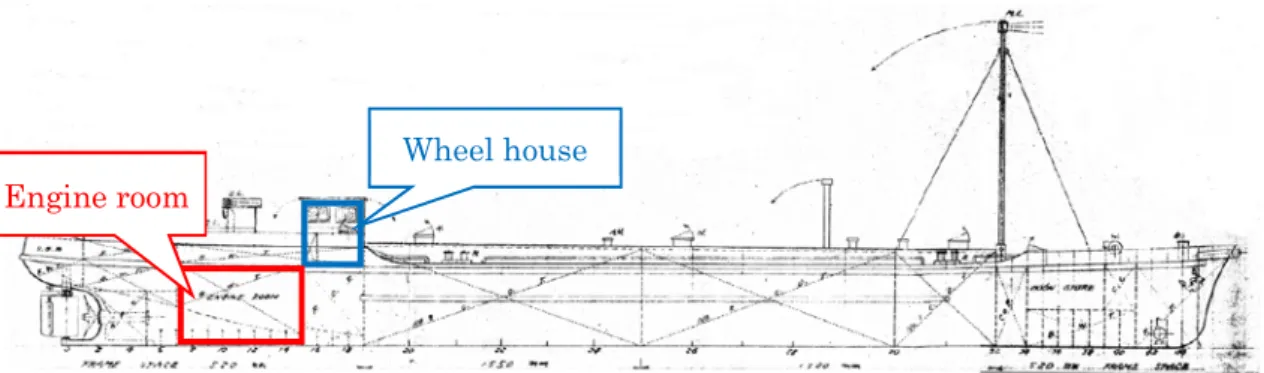
According to Captain B's statement, the rear access door and the port and starboard windows of ship B's wheelhouse were open. It should be noted that, according to a literary source*13, “the average noise level of an engine room is about 100 to 105 dB(A), which has little to do with the size of the vessel or the size of the main engine. Exit.". According to the National Maritime Research Institute of the National Institute of Maritime, Port and Aviation Technology and Company C, the distance-based decay of the sound pressure of a whistle in air can be expressed by the following formula.
In addition, there are cases where, in addition to the reduction in sound pressure, the effects of engine room noise, the sound of the vessel moving through wind and waves while underway, and other factors can cause the whistle to be difficult to hear. 13 Literary source: “Shosen Sekkei no Kiso Chishiki” (Fundamentals of Merchant Ship Design) (by Zosen Tekisuto Kenkyukai; published February 2006).

3 ANALYSIS
Situation of the Accident
A was leading while on autopilot repeatedly changing her course by about 10° and accelerating between about 09:20 and about 09:24. According to 2.1, it is likely that the date and time of the accident was around 09:27:27 on 7 August 2016, when the sound of impact was recorded on the VDR of vessel A, and the location was around 170°. , 1.5 m from the eastern Kawasaki Higashi-Ogishima Breakwater lighthouse from the position of vessel A at the indicated date and time.
Causal Factors of the Accident
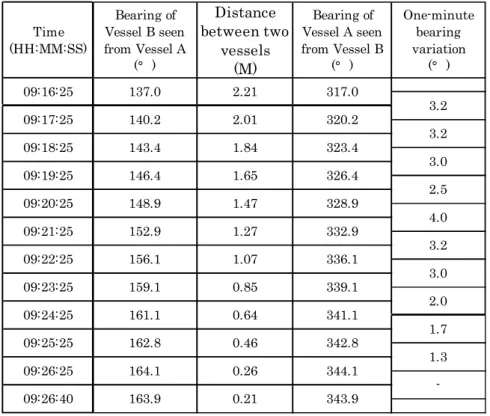
A was able to pass in front of vessel B when he first sighted vessel B, but when he questioned vessel B's movements at about 09:26:25, it is likely that he perceived the danger of collision with vessel B and blew the whistle gave seven short thrusts from around 09:26:32. A came a little closer and was in a position to pass in front of vessel B's bow, he could avoid vessel A if he turned to starboard and sailed astern of vessel A. c He knew that vessel B was earlier than scheduled could start unloading and he has a vacation planned from the next day, so he wanted to arrive at the destination quickly and finish early. It is likely that, at about 09:21, Master B and Navigation Officer B both observed vessel A, which was in a position to cross paths with vessel B, and then looked out for vessel A. Given that vessel A's bearing has been moved approx. 10° to vessel B's stern. between about 09:20:25 and 09:23:25 and it appeared to him that vessel B would pass ahead of vessel A's bow, it is somewhat likely that navigation officer B continued to navigate by maintaining course and speed.
A Using a wheelhouse window frame for reference, ship A's bearings had moved approximately 4° during the one minute between 09:20:25 and about 09:21:25, but had moved approximately 2° between 09:23:25 and 09:24:25, and Ship A had approached from a distance of approximately 1.5 M to approximately 0.6 M with her bow pointed ahead of Ship B's bow, it is somewhat possible that Master B was not observing with any apparent change in vessel A holding and judging that there was a risk of collision. On the other hand, it is likely that ship B, which was heading for the area near Tsurumi Passage, was in a situation where its path crossed the path of ship A, which was heading for Uraga Channel, and that ship B could turn and stop more easily than ship A. Therefore, taking into account the circumstances of the surrounding area, the ease of maneuvering of the ship and other factors, it is likely that ship B should have taken measures to avoid a collision without hesitation when it existed sufficient space for maneuvering. It is likely that at the time Ship B was moving west-southwest approximately 400 meters off Ship A's port bow.
If a sound was at the same level as the sound pressure measured during approval testing for the same whistle model, based on the following calculation it is probable that the sound pressure of ship A's whistle, which was 141 dB(A) at a distance of one metre, had decreased to approximately 89 dB(A) at a distance of approximately 400 metres, where ship B was located. A was able to pass ahead of ship B, but then sensed the risk of collision with ship B at about 09:26:25 and gave seven short blasts from about 09:26:32. On the other hand, it is probable that navigation officer B continued navigating by maintaining course and speed, because ship A's bearing moved towards the stern of ship B and it appeared that ship B was ahead of ship A's bow. would pass.
4 PROBABLE CAUSES
5 SAFETY ACTIONS
Safety Actions Taken
14 "BRM (Bridge Resource Management)" refers to the effective management of crew members, equipment, information and other available resources on the bridge to maintain and improve operational functions on the bridge. It is a concept that focuses on the functions that resource managers (primarily masters) must provide. 15 "BTM (Bridge Team Management)" is a concept with the same purpose as BRM that focuses on the functions that must be provided not only by resource managers, but also every member of the team organized on the bridge (individual crew members, including the master).
16 "Simplified AIS" refers to an AIS unit which has less output than the AIS required in specified vessels under international conventions and which can only transmit and receive information relating to ship name, position, speed, course and ship type.