Follow-up telephone interviews were conducted with 25 consumers and 25 frontline workers who attended the Energy Best Deal sessions during the previous campaign, 2012/2013. This represents 59% of the 10,349 consumers who attended the Energy Best Deal sessions (the remainder were not submitted or did not complete a questionnaire).

The impact of the session
Fifty-seven percent of respondents said they had never switched to another tariff with the same provider, while 26% had done so and the other 16% did not know if they had or not5.
Planned follow‐up actions
Consumers: follow‐up interviews
Action taken since the session
Looking for a better energy tariff
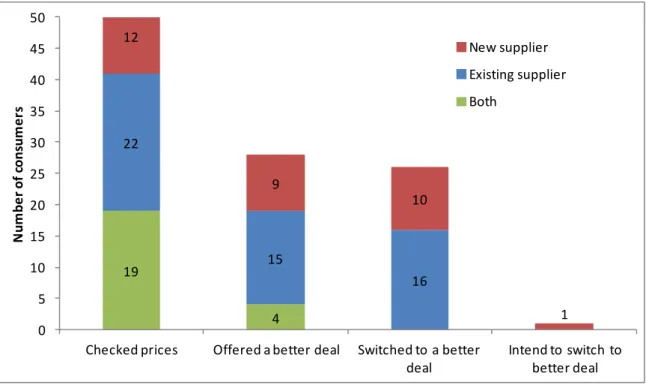
Of the 19 people who got a better deal from their current supplier, 6 relied on the supplier to figure out what the best deal was and didn't check other suppliers' prices. There were four consumers who got a better deal from both their own and another energy supplier.
The process of switching supplier
Thirteen of 31 people (42%) who checked other suppliers' prices were offered a better deal, while 19 of 41 (46%) who contacted their own supplier were offered a better deal, so there was little difference in whether existing or new suppliers could offer a better deal. Of the 27 people who have switched or are planning to switch, eight have never switched suppliers, four of whom have never even switched to a different tariff with the same supplier.
Factors which discouraged people
However, this person also asked another person to help check the rate before switching. Two of these switched to a better tariff with their current supplier, one switched to another supplier and the fourth decided to stay with the current supplier because the agreement with the new supplier would only have saved a small amount of money for a limited period.
Trustworthiness of energy companies
Satisfied with current rate Haven't had time On fixed rate Too much hassle Bills included in accommodation Newly switched (before session) Won't save enough to make it worth it All suppliers are the same Worried about something going wrong Someone else takes care of bills Debt with current supplier Difficult to calculate whether you want to save money Prices are unpredictable.
Payment method
The vast majority stated that they use the best payment method (which is broadly defined as just the cheapest method) or that they are satisfied with their current payment method. The consumer has a fixed tariff and assumes that this also means that the payment method is fixed.
Energy efficiency actions
Interviewees were asked whether they had taken steps to save energy in their homes since the session and whether this was prompted by the Energy Best Deal session. 72 people (48%) said they had done something as a result of the session, while a further 17 said they had.
Identifying consumers qualifying for ECO 6 Home Heating Cost Reduction Obligation
Further actions
Information passed on to friends and family
Frontline workers: questionnaire responses
Profile
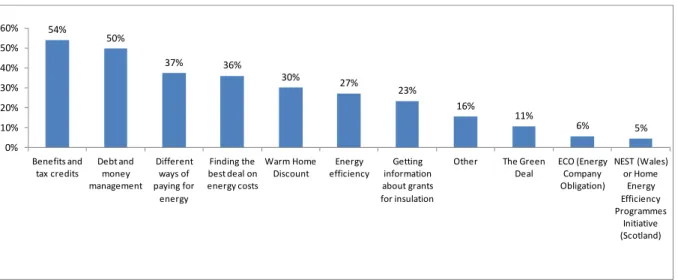
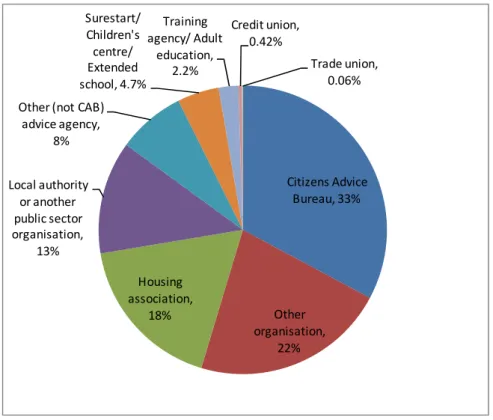
Frontline workers were also asked whether their organization specialized in supporting certain groups or providing advice on certain topics. These are shown in Figure 19 as a percentage of the total number of workers in the first place who attended the sessions (many people chose more than one option, so the total exceeds 100%).
Previous advice‐giving
Frontline workers were asked whether they now feel more or less confident in advising clients on the topics covered in the presentation. In total, 93% of frontline workers felt more confident in one or more topics after the session, while 6% felt less confident in one or more topics. For each topic, a very small number of frontline workers felt less confident after the session.
Passing on information
However, some commented that they now knew more about where to flag people for advice. Some people commented that there were some complex subjects – particularly benefits and the Green Deal – so they felt they would need more information or to study the subject more themselves before they could be sure. Some people felt they didn't want to advise on the Green Deal, in some cases because it is a loan and in some cases just because they didn't think it was a good scheme.
Frontline workers: follow‐up interviews
Advice‐giving on Energy Best Deal topics
Nine percent (13 people) found that the session did not increase their knowledge on topics they were already counseled on; however, five of these people found that the session did give them knowledge of new topics. Interviewees were asked to estimate how many clients they had provided information to since the session. However, two-fifths of those who said they would have provided the information anyway said the session enabled them to do so more effectively.
Passing information on to colleagues
The fact that some frontline workers needed more detailed information than others about the topics covered in the presentation, while others had specific questions that would have been too detailed for most participants, suggests that it could be useful to have an online resource or forum where Frontline Workers can ask these questions (although in some cases this information will already be available, for example on Citizens Advice advice advice.org.uk).
Frontline workers' own energy use
Frontline workers were asked if the presentation encouraged them to save energy in their home. These people mainly took small steps to reduce electricity consumption of appliances and reduce heating use, such as draft proofing, buying energy-saving light bulbs, insulating the hot water tank and not overfilling the boiler.
Quality of the presentation and materials
The majority of participants rated the material used during the session (Figure 37) as good, with most others rating it as excellent. The majority of consumer attendees rated the material provided to take away (Figure 38) as 'good', with most others rating it as 'excellent'. The wide range of abilities and confidence among consumers was evident, with some saying it was helpful and others saying they needed more help to take the actions discussed during the presentation (this is why Energy Best Deal Extra developed is; (see p. 45).
2012/2013 participant interviews – consumers
Looking for a better deal
Last time we spoke to this group of 25 consumers, four had changed their payment method as a result of the Energy Best Deal session and all were still happy with the decision. The remaining 21 people did not change their payment method between the session and the first interview and still have not changed their payment method. Eighteen of these felt that they were already using the best payment method, while two were using fixed rates and therefore did not consider changing their payment method, and one person said they did not want to change.
Other actions
Overall comments
2012/2013 participant interviews – frontline workers
Three people said no, while one of them said the message they got from the presentation was a little confusing. Seven people said they had not, and one person said they could use the information but could not be sure the information was obtained from the Best Energy Deal presentation. One interviewee commented that the session was useful and felt that many people would benefit from it.
Case studies
Successful switch following session
Confidence to research tariffs
Fuel bills cut
Warm Home Discount information passed on
Cheaper tariff and energy monitor
Improved heating control 1
Improved heating control 2
Switch using comparison site
Better tariff and rebate
Frontline worker's own bills
Energy Best Deal Extra
The client was helped to apply for the warm home discount (the application was successful). The advisor contacted the supplier to find out the customer's exact energy usage (this would have been estimates made by the supplier based on the most recent readings, but would be the most accurate information available) and used it to look at comparison sites (the interviewee noted that different comparison sites gave different results, which was confusing). The adviser helped the client get the warm home discount and also saved £150 a year on his fuel bills.
Summary and conclusions
Consumers: 2013/2014 sessions
Five people changed payment methods since the session, and one person was waiting for a prepayment meter to be installed, making a total of 4% of respondents who changed payment methods. Forty-eight percent of respondents have taken steps to save energy in their homes since the session; the majority took no-cost actions such as turning off appliances and adjusting the heating controls. Sixty-three percent of the respondents passed on something they learned during the session to friends and family.
Frontline workers: 2013/2014 sessions
The majority of interviewees felt that the session had helped them greatly in terms of providing more accurate or detailed advice, expanding the range of help and advice they could give to clients, and having more confidence in dealing with energy-related problems. subjects. Sixty-one percent of those interviewed said they would not have provided as much information to clients without attending the session. Forty-nine percent of interviewees had passed on information from the presentation to their colleagues, while 23% said they could not do this because all their colleagues were also at the presentation.
Quality of the presentation and materials: 2013/2014 sessions
However, 9% found that the session did not increase their knowledge on topics that they had already given advice on and 11% found that the session did not inform them of new topics that they had not previously given advice on. Since the session, information from the presentation has been provided to 4,750 customers across all frontline workers (some frontline workers have reached large numbers of customers by talking to people at events and by passing the information on to colleagues managed by the interviewer , who then use this information to help their customers).
Consumers: 2012/2013 sessions
Of the five who looked for a better deal but did not switch at the time of the first interview (group B), four have since rechecked prices. Of the fifteen people who at the time of the first interview (group C) were not looking to get a better deal, eleven have since done nothing further to look for a better deal on their energy. At the time of the previous interview, nine of the 25 interviewees had taken other actions since the session, such as applying for the Warm House Discount.
Frontline workers: 2012/2013 sessions
Two people looked into benefits, although one person had found their income was too high for benefits. Twelve people changed supplier or rate as a result of the advisory agreement, and two people switched from prepaid meters to credit meters. Six people received the Warming Home Discount as a result of the EBDx advice, with another person waiting to hear about their application and.
Conclusions
Topics people specified were: reducing energy use, updates on the government's energy saving schemes, and more information on night storage heaters. One person said he would like more information about the bigger picture, in terms of policy and schemes, rather than practical advice for individuals. Another commented that the session was very relevant and he felt it was a good use of his time.