Building smallholder farmers resilience through climate smart agriculture techniques in Oio and cacheu north regions in Guinea Bissau
Part I: Project Information GEF ID
11010 Project Type MSP
Type of Trust Fund LDCF
CBIT/NGI CBIT No NGI No Project Title
Building smallholder farmers resilience through climate smart agriculture techniques in Oio and cacheu north regions in Guinea Bissau
Countries Guinea-Bissau Agency(ies) BOAD
Other Executing Partner(s) Executing Partner Type
Environment Directorate General / Ministry of
Environment and Biodiversity Government
GEF Focal Area Climate Change Taxonomy
Influencing models, Civil Society, Stakeholders, Focal Areas, Climate Change, Climate Change Adaptation, Livelihoods, Small Island Developing States, Adaptation Tech Transfer, Climate finance, Least Developed Countries, Climate information, Climate resilience, Ecosystem-based Adaptation, Innovation, Land
Degradation, Sustainable Land Management, Sustainable Livelihoods, Improved Soil and Water Management
Techniques, Restoration and Rehabilitation of Degraded Lands, Ecosystem Approach, Sustainable Agriculture, Demonstrate innovative approache, Type of Engagement, Information Dissemination, Participation,
Consultation, Beneficiaries, Community Based Organization, Local Communities, Communications, Awareness Raising, Capacity, Knowledge and Research, Learning, Theory of change, Indicators to measure change, Adaptive management, Enabling Activities, Capacity Development, Knowledge Exchange
Sector
Mixed & Others Rio Markers
Climate Change Mitigation Climate Change Mitigation 0 Climate Change Adaptation Climate Change Adaptation 2 Duration
36 In Months Agency Fee($) 160,000.00 Submission Date 4/13/2022
A. Indicative Focal/Non-Focal Area Elements
Programming Directions Trust Fund GEF Amount($) Co-Fin Amount($)
CCA-1 LDCF 1,400,000.00 6,000,000.00
CCA-2 LDCF 600,000.00 2,000,000.00
Total Project Cost ($) 2,000,000.00 8,000,000.00
B. Indicative Project description summary
Project Objective
Build smallholder farmers resilience through climate smart agriculture techniques Project
Componen t
Financin
g Type Project
Outcomes Project
Outputs Trust
Fund GEF
Amount($) Co-Fin Amount($)
1 :
Strengthenin g the agriculture resilience to climate change
Investment 1.1.
Climate smart agriculture techniques promoted
1.1.1.
Implementatio n of Climate smart agriculture techniques and technologies at farmers?
groups and cooperatives level
1.1.2.
Restoration of agriculture degraded lands with
Ecosystem based adaption approach
LDC F
1,560,000.0 0
7,000,000.0 0
Project Componen t
Financin g Type
Project Outcomes
Project Outputs
Trust Fund
GEF Amount($)
Co-Fin Amount($)
2 : Building Farmers?
technical capacity to implement CSA?s techniques and
technologies
Technical Assistance
2.1. CSA?s techniques and
technologies implemente d by Farmers' groups
2.1.1 Technical capacity building trainings for farmers' on climate-smart farming techniques 2.1.2.
Provisioning Agroclimatic and weather information and early warnings for farmers?
groups climate- resilient decision making
LDC F
200,000.00 200,000.00
3 :
Knowledge and lessons learned disseminatio n
Technical Assistance
3.1. CSA?s knowledge and lessons learned compilated and disseminate d
3.1.1. Project monitoring and evaluation for lessons learned and knowledge compilation 3.1.2. Project knowledge and lessons learned dissemination
LDC F
100,000.00 250,000.00
Sub Total ($) 1,860,000.0
0 7,450,000.0 0 Project Management Cost (PMC)
LDCF 140,000.00 550,000.00
Sub Total($) 140,000.00 550,000.00
Project Management Cost (PMC)
Total Project Cost($) 2,000,000.00 8,000,000.00
Please provide justification -
C. Indicative sources of Co-financing for the Project by name and by type Sources of Co-
financing Name of Co-
financier Type of Co-
financing Investment
Mobilized Amount($) Recipient Country
Government
Ministry of Planning
In-kind Recurrent
expenditures
100,000.00
GEF Agency BOAD Loans Investment
mobilized 7,900,000.00 Total Project Cost($) 8,000,000.00 Describe how any "Investment Mobilized" was identified
Investment mobilized through the "Projet d?appui au d?marrage du projet d?appui a l?intensification de la production vivri?re (PAIPV)" funded by BOAD.
D. Indicative Trust Fund Resources Requested by Agency(ies), Country(ies), Focal Area and the Programming of Funds
Agenc
y Trus
t Fun d
Countr
y Focal
Area Programmin
g of Funds Amount($) Fee($) Total($)
BOAD LDC
F Guinea-
Bissau Climat e Chang e
NA 2,000,000 160,000 2,160,000.0
0
Total GEF Resources($) 2,000,000.0
0 160,000.0
0 2,160,000.0 0
E. Project Preparation Grant (PPG) PPG Required true
PPG Amount ($) 50,000
PPG Agency Fee ($) 3,750
Agenc
y Trust
Fund Country Focal
Area Programmin
g of Funds Amount($) Fee($) Total($)
BOAD LDC
F Guinea-
Bissau Climat
e Change
NA 50,000 3,750 53,750.00
Total Project Costs($) 50,000.00 3,750.00 53,750.00 Please provide justification
The resources are needed to conduct part of the feasibility and ESIA studies, as well as the MSP formulation.
Meta Information - LDCF
LDCF true
SCCF-B (Window B) on technology transfer false SCCF-A (Window-A) on climate Change adaptation true
Is this project LDCF SCCF challenge program?
false
This Project involves at least one small island developing State(SIDS). true
This Project involves at least one fragile and conflict affected state. false
This Project will provide direct adaptation benefits to the private sector. false
This Project is explicitly related to the formulation and/or implementation of national adaptation plans (NAPs). false
This Project has an urban focus. false
This Project covers the following sector(s)[the total should be 100%]:
*
Agriculture 60.00%
Natural resources management 0.00%
Climate information Services 10.00%
Costal zone management 0.00%
Water resources Management 30.00%
Disaster risk Management 0.00%
Other infrastructure 0.00%
Health 0.00%
Other (Please specify:) 0.00%
Total 100%
This Project targets the following Climate change Exacerbated/introduced challenges:
*
Sea level rise false
Change in mean temperature true Increased Climatic Variability true Natural hazards false
Land degradation true
Costal and/or Coral reef degradation false GroundWater quality/quantity true
Core Indicators - LDCF
CORE INDICATOR 1 Total Male Female % for Women Total number of direct
beneficiaries 9,800 6,370 3,430 35.00%
CORE INDICATOR 2 Area of land managed for
climate resilience (ha) 150.00
CORE INDICATOR 3 Total no. of policies/plans that will mainstream climate resilience
7
CORE INDICATOR 4 Male Female % for Women Total number of people
trained 9,800 6,370 3,430 35.00%
Part II. Project Justification
1a. Project Description
1) Global environmental and/or adaptation issues, root causes and barriers that need to be addressed
Development Context : Guinea-Bissau is one of the poorest countries in the world with an estimated population of 1.92 million in 2019 according to the World Bank. Based on projections, the population will increase to 2.46 million in 2030, 3.56 million in 2050 and 5.71 million in 2100. The annual population growth rate is 2.4%. Despite the strong urbanization of recent years, about 56% of the population still lives in rural areas. In 2018, 47,7% of Bissau-Guineans lived below the poverty line, according to the World Bank[1]1. The country's main socioeconomic activities are based on the exploitation of agricultural, fishing, forestry, livestock, and mining resources. Agriculture as the first economic sector of Guinea Bissau, it employs 82% of the active population, generating 45% of the GDP as well as the majority of export earnings.
The country's economy, food security and the livelihoods of its rural communities are extremely vulnerable to the effects of climate change. Guinea-Bissau's climate is becoming warmer and drier, with significant fluctuations in rainfall from year to year. Rising temperatures and increasing variability of rainfall are having a serious impact on agriculture, which is the main source of income and livelihood for 82% of the Guinea-Bissau population. Average annual rainfall has decreased in recent decades and dry spells have increased, while the onset and duration of the rainy season is variable. At the same time, the intensity of rainfall is increasing. Food insecurity, poverty and malnutrition are increasing in Guinea-Bissau due to the negative effects of climate change on the agricultural sector.
According to the harmonized framework, during the period June-August 2021, 7.6% of the Guinea- Bissau population is in a food crisis situation. In the s Oio, Cacheuregion, 8% of the population of each region is in the same situation.
Impacts of climate change: From the standpoint of the effects and impacts of climate change in Guinea-Bissau, the country can be divided into two main regions: the coastal zone and the interior (Figure 1). In the interior, the climate is drier and more sensitive to temperature and precipitation anomalies resulting from the effects of climate change. These anomalies include a shortening of the rainy season and a decrease in temperatures during the " cool season" from three months (December to February) to only two months (December and January). Dusty winds are also expected to become more frequent in the countryside and affect agricultural production. Although climate change scenarios indicate a general trend of increasing average precipitation, phenomena such as longer droughts and increased incidence of forest fires are also expected anomalies. Flooding may also be an effect of climate change in the interior.
? Future temperature and rainfall variations in Guinea-Bissau
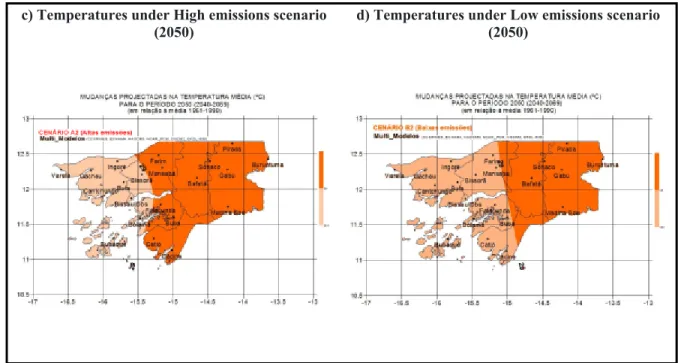
The new climate scenarios predict significant changes in Guinea-Bissau's climate. These scenarios consistently show daily average temperature increases of up to + 1.4?C for the period 2016-2045 and potentially up to + 2.2?C by 2046-2075, under the low emission scenario (RCP4.5). Under the RCP8.5 (high emissions) scenario, the expected changes are even higher with temperature increases in the range of + 1.6?C to + 3.1?C for the period 2046 to 2075 respectively.
a) Temperatures under High emissions scenario
(2020) b) Temperatures under Low emissions scenario
(2020)
c) Temperatures under High emissions scenario
(2050) d) Temperatures under Low emissions scenario (2050)
Figure 2 : Projected average annual temperatures (?C) for 2020 and 2050, downscaled from multimodels
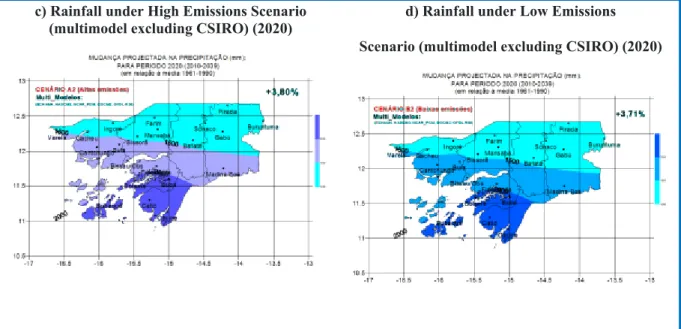
During the same period, annual rainfall would decrease in all parts of the territory by -6.4 mm in 2050 and 11.7 mm of rainfall in 2100, respectively, compared to their current level. In summary, climate variability will remain a dominant aspect of the climate in Guinea-Bissau and therefore given these uncertainties, predicting temperature increases along with the development of resilient planning for extreme drought events, especially in the eastern part of the country (Bafat?) and flooding along the coastal zone and uncertainty in precipitation levels will be necessary. (TCN, 2021).
c) Rainfall under High Emissions Scenario
(multimodel excluding CSIRO) (2020) d) Rainfall under Low Emissions Scenario (multimodel excluding CSIRO) (2020)
c) Rainfall under High Emissions Scenario
(multimodel excluding CSIRO) (2050) d) Rainfall under Low Emissions Scenario (multimodel excluding CSIRO) (2050)
Figure 3 : Projected average annual precipitation for 2020 and 2050, downscaled from multimodels.
Several regions of Guinea Bissau are already facing a significant poverty problem. These regions will instead be subject to increased food and nutritional insecurity and increased poverty. The supply of firewood, agricultural products, meat and fish to urban centers would become difficult and could lead to social tensions, a drop in producers' incomes, loss of biodiversity, land degradation and loss of wetlands.
? Guinea-Bissau's vulnerability to climate change
The latest scientific evidence from the IPCC 6th Assessment Report and other studies confirm this assessment for the West African region, and Guinea-Bissau in particular. Subsistence agriculture and food security are directly vulnerable due to future and existing climatic and non-climatic stressors, such as current lack of inputs (e.g., lack of irrigation or fertilizer use), infrastructure deficits, and poor services. Assessing maize yield data in Africa from 1961 to 2010, Shi and Tao (2014) find that a 1?C increase in average temperature reduces maize productivity by >10% for 8 African countries, including Guinea-Bissau. In addition, droughts tended to exacerbate these impacts: a 0.5 decrease in the standardized precipitation evapotranspiration index (SPEI) resulted in >30% losses in 32 African countries, again including Guinea-Bissau (Shi and Tao, 2014). Temperature increases can also reduce crop cycle length and create greater water stress for plants due to higher evapotranspiration demand, with the SPEI also being a primary constraint on water use for maize in Guinea-Bissau (Estes et al., 2014).
Median future crop yield losses are estimated to average -13% for Guinea-Bissau, caused primarily by a drier and warmer climate in northern West Africa. It is important to note that potentially positive feedback effects on crop yields due to a higher CO2 fertilization effect may not contribute to greater food security, as many West African staple crops (maize, millet, sorghum, with the exception of rice) are C4 crops that are less sensitive to higher CO2 concentrations (Roudier et al., 2011). Another recent study predicts a decline in sorghum yields on the order of 16-20% by 2031-2060 as crop production is increasingly affected by rising temperatures (Sultan et al., 2014). Potentially higher precipitation would have only a limited impact under these scenarios: already under a >2?C warming scenario, any potentially positive effect on millet and sorghum yields would be negated (Thornton et al., 2015).
Livestock are also extremely vulnerable to climate change: under a high-emissions RCP8.5 scenario, Guinea-Bissau's pasture net aerial primary productivity (ANPP) could decline by an average of 87.9%
through the 2050s, relative to a 1971-1990 baseline. In fact, of all African countries, only The Gambia is expected to experience greater losses in NAP, which is closely related to pasture profitability and productivity (Thornton et al., 2015). The incidence of crop and animal diseases or pests will also be affected by a warming climate, as will climate-related damage to critical infrastructure (roads, storage, communication, electricity supply, etc.) and services (health, etc.), posing considerable additional risks to food security and agricultural production (Niang et al., 2014; Porter et al., 2014).
Other concerns include the impacts of climate change on biodiversity, health, civil conflict and economic costs in the region. Habitat loss, environmental degradation, and unsustainable agricultural practices are already affecting biodiversity and species in West Africa, but under increasing climate stress, amphibians in particular could become highly vulnerable in semi-arid Guinea-Bissau (Carr et al, 2014). Increased rainfall could make cholera more common in Africa, especially where it is already endemic (Niang et al., 2014); Guinea-Bissau is also one of these areas. There may also be a connection
between climate change and political stability: Burke et al. (2009) find a significant relationship between the occurrence of armed conflict in sub-Saharan Africa and increasing temperatures. This implies that warmer years would also increase the likelihood of civil conflict. The 1998 coup in Guinea-Bissau was specifically mentioned in this context (Solow, 2013). Finally, the economic damage caused by climate change can be huge for the national economy: according to a 2013 vulnerability assessment by Verisk Maplecroft (2013) Guinea-Bissau's economy is highly vulnerable to economic output losses, ranking second behind Bangladesh globally.
? Surface Water Resources Future Vulnerability
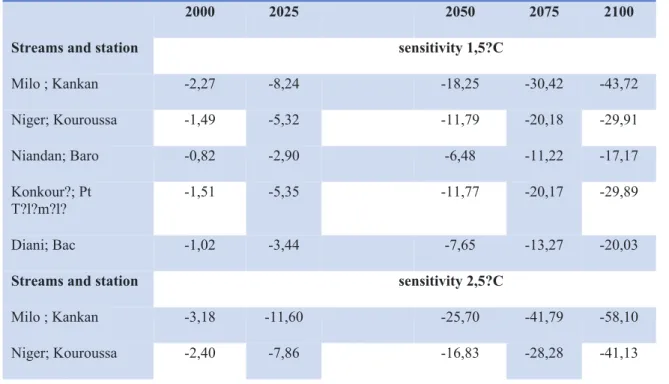
Guinea Bissau's water resources remain vulnerable to climate change impacts. Data indicate that rivers will experience a reduction in flow exceeding 50% of the current average in some places. This reduction phenomenon will be common to all regions of the country, but will be very marked for those located on the 10th parallel north, which includes the upstream of the Niger watershed. It is therefore expected that from 2050 to 2100, for the Niger watershed in Guinea Bissau, the rate of decrease will increase from 16 to 28% at the sensitivity of 2.5?C and from 23 to 54% at the sensitivity of 4.5?C. The main tributaries of the Niger watershed in Guinea Bissau experience phenomena related to the loss of vegetation cover and soil moisture on the one hand, and the increase in water erosion by rainwater and the destruction of gallery forests on the other.
Table : Projected Rate of Change (%) in Selected Streams
2000 2025 2050 2075 2100
Streams and station sensitivity 1,5?C
Milo ; Kankan -2,27 -8,24 -18,25 -30,42 -43,72
Niger; Kouroussa -1,49 -5,32 -11,79 -20,18 -29,91
Niandan; Baro -0,82 -2,90 -6,48 -11,22 -17,17
Konkour?; Pt
T?l?m?l? -1,51 -5,35 -11,77 -20,17 -29,89
Diani; Bac -1,02 -3,44 -7,65 -13,27 -20,03
Streams and station sensitivity 2,5?C
Milo ; Kankan -3,18 -11,60 -25,70 -41,79 -58,10
Niger; Kouroussa -2,40 -7,86 -16,83 -28,28 -41,13
Niandan; Baro -1,21 -4,45 -9,53 -16,30 -24,43 Konkour?; Pt
T?l?m?l? -2,40 -7,86 -16,79 -28,27 -41,12
Diani; Bac -1,28 -4,85 -10,71 -18,75 -27,93
Streams and station sensitivity 4,5?C
Milo ; Kankan -4,32 -15,86 -33,94 -54,46 -72,83
Niger; Kouroussa -2,78 -10,79 -23,01 -38,26 -54,17
Niandan; Baro -1,50 -5,66 -12,63 -21,96 -33,53
Konkour?; Pt T?l?m?l?
-2,80 -10,76 -23,00 -38,25 -54,18
Diani; Bac -1,79 -6,76 -14,92 -25,77 -38,52
Major root causes are of two main origins: human actions and conditions, namely poverty and food insecurity, misuse of natural resources, deforestation and overstocking, excessive use of chemical fertilizers, poor agricultural and irrigation practices; as well as environmental causes such as the salinization by marine intrusion, and climate variability/irregularity.
1. social/human dimension : a. poverty and food insecurity
More than two-thirds of the population live below the poverty line (less than US$1.90 per day). Many are chronically food insecure, with a population rate that ranges from 11% to 51%, depending on the year and region. At the local level, cashew cultivation can compete with food production in subsistence family farming , except in areas unsuitable for cashew cultivation, where mangrove rice prevails. This crop in turn competes with imported rice and makes it difficult to maintain strategic grain banks in the country, causing food security problems. Shocks caused by irregular rainfall, as well as fluctuations in the prices of imported rice and cashew nuts, further exacerbate chronic food insecurity in Guinea- Bissau. Key economic sectors such as transportation, industry, infrastructure, water resources, health, and energy production are still largely underdeveloped in Guinea-Bissau. Investment in the productive sectors, human capital, and technology is insufficient. Climate change tends to seriously worsen the pre-existing vulnerability in Guinea-Bissau, affecting both the population and economic and ecosystem assets. Climate change also makes it difficult to maintain the benefits of development in the country (CND, 2021).
2. environmental factors a. Land degradation
Guinea-Bissau's landscape consists of low-lying coastal plains, which inland to the east give way to a region of savanna (deciduous) forest. Tree growth in the savanna forest is limited primarily to the proximity of (perennial) streams and hills. Forest fires, both induced (slash-and-burn agriculture) and due to high temperatures and low rainfall, are common in the east, with an average density of 1.3 to 2.3 fires per km2 per year, but sometimes as high as 3.0 to 7.6 (World Bank, 2015). Land degradation is further exacerbated by the salinization by marine intrusion as well as climate variability and/irregularity. Additionally, the misuse of natural resources, deforestation and overstocking, excessive use of chemical fertilizers, and poor agricultural and irrigation practices further exacerbate land degradation and thereby the vulnerability of affected populations
The preferred solution is to strengthen the resilience of the agriculture sector in Cacheu and OIO regions to the adverse effects of climate through smart farming practices, ensuring food security, improved socio-economic outcomes for the population, and land restoration. This will involve an ecosystem approach, with restoration of surrounding areas, to provide an appropriate solution to the impacts of climate change on agricultural land. However, the resilience of the agriculture sector and the adoption of agricultural techniques for food security face the following barriers.
Barrier#1: Low technical and technological knowledge and capacity to adopt climate-smart agriculture. Although some traditional practices in terms of ecosystem restoration and protection exist and have been reintroduced, there is a need to adapt these practices to the projected impacts of climate change. However, data, models and lessons learned are limited in Guinea Bissau. Due to this lack of experience, producers are reluctant to adopt new practices; The Outputs 1.1.1. Implementation of Climate smart agriculture techniques and technologies at farmers? groups and cooperatives level, 1.1.2.
Restoration of agriculture degraded lands with Ecosystem based adaption approach, 2.1.1 Technical capacity building trainings for farmers' on climate-smart farming techniques, 2.1.2. Provisioning Agroclimatic and weather information and early warnings for farmers? groups climate-resilient decision making will contribute to remove this barrier.
Barrier#2: Limited technical support from the government to combat climate induced land degradation: Agricultural fields are increasingly exposed to drought and erosion due to climate change and harmful practices such as deforestation. The Outputs 2.1.1 Technical capacity building trainings for farmers' on climate-smart farming techniques, 2.1.2. Provisioning Agroclimatic and weather information and early warnings for farmers? groups climate-resilient decision making, 3.1.2. Project knowledge and lessons learned, will contribute to remove this barrier.
Barrier#3: Unavailable, outdated or inaccessible climate information. Currently, reliable climate information is not available or widely disseminated. The meteorological network is scattered throughout the country and does not provide the level of detail necessary for the adoption of adaptive practices. In addition, the available information is not always disseminated in a way that is understandable to local communities - for example, most information is only available in French and is
not translated into local languages. The Outputs 2.1.2. Provisioning Agroclimatic and weather information and early warnings for farmers? groups climate-resilient decision making, 3.1.1. Project monitoring and evaluation for lessons learned and knowledge compilation, 3.1.2. Project knowledge and lessons learned will take care of this barrier.
1.a.2. The baseline scenario and any associated baseline projects
Climate change affects agriculture in Guinea Bissau and particularly in the regions of Oio and Cacheu where agriculture is practiced by 82% of the active population for family survival. The speculations developed are: (i) cereals, including rice, which is the main staple food of the population (rice is consumed by more than 90% of the population), corn, millet and sorghum. (ii) tubers; (iii) vegetables;
and fruits. The project area faces drought, irregular rainfall and flooding. These phenomena, linked to climate change, affect agricultural production and aggravate food and livestock insecurity. According to the harmonized framework, food insecurity affects 8% of the population in Oio and Cacheu.
In response to this situation of recurrent food insecurity, a number of projects have been implemented and others are underway. Among the latter, we can mention :
? Project on Family Farming Diversification, Market Integration, Nutrition and Resilience to Climate Change in Guinea-Bissau; Co-funded by the International Fund for Agricultural Development, (IFAD), the Abu Dhabi Fund for Development, the Kuwait Fund for Arab Economic Development and the African Development Bank. The objective is to sustainably increase the income and food diversity of rural households in the eastern and northern regions of the country. The 6-year project (2019 - 2025) will take place in the regions of Bafat?, Cacheu, Gab? and Oio in Guinea Bissau. The number of beneficiaries is 26,000 households, approximately 287,000 people. The project is supported with a total of US$ 65,770,000. This project is not specifically within the area reserved for this project.
? ? The Emergency Food Security Project in Guinea-Bissau, the objective of which is to (i) support the increase in food production; and (ii) increase access to food for consumption by food-insecure households in Guinea-Bissau, financed by the World Bank to the tune of $15 million. Approved in 2020, it will end in 2023.
? Projet d?appui au d?marrage du projet d?appui a l?intensification de la production vivri?re (PAIPV) - Support project for the start-up of the food production intensification support Financed by BOAD for 10 millions USD. (. The overall objective of the Project is to contribute to improving food security and reducing poverty in the project area. It specifically aims to: i) intensify rice and market gardening production; ii) improve the development and marketing of targeted agricultural products; and iii) strengthen the management capacities of farmers' organizations. The main results expected from the first phase of the project are, among others: (i) 300 ha are developed for lowland rice cultivation; ii) 38 ha are developed for market gardening; iii) 588 tons of cereal seeds, 1,025 kilograms of market garden seeds, 200 tons of fertilizer, 4,000 liters of phytosanitary products are made available to farmers; (iv) 300 tons of husked rice are distributed to the most vulnerable households; v) 1,000 tons of paddy rice and 1,000 tons of additional market garden produce are produced annually; vi) 17 km of tracks are
rehabilitated; vii) 5 agricultural input shops, 5 multifunctional shops and 5 seed shops are built; viii) 15 cereal mills are procured and ix) 10 rice hullers, 10 threshers, 2 winnowers, 2 destoners and 15 cereal mills are installed. The present project will complement this project with its activities. This BOAD?s project will serve as co-financing.
? The UNDP/GEF Sustainable Land Management (SLM) Project. With a total budget of less than
$0.5 million, the long-term goal of the project is to contribute to the recovery of degraded lands through institutional and individual capacity building. It does so by integrating sustainable land management issues into national development strategies, supplementing the National Action Plan to Combat Desertification (PAN/LCD), strengthening, harmonizing and integrating institutional, technical, organizational and legal aspects in the SLM policy.
? The Rural and Agricultural Sector Rehabilitation Project (PRESAR) which is supported by the African Development Bank. One of PRESAR's three objectives is to build capacity in integrated natural resource management and land management at the village level.
1.a.3. Proposed alternative scenario with a brief description of expected results and project components.
The LDCF-funded project will help agricultural producers adapt to the negative effects of climate change on their production. Crop exposure to droughts and floods will be reduced through climate- smart agriculture and restoration of degraded lands in the project area. Agricultural campaigns will be supported for the duration of the project to increase yields through the implementation of climate-smart agriculture, thereby reducing the risk of food insecurity for the beneficiaries. A mechanism for disseminating climate resilient agricultural practices will be established to disseminate these practices in the project area. The project will take into account the needs of the most vulnerable people, with a focus on women and youth.
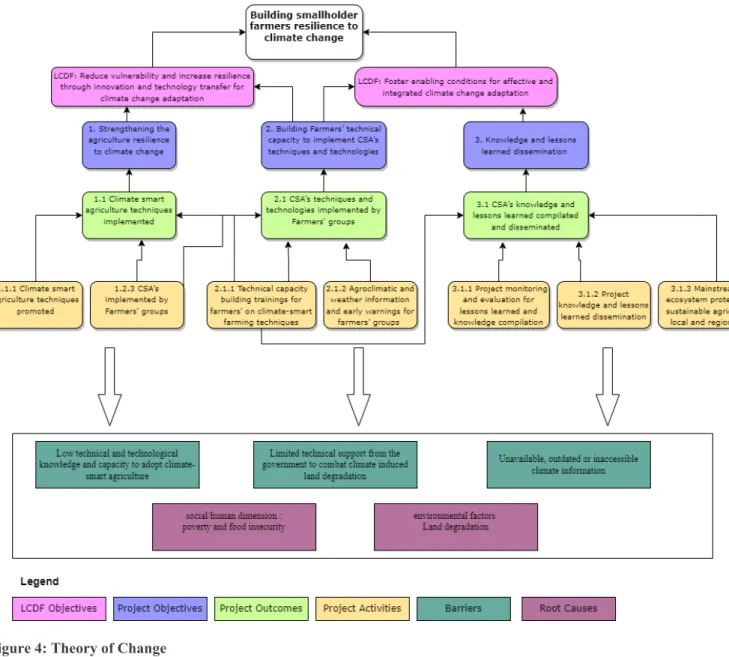
Figure 4: Theory of Change
Poverty, food insecurity and landradation are key factors impacting smallholder farmers resilience to climate change. Additionally, 1) low technical and technological knowledge and capacity to adopt climate-smart agriculture
2) limited technical support from the government to combat climate induced land degradation and 3) unavailable, outdated or inaccessible climate information severely impede progress in that area. The project directly targets these barriers and address the root causes of smalholder?s vulnerability. Barrier 1 is addressed by 1.1.1 the promotion of CSA techniques and 1.2.3 CSA implementation by farmer?s groups, as well as 2.1.1 Technical capacity building on CSA. Investment in improved irrigation as well as implementation of land regeneration techniques by smallholder farmers will lead to Outcome 1.1 and thereby improve the knowledge and capacity of farmers to adopt CSA. In the same vein activities 2.1.1 and 2.1.2 will lead to CSA techniques implementation by farmers groups, which will address Barrier 2. Limited technical support to combat land degradation. Outcome 3.1 CSA knowledge and lessons learned compilated and disseminated addressed Barrier 3. Unavailable, outdated or inaccessible climate information through the sharing of lessons learned and also the mainstreaming of ecosysem protection and sustainable agriculture into regional and local plans. Project Objective 1. Strenghening Agriculture?s reslience to climate change, Objective 2. Building Farmer?s CSA technical capacity
addresses the issue of land degradation on the short and long term. The implementation of CSA remediates water and soil conservation works in cultivated fields, agroforestry, prohibition and assisted natural regeneration, zero-tillage, reforestation, planting in protected communal, village and community forests. This will be done through 1.1.Climate smart agriculture techniques implemented and 2.1. CSA?s techniques and technologies implemented by Farmers' groups. A more resilient and efficient agricultural system will also respond to food security challenges and help alleviate poverty levels. Additionally, Objective 3. Knowledge and lessons learned desseminated will increase the scalability and replicability potential of the project.
Component 1 : Strengthening the agriculture resilience to climate change
This component will align with Guinea Bissau's priorities in its Nationally Determined Contribution (NDC) in terms of adaptation of vulnerable farmers to the adverse effects of climate change. It therefore aims to promote climate-smart techniques for sustainable land management. It will rely on a combination of traditional practices and innovative approaches to restore land and benefit farmers.
Fully functioning ecosystems will improve water retention and reduce the impacts of floods and droughts on vulnerable agricultural lands. This component will have significant climate risk reduction, mitigation, and biodiversity co-benefits by restoring and preserving ecosystems that sequester CO2 and provide living environments for wildlife to thrive.
The Outcome 1.1. Climate smart agriculture techniques promoted, will contribute to implement the component 1. This outcome will be implemented through two outputs: 1.1.1. Implementation of Climate smart agriculture techniques and technologies at farmers? groups and cooperatives level, and 1.1.2. Restoration of agriculture degraded lands with Ecosystem based adaption approach.
Output 1.1.1. : Implementation of Climate smart agriculture techniques and technologies at farmers?
groups and cooperatives level
To combat flooding and drought, micro water storage dams will be constructed to sustainably store water in agricultural systems. The micro-dams will be constructed on selected low-lying lands in flood- prone areas. The constructions will use simple technologies. Thus, the project beneficiaries (local farmers) will be able to manage repairs and maintenance after the project is completed. In addition to these water storage facilities, simple irrigation systems will be developed to maintain the required moisture level in the fields/paddies. The facilities will be designed to ensure proper distribution of water over the areas (plots) to ensure crop development and improve yields.
Micro-dams will be constructed in the three project areas.
Many fields will require irrigation under conditions of high temperatures and insufficient water. The irrigation system in the country is classic type with open-air canals and thermic plants with fossil fuels.
This system has shown its inefficiency through recorded water losses of between 40% and 50% and GHG Production. Evaporation due to the high temperatures currently experienced in the project area in connection with climate change, percolation to the underground, water diversion by other users, etc. are the sources of these water losses. Given that the project area is among the hottest in Guinea-Bissau, with an average maximum temperature of 35 degrees per day, thus favoring the evaporation of water from agricultural dams and open irrigation canals, financial resources of the LDCF will help promote water-saving technologies for irrigation. These losses may increase further due to climate projections predicting a rise in temperature in the coming decades. To limit the water losses and achieve water savings, the project aims to promote drip and California irrigation systems. These systems have an irrigation yield 90% and 85% respectively. These systems will therefore save between 35% and 50% of water.The solar pumps Kits will be installed for the supply of energy for irrigation needs. The kits will be composed of solar pumps, solar panels, inverter, regulator, reservoirs, boosters, and connection accessories for pumping dimensioned to ensure the irrigation.
The technical characteristics of the structures, the construction details and the type of hydraulic infrastructure required for the development will be defined on the basis of detailed hydrological and hydraulic studies at PPG stage..
Output 1.1.2. Restoration of agriculture degraded lands with Ecosystem based adaption approach On the basis of the analysis of past and existing land use that will be carried out during the preparation phase of the project, restoration and protection practices will be introduced. However, techniques such as sills, agroforestry, assisted natural regeneration, zero-tillage etc. will be introduced and/or developed in the project areas. Local communities will be involved in the identification of restoration activities, as well as during the implementation of these activities, providing local employment to youth and especially women. These techniques will restore degraded areas, increase vegetation cover, and protect forests. These practices will be introduced in areas surrounding agricultural lands, to provide large- scale adaptive benefits. For instance, the regenerative techniques considered ? such as water and soil conservation works in cultivated fields, gabion thresholds, agroforestry, prohibition and assisted natural regeneration, zero-tillage, reforestation, planting in protected communal, village and community forests
? have common benefits advantages in terms of added values:
? simple technique requiring low levels of technical skills and easily mastered by farmers;
? relatively inexpensive technique.
? solid and stable infrastructure that can withstand the force of runoff water or water erosion;
? easily adaptable to any form of soil structure and landscape.
? fight against water erosion at the level of an entire watershed system;
? channels runoff water;
? allows the spreading of water.
? allows rapid restoration of soil fertility after 2 to 3 years.
Restoration of key surrounding ecosystems will provide important ecosystem services to farmers by increasing water recharge, reducing landslides and water runoff during floods, and increasing biodiversity.
Component 2 : Building Farmers? technical capacity to implement CSA?s techniques and technologies
This component aims to promote climate-smart agriculture (CSA) techniques and technologies, adapted to the project's intervention areas, to reduce smallholder farmers' vulnerability to climate and enhance food security. Beneficiaries will be provided with practices and techniques for a comprehensive approach to climate change. These practices will build sustainable community resilience to the adverse effects of climate change, improve agricultural production and income of beneficiaries, and contribute to carbon sequestration and thus GHG mitigation.
The component will also build the capacity of local producers to access, understand and use agro- climatic and meteorological information, and contribute to the production of local baseline data.
Discussions with stakeholders during the PPG will identify the most promising value chains to be promoted. This component will be strongly related to component 1 and will build on land restoration.
The project will be implemented through CSA?s techniques and technologies implemented by Farmers' groups which is the Outcome 2.1. This Outcome will be implemented through two outputs: 2.1.1 Technical capacity building trainings for farmers' on climate-smart farming techniques, 2.1.2.
Provisioning Agroclimatic and weather information and early warnings for farmers? groups climate- resilient decision making.
Activity 2.1.1. Technical capacity building trainings for farmers' on climate-smart farming techniques This activity will consist of organizing training sessions on climate-smart agriculture techniques. These trainings will be organized for agricultural technicians and smallholder farmers. During this activity, trainers will work with local authorities as key partners in the design and implementation of the project to ensure their buy-in and involvement in the sustainability and scaling up of practices. The commitment of local authorities and decentralized government officials will be ensured through the establishment of clear monitoring frameworks for the protection of restored ecosystems in the long
term. Local and regional planning and funding will be supported to introduce ecosystem protection and the adoption and scaling up of sustainable agriculture techniques. In addition, the project will establish local committees with beneficiary farmer groups for natural resource management. Awareness-raising activities will be conducted with local communities to discuss the long-term benefits of ecosystem preservation for local agricultural production and food security. Discussions will focus on: the impacts of climate change; key ecosystems such as wetlands, savannahs and forests; their linkages to production systems; and the benefits they offer for climate change adaptation.
Manuals/guides and training on good practices in water management, soil restoration, crop planning will be developed and made available to producer groups.
Activity 2.1.2 : Provisioning Agroclimatic and weather information and early warnings for farmers?
groups climate-resilient decision making
Access to real-time weather and climate information allows for better programming of agricultural activities and improves agricultural productivity and production. It significantly reduces the risk of agricultural investments being lost due to late and/or irregular rainfall. This activity therefore foresees strengthening producers' access to appropriate agro-meteorological information. In addition, it is planned to acquire and install rainfall measurement kits and purchase direct-reading thermometers and anemometers to cover all the communes and prefectures in the project area and to increase the density of the existing network. To eliminate information asymmetry, cell phone services are becoming an important means of providing farmers' groups with weather forecasts and market data. In each area, three to five farmer group members will be identified by the beneficiary groups to receive timely weather information. They will be provided with cell phones to disseminate information received to the rest of the group members. Their capacities will be strengthened to ensure the flow of information in both directions. The dissemination of weather information through cell phones will be reinforced by radio broadcasts in local languages. This activity will be implemented in collaboration with the meteorological services.
Component 3: Knowledge and lessons learned dissemination
The lessons learned will be of interest to the government, civil society and vulnerable populations, regional institutions and donors working in the climate change adaptation sector. In order to ensure the project's contribution to climate change adaptation and to improve current practices in Guinea-Bissau, the various project reports and studies will be used to formulate a comprehensive lessons learned document. This will contain, among other things: (i) the effectiveness and weaknesses of technologies and techniques, processes, financial management and use at the local level, water, soil, flora, fauna, environment, adaptation, productivity/income and mitigation indicators, etc. (ii) recommended best adaptation practices for local, national, and regional adaptation projects; and (iii) proposed solutions to address weaknesses identified during project identification, planning and implementation. This document will be the key knowledge base to share. Additionnally, through these lessons learned, the project will seek to mainstream ecosystem protection and sustainable agricultural techniques in local and regional plans
The Outcome 3.1. CSA?s knowledge and lessons learned compilated and disseminated will implement the component 3 through the Output 3.1.1. Project monitoring and evaluation for lessons learned and knowledge compilation, and the Output 3.1.2. : Project knowledge and lessons learned dissemination
Activity 3.1.1. Project monitoring and evaluation for lessons and knowledge compilation
The project will develop a program of close and ongoing monitoring of the physical investments made on the sites. The program will include network, structure monitoring and other interventions. This ongoing monitoring will be carried out by an M&E specialist, with the support of the Ministry of Agriculture's decentralized services. These services will benefit from technical and material capacity building activities to carry out this monitoring program.
In addition, a project monitoring and evaluation system will be designed and implemented in accordance with LDCF (GEF) and BOAD requirements to monitor: (i) the rate of implementation of project activities, (ii) the progress of project financial data, (ii) regular and systematic recording and reporting of progress against planned project objectives through the creation of a database, and (iii) the assessment of the impact of project activities on the target group and the environment; (iv) collection of gender-disaggregated data and reporting system for each project component, (v) development of participatory tools to measure project performance, (vi) conduct of beneficiary surveys to measure effects/impacts (at the beginning, mid-term and end), (vii) recruitment of a gender mainstreaming consultant to support the Executive Entity, (viii) conduct of an annual analysis/evaluation of the
project's technical, economic, and financial performance, (ix) mid-term evaluation, and (x) final evaluation.
Activity 3.1.2 Project knowledge and lessons learned dissemination
A knowledge management strategy will be developed and will focus on the collection of data, results and lessons at project level, and their collation into accessible and open databases. Open data will be a key element in making the project results available to policy makers, development partners and civil society, who will also be able to add to the knowledge base. Knowledge will be made available to all stakeholders through the production and dissemination of information via fact sheets, policy briefs, press releases, scientific publications, databases on practices and awareness raising tools (documentaries, guided tours for development actors, etc.). A project website will be launched as a platform for information and knowledge exchange in the adaptation sector in relation to previous adaptation projects. All experiences will be capitalised and documented for future replication, fact sheets on the status of smart agriculture and policy briefs will be published and made available to all practitioners and other stakeholders in the agricultural sector. The project can also contribute to providing other projects with relevant information on climate resilient agriculture. Complementary activities such as: (i) annual workshops bringing together community, departmental, regional and national stakeholders, the private sector, associations, NGOs, etc. to discuss opportunities and constraints, share experiences and promote learning, incorporation of reports into the database of municipalities and statistical directorates; (ii) dissemination of information on lessons learned and experiences shared through programmes on public and private media (local and national TV and radio).
Activity 3.1.3 Mainstreaming of ecosystem protection and sustainable agricultural techniques in local and regional plans (contribute to Core Indicator 3)
Local and regional planning and funding will be supported to introduce ecosystem protection and the adoption and scaling up of sustainable agriculture techniques. The local development plans constitute the reference and orientation framework for all development actions at the local level. Therefore, the project will conduct an inventory of existing plans in order to improve coherence between the management of restored degraded lands and landscapes and community development initiatives.This exercise will be participatory and will require regular consultations of all actors and civil society at the local level on issues focused on the integration of smart agriculture, conservation of ecosystems and gender in local development planning. In addition to updating the directory of development actors, the exercise will create a dynamic of sustainable consultation and inclusion of all in the decision-making process at the local level in terms of ecosystems preservation.[1]
3. Does the proposed alternative scenario describe the expected outcomes and components of the project/program?
1.a.4. Alignment with GEF focal area and/or Impact Program strategies
LDCF Focal area Project Focal area
Goal To strengthen resilience and reduce vulnerability to the adverse impacts of climate change in developing countries, and support their efforts to enhance adaptive capacity
Building smallholder farmers resilience through climate smart agriculture techniques in Oio and cacheu north regions in Guinea Bissau
Corporate/Core Indicator
Number of direct beneficiaries (gender disaggregated)
1,400 households
9,800 direct beneficiaries, 40,000 indirect people
(35% women) with a focus on the youth and vulnerable people.
Objective 1 Reduce vulnerability and increase resilience through innovation and technology transfer for climate change adaptation
Component 1: Strengthening the agriculture resilience to climate change
Component 2: Building Farmers? technical capacity to implement CSA?s techniques and technologies
Outcome 1.1 Technologies and innovative solutions piloted or deployed to reduce climate-related risks and/or enhance resilience
Outcome 1.1. : Climate smart agriculture techniques promoted
Outcome 2.1: CSA?s techniques and technologies implemented by Farmers' groups
Output 1.1.1 Physical assets made more resilient to climate variability and change
Output 1.1.1. Implementation of Climate smart agriculture techniques and technologies at farmers? groups and cooperatives level
Output 1.1.2. Restoration of agriculture degraded lands with Ecosystem based adaption approach Output 1.1.2 Livelihoods and sources of
income of vulnerable populations diversified and strengthened (gender disaggregated)
Output 1.1.1. Implementation of Climate smart agriculture techniques and technologies at farmers? groups and cooperatives level
Output 1.1.2. Restoration of agriculture degraded lands with Ecosystem based adaption approach Output 1.1.3 Vulnerability to climatic
hazards reduced through new or improved early
warning systems
Output 2.1.2. Provisioning Agroclimatic and weather information and early warnings for farmers? groups climate-resilient decision making
Output 1.1.4 Vulnerable ecosystem services and natural resource assets strengthened
in response to climate change impacts
Output 1.1.2. Restoration of agriculture degraded lands with Ecosystem based adaption approach
Objective 3 Foster enabling conditions for effective and integrated climate change
adaptation
Component 2: Building Farmers? technical capacity to implement CSA?s techniques and technologies
Component 3: Knowledge and lessons learned dissemination
Outcome 3.1 Climate-resilient planning enabled by stronger climate information
decision-support services, and other relevant analysis
Outcome 2.1.2. Provisioning Agroclimatic and weather information and early warnings for farmers? groups climate-resilient decision making
Output 3.1.1 Countries with systems and frameworks for the continuous monitoring,
reporting and review of adaptation
Output 2.1.2. Provisioning Agroclimatic and weather information and early warnings for farmers? groups climate-resilient decision making Output 3.1.1. Project monitoring and evaluation for lessons learned and knowledge compilation Outcome 3.2 Institutional and human
capacities strengthened to identify and implement adaptation measures
Outcome 2.1.1 Technical capacity building trainings for farmers' on climate-smart farming techniques
Output 3.2.1 Adaptation actions/measures integrated into national, sectoral or
subnational development strategies, plans and budgets
Output 2.1.1 Technical capacity building trainings for farmers' on climate-smart farming techniques Output 3.1.2. Project knowledge and lessons learned dissemination
Output 3.2.2 Strengthened capacity of institutions and humans to respond rapidly to
extreme weather events (gender disaggregated)
Output 2.1.1 Technical capacity building trainings for farmers' on climate-smart farming techniques
Output 3.2.3 Capacity built for long-term research on climate change impacts andadaptation
Output 3.1.1. Project monitoring and evaluation for lessons learned and knowledge compilation
Output 3.1.2. Project knowledge and lessons learned dissemination
1.a.5. Incremental/additional cost reasoning and expected contributions from the baseline, the GEFTF, LDCF, SCCF, and co-financing
As mentioned above, according to the harmonised framework, during the period June-August 2021, 7.6% of the Guinea-Bissau population is in a food crisis situation. In the regions of Oio, and Cacheu, 8% of the population of each region is in the same situation. The project will lead to (i) significant investments by the rural population to cover their food needs and social integration.
Although climate-smart agriculture is a promising technology, producers in Guinea Bissau see the initial costs of installing irrigation kits and dams as exorbitant and the benefits are not immediately apparent. Producers therefore favour the unusual practices with which they feel most comfortable despite the GHG emissions they generate. Indeed, the analysis of the agricultural sector in Guinea Bissau reveals that the sector is facing financial difficulties. There is also a lack of technical, regulatory and institutional framework for the promotion of climate-smart agriculture.
Without the mobilisation of external financial resources, the private sector, but also all actors in the agricultural sector, will still have difficulties in developing the climate-smart agriculture sector and moving towards food self-sufficiency. The mobilisation of funding for the promotion of climate-smart agriculture through the establishment of water-efficient irrigation systems is necessary to raise awareness of the benefits of the environment and good agricultural practices and will create a sustainable framework for food security in the target regions.
The activities described above are best catalysed by the use of a LDCF grant that will address existing policy and regulatory barriers, capacity and knowledge gaps, and lack of appreciation of the technical feasibility and commercial viability of integrated farming systems. The LDCF will therefore support the strengthening of the institutional and regulatory framework governing the energy sector, knowledge and capacity development, and the implementation of the agriculture demonstration, management and
monitoring and evaluation projects. LDCF support will also be used to provide targeted training to market actors to support the adoption of innovative agricultural production techniques in rural areas.
The project will generate several other additional benefits. Households will have: (i) easy access to food; (ii) easy access to drinking water and irrigation of agricultural areas; (iii) improved standard of living; (iv) ability to create income-generating activities; (v) better learning and working conditions for children, school youth and youth enrolled in vocational training; (vi) reduced indoor pollution; and (vii) improved human health. The project interventions will contribute to climate change adaptation by using environmentally friendly technologies to replace environmentally polluting technologies used in a business-as-usual model. Facilitation and activation of the application of smart farming technologies will be achieved by removing barriers associated with regulations and institutional mechanisms, capacity and limited knowledge on the application, design, financing and operation of hybrid systems.
The current LDCF project, with its outcomes, focuses solely on adaptation and climate-smart agriculture needs in the project area. During the PPG phase, exchanges will be pursued with the Guinea Bissau?s Microfinance institutions(MFIs) for their contribution in the form of their agricultural loans that can integrate climate smart agriculture issues. It will be very interesting for them to reduce interest rates and make them, if possible, concessional for medium and long term adaptation investments.
1.a.6. Global environmental benefits (GEFTF) and/or adaptation benefits (LDCF/SCCF)
The project is in line with the GEF/LDCF's main objective 7 on climate change adaptation "Promoting innovation, technology transfer and supportive policies and strategies". In the project area, most of the population is rural and largely dependent on rain-fed agriculture in a context of climate change.
Droughts are recurrent. These phenomena, which occur one after the other and at least two years out of three, cause food deficits and economic shocks with an increase in poverty. The project will contribute to the achievement of LDCF objective 1: Reducing vulnerability and increasing resilience through innovation and technology transfer for climate change adaptation.
The proposed project is expected to increase resilience and reduce vulnerability of 100 hectares of land and 1400 households, representing 9,800 direct beneficiaries and 40,000 indirect beneficiaries, of which 35% are women, with a focus on youth and vulnerable people. The proposed project is also in line with sustainable development, especially in rural areas, and will bring local benefits such as improved living conditions for rural populations. The exact number of women and youth will be provided and a gender action plan will be developed during the PPG stage. These indicators will respond to the LDCF's objective of building resilience and reducing vulnerability to the adverse effects of climate change in developing countries, and supporting their efforts to improve their adaptive capacity. This LDCF objective is expressed in the project as the project objective: To build resilience
and reduce vulnerability of farmers in Cacheu and OIO to the adverse effects of climate change. Thus, the project indicator of number of direct beneficiaries disaggregated by gender will contribute to LDCF core indicator: Number of direct beneficiaries (disaggregated by gender); the project indicator:
Increased yields and livelihood production in targeted areas with relevant adaptation technologies used (drip irrigation, California irrigation network fed by dam water) will contribute to LDCF impact indicator 1: Successful demonstration, deployment and transfer of relevant adaptation technologies in targeted areas, and the project indicator will strengthen LDCF Impact Indicator 3: Improved opportunities for investment in adaptation with and through public and private sector partners.
1.a..7. Innovation, sustainability and potential for scaling up
The particularity of this project is that it pioneers a new paradigm for the sustainable development of climate-smart agriculture in the regions of OIO, and Cacheu. Innovation is a major feature of the project due to the focus on the different technologies that will foster resilience and the fact that the project's approach will synergistically reach different intervention areas. For instance, the project plans to promote the use of drip and California irrigation systems. As noted above, these systems have an irrigation yield of 90% and 85% respectively. These systems will therefore save between 35% and 50%
of water. Additionally, the project will synergistically target irrigation challenges but also the regeneration of degraded land, including through regeneration and reforestation.
An additional and essential element of sustainability will come from promoting local ownership by communities and end-users. Appropriate training and capacity building for local operation and maintenance will be provided to ensure long-term sustainability, and local authorities will be involved from project planning to implementation and monitoring. Local ownership will also be fostered through the creation or training of local management committees that will have their voice in project design, implementation and monitoring. These committees will also ensure that any proposed innovation responds to local needs and realities. Furthermore, the cash-for-work modality that will be used in implementing the CSA will ensure the communities see the social-economic benefits of the project.In addition, social sustainability will be enhanced through systematic gender mainstreaming throughout the project cycle.
The introduction of climate-smart agriculture in rural households has great potential for replication. Indeed, the CSA technologies that will be introduced or re-introduced require a low level of technical expertise and relatively low investment per household. Once the financial mechanism (cash- for-work modality) is in place, it can be used either by other investors or by international and national financial institutions as a catalyst for increasing environmentally friendly agricultural production in other rural localities in Guinea Bissau. This project can also be replicated with other innovative smart agriculture technologies. Several activities will generate results that will be used to demonstrate how the approaches and lessons can be used in the country and in the regions. Replicability also comes from
the project's ability to clearly demonstrate the financial and social benefits of adopting climate-smart agriculture.
Institutionally, sustainability will come from the mainstreaming of CSA in regional and local plans andcollaboration established between several line ministries and the capacity to integrate the concept of climate-smart agriculture as a means of integrated rural development, which is a declared priority of the Government of Guinea Bissau as reflected in its Strategic Plan Horizon 2025.
[1] https://data.worldbank.org/country/guinea-bissau
1b. Project Map and Coordinates
Please provide geo-referenced information and map where the project interventions will take place.
2. Stakeholders
Select the stakeholders that have participated in consultations during the project identification phase:
Indigenous Peoples and Local Communities Yes Civil Society Organizations Yes
Private Sector Entities Yes
If none of the above, please explain why:
In addition, provide indicative information on how stakeholders, including civil society and indigenous peoples, will be engaged in the project preparation, and their respective roles and means of engagement
The stakeholders involved in this project are: (i) the Ministry of Environment and Biodiversity; (ii) the Ministry of Agriculture and Rural Development; (iii) the Ministry of Economy, Planning and Regional Integration; (iv) the National Institute of Agricultural Research; (iv) the West African Development Bank; (v) MFIs; (vi) rural populations; (vii) rural organisations and NGOs; (viii) private companies will provide information on water-saving irrigation kits; and (ix) international financial institutions and international partners.
The Ministry of Environment and Biodiversity will be responsible for the implementation of the project in collaboration with theMinistry of Agriculture and Rural Development . The National Institute of Agricultural Research will be responsible for monitoring the project on the basis of agreements between the project stakeholders. It will be responsible for conducting annual performance tests on the understanding and adoption of climate-smart techniques in agriculture. The Ministry of Economy, Planning and Regional Integration will assist in setting up and operationalising financial mechanisms and incentives, as well as MFIs. Private companies will provide information on water-saving irrigation kits, sales, after-sales services, warranties, and equipment maintenance and will be given incentives to promote smart farming. BOAD, as GEF implementing agency, will approve the design documents, appraise and supervise the project and provide technical support to the project. Rural people, local/rural organisations and NGOs will be involved in the design and implementation of the project, in awareness raising campaigns, and in sharing rural and traditional knowledge. International financial institutions and international partners will ensure synergy with existing or recent projects and support the exchange of experiences. As public participation is vital in the whole process of promoting climate-smart agriculture, the project management unit will maintain very close contact with end-users in local communities.
3. Gender Equality and Women's Empowerment
Briefly include below any gender dimensions relevant to the project, and any plans to address gender in project design (e.g. gender analysis).
During the project preparation phase, gender-based vulnerability assessments will be carried out in the different target villages and regions to highlight specific gender-related vulnerabilities. The results of this assessment will enable the identification and development of gender-sensitive adaptation measures and strategies that will be supported by this LDCF to address gender-related climate risks and vulnerabilities.
These adaptation strategies will be technically specified, including capacity building and financial support. During implementation, programmes to build capacity and support mechanisms for farmer groups will particularly target youth and women. Housewives are also important targets in any communication and information programme to improve climate-resilient agricultural practices. They can be heavily involved in income-generating activities, which will certainly improve their living conditions and financial independence.
Women and youth will therefore play a very important role in the implementation of the project.
In the framework of this project, gender issues will be effectively addressed, namely:
(i) difficulties related to local cultural traditions, according to which men are served before women, leaving only plots far from the pumping stations to women, which could lead to frustrations, (ii) the difficulty of breaking social barriers that maintain gender inequalities, (iii) the low level of understanding of awareness messages, (iii) the low level of understanding of the awareness-raising messages, which can lead to a low level of ownership of the project at individual or collective level, (iii) the
difficulties for women to have land and to pay the maintenance costs of the hydraulic works serving their plots, (iv) the difficulty or impossibility of using paid labour for weeding or watering the fields, (v) the exclusion from the project of women who do not own land, etc.
Does the project expect to include any gender-responsive measures to address gender gaps or promote gender equality and women empowerment? Yes
closing gender gaps in access to and control over natural resources; Yes
improving women's participation and decision-making; and/or Yes
generating socio-economic benefits or services for women.
Will the project?s results framework or logical framework include gender-sensitive indicators?
4. Private sector engagement
Will there be private sector engagement in the project?
No
Please briefly explain the rationale behind your answer.
5. Risks to Achieving Project Objectives
Indicate risks, including climate change, potential social and environmental risks that might prevent the Project objectives from being achieved, and, if possible, propose measures that address these risks to be further developed during the Project design (table format acceptable)