Received February 2nd, 2011, Revised April 20th, 2011 Accepted for publication May 6th, 2011.
*Corresponding author: Tony Hadibarata, Institute of Environmental and Water Research Management, Universiti Teknologi Malaysia, 81310 Skudai, Johor, Malaysia. Tel:+607-5531760; Fax: +607-5531760 Copyright © 2011 Published by LPPM ITB, ISSN: 1978-3043, DOI: 10.5614/itbj.sci.2011.43.3.3
Effects of Glucose on the Reactive Black 5 (RB5)
Decolorization by Two White Rot Basidiomycetes
Tony Hadibarata1,*, Abdull Rahim Mohd Yusoff 1
,
Azmi Aris1,
Risky Ayu Kristanti2, Topik Hidayat3,4 & Adhi Yuniarto51
Institute of Environmental and Water Research Management, Universiti Teknologi Malaysia
2
Dept. of Chemical and Environmental Engineering, Yamanashi University
3
Dept. of Biological Science Faculty of Bioscience and Bioengineering, Universiti Teknologi Malaysia
4
Dept. of Biology Education, Faculty of Mathematic and Natural Science, University of Education (UPI) Bandung, Indonesia
5
Dep. of Environmental Engineering, Institut Teknologi Sepuluh Nopember (ITS) Surabaya, Indonesia
Email: [email protected]
Abstract. The capacities of glucose in the decolorization process of an azo dye, Reactive Black 5 (RB5), by two white rot basidiomycetes, Pleurotus sp. F019 and Trametes sp. F054 were investigated. The results indicated that the dye degradation by the two fungi was extremely correlated with the presence of glucose in the culture and the process of fungi growth. Decolorization of 200 mg dye/l was increased from 62% and 69% to 100% within 20–25 h with the increase of glucose from 5 to 15 g/l, and the activity of manganese dependent peroxidase (MnP) increased by 2–9 fold in this case. Hydrogen peroxide of 0.55 mg/l and 0.43 mg/l were detected in 10 h in Pleurotus sp. F019 and Trametes sp. F054 cultures.
Keywords: Decolorization; Glucose; Manganese peroxidase; Pleurotus sp. F019; Reactive Black 5; Trametes sp. F054.
1
Introduction
extensively investigated in recent years and some bioreactors in lab-scale were suggested for this objective [4]. White rot basidiomycetes are the most powerful ligninolytic microorganisms adequate of degrading various forms of dyes such as reactive, azo, heterocyclic and polymeric dyes. This ability is due to extracellular non-specific and non-stereoselective enzyme systems composed of laccases (EC 1.10.3.2), lignin peroxidases (EC 1.11.10.14) and manganese peroxidases (EC 1.11.1.13) [5,6].
2
Materials and Methods
2.1
Dye
Reactive Black 5 (RB5, Color Index) and other chemicals were purchased from Wako Pure Chemical Industry Co. Ltd. (Osaka, Japan) at the highest purity available. The structure of RB5 is shown in Figure 1.
Figure 1 The chemical structures of RB5.
2.2
Microorganisms and Decolorization Experiments
clear supernatant obtained was used for determination of decolorization rate spectrophotometrically by reading UV-Vis Spectrophotometer with the absorbance at max (598nm). The percentage of decolorization was calculated as follow:
Decolorization (%) =
1
100
0
C
C
where C0 is initial dye concentration and C is final dye concentration [7].
2.3
Assay of Manganese Dependant Peroxidase
Enzyme activity was determined spectrophotometrically at 25C. Manganese peroxidase (MnP) activity was assayed at 468 nm using dimethoxyphenol (DMP) as the substrate [8]. One unit (U) of enzyme activity was defined as the amount of enzyme required producing one micromole of product per minute.
2.4
Determination of H
2O
2Concentration
H2O2 concentration in the culture was determined by iodometric titration as described by Harris [9].
3
Results and Discussion
3.1
Relationship between Glucose Consumption and RB5
Decolorization
their secondary metabolism and was effected by limited nutrient stage. The process of dye removal was developed after production of the enzyme [12]. The condition in two basidiomycetes was slight different from mainly white rot basidiomycetes, wherein the dye removal development occurred throughout the increase phase of fungal cells and at most under the form of sufficiently nutrients availability. The indication of dye removal by basidiomycetes proposed different side of glucose roles and an unknown mechanism of dye removal.
Figure 2 Kinetic relation between glucose utilization and dye decolorization by Pleurotus sp. F019 and Trametes sp. F054. (Data are averages of triplicate experiments).
3.2
Influence of Glucose Concentration on the Production of Mnp
and Decolorization of Rb5
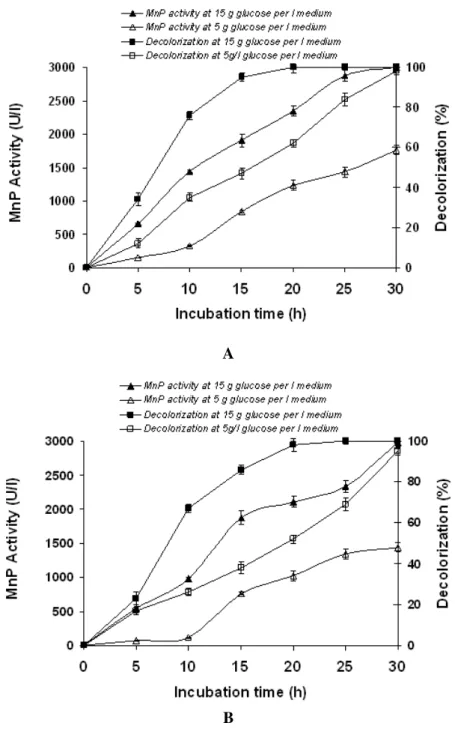
activity and glucose concentration. The MnP activities at 15 g glucose/l were about and glucose concentration. The MnP activities at 15 g glucose/l were
A
B
activity and glucose concentration. The MnP activities at 15 g glucose/l were about 2–9 fold of those at 5 g glucose/l in these two fungi. However, it is inconvenience to clarify how the fungi cells decolorize 200 mg dye/l in few enzyme activity conditions. In addition, there should be other enzymes responsible for RB5 decolorization by Pleurotus sp. F019 and Trametes sp. F054.
Other studies showed that biodegradation of aromatic hydrocarbon could be performed either by extraceluler ligninolytic enzymes system such as MnP, lignin peroxides (LiP) and laccase or by the oxygenase produced by basidiomycetes [13]. On the other hand, the observation of 1,2- and 2,3-dioxygenase suggested that there are a few activities of these enzyme in Pleurotus sp. F019 and Trametes sp. F054cells at either presence or absence of dye in the culture. The detail mechanism of decolorization by Pleurotus sp. F019 and Trametes sp. F054requires further research. At least, production of MnP was a kind of response to the presence of dye by these two fungi and should be related with the process of color removal. As our discussion above, the quick decolorization stage by fungi was strongly accompanied with the cell’s growth. It also suggested that 1,2- and 2,3-dioxygenase producing in the process of cell growth might be responsible for color removal and glucose might play important roles in this process except as a carbon or energy source for fungi growth.
3.3
Hydrogen Peroxide Production
Figure 4 Production of H2O2 by Pleurotus sp. F019 and Trametes sp. F054.
4
Conclusions
The rapid color removal process of RB5 throughout the biodegradation system by two basidiomycetes, Pleurotus sp. F019 and Trametes sp. F054, were highly linked with a carbon source such as glucose, presence in the fungal culture. Increase of addition of glucose concentration from 5 to 15 g/l apparently intensified the color removal efficiency correlated with the production of MnP. In the color removal processes, glucose is playing an important role as a source of carbon for fungi growth and a substrate for production of H2O2. The latter was considered to start the color removal processes and catalytic reaction of MnP. The main role of glucose and H2O2 in the second cycle of color removal
processes tests strongly supported Hofrichter’s assumption about the mechanism of MnP catalysis. The comprehensive characteristic processes of RB5 decolorization by these two basidiomycetes and the crucial enzymes responsible for the decolorization are still required further investigation.
Acknowledgements
References
[1] Aksu, Z. & Donmez, G., Combined Effects of Molasses Sucrose and Reactive Dye on the Growth and Dye Bioaccumulation Properties of Candida Tropicalis, Process Biochem., 40, 2443–2454, 2005.
[2] Fu, Y. & Viraraghavan T, Fungal Decolorization of Dye Wastewaters: A Review, Bioresour. Technol., 79, 251–262, 2001.
[3] Lee, Y.H. & Pavlostathis, S.G., Decolorization and Toxicity of Reactive Anthraquinone Textile Dyes Under Methanogenic Conditions, Water Res., 38, 1838–1852, 2004.
[4] Borchert, M. & Judy, A.L, Decolorization of Reactive Dyes by the White Rot Fungus Trameters Versicolor in Sequencing Batch Reactors, Biotechnol. Bioeng., 75, 313–321. 2001.
[5] Novotny, C., Svobodova, K., Kasinath, A. & Erbanova, P., Biodegradation of Synthetic Dyes by Irpex Lacteus under Various Growth Conditions, Int. Biodeter. Biodegr., 54, 215–223, 2004.
[6] Heinzkill, M., Bech, L., Halkier, T., Schneider, P., & Anke, T., Characterization of Laccases and Peroxidases from Wood Rotting Fungi (Family Coprinaceae), Appl. Environ. Microbiol., 64, 1601–1606, 1998. [7] Sayan, E. Optimization and Modeling Decolorization And COD
Reduction Of Reactive Dye Solution By Ultrasound-Assisted Adsorbtion, Chem. Eng.,119, 175-181, 2006.
[8] Field, J.A., De Jong, E., Feijoo, G. & De Bont, J.A.M., Screeining for Lignolytic Fungi Applicable to the Biodegradation of Xenobiotics, Trends Biotechnol., 11, 44–49, 1993.
[9] Harris, D.C, Quantitative Chemical Analysis (5th ed.), New York: W.H. Freeman and Company, 1999.
[10] Adosinda, M., Martins, M., Ferreira, I.C., Santos, I.M., Queiroz, M.J. & Lima, N., Biodegradation of Bioaccessible Textile Azo Dyes by Phanerochaete Crysoporium, J. Biotechnol., 89, 91–98, 2001.
[11] Swamy, J. & Ramsay, J.A., Effects of glucose and NH4 +
Concentrations On Sequential Dye Decolorization by Trametes Versicolor, Enzyme Microb. Technol., 25, 278–284, 1999.
[12] Wesenberg, D., Kyriakides, I. & Agathos, S.N., White Rot Fungi and Their Enzymes for the Treatment of Industrial Dye Effluents, Biotechnol. Adv., 22, 161–187, 2003.
[13] Cerniglia, C.E., Biodegradation of Polycyclic Aromatic Hydrocarbon: A Review, Biodegradation, 3, 351–368, 1992.