Treatment of Lane-Emden Type Equations via
Second Derivative Backward Differentiation
Formula using Boundary Value Technique
S. A. Okunuga
∗, J. O. Ehigie
†and A. B. Sofoluwe
‡Abstract—In this paper, second order non-linear or-dinary differential equations of Lane-Emden type are solved using the boundary value technique. A class of second derivative backward differentiation formula is derived from some continuous multistep schemes using the multistep collocation technique. The tech-nique transforms the numerical methods to a system of non-linear equations represented as a tridiagonal matrix, thereby obtaining numerical solutions concur-rently on the the entire range of integration. General properties of the numerical method are presented as well as the stability properties. Some equations of Lane-Emden type are solved to demonstrate the effi-ciency of the method.
Keywords: Continuous Schemes, Multistep Colloca-tion, Lane-Emden type equaColloca-tion, Second Derivative Backward Differentiation Formula
1
Introduction
In mathematical physics and astrophysics, the modeling of the temperature variations of a spherical gas cloud un-der the natural attraction of its molecules and subject to the law of classical thermodynamics have been the Lane-Emden type equation, which is generally expressed as,
y′′+k
xy′+f(x)g(y) =h(x) x >0, k >0
y(0) =a, y′(0) =b
(1) A steady case, for k = 2, h(x) = 0 is known as the generalized Emden-Fowler equation given by,
y′′+2 xy
′+f(x)g(y) = 0 (2)
The derivation of equations (1) and (2) can be found in the literatures [9],[17]. Several second order non-linear ordinary differential equations of Lane-Emden type are derived as special cases of (2). Examples of such are:
∗Department of Mathematics, University of Lagos, Nigeria,
†Corresponding Author: Department of Mathematics,
Univer-sity of Lagos, Nigeria, [email protected]
‡Department of Computer Sciences, University of Lagos,
Nige-ria, [email protected]
wheng(y) =ymandf(x) = 1,
(2) is known as the standard Lane-Emden equation, while when,
g(y) =
y2−C32 and
f(x) = 1
gives the white dwarf equation introduced in [4], in the study of gravitational potential of the degenerate white dwarf stars.
Many researchers have attempted the solution of second order non-linear ordinary differential equations of Lane-Emden type, they include [8], [9], [10], [13], [14], [17], [18], [19], [20], [21]. But the results in Horedt [9], ”Polytropes Application in Astrophysics and related fields” is used as the model for this study.
Because of the singularity at the initial value of the prob-lem, we propose a class of Second Derivative Backward Differentiation Formulae (SDBDF) which shall be imple-mented using the boundary value technique as in [1], [2], [3], [11]. These formulae derived from multistep colloca-tion technique allows the generacolloca-tion of the complemen-tary method that shall be used together with the main method as a boundary value method.
The article is organized as follows: The theoretical pro-cedure is presented in section 2 which involves the frame-work for the derivation of the second derivative backward differentiation formulae for special cases of k = 3 and
k= 4. Some properties such as the error constants and the region of absolute stability of the second derivative backward differentiation formula is presented in section 3. The implementation strategy is given in section 4. Fi-nally, some experimental illustration are solved to show the efficiency and accuracy of the methods in section 5.
2
Theoretical Procedure
The Lane-Emden type equation (1) is transformed to a system of first order ODEs,
y′=z y(0) =a
z′=−k
xz+f(x)g(y)−h(x)
z(0) =b
Hence for simplicity, we consider the scalar first order ordinary differential equation,
y′ =f(x, y), y(a) =y
0, x∈[a, b] (4)
The proposed second derivative backward differentiation formula will be of the form,
yn+k= k−1
j=0
αjyn+j+hβkfn+k+h2δkgn+k (5)
where yn+j = y(xn +jh),fn+k ≡ f(xn +jh, y(xn +
jh), y′(x
n+jh)) and
gn+k ≡
df dx|
x=xn+k
y=yn+k
xn is a node point andαj, βj and δj are parameters to
be obtained from the multistep collocation technique.[5], [11], [15], [16]. To derive this method, we use the basis function,
y(x) =
p
j=0
aj
x−xn
h
j
(6)
Equation (6) is then interpolated at points xn+j, j =
0,1,2,· · ·, k−1, whiley′(x) andy′′(x) are collocated at
pointxn+k. The system of equations obtained is solved
for variablesa0, a1, a2,· · ·, ak+1which is substituted back
in (6) to obtain the continuous second derivative back-ward differentiation formula of the form,
y(x) =
k−1
j=0
αj(x)yn+j+hβk(x)fn+k+h2δk(x)gn+k (7)
The main method is obtained at evaluation of (7) atx=
xn+kand complementary methods are obtained on
differ-entiating (7) and evaluating atxn+j,j= 1,2,· · · , k−1.
2.1
Derivation of the Second Derivative
Backward Differentiation Formula for
k
= 3
Using the multistep collocation method to derive the con-tinuous Second Derivative Backward Differentiation For-mula, In the basis functiony(x) in (6), we setp=k+ 1, Hence,
y(x) =
4
j=0
aj
x−xn
h
j
(8)
interpolating (8) at pointx=xn+j, j = 0,1,2,
collocat-ingy′(x) andy′′(x) atx=x
n+3. We obtain a system of
equations represented in the matrix form,
⎛ ⎜ ⎜ ⎜ ⎜ ⎝
1 0 0 0 0
1 1 1 1 1
1 2 4 8 16
0 1 6 27 108 0 0 2 18 108
⎞ ⎟ ⎟ ⎟ ⎟ ⎠ ⎛ ⎜ ⎜ ⎜ ⎜ ⎝ a0 a1 a2 a3 a4 ⎞ ⎟ ⎟ ⎟ ⎟ ⎠ = ⎛ ⎜ ⎜ ⎜ ⎜ ⎝ yn
yn+1
yn+2
hfn+3
h2gn+3
⎞ ⎟ ⎟ ⎟ ⎟ ⎠
solving the system forai,i= 0(1)4, we get
a0 = yn
a1 = −351 170yn+
324 85yn+1+
58 85hfn+3−
39 85h
2
gn+3−297 170yn+2
a2 = −243 170yn−
342 85yn+1−
99 85hfn+3+
139 170h
2 gn+3+
441 170yn+2
a3 = −69 170yn+
116 85yn+1+
47 85hfn+3−
36 85h
2
gn+3−163 170yn+2
a4 = 7
170yn− 13 85yn+1−
6 85hfn+3+
11 170h
2 gn+3+
19 170yn+2
substituting ai, i = 0(1)4 in (8) yields the continuous
second derivative backward differentiation formula,
y(x) =
1−351170
x−xn h
+ 243170x−xnh 2−17069
x−xn h
3
+1707 x−xnh 4 yn + 324 85 x−xn h
−34285 x−xn
h
2
+ 11685 x−xnh 3−1385 x−xn h 4 yn+1 +
−297170
x−xn
h
+ 441170x−xnh 2−163170
x−xn
h
3
+ 19170x−xnh 4 yn+2 +h 58 85 x−xn h
−9985
x−xn
h
2
+ 4785x−xnh 3−856
x−xn
h
4
fn+3
+h2
−3985
x−xn
h
+ 139170x−xnh 2−3685
x−xn
h
3
+ 11170x−xnh 4
gn+3 (9)
evaluating (9) atx=xn+3yields the main method given
in (10) below, while differentiating (9) and evaluating at pointsx =xn+1 and x=xn+2 {xn+1, xn+2} yields the
complementary methods (11) and (12).
yn+3= 4 85yn−
27 85yn+1+
108 85yn+2+
66 85hfn+3−
18 85h
2
gn+3 (10)
hfn+1=−22 85yn−
64 85yn+1+
86 85yn+2−
23 85hfn+3+
14 85h
2
gn+3 (11)
hfn+2= 1 10yn−
4 5yn+1+
7 10yn+2+
2 5hfn+3−
1 5h
2
gn+3 (12)
2.2
Derivation of Second Derivative
Back-ward Differentiation Formula for
k
= 4
The same technique follows fork = 4 and a continuous second derivative backward differentiation formula is,
y(x) = ⎛
⎝
1−28421245
x−xn h +4669 2490 x−xn h 2
−23573320
x−xn h 3 +157 1245 x−xn h 4
−199217
x−xn h
5
⎞
⎠yn
+ ⎛ ⎝ 2064 415 x−xn h −2644415
x−xn h 2 +1219 415 x−xn h 3
−483830
x−xn h 4 + 7 166 x−xn h 5 ⎞
⎠yn+1
+ ⎛
⎝ −1986415
x−xn h +7057 830 x−xn h 2
−154833320
x−xn h 3 +426 415 x−xn h 4
−66453
x−xn h
5
⎞
⎠yn+2
+ ⎛ ⎝ 2608 1245 x−xn h −49881245
x−xn h 2 +1011 415 x−xn h 3
−14212490
x−xn h 4 + 23 498 x−xn h 5 ⎞
⎠yn+3
+h
⎛
⎝ −5783
x−xn h +115 83 x−xn h 2
−305332
x−xn h 3 +20 83 x−xn h 4
−3327
x−xn h
5
⎞
⎠fn+4
+h2
⎛ ⎝ 168 415 x−xn h −691830
x−xn h 2 + 947 1660 x−xn h 3
−131830
x−xn h 4 + 5 332 x−xn h 5 ⎞
⎠gn+4
(13)
Again, evaluating (13) at x = xn+4 yields the main
method (14), while differentiating (13) and evaluatingx
at the 3 points{xn+1, xn+2, xn+3}yields the
yn+4 = −4159 yn+41564yn+1−216415yn+2+576415yn+3+6083hfn+4−41572h2gn+4
(14)
hfn+1 = −1660333yn−891830yn+1+32131660yn+2−549830yn+3+16631hfn+4−83087h2gn+4
(15)
hfn+2 = 2490127yn−415212yn+1−229830yn+2+1245916yn+3−1283hfn+4+41531h2gn+4
(16)
hfn+3 = −4980187yn+237830yn+1−19111660yn+2+22492490yn+3+16651hfn+4−111830h2gn+4
(17)
3
Some Properties of the Second
Deriva-tive Backward Differentiation Formula
The error constantsCp+1of the second derivative
multi-step methods (10), (11), (12), (14), (15), (16) and (17) recovered are obtained by associating the equations re-spectively with the equation,
LT E=L[y(xn;h)] = ⎡ ⎣
k
j=0
y(x+jh)−hβky′(x+kh)−h2δky′′(x+kh) ⎤
LT E=Cp+1hp+1y(p+1)(xn) (18)
On expansion and collecting in terms of the Taylor’s se-ries [12], the order and the error constants for the derived numerical methods in this paper are presented in the Ta-ble 1 below.
Table 1: Order and Error Constants for the Methods
Method Order Error Constant (Cp+1)
(10) 4 9
425 (11) 4 −2550127
(12) 4 11
300
(14) 5 24
2075
(15) 5 531
16600 (16) 5 −37350601
(17) 5 859
49800
The stability of a linear multistep method determines the manner in which the error is propagated as the numeri-cal computation proceeds. Hence, it would be necessary to investigate the stability properties of the main meth-ods, that is the multistep methods methods recovered on evaluation of (9) and (13) atx=xn+k
Definition
The stability regionSof methods (10) and (14) is the set of all pointsz∈Csuch that all rootsξk(z) of
character-istic equation lie on the unit disc|ξi| ≤1 and those with
modulus one are simple.
Applying methods (10) and (14) to the test problem,
y′=λy
with substitution z = λh, we obtain the character-istic equation for method (10) as,
1−66
85z+ 18 85z
2
ξ3−108
85 ξ
2+27
85ξ− 4
85= 0 (19)
while the characteristic equation for method (14) is ob-tained as,
1−60
83z+ 72 415z
2
ξ4−576
415ξ
3+216
415ξ
2− 64
415ξ+ 9 415 = 0
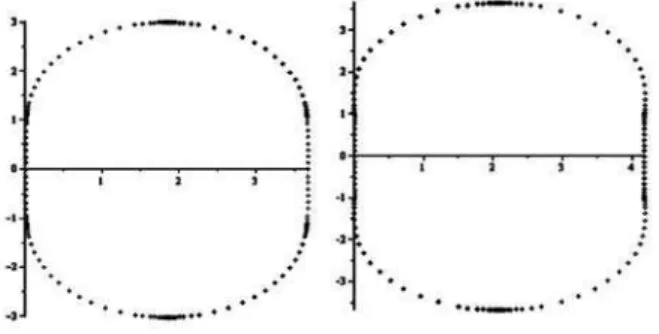
(20) The region of absolute stability (RAS) of the methods (10) and (14) from their respective characteristics equa-tions (19) and (20) are plotted using the maple software in figures 1 and 2 respectively: Remark: The RAS for
Figure 1: RAS for SDBDF fork= 3 andk= 4
the Second Derivative Backward Differentiation Formula presented shows that the main methods (10) and (14) are
A-stable for orderp= 4 andp= 5.
4
Implementation Strategy of the
Meth-ods
In what follows, a general procedure for the implemen-tation of the methods using a Boundary Value tech-nique or method in matrix form as in Fatunla [6] is pre-sented. To obtain the approximate solutions for yn+j,
j= 0,1,2,· · ·, N = b−a
h points on the bound of
integra-tion [a, b], with N-vector YN, FN and GN specified, we
YN = [yn+1, yn+2, yn+3, ..., yn+N]T
YN−1 = [yn−N+1, yn−N+2, yn−N+3, ..., yn]T
FN = [fn+1, fn+2, fn+3, ..., fn+N]T
GN = [gn+1, gn+2, gn+3, ..., gn+N]T
where yn+j = y(xn +jh), fn+j = f(xn +jh, y(xn +
jh)) and gn+j ≡ df(x,ydx(x))|yx==xynn++jj. The integration on the entire block shall be written compactly as,
AYN =BYN−1+hCFN +h2DGN (21)
Which forms a non-linear equation because of the implicit nature, hence we employ the Newton-iteration for the evaluation of the approximate solutions. Hence, (21) can be written as,
AYN −BYN−1−hCFN−h2DGN = 0 (22)
Using the Newton’s approach for the implementation of implicit schemes as given in [12], we have that the solu-tions of the block is given as,
YN(i+1)=YN(i)−J−1 (YN)
AYN−BYN−1−hCFN−h2DGN
(23)
whereJ−1(Y
N) the Jacobian matrix is,
J−1(
YN) =
A−hC∂FN ∂Y −h
2
D∂GN ∂Y
−1
Hence on transformation into matrix form, we have,
AYN =BYN−1+hCFN +h2DGN (24)
such that fork= 2,
A= ⎛ ⎜ ⎜ ⎜ ⎜ ⎜ ⎜ ⎜ ⎝ 64 85 − 86
85 0 · · · 0 0 4
5 −
7
10 0 · · · 0 0 27
85 − 108
85 1 · · · 0 0
0 . .. . .. . .. 0 0
0 0 2785 −10885 1 0 0 0 0 2785 −10885 1
⎞ ⎟ ⎟ ⎟ ⎟ ⎟ ⎟ ⎟ ⎠ B= ⎛ ⎜ ⎜ ⎜ ⎜ ⎜ ⎜ ⎜ ⎝
0 0 0 · · · 0 −2285
0 0 0 · · · 0 101 0 0 0 · · · 0 854
0 0 0 0 0 0
..
. ... ... ... ... ...
0 0 0 0 0 0
⎞ ⎟ ⎟ ⎟ ⎟ ⎟ ⎟ ⎟ ⎠ C= ⎛ ⎜ ⎜ ⎜ ⎜ ⎜ ⎜ ⎜ ⎝
−1 0 −23
85 0 · · · 0
0 −1 2
5 0 · · · 0
0 0 66
85 0 · · · 0
0 0 0 66
85 0 0
0 0 ... 0 . .. 0
0 0 0 0 0 66
85 ⎞ ⎟ ⎟ ⎟ ⎟ ⎟ ⎟ ⎟ ⎠ D= ⎛ ⎜ ⎜ ⎜ ⎜ ⎜ ⎜ ⎜ ⎝
0 0 1485 0 0 0
0 0 −15 0 0 0
0 0 −1885 0 0 0
0 0 0 −1885 0 0
..
. ... ... 0 . .. 0
0 0 0 0 0 −1885
⎞ ⎟ ⎟ ⎟ ⎟ ⎟ ⎟ ⎟ ⎠
and fork= 4, we have,
A= ⎛ ⎜ ⎜ ⎜ ⎜ ⎜ ⎜ ⎜ ⎜ ⎜ ⎝ 891 830 − 3213 1660 549
830 0 · · · 0 0 212
415
229 830 −
916
1245 0 · · · 0 0
−237830 19111660 22492490 0 · · · 0 0
−41564 216415 −576415 1 · · · 0 0
0 . .. . .. . .. . .. 0 0
0 0 −64
415 216 415 −
576
415 1 0
0 0 0 −64
415 216 415 − 576 415 1 ⎞ ⎟ ⎟ ⎟ ⎟ ⎟ ⎟ ⎟ ⎟ ⎟ ⎠ B= ⎛ ⎜ ⎜ ⎜ ⎜ ⎜ ⎜ ⎜ ⎜ ⎜ ⎝
0 0 0 0 · · · 0 −333 1660
0 0 0 0 · · · 0 127 2490
0 0 0 0 · · · 0 −187 4980
0 0 0 0 · · · 0 − 9 415
0 0 0 0 · · · 0 0
..
. ... ... ... ... ...
0 0 0 0 · · · 0 0
⎞ ⎟ ⎟ ⎟ ⎟ ⎟ ⎟ ⎟ ⎟ ⎟ ⎠ C= ⎛ ⎜ ⎜ ⎜ ⎜ ⎜ ⎜ ⎜ ⎜ ⎜ ⎝
−1 0 0 16631 0 · · · 0 0 −1 0 −1283 0 · · · 0 0 0 −1 16651 0 · · · 0 0 0 0 6083 0 · · · 0
0 0 0 0 6083 0 0
0 0 0 0 0 . .. 0
0 0 0 0 0 0 6083
⎞ ⎟ ⎟ ⎟ ⎟ ⎟ ⎟ ⎟ ⎟ ⎟ ⎠ D= ⎛ ⎜ ⎜ ⎜ ⎜ ⎜ ⎜ ⎜ ⎜ ⎜ ⎝
0 0 0 −87
830 0 · · · 0
0 0 0 31
415 0 · · · 0
0 0 0 −111
830 0 · · · 0
0 0 0 −72
415 0 · · · 0
0 0 0 0 −72
415 0 0
..
. ... ... ... . .. ...
0 0 0 0 · · · 0 −72
415 ⎞ ⎟ ⎟ ⎟ ⎟ ⎟ ⎟ ⎟ ⎟ ⎟ ⎠
Remark: The boundary value technique with (23) is made possible using the Newton’s iteration features in the maple software.
5
Experimental Problems
In this section we consider some second order non-linear ordinary differential equations of Lane-Emden type (2) which are transformed to system of first order differential equations. The boundary value methods for k = 3 and
k= 4 will be denoted as BVM3 and BVM4 respectively in the presentation of numerical results.
Problem 5.1 White-dwarf Equation: Consider the White dwarf equation,
y′′+2 xy
′(x) +
introduced in [4] in the study of gravitational potential of the degenerate white-dwarf stars is solved with the BVMs forC= 0.2,0.4,0.6 and 0.8, where atC= 0, (25) becomes the standard Lane-Emden form= 3. (25) can be transformed to the system,
y′=z y(0) = 1
z′=−2 xz+
y2−C32
z(0) = 0 (26)
Solving (26) using the BVMs for k = 3 and k = 4 is denoted as BVM3 and BVM4 respectively, the numerical results are compared with the results obtained in [9] and [10] and are presented in Tables 2 and 3, while graphi-cal results is presented forC = 0,0.2,0.4,0.6 and 0.8 in Figure 3 and 4.
Figure 2: Graphical Result for White Dwarf Equation Using BVM3 and BVM4
Table 2: Numerical result for C = 0 using BVM3 for
h= 0.05
x BVM3 BVM4 Hojjati and Parand [9] Horedt [10] 0.5 0.9598393004 0.9598390586 0.959839069883 0.959839 1.0 0.8550578750 0.8550575772 0.855057568546 0.855058 5.0 0.1108196525 0.1108198152 0.110819835160 0.110820 6.0 0.0437378675 0.0437379642 0.043737983910 0.043738
Table 3: Numerical result for C = 0 using BVM3 for
h= 0.01
x BVM3 BVM4 Hojjati and Parand [9] Horedt [10] 0.5 0.9598390702 0.9598390699 0.959839069883 0.959839 1.0 0.8550575691 0.8550575686 0.855057568546 0.855058 5.0 0.1108198348 0.1108198351 0.110819835160 0.110820 6.0 0.0437379836 0.0437379839 0.043737983910 0.043738
Remark: From the Table 2 and 3, it is easily seen that the boundary value methods (BVM3 and BVM4) are comparable to the results obtained in Hojjati and Parand [9] and Horedt [10].
Problem 5.2We also consider the second order differ-ential equation:
y′′+2 xy
′(x) + 42ey+ey2
= 0 (27)
Problem (27) has an analytical solution: y(x) =
−2 ln
1 +x2
. To solve (27) numerically, we again recast
it to a system of first order ordinary differential equation of the form,
y′=z y(0) = 0
z′ =−2
xz−4
2ey+ey2 z(0) = 0 (28)
The problem is then solved using the derived SDBDF methods by BVM. The Numerical results obtained are presented in Tables 4, 5, 6 and 7 for solution usingh= 0.05 and h = 0.01. Remark: See from Tables 4,
Table 4: Numerical Results for Problem 5.2 for BVM3 usingh= 0.05
x Exact BVM3 Error
0.25 -0.121249243633 -0.121239888642 9.35E-06 0.50 -0.446287102628 -0.446275599224 1.15E-05 0.75 -0.892574205257 -0.892570430056 3.77E-06 1.00 -1.386294361199 -1.386294361120 2.80E-06
Table 5: Numerical Results for Problem 5.2 for BVM3 usingh= 0.01
x Exact BVM3 Error
0.25 -0.121249243633 -0.121249230231 9.35E-08 0.50 -0.446287102628 -0.446287082373 2.02E-08 0.75 -0.892574205257 -0.892574195535 9.72E-09 1.00 -1.386294361199 -1.386294365367 4.24E-09
Table 6: Numerical Results for Problem 5.2 for BVM4 usingh= 0.05
x Exact BVM4 Error
0.25 -0.121249243633 -0.121249559058 3.15E-07 0.50 -0.446287102628 -0.446286113311 9.89E-07 0.75 -0.892574205257 -0.892573230121 9.75E-07 1.00 -1.386294361199 -1.386294072225 2.88E-07
5, 6 and 7, that methods of BVM4 performs better than the methods of BVM3, which justifies that the higher the order of convergence of the BVM the higher the accuracy to be expected viz a viz the step length.
Problem 5.3 The final example in this paper is also given by:
y′′+2 xy
′(x)−2
2x2+ 3
y= 0 (29)
Equation (29) is of Lane-Emden problem type with an analytical solution given by: y(x) =ex2. Equation (29)
transforms to the system of first order ordinary differen-tial equation given as,
y′=z y(0) = 0
z′=−2
xz+ 2
2x2+ 3
y z(0) = 0 (30)
The Tables 8, 9, 10 and 11 shows the numerical results obtained using the BVM3 and BVM4 methods.
Table 7: Numerical Results for Problem 5.2 for BVM4 usingh= 0.01
x Exact BVM4 Error
0.25 -0.121249243633 -0.121249243938 3.04E-10 0.50 -0.446287102628 -0.446287102319 3.09E-10 0.75 -0.892574205257 -0.892574204718 5.39E-10 1.00 -1.386294361199 -1.386294361120 3.34E-10
Table 8: Numerical Results for Problem 5.3 for BVM3 usingh= 0.05
x Exact BVM3 Error
0.25 1.0644944589179 1.0644898251043 4.63E-06 0.50 1.2840254166877 1.2839987348882 2.67E-05 0.75 1.7550546569603 1.7549853685547 6.92E-05 1.00 2.7182818284590 2.7180041217896 2.78E-04
6
Conclusion
We have been able to derive some mixed boundary value methods via the multistep collocation technique. The methods obtained have been represented as a boundary value methods using the representation of block schemes (21). Properties such as order of convergence and re-gion of absolute stability were highlighted using tables and figures respectively. These BVMs methods were im-plemented on second order nonlinear ordinary differential equations of Lane-Emden’s Type and their results were found to be sufficiently accurate for various values of step length.
References
[1] Amodio P and Mazzia F., Variable-step boundary value meth-ods based on reverse Adams schemes and their grid distribution, Appl. Numer. Math. 18, 5 - 21, 1995.
[2] Axelsson A. O. H and Verwer J. G., Boundary value techniques for initial value problems in ordinary differential equations,Math. Comput., 45, 153 - 171, 1985.
[3] Brugnano L. and Trigiante D., Solving Differential Problems by Multitep Initial and Boundary Value Methods, Gordon and Breach Science Publishers, Amsterdam, 1998.
[4] Davis H. T.,Introduction to Nonlinear Differential and Integral Equations, Dover, New York, 1962.
[5] Ehigie J. O., Okunuga S. A. and Sofoluwe A. B., 3-point Block Methods for Direct Integration of Second Order Ordinary Dif-ferential Equations,Advances in Numerical Analysis, Vol. 2011, Article ID 513148, 14 pages, doi:10.1155/2011/513148, 2011.
[6] Fatunla S. O., Parallel methods for Second Order ODEs in Monogragh- Computational Ordinary Differential Equations Ed. By Fatunla S. O., University Press Plc, Ibadan, 87 - 99, 1992.
[7] Hairer E. and Wanner G.,Solving Ordinary Differential Equa-tions II: Stiff and Differential Algebraic Problems, Second Re-vised Edition, Springer Verlag, Germany, 1996.
[8] He J. H., Variational approach to the Lane-Emden equation, Appl. Math. Comput., 143, 539 - 541, 2003.
[9] Hojjati G. and Parand K., An efficient computational algorithm for solving the nonlinear Lane-Emden type equations., Interna-tional Journal of Mathematics and Computer Sciences, 7(4), 182 - 187, 2011.
[10] Horedt G. P.,Polytropes Applications in Astrophysics and Re-lated Fields, Klawer Academic Publishers, Dordrecht, 2004.
[11] Jator S. N. and Sahi R. K., Boundary value technique for initial value problems based on Adams-type second derivative methods, International Journal of Mathematical Education in Science and Education, 1 - 8, iFirst, 2010.
Table 9: Numerical Results for Problem 5.3 for BVM3 usingh= 0.01
x Exact BVM3 Error
0.25 1.0644944589179 1.0644944535753 5.34E-09 0.50 1.2840254166877 1.2840253903544 2.63E-08 0.75 1.7550546569603 1.7550545627475 9.42E-08 1.00 2.7182818284590 2.7182814883158 3.40E-07
Table 10: Numerical Results for Problem 5.3 for BVM4 usingh= 0.05
x Exact BVM4 Error
0.25 1.0644944589179 1.0644960766097 1.62E-06 0.50 1.2840254166877 1.2840299847767 4.57E-06 0.75 1.7550546569603 1.7550684409046 1.37E-05 1.00 2.7182818284590 2.7183249275467 4.31E-04
[12] Lambert J. D.,Computational methods in Ordinary Differential Equations, John Wiley and sons, New York, 1973.
[13] Liao S., A new analytic algorithm of Lane-Emden type equations, Appl. Math, Comput., 142, 1- 16, 2003.
[14] Mandelzweig V. B. and Tabakin F., Quasilinearization approach to nonlinear problems in physics with application to nonlinear ODEs,Comput. Phys. Commun., 141, 268 - 281, 2001.
[15] Onumanyi P., Awoyemi D. O, Jator S. N., and Sirisena U. W., New linear mutlistep methods with continuous coefficients for first order initial value problems,J. Niger. Math. Soc.13, 3751, 1994.
[16] Okunuga S. A. and Ehigie J. O., A New Derivation of Continu-ous Collocation Multistep methods Using Power Series as Basis Function,Journal of Modern Maths and Statistics, 3, 2, 43 - 50, 2009.
[17] Parand K and Shanini M., Rational Chebyshev Collocation method for solving Nonlinear Ordinary Differential Equations of Lane-Emden Type, International Journal of Information and Systems Sciences, 6, 1, 72 - 83, 2010.
[18] Parand K., Shahini M. and Dehghan M., Rational Legendre pseu-dospectral approach for solving nonlinear differential equationds of Lane-Emden type,J. Comput. Phys., 228, 8830 - 8840, 2009.
[19] Ramos J. I., Series approach to the Lane-Emden equation and comparison with the homotopy perturbation method, Chaos. Solit. Fract., 38, 400 - 408, 2008.
[20] Shawagfeh N. T., Nonperturbative approximate solution for Lane-Emden equation,J. Math. Phys., 34, 4364 - 4369, 1993.
[21] Yousefi S. A., Legendre wavelets method for solving differential equations of Lane-Emden type,Appl. Math. Comput., 181, 1417 - 1422, 2006.
Table 11: Numerical Results for Problem 5.3 for BVM4 usingh= 0.01
x Exact BVM4 Error