www.atmos-chem-phys.net/15/4161/2015/ doi:10.5194/acp-15-4161-2015
© Author(s) 2015. CC Attribution 3.0 License.
Single-particle characterization of ice-nucleating particles and ice
particle residuals sampled by three different techniques
A. Worringen1,7, K. Kandler1, N. Benker1, T. Dirsch1, S. Mertes2, L. Schenk2, U. Kästner2, F. Frank3, B. Nillius3,*, U. Bundke3,**, D. Rose3, J. Curtius3, P. Kupiszewski4, E. Weingartner4,***, P. Vochezer5, J. Schneider6, S. Schmidt6, S. Weinbruch1, and M. Ebert1
1Institut für Angewandte Geowissenschaften, Technische Universität Darmstadt, Schnittspahnstr. 9,
64287 Darmstadt, Germany
2Leibniz-Institut für Troposphärenforschung, Permoserstraße 15, 04318 Leipzig, Germany 3Institut für Atmosphäre und Umwelt, Goethe-Universität Frankfurt am Main, Altenhöferallee 1,
60438 Frankfurt am Main, Germany
4Laboratory of Atmospheric Chemistry, Paul Scherrer Institute, 5232 Villigen PSI, Switzerland 5Institute for Meteorology and Climate Research, Karlsruhe Institute of Technology, P.O. Box 3640,
76021 Karlsruhe, Germany
6Max-Planck-Institut für Chemie, Hahn-Meitner-Weg 1, 55128 Mainz, Germany
7Institut für Physik der Atmosphäre, Johannes Gutenberg Universität Mainz, 55099 Mainz, Germany *now at: Max-Planck-Institute für Chemie, Hahn-Meitner-Weg 1, 55128 Mainz, Germany
**now at: Forschungszentrum Juelich GmbH, 52425 Juelich, Germany
***now at: University of Applied Sciences and Arts Northwestern Switzerland, School of Engineering,
Institute of Aerosol and Sensor Technology, Klosterzelgstrasse 2, 5210 Windisch, Switzerland
Correspondence to:S. Weinbruch ([email protected])
Received: 14 August 2014 – Published in Atmos. Chem. Phys. Discuss.: 8 September 2014 Revised: 20 February 2015 – Accepted: 17 March 2015 – Published: 22 April 2015
Abstract. In the present work, three different techniques to separate ice-nucleating particles (INPs) as well as ice particle residuals (IPRs) from non-ice-active particles are compared. The Ice Selective Inlet (ISI) and the Ice Counterflow Virtual Impactor (Ice-CVI) sample ice particles from mixed-phase clouds and allow after evaporation in the instrument for the analysis of the residuals. The Fast Ice Nucleus Chamber (FINCH) coupled with the Ice Nuclei Pumped Counterflow Virtual Impactor (IN-PCVI) provides ice-activating condi-tions to aerosol particles and extracts the activated particles for analysis. The instruments were run during a joint field campaign which took place in January and February 2013 at the High Alpine Research Station Jungfraujoch (Switzer-land). INPs and IPRs were analyzed offline by scanning elec-tron microscopy and energy-dispersive X-ray microanaly-sis to determine their size, chemical composition and mix-ing state. Online analysis of the size and chemical compo-sition of INP activated in FINCH was performed by laser
ablation mass spectrometry. With all three INP/IPR separa-tion techniques high abundances (median 20–70 %) of in-strumental contamination artifacts were observed (ISI: Si-O spheres, probably calibration aerosol; Ice-CVI: Al-O parti-cles; FINCH+IN-PCVI: steel particles). After removal of
Soot/carbonaceous material and metal oxides were present mainly in the sub-micrometer range. Silicates and Ca-rich particles were mainly found with diameters above 1 µm (us-ing ISI and FINCH), in contrast to the Ice-CVI which also sampled many submicron particles of both groups. Due to changing meteorological conditions, the INP/IPR composi-tion was highly variable if different samples were compared. Thus, the observed discrepancies between the different sep-aration techniques may partly result from the non-parallel sampling. The differences of the particle group relative num-ber abundance as well as the mixing state of INP/IPR clearly demonstrate the need of further studies to better understand the influence of the separation techniques on the INP/IPR chemical composition. Also, it must be concluded that the abundance of contamination artifacts in the separated INP and IPR is generally large and should be corrected for, em-phasizing the need for the accompanying chemical measure-ments. Thus, further work is needed to allow for routine op-eration of the three separation techniques investigated.
1 Introduction
The impact of clouds – and in particular cloud–aerosol inter-actions – on earth’s radiation balance is still one of the most uncertain aspects in our understanding of the climate sys-tem (Flato et al., 2013). The understanding of tropospheric cloud ice formation processes is crucial for predicting pre-cipitation and cloud radiative properties. Aerosol–cloud in-teractions play a key role in determining cloud properties like phase, size distribution and colloidal stability of the cloud el-ements, as well as the lifetime, dimensions and precipitating efficiency of a cloud. Though there have been advances dur-ing the last decades, in particular for aerosol–cloud interac-tions, the level of scientific understanding is still classified as “very low” to “low” (Flato et al., 2013). A considerable uncertainty of the response of aerosol and cloud processes to changes in aerosol properties still arises from the lack of fun-damental understanding of the interaction of aerosol particles with the cloud ice phase (Lohmann and Feichter, 2005). Al-though large attention was given to field studies in the last decade (e.g., Richardson et al., 2007; Prenni et al., 2009a, c; Santachiara et al., 2010; Ardon-Dryer et al., 2011; Conen et al., 2012; Ardon-Dryer and Levin, 2014), these measure-ments cover only limited geographic regions as well as a lim-ited time. Thus, additional field work is certainly needed.
Many ice nucleation experiments were performed under laboratory conditions (e.g., Hoose and Möhler, 2012, and ref-erences therein), and provided valuable knowledge on ice-nucleating particle (INP) properties of pure components and artificially generated mixtures. Mineral dust and biological particles are regarded in general as efficient INP, while ex-periments disagreed on the INP abilities of soot and organ-ics (Hoose and Möhler, 2012). Sea salt and sulfate are often
not considered as INP (Pruppacher and Klett, 1997). How-ever, this conclusion is challenged by several authors (Abbatt et al., 2006; Schill and Tolbert, 2014). Furthermore, it was shown recently in laboratory work for NaCl particles that a partial efflorescence under suitable conditions might lead to ice activation (Wise et al., 2012). The situation is even more complex in the ambient atmosphere, where particles are of-ten present as a complex mixture of different compounds. In addition, the particles may be modified by heterogeneous processes, which may change their ice nucleation ability. In laboratory experiments, these effects are currently addressed for single substances (Hoose and Möhler, 2012; Wex et al., 2014), but the level of atmospheric mixing complexity is not yet realized. Though mixing state was regarded by previous investigations (Knopf et al., 2010, 2014; Ebert et al., 2011; Hiranuma et al., 2013), the data basis is still sparse and fur-ther field work is needed.
During the last decade, several techniques emerged which are capable of distinguishing INPs or ice particle residuals (IPRs) for subsequent chemical analysis. Particles are usu-ally exposed to thermodynamic conditions favoring ice nu-cleation, either in the airborne state or on a substrate. Ex-amples for these techniques are the Fast Ice Nucleus Cham-ber (FINCH) (Bundke et al., 2008) in combination with the Ice Nuclei Pumped Counterflow Virtual Impactor (IN-PCVI) (Schenk et al., 2014), the Continuous Flow Diffusion Chamber (CFDC) in combination with the laboratory coun-terflow virtual impactor (LCVI) (Cziczo et al., 2003) and the Frankfurt Ice Nuclei Deposition Freezing Experiment (FRIDGE) (Bundke et al., 2008; Klein et al., 2010). While in FINCH+IN-PCVI and CFDC+LCVI the particles are
kept airborne, ice nucleation occurs on an ice-inert substrate in FRIDGE. In contrast, analysis of IPR relies on the nat-ural selection of INP by a cloud. While for cirrus clouds all cloud elements can be investigated (Cziczo and Froyd, 2014), for mixed-phase clouds the ice particles need to be sepa-rated from droplets. Ice particle separation can be accom-plished with different techniques. In the Ice Selective Inlet (ISI; Kupiszewski et al., 2014) droplets present in the sam-pling flow are evaporated in an ice-saturated environment and the remaining ice crystals are subsequently separated from non-activated particles using a PCVI. Alternatively, cloud el-ements can be impacted on a cooled surface collecting the droplets while bouncing the ice particles for further analysis (Ice Counterflow Virtual Impactor, Ice-CVI) (Mertes et al., 2007).
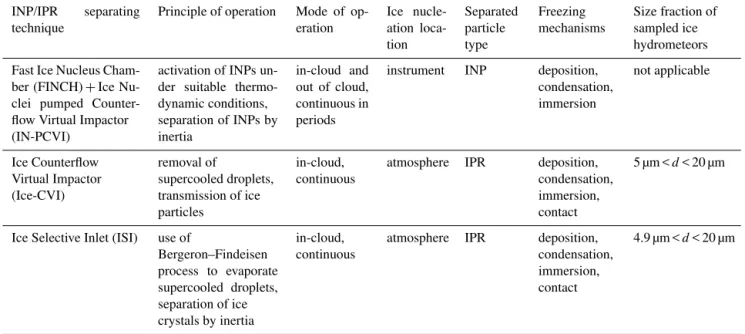
In the present work, three state-of-the-art techniques for INP/IPR sampling – ISI, Ice-CVI and FINCH+IN-PCVI
Table 1.Techniques and operation principles used for ice-nucleating particle (INP) and ice particle residual (IPR) differentiation.
INP/IPR separating
technique
Principle of operation Mode of op-eration
Ice nucle-ation loca-tion
Separated particle type
Freezing mechanisms
Size fraction of sampled ice hydrometeors
Fast Ice Nucleus Cham-ber (FINCH)+Ice Nu-clei pumped Counter-flow Virtual Impactor (IN-PCVI)
activation of INPs un-der suitable thermo-dynamic conditions, separation of INPs by inertia
in-cloud and out of cloud, continuous in periods
instrument INP deposition,
condensation, immersion
not applicable
Ice Counterflow Virtual Impactor (Ice-CVI)
removal of
supercooled droplets, transmission of ice particles
in-cloud, continuous
atmosphere IPR deposition,
condensation, immersion, contact
5 µm <d< 20 µm
Ice Selective Inlet (ISI) use of
Bergeron–Findeisen process to evaporate supercooled droplets, separation of ice crystals by inertia
in-cloud, continuous
atmosphere IPR deposition,
condensation, immersion, contact
4.9 µm <d< 20 µm
INPs and IPRs were investigated recently at this location in a number of studies, a considerable data base is available for comparison. In the previous work, enrichment of min-eral dust (Kamphus et al., 2010; Chou et al., 2011; Ebert et al., 2011), metal oxides (Ebert et al., 2011), Pb-containing particles (Cziczo et al., 2009b; Ebert et al., 2011) and car-bonaceous material/black carbon (Cozic et al., 2008; Ebert et al., 2011) among INPs/IPRs were reported.
2 Experimental
In January/February 2013, a field campaign of INUIT (Ice Nuclei Research Unit) was performed at the High Alpine Research Station Jungfraujoch in Switzerland (JFJ; 3580 m a.s.l., 46.55◦N, 7.98◦E). IPRs were separated from the interstitial aerosol and droplets by ISI and Ice-CVI. INPs were sampled from the total aerosol by FINCH+IN-PCVI
(Table 1). INPs/IPRs were either collected by impactors and analyzed by scanning electron microscopy (SEM) and energy-dispersive X-ray microanalysis (EDX) or analyzed online by laser ablation mass spectrometry (LA-MS).
2.1 INP/IPR sampling
INPs and IPRs were sampled by three different techniques. INPs were detected by the FINCH+IN-PCVI (details of the
experimental setup are given in Bundke et al., 2008, and Schenk et al., 2014). IPRs were collected via selective sam-pling of small (< 20 µm aerodynamic diameter) ice crystals with Ice-CVI and ISI. Subsequent heating of the sampled ice crystals releases IPRs. The extracted IPRs were collected for SEM-EDX with a two-stage impactor system. The setup con-sisted of circular nozzles with 0.7 and 0.25 mm diameters
op-erated at a flow rate of 0.45 L min−1(volume), leading to an approximate 50 % cutoff efficiency for aerodynamic diam-eters of 1 and 0.1 µm, respectively (for details on impactor dimensions see Kandler et al., 2007). Transmission electron microscopy grids (TEM grids type S162N9, Plano GmbH, Wetzlar, Germany) and polished elemental boron embedded in a conductive resin (for manufacturing see Choël et al., 2005) were used as impaction substrates for all methods. Both substrates provide a background signal with low inter-ference with respect to the particle composition. While boron substrates yield a better detection of carbon in the particles and allow for larger particle numbers due to less substrate damage, the TEM grids in principle provide the possibility of being used in a TEM for phase analysis and easier detec-tion of coatings.
2.1.1 Coupling of FINCH and IN-PCVI
FINCH+IN-PCVI was operated in clouds as well as
scat-tered circular polarized light (P44/P11 ratio of the scattering
matrix; Hu et al., 2003). In addition, the auto-fluorescence resulting from the excitation of the grown particles with UV light is detected, which is an indication for biological particle material.
The ice crystals are then separated by the PCVI from the non-activated particles and from the small supercooled droplets (Schenk et al., 2014). As the PCVI input flow must be identical to the FINCH output flow, the counterflow must be continuously adjusted to achieve this requirement. This adjustment leads to variable cutoff diameters between 4.5 and 8 µm. Finally, the sampled FINCH ice particles evapo-rate while they are transported in a dry particle-free air.
The freezing temperature of FINCH during the campaign was slightly varied around −22.1◦C, which matched for
most of the samples the outside air temperature with less than 5◦C difference. The saturation ratio with respect to ice was varied between 1.14 and 1.80 with a mean of 1.54 for all sam-ples. Details on the sampling conditions are given in Table S1 in the Supplement.
2.1.2 Ice-CVI
From the mixed-phase clouds prevailing at JFJ, IPRs were collected by the Ice-CVI (Mertes et al., 2007). It consists of a series of different modules that allow sampling of small ice particles by a simultaneous pre-segregation of all other cloud constituents. The vertical, omnidirectional inlet already re-duces the sampling of ice crystals larger than 50 µm, includ-ing precipitatinclud-ing or windblown ice particles. A virtual im-pactor downstream of the inlet horn limits the upper size of sampled hydrometeors to 20 µm. This limit is reasonable, be-cause the collection efficiency is nearly 1 for these ice parti-cle sizes. The ice partiparti-cle breakup is minimized in the sub-sequent Ice-CVI components, and ice particles in this size range grow by water vapor diffusion, i.e., they should con-tain only the former INP as a residual particle. Downstream of the virtual impactor a pre-impactor removes supercooled drops by contact freezing on cold impaction plates. Ice par-ticles bounce and pass the impaction plates. A conventional CVI (Mertes et al., 2005a, b) is located downstream of the pre-impactor to reject interstitial particles smaller than 5 µm. Thus, only ice particles in the 5–20 µm diameter range com-pletely traverse the Ice-CVI. As with a conventional CVI these small ice crystals are injected into a particle-free and dry carrier gas which leads to evaporation and allows for the analysis of the IPR.
2.1.3 ISI
The novel ISI (Kupiszewski et al., 2014) was designed to ex-tract small ice crystals from mixed-phase clouds, simultane-ously counting, sizing and imaging the hydrometeors con-tained in the cloud with the use of WELAS 2500 sensors (Pallas GmbH, Karlsruhe, Germany) and a Particle Phase
Discriminator (PPD-2K; Kupiszewski et al., 2014). The core of the ISI is a droplet evaporation unit with ice-covered in-ner walls, removing droplets using the Bergeron–Findeisen process, while transmitting the ice crystals. In the final stage of the ISI, a pumped counterflow virtual impactor removes interstitials and cloud condensation nuclei released in the droplet evaporation unit from the sample flow, thus ensur-ing only ice crystals are transmitted. The extracted ice crys-tals are subsequently sublimated, releasing the IPRs which are transferred into the laboratory for further on- and offline characterization of their physical and chemical properties.
2.2 Sample characterization 2.2.1 Scanning electron microscopy
A total of 36 samples (18 from FINCH, 13 from Ice-CVI, 5 from ISI) were acquired during the field campaign. All samples were analyzed by SEM (FEI Quanta 200 FEG, FEI, Eindhoven, the Netherlands) and EDX (EDAX, Tilburg, the Netherlands). The particles of the different samples were manually characterized with respect to their chemical com-position, size, morphology, internal mixing state and stability under electron bombardment. Particle size was determined as the average geometrical diameter (equivalent projected area diameter) from the electron images.
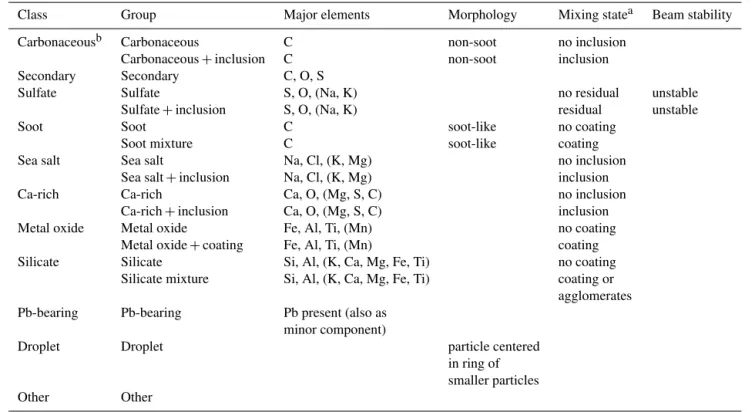
Based on chemical composition, morphology, mixing state and beam stability, 18 particle groups were defined and combined into 11 particle classes. Table 2 lists the parti-cle groups, partiparti-cle classes and classification criteria for the manual analysis.
Pb-bearing particles were classified according to the pres-ence of Pb only (i.e., as soon as Pb could be detected). They might be homogeneous Pb-rich particles or particles contain-ing Pb-rich inclusions. In the latter case, the main matrix particles can be carbonaceous, soot, sulfate, sea salt, silicate, metal oxide, a droplet or belong to the “other” class. Droplets are identified by their typical morphology of larger residual particles centered in a halo of small residuals, originating from the splashing of the droplet at impaction. The center of the residual can consist of unstable material (e.g., sulfate) or stable sea salt, silicate, metal oxide, Ca-rich particles, or mix-tures thereof. The halo particles are usually unstable under electron bombardment. Particles which could not be classi-fied into one of the classes mentioned above are summarized in the particle class “other”. This particle class contains for example Zn-rich and Mg-rich particles as well as Sn-, Ba-, Bi- and Br-bearing particles with a total abundance of usu-ally less than 1 %.
Table 2.Classification criteria for particle classes and particle groups. Common features for certain particle types not used for classification are given in parentheses.
Class Group Major elements Morphology Mixing statea Beam stability
Carbonaceousb Carbonaceous C non-soot no inclusion
Carbonaceous+inclusion C non-soot inclusion
Secondary Secondary C, O, S
Sulfate Sulfate S, O, (Na, K) no residual unstable
Sulfate+inclusion S, O, (Na, K) residual unstable
Soot Soot C soot-like no coating
Soot mixture C soot-like coating
Sea salt Sea salt Na, Cl, (K, Mg) no inclusion
Sea salt+inclusion Na, Cl, (K, Mg) inclusion
Ca-rich Ca-rich Ca, O, (Mg, S, C) no inclusion
Ca-rich+inclusion Ca, O, (Mg, S, C) inclusion
Metal oxide Metal oxide Fe, Al, Ti, (Mn) no coating
Metal oxide+coating Fe, Al, Ti, (Mn) coating
Silicate Silicate Si, Al, (K, Ca, Mg, Fe, Ti) no coating
Silicate mixture Si, Al, (K, Ca, Mg, Fe, Ti) coating or
agglomerates
Pb-bearing Pb-bearing Pb present (also as
minor component)
Droplet Droplet particle centered
in ring of smaller particles
Other Other
aBased on detailed SEM observations. Inclusion refers to a small object with different chemical composition inside a particle. Residuals are compounds left after evaporation of a volatile matrix. Coating is a small film on the surface of a particle. Agglomerates are composed of distinguishable objects of similar size.bCarbonaceous particles are interpreted as organic compounds which condensed from the gas phase due to their unspecific morphology and the absence of tracer elements for primary biological particles (i.e., N, P, K).
2.2.2 Laser ablation mass spectrometry
LA-MS was carried out with ALABAMA (Aircraft-based Laser Ablation Aerosol Mass Spectrometer), which was orig-inally developed for aircraft operation (Brands et al., 2011) but was also used in several ground-based measurement campaigns. It provides the chemical composition of single aerosol particles in an aerodynamic particle size range be-tween 150 and 1500 nm, including refractory compounds such as metals, dust, and soot. It was used during the INUIT-JFJ campaign for the analysis of background aerosol parti-cles and IPR (Schmidt et al., 2015). A total of 1809 IPR mass spectra were collected: 1663 with the Ice-CVI (104 operation hours) and 146 with ISI (32 operation hours).
2.3 Statistical analysis
Confidence intervals (after Clopper and Pearson, 1934) given in this manuscript and in the Supplement were calculated with R version 3.0.3 (R core team, 2014). For data displayed in figures, the confidence intervals are given in the Supple-ment.
2.4 Sampling location and meteorology
The JFJ station is located in a saddle between the moun-tains Jungfrau and Mönch, which is oriented WSW–NNE. This topography results in a channeling of the atmospheric flow leading to a near-binary distribution of wind directions as either NW or SSE. The atmospheric conditions during the campaign are illustrated in Fig. 1. Hourly 5-day backward trajectories for the JFJ station were calculated with the HYS-PLIT (Hybrid Single Particle Lagrangian Integrated Trajec-tory) model based on GDAS (Global Data Assimilation Sys-tem) data (Draxler and Rolph, 2014).
0 1,000 2,000 3,000 4,000
N
,
1
/c
m
^
3
Feb 1 Feb 2 Feb 3 Feb 4 Feb 5 Feb 6 Feb 7 Feb 8 Feb 9 Feb 10 Feb 11 Feb 12 Feb 13 Feb 14
Ice-CVI FINCH+IN-PCVI ISI
0 1,000 2,000 3,000 4,000
N
,
1
/c
m
^
3
Feb 14 Feb 15 Feb 16 Feb 17 Feb 18 Feb 19 Feb 20 Feb 21 Feb 22 Feb 23 Feb 24 Feb 25 Feb 26 Feb 27
Ice-CVI FINCH+IN-PCVI ISI
A
clouds
clouds -30 -20 -10 0
te
m
p
e
ra
tu
re
,
°C
N E S W N
w
in
d
d
ir
e
c
ti
o
n
temperature wind direction FINCH operating temperature
-30 -20 -10 0
te
m
p
e
ra
tu
re
,
°C
N E S W N
w
in
d
d
ir
e
c
ti
o
n
SEM MS
Figure 1.Atmospheric and FINCH operating conditions and INP/IPR sampling periods in February 2013. Times are given in UTC. Particle
number concentrations were taken from the World Data Centre for Aerosols home page (WDCA, 2014). Temperature and wind direction were provided by the Jungfraujoch station operated by International Foundation High Altitude Research Stations Jungfraujoch and Gornergrat. Cloud presence was detected by measuring the liquid water content using a Particulate Volume Monitor (PVM-100, Gerber Scientific, Reston, VA, USA) and a Cloud Droplet Probe (Droplet Measurement Technologies, Boulder, CO, USA). Sampling phases for SEM are marked by wide, intensely colored bars; sampling phases for MS are shown as narrower, pale-colored bars. “A” marks a period used for case comparison.
Atlantic Ocean, in the region of Iceland. Wind, temperature and in-cloud conditions were very stable during this period. While the JFJ is usually in the free troposphere during the winter months (Collaud Coen et al., 2011), abrupt increases in particle concentrations may indicate a rise in the atmo-spheric boundary layer height to the station altitude, which leads to a local influence. This effect is visible as a sudden increase in particle concentration in the middle of this period. The samples were collected before (FINCH+IN-PCVI) and
after (Ice-CVI) the highest particle concentrations, so we consider period A as of Atlantic/free-troposphere origin with minor local influence.
3 Results
3.1 Contamination artifact particles from the INP/IPR sampling instruments
in te n s it y , a rb it ra ry u n it s
0 2 4 6 8
energy, keV (C ) O (N i/ C u ) Si (N i) (C u ) in te n s it y , a rb it ra ry u n it s
0 2 4 6 8
energy, keV (C ) O F e(N i/ C u ) S i C r C r F e F
e (Ni)
(C u ) in te n s it y , a rb it ra ry u n it s
0 2 4 6 8
energy, keV (C ) O (N i/ C u ) Al (N i) (C u ) Fe-Cr-rich Al-O-rich
Si-O sphere 1 µm
1 µm
2 µm
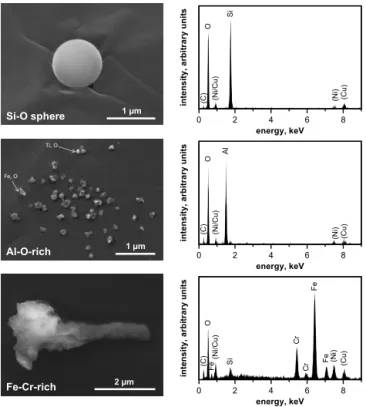
Figure 2.Secondary electron images and energy-dispersive X-ray
spectra of instrumental contamination artifact particles. Character-istic X-ray peaks of elements are labeled. Elements contained in the sample substrate are given in parentheses.
the dominating artifact particles for each instrument is shown in Fig. 3 as box plots.
With all three sampling techniques, small amounts of Fe-Cr particles are observed as an artifact. They may derive from internal abrasion of the instrument or tubing. In addition, for the samples collected on boron substrates, Cu-rich particles are present, which are most likely fragments from the embed-ding material of the boron substrates (an epoxy resin contain-ing copper chips for increased conductivity).
In the ISI samples, mainly Si-O spheres with a size of approx. 1 µm are observed as artifacts. These particles were most likely introduced into the instrument during calibration of the optical particle spectrometers contained within the in-let. The abundance of Si-O spheres in the samples ranged from 26 to 94 %. Including the Fe-Cr-rich and Cu-rich arti-facts, the abundance of all artifact particles ranged from 46 to 94 % during the measurement period.
In the FINCH+IN-PCVI samples, Fe-Cr-rich and
Cu-rich particles as well as a few Au/Ag particles (not shown) are identified as instrumental artifacts. Their total abundance ranges from 0 to 60 % with a median of 20 %.
In the Ice-CVI samples, Al-O particles – probably alu-minium oxides/hydroxides – occur as artifacts. The relative abundance of these Al-O particles varied in the range of 0– 94 % by number. If we consider a particle breakup during impaction as indicated by their small size in relation to the
0 20 40 60 80 100 re la ti v e n u m b e r a b u n d a n c e , % Si-O spheres Fe-Cr-rich Cu-rich Total ISI 0 20 40 60 80 100 re la ti v e n u m b e r a b u n d a n c e , % Fe-Cr-rich Cu-rich Au/Ag-bearing Total FINCH+IN-PCVI 0 20 40 60 80 100 re la ti v e n u m b e r a b u n d a n c e , % Al-O-rich Fe-Cr-rich Cu-rich Total
contamination artifact type
Ice-CVI
Figure 3.Box plots of the different instrumental contamination
ar-tifact particles for each sampling technique. Shown are minimum, lower quartile, median, upper quartile, and maximum.
nominal impactor cutoff size, the relative number abundance might be lower for airborne particles. As all Al-O particles are classified as artifacts in the present paper, potentially oc-curring atmospheric aluminium oxides/hydroxide particles in the Ice-CVI would be overlooked. However, it can be safely assumed that this potential error is minor, as no Al-O parti-cles with the characteristic morphology (Fig. 2) were iden-tified with the other two sampling instruments. The abun-dance of other artifact particles in the Ice-CVI sample is small (range of 0–8 %).
Lead-bearing particles are frequently found in the Ice-CVI samples, but also to a much lesser extent in FINCH+
IN-PCVI samples. These particles are regarded as effective INP in previous works (Cziczo et al., 2009b; Ebert et al., 2011). However, as parts of the Ice-CVI are manufactured from a Pb-containing aluminum alloy, we performed additional tests to evaluate whether the Pb-bearing particles are an instru-mental contamination artifact. SEM inspection of the surface of the impaction plates revealed the presence of large, homo-geneous Pb-rich particles which consist of Pb, C and O (usu-ally without an Al signal, when removed from the plates). The atomic Pb/O ratio varied between 3 and 1, indicating
particles found as INP/IPR are mostly internally mixed with other aerosol compounds, except for a few (less than 10 %) homogeneous Pb-rich particles with a composition similar to the Pb particles encountered on the impaction plates. There-fore, the latter (homogeneous Pb particles) are considered as artifacts. In previous campaigns at the JFJ station, Pb-rich IPR inclusions in other particle types were identified as PbS (Ebert et al., 2011), indicating a non-artifact origin. This in-terpretation is also supported by the observed particle sizes. The Pb-rich particles on the impaction plates are larger than 1 µm (geometric diameter), in contrast to the Pb-bearing IPR which are mostly smaller than 1 µm. The Pb-rich inclusions within the Pb-bearing IPR have sizes of few tens to few hun-dreds of nanometers. In addition, considering the low im-paction speeds inside the Ice-CVI (Mertes et al., 2007), in particular, an abrasion of submicron particles can be consid-ered as improbable. The Pb-rich particles are predominantly observed in the Ice-CVI samples, but also to a lower extent in FINCH+IN-PCVI samples, where no Pb-containing alloys
were used. This observation also indicates that the majority of Pb-rich particles are not instrumental contamination arti-facts. However, for the minor amount of large homogeneous Pb-rich particles an instrumental source is likely.
In summary, it must be concluded that the abundance of contamination artifacts in the separated INP and IPR is gen-erally large and cannot be neglected. Thus, the INP/IPR con-centrations must be corrected to obtain accurate results. It is highly recommended that measurements of INP/IPR con-centrations are always accompanied by chemical and mor-phological single-particle characterization in order to avoid large systematic errors caused by contamination artifacts.
3.2 Composition of INP/IPR at the Jungfraujoch in winter
During the field campaign 5 ISI, 18 FINCH+IN-PCVI, and
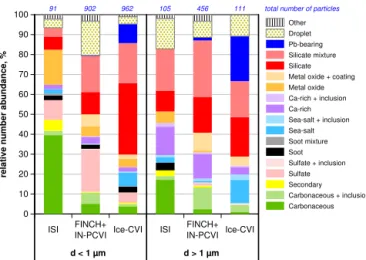
13 Ice-CVI samples were analyzed with a total (non-artifact) INP/IPR particle number of 2627. Due to the low particle number on individual samples, the INPs/IPRs from all sam-ples were integrated for each technique (Fig. 4) to yield better statistics. Particles were classified according to their size in a sub- and supermicron range.
Silicates are the main group of INPs/IPRs, independent of sampling technique and size range (with the exception of submicron particles encountered in ISI). Ca-rich particles are predominantly found in the supermicron range with all three sampling techniques, in contrast to soot and sulfate particles, which occur mainly in the submicron range. Metal oxides are present in both size ranges with a tendency to the submicron range while sea-salt particles tend to be in the supermicron range. However, if the low number of analyzed particles and the resulting statistical uncertainty are considered, the ob-served differences between the techniques are regarded only as a trend. In addition, the three instruments could not be operated strictly in parallel and thus sampled different time
0 10 20 30 40 50 60 70 80 90 100
re
la
ti
v
e
n
u
m
b
e
r
a
b
u
n
d
a
n
c
e
,
%
ISI FINCH+
IN-PCVI Ice-CVI ISI FINCH+ IN-PCVI Ice-CVI
Carbonaceous Carbonaceous + inclusion Secondary Sulfate Sulfate + inclusion Soot Soot mixture Sea-salt Sea-salt + inclusion Ca-rich Ca-rich + inclusion Metal oxide Metal oxide + coating Silicate Silicate mixture Pb-bearing Droplet Other
d < 1 µm d > 1 µm
91 902 962 105 456 111 total number of particles
Figure 4.Relative number abundance (integrated over all samples)
of different particle groups as function of sampling technique and particle size. The total number of analyzed particles is shown above the bars. For confidence intervals see Tables S2 and S3 in the Sup-plement.
periods. In particular, ISI samples were taken only at the end of the field campaign.
The main differences in composition trends between the three sampling methods are the high content of carbonaceous particles measured downstream of the ISI and the high con-tent of Pb-bearing particles obtained by Ice-CVI. The high concentration of carbonaceous particles in the ISI samples may result from different air masses being sampled at the end of the field campaign, when the ISI was operated. Dur-ing this time, higher black carbon concentrations were mea-sured than during the earlier periods (WDCA, 2014). The Pb-bearing particles are discussed later in Sect. 3.4 in more detail.
If the 11 particle classes are grouped into four simpli-fied components – particles of potential terrigenous origin (i.e., silicates and Ca-rich particles), C-dominated particles (carbonaceous, soot), metal-oxides-dominated and soluble particles (sulfate, droplets, sea salt) – the terrigenous par-ticles are the main component with relative abundances of 32 % (ISI), 51 % (FINCH+IN-PCVI) and 55 % (Ice-CVI).
The C-rich particles show a higher variation due to sam-pling of different air masses and range from 9 % (Ice-CVI), and 13 % (FINCH+IN-PCVI) to 34 % (ISI). The soluble
particles vary between 22 % (ISI and Ice-CVI) and 32 % (FINCH+IN-PCVI).
0 10 20 30 40 50 60 70 80 90 100
re
la
ti
v
e
n
u
m
b
e
r
a
b
u
n
d
a
n
c
e
,
%
Ice-CVI FINCH+
IN-PCVI
Carbonaceous Carbonaceous + inclusion Secondary
Sulfate Sulfate + inclusion Soot
Soot mixture Sea-salt Sea-salt + inclusion Ca-rich Ca-rich + inclusion Metal oxide Metal oxide + coating Silicate
Silicate mixture Pb-bearing Droplet Other
395 28 total number of particles
Figure 5.Relative number abundance of different particle groups
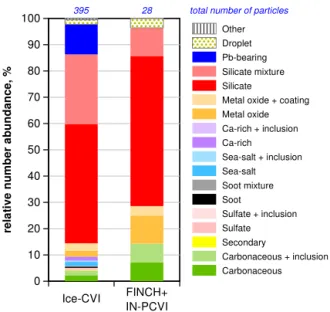
among INP/IPR for 2 February determined by FINCH+IN-PCVI
and Ice-CVI. The total number of analyzed particles is shown above the bars. For confidence intervals see Table S4 in the Supplement.
major components is quite similar, i.e., dominating silicates with a fraction of 71 % (Ice-CVI) and 65 % (FINCH+
IN-PCVI) as well as the presence of organics and metal oxides. The relative abundance of the minor INP/IPR classes seems to differ considerably. However, due to the small number of particles sampled by FINCH+IN-PCVI, no further
conclu-sions can be drawn. In addition, a part of these differences may be caused by the different INP/IPR sampling techniques and short-term changes in meteorological conditions.
Potential INP/IPR sampling artifacts
In addition to the clearly identifiable instrumental contami-nation artifacts, potential INP/IPR sampling artifacts may oc-cur. We define potential sampling artifacts as particles, which pass the selection mechanisms similar to INPs/IPRs, while being questionable to act as INP/IPR (e.g., Pruppacher and Klett, 1997). The potential sampling artifacts include sea-salt particles, sulfate particles and particles which impact on the sampling substrates as droplets. As we cannot exclude that these particles are INPs/IPRs, we do not exclude them from further analysis in contrast to the instrumental contamination artifacts.
Droplets are characterized by their morphology of a resid-ual with a halo (Fig. 6). While in principle the heating and drying line should lead to total evaporation of particle-bound water, obviously some particles were still in liquid state dur-ing impaction sampldur-ing. As we cannot distdur-inguish incom-pletely dried IPRs from supercooled droplets, which were falsely identified as INP/IPR, we consider droplets as poten-tial INP/IPR sampling artifacts. Sulfate particles were pref-erentially found in the submicron size range, while sea-salt
500 nm 500 nm
Figure 6.Secondary electron images of droplets with their typical
morphology of a halo around a residual.
particles have a tendency to be of larger size. Droplets, how-ever, occur rather uniformly in both size ranges.
The relative number abundances of the three potential sampling artifacts (droplets, (non-droplet) sulfate and sea salt) are shown as box plots (in Fig. 7), separately for each INP/IPR sampling instrument. All potential INP/IPR sam-pling artifacts are observed for all three techniques, and their relative abundances are on comparable levels of 0–10 % for each particle type. However, the Ice-CVI, in particular, ex-tracted a higher number of sea-salt particles as IPR. For sin-gle measurements, the abundance of these potential sampling artifacts can reach up to 40 %.
3.3 Size distribution of INP/IPR components
To allow for the display of a size distribution (Fig. 8), we combined the classes into generalized components of INP/IPR to achieve higher particle counts for each particle size interval. Instrumental contamination artifacts and Pb-bearing particles are excluded in this presentation. Note that size distributions obtained with the different techniques can-not be compared directly due to different inlet and transmis-sion efficiencies. However, all three methods yield a maxi-mum of between 0.3 and 0.5 µm in geometric diameter. In ad-dition, ISI shows a secondary maximum of around 1–1.5 µm. With ISI and FINCH-IN-PCVI, silicates and Ca-rich parti-cles are predominantly found at the larger partiparti-cles sizes. The relative abundance of carbonaceous/soot as well as metal ox-ides is higher within the submicron range. The soluble and secondary particles do not show a particular size preference in their relative abundance. For the Ice-CVI, there seems to be a trend towards a higher abundance of soluble/secondary material with increasing particle size. However, this cannot be regarded as significant due to the extremely low parti-cle numbers for supermicron partiparti-cles (less than 10 for each sample and size interval). In the submicron range, no size dependency is visible.
3.4 Mixing state and Pb-bearing INP/IPR
parti-0 10 20 30 40 50 60 re la ti v e n u m b e r a b u n d a n c e , %
Droplets Sulfate Sea-salt
0 10 20 30 40 50 60 re la ti v e n u m b e r a b u n d a n c e , %
Droplets Sulfate Sea-salt
ISI FINCH+IN-PCVI 0 10 20 30 40 50 60 re la ti v e n u m b e r a b u n d a n c e , %
Droplets Sulfate Sea-salt
potential sampling artifact type Ice-CVI
Figure 7.Box plots of impacted droplets, (non-droplet) sulfate and
sea-salt abundance for ISI, FINCH+IN-PCVI and Ice-CVI. Shown are the minimum, lower quartile, median, upper quartile, and maxi-mum.
cle type is summarized in Table 3. It is apparent that mainly silicate particles and to a lesser extent metal oxides are in-ternally mixed. Mixing partners are mostly sulfate and car-bonaceous matter, but also sea salt, if present in the total aerosol. The other particle types are less frequently internally mixed. Regarding differences between the sampling tech-niques, in particular INPs measured by FINCH+IN-PCVI
are considerably more frequently internally mixed than IPRs of ISI and Ice-CVI. The (non-droplet) sulfates obtained as INP/IPR contain in most cases no heterogeneous inclusions. Also, most of the soot and Ca-rich particles have no coating, which is consistent for all sampling techniques. In contrast, the mixing state of carbonaceous particles was found to be highly different, rarely mixed for ISI (7 %) and frequently mixed for FINCH+IN-PCVI (64 %).
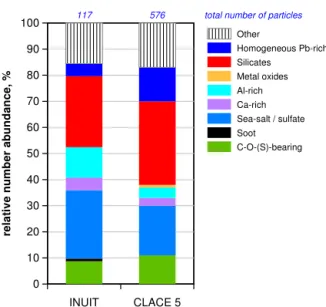
In previous IPR measurements at the JFJ station (Cziczo et al., 2009b; Ebert et al., 2011), Pb-bearing particles were found in high abundance with the Ice-CVI. For comparison with the previous work (Fig. 9), we have selected the Pb-bearing particles from the total INPs/IPRs and determined their mixing partner. For comparability, the particles were classified in the same way as for the CLACE 5 campaign (Ebert et al., 2011). Pb-bearing particles are only found with Ice-CVI and FINCH+IN-PCVI. The Pb inclusions occur
0 1 re la ti v e a b u n d a n c e
0 1 2 3
d, µm 0 1 re la ti v e a b u n d a n c e
0 1 2 3
d N /d d , a rb it ra ry u n it s
0 1 2 3
Carbonaceous/soot Silicates/Ca-rich Metal oxides Soluble/secondary d N /d d , a rb it ra ry u n it s
0 1 2 3
FINCH+IN-PCVI ISI d N /d d , a rb it ra ry u n it s
0 1 2 3
d, µm Ice-CVI 0 1 re la ti v e a b u n d a n c e
0 1 2 3
Figure 8.Average of all single sample size distributions of major
INP/IPR components for ISI, FINCH+IN-PCVI and Ice-CVI. Par-ticle groups were combined according to potential sources to obtain a sufficient number of particles in each size interval. Left column: number size distribution in dN/dd (number density per size inter-val). Note that the different size distributions cannot be compared directly due to different instrumental inlet and transmission efficien-cies. Right column: relative number abundance. Size intervals with less than 15 particles are not shown.
Table 3.Number fraction (%) of internally mixed particles in each particle class (95 % confidence interval in parentheses).
Particle class ISI FINCH+IN-PCVI Ice-CVI
Silicate 58.5 (44.1–71.9) 61.5 (56.9–65.9) 36.9 (33.0–40.9)
Metal oxide 4.3 (0.1–21.9) 66.7 (58.3–74.3) 38.8 (27.1–51.5)
Ca-rich 9.1 (1.1–29.2) 7.5 (3.1–14.9) 7.4 (0.9–24.3)
Sea salt 10.0 (0.3–44.5) 53.8 (25.1–80.8) 8.7 (3.8–16.4)
Soot 12.5 (0.3–52.7) 5.0 (0.1–24.9) 6.3 (0.8–20.8)
Sulfate 0.0 (0.0–30.8) 2.0 (0.6–5.1) 3.9 (0.5–13.5)
Carbonaceous 6.8 (1.9–16.5) 63.9 (55.9–71.4) 27.8 (16.5–41.6)
0 10 20 30 40 50 60 70 80 90 100
re
la
ti
v
e
n
u
m
b
e
r
a
b
u
n
d
a
n
c
e
,
%
INUIT CLACE 5
C-O-(S)-bearing Soot Sea-salt / sulfate Ca-rich Al-rich Metal oxides Silicates
Homogeneous Pb-rich Other
117 576 total number of particles
Figure 9. Comparison of the composition/mixing state of
Pb-bearing particles from INUIT (present contribution) and CLACE 5 (Ebert et al., 2011) from the Ice-CVI. Note that classification crite-ria and nomenclature of Ebert et al. (2011) were used for this graph. For confidence intervals see Table S5 in the Supplement.
4 Discussion
4.1 Composition of INP/IPR
4.1.1 Which particle classes can be regarded as INP/IPR?
Silicates were identified as common INP/IPR in laboratory experiments as well as in field experiments (Hoose and Möh-ler, 2012; Murray et al., 2012). Also, in our field campaign silicates are the most abundant INP/IPR components. Ca-rich particles – e.g., carbonates like calcite – are not frequently regarded as INPs (e.g., Murray et al., 2012). However, ac-cording to laboratory experiments calcite can act as an INP (Zimmermann et al., 2008). Therefore, the Ca-rich particles are regarded as INP/IPR. Metal oxides are also commonly observed as IPR in field experiments (Chen et al., 1998; De-Mott et al., 2003). Similar to our study, Fe-rich particles are usually the main group within the metal oxides. In addition,
Al-, Ti-, Zn-, Cr-, and Ca-rich particles were found in the present investigation and by Chen et al. (1998).
Based on field experiments and laboratory studies, Pb-bearing particles are in general regarded as good ice nuclei (for a detailed discussion refer to Cziczo et al., 2009b). In the present study, lead is found in two forms: as Pb-rich in-clusions in other particles (major abundance) and as homoge-neous Pb-rich particles (minor abundance). The minor frac-tion of homogeneous Pb-rich particles is regarded as an in-strumental artifact (see discussion above), but due to its low abundance of less than 10 % (equaling about 10 particles), it is neglected from further discussion.
The ice nucleation ability of soot and carbonaceous par-ticles is discussed controversially in the previous literature. While an enrichment of black carbon in IPRs was observed in field experiments (Cozic et al., 2008), there are also other findings where organic-rich particles preferentially remain unfrozen (Cziczo et al., 2004). It has to be mentioned, how-ever, that carbon-rich particles are often named ambiguously depending on the technique used for analysis (see also Mur-ray et al., 2012; Petzold et al., 2013). Thus, discrepancies may arise from the fact that different types of carbona-ceous material (e.g., nanocrystalline graphite, organic ma-terial) are compared. Laboratory experiments show that the ice-forming activity of soot is influenced by size, surface area and the concentration of the surface chemical groups that can form hydrogen bonds with water molecules (Gorbunov et al., 2001; Koehler et al., 2009). According to the latter, the ice-forming activity of soot is close to that of metal oxides. In summary, we conclude that soot and carbonaceous particles observed in our samples were active as INP.
Sea salt as INP/IPR was described for field studies by Cziczo and Froyd (2014) and Targino et al. (2006). While crystalline salts were found in a laboratory study to be able to act as INPs under upper-tropospheric conditions (Zuberi et al., 2001), there has been a need of clarifying the process by which a hygroscopic and soluble material should act as IN. However, recently, Wise et al. (2012) explained this be-havior by fractional crystallization of the solute component under decreasing temperatures. Based on these findings, we consider sea salt as potential sampling artifacts.
Similar to sea salt, no agreement exists on the ice nucle-ation ability of sulfate particles. Sulfates may act as INP in cirrus clouds in the upper troposphere and lower strato-sphere, both in immersion and deposition modes (Abbatt et al., 2006, and references therein; Hoose and Möhler, 2012). Sulfates acting as INP are found in a field study in increasing abundance with decreasing temperature under cirrus condi-tions (−56 to−39◦C; Twohy and Poellot, 2005) but usually
not in the warmer mixed-phase clouds as encountered dur-ing our field experiment. Considerdur-ing the usually high rela-tive abundance of sulfates in the total aerosol (Ebert et al., 2011), we cannot exclude the possibility that sulfates are an artifact of the INP/IPR discrimination techniques not having perfect (i.e., 100 %) discrimination efficiency. Thus, we con-sider sulfate particles as potential sampling artifacts. Similar considerations apply to the observed droplets.
As explained in the methods section, contamination arti-fact particles were removed from the further analysis, while potential sampling artifacts are included in the data.
4.1.2 Relative abundance of particle classes among INP/IPR
If all INP/IPR particles of the three sampling methods are summed up, the following averaged INP/IPR composition of the whole field campaign is obtained: 52 % terrigenous parti-cles (38 % silicates, 9 % metal oxides, 5 % Ca-rich partiparti-cles), 14 % C-rich particles (12 % carbonaceous particles, 2 % soot), 1 % secondary particles, 11 % sulfate, 11 % droplets, 4 % sea salt, 5 % Pb-bearing particles, and 2 % other parti-cles.
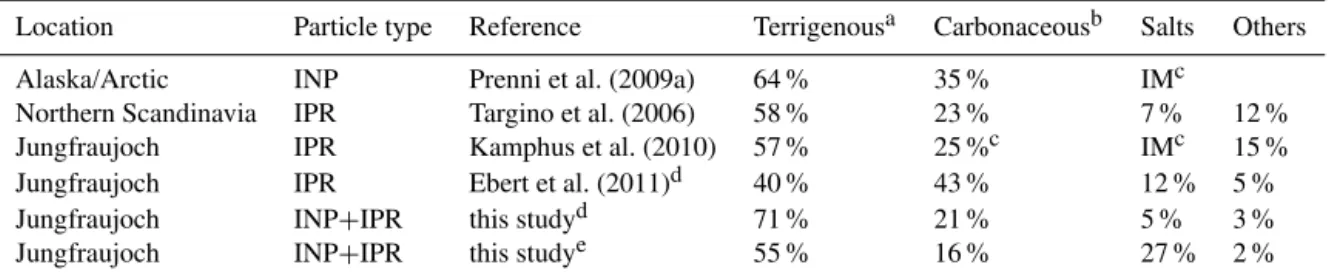
A compilation of INP/IPR composition encountered in mixed-phase clouds is shown in Table 4. In general, the re-sults of the present study are in good agreement with the find-ings of previous work. Silicates are the most abundant com-ponent of INP/IPR with a relative number abundance vary-ing between 40 and 71 %. The second most abundant com-ponent is carbonaceous material (16–43 %), followed by salts (sea salt, sulfates, droplets) with a relative number abundance between 5 and 27 %. The high abundance of coated parti-cles observed in the present study is in good agreement with Targino et al. (2006), who observed sulfur coatings for all groups indicating ageing and in-cloud processing.
An overview of IPR compositions found during 13 field campaigns of cirrus clouds is given by Cziczo and
Froyd (2014). Also, here the main particle types are mineral dust, metals, BC/soot, sea salt, sulfate, and biomass burning. A relatively high abundance of Pb-bearing particles, in particular internally mixed ones, seems to be characteris-tic for IPR at the JFJ station. They were found in previ-ous work (Cziczo et al., 2009b; Ebert et al., 2011) and dur-ing the present field campaign. However, the fraction of Pb-bearing particles in the whole INUIT campaign is 1 % for FINCH+IN-PCVI, and 10 % for Ice-CVI. In contrast, a
higher fraction of up to 20 % was found during CLACE 5. As helicopter flights – where Pb-rich particles might be emitted due to leaded fuel usage – around the JFJ station were more frequent during CLACE 5 than during the present field cam-paign, the decrease in the abundance of Pb-bearing particles indicates a considerable contribution of local emissions to the INP formation at the JFJ station.
Feldspar minerals and in particular K-feldspars (e.g., mi-crocline) were discussed as efficient INPs (Atkinson et al., 2013; Yakobi-Hancock et al., 2013). Despite the fact that we did not determine the mineralogical phase of the sili-cate particles, we can show by SEM-EDX that they have low potassium contents (K/Si atomic ratio < 0.1). Thus, it is
concluded that K-feldspar particles do not occur as INP/IPR at JFJ in winter. Ca-rich particles appear in the supermicron fraction with a number abundance ratio of 0.1–0.33 relative to silicates (depending on method and sample), which is in the range reported for natural mineral dust (Kandler et al., 2007, 2009, 2011; Coz et al., 2009). Thus, Ca-rich particles can be considered as similarly effective IN as silicates.
4.2 Significance of mixing state and particle class for ice nucleation
A significant fraction of the INPs/IPRs occurs as internal mixtures (Table 3). This fraction is similar to previous lit-erature data. Chen et al. (1998) reported that a fraction of 25 % of the INPs were a mixture of sulfates and elements indicative of insoluble particles. The same relative abun-dance of mixtures of metal oxides/dust with either carbona-ceous components or salts/sulfates was reported by Prenni et al. (2009a). For the JFJ station, a slightly lower fraction of internally mixed particles was found during the CLACE 5/6 campaigns: 9–15 % by Ebert et al. (2011) and up to 15 % by Kamphus et al. (2010).
lab-Table 4.Average INP/IPR composition encountered in mixed-phase clouds for several field experiments.
Location Particle type Reference Terrigenousa Carbonaceousb Salts Others
Alaska/Arctic INP Prenni et al. (2009a) 64 % 35 % IMc
Northern Scandinavia IPR Targino et al. (2006) 58 % 23 % 7 % 12 %
Jungfraujoch IPR Kamphus et al. (2010) 57 % 25 %c IMc 15 %
Jungfraujoch IPR Ebert et al. (2011)d 40 % 43 % 12 % 5 %
Jungfraujoch INP+IPR this studyd 71 % 21 % 5 % 3 %
Jungfraujoch INP+IPR this studye 55 % 16 % 27 % 2 %
aContaining internal mixtures of terrigenous materials with sulfate and organics;bcontaining also sulfate;cIM: present in internal mixtures only; dexcluding droplets and sulfate; Pb-bearing particles classified according to major particle composition;eincluding droplets and sulfate; Pb-bearing particles classified according to major particle composition.
oratory experiments, conflicting results are obtained. While Cziczo et al. (2009a) as well as Hoose and Möhler (2012) reported a deactivation of the ice nuclei due to coatings, Sul-livan et al. (2010) found that coatings do not always effect the ice nucleation ability. In contrast, Archuleta et al. (2005) and Zuberi et al. (2002) discuss mineral dust as an efficient nucleus for ice in NH4SO4–H2O aerosols and demonstrated that mineral particles coated with sulfate increase the freez-ing temperature up to 10 K compared to pure sulfate solu-tions. In addition, Richardson et al. (2007) reported that sol-uble coatings favor condensation-freezing nucleation and in-hibit nucleation by vapor deposition. But they also mention, that coating itself may act either to increase or decrease ice nucleation efficiency independently of the nucleation mech-anism.
4.3 Comparison between FINCH+IN-PCVI, Ice-CVI and ISI
A reasonable agreement between the different sampling tech-niques is obtained for the major particle classes observed among the INP/IPR. However, the variation in INP/IPR composition due to meteorological conditions in connection with the non-parallel sampling introduces a systematic error. The non-parallel sampling could not be avoided during the present field campaign, as the sampling techniques were not yet in a state allowing for synchronized operation and the available flow from the INP/IPR samplers was insufficient for a sampling for SEM and operation of LA-MS in parallel. Consequently, INP/IPR composition snapshots from differ-ent time periods needed to be integrated for comparison of the INP/IPR composition.
The reasons for the different instrumental contamination artifacts were identified. Thus, these artifacts can be avoided in future by removing their sources (e.g., replacement/sealing of contaminating surfaces, thoroughly purging). The relative abundance of potential sampling artifacts is in general low (median < 5 %), except for sea-salt particles sampled by the Ice-CVI with a median of 10 % (Fig. 7).
Despite the frequent non-parallel sampling, the major INP/IPR classes found by all three techniques include
sili-cates, Ca-rich particles, carbonaceous material, and metal ox-ides. In addition, soot was observed as a minor component in the fine fraction (< 1 µm diameter) by all methods. These ob-servations are also in general agreement with previous work (see above).
In contrast, in the fine fraction a considerably higher rel-ative abundance of carbonaceous material was found by ISI and a higher relative abundance of silicates and silicate mix-tures by Ice-CVI. These differences are most likely caused by the non-parallel sampling. It must be emphasized again that samples from the ISI were only obtained during the last week of the field campaign (Fig. 1).
4.4 Comparison between scanning electron microscopy and laser ablation mass spectrometry
The results of the offline SEM-EDX analysis of the collected INP/IPR particles can be compared to the findings of on-line LA-MS. Unfortunately, both techniques could not be run in parallel because of the limited available sample flow that could be provided by the sampling systems. Due to the low INP/IPR concentrations, it was necessary to integrate all available data, which may lead to systematic errors due to significant variations in the IPR chemical composition as a function of changing air masses and meteorological con-ditions. Furthermore, for a comparison between SEM-EDX and LA-MS a more general particle classification scheme, combining the detailed SEM-EDX classes, was necessary.
0 10 20 30 40 50 60 70 80 90 100
re
la
ti
v
e
n
u
m
b
e
r
a
b
u
n
d
a
n
c
e
,
%
SEM-EDX LA-MS SEM-EDX LA-MS
Carbonaceous + soot Pb-rich
Metal oxides Silicates + sea-salt Sulfates Secondary Droplets Other OC/BC Pb-bearing Industrial metals Minerals + metals Other
ISI Ice-CVI
5
196
n/a
146
13
1073
n/a
1663
number of samples
total number of particles
LA-MS classification
SEM-EDX classification
Figure 10.Comparison of particle class relative number abundance
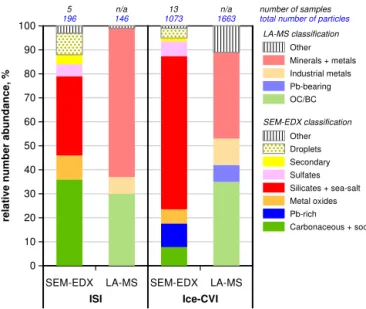
determined by SEM-EDX and LA-MS for IPRs sampled by ISI and Ice-CVI. To allow for a comparison of the two different analytical approaches of SEM-EDX and LA-MS, classes were combined ac-cordingly. For confidence intervals see Table S6 in the Supplement.
are classified according to their dominant cations and are as-signed to one of the listed particle groups.
For the other classes, a fair agreement of the results is ob-tained. First, the sum of mineral dust, sea salt, carbonaceous material and soot (red and green colors in Fig. 10) contributes 70–90 % to the IPR. Second, metal oxides (based on SEM-EDX: mainly iron oxides) occur at an abundance of 5–10 %. Third, Ice-CVI samples contain Pb-rich particles (5–10 %), while these particles are absent in the ISI. These results do not change considerably if, for SEM-EDX, the particles out-side the LA-MS size range (> 1.5 µm diameter) are neglected. However, pronounced discrepancies exist between SEM-EDX and LA-MS data, in particular for Ice-CVI. For this sampling technique, a lower abundance of carbonaceous ma-terial is found by SEM-EDX as is a higher abundance of sil-icates. This quantitative comparison of compositional data from both analysis techniques is hampered by the different approach in particle characterization. The particle classifica-tion with SEM-EDX relies on the characteristic X-ray sig-nals, which can be used to quantify the chemical compo-sition of a particle. Our classification scheme uses mainly the major elements (i.e., a relative contribution larger than 10 at. %, excluding oxygen) detected inside a particle to as-sign it to the respective group. Minor elements (less than ap-proximately 10 at. %) are mostly neglected in particle classi-fication. Trace elements (less than 0.5 at. %) cannot be mea-sured at all. In contrast, single particle LA-MS relies on ionized compounds, so ionization efficiency plays a major role. Thus, strong signals often originate from the atoms or molecules, which can be ionized best in LA-MS, but are not necessarily a major component of the particle. While LA-MS
works usually well for externally mixed particles, problems can arise for the classification of internally mixed particles. In our particular case, it cannot be excluded that, for example, a silicate particle with a thin organic coating is classified as silicate in SEM-EDX (based on Si as major element) but as a carbonaceous particle in LA-MS (based on a strong signal of ionized carbonaceous matter). This example clearly demon-strates the need for further systematical comparison between these two analytical techniques.
5 Summary and conclusions
For the first time, the chemical composition of individual INPs/IPRs collected by three techniques – ISI, FINCH+
IN-PCVI and Ice-CVI – was analyzed in a field experiment. In winter, the INP/IPR composition at the Jungfraujoch sta-tion is composed of five main classes: the dominating ter-rigenous silicates/Ca-rich particles, carbonaceous particles, metal oxides/hydroxides (Fe-, Ti-, or Al-oxides/hydroxides), soot, and soluble particles like sea salt, sulfates and droplets. However, the latter class of soluble particles are considered as potential sampling artifacts. Lead inclusions occur in sev-eral INPs/IPRs, while large homogeneous Pb-rich particles are considered partially as artifacts. The composition is gen-erally similar to earlier field experiments. Despite the non-parallel sampling, the methods roughly agree regarding ma-jor and minor components. Thus, we consider this experi-ment as a successful step in improving the accuracy of mea-suring the INP/IPR chemical composition.
For all three INP/IPR separation techniques, different con-tamination artifacts and potential sampling artifacts were identified. These artifacts are easily detectable by the chem-ical and morphologchem-ical analysis. In contrast, the counting or size distribution techniques would consider these contami-nation and sampling artifacts as real INP/IPR and, conse-quently, overestimate the INP/IPR concentration. Thus, the present work provides information suitable for correction of counting techniques, for the contamination artifacts as well as for sampling artifacts. While, for the former, correction is necessary, interpretation of the latter might change with further knowledge regarding the INP/IPR abilities of soluble compounds.
chem-ical selectivity of the different INP/IPR-discriminating tech-niques.
Finally, a few statements regarding limitations of the in-vestigated techniques as well as recommendations for future work on INP/IPR can be made.
a. Measurements of INP/IPR concentrations should be al-ways accompanied by characterization of the INP/IPR chemistry to readily identify strong contributions of instrumental artifacts. Although different techniques are in principal possible, scanning electron microscopy with high-resolution instruments has proven to be espe-cially suited for this purpose.
b. More work is needed to clarify the ice nucleation ability of sea salt and sulfates in mixed-phase clouds.
c. More emphasis should be placed on the particle mixing state in the atmosphere. Due to its complexity, labora-tory tests on the performance of the different INP/IPR sampling techniques may lead to overconfidence in the results of field measurements.
d. Substantial work is still necessary to develop the here-presented approaches of INP/IPR sampling to robust routine techniques.
The Supplement related to this article is available online at doi:10.5194/acp-15-4161-2015-supplement.
Acknowledgements. We gratefully acknowledge financial support
by the Deutsche Forschungsgemeinschaft within the research group Ice Nuclei Research Unit – INUIT (FOR 1525). We thank Emanuel Hammer and Gary Lloyd for providing the liquid water content data and MeteoSwiss/EMPA for the meteorological data.
We also thank Stephan Günnel (Institut für Troposphären-forschung, Leipzig, Germany) for his help in setting up the Ice-CVI on the platform of the Sphinx Laboratory at the Jungfraujoch Re-search Station. In addition, we thank the International Foundation High Altitude Research Stations Jungfraujoch and Gornergrat (HF-SJG) for the opportunity to perform experiments at the Jungfraujoch station.
Finally, we gratefully recognize the thorough reading and the many helpful comments of our reviewers.
Edited by: B. Ervens
References
Abbatt, J. P. D., Benz, S., Cziczo, D. J., Kanji, Z., Lohmann, U., and Möhler, O.: Solid Ammonium Sulfate Aerosols as Ice Nuclei: A Pathway for Cirrus Cloud Formation, Science, 313, 1770–1773, doi:10.1126/science.1129726, 2006.
Archuleta, C. M., DeMott, P. J., and Kreidenweis, S. M.: Ice nu-cleation by surrogates for atmospheric mineral dust and mineral dust/sulfate particles at cirrus temperatures, Atmos. Chem. Phys., 5, 2617–2634, doi:10.5194/acp-5-2617-2005, 2005.
Ardon-Dryer, K. and Levin, Z.: Ground-based measurements of im-mersion freezing in the eastern Mediterranean, Atmos. Chem. Phys., 14, 5217–5231, doi:10.5194/acp-14-5217-2014, 2014. Ardon-Dryer, K., Levin, Z., and Lawson, R. P.: Characteristics of
immersion freezing nuclei at the South Pole station in Antarctica, Atmos. Chem. Phys., 11, 4015–4024, doi:10.5194/acp-11-4015-2011, 2011.
Atkinson, J. D., Murray, B. J., Woodhouse, M. T., Whale, T. F., Baustian, K. J., Carslaw, K. S., Dobbie, S., O’Sullivan, D., and Malkin, T. L.: The importance of feldspar for ice nucleation by mineral dust in mixed-phase clouds, Nature, 498, 355–358, doi:10.1038/nature12278, 2013.
Brands, M., Kamphus, M., Böttger, T., Schneider, J., Drewnick, F., Roth, A., Curtius, J., Voigt, C., Borbon, A., Beekmann, M., Bourdon, A., Perrin, T., and Borrmann, S.: Charac-terization of a Newly Developed Aircraft-Based Laser Ab-lation Aerosol Mass Spectrometer (ALABAMA) and First Field Deployment in Urban Pollution Plumes over Paris Dur-ing MEGAPOLI 2009, Aerosol Sci. Technol., 45, 46–64, doi:10.1080/02786826.2010.517813, 2011.
Bundke, U., Nillius, B., Jaenicke, R., Wetter, T., Klein, H., and Bingemer, H.: The fast Ice Nucleus chamber FINCH, Atmos. Res., 90, 180–186, doi:10.1016/j.atmosres.2008.02.008, 2008. Bundke, U., Reimann, B., Nillius, B., Jaenicke, R., and Bingemer,
H.: Development of a Bioaerosol single particle detector (BIO IN) for the Fast Ice Nucleus CHamber FINCH, Atmos. Meas. Tech., 3, 263–271, doi:10.5194/amt-3-263-2010, 2010. Chen, Y., Kreidenweis, S. M., McInnes, L. M., Rogers, D. C., and
DeMott, P. J.: Single particle analyses of ice nucleating aerosols in the upper troposphere and lower stratosphere, Geophys. Res. Lett., 25, 1391–1394, 1998.
Choël, M., Deboudt, K., Osán, J., Flament, P., and Van Grieken, R.: Quantitative Determination of Low-Z Elements in Single At-mospheric Particles on Boron Substrates by Automated Scan-ning Electron Microscopy-Energy-Dispersive X-ray Spectrome-try, Anal. Chem, 77, 5686–5692, doi:10.1021/ac050739x, 2005. Chou, C., Stetzer, O., Weingartner, E., Jurányi, Z., Kanji, Z. A., and Lohmann, U.: Ice nuclei properties within a Saharan dust event at the Jungfraujoch in the Swiss Alps, Atmos. Chem. Phys., 11, 4725–4738, doi:10.5194/acp-11-4725-2011, 2011.
Clopper, C. J. and Pearson, E. S.: The use of confidence or fiducial limits illustrated in the case of the binomial, Biometrika, 26, 404– 413, doi:10.1093/biomet/26.4.404, 1934.
Collaud Coen, M., Weingartner, E., Furger, M., Nyeki, S., Prévôt, A. S. H., Steinbacher, M., and Baltensperger, U.: Aerosol cli-matology and planetary boundary influence at the Jungfraujoch analyzed by synoptic weather types, Atmos. Chem. Phys., 11, 5931–5944, doi:10.5194/acp-11-5931-2011, 2011.
Conen, F., Henne, S., Morris, C. E., and Alewell, C.: Atmospheric ice nucleators active≥ −12◦C can be quantified on PM10 filters, Atmos. Meas. Tech., 5, 321–327, doi:10.5194/amt-5-321-2012, 2012.