http://jppres.com/jppres
Original Article | Artículo Original
A novel high-performance thin layer chromatography method for
quantification of long chain aliphatic hydrocarbons
from
Cissus quadrangularis
[Nuevo método de cromatografía en capa fina de alta resolución para cuantificar hidrocarburos alifáticos de cadena larga de Cissus quadrangularis]
Vandana Jain1, Vedang Kinjawadekar1, Kirti Laddha2
1
Oriental College of Pharmacy, Sanpada, Navi Mumbai 400705, India.
2
Medicinal Natural Product Research Laboratory, Pharmaceutical Division, Institute of Chemical Technology, Matunga (E), Mumbai 400 019, India. *E-mail: [email protected]
Abstract Resumen
Context: A high-performance thin layer chromatography (HPTLC) is an analytical technique, which can be used for the determination of constituents or marker components in various parts of the plants. Earlier studies have estimated phytoconstituents from the stem and other aerial plant parts of Cissus quadrangularis Linn. Estimation of hydrocarbons can also be successfully done using HPTLC technique using suitable derivatization.
Aims: To develop and validate a simple and rapid method for the estimation of long chain aliphatic hydrocarbons from the leaves of C. quadrangularis using HPTLC technique.
Methods: Precoated silica gel 60 F254 plates were used as stationary phase.
The mobile phase used was hexane (100 %). The detection of spots was carried out using berberine sulphate as detecting reagent.
Results: The method was validated in terms of linearity, sensitivity, accuracy, and precision. Linearity range was found to be 2-10 µg/mL, limit of detection 0.127 µg/mL, and limit of quantification 0.384 µg/mL.
Conclusions: A novel, simple, accurate, precise and sensitive HPTLC method has been developed and validated for the estimation of long chain aliphatic hydrocarbons obtained from the leaves of C. quadrangularis Linn.
Contexto: La cromatografía en capa fina de alto resolución (HPTLC) es una técnica analítica que puede ser utilizada para la determinación de los constituyentes o marcadores en varias partes de las plantas. Estudios anteriores han estimado fitoconstituyentes del tallo y otras partes aéreas de la planta de Cissus quadrangularis Linn. La estimación de hidrocarburos también se puede realizar con éxito mediante esta técnica utilizando una derivatización adecuada.
Objetivos: Desarrollar y validar un método sencillo y rápido para la estimación de los hidrocarburos alifáticos de cadena larga de las hojas de
C. quadrangularis utilizando la técnica de HPTLC.
Métodos:Placas recubiertas de sílica gel 60 F254 fueron utilizadas como fase estacionaria. La fase móvil fue hexano (100%). La detección de las manchas se realizó mediante sulfato de berberina como reactivo de detección.
Resultados: El método fue validado en términos de linealidad, sensibilidad, exactitud y precisión. Se encontró un rango de linealidad de 2-10 µg/mL, límite de detección 0.127 µg/mL y límite de cuantificación 0.384 µg/mL.
Conclusiones: Un nuevo método de HPTLC simple, exacto, preciso y sensible se ha desarrollado y validado para la estimación de hidrocarburos alifáticos de cadena larga obtenidos de las hojas de C. quadrangularis
Linn.
Keywords: Berberine sulphate; high-performance thin layer chromatography; long chain aliphatic hydrocarbons.
Palabras Clave: Cromatografía en capa fina de alta resolución; hidrocarburos alifáticos de cadena larga; sulfato de berberina.
ARTICLE INFO
Received | Recibido: April 11, 2016.
Received in revised form | Recibido en forma corregida: June 30, 2016. Accepted | Aceptado: July 8, 2016.
Available Online | Publicado en Línea: July 22, 2016.
Declaration of interests | Declaración de Intereses: The authors declare no conflict of interest.
Funding | Financiación: This work was partially supported by aJunior Research Fellowship in Engineering and Technology of UGC, New Delhi [No.F.10-1/2005 (SA-I)].
Academic Editor | Editor Académico: Douglas Chaves.
INTRODUCTION
Cissus quadrangularis Linn. (Hadjod) is a medic-inal plant found in the Indian Subcontinent as well as in Africa. Ancient literature of Ayurveda has pre-scribed it a tonic and has been used to cure frac-tures (Nayar, 1959; Justin and Joseph, 2001; Sanyal et al., 2005;
Justin and Baby, 2011). Other pharmacological effects
reported are oxidant, ulcer, microbial, central nervous depressant, anti-epileptic and anti-cancer activity (Chidambara Murthy
et al., 2004; Subhashri et al., 2013; Anusiya et al., 2014).
The phytochemical studies suggest the presence of triterpene derivatives, polyphenols, ketosteroids, carotenoids, stilbenes, flavonoids and iridoids (Sen,
1966; Bhutani et al., 1984; Gupta and Verma, 1990; 1991).
Studies have reported the presence of three ad-ditional components fromstems: δ-amyrin acetate, hexadecanoic acid and trans-resveratrol-3-O -gluco-side (Thakur et al., 2009a). Phytochemical investiga-tions of leaves have revealed the presence of eicosyl eicosanoate, tetratriacontanol, tetratriacontanoic
acid, α-amyrin and β-sitoterol (Jain et al., 2009).
Isola-tion and characterizaIsola-tion of long chain aliphatic hydrocarbon fraction containing heptacosane (C27H56), pentatriacontane (C35H72) and hexatria-contane (C36H74), using column chromatography followed by IR, Nuclear Magnetic Resonance (NMR) 1H and 13C and GC-MS from leaves is also reported (Jain et al., 2010).
Analytical methods to determine C. quadrangularis phytoconstituents (amyrin, amyro-ne, hexadecanoic acid ethyl ester, quercetin, and kaempferol) are available like GC-MS, HPTLC
(Me-hta 2001; Sumitra et al., 2013) and HPLC (Thakur et al.,
2009b).
Hydrocarbons act as a barrier to the penetration by microorganisms and prevent desiccation. A major problem associated with hydrocarbon analy-sis is because of their inert nature (Cossio et al., 2000b). They do not give any UV or fluorescent response under the usual analytical conditions. Such com-pounds provide a fluorescent emission signal when spotted onto a silica gel TLC plate previously im-pregnated with berberine sulphate and irradiated using 366 nm UV light. Berberine does not affect separation and only allows the detection of satu-rates (Cebolla et al., 1999; Cossio et al., 2000a).
In our previous studies the isolation of aliphatic hydrocarbon is reported (Jain et al., 2010). In continua-tion of the earlier report, it was thought worthwhile to develop and validate novel quantification meth-od for hydrocarbons by HPTLC in plant extract.
MATERIAL AND METHODS
Plant material
Leaves of C. quadrangularis were procured from in-house medicinal plant garden maintained at Ori-ental College of Pharmacy, Sanpada, Navi Mumbai and were authenticated by a Prof. H. M. Pandit, Botanist, Khalsa College, Mumbai (Voucher speci-men number CQL-1).
Instrumentation and reagents
The stationary phase used was silica gel 60F254 TLC plates (10 x 10 cm, layer thickness 0.2 mm, E. Merck, Mumbai). All the chemicals and reagents were of analytical grade purchased from S.D. Fine Chemicals. Long chain aliphatic hydrocarbon iso-lated and characterized in our previous report was used as a standard (Jain et al., 2010). A Camag HPTLC system (Mumbai, India) equipped with Camag Linnomate IV (Mumbai, India) automatic sample applicator, Hamilton syringe (100 µL), Camag TLC Scanner III (Mumbai, India), controlled by Win CATS planar chromatography manager, Camag Twin-trough chamber (10 × 10 cm) were used during study.
Preparation of solutions
Standard solution: Accurately weighed quantity (10 mg) of aliphatic hydrocarbon was dissolved in 10 mL hexane. The above stock solution (1 mg/mL) was then used for spotting to achieve concentra-tions of 2-10 µg on the plate.
Chromatographic conditions
Chromatography was performed in Camag twin trough chamber, which was pre-saturated with the hexane before use. Precoated silica gel 60 F254 plates were used as stationary phase. The plates were pre-washed in methanol for removing any impurities picked up during storage in the laboratory envi-ronment. After pre-washing the plates were activat-ed at 110-120°C for 30 min. The plates were developed with hexane (100%) as the mobile phase. Both standard and sample solutions of specific con-centrations (as specified above) were applied to the plates as 5 mm bands by means of Camag Linomat IV sample applicator. After development and drying the plates were dipped in berberine sulphate (3 mg/L methanol) used as detecting reagent. Evalua-tion of standard and extract were performed after derivatization by scanning the plate at 366 nm us-ing Camag TLC scanner III controlled by Win CATS planar chromatography manager.
Statistical analysis
The method was validated as per the ICH guide-lines Q2 (R1). Linearity, precision, Limit of Detection (LOD), Limit of Quantitation (LOQ) and accuracy were the parameters performed, to vali-date the developed method.
Linearity: The linearity was evaluated by analyz-ing area under the curve as a function of analyte concentration. Test results were evaluated by calcu-lating regression coefficient (r2).
Precision: Precision of an analytical procedure expresses the closeness of agreement between a se-ries of measurement obtained from multiple sampling of the same homogeneous sample under the prescribed condition. Precision was determined in terms of percent relative standard deviation. Three replicates of standard at three different con-centration levels (2, 6, 10 µg/spot) were analyzed on three separate days for inter-day precision (repro-ducibility) and at three different times on the same day for intra-day precision (repeatability).
LOD and LOQ: The LOQ of an individual analytical procedure is the lowest amount of analyte in a sample, which can be quantitatively determined with suitable precision and accuracy. The LOD and LOQ were established using the
calibration curve parameters viz. slope and standard deviation. They are expressed as:
LOD = 3.3 σ/S
LOQ = 10 σ/S
Where σ = standard deviation and S = slope of
the curve.
Accuracy (recovery): Accuracy study was performed by spiking 80, 100, and 120% amount of standard drug externally added to the pre-analyzed sample. The experiment was conducted in tripli-cate. It was conducted to check the recovery of the drug at different levels.
RESULTS AND DISCUSSION
Method development
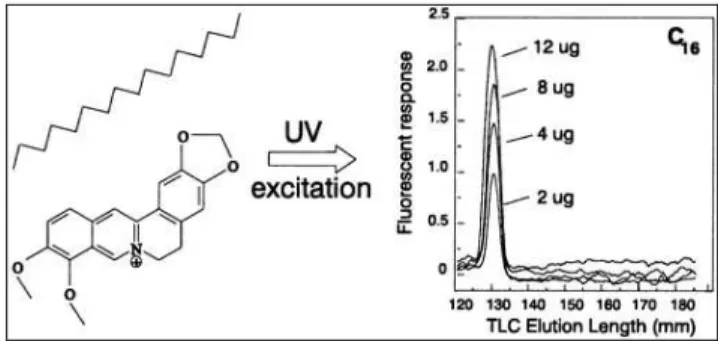
Alkanes in the presence of berberine sulfate provide an enhancement of fluorescent signal, de-pending on the alkane concentration, when the sys-tem is irradiated with UV light. Computational analysis indicates an ion-induced dipole between berberine sulfate and alkanes is responsible for this phenomenon. This interaction can properly model the experimentally obtained fluorescent response (Fig. 1) (Cossio et al., 2000b).
Figure 1. Fluorescent response after berberine sulfate and alkane interaction and its UV activation.
[Adapted with permission from Cossio et al., 2000b Copyright (2000) American Chemical Society].
interac-tion between the alkane molecule and the deficient electron π-system of berberine and that there are intermolecular distances close to van der Waals contacts in several positions. The role of alkanes is to provide a non-polar environment to the excited berberine cation, which hinders alternative relaxa-tion mechanisms and favors the fluorescence emis-sion. Thus, at 366 nm the fluorescence can be ob-served for hydrocarbons using berberine sulphate.
A solvent system, which would provide dense, compact, accurate spots with significant Rf values was selected for quantification of the hydrocarbons. The mobile phase hexane (100%) provided Rf value of 0.69 for the standard long chain aliphatic hydro-carbon (Fig. 2). The purity of the compound was 95% as determined by HPTLC.
Figure 2. HPTLC chromatogram of standard long chain ali-phatic hydrocarbon.
Calibration curve for the concentration range 2-10 µg was plotted. The linear regression equation (n=5) was found to be y = 50x – 80 (r2 = 0.999), which shows that the method is linear over the range of 2-10 µg. Low values of LOD and LOQ indi-cate the method is sensitive.
Repeatability studies were carried out by sample application five times and also on the basis of peak area measurement for five times and the plated were developed and analyzed. The Percent Relative Standard Deviation (%RSD) was found to be 0.98 and 0.55% for repeatability of application and re-peatability of measurement respectively (Table 1). Lower %RSD values indicate that the method can be successful applied for application and measure-ment of the sample at different concentrations.
Precision was determined as intra-day precision and inter-day precision. This was done by measuring three different levels of the standard so-lution with three replicates of each sample. The low %RSD values indicate the method is precise (Table 2). For recovery studies, to the pre-analyzed sample, three concentrations were added (80, 100, and 120 %) and analyzed using standard addition method. Percent recovery for extracted sample was found to be in the range of 100.86 to 101.54%. The recovery studies indicated that the sample consisted of no interference of other components (Table 3).
Table 1. Method validation parameters.
Parameters Values
obtained
Linearity range (µg/spot) 2 - 10
Correlation coefficient © 0.999
Regression Equation (y = mx + c) y = 50x – 80
Slope (m) 50
Intercept © -8
Limit of detection (LOD) 0.127
Limit of quantification (LOQ) 0.384
Repeatability of application* (% RSD) 0.98
Repeatability of measurement* (% RSD) 0.55
n 5
% RSD: Percent Relative Standard Deviation.
Table 2. Method precision data.
Component Concentration (Levels)
Intra-day precision (n=3) (%RSD)
Inter-day precision (n=3) (%RSD)
Standard hydrocarbon
2 0.70 0.98
6 0.55 0.89
10 0.63 0.94
Table 3. Recovery studies performed on standard long chain aliphatic hydrocarbon.
Component Amount present (µg/spot)
Amount added (µg/spot)
Amount found (µg/spot)
Amount recovered (µg/spot)
% Recovery Avg. SD %RSD
Standard hydrocarbon
2.4 1.94 4.37 1.97 101.54 ± 0.21
101.253 0.3523 0.35
2.4 2.32 4.74 2.34 100.86 ± 0.33
2.4 2.92 5.36 2.96 101.36 ± 0.47
Avg.: Average; SD: Standard deviation; % RSD: Percent Relative Standard Deviation.
Sample analysis
As per the developed chromatographic method,
C. quadrangularis leaves extract was analyzed. The retention factor was found same as that of the standard value. The leaves extract had a Rf value near to 0.69 (Fig. 3). The spots on the plates of TLC could be visible under fluorescence using berberine sulfate reagent. The total aliphatic hydrocarbon content in the C. quadrangularis leaves was found to be 0.24% w/w as determined by the linear regres-sion equation. It proves that the method can be successfully applied to determine the hydrocarbon content present in the leaves of C. quadrangularis.
Figure 3. HPTLC chromatogram of C. quadrangularis leaves extract.
CONCLUSIONS
The developed HPTLC technique is a novel technique to determine the long chain aliphatic hy-drocarbons from C. quadrangularis leaves. The technique uses berberine sulphate as a detecting reagent, which helps to determine hydrocarbons easily at 366 nm. The technique can be applied for the determination of other hydrocarbons and the results imply that technique is reproducible and
selective for determination of hydrocarbons using HPTLC technique. Also, the method focuses on the determination of hydrocarbon from the leaves of C. quadrangularis, which has not been quantified ear-lier. The developed technique was found to be sim-ple, sensitive, precise, and accurate and can be successfully applied for the determination of long-chain aliphatic hydrocarbons obtained from other plants or other species.
CONFLICT OF INTEREST
The authors declare no conflict of interest.
ACKNOWLEDGEMENT
The authors are thankful to UGC, New Delhi, for providing Junior Research Fellowship in Engineering and Technology [No.F.10-1/2005 (SA-I)].
REFERENCES
Anusiya K, Deepa B, Renuka S (2014) Reactive oxygen and nitrogen species scavenging and anticancer potential of
Cissus quadrangularis L. against EAC cell line. Int J Pharm Pharm Sci 6: 269-274.
Bhutani KK, Kapoor R, Atal CK (1984) Two unsymmetric
tetra-cyclic triterpenoid from Cissus quadrangularis.
Phytochemistry 23: 407-410.
Cebolla VL, Membrado L, Domingo MP, Henrion P, Garriga R, Gonzalez P, Cossio FP, Arrieta A, Vela J (1999) Quantita-tive applications of fluorescence and ultraviolet scanning densitometry for compositional analysis of petroleum products in thin-layer chromatography. J Chromatogr Sci 37: 219-226.
Chidambara Murthy KN, Vanitha A, Mahadeva Swamy M, Ravishankar GA (2004) Antioxidant and antimicrobial
activity of Cissus quadrangularis L. J Med Food 6: 99-105.
Cossio FP, Arrieta A, Cebolla VL, Membrado L, Vela J (2000b) Berberine cation: A fluorescent chemosensor for alkanes and other low-polarity compounds: An explanation of this phenomenon. Org Lett 2: 2311-2313.
Gupta MM, Verma RK (1990) Unsymmetric tetracyclic
triterpenoid from Cissus quadrangularis. Phytochemistry
29: 336-337.
Gupta MM, Verma RK (1991) Lipid constituents of Cissus
quadrangularis. Phytochemistry 30: 875-878.
Jain V, Thakur A, Hingorani L, Laddha KS (2009) Lipid
constit-uents from Cissus quadrangularis leaves. Phcog Res 1:
231-233.
Jain V, Thakur A, Laddha KS (2010) Long chain aliphatic
hydro-carbons from Cissus quadrangularis. Indian drugs
-Bombay- Indian Drug Manufacturers Association (IDMA) 47: 52-54.
Justin RS, Joseph B (2001) Pharmacognostic and traditional
properties of Cissus quadrangularis Linn -An overview. Int
J Pharm Biosci 2: 136-137.
Justin SR, Baby J (2011) Pharmacognostic and traditional
prop-erties of Cissus quadrangularis Linn – An overview. Int J
Pharm Bio Sci 2: 131-139.
Mehta M, Kaur N, Bhutani KK (2001) Determination of marker
constituents from Cissus quadrangularis Linn. and their
quantification by HPTLC and HPLC. Phytochem Anal 12 (2): 91-95.
Nayar M (1959) Pharmacological study of the stem of Cissus
quadrangularis Linn. J Sci Ind Res 18: 253.
Sanyal A, Ahmad A, Sastry M (2005) Calcite growth in Cissus
quadrangularis plant extract, a traditional Indian bone healing aid. Curr Sci 89: 1742-1745.
Sen SP (1966) Studies on the active constituents of Cissus
quadrangularis-II. Curr Sci 35: 317.
Subhashri S, Vedha Hari BN, Ramya DD (2013)
Pharmacologi-cal activities based on different extracts of Cissus
quadrangularis. Int J of Phcog Phyto Res 5: 128-133. Sumitra C, Yogesh B, Krunal N (2013) Spectral analysis of
meth-anol extract of Cissus quadrangularis L. stem and its
frac-tions. J Pharmacogn Phytochem 2: 149-157.
Thakur AK, Jain V, Hingorani L, Laddha KS (2009a)
Phyto-chemical studies on Cissus quadrangularis Linn. Phcog Res
1: 213-215.
Thakur AK, Jain V, Hingorani L, Laddha KS (2009b) Improved high-performance liquid chromatography-DAD method for the simultaneous analysis of quercetin and kaempferol
in the stems of Cissus quadrangularis Linn. Acta
Chromatogr 21: 95-103.