Research paper
Corrosion Study of Stainless Steels in Peracetic Acid
Bleach Media With and Without Chloride and Chelant
Rohtash1*, Ajay K. Singh2, Rajendra Kumar3
1
Assistant Prof. MRK Institute of Engineering & Technology, Rewari, India,
2
Professor of Physics Department of Paper Technology, IIT Roorkee, India
3
Prof & Head, Department of Physics, Gurukula Kangri Vishwavidyalaya, Haridwar, India. *Corresponding author E-mail: [email protected]
Copyright © 2014 IJRIST. This is an open access article distributed under theCreative Commons Attribution License, which permits unrestricted use, distribution, and reproduction in any medium, provided the original work is properly cited.
Abstract
The paper industries are adopting non-chlorine containing chemicals e.g. peroxide, ozone, peracids etc. as alternate of chlorine based bleach chemicals e.g. chlorine and chlorine dioxide etc. with the aim of eco-friend atmospheres. Changeover to the new chemicals in the bleaching process is likely to affect the metallurgy of the existing bleach plants due to change in the corrosivity of the media. Accordingly, corrosion investigations were performed in a peracid namely peracetic acid to test the suitability of austenitic stainless steels 654SMO, 265SMO, 2205, 317L and 316L. The performance of above stainless steels was evaluated through long term immersion tests and Electrochemical polarization measurements in peracetic acid (PAA) bleach media at pH value 4 maintaining concentration 0.2 % as active oxygen along with three chloride levels 0, 500 and 1000 ppm in pulp-free laboratory. To study the effect of corrosion inhibitors with extending limit of chloride in liquors, measurements were also made with two types of chelants- EDTA & MgSO4. The results showed that corrosivity of PAA reduced by addition of chelant while increased
with concentration of Cl¯. The results also exhibited that EDTA is better inhibitor than MgSO4.
Keywords:Bleach plant corrosion, chelants, electrochemical reactions, peracetic acid, stainless steel, material selection.
1.
Introduction
Peracetic acid is considered as effective for bleaching like peroxide and ozone but this is preferred over the later two alternatives on account of their superiority with regard to associated safety hazards, ingredient costs and effluent loads. Peracetic acid has not been adopted by Indian Paper Industry on considerable scale up to now but these are the futuristic bleach chemicals. The work in this article mentions the corrosion effects on stainless steels in peracetic acid bleach solution with and without chloride as well as effects of corrosion inhibitors. With the use of newer chemicals, their corrosive effect has been studied. There are very few studies related to corrosivity in peracids solutions, Pehkonen et al [7] studied corrosion of SS in ozone and PAA. Been [5] studied the effect of calcium as inhibitor and Varjonen et al [21] studied titanium with MgSO4inhibitor in H2O2. Recently, some studies by Singh et al [9, 10 &11] has appeared on
corrosivity of peracids bleach media. A study on SS has been done by Singh R & Singh A. K. on SS using chelants but in peroxide media [13]. Another study has been done in same bleach media on cold rolled steel by Qing Quad, Jun Zhou et al [16]. In present study corrosion investigations were performed in peracetic acid to test austenitic stainless steels 654SMO, 254SMO, 316L, 317L and a duplex stainless steel 2205.
handling different in solutions for bleaching in paper industry. So, this paper report on investigations were performed in peracetic acid solutions to said austenitic stainless steels (Table1) with chloride level 0, 500 and 1000 ppm and chelant EDTA (0.2% of pulp) , MgSO4(0.25% of pulp) in laboratory simulating all the conditions of bleach plant of paper
industry as appropriate bleaching.
2.
Experimental
2.1. Material
For Corrosion study, Test samples from plate samples of austenitic stainless steels- 6% Mo (654SMO, 254SMO), 317L, 316L and a duplex stainless steel 2205 were selected for the weight loss tests and electrochemical tests. The composition of these stainless steels is shown in Table 1. All the SS test samples were as received in the solution annealed condition as per ASTM specification A 240 [14]. Before exposure, the coupons were polished until a mirror finish surface is obtained, for achieving this state polishing machine was used. Polishing and finishing were done by abrading the specimen on emery papers with grit sequence from coarser to finer i.e. up to 800, 1000 grit size and then subjected to finishing papers 1/0, 2/0 and at last 4/0. Finally the samples were degreased using acetone solution, and weighed. For the electrochemical studies, coupons of 1 cm2were embedded in a mould of epoxy resin and an electrical connection was established via a copper wire. The polished test metals were degreased as described above. All the chemicals used during characterization of bleach solutions, were AR grade.
Table 1: Composition of stainless steels plate samples (%)
ALLOY C Ni Mn P Cr Mo S Cu N Si
316L 0.020 10.87 1.69 0.030 17.44 2.16 0.030 0.31 0.04 0.69
317L 0.016 13.44 1.75 0.026 18.80 3-7 0.004 0.42 0.047 0.50
2205 0.020 5.480 1.45 0.026 22.25 3.08 0.002 0.21 0.15 0.52
254SMO 0.009 18.00 0.44 0.028 20.10 6.15 0.001 0.74 0.20 0.31
654SMO 0.02 21-23 2-4 0.30 24-25 7-8 0.005 0.3-0.60 0.50 0.50
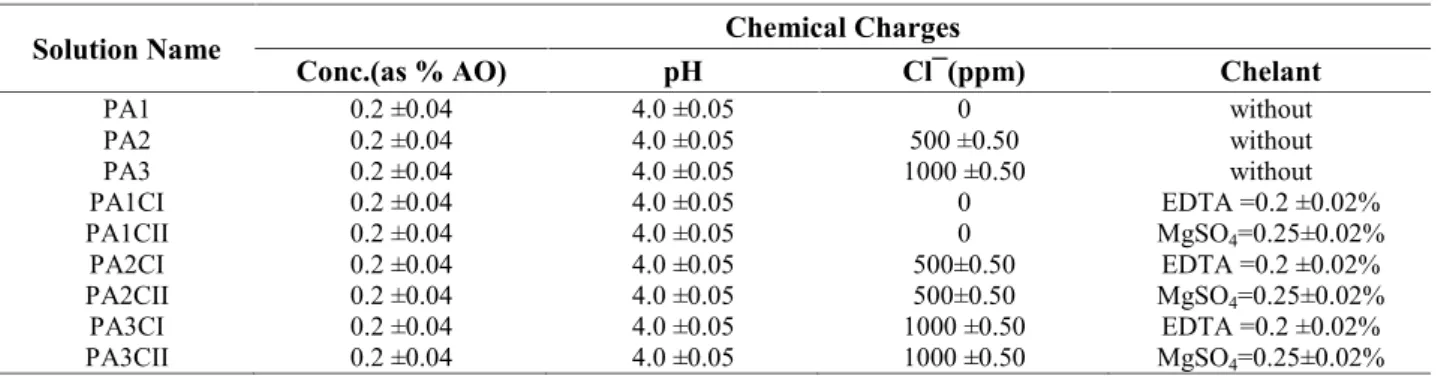
Table 2: Chemical composition of PAA bleach solutions.
Solution Name Chemical Charges
Conc.(as % AO) pH Cl¯(ppm) Chelant
PA1 0.2 ±0.04 4.0 ±0.05 0 without
PA2 0.2 ±0.04 4.0 ±0.05 500 ±0.50 without
PA3 0.2 ±0.04 4.0 ±0.05 1000 ±0.50 without
PA1CI 0.2 ±0.04 4.0 ±0.05 0 EDTA =0.2 ±0.02%
PA1CII 0.2 ±0.04 4.0 ±0.05 0 MgSO4=0.25±0.02%
PA2CI 0.2 ±0.04 4.0 ±0.05 500±0.50 EDTA =0.2 ±0.02%
PA2CII 0.2 ±0.04 4.0 ±0.05 500±0.50 MgSO4=0.25±0.02%
PA3CI 0.2 ±0.04 4.0 ±0.05 1000 ±0.50 EDTA =0.2 ±0.02%
PA3CII 0.2 ±0.04 4.0 ±0.05 1000 ±0.50 MgSO4=0.25±0.02%
2.2. Solutions
Table 2 shows the test conditions and composition of the solutions of PAA test media. For both the long term immersion test and the electrochemical polarization test, the stainless steel samples were exposed to three peracetic acid (PAA) solutions namely PA1, PA2 and PA3 according to desired Cl¯ levels 0, 500 and 1000 ppm respectively. pH value of these solutions was adjusted and kept in the range 4.0 ±0.05 by adding required amount of sodium hydroxide. Six solutions were prepared on adding chelants in PAA, namely PA1CI, PA1CII, PA2CI, PA2CII and PA3CI, PA3CII here CI refer as chelant I namely EDTA while CII refer chelant II namely MgSO4(Table 2). All the solutions of PAA
were prepared as per described Amini and Webster [1]. Accordingly, peracetic acid (CH3COOOH) was prepared by
3.
Corrosion Tests
3.1. Long term Immersion tests
For weight loss test, the prepared stainless steel coupons were exposed for six months at room temperature (27°C average) each coupon was immersed in the solutions of peracetic acid as per described in Table 2 with serrated washers to initiate crevice corrosion. During the test, the percent active oxygen (AO) and pH value of the test solutions were monitored and maintained each third day. While pH did not change much (±0.04), decrease in percent AO was compensated to keep it within limit, as per Table 2 by adding requisite amounts of peracetic acid. After the six month exposure, the corroded coupons were cleaned mechanically as per as per ASTM G1-72 [14]. Further tested coupons were cleaned by treating them with a cold solution of concentrated hydrogen chloride with 50 g/L stannous chloride and 20 g/L antimonies chloride [17]. The coupons were then weighed to determine corrosion rate in mils per year as;
6
3.45 10 W
Corrosion rate mpy
DAT
(1)
Where W =weight loss [gm],
D=density of metal in [gm/cm3] A = area [cm2]
T =exposure time [hours]
To estimate the extent of localized attack the corroded samples were viewed under the microscope. The extent of pitting was estimated by measuring maximum pit depth on the surface of cleaned coupons using a stereo microscope (Olympus) and an optical microscope (Leica Q500MC).
3.2. Electrochemical tests
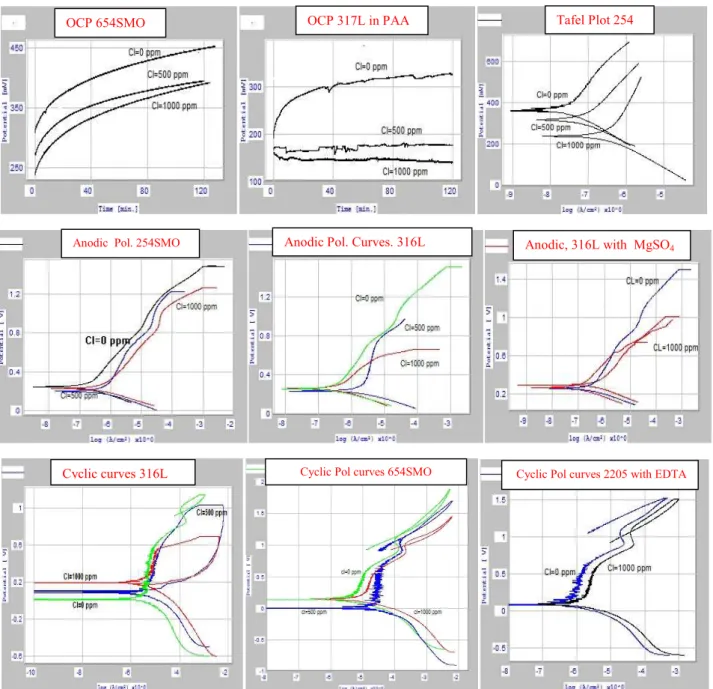
Electrochemical polarization tests were carried out using Radiometer Voltalab Electrochemical Laboratory Model PGZ301of Radiometer France supplied with compatible corrosion measurement software (Volta Master-4). A saturated calomel electrode (SCE) was used as the reference electrode, graphite rods as the auxiliary, and the test specimen was the working electrode within corrosion cell. The tests conducted were open circuit potential (OCP), potentiodynamic (anodic) polarization, cyclic polarization and potentiostatic with the help of software Volta master 4. All the experiments were carried out at 27°C. Figure 1 shows some representative curves of different stainless steels obtained through conducted electrochemical tests. Tafel plots were used to evaluate corrosion potential (Ecorr), Icorr and a, c,
(anodic and cathodic Tafel slopes) and hence corrosion rate. Other polarization techniques give an idea about passivation range and possibility of pitting or crevice corrosion. Electrochemical parameters derived from these curves are presented in Table 4. All the potentials referred in paper are with respect to saturated calomel electrode. Each electrochemical test was repeated to verify the reproducibility of the results. The electrochemical tests described above were conducted in the bleach solution having conditions mentioned above; by using a potentiostat and polarization cell having five necks meant for a working electrode, two counter electrodes, a reference electrode saturated calomel electrode (SCE) as reference electrode and for gas purging. Open circuit potential (OCP), Corrosion (Ecorr.), pitting potential (Ep), and repassivation potential (Ec) were evaluated from these tests. Figure 1 shows some representative curves of different stainless steels obtained through conducted electrochemical tests.
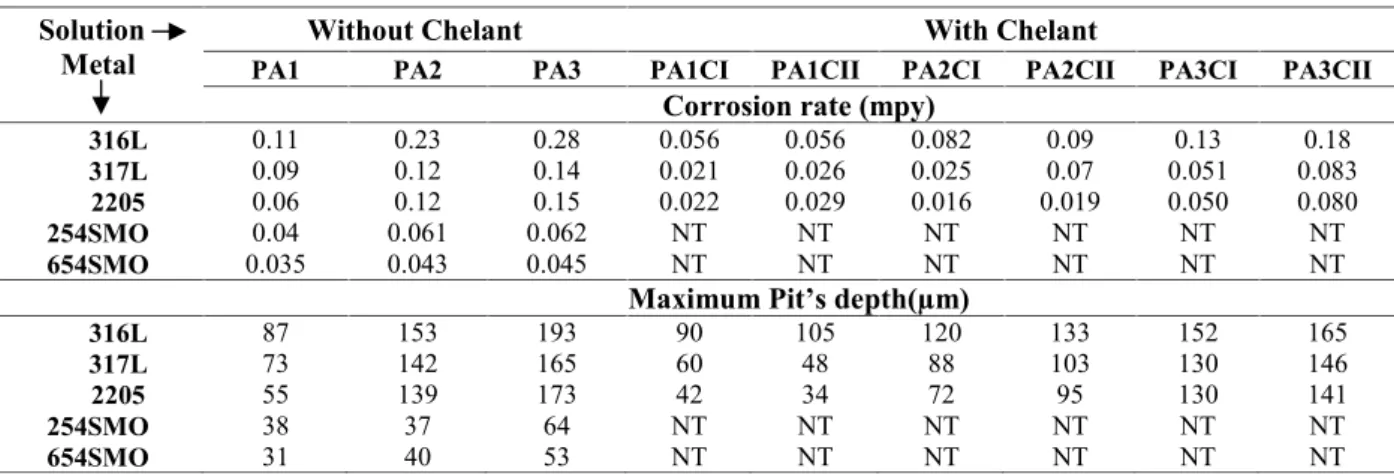
Table 3:Long term immersion test results (corrosion rate and maximum pits depth)
Solution Metal
Without Chelant With Chelant
PA1 PA2 PA3 PA1CI PA1CII PA2CI PA2CII PA3CI PA3CII
Corrosion rate (mpy)
316L 0.11 0.23 0.28 0.056 0.056 0.082 0.09 0.13 0.18
317L 0.09 0.12 0.14 0.021 0.026 0.025 0.07 0.051 0.083
2205 0.06 0.12 0.15 0.022 0.029 0.016 0.019 0.050 0.080
254SMO 0.04 0.061 0.062 NT NT NT NT NT NT
654SMO 0.035 0.043 0.045 NT NT NT NT NT NT
Maximum Pit s depth(µm)
316L 87 153 193 90 105 120 133 152 165
317L 73 142 165 60 48 88 103 130 146
2205 55 139 173 42 34 72 95 130 141
254SMO 38 37 64 NT NT NT NT NT NT
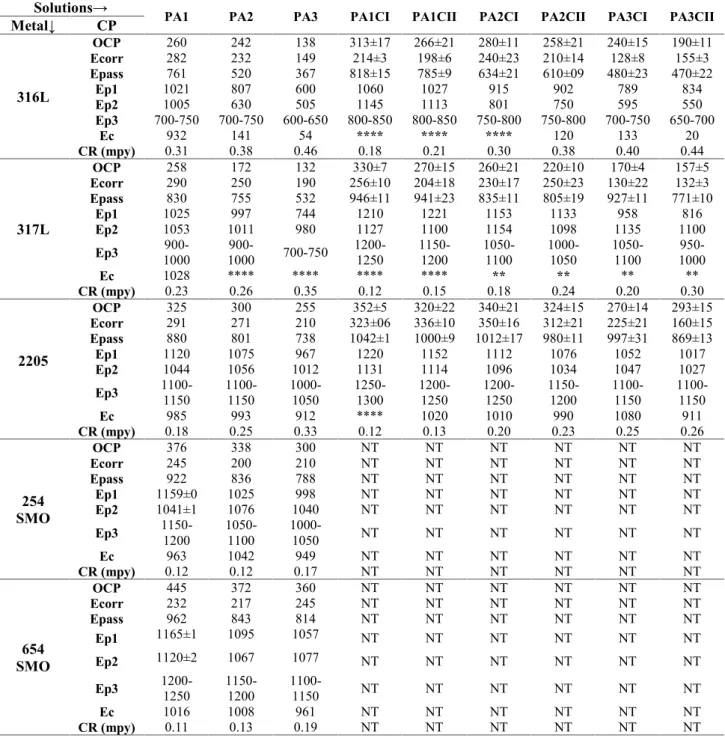
Table 4: Electrochemical test results (corrosion parameters, pot. in mV)
Solutions
PA1 PA2 PA3 PA1CI PA1CII PA2CI PA2CII PA3CI PA3CII
Metal CP
316L
OCP 260 242 138 313±17 266±21 280±11 258±21 240±15 190±11
Ecorr 282 232 149 214±3 198±6 240±23 210±14 128±8 155±3
Epass 761 520 367 818±15 785±9 634±21 610±09 480±23 470±22
Ep1 1021 807 600 1060 1027 915 902 789 834
Ep2 1005 630 505 1145 1113 801 750 595 550
Ep3 700-750 700-750 600-650 800-850 800-850 750-800 750-800 700-750 650-700
Ec 932 141 54 **** **** **** 120 133 20
CR (mpy) 0.31 0.38 0.46 0.18 0.21 0.30 0.38 0.40 0.44
317L
OCP 258 172 132 330±7 270±15 260±21 220±10 170±4 157±5
Ecorr 290 250 190 256±10 204±18 230±17 250±23 130±22 132±3
Epass 830 755 532 946±11 941±23 835±11 805±19 927±11 771±10
Ep1 1025 997 744 1210 1221 1153 1133 958 816
Ep2 1053 1011 980 1127 1100 1154 1098 1135 1100
Ep3 900-1000 900-1000 700-750 1200-1250 1150-1200 1050-1100 1000-1050 1050-1100 950-1000
Ec 1028 **** **** **** **** ** ** ** **
CR (mpy) 0.23 0.26 0.35 0.12 0.15 0.18 0.24 0.20 0.30
2205
OCP 325 300 255 352±5 320±22 340±21 324±15 270±14 293±15
Ecorr 291 271 210 323±06 336±10 350±16 312±21 225±21 160±15
Epass 880 801 738 1042±1 1000±9 1012±17 980±11 997±31 869±13
Ep1 1120 1075 967 1220 1152 1112 1076 1052 1017
Ep2 1044 1056 1012 1131 1114 1096 1034 1047 1027
Ep3 1100-1150 1100-1150 1000-1050 1250-1300 1200-1250 1200-1250 1150-1200 1100-1150 1100-1150
Ec 985 993 912 **** 1020 1010 990 1080 911
CR (mpy) 0.18 0.25 0.33 0.12 0.13 0.20 0.23 0.25 0.26
254 SMO
OCP 376 338 300 NT NT NT NT NT NT
Ecorr 245 200 210 NT NT NT NT NT NT
Epass 922 836 788 NT NT NT NT NT NT
Ep1 1159±0 1025 998 NT NT NT NT NT NT
Ep2 1041±1 1076 1040 NT NT NT NT NT NT
Ep3
1150-1200
1050-1100
1000-1050 NT NT NT NT NT NT
Ec 963 1042 949 NT NT NT NT NT NT
CR (mpy) 0.12 0.12 0.17 NT NT NT NT NT NT
654 SMO
OCP 445 372 360 NT NT NT NT NT NT
Ecorr 232 217 245 NT NT NT NT NT NT
Epass 962 843 814 NT NT NT NT NT NT
Ep1 1165±1 1095 1057 NT NT NT NT NT NT
Ep2 1120±2 1067 1077 NT NT NT NT NT NT
Ep3
1200-1250
1150-1200
1100-1150 NT NT NT NT NT NT
Ec 1016 1008 961 NT NT NT NT NT NT
CR (mpy) 0.11 0.13 0.19 NT NT NT NT NT NT
CP (Corrosion Parameter),
CR (Corrosion rate from anodic Pol. Test in mpy), OCP (Open circuit potential),
Epass (Passivation range) i.e. Ep1-Ecorr, Ecorr = Corrosion Potential,
Ep1 Pitting potential from anodic polarization, Ep2 pitting potential from cyclic polarization,
Ep3 pitting potential from potentiostatic measurements, Ec =Repassivation potential, all the potentials in mV, Pol = Polarization,
**** Cases in which cyclic curve does not cut at all during reverses direction (least resistance to crevice corrosion),
**Curve takes lower side but not cut the passivation curve indicate very little resistance to localized corrosion, (formation bigger loop),
Figure 1: Electrochemical measurement (OCP, Tafel plots, anodic and cyclic polarization.) representative curves of different test metals in PAA bleach media without and with chelant, (values of Cl¯ are in ppm).
4.
Results
Corrosion rate was calculated by weight loss formula (1); weight loss is determined by subtracting the weight of the corroded and cleaned coupon from its original weight. The extent of pitting (evaluated by measuring the maximum depth of pits formed on freely exposed surface), and crevice corrosion on occluded surface formed by serrated washers. Values of these parameters are given in Table 3. The tests did not show any remarkable pitting attack on stainless steels containing 6% Mo. in test media without chloride.
The potentiostatic test was conducted to evaluate pitting potential Ep, which decides the vertex potential required for recording the cyclic polarization curves, The closed loop cyclic curves in Figure 1 indicate that localized corrosion has begun but was subsequently repassivated and that the downward curve therefore shows a weighted average of alloys behaviour in the solution and the localized corrosion environment. Some open loop curves (figure 1) indicate that the pits have not repassivated. Corrosion parameters Ecorr, Epass, Ep, Ec and CR are obtained from these tests are given in Table 4.
OCP 654SMO OCP 317L in PAA
Anodic Pol. Curves. 316L Anodic, 316L with MgSO4
Cyclic curves 316L
Tafel Plot 254
Anodic Pol. 254SMO
5. Discussion
5.1. Corrosivity of solutions
The corrosion rate and pits depth of stainless steels were found greater in case of PAA solution without chelant PAA in comparison to solutions containing chelant. So, corrosivity of media reduces on adding chelant. These values are maximum for all the test metals in PA3 solutions and minimum for PA1CI i.e. in PAA solution with chelant EDTA (Table 3). No, accountable pit is observed for solutions of PAA with chelant for metals 6% Mo. On adding chloride in test solutions, corrosion rate and maximum pits depth is observed as increasing which was highest in PA3 solution and lowest in PA1 solution this behaviour of test samples indicates that corrosivity of stainless steels increases with Cl¯ concentration into the test media. Similarly, comparison of these parameters (Table 3) on adding chelants in test media show PA2CII to be more corrosive than PA1CI and PA2CII is also found more corrosive than PA2CI we conclude that solutions having more chloride were more corrosive. The solutions with MgSO4were more corrosive than solutions
with EDTA for all the three Cl¯ levels. Corrosivity in peracetic media was found according to chloride concentration PA1<PA2<PA3 and according to chelant PACI<PACII.
Test results from Tabel plots (Table 4) indicate that value of Ecorr of test metals is highest in PA1 and decreases on adding chloride while increases again when measured on adding chelant. This improvement was more in case of chelant EDTA i.e. in solution PA1CI. On increasing Cl¯, the passivation range (Ep-Ecorr) decreases, this is expected due to Ep (pitting potential) decreases and Ecorr shifts to anodic direction. The values of OCP, Ep, Ec and Epass for tested SS show that solutions PA3 is more corrosive than PA2 and PA2 is more corrosive than PA1CI.
According to ascending order of corrosivity, the solution can be put as;
Without chelant: PA1<PA2<PA3, with chelant: PA1CI<PA1CII<PA2CI<PA2CII< PA3CI<PA3CII
The greater corrosivity of PAA can be explained on the basis of (i) the prevailing reduction reaction which in turn affect the corrosion of materials (ii) the nature of peracetic acid. The following reduction can be considered to be responsible for corrosion in the solutions.
CH3COOO¯ +3H++ 3e¯ CH3COOOH + H2O (2)
According to this reduction reaction, two ions of CH3COOO¯ are responsible for consumption of 6 electrons. Thus
corrosion of steels takes place when exposed to peracetic acid media , Peracetic acid is more oxidizing than hydrogen peroxide due to electrophilicity character which is greater in case of PAA is than another peracid such as Caro s acid so, at a given pH PAA is also more corrosive than Caro s acid [11]. Results (Table 4) show that the open circuit potential of different steels is higher than respective Ecorr an increase in chloride content decrease in passivation range in both cases without and with chelant.
Margin of safety, MOS i.e. (Passivation range) was found as reduced with corrosivity of solutions for test metals this rate was found lower in PAA solutions with chelant. A reduction in Ep is observed in same manner in case of potentiostatic and cyclic tests. Values of Ep, Ec and Epass is found greatest for 654SMO, 254SMO intermediate for SS-2205 and lowest for 317L and 316L while for 316L a rapid reduction is observed with chloride concentration as increasing in Cl¯ makes this SS more vulnerable to localized corrosion.
No remarkable pitting was observed under microscope [20X] for 6% Mo SS in test solutions containing chelants without Cl¯. Some anodic and cyclic polarization Curves within test solutions show a kink in the curves (Fig. 1 anodic & cyclic) which indicates onset of pitting on higher potential due to O2evolution reaction. In some cases, cyclic
polarization curve shows hysteresis behaviour when polarization scan reverses to cathodic direction on reaching vertex potential.
5.2. Material performance
5.2.1. Weight Loss Test:
In peracetic acid bleach solutions, on the basis of weight loss the metals can be put in following increasing order of observed corrosion resistance (Tables 2).
Without Cl¯: 316L<317L<2205<254SMO<654SMO, With Cl¯=500 ppm: 316L<317L 2205 <254SMO<654SMO, With Cl¯=1000 ppm: 316L 317L 2205<254SMO<654SMO .
of Mo hence greater *PRE No. than 316L, as concentration of chloride increased, corrosion rate of 316L is seen highest, increased rapidly than 317L. Duplex SS-2205 exhibits intermediate performance as per its composition i.e. greater PRE. No. than 316L and 317L but its corrosion rate improved rapidly in presence of extended Cl¯. So, In case of PA3 solution 2205 does not show good performance for handling in PAA bleach media.
(ii) The metals 654SMO & 254SMO show best resistance against all types of corrosion. CR and pits depth are lowest for these metals due to having highest PRE No. The 654SMO showed better performance than 254SMO due to larger Cr and Mo value in composition. With increasing chloride concentration CR increased by lower rate in comparison to SS-316L & 317L. So, we concluded that 654SMO & 254SMO metals can be handled in peracetic acid bleach media with extended value of chloride.
5.2.2. Electrochemical tests
(i) On the basis of anodic polarization measured parameters OCP, Ep, Ecorr& Epass(Table 4), this is found that value of Epis highest & of Ecorr The metals 6% Mo SS (654SMO, 254SMO) showed higher Epand lower Ecorrvalues i.e. greater Epass (passivation range) in comparison to SS-2205, 317L and 316L. In cyclic polarization curves (Fig.1), Ep can be seen very close to Ec i.e. smaller value of (Ep-Ec), we can say smaller cyclic loop forms for these metals, which implies highest resistance against localized corrosion of 6% Mo SS as having higher amount of Cr, Mo, Ni and N in its composition and highest PRE No., CCT, CPT values. .
(ii) SS-316L shows very low value of above parameters due to containing lowest quantity of Cr, Mo and nitrogen in its composition. This metal contains greater value of carbon which is also responsible for its weak performance among the tested metal samples.
(iii) Duplex SS-2205 shows intermediate behaviour by corrosion parameters in different test solutions with lower chloride or non chloride, but in case of extended chloride contained solution (PA3), the behaviour of SS-2205 tends to SS-317L and 316L. This is due to its weak resistance against chloride environmental bleach media. (iv) In case of corrosion measurements with chelant, however, resistance against crevice corrosion is observed to be
higher in case of PA1CI, PA1CII (solutions non Cl¯, with chelant) than in solution PA1 (without chelant). Passivation range and pitting potential Ep is highest for 6% Mo SS and lowest for 316L. Results suggest higher resistance of 2205 than 317L and much higher than 316L against localized.
(vi) Cyclic polarization curves show non passivation pits (Ec<Ecorr) especially in case of 316L and 317L in chloride contained solutions and their Ec is likely to be around Ecorr. For metal 2205, Epand hence passivation range (Epass) is measured as intermediate among the five tested metals in non chelant case. Ec>Ecorrbehaviour of SS-654SMO and 254SMO showed repassivation of pits and more resistance to localized corrosion in all the PAA solutions. SS-2205 also exhibited good performance but under the condition of nil or lower quantity of chloride with chelant in PAA media.
(v) The stainless steel 2205 in PA2, PA3 (PAA with Cl¯) solutions showed a lower value of Ep, Ec & Epasswhich indicates smaller resistance to crevice corrosion. But on adding chelant, the values of Ep and Epass improved especially in case of EDTA inhibitor. So, the performance of 2205 is still poorer with chloride. While relative performance of SS-316L, 317L is found poorer with and without chloride which improved on adding chelant. (vi) Metal 254SMO, 654SMO show best resistance against pitting and crevice corrosion in solutions PA2 & PA3 too.
Due to having highest PRE No. , these can be suggested suitable to handle in PAA solutions with chloride. The stainless steels 317Land 316L are not appropriate to handle in PAA bleach media with extended chloride.
5.3. Effect of chloride
(i) On adding chloride, CR increased with concentration of chloride in all the test solutions of PAA bleach media. On adding NaCl, Na+ and Cl¯ ions become free as charge careers in solution by which conductivity of solution increases. According to penetration theory [7, 22] anodic dissolution take place by chloride i.e. Cl¯ ions replace the oxygen from per acetate ion by which protective layer becomes weaker on attacking Cl¯ ion on the surface of metal. So reaction rate increases, metal oxidation rate will also increase due to this is electrochemical process. So, corrosion of SS in peracetic acid bleach media accelerates by increasing concentration of NaCl.
(ii) As concentration of chloride increases, the behaviour of SS-2205 is seen same as 317L in the solution PA3 this exhibits good performance in PA1 or PA2CI (Cl¯ =500 ppm with EDTA). SS-654SMO, 254SMO showed best performance (highest corrosion resistance) in all test solutions, while SS-316L is found most affected metal under each condition of solutions in all the tested stainless steels.
case of all the test metals in similar test conditions. An improvement in resistance against corrosion was seen in bleach media with chelant for all the stainless steels.
(iii) The values of OCP, Ep, Epass& Ecare seen least affected for 6% Mo SS, while for 2205 metal more affected than SS-317L in PA2 and PA3 solutions as this metal have higher PRE No. CCT & CPT. for SS-2205 and 316L value of these parameters (Table 4) are found more affected when concentration of chloride extended above 500 ppm. So, this metal did not show good performance in the solutions with extending limit of chloride.
(iv) For SS 316L, Cyclic polarization measurements show lowest Epass and its' Ec tends to Ecorr when chloride concentration increased in solution. Value of Ep-Ecis bigger as a result a big loop forms which indicates lowest resistance to localised corrosion.
5.4. Effect of chelant
A surface film formed by reaction of EDTA and metal cations as complex materials at the metal solution interface considered as barrier which is responsible to inhibition,
2Fe+++ [EDTA] Fe [EDTA]
Such reactions are possible for other metal composition of SS. The absorbed inhibitor EDTA or MgSO4used in PAA
media may form a surface film that acts as a physical barrier to restrict the diffusion of ions or molecules to or from the metal surface and so retard the rate of corrosion reactions hence works as inhibitor.
The results from weight loss test were analyzed on adding chelant in test solutions as per Table 2. The values of CR as well as pits depth decreased for all the test conducted metals in every condition of chemical charges (Table 3). This is due to passive layer on metal surface becomes strong on adding chelant.
With reference to electrochemical tests, on adding chelant, the corrosivity of solutions is seen as reduced and hence value of Ecorr decreased and corresponding value of pitting potential Ep increased in both the anodic and cyclic polarization curves; as a result the MOS value (margin of safety) increased for all the test metals without and with Cl.
The value of OCP increases in presence of chelant EDTA or MgSO4in PAA solutions. This effect indicates that the test
materials can be handled in media with EDTA having chloride (Table 4). The values of Ep& Ecfor metal 2205 and 317Lwere found greater in solutions with chelant EDTA than 316L. This improvement was greater in case of EDTA than MgSO4. SS-2205 showed best performance with chelant EDTA in case of smaller quantity of chloride in the bleach
solutions. Inhibition efficiency is observed more in case of EDTA than MgSO4.
5.5. EDTA versus MgSO
4inhibitor
As per analyzed earlier the corrosion parameters show that bleach solutions with chelant MgSO4is more corrosive than
solutions with chelant EDTA for both without and with chloride in test media. Varjonen et al [21] studied on titanium in peroxide and found that MgSO4was not found effective inhibitor.
Experimental results imply that EDTA is better inhibitor than MgSO4as SO4¯ ¯ ion make complex as single site but
EDTA has six coordination sites free with four negative ions on its four branches on which it make complex. The reduction reaction with EDTA takes place rapidly [15]. EDTA has stronger ability to complexion. It has COOOH and NH2functional group which form a ring structure around the metal. So, we can handle the more affective metals or with
extended limit of Cl¯ in the peracids with EDTA inhibitor.
5.6. Material Selection
A proposition is now given about the appropriate material for handling against adopted PAA bleach solutions considering the results and analysis of immersion test, criterion by Tuthill [20] and EC polarization measurements. With reference to material selection we concluded as follows:
(i) The stainless steels 654SMO, 254SMO are appropriate in PA1, PA2 and PA3 solution at pH=4.0. Their suitability remains same on adding the chloride while 317L and SS-2205 are not appropriate for PA3 and PA2 solutions under the similar conditions. Their use is doubtful in view of the electrochemical measurements. Immersion test showed better performance of 2205 in PA1 and much better with chelant in same solutions. Exhibition of resistance of 254SMO & 654SMO against localized corrosion indicates that these steel to be most appropriate in PAA beach solutions.
(iii) Duplex stainless steel 2205 shows even better resistance in these solutions with chelant which is acceptable for PA2CI and PA2CII too, at room temperature. It is may be more appropriate in solutions with lower values (<500 ppm) of chloride but with EDTA inhibitor. The metals 654SMO and 254SMO are suitable for handling in peracetic acid solutions containing extending limit of chloride (Tables 2 & 3). Application of 2205 is more cost effective on the basis of its improved cost/strength ratio in addition to better corrosion resistance and can be considered suitable for handling with EDTA inhibitor with extended limit of chloride. This aspect of corrosion behaviour of this metal needs further investigation.
6. Conclusion
Present study reports corrosion investigation carried out on selected stainless steels (Table1) in laboratory prepared peracetic acid solutions with/without chloride and chelant at pH=4. Following conclusions can be drawn on the basis of analysis of corrosion test results.
(i) Corrosion rate and maximum pits depth increases with test metals according to 654SMO<254SMO<2205<317L<316L. The observed increasing order of corrosivity of test solutions can be put as PA1<PA2<PA3, and with chelant: PA1CI<PA1CII<PA2CI<PA2CII< PA3CI<PA3CII i.e. corrosivity of solutions increases on adding chloride while decreases on adding chelant.
(ii) The value of OCP of all the test material also decreases according to above manner with chloride in the above test solutions with and without chelant. The 654SMO, 254SMO show highest OCP value while SS-2205 shows intermediate value and 317L, 316L show lowest for similar conditions (Table 4).
(iii) Electrochemical measurements were run on stainless steels in PAA solutions with Cl¯ exhibit higher degree of localized corrosion whereas it is less severe in case of solutions without chloride. Corrosion parameters obtained from electrochemical tests i.e. OCP, Ep, Ec, Epassetc. (Table 4) indicate that test metals can be put in following order of increasing corrosion resistance 316L<317L<2205 <254SMO<654SMO in test media. Performance of studied stainless steels with chelants EDTA & MgSO4is seen as improved against corrosion attack. The measured
corrosion parameters imply that corrosion resistance is greater in case of solutions with EDTA than solutions with MgSO4under similar conditions i.e. corrosivity of media reduced on adding chelants for all the tested stainless
steels in the present investigations.
(iv) On the bases of long term immersion and electrochemical corrosion measurements in PAA, it is concluded that metal 654SMO and 254SMO show highest resistance against all types of corrosion. The comparison of performance of different test materials suggests, SS-2205 to be resistant in case of nil chloride PAA media while 316L least resistant against all types of corrosion attacks.
(v) In PAA solutions with chelants, the suitability of test metals is fixed with extending limit of chloride. The SS-2205 can be handled in bleach media with chloride as well as with chelant MgSO4and found more suitable in media
with EDTA. In this case this metal can be handled containing even by increased quantity of chloride in PAA solutions,
(vi) This is also concluded that 654SMO & 254SMO are apt for handling in extended Cl¯ containing PAA media. SS-2205 exhibits greater corrosion resistance than 317L in case of solutions with chelant while SS-316L shows lowest. This behavior is due to its greater PRE No. of 2205. So, this metal is appropriate for handling in bleach solutions without Cl¯ or with lower concentration of chloride on the basis of degree of attack alongside comparison of cost versus strength of different stainless steels.
Acknowledgement
For experimental facilities the Corrosion Laboratory, Department of Paper Technology I.I.T. Roorkee, India is thankfully acknowledged.
References
[1] Amini, B. and Webster J., TAPPI International Pulping Conference Proceedings, TAPPIPRESS, Atlanta, Georgia, USA, Tappi J p.371. 1994
[2] Varjonen, O.A. and Hakkarainen, T.J. Tappi J. 78(6): 161(1995)
[3] Macdiarmid, J.A. and Reichert, D.L., Proceedings of the International Symposium on Corrosion in Pulp and Paper Industry, TAPPI PRESS, Atlanta, p 99. TAPPI 1992.
[4] Wyllie I I, W.E., Brown, B.E., and Duquette, D.J., Tappi J. 78(6):151(1995).
[7] Pehkonen, A., Salo, T., Aromaa, J., and Forsen, O., Pulp Paper Can.101 (4): T104 (2000). [8] ASTM G1-10, Vol.03.02, 1991, Preparing, cleaning and evaluating corrosion test Specimens . [9] Singh, A.K. and Singh, G., Anti-Corrosion Methods & Materials 49(6): 417(2002).
[10] G. Singh and A. K. Singh, Performance of steels against corrosion in per acid bleach media , TAPPI J.84 (2): 42(2001). [11] Sharma and A.K. Singh, Corrosion study of steels in peracid bleach solutions Appita Vol. 60, No 4, P 333 JULY, 2007 [12] Tuthill A.H., SCI 1983 4thInternational Symposium on Corrosion in the Pulp & Paper Industry Proceedings, SCI PRESS,
Stockholm, Sweden, p. 133.
[13] Singh R. and Singh A. K., Corrosion studies of stainless steels in peroxide bleach media. Tappi.J. Dec. 1995.Vol. 78 No. 12 P. -111
[14] Preparing, Cleaning and Evaluating Corrosion test Specimens , ASTM Standards G1-90 Vol. 03, P. 35, (1991).
[15] L. Li, A. A. Sagues, Effect of Chloride Concentration on the Pitting and Repassivation Potentials of Reinforcing Steel in Alkaline Solutions. CORROSION 99, NACE International, (1999).
[16] Qing Quad, Shaun, Jiang, Lei Li, Wei Bai, Jun Zhou, Corrosion behaviour of cold rolled steel in peracetic acid solutions Scince Direct, Corrosion Science Vol-50, p. 35-40, (2008).
[17] Singh, A.K. Corrosion Management in Bleach Plant Electrochemical Protection , APPITA J., Vol. 3, No.1, P.1, (1991). [18] K. Singh (co-ordinater), Corrosion and its control in paper industry , Sponsored by All India Council for Technical
Education, New Delhi.
[19] Chang, H.M., Kalda, J.F. and Jameel H. 10thISWPC proceeding, Yokoyama (1999).
[20] Tuthill A. H. (Ed.); Stainless Steels and Speciality Alloys for Modren Pulp and Paper Mills Nickel Development Institute Reference Book Series No. 11025. P 138, Aug. (2002).
[21] Varjonen, O.A. and Hakkarainen, T J. Corrosion of titanium in alkaline hydrogen peroxide bleaching solution, Tappi J. 78(6): 161 (1995).